R146
A. Researches andPeriodicals
1. ALLAMEH, S. M., ABBASI, S. and SHOKRANI, A. R. (2010) the mediating
role of organizational learning capability between intellectual capital and job
satisfaction, European Journal of Social Sciences, 17 (4). p.125-136.
2. AMABILE, TREESAM (1998) Assessing the work Environment for creativity,
Academy of management Journal, 39 (5). P.45-63
3. ANNA, JENKINS (2008) Entrepreneurial Learning: Entrepreneurial response to
firm failure", Master Thesis, Jönköping University, Sweden.
4. BAHADORI, M. K., HAMOUZADEH, P., QODOOSINEJAD, J. and
YOUSEFVAND, M. (2012) Organizational learning capabilities of nurses in Iran,
International Journal of Global Business and Management Research, 4 (4). P.248-
254.
5. BAHAEE, M. and PRASAD, S.B. (1992) Are Business Founders the Only
Entrepreneurs? American Business Review, vol. 10 (1). P.46-52.
6. BARON, R.A., and MARKMAN, G.D. (2003) Person- entrepreneurship fit: why
some people are more successful as entrepreneurs than others, Human Resource
Management Review, 13 (5). p. 281-301.
7. BATEMAN, T. and CRANT, M. (2000) The Proactive component of
Organizational Behavior: A measure and Correlates. Journal of organizational
Behavior, 14 (2). P.103-118.
8. BOLLEN, L., VERGAUWEN, P., and SCHNIEDERS, S. (2005) Linking
intellectual capital and Intellectual Property to Company Performance.
Management Decision, 43 (9). p. 1161-1185.
9. BONTIS, N., KEOW, W.C., and RICHARDSON, S.T. (2000) Intellectual Capital
and Business Performance in Malaysian Industries. Journal of intellectual capital,
Vol. 1 (1). p. 85-100.
163.
R147
10.BONTIS, NICK (1999)Managing organizational knowledge by diagnosing
intellectual capital: framing and advancing the state of the field Int. Journal of
Technology Management, 18 (5). P.433-466.
11.BROWN, T. H., DAVIDSSON, P., and WIKLUND, J. (2001) an
operationalization of Stevenson’s conceptualization of entrepreneurship as
opportunity-based firm behavior, Strategic Management Journal, 22 (1). P.953–
968.
12.BULUT, C. (2008) financial performance Impacts of Corporate Entrepreneurship
in Emerging Marketing: A Case of Turkey", European Journal of Economics,
Finance and Administrative Science, 40 (8). P.69-79.
13.BURGMAN, R., and ROOS, G. (2007) the importance of intellectual capital
reporting: evidence and Implications, Journal of Intellectual Capital, 8 (1). p. 7-
51.
14.BUSENITZ, L. and JAY, B. (1997) Differences between Entrepreneurs and
managers in Large Organizations: Biases and Heuristics in Strategic Decision –
Making, Journal of Business Venturing. 12 (2). P.9-30.
15.CHAN, C. W., KEVIN, CHEN, C. and ZHIHONG, JOHN WEI, K. (2010)
Disclosure, Corporate Governance, and the Cost of Equity Capital in Emerging
Markets, Hong Kong University of Science & Technology.
16.COVIN, J. G., and SLEVIN, D.P. (1991) A conceptual model of entrepreneurship
as firm behavior. Entrepreneurship Theory & Practice, 16 (1). p.43-51.
17.DENRELL, JERKER (2008) Organizational risk taking: adaptation versus
variable risk preferences, Industrial and Corporate Change, 17 (3). p. 427-466.
18.DESS, G.G. and LUMPKIN, G.T. (1996) Clarifying the entrepreneurial
orientation construct and linking it to performance, Academy of Management
Review, 21 (1). P.135-172.
19.DRUKER, P. F. (1999) knowledge Worker Productivity: The Biggest Challenge,
California Management Review, 41 (2). P.47-62.
164.
R148
20.ERNST, DIETER (2006)Knowledge in Global World Economy, East West
Center, Honoulu, IBM, Tsingua Study on Innovation in China.
21.FERNSTROM, S. PIKE, and ROOS, G. (2005) Intellectual capital Management
approach in ICS Ltd, Journal of Intellectual Capital, 6 (4). p. 489-509.
22.FISSCHER, OALF, F., DAVID, LURIE, Y., and NIJHOF, ANDREE (2005)
Stretching the Frontiers: Exploring the relationship Between Entrepreneurship
and Ethics, Journal of Business Ethics, 60 (1). p. 207-209.
23.GHASEMI, GHASEM, and NASLMOSAVI, SEYED HOSSEIN (2011) the
study of intellectual capital measurement and its two proposed new models, lacsit
press ipedr. 10 (2). p. 430-434.
24.GOH, S. (2003) Improving Organizational Learning Capability: Lessons for tow
Case Studies, The Learning Organization, 10 (4). P. 216-227.
25.HAFER R.W. (2013) Entrepreneurship and state economic growth “Journal
26.HANSEN, M.T., NOHRIA, N. and TIERNEY, T. (1999) what’s your Strategy for
Managing Knowledge, Harvard Business Review, 77 (2). P.106-116.
27.HUBERT, SAINT–ONGE (1996) Tacit Knowledge: The Key to the Strategic
Alignment of Intellectual Capital, Planning Review, of Entrepreneurship and
Public Policy, 24 (2). p.10-14.
28.JENNINGS, DANIEL. F. and HINDLE, KEVIN G. (2004) Equifinality,
corporate entrepreneurship and strategy-structure performance Relationships.
Texas A&M University, USA.
29.KHAN, F.A., KHAN, R. G., and KHAN, M.A. (2012) Impact of Intellectual
Capital on Financial Performance of Banks in Pakistan: Corporate Restructuring
and Its Effect on Employee Morale and Performance, International Journal of
Business and Behavioral Sciences, 2 (6). P.22-30.
30.KHANDEKAR, A. and SHARMA, ANURADHA. (2005) Organizational
Learning in Indian Organizations: a strategic HRM Perspective, Journal of Small
Business and Enterprise Development, 12 (2). P. 211.
165.
R149
31.KNANAI, KAZUYORI, (1992)Corporate Entrepreneurship and organizational
Learning, Hokkaido University, Economic Journal of Hokkaido University, 21
(1). p.123-13.
32.KNIGHT, DANIEL J. (1999). Performance Measures for Increasing Intellectual
Capital, Planning Review, 27 (2). P. 22-29.
33.KOENIG, G. (2006) L’apprentissage Organisationnel: repérage des lieux, revue
française de gestion, 4 (160). P.77-103.
34.KURATKO, D. (2007) Entrepreneurship Leadership in the 21 century, journal of
leadership and organizational studies, 13 (4).
35.KURATKO, DONALD F. (2005) The Emergence of Entrepreneurship Education:
trends and Challenges, Entrepreneurship Theory and Practice, 29 (5). p. 578.
36.LAM, VICTOR M.Y., GARY K.K. and POON, K.S. CHIN, (2006) The Link
between Organizational Learning Capability and Quality Culture for Total
Quality Management: A Case Study in Vocational Education, Asian Journal on
Quality, 7 (1). P.195-205.
37.MADITINOS, D., CHATZOUDES, D., TSAIRIDIS, C. and THERIOU, G.
(2011) the Impact of Intellectual Capital on Firms’ Market Value and Financial
Performance, Journal of Intellectual Capital, 12 (1). p. 132-151.
38.MALHOTRA, Y. (2000) Knowledge Management and New Organization Forms:
A Framework for Business Model Innovation. Information Resources
Management Journal, 13 (1). p.5-14.
39.MICHALSKI, M. and VAZQUEZ, F.J. (2008) The Importance of Intellectual
Capital for the Entrepreneurial Firm, International Business and entrepreneurship,
Master’s Program 2007-2008, Mälardalen University, Vasteras.
40.MILES, MORGAN P. and DARROCH, JENNY, D. (2006) large firms,
entrepreneurial marketing processes, and the cycle of competitive advantage,
European Journal of Marketing, 40 (6). P.77-156.
166.
R150
41.MILLER, D., andFRIESEN, P.H. (1982) Innovation in conservative and
entrepreneurial firms: two models of strategic momentum, Strategic Management
Journal. 3 (1). p.1-25.
42.MOGHADAM, S. KHAYAT, ZABIHI, M. R., KARGARAN, M. and
HAKIMZADEH, A. (2013) Intellectual Capital and organizational learning
capability, Journal of Soft Computing and Applications, 13 (11). p.78
43.MOGHADDAMA, JAVAD, Y., ALIREZA, K. and YAGHOOB, M. (2014)
Organizational Entrepreneurship and Its Impact on the Performance of
Governmental Organizations in the City of Mashhad, Procedia - Social and
Behavioral Science. 13 (11). p75- 87.
44.MOHAMMAD, N. A., ANSARI, M. O., ANDREW, C. and REZAEI, G. (2013)
Investigating The Effect of Intellectual Capital on Organizational Performance
and Mediating Role of Entrepreneurial Orientation, Faculty of Management and
Human Resource Development, University Technology Malaysia (UTM),
International Review of Business Research Papers 9 (1). p. 99 -113.
45.MORRIS, M., NOEL, TERRY and SCHINDEHUTTE, M. (2001)
Entrepreneurial and the need for Management Control: Efficiency vs.
Effectiveness ", (Second Annual USASBE/SBIDA, Joint National Conference in
Orlando, Florida, 7 (10). P.30- 64.
46.NEEFE, D. O. (2001) Comparing Levels of Organizational Learning Maturity of
Colleges and universities participating in Traditional and Non Traditional
Academic Quality Improvement Project. Master Thesis ،the university of
Wisconsin-Stout.
47.NORDBY JR, REIDAR, (2005) The IC Rating model by Intellectual Capital
Sweden, Journal of Intellectual Capital. 6 (4). P.570-587.
48.PETTY, R. and GUTHRIE, J. (2000) Intellectual Capital Literature Review,
Measurement Reporting and Management, Journal of Intellectual Capital, 1 (2).
P.1-23.
167.
R151
49.PHATAK, ALOKE (2003)Intellectual Capital in Small Teams: Towards a
Methodology for Capturing Intangible Assets, CSIRO Mathematical Information
Sciences, 33 (5). p.3-81.
50.POPPER, M. and LIPSHITS, R. (2000) Installing Mechanisms and I stalling
Values: The role of Leadership in Organizational Learning. The Organizational
Learning, 7 (3). p.135-146.
51.QUINN, J.B., ANDERSON, P. and FINKELSTEIN, S. (1996) Managing
Professional Intellect: Making the Most of the Best, Harvard Business Review, 74
(2). p.71-80.
52.ROBERT, M. and MEIER, R. (2001) Sex Differences and Risk-Taking
Propensity of Entrepreneurs. Journal of Small Business Management. 26 (1).
P.100-167.
53.ROSALIND, J., and JENNIFER, R. (2009) Presentation of a generic “EMICO”
framework for research exploration of entrepreneurial marketing in SMEs,
Journal of Research in Marketing and Entrepreneurship, 11 (1). p.5-21.
54.SAYADI, S. (2013) Intellectual Capital and Organizational Entrepreneurship,
Islamic Azad University Kerman Branch, Interdisciplinary Journal of
Contemporary Research in Business, 5 (3). P.611-626.
55.SEBAB, ZARIN, and SALARI, M. S. (2011) the intellectual capital management
as a new strategy in developing institutional innovation, Sanaati Sharif University
Pub, 1 (1). P.18-19.
56.SHANE, S. and VENKATARAMAN, S. (2000) the Promise of Entrepreneurship
as a Field of Research, Academy of Management Review, vol. 25 (1) p. 217-226.
57.SHANE, S., LOCKE, EDWIN, and COLLINS, C. (2003) Entrepreneurial
motivation. Human Resource Management Review, 13 (1). P.257-279.
58.STOREY D. J. (2008) Entrepreneurship and some policy. World
entrepreneurship forum.2 (1). P.10-46.
168.
R152
59.TAN, WEE LIANGand TAN, TECK, M. (2009) The Impact of Corporate
Governance on Value Creation in Entrepreneurial Firms, Research assistance and
to the SMU Enterprise Development Growth and Expansion Program. 1 (1). P.1-
7.
60.WEERAWARDENA, MORT, G.S. (2003) Social entrepreneurship: Towards
conceptualization, International Journal of Nonprofit and Voluntary Sector
Marketing, 8 (1). P.1-49.
61.YANG, B., WATKINS, E. K. and MARSICK, J. V. (2004) The Construct of the
Learning Organization: Dimension, Measurement, and validation, Human
Resource Development Journal, 15 (1). P.1-24.
62.YILMAZ, K. (2012) the response of the entrepreneurship to the changing
business environment: Strategic entrepreneurship, international journal of
economic and Administrative studies. 1 (1). P. 240-263.
B. Books
1. AMERRIAM, (1959) Westers New International Dictionary, 2nd Ed, Published
in U. S. A.
2. BARRINGER, R. B. and IRELAND, R. D. (2008) Entrepreneurship:
Successfully Launching New Ventures, Pearson Education, Inc. Hall, New Jersey.
3. BATEMAN S. THOMAS and SNELL A. S. (2007) Management: Leading and
Collaboration in Competitive World, 7th Ed, Inc. McGraw- Hill Books, New
York, U.S.A.
4. BAUMOL, W. J. (1993) Entrepreneurship, management, and the structure of
payoffs, Massachusetts institute of Technology.
5. BROOKING, A. (1999) Corporate Memory, Thomson Business Press, London
after Phatak.
6. CARPENTER .M A. and SANDERS G.W. (2009) strategic management,
dynamic perspective concepts, 2Ed Prentice-Hill.
169.
R153
7. CHATZKEL, JAY.(2002) Intellectual Capital, Printed and Bound in Great
Britain.
8. DAFT, R. L. (2010) Organization: Theory and Design, 7th ed. Ohio, South
Western.
9. DAVIDSSON, P. (2004) Researching Entrepreneurship, Media, Inc. Springer
Science & Business, New York, U.S.A.
10.DESCANZO and ROBBIN S. (2002) Human Resource Management, 7TH Ed,
John Wiley & Sonc, Inc., New York.
11.DESS, GREGORY G., LUMPKIN, G.T. and EISNER, ALAN B. (2007) Strategic
Management: Creating competitive Advantage, McGraw-Hill, Barded. New
York.
12.DODGSON, M. (1993) Organizational Learning: A Review of Some Literatures,
printed USA .
13.DON, HARVEY and DONALD, B. (2001) an Experiential Approach to
Organization Development, 6th ed., Prentice- Hall, New Jersey. U.S.A.
14.GRIFFIN, RICKY W. (2005) Fundamentals of Management: Core Concepts and
Applications, Boston, Houghton Mifflin Company.
15.HEFER, JP and JORSONI MALIKA. M. (2002) Management: Strategy and
organization, Vuibert Bookstore, 4th Edition.
16.HERBERT, THEODORE, T. (1981) Dimensions of Organizational Behavior, 8th
Ed, Co. Inc., New York .
17.HILL, CHARLES W.L and JONES, GARETH R. (2008) Strategic Management
an Integrated Approach, 8eEd, Houghton Mifflin Company, Boston Company
New York.
18.HISRICH, D. R. and PETERS P. M. (2005) Entrepreneurship, 5th edition. The
McGraw-Hill companies.
170.
R154
19.HITT, MICHAEL A.,IRELAND, DUANE R., and HOSKISSON, ROBERT E.
(2007) Strategic management, Competitiveness and Globalization concepts and
cases, 7th edition, Thomson Higher Education, Mason, USA.
20.HODGETTS, M. R. and ALTMAN, S. (1979) Organizational Behavior, W. B.
Sounders Company, U.S.A .
21.IVANCEVICH, J. M. and SKINNER, S. (1997) Management Quality and
competitiveness, McGraw-Hill companies, Inc.; Chicago.
22.JACKSON, BRIAN A. (2005) Organizational Learning in Terrorist Groups,
RAND Corporation.
23.JASHAPARA, A. (2011) Knowledge Management an Integrated Approach, 2Ed,
Pearson Prentice Hall.
24.JONES, GARETH R. (2010) Organizational Theory, Design and change, 6Ed,
Pearson Prentice Hall, Inc., Upper Saddle River, New Jersey.
25.KHANDWALLA, P.D. (1977) the design of organizations. New York: Harcourt
Brace Jovanovich, Inc.
26.LUSSIER, R. N. (2008) Management Fundamentals: Concepts, Application,
Skill, Development, south-Western, Mason, USA.
27.LYNCH, P. (2000) Corporate Strategy, 2nd Ed, Printed -Hall, New Jersey.
28.MARQUARDT, M. J. (2002) Building the learning organization: The five
elements for corporate Learning, Davies Blank Inc. Publishing, Palo Alto USA.
29.MOORHEAD, G. and GRIFFIN, R. (1995) Organizational Behavior, Houghton
Mifflin Co. USA.
30.OXFORD (1960) Fowler Clamdon Press, USA.
31.PENROSE, E. (1995) the Theory of the Growth of the Firm, Oxford University
Press.
32.ROOS, J., ROOS, G., DRAGONETTI, N. and EDVINSSON, L. (1997)
Intellectual Capital: Navigating the New Business Landscape, London:
Macmillan Press Ltd.
171.
R155
33.SCHERMERN, R. J.,HUNT, G. H. JAMES and OSBORN, N. R. (1994)
Organizational Behavior, 5th
Ed, John Wiley & Sons, Inc. Canada .
34.SENGE, P. (1994) the fifth discipline: The Art and Practice of the Learning
Organization. Doubleday-Currency, New York.
35.STEWART, T. (1997) Intellectual Capital: The New Wealth of Organizations,
Doubleday/Currency, New York, NY.
36.STEWART, T. (1999) Intellectual Capital: The New Wealth of Organizations,
Doubleday-Currency, New York, NY.
37.SVIEBY, K. (1998) Intellectual Capital Thinking head, CAP, Australian.
38.VERNA, ALLEE (2003) the Future of Knowledge, Butter worth Heinemann,
Amsterdam.
39.WHEELEN, THOMAS L. and HUNGER, J. DAVID (2010) Strategic
Management and Business Policy, 12Ed, Pearson Education, Inc., Prentice Hall,
New Jersey.
40.WICKHAM, PHILIP (2006) Strategic Entrepreneurship: A Decision Making
Approach to New Venture Creation and Management, England, Prentice Hall.
C. Internet and Publication
1. BROWN, T. (1998) ringing up Intellectual Capital, Management Review: p.1-8.
Available from: https://www.questia.com. [Accessed: 10th, September, 2015].
2. DSVSNTER, VAN M.J. (2000) Developing Intellectual Capital”, Chapter3,
University of Pretoria, ETD. PDF [Accessed: 10th, September, 2015].
3. EDVINSON, L. and MIKKLESEN, E. (1993) Balanced Annual Report on
Intellectual Capital, Skandia Assurance and Financial Services. Available from:
http://www.exinfm.com. [Accessed: 1, September, 2015].
4. GREEN, P. (1998) the Management of Intellectual Capital: The Issues and the
Practice”, Business and Industry: p.1-15.
172.
R156
5. MORGAN, ROBERT,(2001) Market-based organizational learning, Available
from: http:// citeseerx.ist.psu.edu. [Accessed: 1st, September, 2015].
6. ROSE, LAN (2000) valuing intellectual capital, Summary Report, Organizational
Change Program for the cgiar Centers. Available from: http:// www.iasj.net.
[Accessed: 2nd, September, 2015].
7. SKANDIA (1996), Value Creation Processes, Supplement to Skandia’s 1995,
Annual Report. Available from: http://www.exinfm.com. [Accessed: 1,
September, 2015].
8. THOMPSON J. (2006) Enabling Entrepreneurs - Maximizing Effectiveness in
Advising, Coaching, Mentoring and Incubating New Businesses, University of
Huddersfield -UK, [online] Institute for Small Business & Entrepreneurship, p.1-
12, Available from: http://www.isbe.org.uk. [Accessed: 11th, November, 2015].
A169
) ا4(
إا ما رة
د يزام-َو
Salahaddin University-Erbil
Subject: Questionnaire Form
Dear Sir / Madam Respondent
This questionnaire form is a part of the study entitled “Analysis the
Relationship of Intellectual Capital and Organizational Learning and its Impact
on Achieving Business Entrepreneurship: An Analytical study of the managers
sample views at private hospitals in Erbil city” in Partial Fulfillment of the
Requirements for the Degree of Master in Management Science.
I would be pleased if you accept to participate in the research by answering the
study questionnaire conferring to your experiences and knowledge as it would have
a positive impact in outputting this study at the required level. Please respond as
candidly as possible to the following statements by mark (√) in the appropriate place
rendering to your views and thoughtful.
All information will remain confidential. Results will be aggregated by
categories and reported only by statistical summaries. Information about individual
hospitals will not be identified.
Thanks in advance for your time and cooperation that is deeply appreciated and
respected.
Sincerely,
Contacts:
E-mail: hussein.mustafa88@gmail.com
Mob: 0750 4068474
Researcher
Hussein Ahmad Mustafa
Master Student
Supervisor
Assistant Prof. Dr. Ahlam Ibrahim Wali
186.
A170
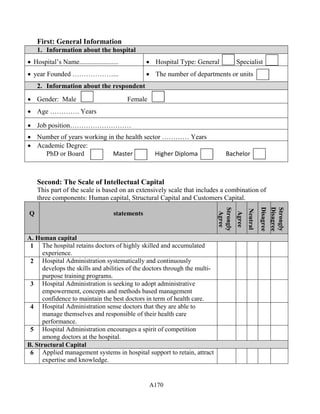
First: General Information
1.Information about the hospital
Hospital’s Name....................... Hospital Type: General Specialist
year Founded ………………... The number of departments or units
2. Information about the respondent
Gender: Male Female
Age …………. Years
Job position………………………
Number of years working in the health sector ………… Years
Academic Degree:
PhD or Board Master Higher Diploma Bachelor
Second: The Scale of Intellectual Capital
This part of the scale is based on an extensively scale that includes a combination of
three components: Human capital, Structural Capital and Customers Capital.
Q statements
Strongly
Agree
Agree
Neutral
Disagree
Strongly
Disagree
A. Human capital
1 The hospital retains doctors of highly skilled and accumulated
experience.
2 Hospital Administration systematically and continuously
develops the skills and abilities of the doctors through the multi-
purpose training programs.
3 Hospital Administration is seeking to adopt administrative
empowerment, concepts and methods based management
confidence to maintain the best doctors in term of health care.
4 Hospital Administration sense doctors that they are able to
manage themselves and responsible of their health care
performance.
5 Hospital Administration encourages a spirit of competition
among doctors at the hospital.
B. Structural Capital
6 Applied management systems in hospital support to retain, attract
expertise and knowledge.
187.
A171
7 Internal relationsat the hospital provide favorable conditions for
the work of the doctors work as a team.
8 Organize Work Departments in the hospital assistances to
provide better service to beneficiaries.
9 The Hospital set of guidelines and written notes and publications
that explain the functioning of the doctors.
10 Administration Confirms that doctors are an important part of the
health system and without them the hospital could not achieve its
objectives.
C. Customers Capital
11 Hospital Administration seeks to promote interaction with the
beneficiaries and provide them with as much information as
possible to ensure the provision of appropriate service for them.
12 The hospital has a competitive advantage in terms of health
services provided to beneficiaries, which qualifies them to
differentiate from other hospitals.
13 Administration carefulness to achieve loyalty with beneficiaries,
through a humanitarian deal for the services provided to them.
14 Hospital Administration evaluates doctor’s performance based on
a quality of the services they provide to the beneficiary and not
on the number of beneficiaries served.
15 The Administration dealing with the proposals of the
beneficiaries with highly important.
Third: The Scale of Organizational Learning
This part of the scale is based on a comprehensively scale that includes a combination
of three components: strategic, Organizational and cultural component.
Q statements
Strongly
Agree
Agree
Neutral
Disagree
Strongly
Disagree
A. Strategic Component
16 Doctors learn from experiences in various positions and apply
what they have learned of new knowledge in the future
situations.
17 Hospital Administration Supports doctors learning opportunities
and encourage the application of new knowledge.
18 The various departments of the hospital coordination efforts
through the set of common objectives for work and learning.
19 Hospital Administration encourages doctors on their own in
order to adapt to the expected environmental changes.
188.
A172
20 Hospital Administrationtraining and guide doctors on how to
self-learning.
B. Organizational Component
21 The Hospital's Organizational Structure permits efficient
communication and learning across organizational levels.
22 Hospital Administration exercise decentralization and
delegated powers commensurate with the responsibility and
ability to learn.
23 Doctors can think and act according to the entrance of the
comprehensive systems which take into account the relations
and interactions between parts of the organization.
24 Hospital Administration backing doctors learning with
beneficiaries and other related sectors.
25 Doctors at the hospital involved in the activities of learning with
academic and professional institutions in society.
C. Cultural Component
26 Hospital Administration considers mistakes as opportunities for
learning and motivates doctors and staff to learn and teach
others.
27 Organizing Climate in the hospital Supports organizational
learning.
28 Doctors can access the data and information that they need to
perform their jobs effectively.
29 Electronic support systems designed to performance based on
learning needs and requirements.
30 Hospital Administration uses techniques that help doctors to do
their jobs effectively, such as hardware supplied to the
meetings, seminars, and conference rooms.
Fourth: The Scale of Business Entrepreneurship
This part of the scale is based on a lengthily scale that includes a combination of four
components: Risk Taking, proactiveness, Innovativeness and competitive
aggressiveness.
Q statements
Strongly
Agree
Agree
Neutral
Disagree
Strongly
Disagree
A. Risk Taking
31 Doctors tend toward the search for new opportunities in health
services with low risks.
32 Doctors believe that ideas involving risk are most useful.
189.
A173
33 Hospital Administrationcontributes significantly to support
Doctors in adopting the calculated risk taking in their
professional.
34 Hospital Administration allows having an acceptable level of
self-control and preference for distinguished doctors.
35 Hospital Administration constantly evaluates internal and
external risk scope to take appropriate action and response.
B. proactiveness
36 Hospital Administration runs to be first in service delivery to
beneficiaries.
37 Hospital Administration fascinated in the development and
improvement of the potentials before others.
38 Hospital Administration is making a great effort to find new
potentials.
39 Hospital Administration aims to be the first to use contemporary
techniques.
40 Hospital Administration confirms the importance of the
continued improvement and good understanding of the business
and other initiatives.
C. Innovativeness
41 Hospital Administration motivates all doctors to provide new
ideas.
42 Hospital Administration to enter permanent modifications to
their services in order to improve for the better.
43 Backed the hospital administration ideas of external experts for
the development of services.
44 Hospital Administration profound to implement new ideas
quickly.
45 Hospital Administration assistances doctor with Innovative
ideas, and provide them with suitable research environment.
D. Competitive Aggressiveness
46 Highly competitive, contribute to creating a climate
encouraging creativity and provide better services to the
beneficiaries.
47 The hospital keeps doctors, who they have the entrepreneurial
mindset to deal with environment variables.
48 The hospital’s competitive strategies based on the trends of the
set of hospital vision and mission.
49 Competitive aggressiveness is an important part in the assistant
of hospital improvement.
50 Hospital Administration provides increased opportunities to
participate in decision-making and draw some competitive
policies that help improve the working environment.
ا
I
Abstract
Purpose: the presentstudy aims to analysis the relationship of intellectual
capital (i.e. human capital, structural capital, customers capital) and organizational
learning through its components (strategic component, organizational component,
cultural component) then knowing the impact of this relationship on the achieving
business entrepreneurship in private sector hospitals in Erbil city.
Methodology: the methodology adopted by the study is to identify the
study's problem, by examining several questions, concentrated on the nature of the
relationship, impact, and variance between independent variables and dependent
variable that represents entrepreneurship, and a conceptual scheme designed for
the study, and produced seven main hypotheses, so to make sure that the
hypotheses are correct or may not, they subjected to several statistical tests.
Method: the study followed the analytical descriptive method, as described
the study variables and dimensions as well as the study population, private sector
hospitals in Erbil city. Which are represented in (15) hospitals and after
distributing (75) questionnaire form on the responders, (68) valid form were
obtained for analysis, and it had been examined the relationship, impact, and
variance by applying the statistical methods through SPSS version 22.
Findings: the study reach to several conclusions, most notably the presence
of high levels of intellectual capital and organizational learning, as well the
existence of business entrepreneurship in the surveyed hospitals in Erbil, the study
also found a correlation and effect between independent variables and dependent
variable on the aggregate and partial levels, the study presented that there are no
significant variances in the attitudes of respondents on the relationship of
intellectual capital and organizational learning and its impact on achieving
199.
ا
II
business entrepreneurship accordingto responders personal characteristics
differences.
Recommendations: the researcher recommended that it is necessary to
retain high levels of intellectual capital and organizational learning, besides
employ and increase investing them in achieving business entrepreneurship, with
necessity of stimulating customers’ capital for its importance in the advantage of
entrepreneurship, and work to increase the financial allocations for the
organizational learning process and more emphasis on proactiveness and
innovativeness as components of business entrepreneurship through seminars,
debates and discuss issues related to health care and more interest in taking risk
and competition, as well as some suggestions regarding future studies.
201.
د يزام-َو
Salahaddin University-Erbil
Analysisthe Relationship of Intellectual Capital and
Organizational Learning and its impact on Achieving
Business Entrepreneurship
An Analytical study of the managers sample views at private hospitals in
Erbil city
A Thesis
Submitted to the Council of the College of Administration and Economic
- Salahaddin University- Erbil in Partial Fulfillment of the Requirements
for the Degree of Master in Management Science
By
Hussein Ahmad Mustafa
B.A. Administration- Salahaddin University- Erbil- 2013
Supervised by
Asst. Prof. Dr. Ahlam Ibrahim Wali
Erbil- KURDISTAN
May 2016





























![R155
33.SCHERMERN, R. J., HUNT, G. H. JAMES and OSBORN, N. R. (1994)
Organizational Behavior, 5th
Ed, John Wiley & Sons, Inc. Canada .
34.SENGE, P. (1994) the fifth discipline: The Art and Practice of the Learning
Organization. Doubleday-Currency, New York.
35.STEWART, T. (1997) Intellectual Capital: The New Wealth of Organizations,
Doubleday/Currency, New York, NY.
36.STEWART, T. (1999) Intellectual Capital: The New Wealth of Organizations,
Doubleday-Currency, New York, NY.
37.SVIEBY, K. (1998) Intellectual Capital Thinking head, CAP, Australian.
38.VERNA, ALLEE (2003) the Future of Knowledge, Butter worth Heinemann,
Amsterdam.
39.WHEELEN, THOMAS L. and HUNGER, J. DAVID (2010) Strategic
Management and Business Policy, 12Ed, Pearson Education, Inc., Prentice Hall,
New Jersey.
40.WICKHAM, PHILIP (2006) Strategic Entrepreneurship: A Decision Making
Approach to New Venture Creation and Management, England, Prentice Hall.
C. Internet and Publication
1. BROWN, T. (1998) ringing up Intellectual Capital, Management Review: p.1-8.
Available from: https://www.questia.com. [Accessed: 10th, September, 2015].
2. DSVSNTER, VAN M.J. (2000) Developing Intellectual Capital”, Chapter3,
University of Pretoria, ETD. PDF [Accessed: 10th, September, 2015].
3. EDVINSON, L. and MIKKLESEN, E. (1993) Balanced Annual Report on
Intellectual Capital, Skandia Assurance and Financial Services. Available from:
http://www.exinfm.com. [Accessed: 1, September, 2015].
4. GREEN, P. (1998) the Management of Intellectual Capital: The Issues and the
Practice”, Business and Industry: p.1-15.](https://image.slidesharecdn.com/365ec77b-4263-41a4-8bc4-5f881d824eb2-161125210646/85/slide-171-320.jpg)
![R156
5. MORGAN, ROBERT, (2001) Market-based organizational learning, Available
from: http:// citeseerx.ist.psu.edu. [Accessed: 1st, September, 2015].
6. ROSE, LAN (2000) valuing intellectual capital, Summary Report, Organizational
Change Program for the cgiar Centers. Available from: http:// www.iasj.net.
[Accessed: 2nd, September, 2015].
7. SKANDIA (1996), Value Creation Processes, Supplement to Skandia’s 1995,
Annual Report. Available from: http://www.exinfm.com. [Accessed: 1,
September, 2015].
8. THOMPSON J. (2006) Enabling Entrepreneurs - Maximizing Effectiveness in
Advising, Coaching, Mentoring and Incubating New Businesses, University of
Huddersfield -UK, [online] Institute for Small Business & Entrepreneurship, p.1-
12, Available from: http://www.isbe.org.uk. [Accessed: 11th, November, 2015].](https://image.slidesharecdn.com/365ec77b-4263-41a4-8bc4-5f881d824eb2-161125210646/85/slide-172-320.jpg)