Health effects of PM2.5: is there
anything new to add?
Ian Mudway
MRC Centre for Environment and Health
NIHR-HPRU - Health impact of environmental hazards
Asthma UK Centre in Allergic Mechanisms of Asthma
Review, upon review, upon review
• 1000’s new health studies, reviews
(2006-2019)
• NPACT study (2013); ESCAPE
(2013)
• REVIHAAP (July 2013); HRAPIE
(Dec 2013)
• HEI Ultrafines report (2013)
• WHO Black Carbon report (2012)
• IARC Diesel exhaust reports
(2013/2014)
• WHO Burden of disease report
(March 2014)
• Every Breathe we take (RCP –
2016)
If there’s nothing more to add then there seems to be an
awful lot of people publishing on it………….
27.6%
25.9%
23.2%
26.2%
23.6%
23.3%
24.7%
29.6%
27.2%
25.5%
26.0%
1.8
papers/day
6.4
papers/day
REVIHAAP
KEY Themes
• Multi-cohort analysis - ESCAPE
• Contribution of PM2.5 to the global burden of disease
• Primary combustion derived pollutants - diesel
• Multi-pollutant models
• Effects bellow the WHO guideline value
• Impacts of PM2.5 exposures on the brain – from early life
cognition to dementia
• Indoor pollution – biomass
• Alternative metrics – black carbon / PNC/ oxidative potential
• Improved models / exposure estimates
• Prenatal impacts
Annual average PM2.5 concentrations in 2017 relative to the WHO Air
Quality Guideline.
State of Global Air – HEI/IHME, 2019
Proportion of population exposed to household air pollution from
burning of solid fuels for cooking in 2017.
State of Global Air – HEI/IHME, 2019
Global ranking of risk factors by total number of deaths
from all causes for all ages and both sexes in 2017.
State of Global Air – HEI/IHME, 2019
• 4,900,000 premature deaths and a total of
147,000,000 disability adjusted life years
worldwide in 2017.
• Of these 60 and 56% were attributable to
ambient PM2.5, respectively, with the
remaining proportion largely related to
indoor PM2.5 exposures.
• In terms of mortality related to ambient
PM2.5,
o 48.% was attributable to CVR causes.
o 9.0% cancers of the respiratory system.
o 36.2% to respiratory infections and
COPD.
Impacts of Air Pollution across the Life Course
7
Low birth weight
Smaller lungs
Increased risk of chronic disease
Acute respiratory exacerbations
Increased
vulnerability
Premature
death
Quality of Life
Limiting
potentialMental Health
Hong Chen et al. Lancet 2017
Ontario, Canada
Medicare
9.8 million fee-for-service Medicare
enrollees (≥ 65 years old) from 50
cities across the north eastern United
States, 1999-2010.
Kioumourtzoglou MA, et al. Environ Health Perspect. 2016.
Time of first admission
Peters R et al., J Alzheimers Dis. 2019
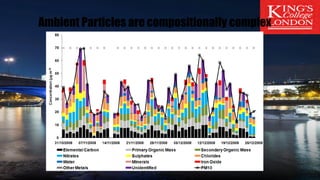
Ambient Particles are compositionally complex
Global Variation in Composition and Source Appointment
Weagle CL et al. Environ. Sci. Technol. 2018Snider G et al. Atmos. Chem. Phys. 2016
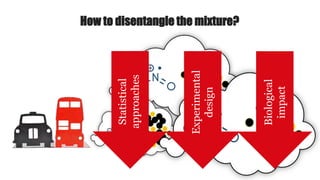
How to disentangle the mixture?
Statistical
approaches
Experimental
design
Biological
impact
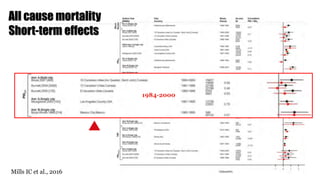
All cause mortality
Short-term effects
Mills IC et al., 2016
1984-2000
Black Carbon – a better health indictor?
Toxic component or source indicator?
Estimated county- and
season-specific relative
risks (RR) of
cardiovascular and
respiratory hospitalization
associated with PM2.5
components in 106 U.S.
counties for the years 1999
through 2005
Short-term exposure to traffic-related air pollution and daily
mortality in London (2011–2013)
NOx: General traffic indicator
CO: Petrol vehicle exhaust
EC: Diesel vehicle exhaust
BC: Diesel vehicle exhaust
Cu: Brake wear
Zn: Tire wear
Al: Road dust resuspension
Percentchangeintotaland
respiratorymortality
Atkinson RW, et al. Int J Hyg Environ Health. 2016;219(6):566-72
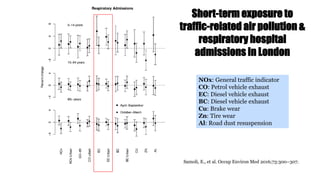
Short-term exposure to
traffic-related air pollution &
respiratory hospital
admissions in London
NOx: General traffic indicator
CO: Petrol vehicle exhaust
EC: Diesel vehicle exhaust
BC: Diesel vehicle exhaust
Cu: Brake wear
Zn: Tire wear
Al: Road dust resuspension
Samoli, E., et al. Occup Environ Med 2016;73:300–307.
Samoli, E., et al. Environ Int. 2016 pii: S0160-4120(16)30451-2.
Differential health effects of short-term exposure to
source-specific particles in London.
PATPES: Human exposures in different
microenvironments
Environ Health Perspect 120:1183–1189 (2012).
31 subjects exposed at an underground train station, two traffic sites, a farm, and an
urban background site (FeNO)
Adverse Outcome Pathway
Acute
health
endpoint
A D M E
Modes of action
Causal chain of evidence
Molecular initiating event
• Asthma exacerbation
• COPD exacerbation
• Ischaemia
• Arrythmia
• Thrombosis
Adverse Outcome Pathway
A D M E
Modes of action
Causal chain of evidence
• Airway remodelling
• Loss of lung
function
• Atherosclerosis
• Immune modulation
Molecular initiating event
Chronic
health
endpoint
Adverse Outcome Pathway
A D M E
Modes of action
Causal chain of evidence
A D M E
A D M E
Health
impacts
Molecular initiating event (s)
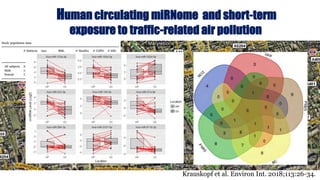
Krauskopf et al. Environ Int. 2018;113:26-34.
Human circulating miRNome and short-term
exposure to traffic-related air pollution
“Reducing the number of people living
in places with PM2.5 concentrations
above 10 μg/m³ (the WHO
recommended limit) by 50% by 2025.”
“Informing policy to prevent perverse
outcomes.”
Question: Should we really be
prioritising mass reductions over targeted
actions on the most health relevant
components/sources within PM2.5?

Health effects of PM2.5. Is there anything new to add? - Dr Ian Mudway

  • 1.
    Health effects ofPM2.5: is there anything new to add? Ian Mudway MRC Centre for Environment and Health NIHR-HPRU - Health impact of environmental hazards Asthma UK Centre in Allergic Mechanisms of Asthma
  • 2.
    Review, upon review,upon review • 1000’s new health studies, reviews (2006-2019) • NPACT study (2013); ESCAPE (2013) • REVIHAAP (July 2013); HRAPIE (Dec 2013) • HEI Ultrafines report (2013) • WHO Black Carbon report (2012) • IARC Diesel exhaust reports (2013/2014) • WHO Burden of disease report (March 2014) • Every Breathe we take (RCP – 2016)
  • 3.
    If there’s nothingmore to add then there seems to be an awful lot of people publishing on it…………. 27.6% 25.9% 23.2% 26.2% 23.6% 23.3% 24.7% 29.6% 27.2% 25.5% 26.0% 1.8 papers/day 6.4 papers/day REVIHAAP KEY Themes • Multi-cohort analysis - ESCAPE • Contribution of PM2.5 to the global burden of disease • Primary combustion derived pollutants - diesel • Multi-pollutant models • Effects bellow the WHO guideline value • Impacts of PM2.5 exposures on the brain – from early life cognition to dementia • Indoor pollution – biomass • Alternative metrics – black carbon / PNC/ oxidative potential • Improved models / exposure estimates • Prenatal impacts
  • 4.
    Annual average PM2.5concentrations in 2017 relative to the WHO Air Quality Guideline. State of Global Air – HEI/IHME, 2019
  • 5.
    Proportion of populationexposed to household air pollution from burning of solid fuels for cooking in 2017. State of Global Air – HEI/IHME, 2019
  • 6.
    Global ranking ofrisk factors by total number of deaths from all causes for all ages and both sexes in 2017. State of Global Air – HEI/IHME, 2019 • 4,900,000 premature deaths and a total of 147,000,000 disability adjusted life years worldwide in 2017. • Of these 60 and 56% were attributable to ambient PM2.5, respectively, with the remaining proportion largely related to indoor PM2.5 exposures. • In terms of mortality related to ambient PM2.5, o 48.% was attributable to CVR causes. o 9.0% cancers of the respiratory system. o 36.2% to respiratory infections and COPD.
  • 7.
    Impacts of AirPollution across the Life Course 7 Low birth weight Smaller lungs Increased risk of chronic disease Acute respiratory exacerbations Increased vulnerability Premature death Quality of Life Limiting potentialMental Health
  • 8.
    Hong Chen etal. Lancet 2017 Ontario, Canada
  • 9.
    Medicare 9.8 million fee-for-serviceMedicare enrollees (≥ 65 years old) from 50 cities across the north eastern United States, 1999-2010. Kioumourtzoglou MA, et al. Environ Health Perspect. 2016. Time of first admission
  • 10.
    Peters R etal., J Alzheimers Dis. 2019
  • 11.
    Ambient Particles arecompositionally complex
  • 12.
    Global Variation inComposition and Source Appointment Weagle CL et al. Environ. Sci. Technol. 2018Snider G et al. Atmos. Chem. Phys. 2016
  • 13.
    How to disentanglethe mixture? Statistical approaches Experimental design Biological impact
  • 14.
    All cause mortality Short-termeffects Mills IC et al., 2016 1984-2000
  • 15.
    Black Carbon –a better health indictor? Toxic component or source indicator? Estimated county- and season-specific relative risks (RR) of cardiovascular and respiratory hospitalization associated with PM2.5 components in 106 U.S. counties for the years 1999 through 2005
  • 16.
    Short-term exposure totraffic-related air pollution and daily mortality in London (2011–2013) NOx: General traffic indicator CO: Petrol vehicle exhaust EC: Diesel vehicle exhaust BC: Diesel vehicle exhaust Cu: Brake wear Zn: Tire wear Al: Road dust resuspension Percentchangeintotaland respiratorymortality Atkinson RW, et al. Int J Hyg Environ Health. 2016;219(6):566-72
  • 17.
    Short-term exposure to traffic-relatedair pollution & respiratory hospital admissions in London NOx: General traffic indicator CO: Petrol vehicle exhaust EC: Diesel vehicle exhaust BC: Diesel vehicle exhaust Cu: Brake wear Zn: Tire wear Al: Road dust resuspension Samoli, E., et al. Occup Environ Med 2016;73:300–307.
  • 18.
    Samoli, E., etal. Environ Int. 2016 pii: S0160-4120(16)30451-2. Differential health effects of short-term exposure to source-specific particles in London.
  • 19.
    PATPES: Human exposuresin different microenvironments Environ Health Perspect 120:1183–1189 (2012). 31 subjects exposed at an underground train station, two traffic sites, a farm, and an urban background site (FeNO)
  • 20.
    Adverse Outcome Pathway Acute health endpoint AD M E Modes of action Causal chain of evidence Molecular initiating event • Asthma exacerbation • COPD exacerbation • Ischaemia • Arrythmia • Thrombosis
  • 21.
    Adverse Outcome Pathway AD M E Modes of action Causal chain of evidence • Airway remodelling • Loss of lung function • Atherosclerosis • Immune modulation Molecular initiating event Chronic health endpoint
  • 22.
    Adverse Outcome Pathway AD M E Modes of action Causal chain of evidence A D M E A D M E Health impacts Molecular initiating event (s)
  • 23.
    Krauskopf et al.Environ Int. 2018;113:26-34. Human circulating miRNome and short-term exposure to traffic-related air pollution
  • 24.
    “Reducing the numberof people living in places with PM2.5 concentrations above 10 μg/m³ (the WHO recommended limit) by 50% by 2025.” “Informing policy to prevent perverse outcomes.” Question: Should we really be prioritising mass reductions over targeted actions on the most health relevant components/sources within PM2.5?