Professor Martin Williams
King’s College London
Some thoughts on future air
quality issues
Routes to Clean Air IAQM Conference Sept 2019
Structure of talk
• Issues local to the UK
• Wider European and international issues
• Outlook for research/legislation/policy
Some of the issues
• Can the commitments in the Clean Air Strategy be
translated into action?
• The NO2 issue - will CAZs/ULEZ work?
• Will agricultural emissions reduce enough?
• How big an effect will a Net-Zero Climate Change
Act have on air quality? Can we manage the
antagonisms?
• How will the WHO air quality Guidelines change?
• Post-Brexit legislation – what scope for more
ambitious targets? What sanctions for non-
compliance? Limit Value compliance or improved
public health?
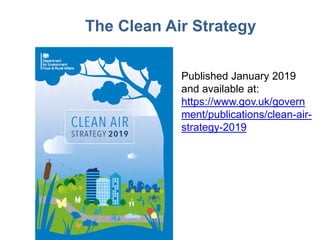
Published January 2019
and available at:
https://www.gov.uk/govern
ment/publications/clean-air-
strategy-2019
The Clean Air Strategy
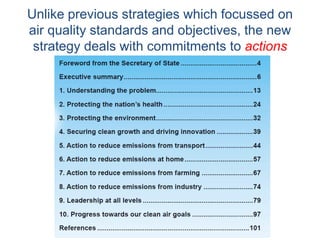
Unlike previous strategies which focussed on
air quality standards and objectives, the new
strategy deals with commitments to actions
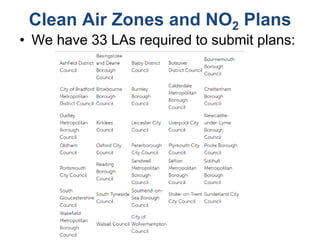
Clean Air Zones and NO2 Plans
• We have 33 LAs required to submit plans:
CAZs, the ULEZ and NO2
• Not all LAs will necessarily opt for CAZs
• But where they are implemented there are
question marks:
– How will the public respond?
– What health benefit will the CAZs have?
– Are Euro standards too blunt an instrument to
be effective?
– What’s Plan B?
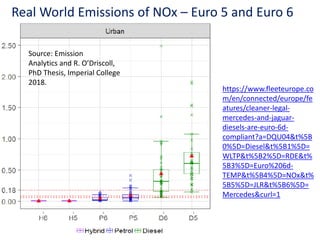
Real World Emissions of NOx – Euro 5 and Euro 6
Source: Emission
Analytics and R. O’Driscoll,
PhD Thesis, Imperial College
2018.
https://www.fleeteurope.co
m/en/connected/europe/fe
atures/cleaner-legal-
mercedes-and-jaguar-
diesels-are-euro-6d-
compliant?a=DQU04&t%5B
0%5D=Diesel&t%5B1%5D=
WLTP&t%5B2%5D=RDE&t%
5B3%5D=Euro%206d-
TEMP&t%5B4%5D=NOx&t%
5B5%5D=JLR&t%5B6%5D=
Mercedes&curl=1
Climate change policy and air quality
• We now have a net-zero CO2-equivalents target for 2050
• A range of measures will be needed some of which could worsen air
quality (Williams et al, 2018)
• Since that study important changes have taken place
• The cost of off-shore wind generation has plummeted
• Heat pumps are potentially significant
• Defra have begun to address possible antagonisms – the CAS has
commitments to address wood burning and other polluting fuels as
well as measures on agriculture
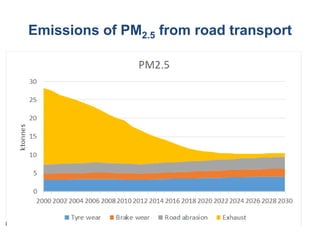
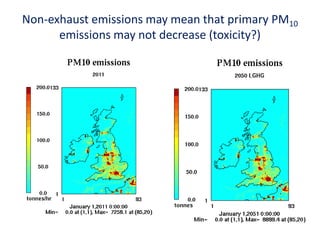
• Non-exhaust emissions (NEE) of PM are still uncertain however, as
is their toxicity
• Industry is beginning to address the issue of NEE
• We could therefore see very large improvements in air quality
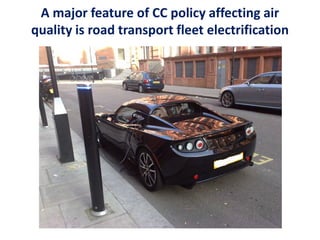
A major feature of CC policy affecting air
quality is road transport fleet electrification
Emissions of PM2.5 from road transport
Non-exhaust emissions may mean that primary PM10
emissions may not decrease (toxicity?)
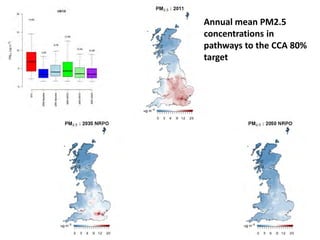
Annual mean PM2.5
concentrations in
pathways to the CCA 80%
target
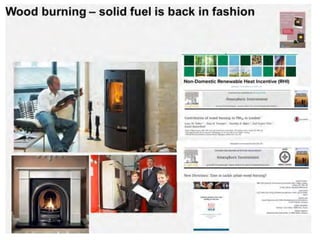
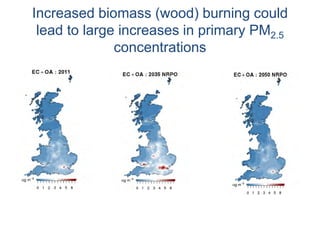
Increased biomass (wood) burning could
lead to large increases in primary PM2.5
concentrations
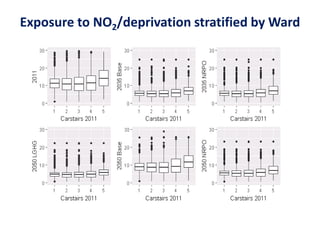
Exposure to NO2/deprivation stratified by Ward
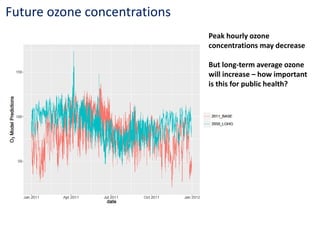
Future ozone concentrations
Peak hourly ozone
concentrations may decrease
But long-term average ozone
will increase – how important
is this for public health?
Indoor Air Quality
• Considerable current interest, including from the
private sector
• Future research needs to answer the ‘So What?’
question
• Little point in simply cataloguing concentrations
in a range of micro-environments
• There needs to be associated health studies
• Policy options will be very limited
• Antagonisms between CC and IAQ e.g. as ‘tight
houses’ are built
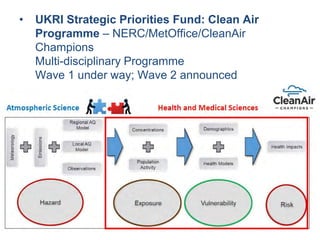
• UKRI Strategic Priorities Fund: Clean Air
Programme – NERC/MetOffice/CleanAir
Champions
Multi-disciplinary Programme
Wave 1 under way; Wave 2 announced
International Developments
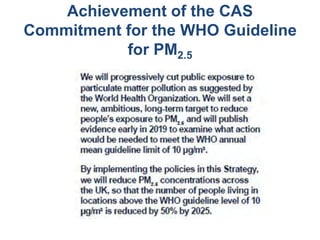
Achievement of the CAS
Commitment for the WHO Guideline
for PM2.5
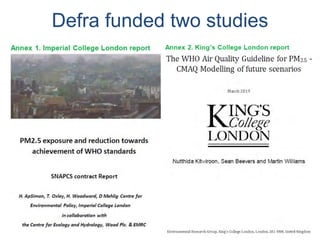
Defra funded two studies
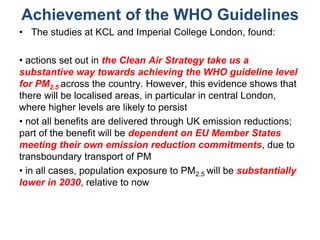
Achievement of the WHO Guidelines
• The studies at KCL and Imperial College London, found:
• actions set out in the Clean Air Strategy take us a
substantive way towards achieving the WHO guideline level
for PM2.5 across the country. However, this evidence shows that
there will be localised areas, in particular in central London,
where higher levels are likely to persist
• not all benefits are delivered through UK emission reductions;
part of the benefit will be dependent on EU Member States
meeting their own emission reduction commitments, due to
transboundary transport of PM
• in all cases, population exposure to PM2.5 will be substantially
lower in 2030, relative to now
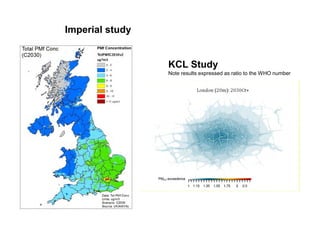
KCL Study
Note results expressed as ratio to the WHO number
Imperial study
Update of the
WHO Global Air Quality Guidelines:
process and progress
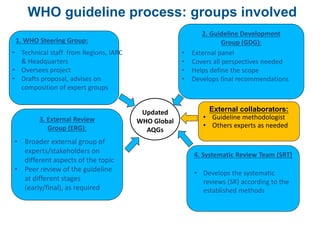
WHO guideline process: groups involved
1. WHO Steering Group:
• Technical staff from Regions, IARC
& Headquarters
• Oversees project
• Drafts proposal, advises on
composition of expert groups
3. External Review
Group (ERG):
• Broader external group of
experts/stakeholders on
different aspects of the topic
• Peer review of the guideline
at different stages
(early/final), as required
2. Guideline Development
Group (GDG):
• External panel
• Covers all perspectives needed
• Helps define the scope
• Develops final recommendations
4. Systematic Review Team (SRT)
• Develops the systematic
reviews (SR) according to the
established methods
Updated
WHO Global
AQGs
External collaborators:
• Guideline methodologist
• Others experts as needed
Jun Aug Oct Dec Feb Apr Jun
3rd GDG meeting (GRADE
assessment)
Completion of
reviews on
contextual factors
Completion of first draft of
guideline document
Meeting of WG on
approach for ITs
4th GDG meeting
(guideline exposure values)
Publication of SRs
5th GDG meeting
(interim targets)
WHO guidelines: what’s next?
2019 2020
Revised WHO Guidelines
• Will there be Guidelines for PM components – Black
Carbon? Ultrafines?
• Will the PM2.5 Guideline change?
• Will the evidence result in changes in the NO2
Guideline?!
BREXIT
• The Withdrawal Agreement Part Two Article 2 p.355 as
currently written says:
With the aim of ensuring the proper functioning of the single
customs territory, the Union and the United Kingdom shall
ensure that the level of environmental protection provided by
law, regulations and practices is not reduced below the level
provided by the common standards applicable within the
Union and the United Kingdom at the end of the transition
period in relation to: access to environmental information,
public participation and access to justice in environmental
matters; environmental impact assessment and strategic
environmental assessment; industrial emissions; air emissions
and air quality targets and ceilings;
• Having regard to the common standards referred to in paragraph 1,
the Joint Committee shall
• adopt decisions laying down minimum commitments for:
(a) the reduction of national emissions of certain atmospheric
pollutants;
(b) the maximum sulphur content of marine fuels which may be used
in the territorial seas, exclusive economic zones, including in the SOx-
Emission Control Area (SOx-ECA)designated in the North Sea and Baltic
Sea area, and in the ports of the Member States of the Union and of
the United Kingdom; and
(c) those best available techniques, including emission limit values, in
relation to industrial emissions.
• These decisions shall apply as from the end of the transition period.
What happens after Brexit?
• Currently we have an independent institutional check on
the UK government’s performance in meeting legal
obligations via the European Commission and the ECJ
• We also have the challenges in the UK Courts from Client
Earth
• After Brexit, ignoring any transition period, presumably
(??) we will not be under the jurisdiction of the ECJ
• So what accountability checks will we have?
• A ‘Norway’ style agreement could mean being under the
EFTA Court – who would take the UK to that court? Are the
sanctions as powerful as the ECJ?
• Is it enough to rely on the goodwill and diligence of NGOs
such as Client Earth?
After Brexit continued
• If we have an Office of Environmental Protection as the
Environment Bill proposes, what powers will it have?
• Whatever powers it theoretically has, unlike the
European Commission/ECJ, or the Federal Government
vs the individual US states, it’s a body within the UK - is
it a bit like marking one’s own homework?
• Current EU Directives are transposed into UK law but
what happens to the next generation?!
Thank you!

Some thoughts on future air quality issues - Professor Martin Williams

  • 1.
    Professor Martin Williams King’sCollege London Some thoughts on future air quality issues Routes to Clean Air IAQM Conference Sept 2019
  • 2.
    Structure of talk •Issues local to the UK • Wider European and international issues • Outlook for research/legislation/policy
  • 3.
    Some of theissues • Can the commitments in the Clean Air Strategy be translated into action? • The NO2 issue - will CAZs/ULEZ work? • Will agricultural emissions reduce enough? • How big an effect will a Net-Zero Climate Change Act have on air quality? Can we manage the antagonisms? • How will the WHO air quality Guidelines change? • Post-Brexit legislation – what scope for more ambitious targets? What sanctions for non- compliance? Limit Value compliance or improved public health?
  • 4.
    Published January 2019 andavailable at: https://www.gov.uk/govern ment/publications/clean-air- strategy-2019 The Clean Air Strategy
  • 5.
    Unlike previous strategieswhich focussed on air quality standards and objectives, the new strategy deals with commitments to actions
  • 6.
    Clean Air Zonesand NO2 Plans • We have 33 LAs required to submit plans:
  • 7.
    CAZs, the ULEZand NO2 • Not all LAs will necessarily opt for CAZs • But where they are implemented there are question marks: – How will the public respond? – What health benefit will the CAZs have? – Are Euro standards too blunt an instrument to be effective? – What’s Plan B?
  • 8.
    Real World Emissionsof NOx – Euro 5 and Euro 6 Source: Emission Analytics and R. O’Driscoll, PhD Thesis, Imperial College 2018. https://www.fleeteurope.co m/en/connected/europe/fe atures/cleaner-legal- mercedes-and-jaguar- diesels-are-euro-6d- compliant?a=DQU04&t%5B 0%5D=Diesel&t%5B1%5D= WLTP&t%5B2%5D=RDE&t% 5B3%5D=Euro%206d- TEMP&t%5B4%5D=NOx&t% 5B5%5D=JLR&t%5B6%5D= Mercedes&curl=1
  • 9.
    Climate change policyand air quality • We now have a net-zero CO2-equivalents target for 2050 • A range of measures will be needed some of which could worsen air quality (Williams et al, 2018) • Since that study important changes have taken place • The cost of off-shore wind generation has plummeted • Heat pumps are potentially significant • Defra have begun to address possible antagonisms – the CAS has commitments to address wood burning and other polluting fuels as well as measures on agriculture • Non-exhaust emissions (NEE) of PM are still uncertain however, as is their toxicity • Industry is beginning to address the issue of NEE • We could therefore see very large improvements in air quality
  • 10.
    A major featureof CC policy affecting air quality is road transport fleet electrification
  • 12.
    Emissions of PM2.5from road transport
  • 13.
    Non-exhaust emissions maymean that primary PM10 emissions may not decrease (toxicity?)
  • 14.
    Annual mean PM2.5 concentrationsin pathways to the CCA 80% target
  • 16.
    Increased biomass (wood)burning could lead to large increases in primary PM2.5 concentrations
  • 17.
    Exposure to NO2/deprivationstratified by Ward
  • 18.
    Future ozone concentrations Peakhourly ozone concentrations may decrease But long-term average ozone will increase – how important is this for public health?
  • 19.
    Indoor Air Quality •Considerable current interest, including from the private sector • Future research needs to answer the ‘So What?’ question • Little point in simply cataloguing concentrations in a range of micro-environments • There needs to be associated health studies • Policy options will be very limited • Antagonisms between CC and IAQ e.g. as ‘tight houses’ are built
  • 20.
    • UKRI StrategicPriorities Fund: Clean Air Programme – NERC/MetOffice/CleanAir Champions Multi-disciplinary Programme Wave 1 under way; Wave 2 announced
  • 21.
  • 22.
    Achievement of theCAS Commitment for the WHO Guideline for PM2.5
  • 23.
  • 24.
    Achievement of theWHO Guidelines • The studies at KCL and Imperial College London, found: • actions set out in the Clean Air Strategy take us a substantive way towards achieving the WHO guideline level for PM2.5 across the country. However, this evidence shows that there will be localised areas, in particular in central London, where higher levels are likely to persist • not all benefits are delivered through UK emission reductions; part of the benefit will be dependent on EU Member States meeting their own emission reduction commitments, due to transboundary transport of PM • in all cases, population exposure to PM2.5 will be substantially lower in 2030, relative to now
  • 25.
    KCL Study Note resultsexpressed as ratio to the WHO number Imperial study
  • 26.
    Update of the WHOGlobal Air Quality Guidelines: process and progress
  • 27.
    WHO guideline process:groups involved 1. WHO Steering Group: • Technical staff from Regions, IARC & Headquarters • Oversees project • Drafts proposal, advises on composition of expert groups 3. External Review Group (ERG): • Broader external group of experts/stakeholders on different aspects of the topic • Peer review of the guideline at different stages (early/final), as required 2. Guideline Development Group (GDG): • External panel • Covers all perspectives needed • Helps define the scope • Develops final recommendations 4. Systematic Review Team (SRT) • Develops the systematic reviews (SR) according to the established methods Updated WHO Global AQGs External collaborators: • Guideline methodologist • Others experts as needed
  • 28.
    Jun Aug OctDec Feb Apr Jun 3rd GDG meeting (GRADE assessment) Completion of reviews on contextual factors Completion of first draft of guideline document Meeting of WG on approach for ITs 4th GDG meeting (guideline exposure values) Publication of SRs 5th GDG meeting (interim targets) WHO guidelines: what’s next? 2019 2020
  • 29.
    Revised WHO Guidelines •Will there be Guidelines for PM components – Black Carbon? Ultrafines? • Will the PM2.5 Guideline change? • Will the evidence result in changes in the NO2 Guideline?!
  • 30.
    BREXIT • The WithdrawalAgreement Part Two Article 2 p.355 as currently written says: With the aim of ensuring the proper functioning of the single customs territory, the Union and the United Kingdom shall ensure that the level of environmental protection provided by law, regulations and practices is not reduced below the level provided by the common standards applicable within the Union and the United Kingdom at the end of the transition period in relation to: access to environmental information, public participation and access to justice in environmental matters; environmental impact assessment and strategic environmental assessment; industrial emissions; air emissions and air quality targets and ceilings;
  • 31.
    • Having regardto the common standards referred to in paragraph 1, the Joint Committee shall • adopt decisions laying down minimum commitments for: (a) the reduction of national emissions of certain atmospheric pollutants; (b) the maximum sulphur content of marine fuels which may be used in the territorial seas, exclusive economic zones, including in the SOx- Emission Control Area (SOx-ECA)designated in the North Sea and Baltic Sea area, and in the ports of the Member States of the Union and of the United Kingdom; and (c) those best available techniques, including emission limit values, in relation to industrial emissions. • These decisions shall apply as from the end of the transition period.
  • 32.
    What happens afterBrexit? • Currently we have an independent institutional check on the UK government’s performance in meeting legal obligations via the European Commission and the ECJ • We also have the challenges in the UK Courts from Client Earth • After Brexit, ignoring any transition period, presumably (??) we will not be under the jurisdiction of the ECJ • So what accountability checks will we have? • A ‘Norway’ style agreement could mean being under the EFTA Court – who would take the UK to that court? Are the sanctions as powerful as the ECJ? • Is it enough to rely on the goodwill and diligence of NGOs such as Client Earth?
  • 33.
    After Brexit continued •If we have an Office of Environmental Protection as the Environment Bill proposes, what powers will it have? • Whatever powers it theoretically has, unlike the European Commission/ECJ, or the Federal Government vs the individual US states, it’s a body within the UK - is it a bit like marking one’s own homework? • Current EU Directives are transposed into UK law but what happens to the next generation?!
  • 34.