Objectives
1001. Improve user satisfaction


                                   May 2012
                                  Version 1.0
Agenda

•   What is Satisfaction
•   Why is it important
•   Metrics
•   Strategies


                           2
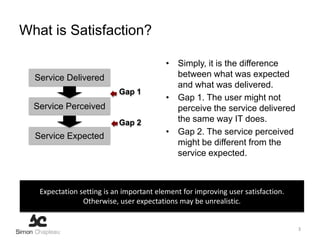
What is Satisfaction?

                                          • Simply, it is the difference
  Service Delivered                         between what was expected
                                            and what was delivered.
                           Gap 1
                                          • Gap 1. The user might not
  Service Perceived                         perceive the service delivered
                           Gap 2            the same way IT does.
  Service Expected                        • Gap 2. The service perceived
                                            might be different from the
                                            service expected.


   Expectation setting is an important element for improving user satisfaction.
                Otherwise, user expectations may be unrealistic.


                                                                                  3
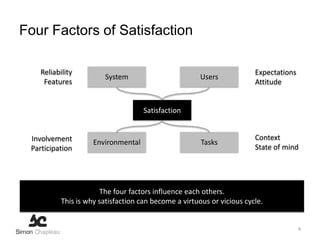
Four Factors of Satisfaction

    Reliability                                                         Expectations
                         System                        Users
     Features                                                           Attitude


                                     Satisfaction


 Involvement                                                            Context
                     Environmental                     Tasks
 Participation                                                          State of mind


                       The four factors influence each others.
           This is why satisfaction can become a virtuous or vicious cycle.


                                                                                       4
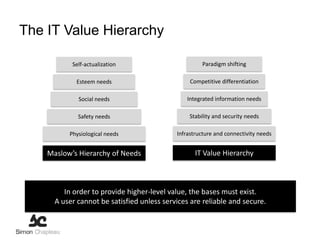
The IT Value Hierarchy

           Self-actualization                        Paradigm shifting

            Esteem needs                         Competitive differentiation

             Social needs                       Integrated information needs

             Safety needs                       Stability and security needs

          Physiological needs               Infrastructure and connectivity needs


    Maslow’s Hierarchy of Needs                    IT Value Hierarchy


         In order to provide higher-level value, the bases must exist.
      A user cannot be satisfied unless services are reliable and secure.
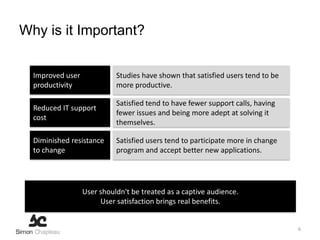
Why is it Important?


  Improved user             Studies have shown that satisfied users tend to be
  productivity              more productive.

                            Satisfied tend to have fewer support calls, having
  Reduced IT support
                            fewer issues and being more adept at solving it
  cost
                            themselves.

  Diminished resistance     Satisfied users tend to participate more in change
  to change                 program and accept better new applications.


                  User shouldn't be treated as a captive audience.
                       User satisfaction brings real benefits.


                                                                                 6
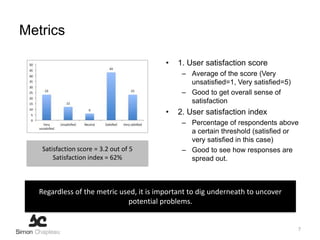
Metrics

                                          •   1. User satisfaction score
                                               – Average of the score (Very
                                                 unsatisfied=1, Very satisfied=5)
                                               – Good to get overall sense of
                                                 satisfaction
                                          •   2. User satisfaction index
                                               – Percentage of respondents above
                                                 a certain threshold (satisfied or
                                                 very satisfied in this case)
    Satisfaction score = 3.2 out of 5          – Good to see how responses are
        Satisfaction index = 62%                 spread out.


   Regardless of the metric used, it is important to dig underneath to uncover
                              potential problems.


                                                                                    7
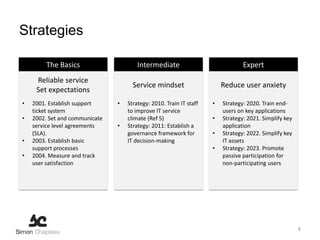
Strategies

         The Basics                     Intermediate                             Expert
     Reliable service
                                      Service mindset                    Reduce user anxiety
     Set expectations
•   2001. Establish support     •   Strategy: 2010. Train IT staff   •   Strategy: 2020. Train end-
    ticket system                   to improve IT service                users on key applications
•   2002. Set and communicate       climate (Ref 5)                  •   Strategy: 2021. Simplify key
    service level agreements    •   Strategy: 2011: Establish a          application
    (SLA).                          governance framework for         •   Strategy: 2022. Simplify key
•   2003. Establish basic           IT decision-making                   IT assets
    support processes                                                •   Strategy: 2023. Promote
•   2004. Measure and track                                              passive participation for
    user satisfaction                                                    non-participating users


                                                                                                        8
For More Information


          www.simonchapleau.com

         simon@simonchapleau.com


                                   9

Objective 1001: Improve end-user satisfaction

  • 1.
    Objectives 1001. Improve usersatisfaction May 2012 Version 1.0
  • 2.
    Agenda • What is Satisfaction • Why is it important • Metrics • Strategies 2
  • 3.
    What is Satisfaction? • Simply, it is the difference Service Delivered between what was expected and what was delivered. Gap 1 • Gap 1. The user might not Service Perceived perceive the service delivered Gap 2 the same way IT does. Service Expected • Gap 2. The service perceived might be different from the service expected. Expectation setting is an important element for improving user satisfaction. Otherwise, user expectations may be unrealistic. 3
  • 4.
    Four Factors ofSatisfaction Reliability Expectations System Users Features Attitude Satisfaction Involvement Context Environmental Tasks Participation State of mind The four factors influence each others. This is why satisfaction can become a virtuous or vicious cycle. 4
  • 5.
    The IT ValueHierarchy Self-actualization Paradigm shifting Esteem needs Competitive differentiation Social needs Integrated information needs Safety needs Stability and security needs Physiological needs Infrastructure and connectivity needs Maslow’s Hierarchy of Needs IT Value Hierarchy In order to provide higher-level value, the bases must exist. A user cannot be satisfied unless services are reliable and secure.
  • 6.
    Why is itImportant? Improved user Studies have shown that satisfied users tend to be productivity more productive. Satisfied tend to have fewer support calls, having Reduced IT support fewer issues and being more adept at solving it cost themselves. Diminished resistance Satisfied users tend to participate more in change to change program and accept better new applications. User shouldn't be treated as a captive audience. User satisfaction brings real benefits. 6
  • 7.
    Metrics • 1. User satisfaction score – Average of the score (Very unsatisfied=1, Very satisfied=5) – Good to get overall sense of satisfaction • 2. User satisfaction index – Percentage of respondents above a certain threshold (satisfied or very satisfied in this case) Satisfaction score = 3.2 out of 5 – Good to see how responses are Satisfaction index = 62% spread out. Regardless of the metric used, it is important to dig underneath to uncover potential problems. 7
  • 8.
    Strategies The Basics Intermediate Expert Reliable service Service mindset Reduce user anxiety Set expectations • 2001. Establish support • Strategy: 2010. Train IT staff • Strategy: 2020. Train end- ticket system to improve IT service users on key applications • 2002. Set and communicate climate (Ref 5) • Strategy: 2021. Simplify key service level agreements • Strategy: 2011: Establish a application (SLA). governance framework for • Strategy: 2022. Simplify key • 2003. Establish basic IT decision-making IT assets support processes • Strategy: 2023. Promote • 2004. Measure and track passive participation for user satisfaction non-participating users 8
  • 9.
    For More Information www.simonchapleau.com simon@simonchapleau.com 9