API Gateway : To be or not to be?
Platform Architecture Team
SK Planet
Synopsis
• You’re developing based on MSA(Micro-
Services Architecture)
• How do the clients access the individual
Micro-services?
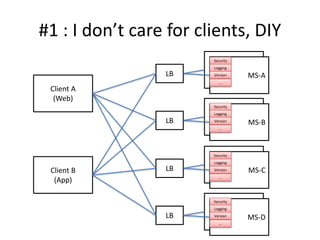
#1 : I don’t care for clients, DIY
Client A
(Web)
Client B
(App)
MS-A
MS-ALB
MS-A
MS-BLB
MS-A
MS-CLB
MS-A
MS-DLB
Security
Logging
Version
…
Security
Logging
Version
…
Security
Logging
Version
…
Security
Logging
Version
…
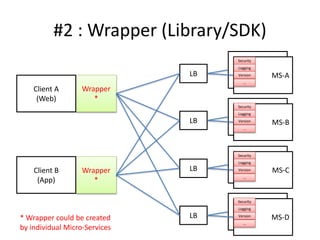
#1 : I don’t care for clients, DIY
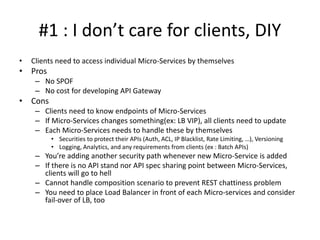
• Clients need to access individual Micro-Services by themselves
• Pros
– No SPOF
– No cost for developing API Gateway
• Cons
– Clients need to know endpoints of Micro-Services
– If Micro-Services changes something(ex: LB VIP), all clients need to update
– Each Micro-Services needs to handle these by themselves
• Securities to protect their APIs (Auth, ACL, IP Blacklist, Rate Limiting, …), Versioning
• Logging, Analytics, and any requirements from clients (ex : Batch APIs)
– You’re adding another security path whenever new Micro-Service is added
– If there is no API standard nor API spec sharing point between Micro-Services,
clients will go to hell
– Cannot handle composition scenario to prevent REST chattiness problem
– You need to place Load Balancer in front of each Micro-services and consider
fail-over of LB, too
#2 : Wrapper (Library/SDK)
Wrapper
*
Wrapper
*
MS-A
MS-ALB
MS-A
MS-BLB
MS-A
MS-CLB
MS-A
MS-DLB
Client A
(Web)
Client B
(App)
* Wrapper could be created
by individual Micro-Services
Security
Logging
Version
…
Security
Logging
Version
…
Security
Logging
Version
…
Security
Logging
Version
…
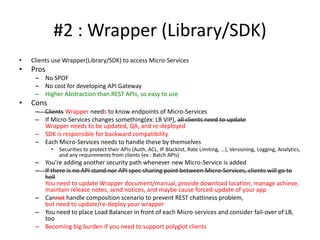
#2 : Wrapper (Library/SDK)
• Clients use Wrapper(Library/SDK) to access Micro-Services
• Pros
– No SPOF
– No cost for developing API Gateway
– Higher Abstraction than REST APIs, so easy to use
• Cons
– Clients Wrapper needs to know endpoints of Micro-Services
– If Micro-Services changes something(ex: LB VIP), all clients need to update
Wrapper needs to be updated, QA, and re-deployed
– Wrapper is responsible for backward compatibility
– Each Micro-Services needs to handle these by themselves
• Securities to protect their APIs (Auth, ACL, IP Blacklist, Rate Limiting, …), Versioning, Logging, Analytics,
and any requirements from clients (ex : Batch APIs)
– You’re adding another security path whenever new Micro-Service is added
– If there is no API standard nor API spec sharing point between Micro-Services, clients will go
to hell
You need to update Wrapper document/manual, provide download location, manage achieve,
maintain release notes, send notices, and maybe cause forced-update of your app
– Cannot handle composition scenario to prevent REST chattiness problem,
but need to update/re-deploy your wrapper
– You need to place Load Balancer in front of each Micro-services and consider fail-over of LB,
too
– Becoming big burden if you need to support polyglot clients
Checkpoint
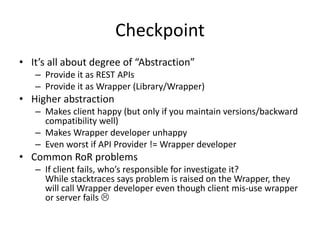
• It’s all about level of “Abstraction”
– Provide it as REST APIs
– Provide it as Wrapper (Library/Wrapper)
• Higher abstraction
– Makes client happy (but only if you maintain versions/backward
compatibility well)
– Makes Wrapper developer unhappy
– Even worst if API Provider != Wrapper developer
• Common RoR problems
– If client fails, who’s responsible for investigate it?
While stacktraces says problem is raised on the Wrapper, they
will call Wrapper developer even though client mis-use wrapper
or server fails 
API Gateway
#3 : API Gateway
Client A
(Web)
Client B
(App)
MS-A
MS-A
MS-A
MS-B
MS-A
MS-C
MS-A
MS-D
Security
Logging
Version
…
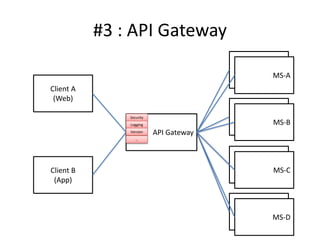
#3 : API Gateway
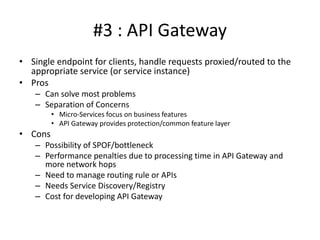
• Single endpoint for clients, handle requests proxied/routed to the
appropriate service (or service instance)
• Pros
– Can solve most problems
– Separation of Concerns
• Micro-Services focus on business features
• API Gateway provides protection/common feature layer
– Minimize/Isolate services’ change impacts
• Cons
– Possibility of SPOF/bottleneck
– Performance tradeoff due to processing time in API Gateway and more
network hops
– Need to manage routing rule or APIs
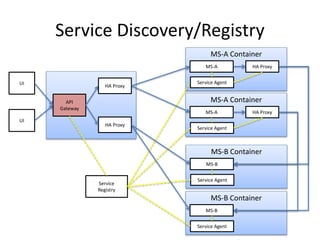
– Needs Service Discovery/Registry
– Cost for developing API Gateway
– Additional Hardware/Network/Management cost
– Risk of management bottleneck
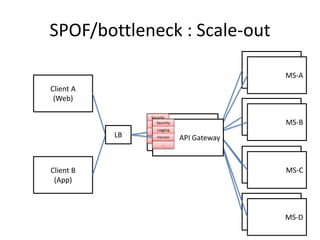
SPOF/bottleneck : Scale-out
API Gateway
Client A
(Web)
Client B
(App)
MS-A
MS-A
MS-A
MS-B
MS-A
MS-C
MS-A
MS-D
Security
Logging
Version
… API Gateway
Security
Logging
Version
…
LB
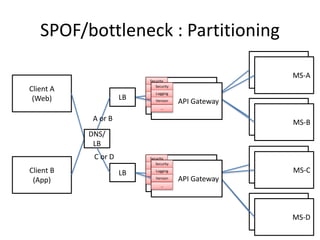
SPOF/bottleneck : Partitioning
API Gateway
Client A
(Web)
Client B
(App)
MS-A
MS-A
MS-A
MS-B
MS-A
MS-C
MS-A
MS-D
Security
Logging
Version
…
API Gateway
Security
Logging
Version
…
LB
API Gateway
Security
Logging
Version
…
API Gateway
Security
Logging
Version
…
LB
DNS/
LB
A or B
C or D
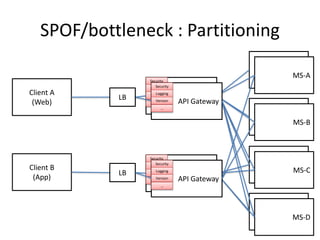
SPOF/bottleneck : Partitioning
API GatewayClient A
(Web)
Client B
(App)
MS-A
MS-A
MS-A
MS-B
MS-A
MS-C
MS-A
MS-D
Security
Logging
Version
…
API Gateway
Security
Logging
Version
…
LB
API Gateway
Security
Logging
Version
…
API Gateway
Security
Logging
Version
…
LB
Performance Tradeoff
• Network hop/latency depends on network
topology
• API Gateway processing time depends on
what you want to do in API Gateway
• Consider Tradeoff : What’s more important?
• Some Tips
– Don’t parse request/response body if you don’t
need it
– Caching on API Gateway
Managing Routing Rule or APIs
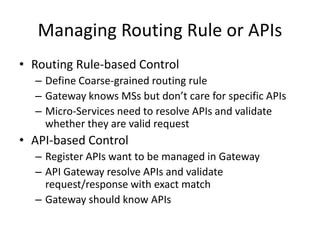
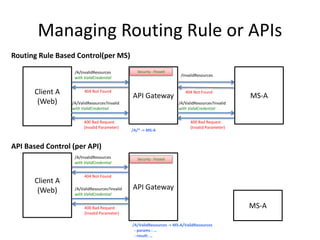
• Routing Rule-based Control
– Define Coarse-grained routing rule
– Gateway knows MSs but don’t care for specific APIs
– Micro-Services need to resolve APIs and validate
whether they are valid request
• API-based Control
– Register APIs want to be managed in Gateway
– API Gateway resolve APIs and validate
request/response with exact match
– Gateway should know APIs
Managing Routing Rule or APIs
Client A
(Web)
API Gateway MS-A
/A/InvalidResources
with ValidCredential
/InvalidResources
404 Not Found404 Not Found
Security : Passed
Client A
(Web) API Gateway
/A/InvalidResources
with ValidCredential
404 Not Found
Security : Passed
/A/* -> MS-A
/A/ValidResources -> MS-A/ValidResources
- params : …
- result: …
MS-A
/A/ValidResources?invalid
with ValidCredential
400 Bad Request
(Invalid Parameter)
/A/ValidResources?invalid
with ValidCredential
400 Bad Request
(Invalid Parameter)
/A/ValidResources?invalid
with ValidCredential
400 Bad Request
(Invalid Parameter)
Routing Rule Based Control(per MS)
API Based Control (per API)
Managing Routing Rules or APIs
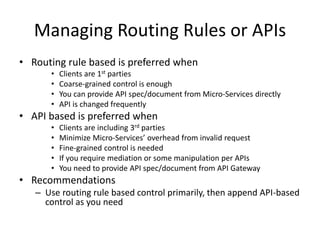
• Routing rule based is preferred when
• Clients are 1st parties
• Coarse-grained control is enough
• You can provide API spec/document from Micro-Services directly
• API is changed frequently
• API based is preferred when
• Clients are including 3rd parties
• Minimize Micro-Services’ overhead from invalid request
• Fine-grained control is needed
• If you require mediation or some manipulation per APIs
• You need to provide API spec/document from API Gateway
• Recommendations
– Use routing rule based control primarily, then append API-based
control as you need
Managing API specification
• You can manage it
– Deeply coupled with API Gateway
API-based Control requires for API Gateway to
know API specification
– Externally (ex : Swagger, ProtocolBuffer)
Both Routing Rule-based and API-based control
• If you have a API spec,
– Client developer can create client codes (even
wrapper)
– Server developer can create server codes
Service Discovery/Registry
MS-A Container
API
Gateway
UI
UI
MS-A
HA Proxy
HA Proxy
HA Proxy
Service
Registry
Service Agent
MS-A Container
MS-A HA Proxy
Service Agent
MS-B Container
MS-B
Service Agent
MS-B Container
MS-B
Service Agent
Cost for developing API Gateway
• Depends on what you want to do with API
Gateway
• Simple requirements = Simple API Gateway
(nginx/HA proxy might be enough for you)
• Node.js is a good start point to implement
• But going complex
– If you need to consider 3rd parties and Open API since
Developer portal and Onboarding process is required
– If you want some GUI and management console (=
Publisher portal)
– Consider API Gateway as Silver Bullet (ESB?)…
Additional
Hardware/Network/Management cost
• Another tradeoff : What’s more important?
• Depends on how you implement it and what
you want to do
• Cost could be issue
– If you consider adopting commercial products
– If you consider doing a lot of manipulation in API
Gateway
Risk of management bottleneck
• If API Gateway is managed by single team,
there are risks of management bottleneck
– API Gateway team has primary responsibility for
changes/failure/backward compatibility, …
– API Gateway team could be a bottleneck (going
worse if you do a lot of manipulations in it)
• Recommendation : separate managements
– API Gateway itself (API Gateway team)
– Services on the API Gateway (each service teams)
API Gateway: To be or not to be
• Consider your scenario
• But generally,
API Gateway is a good choice…
and it begins API Managements of your
organization
• To adopt it, start with simple one
– again, nginx/HA proxy might be enough for you
– Consider complex product/solution later
Send a feedback
var you = {};
if (you.like||you.dislike||you.suggest||you.request)
{
var url = "https://www.linkedin.com/in/lancersahn";
linkedin.contact(url);
}

Api gateway : To be or not to be

  • 1.
    API Gateway :To be or not to be? Platform Architecture Team SK Planet
  • 2.
    Synopsis • You’re developingbased on MSA(Micro- Services Architecture) • How do the clients access the individual Micro-services?
  • 3.
    #1 : Idon’t care for clients, DIY Client A (Web) Client B (App) MS-A MS-ALB MS-A MS-BLB MS-A MS-CLB MS-A MS-DLB Security Logging Version … Security Logging Version … Security Logging Version … Security Logging Version …
  • 4.
    #1 : Idon’t care for clients, DIY • Clients need to access individual Micro-Services by themselves • Pros – No SPOF – No cost for developing API Gateway • Cons – Clients need to know endpoints of Micro-Services – If Micro-Services changes something(ex: LB VIP), all clients need to update – Each Micro-Services needs to handle these by themselves • Securities to protect their APIs (Auth, ACL, IP Blacklist, Rate Limiting, …), Versioning • Logging, Analytics, and any requirements from clients (ex : Batch APIs) – You’re adding another security path whenever new Micro-Service is added – If there is no API standard nor API spec sharing point between Micro-Services, clients will go to hell – Cannot handle composition scenario to prevent REST chattiness problem – You need to place Load Balancer in front of each Micro-services and consider fail-over of LB, too
  • 5.
    #2 : Wrapper(Library/SDK) Wrapper * Wrapper * MS-A MS-ALB MS-A MS-BLB MS-A MS-CLB MS-A MS-DLB Client A (Web) Client B (App) * Wrapper could be created by individual Micro-Services Security Logging Version … Security Logging Version … Security Logging Version … Security Logging Version …
  • 6.
    #2 : Wrapper(Library/SDK) • Clients use Wrapper(Library/SDK) to access Micro-Services • Pros – No SPOF – No cost for developing API Gateway – Higher Abstraction than REST APIs, so easy to use • Cons – Clients Wrapper needs to know endpoints of Micro-Services – If Micro-Services changes something(ex: LB VIP), all clients need to update Wrapper needs to be updated, QA, and re-deployed – Wrapper is responsible for backward compatibility – Each Micro-Services needs to handle these by themselves • Securities to protect their APIs (Auth, ACL, IP Blacklist, Rate Limiting, …), Versioning, Logging, Analytics, and any requirements from clients (ex : Batch APIs) – You’re adding another security path whenever new Micro-Service is added – If there is no API standard nor API spec sharing point between Micro-Services, clients will go to hell You need to update Wrapper document/manual, provide download location, manage achieve, maintain release notes, send notices, and maybe cause forced-update of your app – Cannot handle composition scenario to prevent REST chattiness problem, but need to update/re-deploy your wrapper – You need to place Load Balancer in front of each Micro-services and consider fail-over of LB, too – Becoming big burden if you need to support polyglot clients
  • 7.
    Checkpoint • It’s allabout level of “Abstraction” – Provide it as REST APIs – Provide it as Wrapper (Library/Wrapper) • Higher abstraction – Makes client happy (but only if you maintain versions/backward compatibility well) – Makes Wrapper developer unhappy – Even worst if API Provider != Wrapper developer • Common RoR problems – If client fails, who’s responsible for investigate it? While stacktraces says problem is raised on the Wrapper, they will call Wrapper developer even though client mis-use wrapper or server fails 
  • 8.
    API Gateway #3 :API Gateway Client A (Web) Client B (App) MS-A MS-A MS-A MS-B MS-A MS-C MS-A MS-D Security Logging Version …
  • 9.
    #3 : APIGateway • Single endpoint for clients, handle requests proxied/routed to the appropriate service (or service instance) • Pros – Can solve most problems – Separation of Concerns • Micro-Services focus on business features • API Gateway provides protection/common feature layer – Minimize/Isolate services’ change impacts • Cons – Possibility of SPOF/bottleneck – Performance tradeoff due to processing time in API Gateway and more network hops – Need to manage routing rule or APIs – Needs Service Discovery/Registry – Cost for developing API Gateway – Additional Hardware/Network/Management cost – Risk of management bottleneck
  • 10.
    SPOF/bottleneck : Scale-out APIGateway Client A (Web) Client B (App) MS-A MS-A MS-A MS-B MS-A MS-C MS-A MS-D Security Logging Version … API Gateway Security Logging Version … LB
  • 11.
    SPOF/bottleneck : Partitioning APIGateway Client A (Web) Client B (App) MS-A MS-A MS-A MS-B MS-A MS-C MS-A MS-D Security Logging Version … API Gateway Security Logging Version … LB API Gateway Security Logging Version … API Gateway Security Logging Version … LB DNS/ LB A or B C or D
  • 12.
    SPOF/bottleneck : Partitioning APIGatewayClient A (Web) Client B (App) MS-A MS-A MS-A MS-B MS-A MS-C MS-A MS-D Security Logging Version … API Gateway Security Logging Version … LB API Gateway Security Logging Version … API Gateway Security Logging Version … LB
  • 13.
    Performance Tradeoff • Networkhop/latency depends on network topology • API Gateway processing time depends on what you want to do in API Gateway • Consider Tradeoff : What’s more important? • Some Tips – Don’t parse request/response body if you don’t need it – Caching on API Gateway
  • 14.
    Managing Routing Ruleor APIs • Routing Rule-based Control – Define Coarse-grained routing rule – Gateway knows MSs but don’t care for specific APIs – Micro-Services need to resolve APIs and validate whether they are valid request • API-based Control – Register APIs want to be managed in Gateway – API Gateway resolve APIs and validate request/response with exact match – Gateway should know APIs
  • 15.
    Managing Routing Ruleor APIs Client A (Web) API Gateway MS-A /A/InvalidResources with ValidCredential /InvalidResources 404 Not Found404 Not Found Security : Passed Client A (Web) API Gateway /A/InvalidResources with ValidCredential 404 Not Found Security : Passed /A/* -> MS-A /A/ValidResources -> MS-A/ValidResources - params : … - result: … MS-A /A/ValidResources?invalid with ValidCredential 400 Bad Request (Invalid Parameter) /A/ValidResources?invalid with ValidCredential 400 Bad Request (Invalid Parameter) /A/ValidResources?invalid with ValidCredential 400 Bad Request (Invalid Parameter) Routing Rule Based Control(per MS) API Based Control (per API)
  • 16.
    Managing Routing Rulesor APIs • Routing rule based is preferred when • Clients are 1st parties • Coarse-grained control is enough • You can provide API spec/document from Micro-Services directly • API is changed frequently • API based is preferred when • Clients are including 3rd parties • Minimize Micro-Services’ overhead from invalid request • Fine-grained control is needed • If you require mediation or some manipulation per APIs • You need to provide API spec/document from API Gateway • Recommendations – Use routing rule based control primarily, then append API-based control as you need
  • 17.
    Managing API specification •You can manage it – Deeply coupled with API Gateway API-based Control requires for API Gateway to know API specification – Externally (ex : Swagger, ProtocolBuffer) Both Routing Rule-based and API-based control • If you have a API spec, – Client developer can create client codes (even wrapper) – Server developer can create server codes
  • 18.
    Service Discovery/Registry MS-A Container API Gateway UI UI MS-A HAProxy HA Proxy HA Proxy Service Registry Service Agent MS-A Container MS-A HA Proxy Service Agent MS-B Container MS-B Service Agent MS-B Container MS-B Service Agent
  • 19.
    Cost for developingAPI Gateway • Depends on what you want to do with API Gateway • Simple requirements = Simple API Gateway (nginx/HA proxy might be enough for you) • Node.js is a good start point to implement • But going complex – If you need to consider 3rd parties and Open API since Developer portal and Onboarding process is required – If you want some GUI and management console (= Publisher portal) – Consider API Gateway as Silver Bullet (ESB?)…
  • 20.
    Additional Hardware/Network/Management cost • Anothertradeoff : What’s more important? • Depends on how you implement it and what you want to do • Cost could be issue – If you consider adopting commercial products – If you consider doing a lot of manipulation in API Gateway
  • 21.
    Risk of managementbottleneck • If API Gateway is managed by single team, there are risks of management bottleneck – API Gateway team has primary responsibility for changes/failure/backward compatibility, … – API Gateway team could be a bottleneck (going worse if you do a lot of manipulations in it) • Recommendation : separate managements – API Gateway itself (API Gateway team) – Services on the API Gateway (each service teams)
  • 22.
    API Gateway: Tobe or not to be • Consider your scenario • But generally, API Gateway is a good choice… and it begins API Managements of your organization • To adopt it, start with simple one – again, nginx/HA proxy might be enough for you – Consider complex product/solution later
  • 23.
    Send a feedback varyou = {}; if (you.like||you.dislike||you.suggest||you.request) { var url = "https://www.linkedin.com/in/lancersahn"; linkedin.contact(url); }