
   Purpose: To break a piece of literature
    down into parts, discuss individual
    components, and make a
    specific, arguable point.
    › You could argue about
       Literary elements
       Issues raised or resolved by the work
       The author’s personal psychology
       Reflection of period in which work was written
        or that it is supposed to represent
                                                 Page 5
 Select a poem, short story or play from
  your textbook that looks interesting. You
  will be discussing this for weeks, so select
  carefully.
 Read in its entirety.
 As you read, keep a log of observations
  and questions you have about the text
  or the time period it reflects/was created
 After you have read your chosen piece,
 You need to bring to class:
    › 3X5 or 4X6 index cards (at least 30)
    › Manila envelope (keep all components)
    › Establish a working Google site/email
      account and bring a flash drive
   Decide on possible controlling
    ideas, Supporting topics and subtopics
    › Need to have at least three
    › (Become “slugs” on the note cards)
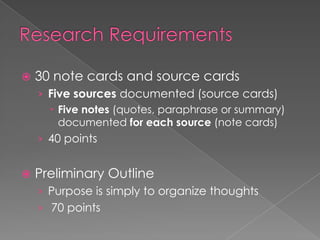
   30 note cards and source cards
    › Five sources documented (source cards)
       Five notes (quotes, paraphrase or summary)
        documented for each source (note cards)
    › 40 points


   Preliminary Outline
    › Purpose is simply to organize thoughts
    › 70 points
   Final Outline (100 points)
    › All sources used, thesis clearly labeled
   Rough Draft (100 points)
    › Typed, posted to Google site
   Final Draft Requirements: (100 points)
    › Main controlling idea (thesis statement)
       Examples on page 5
    › Quotations/paraphrases from the work
      (minimum 1/paragraph)
    › Parenthetical citations
      (3 sources required, ONE internet source)
Five Required due Monday April 8

 Contain the bibliographic information for
  that source
 Should be done at the beginning of
  note-taking (this week and next
  Monday)
 Follow appropriate MLA format
 Used for parenthetical citations and the
  works cited page
                                       Page 7
Note:
underlining
                                                 Title of Book
is no longer      Author’s name                  (italics)
acceptable.
MUST use                                                         Place of
italics on all                                                   publication
                    Brindle, Reginald Smith. The New
typed work.
                              Music: The Avant-Garde
                              since 1945. New York:
                              Oxford University Press,             Publisher
                              1975. Print..


                                               Publication
                 Copyright                     medium
                 Date
                    **NOTE: second and all subsequent
                    lines are indented. Use “hanging                           Page
                    indent” format in paragraph tools.                         11
Date of Internet
                      Web site              publication:
Author’s              title                 written day
name                                        Month year


                                                               Date of Access:
     Woodward, Richard B. Cormac McCarthy’s                    written
            Venomous Fiction. 19 April 1992.                   day month year
            Web. 21 March 2013.


                                                           Publication
                                                           Medium

     **NOTE: second and all subsequent lines are
     indented 5 spaces to create a tab of the first
     line.
 3 Types of Note Cards
     Quotation
     Paraphrase
     Summary
 These will construct the outline of your
  paper
 Each should have a SLUG – a reason
  connecting to the controlling idea -thesis
                                       Page 10
2. SLUG
                                          1. TAG


      Personal              (Marius 73)


      Quote: “Though the film portrays
      More as ideal, the real More
      wanted his hatred for heretics
      inscribed on his tomb.”


                 3. INFORMATION


                                                   Page 10
Source card                                                Note card 
                                                              Personally                         (Marius 72)
   Marius, Richard. “A Man for all Seasons.” Past
                                                              *film portrays More as ideal version of hero
        Imperfect: History According to the Movies. Ed.
        Mark C. Carnes. New York: Henry Hold and              * The real More wanted “his hatred for heretics
        Company, 1996.Print.                                  inscribed on his tomb.” –page 72


Text page 2                                                 Works cited page 

                                                 Student 2
                                                                                                                       Student 4


Yes, More did refuse to convert to Anglicanism, to
support his king openly, or even to speak on Henry’s                                  Works Cited
Great Matter specifically. But, as Marius relays, More’s     Marius, Richard. “A Man for all Seasons.” Past Imperfect: History
hatred of Luther and other reformers was well-                     According to the Movies. Ed. Mark C. Carnes. New
documented in reams of diatribes he had written                    York: Henry Hold and Company,        1996. Print.
against them, whom he considered heretics and for
whom he felt death by fire was the only solution (73).
In fact, the real More wanted “his hatred for heretics
inscribed on his tomb” (Marius 72). Such opinions
   Sign up on the glass wall in my hallway

   Only one person may write on a
    selection in each class, so if it’s taken, go
    with your back up

   Have the piece read by Friday when we
    begin research.
   Notes: Introduction
    › 12 chapter book (we will read about two
      chapters a week)
    › Books stay in classroom (you can check out
      if you need to make up work)
    › Study guides will be due each week on
      Monday.
 First published in 1954
 Wasn’t originally popular but has gained
  in critical success.
 Explores the ideas of society, lawlessness
  and anarchy, and power

   In a nutshell, a group of private school
    boys find themselves stranded on an
    island and must establish leadership
   Foreshadowing


   Irony

Source cards, note cards

  • 2.
    Purpose: To break a piece of literature down into parts, discuss individual components, and make a specific, arguable point. › You could argue about  Literary elements  Issues raised or resolved by the work  The author’s personal psychology  Reflection of period in which work was written or that it is supposed to represent Page 5
  • 3.
     Select apoem, short story or play from your textbook that looks interesting. You will be discussing this for weeks, so select carefully.  Read in its entirety.  As you read, keep a log of observations and questions you have about the text or the time period it reflects/was created
  • 4.
     After youhave read your chosen piece,  You need to bring to class: › 3X5 or 4X6 index cards (at least 30) › Manila envelope (keep all components) › Establish a working Google site/email account and bring a flash drive  Decide on possible controlling ideas, Supporting topics and subtopics › Need to have at least three › (Become “slugs” on the note cards)
  • 5.
    30 note cards and source cards › Five sources documented (source cards)  Five notes (quotes, paraphrase or summary) documented for each source (note cards) › 40 points  Preliminary Outline › Purpose is simply to organize thoughts › 70 points
  • 6.
    Final Outline (100 points) › All sources used, thesis clearly labeled  Rough Draft (100 points) › Typed, posted to Google site  Final Draft Requirements: (100 points) › Main controlling idea (thesis statement)  Examples on page 5 › Quotations/paraphrases from the work (minimum 1/paragraph) › Parenthetical citations (3 sources required, ONE internet source)
  • 7.
    Five Required dueMonday April 8  Contain the bibliographic information for that source  Should be done at the beginning of note-taking (this week and next Monday)  Follow appropriate MLA format  Used for parenthetical citations and the works cited page Page 7
  • 8.
    Note: underlining Title of Book is no longer Author’s name (italics) acceptable. MUST use Place of italics on all publication Brindle, Reginald Smith. The New typed work. Music: The Avant-Garde since 1945. New York: Oxford University Press, Publisher 1975. Print.. Publication Copyright medium Date **NOTE: second and all subsequent lines are indented. Use “hanging Page indent” format in paragraph tools. 11
  • 9.
    Date of Internet Web site publication: Author’s title written day name Month year Date of Access: Woodward, Richard B. Cormac McCarthy’s written Venomous Fiction. 19 April 1992. day month year Web. 21 March 2013. Publication Medium **NOTE: second and all subsequent lines are indented 5 spaces to create a tab of the first line.
  • 10.
     3 Typesof Note Cards Quotation Paraphrase Summary  These will construct the outline of your paper  Each should have a SLUG – a reason connecting to the controlling idea -thesis Page 10
  • 11.
    2. SLUG 1. TAG Personal (Marius 73) Quote: “Though the film portrays More as ideal, the real More wanted his hatred for heretics inscribed on his tomb.” 3. INFORMATION Page 10
  • 12.
    Source card Note card  Personally (Marius 72) Marius, Richard. “A Man for all Seasons.” Past *film portrays More as ideal version of hero Imperfect: History According to the Movies. Ed. Mark C. Carnes. New York: Henry Hold and * The real More wanted “his hatred for heretics Company, 1996.Print. inscribed on his tomb.” –page 72 Text page 2  Works cited page  Student 2 Student 4 Yes, More did refuse to convert to Anglicanism, to support his king openly, or even to speak on Henry’s Works Cited Great Matter specifically. But, as Marius relays, More’s Marius, Richard. “A Man for all Seasons.” Past Imperfect: History hatred of Luther and other reformers was well- According to the Movies. Ed. Mark C. Carnes. New documented in reams of diatribes he had written York: Henry Hold and Company, 1996. Print. against them, whom he considered heretics and for whom he felt death by fire was the only solution (73). In fact, the real More wanted “his hatred for heretics inscribed on his tomb” (Marius 72). Such opinions
  • 13.
    Sign up on the glass wall in my hallway  Only one person may write on a selection in each class, so if it’s taken, go with your back up  Have the piece read by Friday when we begin research.
  • 14.
    Notes: Introduction › 12 chapter book (we will read about two chapters a week) › Books stay in classroom (you can check out if you need to make up work) › Study guides will be due each week on Monday.
  • 15.
     First publishedin 1954  Wasn’t originally popular but has gained in critical success.  Explores the ideas of society, lawlessness and anarchy, and power  In a nutshell, a group of private school boys find themselves stranded on an island and must establish leadership
  • 16.
    Foreshadowing  Irony