WCE Internals
      Hernan Ochoa
(hernan@ampliasecurity.com)
What is WCE?
• Windows Credentials Editor v1.0

• Manipulates Windows Logon Sessions

• Evolution of the Pass-the-Hash Toolkit (also
  written by me)

• WCE v1.1 to be published after this is over 
WCE features
• Dump in-memory credentials of logon
  sessions
  – Lists in-memory logon sessions
     • Dumps in-memory username, domain, LM & NT
       hashes
     • current, future and terminated (…)
  – Great to ‘steal’ credentials not stored locally
WCE features

• Pass-The-Hash
  – Change/delete NTLM credentials of logon sessions
  – Create new logon sessions and associate arbitrary
    NTLM credentials
WCE features

• Does not require code injection to dump in-
  memory credentials (v1.1)
  – No need to run code inside LSASS.EXE
  – Can locate, list and decrypt Logon Sessions and
    NTLM credentials just by reading memory
WCE features
• Single executable (wce.exe)
  – Easier to use, upload, etc.

• Supports
  – Windows XP
  – Windows 2003
  – Windows Vista
  – Windows 7
  – Windows 2008
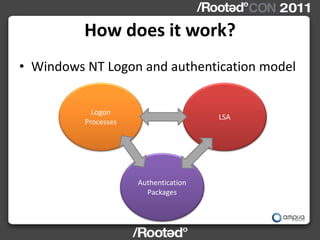
How does it work?
• Windows NT Logon and authentication model


            Logon
                                       LSA
          Processes


                      Authentication
                        Packages
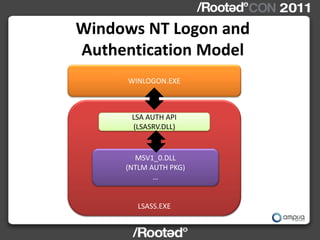
Windows NT Logon and
Authentication Model
      WINLOGON.EXE


      LSA AUTH API
      (LSASRV.DLL)


       MSV1_0.DLL
     (NTLM AUTH PKG)
            …


        LSASS.EXE
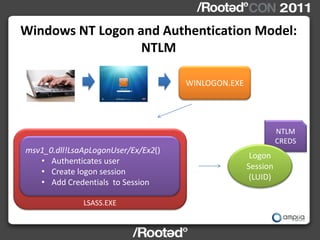
Windows NT Logon and Authentication Model:
                  NTLM

                                     WINLOGON.EXE


                                                              NTLM
                                                              CREDS
msv1_0.dll!LsaApLogonUser/Ex/Ex2()
                                                     Logon
   • Authenticates user
                                                    Session
   • Create logon session
                                                     (LUID)
   • Add Credentials to Session

              LSASS.EXE
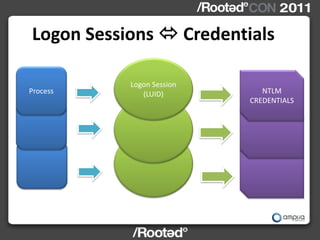
Logon Sessions  Credentials

           Logon Session
Process       (LUID)          NTLM
                           CREDENTIALS
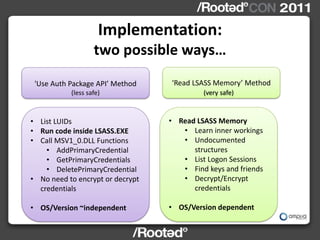
Implementation:
                   two possible ways…
 'Use Auth Package API’ Method    ‘Read LSASS Memory’ Method
           (less safe)                     (very safe)


• List LUIDs                      • Read LSASS Memory
• Run code inside LSASS.EXE          • Learn inner workings
• Call MSV1_0.DLL Functions          • Undocumented
    • AddPrimaryCredential              structures
    • GetPrimaryCredentials          • List Logon Sessions
    • DeletePrimaryCredential        • Find keys and friends
• No need to encrypt or decrypt      • Decrypt/Encrypt
  credentials                           credentials

• OS/Version ~independent         • OS/Version dependent
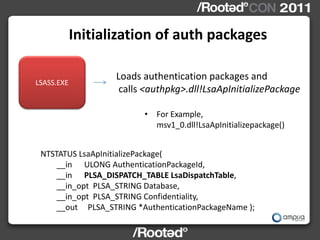
Initialization of auth packages

                   Loads authentication packages and
LSASS.EXE
                    calls <authpkg>.dll!LsaApInitializePackage

                         • For Example,
                           msv1_0.dll!LsaApInitializepackage()


 NTSTATUS LsaApInitializePackage(
     __in ULONG AuthenticationPackageId,
     __in PLSA_DISPATCH_TABLE LsaDispatchTable,
     __in_opt PLSA_STRING Database,
     __in_opt PLSA_STRING Confidentiality,
     __out PLSA_STRING *AuthenticationPackageName );
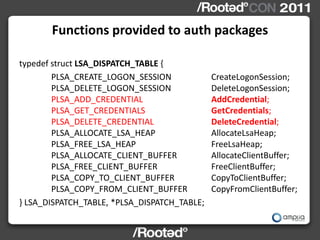
Functions provided to auth packages

typedef struct LSA_DISPATCH_TABLE {
        PLSA_CREATE_LOGON_SESSION             CreateLogonSession;
        PLSA_DELETE_LOGON_SESSION             DeleteLogonSession;
        PLSA_ADD_CREDENTIAL                   AddCredential;
        PLSA_GET_CREDENTIALS                  GetCredentials;
        PLSA_DELETE_CREDENTIAL                DeleteCredential;
        PLSA_ALLOCATE_LSA_HEAP                AllocateLsaHeap;
        PLSA_FREE_LSA_HEAP                    FreeLsaHeap;
        PLSA_ALLOCATE_CLIENT_BUFFER           AllocateClientBuffer;
        PLSA_FREE_CLIENT_BUFFER               FreeClientBuffer;
        PLSA_COPY_TO_CLIENT_BUFFER            CopyToClientBuffer;
        PLSA_COPY_FROM_CLIENT_BUFFER          CopyFromClientBuffer;
} LSA_DISPATCH_TABLE, *PLSA_DISPATCH_TABLE;
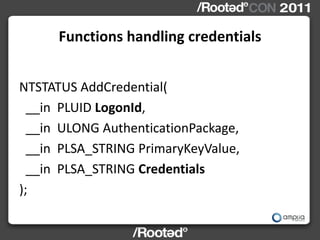
Functions handling credentials


NTSTATUS AddCredential(
  __in PLUID LogonId,
  __in ULONG AuthenticationPackage,
  __in PLSA_STRING PrimaryKeyValue,
  __in PLSA_STRING Credentials
);
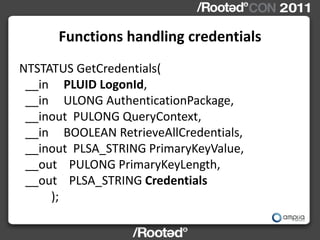
Functions handling credentials
NTSTATUS GetCredentials(
 __in PLUID LogonId,
 __in ULONG AuthenticationPackage,
 __inout PULONG QueryContext,
 __in BOOLEAN RetrieveAllCredentials,
 __inout PLSA_STRING PrimaryKeyValue,
 __out PULONG PrimaryKeyLength,
 __out PLSA_STRING Credentials
     );
Functions handling credentials


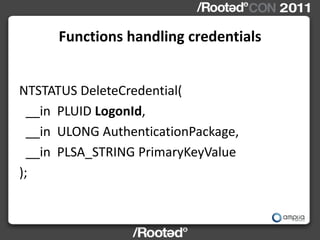
NTSTATUS DeleteCredential(
  __in PLUID LogonId,
  __in ULONG AuthenticationPackage,
  __in PLSA_STRING PrimaryKeyValue
);
Windows NT Logon and Authentication Model:
             NTLM in detail

                                            WINLOGON.EXE


 LUID luid = LsaLogonUser( …,MSV1_0_PACKAGE_ID,… )


 msv1_0.dll!LsaApLogonUser/Ex/Ex2()
     • Create logon session
     • Authenticates against local sam or AD
     • msv1_0.dll!NlpAddPrimaryAddCredential(LUID, [username, domain,
        LM/NT hashes],…)
         • Lsasrv.dll!AddCredential(LUID,…)
'Use Auth
                    Implementation:
Package API’
  Method
                       Summary
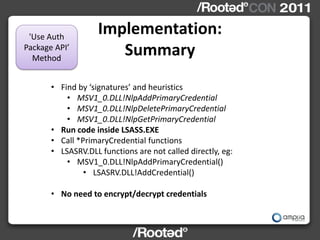
       • Find by ‘signatures’ and heuristics
           • MSV1_0.DLL!NlpAddPrimaryCredential
           • MSV1_0.DLL!NlpDeletePrimaryCredential
           • MSV1_0.DLL!NlpGetPrimaryCredential
       • Run code inside LSASS.EXE
       • Call *PrimaryCredential functions
       • LSASRV.DLL functions are not called directly, eg:
           • MSV1_0.DLL!NlpAddPrimaryCredential()
                • LSASRV.DLL!AddCredential()

       • No need to encrypt/decrypt credentials
'Use Auth          Implementation:
 Package API’
   Method        Credentials Block Format


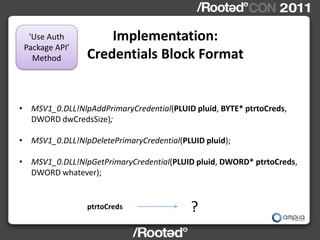
• MSV1_0.DLL!NlpAddPrimaryCredential(PLUID pluid, BYTE* ptrtoCreds,
  DWORD dwCredsSize);

• MSV1_0.DLL!NlpDeletePrimaryCredential(PLUID pluid);

• MSV1_0.DLL!NlpGetPrimaryCredential(PLUID pluid, DWORD* ptrtoCreds,
  DWORD whatever);


                 ptrtoCreds                ?
'Use Auth
                       Implementation:
Package API’       Credentials Block Format
  Method


      ptrtoCreds

                   typedef struct {
                      UNICODE_STR ustr_domain;
                      UNICODE_STR ustr_username;
                      BYTE NThash[16];
                      BYTE LMhash[16];
                      BYTE Udomain[MAX_DOMAIN_LEN];
                      BYTE Uuser[MAX_USERNAME_LEN];
                   } CREDSBLOCK;
'Use Auth
Package API’
                   Implementation:
  Method       Credentials Block Format

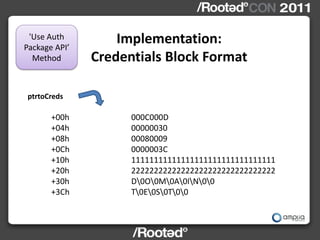
ptrtoCreds

       +00h          000C000D
       +04h          00000030
       +08h          00080009
       +0Ch          0000003C
       +10h          11111111111111111111111111111111
       +20h          22222222222222222222222222222222
       +30h          D0O0M0A0IN00
       +3Ch          T0E0S0T00
'Use Auth
 Package         Implementation:
   API’
 Method
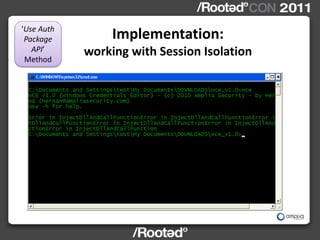
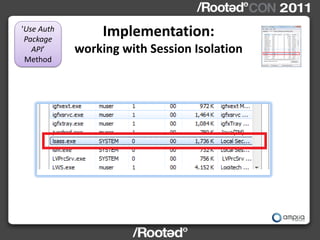
            working with Session Isolation
'Use Auth
 Package           Implementation:
   API’
 Method
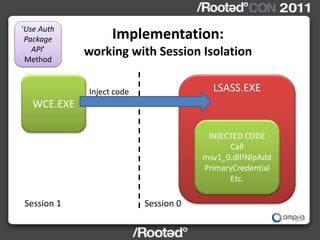
             working with Session Isolation

             Inject code                 LSASS.EXE
   WCE.EXE

                                        INJECTED CODE
                                             Call
                                       msv1_0.dll!NlpAdd
                                       PrimaryCredential
                                             Etc.

Session 1                  Session 0
'Use Auth
 Package
                 Implementation:
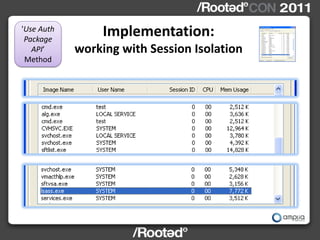
   API’     working with Session Isolation
 Method
'Use Auth
 Package
                 Implementation:
   API’     working with Session Isolation
 Method
'Use Auth
 Package
                 Implementation:
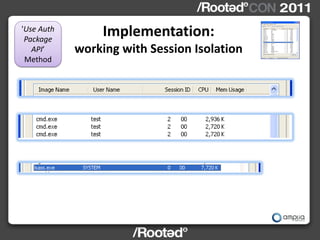
   API’     working with Session Isolation
 Method
'Use Auth
   Package                        Implementation:
     API’
   Method
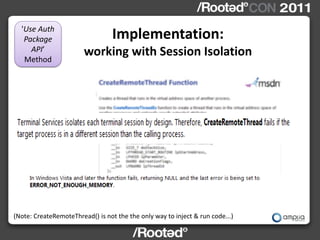
                        working with Session Isolation


(Note: CreateRemoteThread() is not the the only way to inject & run code...)
'Use Auth
 Package              Implementation:
   API’
 Method
               working with Session Isolation

   • Windows Vista/7/2008
         • NTDLL.DLL!NtCreateThreadEx

   • Windows XP/2003
     • RDP / Terminal Services
         • Create a Windows Service and do everything there
         • WCE.EXE also acts as a Windows Service
             • Installs, starts, stops and removes itself
             • IPC via Named Pipe
‘Read LSASS
  Memory’          Implementation
  Method


• No need to run code inside LSASS.EXE (SUPER SAFE!)
   • ReadProcessMemory() only!

• Reverse engineer inner workings of LSASS.EXE (LSASRV.DLL)
   • Structures used internally to hold logon sessions
   • Structures used internally to hold credentials
       • Structures used internally to hold NTLM Hashes
   • Decrypt credentials
       • Find keys
       • Algorithm
       • Anything else needed to decrypt (e.g.: IV)
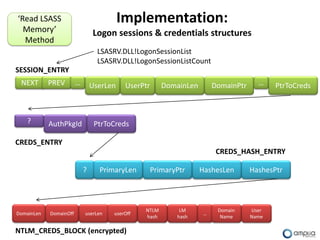
‘Read LSASS                               Implementation:
  Memory’                       Logon sessions & credentials structures
  Method
                                  LSASRV.DLL!LogonSessionList
                                  LSASRV.DLL!LogonSessionListCount
SESSION_ENTRY
 NEXT       PREV        …       UserLen    UserPtr      DomainLen       DomainPtr     …    PtrToCreds


   ?        AuthPkgId            PtrToCreds

CREDS_ENTRY
                                                                         CREDS_HASH_ENTRY

                            ?     PrimaryLen         PrimaryPtr     HashesLen       HashesPtr


                                                NTLM         LM          Domain     User
DomainLen   DomainOff       userLen   userOff                       …
                                                hash        hash          Name      Name

NTLM_CREDS_BLOCK (encrypted)
‘Read LSASS              Implementation:
       Memory’
       Method         changes in SESSION_ENTRY
        Windows XP/2003                      Windows Vista/7/2008

struct SESSION_ENTRY {                 struct SESSION_ENTRY {

           DWORD nextEntry;                    DWORD nextEntry;
           DWORD prevEntry;                    DWORD prevEntry;
           DWORD unk1;                         DWORD UNKNOWN[18];
           DWORD unk2;                         DWORD userSize;
           DWORD userSize;                     DWORD userNamePtrUnicode;
                                               DWORD machineSize;
           DWORD userNamePtrUnicode;
                                               DWORD machinePtrUnicode;
           DWORD machineSize;
                                               …
           DWORD machinePtrUnicode;
           ….
     +0x48 DWORD PtrToCreds;            +0x88 DWORD PtrToCreds;
};                                     };
Implementation:
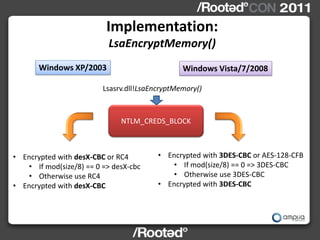
                           LsaEncryptMemory()
       Windows XP/2003                          Windows Vista/7/2008

                         Lsasrv.dll!LsaEncryptMemory()


                              NTLM_CREDS_BLOCK


• Encrypted with desX-CBC or RC4         • Encrypted with 3DES-CBC or AES-128-CFB
   • If mod(size/8) == 0 => desX-cbc        • If mod(size/8) == 0 => 3DES-CBC
   • Otherwise use RC4                      • Otherwise use 3DES-CBC
• Encrypted with desX-CBC                • Encrypted with 3DES-CBC
Implementation
lsasrv.dll!LsaInitializeProtectedMemory (XP/2003)
                                0                                    190h
   VirtualAlloc()
                                    90h      8 8 8

  cbRandomKey = 100h
  pDESXTable
  pRandomKey
                                           struct DESXTable {
  SystemFunction036( byte                    byte inWhitening[8];
  Feedback[8],8)                             byte outWhitening[8];
                                             DESTable desTable;
                                          }
  desxkey( pDESXTable ,
  pRandomKey )                            struct DESTable {
                                             unsigned long keys[16][2];
                                          }
  SystemFunction036(
  pRandomKey, cbRandomKey )
Implementation
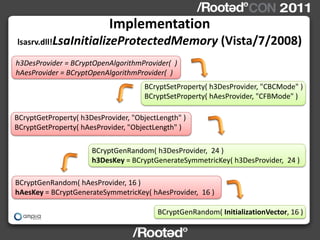
lsasrv.dll!LsaInitializeProtectedMemory                    (Vista/7/2008)
h3DesProvider = BCryptOpenAlgorithmProvider( )
hAesProvider = BCryptOpenAlgorithmProvider( )
                                     BCryptSetProperty( h3DesProvider, "CBCMode" )
                                     BCryptSetProperty( hAesProvider, "CFBMode" )

BCryptGetProperty( h3DesProvider, "ObjectLength" )
BCryptGetProperty( hAesProvider, "ObjectLength" )

                      BCryptGenRandom( h3DesProvider, 24 )
                      h3DesKey = BCryptGenerateSymmetricKey( h3DesProvider, 24 )

BCryptGenRandom( hAesProvider, 16 )
hAesKey = BCryptGenerateSymmetricKey( hAesProvider, 16 )

                                         BCryptGenRandom( InitializationVector, 16 )
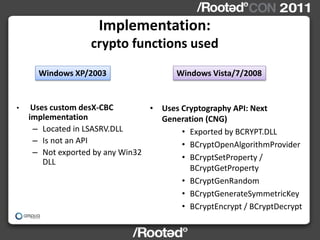
Implementation:
                   crypto functions used
      Windows XP/2003                   Windows Vista/7/2008


•    Uses custom desX-CBC        • Uses Cryptography API: Next
    implementation                 Generation (CNG)
     – Located in LSASRV.DLL            • Exported by BCRYPT.DLL
     – Is not an API                    • BCryptOpenAlgorithmProvider
     – Not exported by any Win32
                                        • BCryptSetProperty /
        DLL
                                          BCryptGetProperty
                                        • BCryptGenRandom
                                        • BCryptGenerateSymmetricKey
                                        • BCryptEncrypt / BCryptDecrypt
Implementation
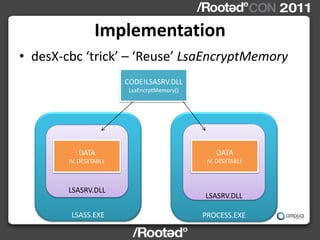
• desX-cbc ‘trick’ – ‘Reuse’ LsaEncryptMemory
                        CODE!LSASRV.DLL
                         LsaEncrptMemory()


           DATA                                  DATA
        IV, DESXTABLE                         IV, DESXTABLE


        LSASRV.DLL
                                             LSASRV.DLL

        LSASS.EXE                            PROCESS.EXE
Implementation:
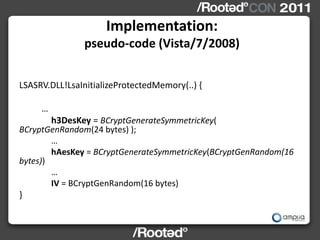
                pseudo-code (Vista/7/2008)


LSASRV.DLL!LsaInitializeProtectedMemory(..) {

     …
        h3DesKey = BCryptGenerateSymmetricKey(
BCryptGenRandom(24 bytes) );
        …
        hAesKey = BCryptGenerateSymmetricKey(BCryptGenRandom(16
bytes))
        …
        IV = BCryptGenRandom(16 bytes)
}
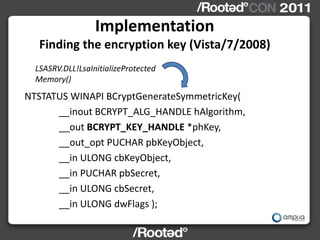
Implementation
   Finding the encryption key (Vista/7/2008)
  LSASRV.DLL!LsaInitializeProtected
  Memory()
NTSTATUS WINAPI BCryptGenerateSymmetricKey(
      __inout BCRYPT_ALG_HANDLE hAlgorithm,
      __out BCRYPT_KEY_HANDLE *phKey,
      __out_opt PUCHAR pbKeyObject,
      __in ULONG cbKeyObject,
      __in PUCHAR pbSecret,
      __in ULONG cbSecret,
      __in ULONG dwFlags );
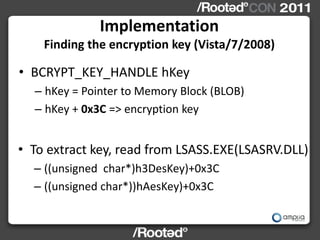
Implementation
    Finding the encryption key (Vista/7/2008)

• BCRYPT_KEY_HANDLE hKey
  – hKey = Pointer to Memory Block (BLOB)
  – hKey + 0x3C => encryption key


• To extract key, read from LSASS.EXE(LSASRV.DLL)
  – ((unsigned char*)h3DesKey)+0x3C
  – ((unsigned char*))hAesKey)+0x3C
Implementation
    Finding the encryption key (Vista/7/2008)

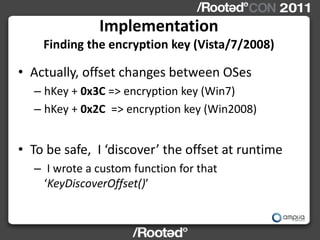
• Actually, offset changes between OSes
  – hKey + 0x3C => encryption key (Win7)
  – hKey + 0x2C => encryption key (Win2008)


• To be safe, I ‘discover’ the offset at runtime
  – I wrote a custom function for that
    ‘KeyDiscoverOffset()’
Implementation
     Finding the encryption key (Vista/7/2008)
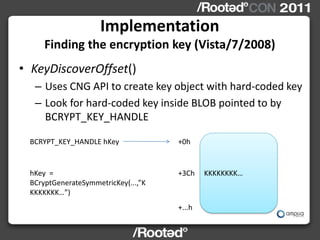
• KeyDiscoverOffset()
  – Uses CNG API to create key object with hard-coded key
  – Look for hard-coded key inside BLOB pointed to by
    BCRYPT_KEY_HANDLE

 BCRYPT_KEY_HANDLE hKey              +0h


 hKey =                              +3Ch    KKKKKKKK…
 BCryptGenerateSymmetricKey(...,”K
 KKKKKKK…”)
                                     +...h
Implementation
          Finding the IV (Vista/7/2008)
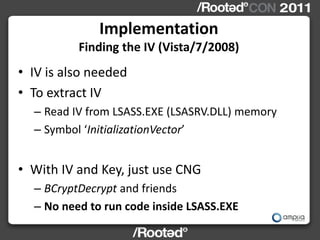
• IV is also needed
• To extract IV
  – Read IV from LSASS.EXE (LSASRV.DLL) memory
  – Symbol ‘InitializationVector’


• With IV and Key, just use CNG
  – BCryptDecrypt and friends
  – No need to run code inside LSASS.EXE
Implementation:
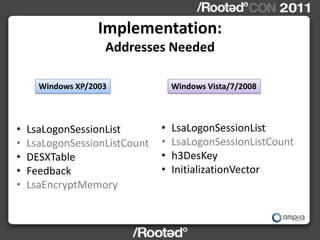
                    Addresses Needed

      Windows XP/2003              Windows Vista/7/2008


•   LsaLogonSessionList        •   LsaLogonSessionList
•   LsaLogonSessionListCount   •   LsaLogonSessionListCount
•   DESXTable                  •   h3DesKey
•   Feedback                   •   InitializationVector
•   LsaEncryptMemory
Implementation:
             Addresses Needed

• Database of addresses

• ID by SHA1 hash of LSASRV.DLL

• Yes, addresses still an issue..
   • But ..
       • Getlsasrvaddr.exe to the rescue..
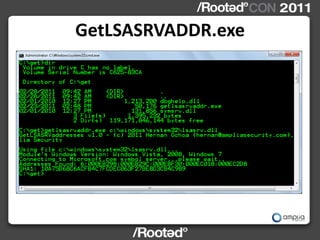
GetLSASRVADDR.exe
• Finds needed addresses automatically
   • User-friendly
   • No IDC script, IDA or anything weird like that
     is needed 

• Uses Microsoft symbol server
   • Requires http outbound connection (!)

• Associates addresses and DLLs using SHA1
GetLSASRVADDR.exe
GetLSASRVADDR.exe
• Could be integrated with WCE but..
      • The outbound connection might be an
        issue
      • huge not-there-by-default DLLs needed
           •   Symsrv.dll and dbghelp.dll (new version,
               not the default one)

•   Could implement own version of ‘symbol
    server’ protocol

•   Or perhaps it is best to use heuristics..
Implementation:
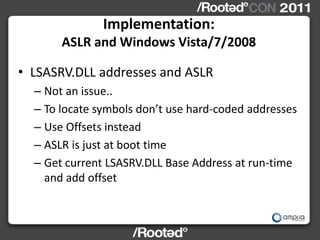
       ASLR and Windows Vista/7/2008

• LSASRV.DLL addresses and ASLR
  – Not an issue..
  – To locate symbols don’t use hard-coded addresses
  – Use Offsets instead
  – ASLR is just at boot time
  – Get current LSASRV.DLL Base Address at run-time
    and add offset
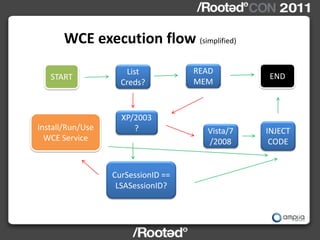
WCE execution flow (simplified)
                     List           READ
   START                                        END
                    Creds?          MEM


                    XP/2003
Install/Run/Use        ?              Vista/7   INJECT
  WCE Service                         /2008      CODE


                  CurSessionID ==
                   LSASessionID?
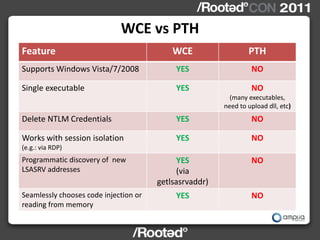
WCE vs PTH
Feature                                    WCE                  PTH
Supports Windows Vista/7/2008               YES                  NO

Single executable                           YES                  NO
                                                          (many executables,
                                                        need to upload dll, etc)
Delete NTLM Credentials                     YES                  NO

Works with session isolation                YES                  NO
(e.g.: via RDP)
Programmatic discovery of new                YES                 NO
LSASRV addresses                             (via
                                       getlsasrvaddr)
Seamlessly chooses code injection or        YES                  NO
reading from memory
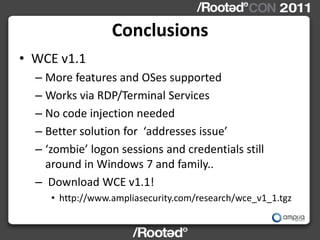
Conclusions
• WCE v1.1
  – More features and OSes supported
  – Works via RDP/Terminal Services
  – No code injection needed
  – Better solution for ‘addresses issue’
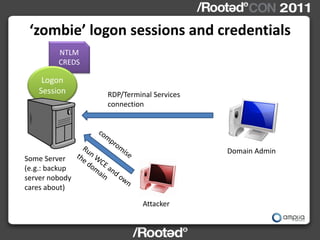
  – ‘zombie’ logon sessions and credentials still
    around in Windows 7 and family..
  – Download WCE v1.1!
     • http://www.ampliasecurity.com/research/wce_v1_1.tgz
‘zombie’ logon sessions and credentials
         NTLM
         CREDS

    Logon
   Session       RDP/Terminal Services
                 connection


                                         Domain Admin
Some Server
(e.g.: backup
server nobody
cares about)

                           Attacker
Preguntas?
             Gracias!
Hernan Ochoa (hernan@ampliasecurity.com)

http://www.twitter.com/hernano
http://www.twitter.com/ampliasecurity
http://www.ampliasecurity.com/blog/

Hernan Ochoa - WCE Internals [RootedCON 2011]

  • 1.
    WCE Internals Hernan Ochoa (hernan@ampliasecurity.com)
  • 2.
    What is WCE? •Windows Credentials Editor v1.0 • Manipulates Windows Logon Sessions • Evolution of the Pass-the-Hash Toolkit (also written by me) • WCE v1.1 to be published after this is over 
  • 3.
    WCE features • Dumpin-memory credentials of logon sessions – Lists in-memory logon sessions • Dumps in-memory username, domain, LM & NT hashes • current, future and terminated (…) – Great to ‘steal’ credentials not stored locally
  • 4.
    WCE features • Pass-The-Hash – Change/delete NTLM credentials of logon sessions – Create new logon sessions and associate arbitrary NTLM credentials
  • 5.
    WCE features • Doesnot require code injection to dump in- memory credentials (v1.1) – No need to run code inside LSASS.EXE – Can locate, list and decrypt Logon Sessions and NTLM credentials just by reading memory
  • 6.
    WCE features • Singleexecutable (wce.exe) – Easier to use, upload, etc. • Supports – Windows XP – Windows 2003 – Windows Vista – Windows 7 – Windows 2008
  • 7.
    How does itwork? • Windows NT Logon and authentication model Logon LSA Processes Authentication Packages
  • 8.
    Windows NT Logonand Authentication Model WINLOGON.EXE LSA AUTH API (LSASRV.DLL) MSV1_0.DLL (NTLM AUTH PKG) … LSASS.EXE
  • 9.
    Windows NT Logonand Authentication Model: NTLM WINLOGON.EXE NTLM CREDS msv1_0.dll!LsaApLogonUser/Ex/Ex2() Logon • Authenticates user Session • Create logon session (LUID) • Add Credentials to Session LSASS.EXE
  • 10.
    Logon Sessions Credentials Logon Session Process (LUID) NTLM CREDENTIALS
  • 11.
    Implementation: two possible ways… 'Use Auth Package API’ Method ‘Read LSASS Memory’ Method (less safe) (very safe) • List LUIDs • Read LSASS Memory • Run code inside LSASS.EXE • Learn inner workings • Call MSV1_0.DLL Functions • Undocumented • AddPrimaryCredential structures • GetPrimaryCredentials • List Logon Sessions • DeletePrimaryCredential • Find keys and friends • No need to encrypt or decrypt • Decrypt/Encrypt credentials credentials • OS/Version ~independent • OS/Version dependent
  • 12.
    Initialization of authpackages Loads authentication packages and LSASS.EXE calls <authpkg>.dll!LsaApInitializePackage • For Example, msv1_0.dll!LsaApInitializepackage() NTSTATUS LsaApInitializePackage( __in ULONG AuthenticationPackageId, __in PLSA_DISPATCH_TABLE LsaDispatchTable, __in_opt PLSA_STRING Database, __in_opt PLSA_STRING Confidentiality, __out PLSA_STRING *AuthenticationPackageName );
  • 13.
    Functions provided toauth packages typedef struct LSA_DISPATCH_TABLE { PLSA_CREATE_LOGON_SESSION CreateLogonSession; PLSA_DELETE_LOGON_SESSION DeleteLogonSession; PLSA_ADD_CREDENTIAL AddCredential; PLSA_GET_CREDENTIALS GetCredentials; PLSA_DELETE_CREDENTIAL DeleteCredential; PLSA_ALLOCATE_LSA_HEAP AllocateLsaHeap; PLSA_FREE_LSA_HEAP FreeLsaHeap; PLSA_ALLOCATE_CLIENT_BUFFER AllocateClientBuffer; PLSA_FREE_CLIENT_BUFFER FreeClientBuffer; PLSA_COPY_TO_CLIENT_BUFFER CopyToClientBuffer; PLSA_COPY_FROM_CLIENT_BUFFER CopyFromClientBuffer; } LSA_DISPATCH_TABLE, *PLSA_DISPATCH_TABLE;
  • 14.
    Functions handling credentials NTSTATUSAddCredential( __in PLUID LogonId, __in ULONG AuthenticationPackage, __in PLSA_STRING PrimaryKeyValue, __in PLSA_STRING Credentials );
  • 15.
    Functions handling credentials NTSTATUSGetCredentials( __in PLUID LogonId, __in ULONG AuthenticationPackage, __inout PULONG QueryContext, __in BOOLEAN RetrieveAllCredentials, __inout PLSA_STRING PrimaryKeyValue, __out PULONG PrimaryKeyLength, __out PLSA_STRING Credentials );
  • 16.
    Functions handling credentials NTSTATUSDeleteCredential( __in PLUID LogonId, __in ULONG AuthenticationPackage, __in PLSA_STRING PrimaryKeyValue );
  • 17.
    Windows NT Logonand Authentication Model: NTLM in detail WINLOGON.EXE LUID luid = LsaLogonUser( …,MSV1_0_PACKAGE_ID,… ) msv1_0.dll!LsaApLogonUser/Ex/Ex2() • Create logon session • Authenticates against local sam or AD • msv1_0.dll!NlpAddPrimaryAddCredential(LUID, [username, domain, LM/NT hashes],…) • Lsasrv.dll!AddCredential(LUID,…)
  • 18.
    'Use Auth Implementation: Package API’ Method Summary • Find by ‘signatures’ and heuristics • MSV1_0.DLL!NlpAddPrimaryCredential • MSV1_0.DLL!NlpDeletePrimaryCredential • MSV1_0.DLL!NlpGetPrimaryCredential • Run code inside LSASS.EXE • Call *PrimaryCredential functions • LSASRV.DLL functions are not called directly, eg: • MSV1_0.DLL!NlpAddPrimaryCredential() • LSASRV.DLL!AddCredential() • No need to encrypt/decrypt credentials
  • 19.
    'Use Auth Implementation: Package API’ Method Credentials Block Format • MSV1_0.DLL!NlpAddPrimaryCredential(PLUID pluid, BYTE* ptrtoCreds, DWORD dwCredsSize); • MSV1_0.DLL!NlpDeletePrimaryCredential(PLUID pluid); • MSV1_0.DLL!NlpGetPrimaryCredential(PLUID pluid, DWORD* ptrtoCreds, DWORD whatever); ptrtoCreds ?
  • 20.
    'Use Auth Implementation: Package API’ Credentials Block Format Method ptrtoCreds typedef struct { UNICODE_STR ustr_domain; UNICODE_STR ustr_username; BYTE NThash[16]; BYTE LMhash[16]; BYTE Udomain[MAX_DOMAIN_LEN]; BYTE Uuser[MAX_USERNAME_LEN]; } CREDSBLOCK;
  • 21.
    'Use Auth Package API’ Implementation: Method Credentials Block Format ptrtoCreds +00h 000C000D +04h 00000030 +08h 00080009 +0Ch 0000003C +10h 11111111111111111111111111111111 +20h 22222222222222222222222222222222 +30h D0O0M0A0IN00 +3Ch T0E0S0T00
  • 22.
    'Use Auth Package Implementation: API’ Method working with Session Isolation
  • 23.
    'Use Auth Package Implementation: API’ Method working with Session Isolation Inject code LSASS.EXE WCE.EXE INJECTED CODE Call msv1_0.dll!NlpAdd PrimaryCredential Etc. Session 1 Session 0
  • 24.
    'Use Auth Package Implementation: API’ working with Session Isolation Method
  • 25.
    'Use Auth Package Implementation: API’ working with Session Isolation Method
  • 26.
    'Use Auth Package Implementation: API’ working with Session Isolation Method
  • 27.
    'Use Auth Package Implementation: API’ Method working with Session Isolation (Note: CreateRemoteThread() is not the the only way to inject & run code...)
  • 28.
    'Use Auth Package Implementation: API’ Method working with Session Isolation • Windows Vista/7/2008 • NTDLL.DLL!NtCreateThreadEx • Windows XP/2003 • RDP / Terminal Services • Create a Windows Service and do everything there • WCE.EXE also acts as a Windows Service • Installs, starts, stops and removes itself • IPC via Named Pipe
  • 29.
    ‘Read LSASS Memory’ Implementation Method • No need to run code inside LSASS.EXE (SUPER SAFE!) • ReadProcessMemory() only! • Reverse engineer inner workings of LSASS.EXE (LSASRV.DLL) • Structures used internally to hold logon sessions • Structures used internally to hold credentials • Structures used internally to hold NTLM Hashes • Decrypt credentials • Find keys • Algorithm • Anything else needed to decrypt (e.g.: IV)
  • 30.
    ‘Read LSASS Implementation: Memory’ Logon sessions & credentials structures Method LSASRV.DLL!LogonSessionList LSASRV.DLL!LogonSessionListCount SESSION_ENTRY NEXT PREV … UserLen UserPtr DomainLen DomainPtr … PtrToCreds ? AuthPkgId PtrToCreds CREDS_ENTRY CREDS_HASH_ENTRY ? PrimaryLen PrimaryPtr HashesLen HashesPtr NTLM LM Domain User DomainLen DomainOff userLen userOff … hash hash Name Name NTLM_CREDS_BLOCK (encrypted)
  • 31.
    ‘Read LSASS Implementation: Memory’ Method changes in SESSION_ENTRY Windows XP/2003 Windows Vista/7/2008 struct SESSION_ENTRY { struct SESSION_ENTRY { DWORD nextEntry; DWORD nextEntry; DWORD prevEntry; DWORD prevEntry; DWORD unk1; DWORD UNKNOWN[18]; DWORD unk2; DWORD userSize; DWORD userSize; DWORD userNamePtrUnicode; DWORD machineSize; DWORD userNamePtrUnicode; DWORD machinePtrUnicode; DWORD machineSize; … DWORD machinePtrUnicode; …. +0x48 DWORD PtrToCreds; +0x88 DWORD PtrToCreds; }; };
  • 32.
    Implementation: LsaEncryptMemory() Windows XP/2003 Windows Vista/7/2008 Lsasrv.dll!LsaEncryptMemory() NTLM_CREDS_BLOCK • Encrypted with desX-CBC or RC4 • Encrypted with 3DES-CBC or AES-128-CFB • If mod(size/8) == 0 => desX-cbc • If mod(size/8) == 0 => 3DES-CBC • Otherwise use RC4 • Otherwise use 3DES-CBC • Encrypted with desX-CBC • Encrypted with 3DES-CBC
  • 33.
    Implementation lsasrv.dll!LsaInitializeProtectedMemory (XP/2003) 0 190h VirtualAlloc() 90h 8 8 8 cbRandomKey = 100h pDESXTable pRandomKey struct DESXTable { SystemFunction036( byte byte inWhitening[8]; Feedback[8],8) byte outWhitening[8]; DESTable desTable; } desxkey( pDESXTable , pRandomKey ) struct DESTable { unsigned long keys[16][2]; } SystemFunction036( pRandomKey, cbRandomKey )
  • 34.
    Implementation lsasrv.dll!LsaInitializeProtectedMemory (Vista/7/2008) h3DesProvider = BCryptOpenAlgorithmProvider( ) hAesProvider = BCryptOpenAlgorithmProvider( ) BCryptSetProperty( h3DesProvider, "CBCMode" ) BCryptSetProperty( hAesProvider, "CFBMode" ) BCryptGetProperty( h3DesProvider, "ObjectLength" ) BCryptGetProperty( hAesProvider, "ObjectLength" ) BCryptGenRandom( h3DesProvider, 24 ) h3DesKey = BCryptGenerateSymmetricKey( h3DesProvider, 24 ) BCryptGenRandom( hAesProvider, 16 ) hAesKey = BCryptGenerateSymmetricKey( hAesProvider, 16 ) BCryptGenRandom( InitializationVector, 16 )
  • 35.
    Implementation: crypto functions used Windows XP/2003 Windows Vista/7/2008 • Uses custom desX-CBC • Uses Cryptography API: Next implementation Generation (CNG) – Located in LSASRV.DLL • Exported by BCRYPT.DLL – Is not an API • BCryptOpenAlgorithmProvider – Not exported by any Win32 • BCryptSetProperty / DLL BCryptGetProperty • BCryptGenRandom • BCryptGenerateSymmetricKey • BCryptEncrypt / BCryptDecrypt
  • 36.
    Implementation • desX-cbc ‘trick’– ‘Reuse’ LsaEncryptMemory CODE!LSASRV.DLL LsaEncrptMemory() DATA DATA IV, DESXTABLE IV, DESXTABLE LSASRV.DLL LSASRV.DLL LSASS.EXE PROCESS.EXE
  • 37.
    Implementation: pseudo-code (Vista/7/2008) LSASRV.DLL!LsaInitializeProtectedMemory(..) { … h3DesKey = BCryptGenerateSymmetricKey( BCryptGenRandom(24 bytes) ); … hAesKey = BCryptGenerateSymmetricKey(BCryptGenRandom(16 bytes)) … IV = BCryptGenRandom(16 bytes) }
  • 38.
    Implementation Finding the encryption key (Vista/7/2008) LSASRV.DLL!LsaInitializeProtected Memory() NTSTATUS WINAPI BCryptGenerateSymmetricKey( __inout BCRYPT_ALG_HANDLE hAlgorithm, __out BCRYPT_KEY_HANDLE *phKey, __out_opt PUCHAR pbKeyObject, __in ULONG cbKeyObject, __in PUCHAR pbSecret, __in ULONG cbSecret, __in ULONG dwFlags );
  • 39.
    Implementation Finding the encryption key (Vista/7/2008) • BCRYPT_KEY_HANDLE hKey – hKey = Pointer to Memory Block (BLOB) – hKey + 0x3C => encryption key • To extract key, read from LSASS.EXE(LSASRV.DLL) – ((unsigned char*)h3DesKey)+0x3C – ((unsigned char*))hAesKey)+0x3C
  • 40.
    Implementation Finding the encryption key (Vista/7/2008) • Actually, offset changes between OSes – hKey + 0x3C => encryption key (Win7) – hKey + 0x2C => encryption key (Win2008) • To be safe, I ‘discover’ the offset at runtime – I wrote a custom function for that ‘KeyDiscoverOffset()’
  • 41.
    Implementation Finding the encryption key (Vista/7/2008) • KeyDiscoverOffset() – Uses CNG API to create key object with hard-coded key – Look for hard-coded key inside BLOB pointed to by BCRYPT_KEY_HANDLE BCRYPT_KEY_HANDLE hKey +0h hKey = +3Ch KKKKKKKK… BCryptGenerateSymmetricKey(...,”K KKKKKKK…”) +...h
  • 42.
    Implementation Finding the IV (Vista/7/2008) • IV is also needed • To extract IV – Read IV from LSASS.EXE (LSASRV.DLL) memory – Symbol ‘InitializationVector’ • With IV and Key, just use CNG – BCryptDecrypt and friends – No need to run code inside LSASS.EXE
  • 43.
    Implementation: Addresses Needed Windows XP/2003 Windows Vista/7/2008 • LsaLogonSessionList • LsaLogonSessionList • LsaLogonSessionListCount • LsaLogonSessionListCount • DESXTable • h3DesKey • Feedback • InitializationVector • LsaEncryptMemory
  • 44.
    Implementation: Addresses Needed • Database of addresses • ID by SHA1 hash of LSASRV.DLL • Yes, addresses still an issue.. • But .. • Getlsasrvaddr.exe to the rescue..
  • 45.
    GetLSASRVADDR.exe • Finds neededaddresses automatically • User-friendly • No IDC script, IDA or anything weird like that is needed  • Uses Microsoft symbol server • Requires http outbound connection (!) • Associates addresses and DLLs using SHA1
  • 46.
  • 47.
    GetLSASRVADDR.exe • Could beintegrated with WCE but.. • The outbound connection might be an issue • huge not-there-by-default DLLs needed • Symsrv.dll and dbghelp.dll (new version, not the default one) • Could implement own version of ‘symbol server’ protocol • Or perhaps it is best to use heuristics..
  • 48.
    Implementation: ASLR and Windows Vista/7/2008 • LSASRV.DLL addresses and ASLR – Not an issue.. – To locate symbols don’t use hard-coded addresses – Use Offsets instead – ASLR is just at boot time – Get current LSASRV.DLL Base Address at run-time and add offset
  • 49.
    WCE execution flow(simplified) List READ START END Creds? MEM XP/2003 Install/Run/Use ? Vista/7 INJECT WCE Service /2008 CODE CurSessionID == LSASessionID?
  • 50.
    WCE vs PTH Feature WCE PTH Supports Windows Vista/7/2008 YES NO Single executable YES NO (many executables, need to upload dll, etc) Delete NTLM Credentials YES NO Works with session isolation YES NO (e.g.: via RDP) Programmatic discovery of new YES NO LSASRV addresses (via getlsasrvaddr) Seamlessly chooses code injection or YES NO reading from memory
  • 51.
    Conclusions • WCE v1.1 – More features and OSes supported – Works via RDP/Terminal Services – No code injection needed – Better solution for ‘addresses issue’ – ‘zombie’ logon sessions and credentials still around in Windows 7 and family.. – Download WCE v1.1! • http://www.ampliasecurity.com/research/wce_v1_1.tgz
  • 52.
    ‘zombie’ logon sessionsand credentials NTLM CREDS Logon Session RDP/Terminal Services connection Domain Admin Some Server (e.g.: backup server nobody cares about) Attacker
  • 53.
    Preguntas? Gracias! Hernan Ochoa (hernan@ampliasecurity.com) http://www.twitter.com/hernano http://www.twitter.com/ampliasecurity http://www.ampliasecurity.com/blog/