

Session 2: Elicit and
Strengthen Change Talk
Session 2: Elicit and
Strengthen Change Talk
Stephen R. Andrew, LCSW LADC CCS
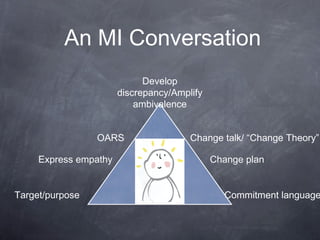
An MI Conversation
Target/purpose
Express empathy
OARS
Develop
discrepancy/Amplify
ambivalence
Change talk/ “Change Theory”
Change plan
Commitment language
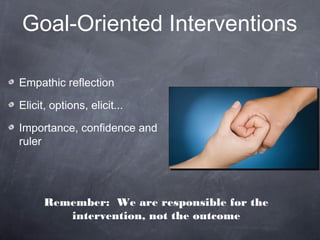
Goal-Oriented Interventions
Empathic reflection
Elicit, options, elicit...
Importance, confidence and
ruler
Remember: We are responsible for the
intervention, not the outcome
Find Out Where the Patient is
Meet them where they are
Continuum of ambivalence
Explore importance and confidence
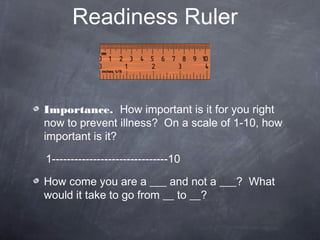
Readiness Ruler
Importance. How important is it for you right
now to prevent illness? On a scale of 1-10, how
important is it?
1-------------------------------10
How come you are a ___ and not a ___? What
would it take to go from __ to __?
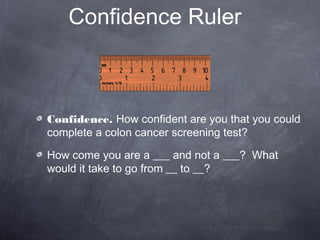
Confidence Ruler
Confidence. How confident are you that you could
complete a colon cancer screening test?
How come you are a ___ and not a ___? What
would it take to go from __ to __?
Strategies to Increase
Importance and Confidence
ELicit & reflect change talk
Explore goals & values
Highlight personal strengths
& supports
Brainstorm solutions
Hypothetical change (“I
wonder if...”)
Resistance or Change
Talk?
“I want to lose weight.”
“I’d like to spend less money.”
“I could if I wanted to, but I don’t really want
to.”
Resistance or Change
Talk?
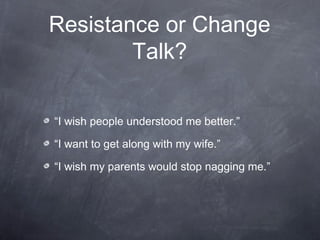
“I wish people understood me better.”
“I want to get along with my wife.”
“I wish my parents would stop nagging me.”
Resistance or Change
Talk?
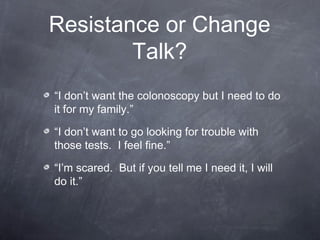
“I don’t want the colonoscopy but I need to do
it for my family.”
“I don’t want to go looking for trouble with
those tests. I feel fine.”
“I’m scared. But if you tell me I need it, I will
do it.”
Thank You!
Stephen Andrew, LCSW LADC CCS
heti@gwi.net
www.hetimaine.org

Motivational Interviewing: Elicit Change Talk

  • 1.
    Session 2: Elicitand Strengthen Change Talk Session 2: Elicit and Strengthen Change Talk Stephen R. Andrew, LCSW LADC CCS
  • 2.
    An MI Conversation Target/purpose Expressempathy OARS Develop discrepancy/Amplify ambivalence Change talk/ “Change Theory” Change plan Commitment language
  • 3.
    Goal-Oriented Interventions Empathic reflection Elicit,options, elicit... Importance, confidence and ruler Remember: We are responsible for the intervention, not the outcome
  • 4.
    Find Out Wherethe Patient is Meet them where they are Continuum of ambivalence Explore importance and confidence
  • 5.
    Readiness Ruler Importance. Howimportant is it for you right now to prevent illness? On a scale of 1-10, how important is it? 1-------------------------------10 How come you are a ___ and not a ___? What would it take to go from __ to __?
  • 6.
    Confidence Ruler Confidence. Howconfident are you that you could complete a colon cancer screening test? How come you are a ___ and not a ___? What would it take to go from __ to __?
  • 7.
    Strategies to Increase Importanceand Confidence ELicit & reflect change talk Explore goals & values Highlight personal strengths & supports Brainstorm solutions Hypothetical change (“I wonder if...”)
  • 8.
    Resistance or Change Talk? “Iwant to lose weight.” “I’d like to spend less money.” “I could if I wanted to, but I don’t really want to.”
  • 9.
    Resistance or Change Talk? “Iwish people understood me better.” “I want to get along with my wife.” “I wish my parents would stop nagging me.”
  • 10.
    Resistance or Change Talk? “Idon’t want the colonoscopy but I need to do it for my family.” “I don’t want to go looking for trouble with those tests. I feel fine.” “I’m scared. But if you tell me I need it, I will do it.”
  • 11.
    Thank You! Stephen Andrew,LCSW LADC CCS heti@gwi.net www.hetimaine.org

Editor's Notes

  • #4 Complex Empathic Reflections.. amplify, double-sided, continuing paragraph, metaphor, affective... Elicit, Provide Options, Elicit.. Importance,Confidence & Energy Rulers.. Elicit Commitment Language.. We are responsible for the intervention, not the outcome...
  • #5 Its important to meet the patient where he/she is at in terms of thinking about CRC screening. MI involves an approach to making this “diagnosis” or determination using a continuum of ambivalence that ranges from resistance to true ambivalence. The MI approach involves exploring IMPORTANCE and CONFIDENCE.