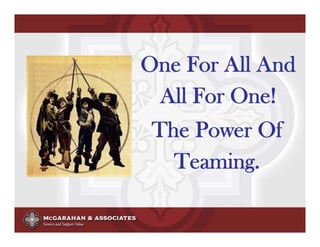
One For All And
 All For One!
 The Power Of
   Teaming.

      Š2008 Copyright McGarahan & Associates. All rights reserved.
Purpose


• To celebrate the team.

• To refocus ourselves on teaming.

• To learn from other successful teams.

• To engage ourselves in trust and open
 communication with our team mates.

                              Š2008 Copyright McGarahan & Associates. All rights reserved.
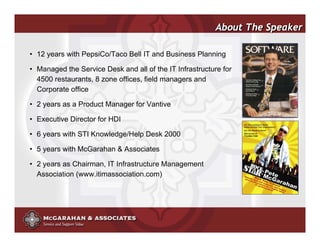
About The Speaker

• 12 years with PepsiCo/Taco Bell IT and Business Planning

• Managed the Service Desk and all of the IT Infrastructure for
  4500 restaurants, 8 zone offices, field managers and
  Corporate office

• 2 years as a Product Manager for Vantive

• Executive Director for HDI

• 6 years with STI Knowledge/Help Desk 2000

• 5 years with McGarahan & Associates

• 2 years as Chairman, IT Infrastructure Management
  Association (www.itimassociation.com)


                                                        Š2008 Copyright McGarahan & Associates. All rights reserved.
In Appreciation


• Thank a team member who has always
 been there for you!

• Tell a new team member what you really
 appreciate and admire most about them.

• Extend yourself to someone you don’t
 interact with often and make it a point to
 get to know them better.

• Feel confident about the power of the
 team behind you at all times.


                                              Š2008 Copyright McGarahan & Associates. All rights reserved.
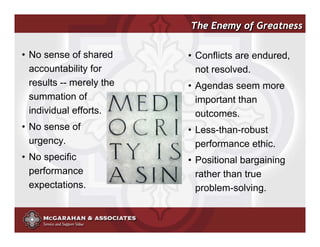
The Enemy of Greatness

• No sense of shared      • Conflicts are endured,
  accountability for        not resolved.
  results -- merely the   • Agendas seem more
  summation of              important than
  individual efforts.       outcomes.
• No sense of             • Less-than-robust
  urgency.                  performance ethic.
• No specific             • Positional bargaining
  performance               rather than true
  expectations.             problem-solving.


                               Š2008 Copyright McGarahan & Associates. All rights reserved.
Values that Support Trust

• No looking good at another's     • Managers welcome criticism.
  expense.                         • OK to evaluate team's efforts.
• OK to be wrong at the            • Rewards based on team
  beginning.                         product.
• Respect for facts, data,         • Trust the teaming process.
  objective analysis.              • Be prepared.
• Tolerance for work in process.
• Assume innocence.
• Seek to understand.
• Respect each other’s time.


                                                Š2008 Copyright McGarahan & Associates. All rights reserved.
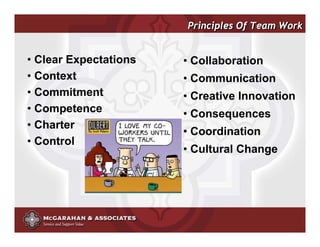
Principles Of Team Work


• Clear Expectations   • Collaboration
• Context              • Communication
• Commitment           • Creative Innovation
• Competence           • Consequences
• Charter
                       • Coordination
• Control
                       • Cultural Change


                            Š2008 Copyright McGarahan & Associates. All rights reserved.
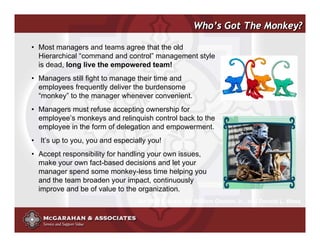
Who’s Got The Monkey?

• Most managers and teams agree that the old
  Hierarchical “command and control” management style
  is dead, long live the empowered team!
• Managers still fight to manage their time and
  employees frequently deliver the burdensome
  “monkey” to the manager whenever convenient.
• Managers must refuse accepting ownership for
  employee’s monkeys and relinquish control back to the
  employee in the form of delegation and empowerment.
• It’s up to you, you and especially you!
• Accept responsibility for handling your own issues,
  make your own fact-based decisions and let your
  manager spend some monkey-less time helping you
  and the team broaden your impact, continuously
  improve and be of value to the organization.
                                 An HBR Classis: By William Oncken Jr., and Donald L. Wass


                                                          Š2008 Copyright McGarahan & Associates. All rights reserved.
Anyone ENGAGED?

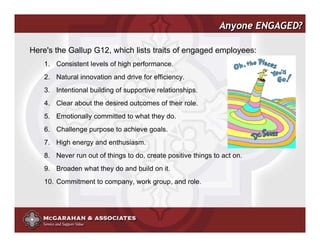
Here's the Gallup G12, which lists traits of engaged employees:
    1. Consistent levels of high performance.
    2. Natural innovation and drive for efficiency.
    3. Intentional building of supportive relationships.
    4. Clear about the desired outcomes of their role.
    5. Emotionally committed to what they do.
    6. Challenge purpose to achieve goals.
    7. High energy and enthusiasm.
    8. Never run out of things to do, create positive things to act on.
    9. Broaden what they do and build on it.
    10. Commitment to company, work group, and role.


                                                            Š2008 Copyright McGarahan & Associates. All rights reserved.
The Gallup Q12

• The Gallup organization came up with 12 questions or statements where employees
  are asked to rank each one on a scale of 1 to 5, with 1 meaning they totally disagree
  with the statement and 5 meaning they completely agree with the statement.

    1. I know what is expected of me at work.
    2. I have the materials and equipment I need to do my work right.
    3. At work, I have the opportunity to do what I do best every day.
    4. In the last seven days, I have received recognition or praise for doing good work.
    5. My supervisor, or someone at work, seems to care about me as a person.
    6. There is someone at work who encourages my development.
    7. At work, my opinions seem to count.
    8. The mission/purpose of my company makes me feel my job is important.
    9. My associates (fellow employees) are committed to doing quality work.
    10.I have a best friend at work.
    11. In the last six months, someone at work talked to me about my progress.
    12. In the last year, I have had opportunities at work to learn and grow.


                                                              Š2008 Copyright McGarahan & Associates. All rights reserved.
1980 U.S. Olympic Hockey Team

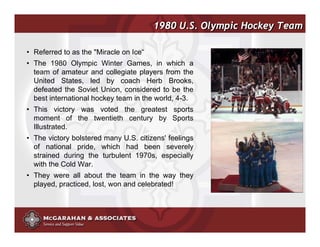
• Referred to as the "Miracle on Ice“
• The 1980 Olympic Winter Games, in which a
  team of amateur and collegiate players from the
  United States, led by coach Herb Brooks,
  defeated the Soviet Union, considered to be the
  best international hockey team in the world, 4-3.
• This victory was voted the greatest sports
  moment of the twentieth century by Sports
  Illustrated.
• The victory bolstered many U.S. citizens' feelings
  of national pride, which had been severely
  strained during the turbulent 1970s, especially
  with the Cold War.
• They were all about the team in the way they
  played, practiced, lost, won and celebrated!


                                                       Š2008 Copyright McGarahan & Associates. All rights reserved.
Failure Is Not An Option

                            Apollo 13 Mission Control, Houston:
                                                                   • Houston, we have a problem.
                                                                        • Failure is not an option!


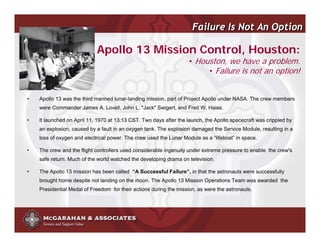
•   Apollo 13 was the third manned lunar-landing mission, part of Project Apollo under NASA. The crew members
    were Commander James A. Lovell, John L. "Jack" Swigert, and Fred W. Haise.

•   It launched on April 11, 1970 at 13:13 CST. Two days after the launch, the Apollo spacecraft was crippled by
    an explosion, caused by a fault in an oxygen tank. The explosion damaged the Service Module, resulting in a
    loss of oxygen and electrical power. The crew used the Lunar Module as a “lifeboat” in space.

•   The crew and the flight controllers used considerable ingenuity under extreme pressure to enable the crew's
    safe return. Much of the world watched the developing drama on television.

•   The Apollo 13 mission has been called “A Successful Failure”, in that the astronauts were successfully
    brought home despite not landing on the moon. The Apollo 13 Mission Operations Team was awarded the
    Presidential Medal of Freedom for their actions during the mission, as were the astronauts.


                                                                             Š2008 Copyright McGarahan & Associates. All rights reserved.
Ground Rules for Teaming

• Here are some reflections from a recent Team
  Building exercise I conducted:
   – Build trust and get to know each other.
   – Spend time clarifying a common vision and shared
     purpose.
   – Agree on the behaviors and ground rules.
   – Discuss roles and procedures.
   – Set up regular opportunities for dialogue.
   – Establish measures for evaluation.
   – Celebrate success.


                                                  Š2008 Copyright McGarahan & Associates. All rights reserved.
Pay it Forward

• Extending the reach of your team, out to:
    – Customers
    – Peer teams
    – Vendors
    – Management

• Everyone wants to be a part of a winning team.
• You will accomplish and learn more in a team
  environment than you will in any chosen solo
  performance.
• The number of one stumbling block of managers                  Always
  is arrogance. Never believe your own press that
  you know and have seen it all.                                 Listen!


                                                    Š2008 Copyright McGarahan & Associates. All rights reserved.
Customer Service - Passion

• Customer Service – It’s just that simple.
• Simplicity is a paradox; it’s easy to
  change from the inside out with an
  outside in perspective - if you are
  passionate enough about it!
• Change has to address the WHY factor!
• The trick is tapping into people’s
  passions for serving others while also
  benefiting themselves.

Passion. You either have it or you don't. It's just that simple.


                                               Š2008 Copyright McGarahan & Associates. All rights reserved.
It’s Just That Simple


Doing right BY the customer and
doing right FOR the customer – it’s
       JUST THAT SIMPLE.
If so, why do we make it so hard?

             1. Take the time to do it right.
2. Take the time to do it differently based upon what you
       have learned from prior days and experiences.


                                           Š2008 Copyright McGarahan & Associates. All rights reserved.
The Top 10 Service and Support Best Practices

• Attitude is everything
    – Go into every situation with a positive attitude and the intent on doing the right thing for the
      customer and everyone will benefit.
• No excuses, just solutions
    – Never dead-end your customer or assume you know the details of their issue/request
      without "seeking to understand", asking the right questions and actively listening
• Team work
    – Empowering the team to make front-line decisions and coordinate best practice processes
      is the only way Service Desks can survive and thrive in today's ever demanding role as the
      Customer Advocate and single point of contact for all customer issues and requests.
• Customer Advocate
    – You represent the 'voice of the customer' which means the customer trusts you to
      represent them and their issue/request to the other support teams, coordinate timely
      resolutions and eliminate reoccurring issues.
• Total Contact Ownership
    – Is built upon the premise that the Service Desk will continue to address a customer's
      issue/request and follow up until the issue or question is resolved to the customer's
      satisfaction.


                                                                         Š2008 Copyright McGarahan & Associates. All rights reserved.
The Top 10 Service and Support Best Practices

• Quality Ticket Documentation
    – Research, diagnose, prioritize and document thoroughly (it did not happen if it's not
      documented in the ticket).
• Fun
    – Having fun is a key component of successful teams. It is up to all of you to make your
      environment and Service Desk culture a place that is supportive, respectful, hard-
      working, focused & fun.
• Being Proactive
    – Spotting trends, related issues and reoccurring issues and working to ensure that we
      minimize business impact, communicate appropriately and work to learn from the
      situation.
• First Contact Resolution
    – You should use all of our available resources (team members, training, tools,
      documentation, past incidents, etc.) to facilitate solving our customers issue on the first
      contact. It leads to a higher level of customer satisfaction, improves our image, allows
      Level-2 teams to be more responsive and improves our productivity.
• Solve the Business Problem First
    – Then address the technical or policy issues. Always ask yourself and then document it in
      the ticket - who is the customer, what are they trying to do, what can’t they do and how
      critical is it in terms of productivity, impact and patient care.


                                                                        Š2008 Copyright McGarahan & Associates. All rights reserved.
In the End, You Decide What Success Is!

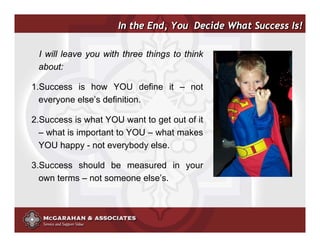
 I will leave you with three things to think
 about:

1.Success is how YOU define it – not
  everyone else’s definition.

2.Success is what YOU want to get out of it
  – what is important to YOU – what makes
  YOU happy - not everybody else.

3.Success should be measured in your
  own terms – not someone else’s.


                                               Š2008 Copyright McGarahan & Associates. All rights reserved.
"Being a leader is not about
 you, it's about all that you
 can do to make other
 people successful.“
                         Thank You!
                    Pete McGarahan
             McGarahan & Asssociates
                             Pete@mcgarahan.com
                                    714.694.1158


             Š2008 Copyright McGarahan & Associates. All rights reserved.

One For All All For One

  • 1.
    One For AllAnd All For One! The Power Of Teaming. Š2008 Copyright McGarahan & Associates. All rights reserved.
  • 2.
    Purpose • To celebratethe team. • To refocus ourselves on teaming. • To learn from other successful teams. • To engage ourselves in trust and open communication with our team mates. ©2008 Copyright McGarahan & Associates. All rights reserved.
  • 3.
    About The Speaker •12 years with PepsiCo/Taco Bell IT and Business Planning • Managed the Service Desk and all of the IT Infrastructure for 4500 restaurants, 8 zone offices, field managers and Corporate office • 2 years as a Product Manager for Vantive • Executive Director for HDI • 6 years with STI Knowledge/Help Desk 2000 • 5 years with McGarahan & Associates • 2 years as Chairman, IT Infrastructure Management Association (www.itimassociation.com) ©2008 Copyright McGarahan & Associates. All rights reserved.
  • 4.
    In Appreciation • Thanka team member who has always been there for you! • Tell a new team member what you really appreciate and admire most about them. • Extend yourself to someone you don’t interact with often and make it a point to get to know them better. • Feel confident about the power of the team behind you at all times. ©2008 Copyright McGarahan & Associates. All rights reserved.
  • 5.
    The Enemy ofGreatness • No sense of shared • Conflicts are endured, accountability for not resolved. results -- merely the • Agendas seem more summation of important than individual efforts. outcomes. • No sense of • Less-than-robust urgency. performance ethic. • No specific • Positional bargaining performance rather than true expectations. problem-solving. ©2008 Copyright McGarahan & Associates. All rights reserved.
  • 6.
    Values that SupportTrust • No looking good at another's • Managers welcome criticism. expense. • OK to evaluate team's efforts. • OK to be wrong at the • Rewards based on team beginning. product. • Respect for facts, data, • Trust the teaming process. objective analysis. • Be prepared. • Tolerance for work in process. • Assume innocence. • Seek to understand. • Respect each other’s time. ©2008 Copyright McGarahan & Associates. All rights reserved.
  • 7.
    Principles Of TeamWork • Clear Expectations • Collaboration • Context • Communication • Commitment • Creative Innovation • Competence • Consequences • Charter • Coordination • Control • Cultural Change ©2008 Copyright McGarahan & Associates. All rights reserved.
  • 8.
    Who’s Got TheMonkey? • Most managers and teams agree that the old Hierarchical “command and control” management style is dead, long live the empowered team! • Managers still fight to manage their time and employees frequently deliver the burdensome “monkey” to the manager whenever convenient. • Managers must refuse accepting ownership for employee’s monkeys and relinquish control back to the employee in the form of delegation and empowerment. • It’s up to you, you and especially you! • Accept responsibility for handling your own issues, make your own fact-based decisions and let your manager spend some monkey-less time helping you and the team broaden your impact, continuously improve and be of value to the organization. An HBR Classis: By William Oncken Jr., and Donald L. Wass ©2008 Copyright McGarahan & Associates. All rights reserved.
  • 9.
    Anyone ENGAGED? Here's theGallup G12, which lists traits of engaged employees: 1. Consistent levels of high performance. 2. Natural innovation and drive for efficiency. 3. Intentional building of supportive relationships. 4. Clear about the desired outcomes of their role. 5. Emotionally committed to what they do. 6. Challenge purpose to achieve goals. 7. High energy and enthusiasm. 8. Never run out of things to do, create positive things to act on. 9. Broaden what they do and build on it. 10. Commitment to company, work group, and role. Š2008 Copyright McGarahan & Associates. All rights reserved.
  • 10.
    The Gallup Q12 •The Gallup organization came up with 12 questions or statements where employees are asked to rank each one on a scale of 1 to 5, with 1 meaning they totally disagree with the statement and 5 meaning they completely agree with the statement. 1. I know what is expected of me at work. 2. I have the materials and equipment I need to do my work right. 3. At work, I have the opportunity to do what I do best every day. 4. In the last seven days, I have received recognition or praise for doing good work. 5. My supervisor, or someone at work, seems to care about me as a person. 6. There is someone at work who encourages my development. 7. At work, my opinions seem to count. 8. The mission/purpose of my company makes me feel my job is important. 9. My associates (fellow employees) are committed to doing quality work. 10.I have a best friend at work. 11. In the last six months, someone at work talked to me about my progress. 12. In the last year, I have had opportunities at work to learn and grow. ©2008 Copyright McGarahan & Associates. All rights reserved.
  • 11.
    1980 U.S. OlympicHockey Team • Referred to as the "Miracle on Ice“ • The 1980 Olympic Winter Games, in which a team of amateur and collegiate players from the United States, led by coach Herb Brooks, defeated the Soviet Union, considered to be the best international hockey team in the world, 4-3. • This victory was voted the greatest sports moment of the twentieth century by Sports Illustrated. • The victory bolstered many U.S. citizens' feelings of national pride, which had been severely strained during the turbulent 1970s, especially with the Cold War. • They were all about the team in the way they played, practiced, lost, won and celebrated! ©2008 Copyright McGarahan & Associates. All rights reserved.
  • 12.
    Failure Is NotAn Option Apollo 13 Mission Control, Houston: • Houston, we have a problem. • Failure is not an option! • Apollo 13 was the third manned lunar-landing mission, part of Project Apollo under NASA. The crew members were Commander James A. Lovell, John L. "Jack" Swigert, and Fred W. Haise. • It launched on April 11, 1970 at 13:13 CST. Two days after the launch, the Apollo spacecraft was crippled by an explosion, caused by a fault in an oxygen tank. The explosion damaged the Service Module, resulting in a loss of oxygen and electrical power. The crew used the Lunar Module as a “lifeboat” in space. • The crew and the flight controllers used considerable ingenuity under extreme pressure to enable the crew's safe return. Much of the world watched the developing drama on television. • The Apollo 13 mission has been called “A Successful Failure”, in that the astronauts were successfully brought home despite not landing on the moon. The Apollo 13 Mission Operations Team was awarded the Presidential Medal of Freedom for their actions during the mission, as were the astronauts. ©2008 Copyright McGarahan & Associates. All rights reserved.
  • 13.
    Ground Rules forTeaming • Here are some reflections from a recent Team Building exercise I conducted: – Build trust and get to know each other. – Spend time clarifying a common vision and shared purpose. – Agree on the behaviors and ground rules. – Discuss roles and procedures. – Set up regular opportunities for dialogue. – Establish measures for evaluation. – Celebrate success. ©2008 Copyright McGarahan & Associates. All rights reserved.
  • 14.
    Pay it Forward •Extending the reach of your team, out to: – Customers – Peer teams – Vendors – Management • Everyone wants to be a part of a winning team. • You will accomplish and learn more in a team environment than you will in any chosen solo performance. • The number of one stumbling block of managers Always is arrogance. Never believe your own press that you know and have seen it all. Listen! ©2008 Copyright McGarahan & Associates. All rights reserved.
  • 15.
    Customer Service -Passion • Customer Service – It’s just that simple. • Simplicity is a paradox; it’s easy to change from the inside out with an outside in perspective - if you are passionate enough about it! • Change has to address the WHY factor! • The trick is tapping into people’s passions for serving others while also benefiting themselves. Passion. You either have it or you don't. It's just that simple. ©2008 Copyright McGarahan & Associates. All rights reserved.
  • 16.
    It’s Just ThatSimple Doing right BY the customer and doing right FOR the customer – it’s JUST THAT SIMPLE. If so, why do we make it so hard? 1. Take the time to do it right. 2. Take the time to do it differently based upon what you have learned from prior days and experiences. ©2008 Copyright McGarahan & Associates. All rights reserved.
  • 17.
    The Top 10Service and Support Best Practices • Attitude is everything – Go into every situation with a positive attitude and the intent on doing the right thing for the customer and everyone will benefit. • No excuses, just solutions – Never dead-end your customer or assume you know the details of their issue/request without "seeking to understand", asking the right questions and actively listening • Team work – Empowering the team to make front-line decisions and coordinate best practice processes is the only way Service Desks can survive and thrive in today's ever demanding role as the Customer Advocate and single point of contact for all customer issues and requests. • Customer Advocate – You represent the 'voice of the customer' which means the customer trusts you to represent them and their issue/request to the other support teams, coordinate timely resolutions and eliminate reoccurring issues. • Total Contact Ownership – Is built upon the premise that the Service Desk will continue to address a customer's issue/request and follow up until the issue or question is resolved to the customer's satisfaction. ©2008 Copyright McGarahan & Associates. All rights reserved.
  • 18.
    The Top 10Service and Support Best Practices • Quality Ticket Documentation – Research, diagnose, prioritize and document thoroughly (it did not happen if it's not documented in the ticket). • Fun – Having fun is a key component of successful teams. It is up to all of you to make your environment and Service Desk culture a place that is supportive, respectful, hard- working, focused & fun. • Being Proactive – Spotting trends, related issues and reoccurring issues and working to ensure that we minimize business impact, communicate appropriately and work to learn from the situation. • First Contact Resolution – You should use all of our available resources (team members, training, tools, documentation, past incidents, etc.) to facilitate solving our customers issue on the first contact. It leads to a higher level of customer satisfaction, improves our image, allows Level-2 teams to be more responsive and improves our productivity. • Solve the Business Problem First – Then address the technical or policy issues. Always ask yourself and then document it in the ticket - who is the customer, what are they trying to do, what can’t they do and how critical is it in terms of productivity, impact and patient care. ©2008 Copyright McGarahan & Associates. All rights reserved.
  • 19.
    In the End,You Decide What Success Is! I will leave you with three things to think about: 1.Success is how YOU define it – not everyone else’s definition. 2.Success is what YOU want to get out of it – what is important to YOU – what makes YOU happy - not everybody else. 3.Success should be measured in your own terms – not someone else’s. ©2008 Copyright McGarahan & Associates. All rights reserved.
  • 20.
    "Being a leaderis not about you, it's about all that you can do to make other people successful.“ Thank You! Pete McGarahan McGarahan & Asssociates Pete@mcgarahan.com 714.694.1158 ©2008 Copyright McGarahan & Associates. All rights reserved.