ICT
WEEK: 2
DATE
CLASS: Year 3
SUBJECT: ICT
LESSON TOPIC: INPUT,PROCESSING
AND OUT
SUB TOPIC: INPUT,FUCTIONS
PERIOD: 2
DURATION: 40 Mins
RESOURCES & MATERIALS: computer system,
internet, Wabp, Communication Technology
BUILDING BACKGROUND/CONNECTION TO
PRIOR KNOWLEDGE:
Pupils have been introduced to Input device in their
previous class
BOJECTIVES
• At the end of the lesson, pupils should
be able to;
(a)Define input, processing and output
(b)State the examples of input, output
and processing device
(c)Identify and explain each of the
devices

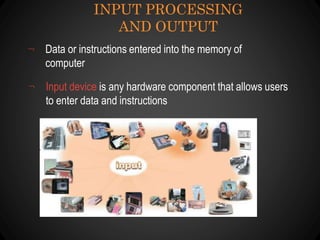
Data or instructions entered into the memory of
computer
Input device is any hardware component that allows users
to enter data and instructions

INPUT PROCESSING
AND OUTPUT
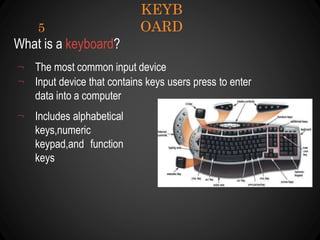
What is a keyboard?


The most common input device
Input device that contains keys users press to enter
data into a computer
Includes alphabetical
keys,numeric
keypad,and function
keys

KEYB
OARD
5
THE KEYBOARD -
STANDARD KEYBOARD
LAYOUT
 A standard computer keyboard has about 100 keys.
Most keyboards use the QWERTY layout, named for the
first
six keys in the top row of letters.
KEYBOARD
DATA ENTRY
7
• suitable for a wide range of applications
– entering programs
– typing all kinds of documents using a word processor
– entering personal details of customers or patients at a
hospital, etc.
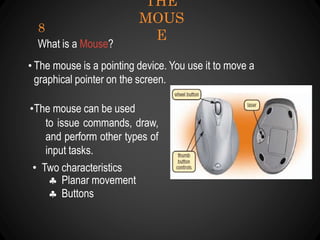
THE
MOUS
E
8
What is a Mouse?
• The mouse is a pointing device. You use it to move a
graphical pointer on the screen.
•The mouse can be used
to issue commands, draw,
and perform other types of
input tasks.
• Two characteristics
 Planar movement
 Buttons
THE MOUSE - MOUSE
TECHNIQUES
Using the mouse involves five techniques:
1.Pointing: Move the mouse to move the on-screen pointer.
2.Clicking: Press and release the left mouse button once.
3.Double-clicking: Press and release the left mouse button twice.
4.Dragging: Hold down the left mouse button as you move the
pointer.
5.Right-clicking: Press and release the right mouse button.
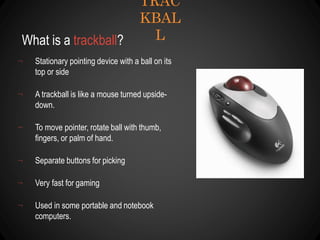
What is a trackball?
 Stationary pointing device with a ball on its
top or side
 A trackball is like a mouse turned upside-
down.
 To move pointer, rotate ball with thumb,
fingers, or palm of hand.
 Separate buttons for picking
 Very fast for gaming
 Used in some portable and notebook
computers.
TRAC
KBAL
L
•
•
•
Small touch sensitive tablets
‘Stroke’ to move mouse pointer
Used mainly in laptop computers
• Good ‘acceleration’ settings important
– fast stroke
• lots of pixels per inch moved
• initial movement to the target
– slow stroke
• less pixels per inch
• for accurate positioning
TOUCHPAD
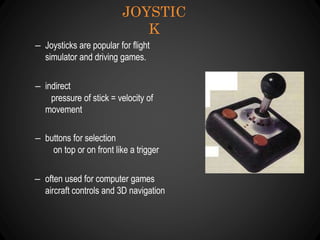
– Joysticks are popular for flight
simulator and driving games.
– indirect
pressure of stick = velocity of
movement
– buttons for selection
on top or on front like a trigger
– often used for computer games
aircraft controls and 3D navigation
JOYSTIC
K
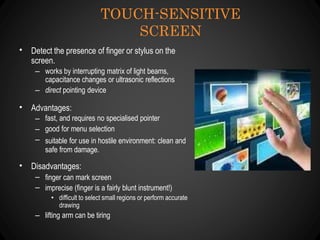
• Detect the presence of finger or stylus on the
screen.
– works by interrupting matrix of light beams,
capacitance changes or ultrasonic reflections
– direct pointing device
• Advantages:
–
–
–
fast, and requires no specialised pointer
good for menu selection
suitable for use in hostile environment: clean and
safe from damage.
• Disadvantages:
–
–
finger can mark screen
imprecise (finger is a fairly blunt instrument!)
• difficult to select small regions or perform accurate
drawing
lifting arm can be tiring
–
TOUCH-SENSITIVE
SCREEN
SCANNERS
•
Converts a document into a series of pixels (picture elements –
these are small squares that, when put together, form a picture).
•
The larger the number of pixels, or conversely the smaller each
individual pixel, the better the definition of the final picture.
SCANNERS
• Take paper and convert it into a bitmap
• Two sorts of scanner
– flat-bed: paper placed on a glass plate, whole page converted into
bitmap
– hand-held: scanner passed over paper, digitising strip typically 3-
4” wide
• Shines light at paper and note intensity of reflection
– colour or greyscale
• Typical resolutions from 600–2400 dpi
SCANNERS
Used in
– desktop publishing for incorporating photographs and
other images
– document storage and retrieval systems, doing away
with paper storage
+ special scanners for slides and photographic negatives
A technology that allows an input device (e.g.
imaging scanner) to read hand-drawn marks
such as small circles or rectangles on
specially designed paper.
• Can recognise the presence of a mark on a
sheet of paper by light reflection.
• The position of the mark conveys information
to the machine.
• Printing is done using a special type of ink
which the optical scanner does not see.
OMR (OPTICAL MARK
READER)
• Advantage:
– It is fast, using minimum processing power to process forms
– Costs are predictable and defined
– OMR capture speeds range around 4000 forms per hr
Disadvantage:
– Cannot read paper if folded or dirty.
– Restricted to multi choice questions.
– OMR cannot recognize hand-printed or machine-printed characters.
– With OMR, images of forms are not captured by scanners so electronic
retrieval is not possible.
– Tick boxes may not be suitable for all types of questions
•
OMR
• a system that provides a full alphanumeric recognition of printed or
handwritten characters at electronic speed by simply scanning the form.
• Intelligent Character Recognition (ICR) is used to describe the process of
interpreting image data, in particular alphanumeric text.
• Sometimes OCR is known as ICR
OCR
MICR
• MICR has several advantages for processing
cheques:
– It is hard to forge the characters
– The characters can be read even if the cheque is
crumpled, dirty or smudged
– The characters are readable by humans, unlike bar
codes
BAR CODE READERS
• Bar code readers can read bar codes—patterns of printed bars.
• The reader emits light, which reflects off the bar code and into a
detector in the reader. The detector translates the code into
numbers.
• Flatbed bar code readers are commonly found in supermarkets.
Courier services often use handheld readers.
OTHER USES OF
BAR CODES
• Warehousing
– bar coded containers of raw materials are stored in
racks of bins which are also bar coded.
• Transport and distribution
– individual packages are bar coded
• Manufacturing
– work in progress tracked using bar codes
MORE USES OF BAR
CODES
• Marketing
– bar coded multiple choice questionnaires
• Medical
– bar codes used to identify blood and other samples
• Libraries
– used to record loans and track stock
• Banking, insurance and local government
– for document control and retrieval.
VOICE DATA ENTRY
• The user speaks the text into a microphone
• Special software interprets the text and displays it on a screen
• Text may be edited using the keyboard and exported to a word
processing package such as Word.
• The accuracy of the voice recognition system is improved by ‘training’
it to a particular user’s voice

Input, processing and output (week 2).pptx

  • 1.
    ICT WEEK: 2 DATE CLASS: Year3 SUBJECT: ICT LESSON TOPIC: INPUT,PROCESSING AND OUT SUB TOPIC: INPUT,FUCTIONS PERIOD: 2
  • 2.
    DURATION: 40 Mins RESOURCES& MATERIALS: computer system, internet, Wabp, Communication Technology BUILDING BACKGROUND/CONNECTION TO PRIOR KNOWLEDGE: Pupils have been introduced to Input device in their previous class
  • 3.
    BOJECTIVES • At theend of the lesson, pupils should be able to; (a)Define input, processing and output (b)State the examples of input, output and processing device (c)Identify and explain each of the devices
  • 4.
     Data or instructionsentered into the memory of computer Input device is any hardware component that allows users to enter data and instructions  INPUT PROCESSING AND OUTPUT
  • 5.
    What is akeyboard?   The most common input device Input device that contains keys users press to enter data into a computer Includes alphabetical keys,numeric keypad,and function keys  KEYB OARD 5
  • 6.
    THE KEYBOARD - STANDARDKEYBOARD LAYOUT  A standard computer keyboard has about 100 keys. Most keyboards use the QWERTY layout, named for the first six keys in the top row of letters.
  • 7.
    KEYBOARD DATA ENTRY 7 • suitablefor a wide range of applications – entering programs – typing all kinds of documents using a word processor – entering personal details of customers or patients at a hospital, etc.
  • 8.
    THE MOUS E 8 What is aMouse? • The mouse is a pointing device. You use it to move a graphical pointer on the screen. •The mouse can be used to issue commands, draw, and perform other types of input tasks. • Two characteristics  Planar movement  Buttons
  • 9.
    THE MOUSE -MOUSE TECHNIQUES Using the mouse involves five techniques: 1.Pointing: Move the mouse to move the on-screen pointer. 2.Clicking: Press and release the left mouse button once. 3.Double-clicking: Press and release the left mouse button twice. 4.Dragging: Hold down the left mouse button as you move the pointer. 5.Right-clicking: Press and release the right mouse button.
  • 10.
    What is atrackball?  Stationary pointing device with a ball on its top or side  A trackball is like a mouse turned upside- down.  To move pointer, rotate ball with thumb, fingers, or palm of hand.  Separate buttons for picking  Very fast for gaming  Used in some portable and notebook computers. TRAC KBAL L
  • 11.
    • • • Small touch sensitivetablets ‘Stroke’ to move mouse pointer Used mainly in laptop computers • Good ‘acceleration’ settings important – fast stroke • lots of pixels per inch moved • initial movement to the target – slow stroke • less pixels per inch • for accurate positioning TOUCHPAD
  • 12.
    – Joysticks arepopular for flight simulator and driving games. – indirect pressure of stick = velocity of movement – buttons for selection on top or on front like a trigger – often used for computer games aircraft controls and 3D navigation JOYSTIC K
  • 13.
    • Detect thepresence of finger or stylus on the screen. – works by interrupting matrix of light beams, capacitance changes or ultrasonic reflections – direct pointing device • Advantages: – – – fast, and requires no specialised pointer good for menu selection suitable for use in hostile environment: clean and safe from damage. • Disadvantages: – – finger can mark screen imprecise (finger is a fairly blunt instrument!) • difficult to select small regions or perform accurate drawing lifting arm can be tiring – TOUCH-SENSITIVE SCREEN
  • 14.
    SCANNERS • Converts a documentinto a series of pixels (picture elements – these are small squares that, when put together, form a picture). • The larger the number of pixels, or conversely the smaller each individual pixel, the better the definition of the final picture.
  • 15.
    SCANNERS • Take paperand convert it into a bitmap • Two sorts of scanner – flat-bed: paper placed on a glass plate, whole page converted into bitmap – hand-held: scanner passed over paper, digitising strip typically 3- 4” wide • Shines light at paper and note intensity of reflection – colour or greyscale • Typical resolutions from 600–2400 dpi
  • 16.
    SCANNERS Used in – desktoppublishing for incorporating photographs and other images – document storage and retrieval systems, doing away with paper storage + special scanners for slides and photographic negatives
  • 17.
    A technology thatallows an input device (e.g. imaging scanner) to read hand-drawn marks such as small circles or rectangles on specially designed paper. • Can recognise the presence of a mark on a sheet of paper by light reflection. • The position of the mark conveys information to the machine. • Printing is done using a special type of ink which the optical scanner does not see. OMR (OPTICAL MARK READER)
  • 18.
    • Advantage: – Itis fast, using minimum processing power to process forms – Costs are predictable and defined – OMR capture speeds range around 4000 forms per hr Disadvantage: – Cannot read paper if folded or dirty. – Restricted to multi choice questions. – OMR cannot recognize hand-printed or machine-printed characters. – With OMR, images of forms are not captured by scanners so electronic retrieval is not possible. – Tick boxes may not be suitable for all types of questions • OMR
  • 19.
    • a systemthat provides a full alphanumeric recognition of printed or handwritten characters at electronic speed by simply scanning the form. • Intelligent Character Recognition (ICR) is used to describe the process of interpreting image data, in particular alphanumeric text. • Sometimes OCR is known as ICR OCR
  • 20.
    MICR • MICR hasseveral advantages for processing cheques: – It is hard to forge the characters – The characters can be read even if the cheque is crumpled, dirty or smudged – The characters are readable by humans, unlike bar codes
  • 21.
    BAR CODE READERS •Bar code readers can read bar codes—patterns of printed bars. • The reader emits light, which reflects off the bar code and into a detector in the reader. The detector translates the code into numbers. • Flatbed bar code readers are commonly found in supermarkets. Courier services often use handheld readers.
  • 22.
    OTHER USES OF BARCODES • Warehousing – bar coded containers of raw materials are stored in racks of bins which are also bar coded. • Transport and distribution – individual packages are bar coded • Manufacturing – work in progress tracked using bar codes
  • 23.
    MORE USES OFBAR CODES • Marketing – bar coded multiple choice questionnaires • Medical – bar codes used to identify blood and other samples • Libraries – used to record loans and track stock • Banking, insurance and local government – for document control and retrieval.
  • 24.
    VOICE DATA ENTRY •The user speaks the text into a microphone • Special software interprets the text and displays it on a screen • Text may be edited using the keyboard and exported to a word processing package such as Word. • The accuracy of the voice recognition system is improved by ‘training’ it to a particular user’s voice