1)
2)

#
#

Ancient Greek Interior
#
Design & Furniture
#
3) #

Group Presentation

Omaima Salih Alansari
ID# 211410XXX

Reema Almoshigah
ID# 211410XXX

Nourah Al-ashaikh
ID# 211410XXX

ID222, History of Furniture
Sec: 73
HOUSES


IN ANCIENT GREECE

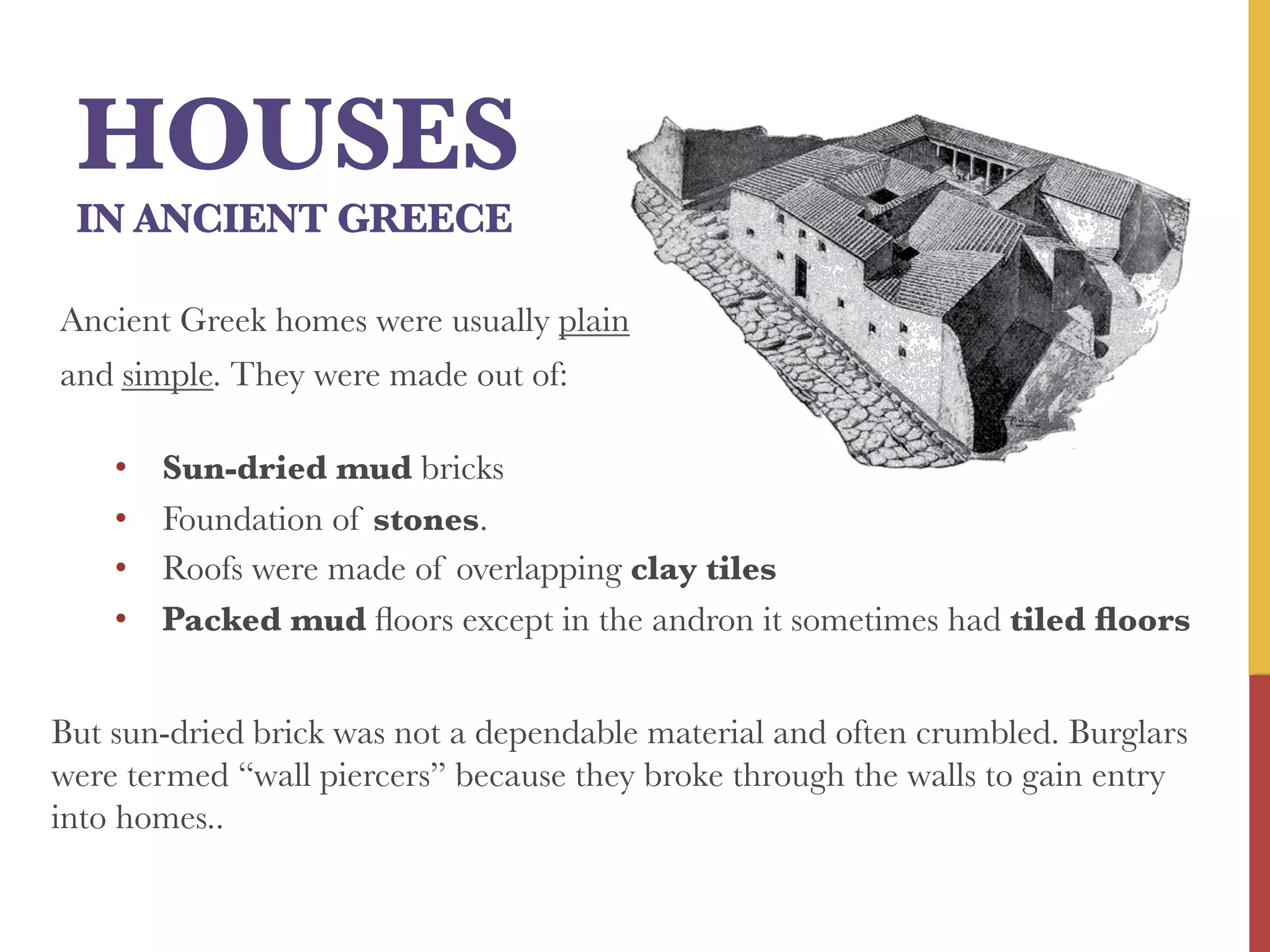
Ancient Greek homes were usually plain
and simple. They were made out of:


• 
• 
• 
• 

Sun-dried mud bricks
Foundation of stones.
Roofs were made of overlapping clay tiles
Packed mud floors except in the andron it sometimes had tiled floors

But sun-dried brick was not a dependable material and often crumbled. Burglars
were termed “wall piercers” because they broke through the walls to gain entry
into homes..
HOUSES


IN ANCIENT GREECE

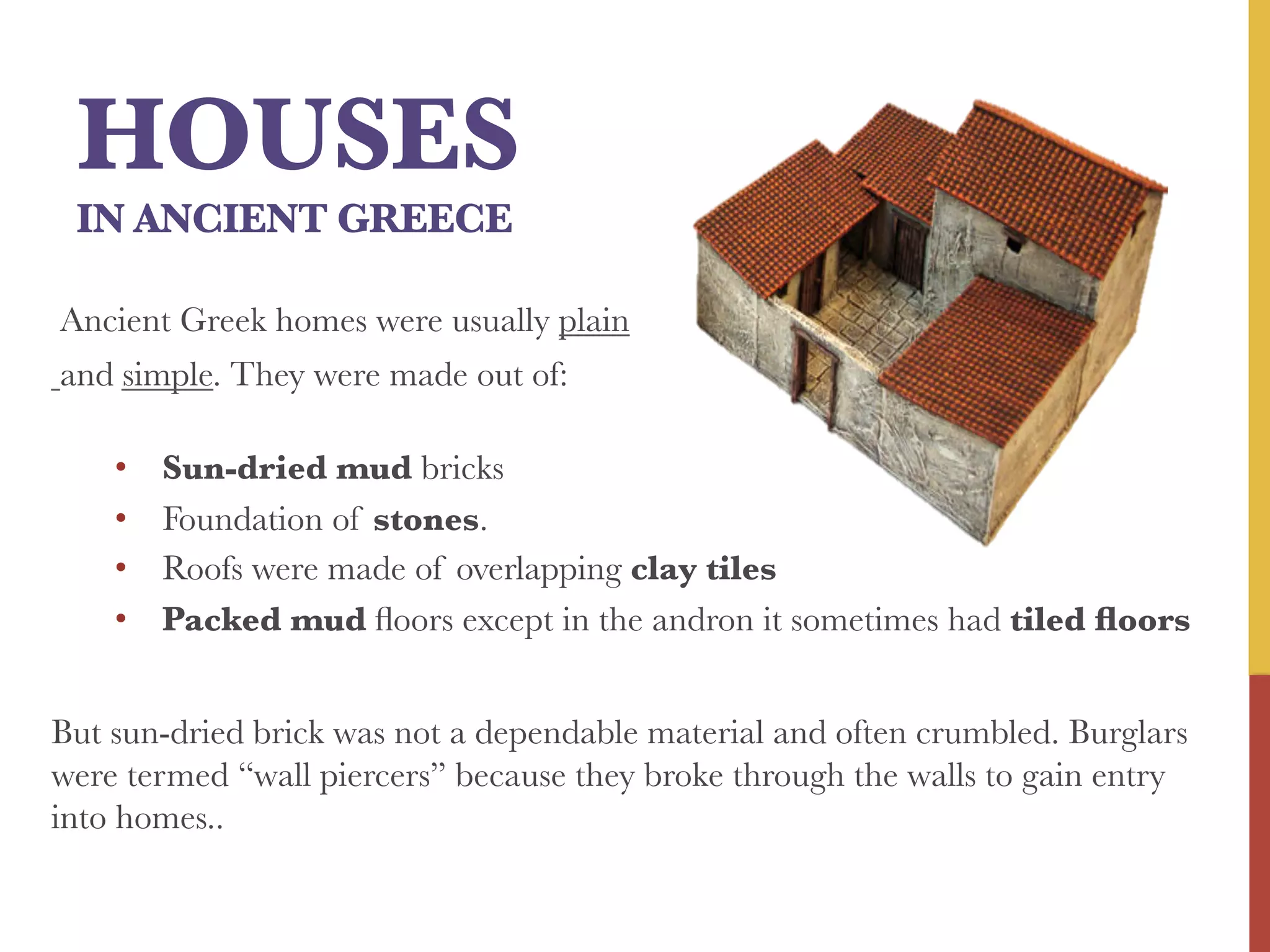
Ancient Greek homes were usually plain
and simple. They were made out of:


• 
• 
• 
• 

Sun-dried mud bricks
Foundation of stones.
Roofs were made of overlapping clay tiles
Packed mud floors except in the andron it sometimes had tiled floors

But sun-dried brick was not a dependable material and often crumbled. Burglars
were termed “wall piercers” because they broke through the walls to gain entry
into homes..
INTERIOR SPACES


IN ANCIENT GREEK HOUSES
INTERIOR SPACES


IN ANCIENT GREEK HOUSES

• 

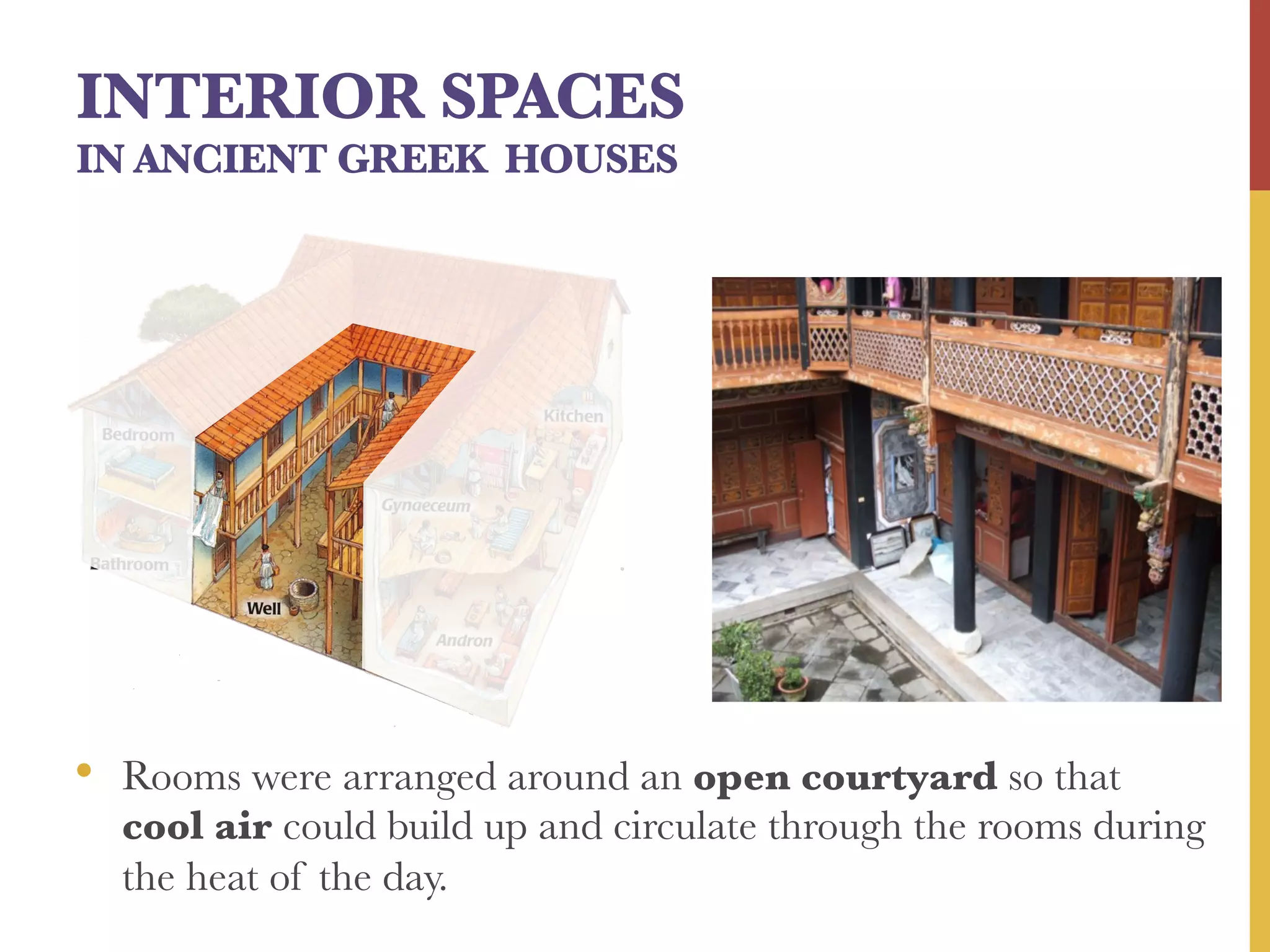
Rooms were arranged around an open courtyard so that
cool air could build up and circulate through the rooms during
the heat of the day.
INTERIOR SPACES


IN ANCIENT GREEK HOUSES

• 

There were bathrooms consisted of a chamber pot, but no
toilets, so people used a back alley or a communal toilet
outdoors.
INTERIOR SPACES


IN ANCIENT GREEK HOUSES

• 

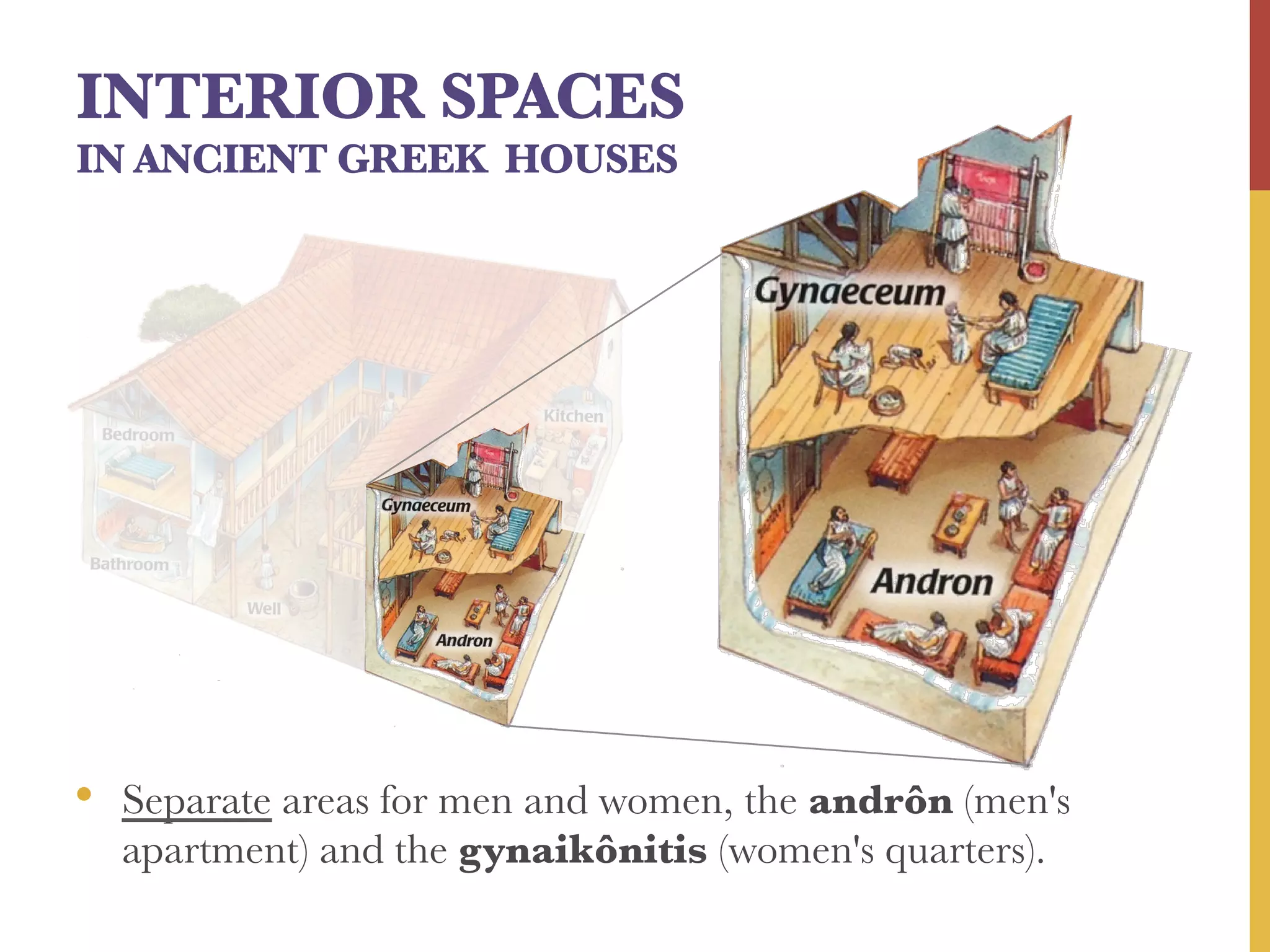
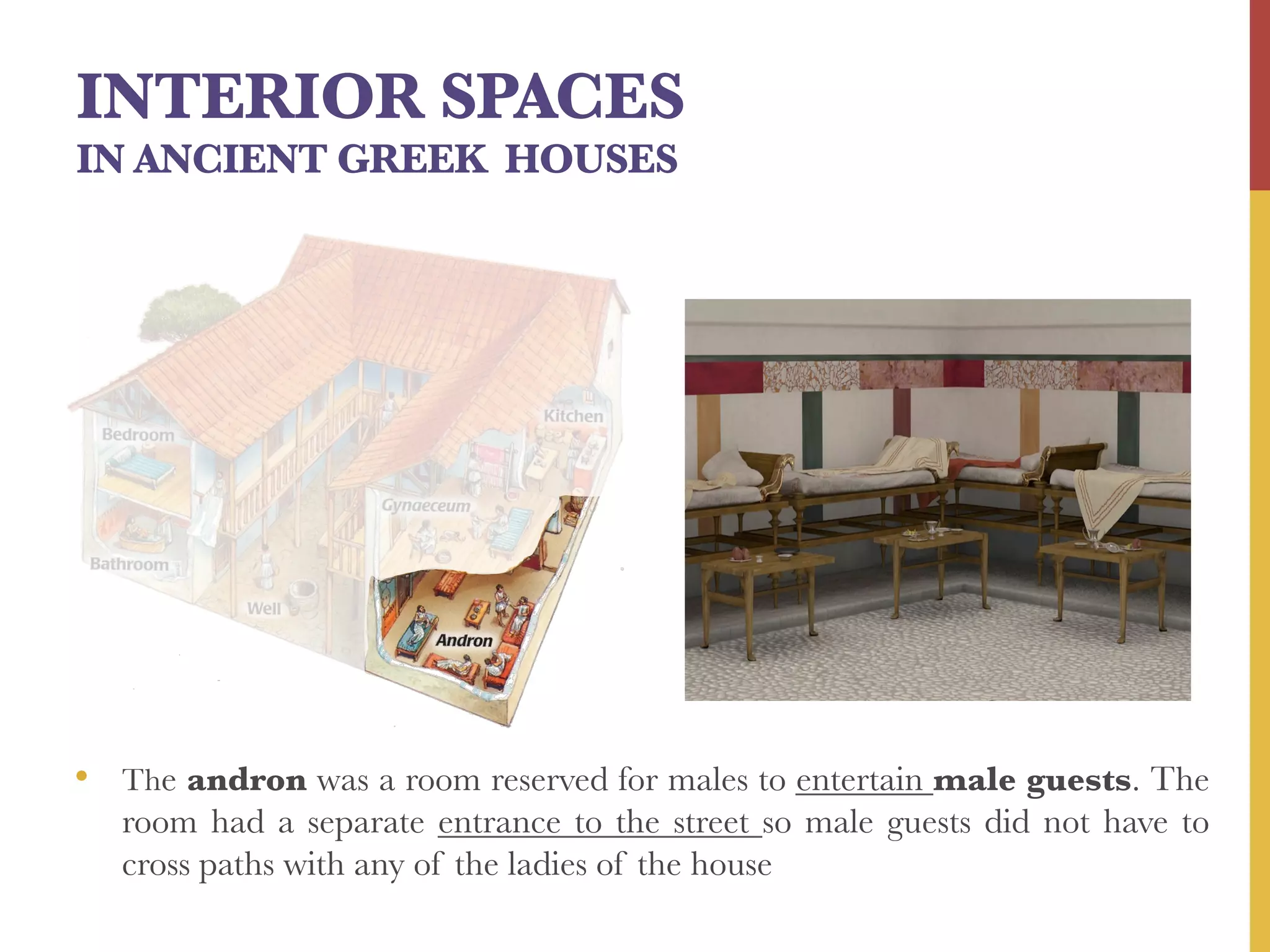
Separate areas for men and women, the andrôn (men's
apartment) and the gynaikônitis (women's quarters).
INTERIOR SPACES


IN ANCIENT GREEK HOUSES

• 

The andron was a room reserved for males to entertain male guests. The

room had a separate entrance to the street so male guests did not have to
cross paths with any of the ladies of the house
INTERIOR SPACES


IN ANCIENT GREEK HOUSES

• 

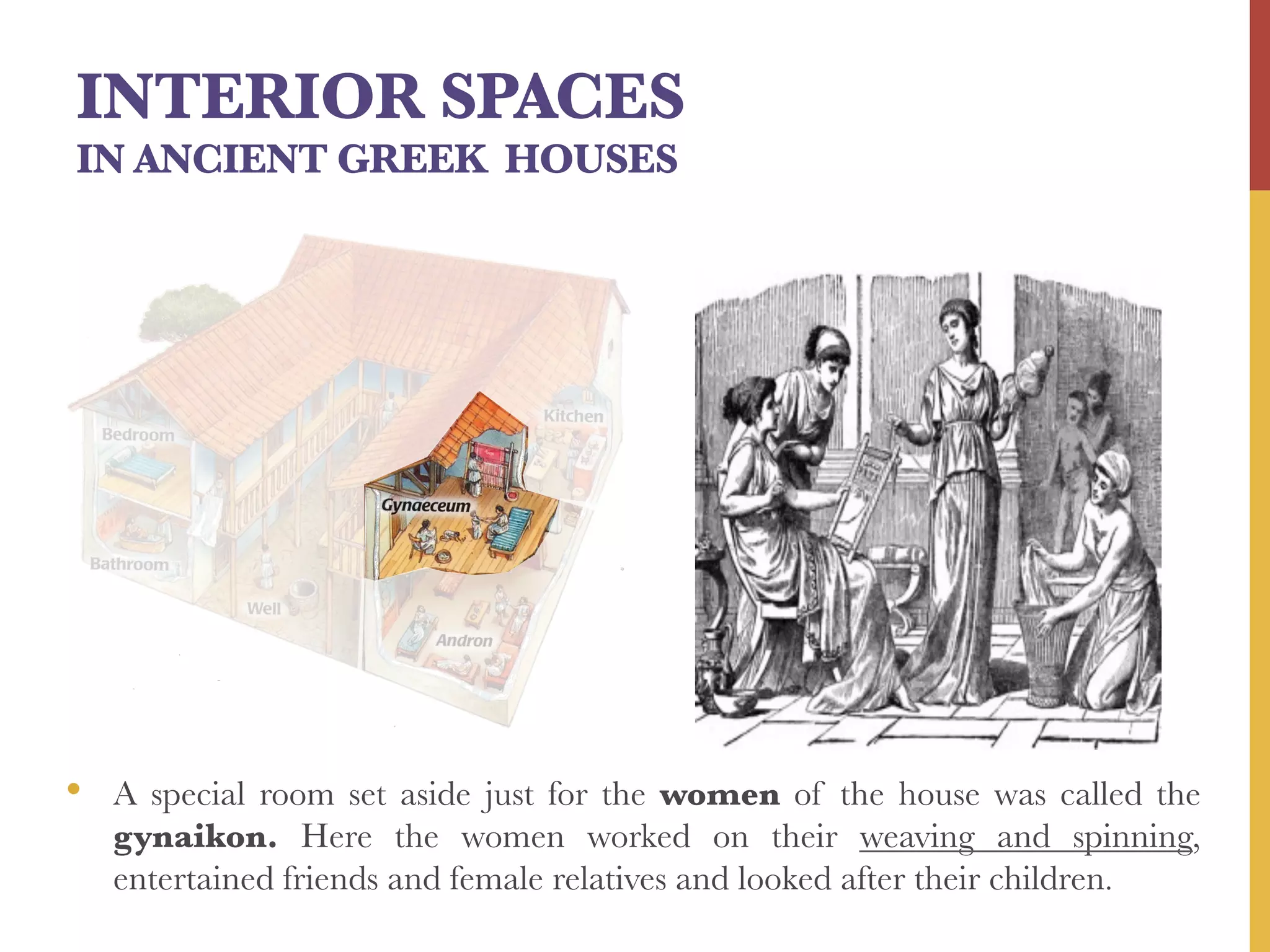
A special room set aside just for the women of the house was called the
gynaikon. Here the women worked on their weaving and spinning,
entertained friends and female relatives and looked after their children.
INTERIOR SPACES


IN ANCIENT GREEK HOUSES

• 

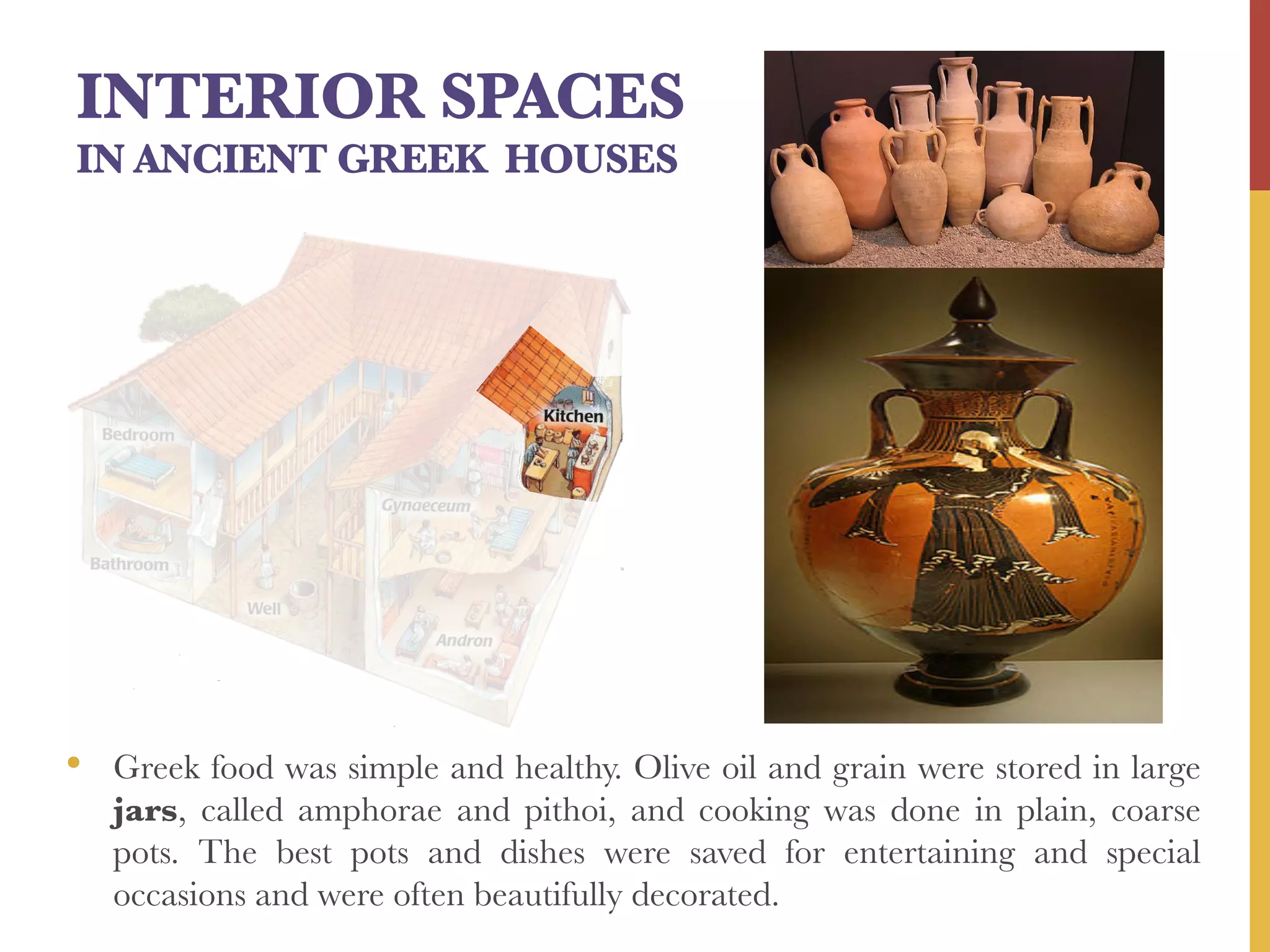
Greek food was simple and healthy. Olive oil and grain were stored in large
jars, called amphorae and pithoi, and cooking was done in plain, coarse
pots. The best pots and dishes were saved for entertaining and special
occasions and were often beautifully decorated.
INTERIOR SPACES


IN ANCIENT GREEK HOUSES

• 

The bedrooms of the family were simply furnished. Beds were similar to the
couches used in the men's dining room. Wooden chests were used to
store clothing and other items.
FURNITURE

IN ANCIENT GREEK HOUSES

Video:
http://www.youtube.com/watch?
feature=player_detailpage&v=ApohqxsWKI#t=79

• 

Greeks was influenced by the Egyptians, that copied their furniture style.

• 

Greek furniture emphasis the comfort, its soft, rounded, has mare curves and 
adequate the human body requirements more than the Egyptian furniture.
FURNITURE

IN ANCIENT GREEK HOUSES

Greek Furniture was typically constructed out of
wood. Though it might also be made of stone
or metal, such as bronze, iron, gold and silver
There is 5 main types of furniture and little else: 

•  Stools
•  Couches
•  Chests
•  Small tables
•  Chairs
STOOLS
Ancient Greek furniture

Two main styles of stools of ancient
Greece have survived through reliefs:


1.  Bathron: looks more like what
would today be considered to be
a small table. The typical stool
consisted of a flat top and four
straight legs. There Was No Back
Support And The Bottom Was
Hard And Uncompromising.
STOOLS
Ancient Greek furniture

Two main styles of stools of ancient
Greece have survived through reliefs:


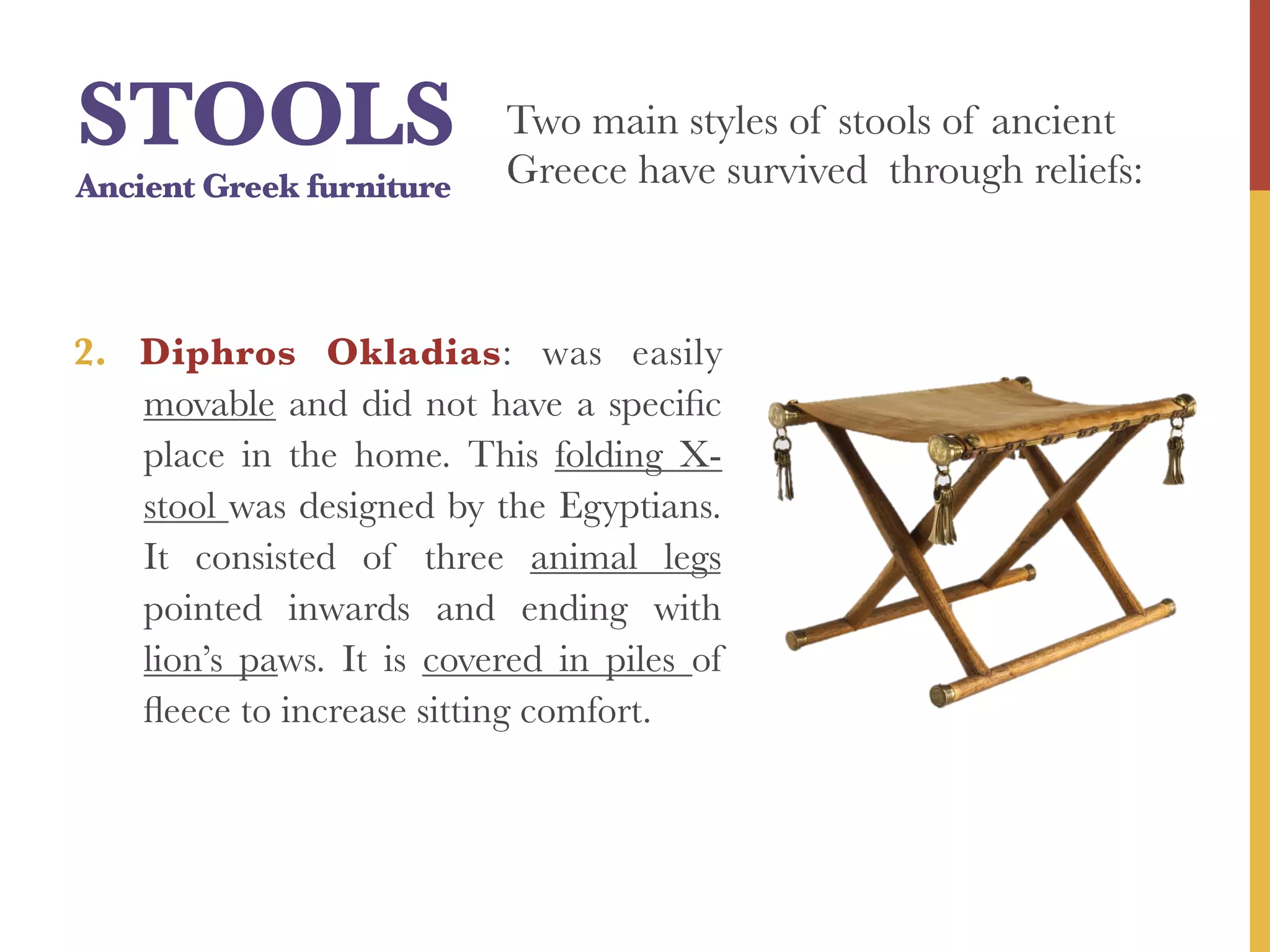
2.  Diphros Okladias: was easily
movable and did not have a specific
place in the home. This folding Xstool was designed by the Egyptians.
It consisted of three animal legs
pointed inwards and ending with
lion’s paws. It is covered in piles of
fleece to increase sitting comfort.
STOOLS
Ancient Greek furniture

Two main styles of stools of ancient
Greece have survived through reliefs:


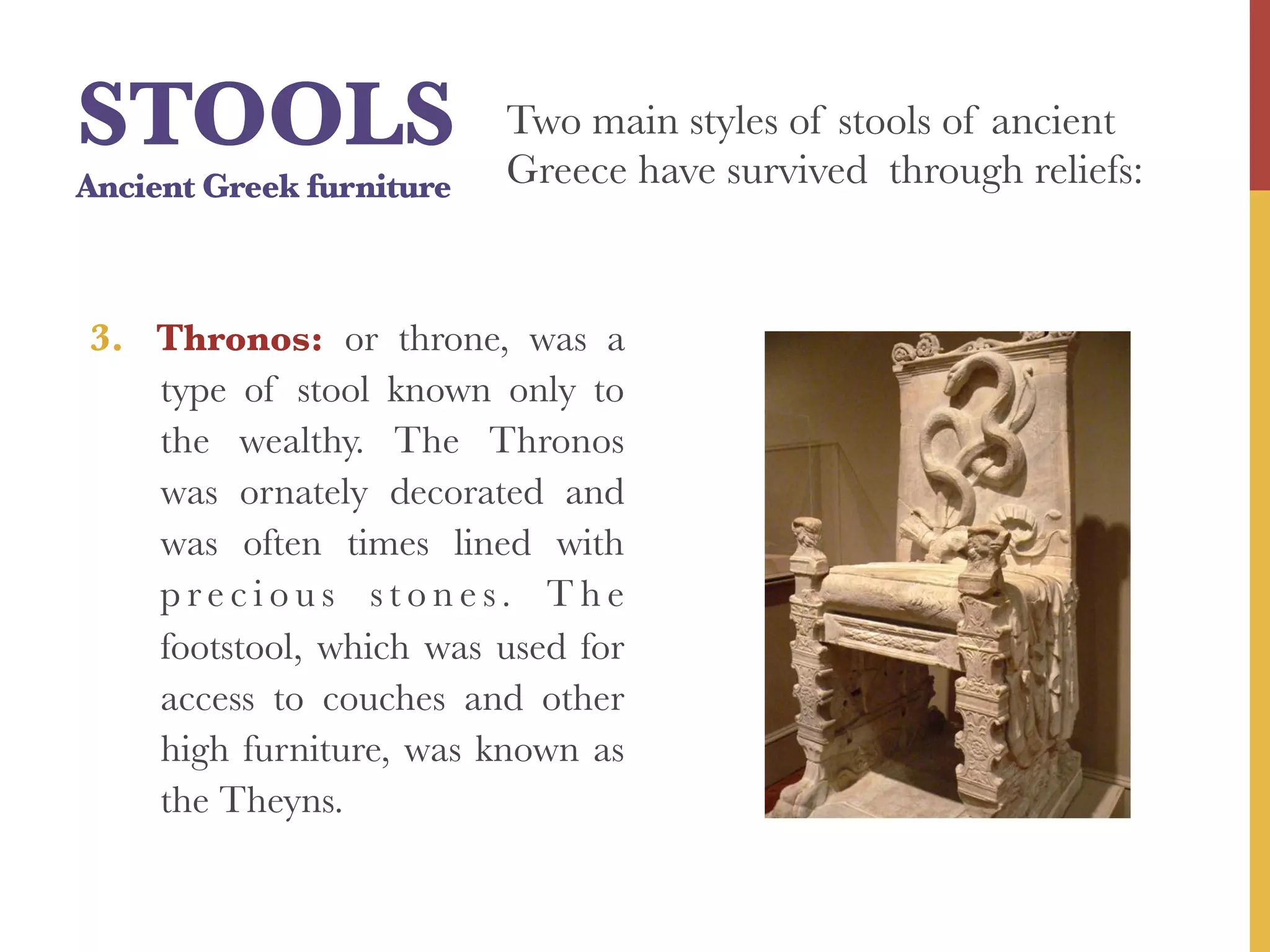
3.  Thronos: or throne, was a
type of stool known only to
the wealthy. The Thronos
was ornately decorated and
was often times lined with
precious stones. The
footstool, which was used for
access to couches and other
high furniture, was known as
the Theyns.
COUCHES
Ancient Greek furniture


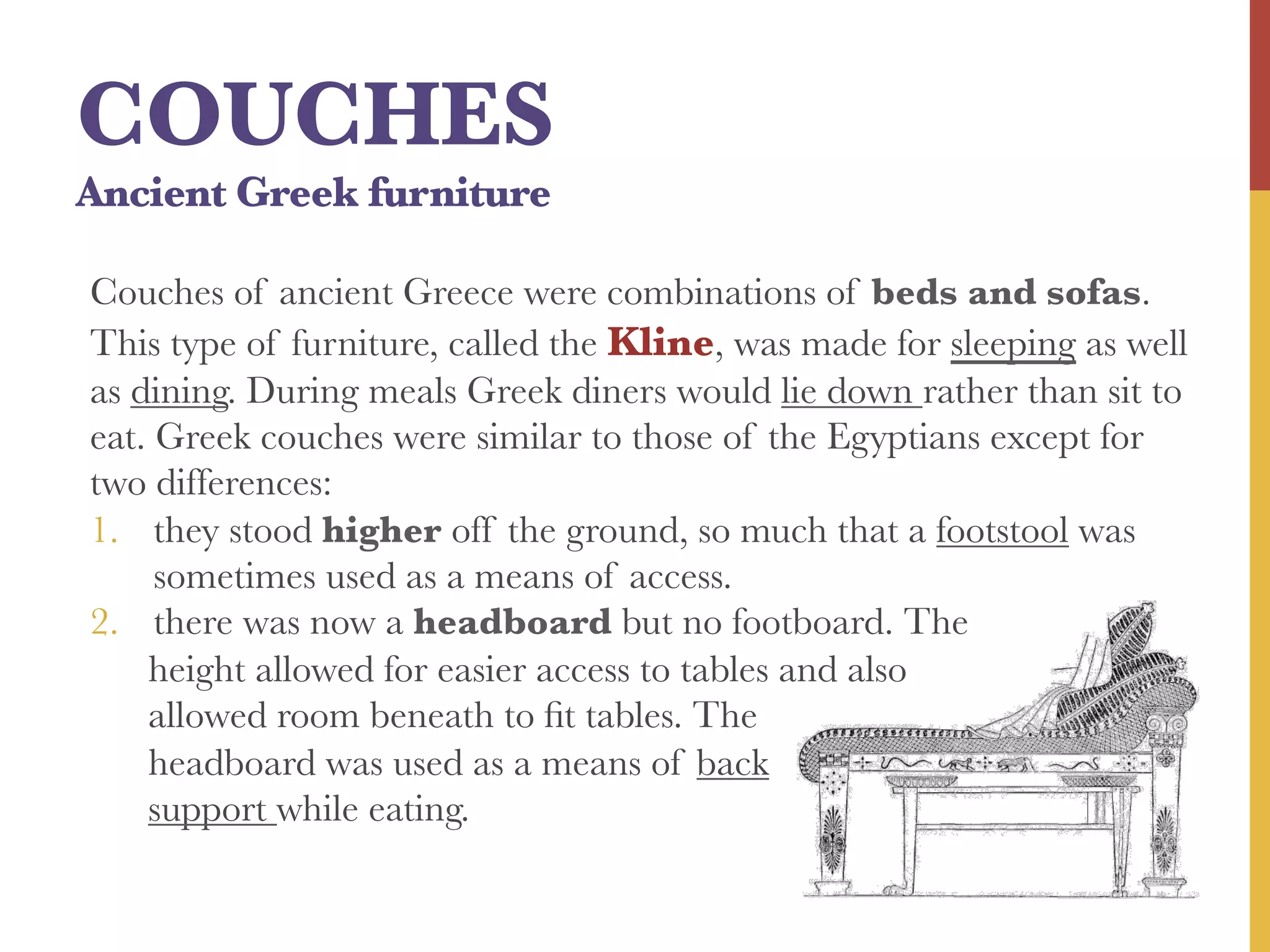
Couches of ancient Greece were combinations of beds and sofas.
This type of furniture, called the Kline, was made for sleeping as well
as dining. During meals Greek diners would lie down rather than sit to
eat. Greek couches were similar to those of the Egyptians except for
two differences:
1.  they stood higher off the ground, so much that a footstool was
sometimes used as a means of access.
2.  there was now a headboard but no footboard. The
height allowed for easier access to tables and also
allowed room beneath to fit tables. The
headboard was used as a means of back
support while eating.
TABLES
Ancient Greek furniture

• 

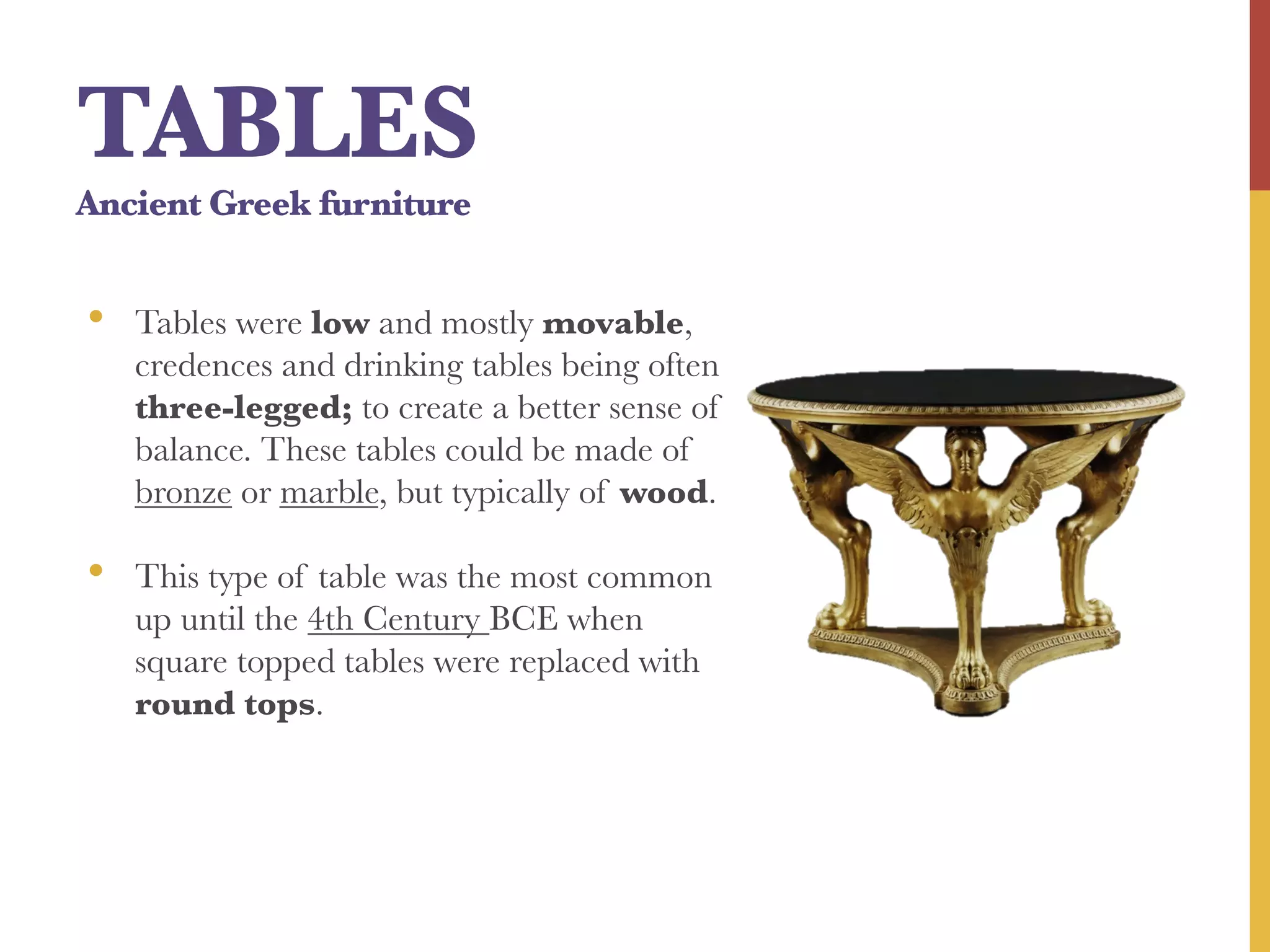
Tables were low and mostly movable,
credences and drinking tables being often
three-legged; to create a better sense of
balance. These tables could be made of
bronze or marble, but typically of wood.


• 

This type of table was the most common
up until the 4th Century BCE when
square topped tables were replaced with
round tops.
CHESTS
Ancient Greek furniture

• 

Chests were the only means for
storing clothing because
shelves were generally not used
for that purpose. Jewelry,
coverings, and fruits
(predominantly quince) were
hidden alongside the clothing for
protection. Chests were also
often valued enough to be part
of a wife's dowry.
CHAIRS
Ancient Greek furniture

• 

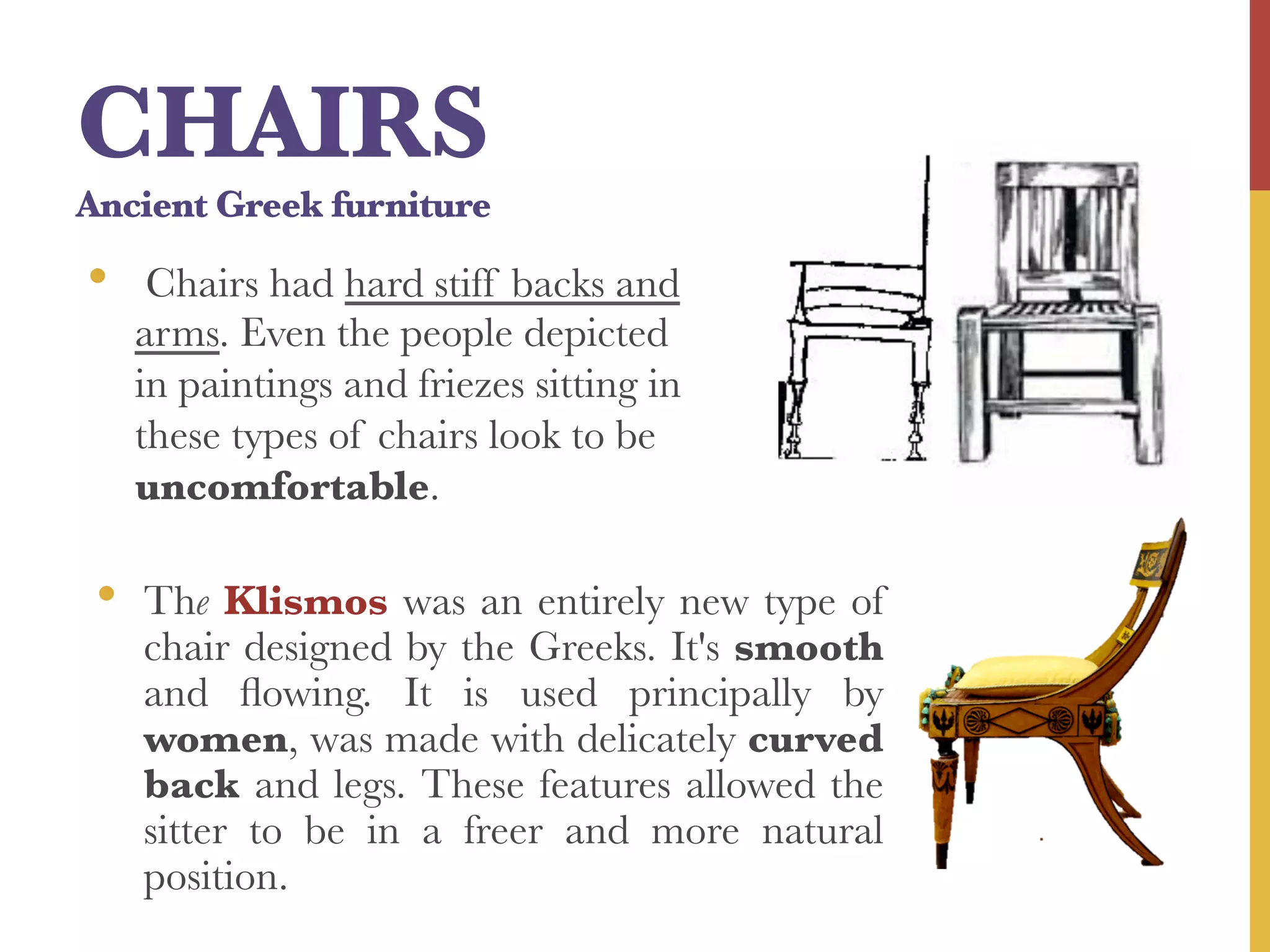
Chairs had hard stiff backs and
arms. Even the people depicted
in paintings and friezes sitting in
these types of chairs look to be
uncomfortable.

• 

The Klismos was an entirely new type of
chair designed by the Greeks. It's smooth
and flowing. It is used principally by
women, was made with delicately curved
back and legs. These features allowed the
sitter to be in a freer and more natural
position.
⎨THANK YOU

Ancient Greece Interior Design & Furniture

  • 1.
    1) 2) # # Ancient Greek Interior # Design& Furniture # 3) # Group Presentation Omaima Salih Alansari ID# 211410XXX Reema Almoshigah ID# 211410XXX Nourah Al-ashaikh ID# 211410XXX ID222, History of Furniture Sec: 73
  • 2.
    HOUSES IN ANCIENT GREECE AncientGreek homes were usually plain and simple. They were made out of: •  •  •  •  Sun-dried mud bricks Foundation of stones. Roofs were made of overlapping clay tiles Packed mud floors except in the andron it sometimes had tiled floors But sun-dried brick was not a dependable material and often crumbled. Burglars were termed “wall piercers” because they broke through the walls to gain entry into homes..
  • 3.
    HOUSES IN ANCIENT GREECE AncientGreek homes were usually plain and simple. They were made out of: •  •  •  •  Sun-dried mud bricks Foundation of stones. Roofs were made of overlapping clay tiles Packed mud floors except in the andron it sometimes had tiled floors But sun-dried brick was not a dependable material and often crumbled. Burglars were termed “wall piercers” because they broke through the walls to gain entry into homes..
  • 4.
  • 5.
    INTERIOR SPACES IN ANCIENTGREEK HOUSES •  Rooms were arranged around an open courtyard so that cool air could build up and circulate through the rooms during the heat of the day.
  • 6.
    INTERIOR SPACES IN ANCIENTGREEK HOUSES •  There were bathrooms consisted of a chamber pot, but no toilets, so people used a back alley or a communal toilet outdoors.
  • 7.
    INTERIOR SPACES IN ANCIENTGREEK HOUSES •  Separate areas for men and women, the andrôn (men's apartment) and the gynaikônitis (women's quarters).
  • 8.
    INTERIOR SPACES IN ANCIENTGREEK HOUSES •  The andron was a room reserved for males to entertain male guests. The room had a separate entrance to the street so male guests did not have to cross paths with any of the ladies of the house
  • 9.
    INTERIOR SPACES IN ANCIENTGREEK HOUSES •  A special room set aside just for the women of the house was called the gynaikon. Here the women worked on their weaving and spinning, entertained friends and female relatives and looked after their children.
  • 10.
    INTERIOR SPACES IN ANCIENTGREEK HOUSES •  Greek food was simple and healthy. Olive oil and grain were stored in large jars, called amphorae and pithoi, and cooking was done in plain, coarse pots. The best pots and dishes were saved for entertaining and special occasions and were often beautifully decorated.
  • 11.
    INTERIOR SPACES IN ANCIENTGREEK HOUSES •  The bedrooms of the family were simply furnished. Beds were similar to the couches used in the men's dining room. Wooden chests were used to store clothing and other items.
  • 12.
    FURNITURE IN ANCIENT GREEKHOUSES Video: http://www.youtube.com/watch? feature=player_detailpage&v=ApohqxsWKI#t=79 •  Greeks was influenced by the Egyptians, that copied their furniture style. •  Greek furniture emphasis the comfort, its soft, rounded, has mare curves and adequate the human body requirements more than the Egyptian furniture.
  • 13.
    FURNITURE IN ANCIENT GREEKHOUSES Greek Furniture was typically constructed out of wood. Though it might also be made of stone or metal, such as bronze, iron, gold and silver There is 5 main types of furniture and little else: •  Stools •  Couches •  Chests •  Small tables •  Chairs
  • 14.
    STOOLS Ancient Greek furniture Twomain styles of stools of ancient Greece have survived through reliefs: 1.  Bathron: looks more like what would today be considered to be a small table. The typical stool consisted of a flat top and four straight legs. There Was No Back Support And The Bottom Was Hard And Uncompromising.
  • 15.
    STOOLS Ancient Greek furniture Twomain styles of stools of ancient Greece have survived through reliefs: 2.  Diphros Okladias: was easily movable and did not have a specific place in the home. This folding Xstool was designed by the Egyptians. It consisted of three animal legs pointed inwards and ending with lion’s paws. It is covered in piles of fleece to increase sitting comfort.
  • 16.
    STOOLS Ancient Greek furniture Twomain styles of stools of ancient Greece have survived through reliefs: 3.  Thronos: or throne, was a type of stool known only to the wealthy. The Thronos was ornately decorated and was often times lined with precious stones. The footstool, which was used for access to couches and other high furniture, was known as the Theyns.
  • 17.
    COUCHES Ancient Greek furniture Couchesof ancient Greece were combinations of beds and sofas. This type of furniture, called the Kline, was made for sleeping as well as dining. During meals Greek diners would lie down rather than sit to eat. Greek couches were similar to those of the Egyptians except for two differences: 1.  they stood higher off the ground, so much that a footstool was sometimes used as a means of access. 2.  there was now a headboard but no footboard. The height allowed for easier access to tables and also allowed room beneath to fit tables. The headboard was used as a means of back support while eating.
  • 18.
    TABLES Ancient Greek furniture •  Tableswere low and mostly movable, credences and drinking tables being often three-legged; to create a better sense of balance. These tables could be made of bronze or marble, but typically of wood. •  This type of table was the most common up until the 4th Century BCE when square topped tables were replaced with round tops.
  • 19.
    CHESTS Ancient Greek furniture •  Chestswere the only means for storing clothing because shelves were generally not used for that purpose. Jewelry, coverings, and fruits (predominantly quince) were hidden alongside the clothing for protection. Chests were also often valued enough to be part of a wife's dowry.
  • 20.
    CHAIRS Ancient Greek furniture •  Chairshad hard stiff backs and arms. Even the people depicted in paintings and friezes sitting in these types of chairs look to be uncomfortable. •  The Klismos was an entirely new type of chair designed by the Greeks. It's smooth and flowing. It is used principally by women, was made with delicately curved back and legs. These features allowed the sitter to be in a freer and more natural position.
  • 21.