Welcome To The Darkness
A Cinematic Perspective
Technology & the Darkness :
The Emergence of the Creative Class
Welcome to the Darkness
A Cinematic Perspective
Technology & the Darkness :
The Emergence of the Creative Class
Grunberg, C 1997, Gothic - Transmutations of Horror in Late 21st Century Art in
The Gothic, (p38-44)
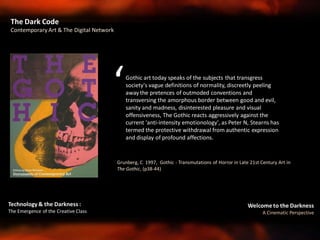
Gothic art today speaks of the subjects that transgress
society's vague definitions of normality, discreetly peeling
away the pretences of outmoded conventions and
transversing the amorphous border between good and evil,
sanity and madness, disinterested pleasure and visual
offensiveness, The Gothic reacts aggressively against the
current 'anti-intensity emotionology', as Peter N, Stearns has
termed the protective withdrawal from authentic expression
and display of profound affections.
‘
The Dark Code
Contemporary Art & The Digital Network
Welcome to the Darkness
A Cinematic Perspective
Technology & the Darkness :
The Emergence of the Creative Class
Grunberg, C 1997, Gothic - Transmutations of Horror in Late 21st Century Art in
The Gothic, (p38-44)
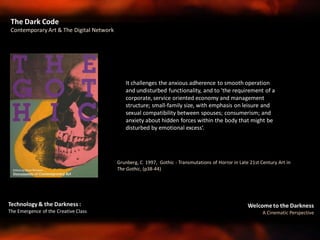
It challenges the anxious adherence to smooth operation
and undisturbed functionality, and to 'the requirement of a
corporate, service oriented economy and management
structure; small-family size, with emphasis on leisure and
sexual compatibility between spouses; consumerism; and
anxiety about hidden forces within the body that might be
disturbed by emotional excess‘.
The Dark Code
Contemporary Art & The Digital Network
Welcome to the Darkness
A Cinematic Perspective
Technology & the Darkness
The Emergence of the Creative Class
The Dark Code
Contemporary Art & The Digital Network
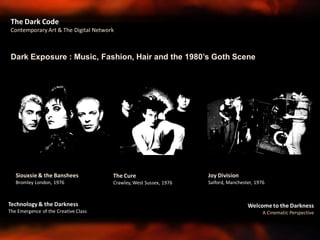
Dark Exposure : Music, Fashion, Hair and the 1980’s Goth Scene
Siouxsie & the Banshees
Bromley London, 1976
The Cure
Crawley, West Sussex, 1976
Joy Division
Salford, Manchester, 1976
Welcome to the Darkness
A Cinematic Perspective
Technology & the Darkness :
The Emergence of the Creative Class
• The movement away from the mainstream in the
music scene created a niche of vital contextual
elements that would later be picked up in other areas
of popular culture.
• In late 1970’s and early 1980’s cinema, as audiences
expanded and the notion of the “blockbuster” was
invented, the subtext of the mainstream fair was dark
and the retro stylings of the “other” had an air of
nostalgia.
• References abound for the exploitation of the visual
iconography of the “gothic”, of “horror”, and of the
“surreal” and the “fantastic “.
Cinema and the rise of the Darkness
The Dark Code
Contemporary Art & The Digital Network
Welcome to the Darkness
A Cinematic Perspective
Technology & the Darkness
The Emergence of the Creative Class
The Dark Code
Contemporary Art & The Digital Network
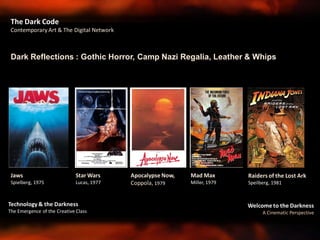
Dark Reflections : Gothic Horror, Camp Nazi Regalia, Leather & Whips
Jaws
Spielberg, 1975
Raiders of the Lost Ark
Speilberg, 1981
Star Wars
Lucas, 1977
Mad Max
Miller, 1979
Apocalypse Now,
Coppola, 1979
Welcome to the Darkness
A Cinematic Perspective
Technology & the Darkness :
The Emergence of the Creative Class
• This would be fabulously exploited two decades
later by a much more pervasive and influential force
: (Hollywood/ Blockbuster) cinema
• The most obvious manifestation of this tendency
can be seen in the “rebooted” comic strips produced
by the Hollywood studio system of the early 21C
• In particular the Batman & Superman franchises.
However, this can also be seen in the more recent
renderings of Spiderman & the Incredible Hulk
Cinema and the rise of the Darkness
The Dark Code
Contemporary Art & The Digital Network
Welcome to the Darkness
A Cinematic Perspective
Technology & the Darkness :
The Emergence of the Creative Class
• If we take for a moment this macro perspective on the comic book genre of Hollywood adaptation we
will see some recurring elements which marked a distinct shift in style and the co-opting of “new
gothic” properties :
• Obvious “dark” colour & textureshadings to the production design
• Gothic architecture, brooding locations and retro costuming
• Character Introspectionresulting in self doubt and at times self loathing
• Steam punk technology in science fiction and contemporary metaphysical settings
• The anxiety attack - the recoil from the calamity of the modern well stitched urban environment
and prosaic society
Cinema and the rise of the Darkness
The Dark Code
Contemporary Art & The Digital Network
Welcome to the Darkness
A Cinematic Perspective
Technology & the Darkness :
The Emergence of the Creative Class
Cinema and the rise of the Darkness – Iconography
The Dark Code
Contemporary Art & The Digital Network
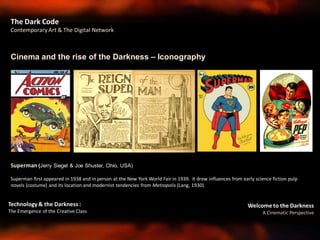
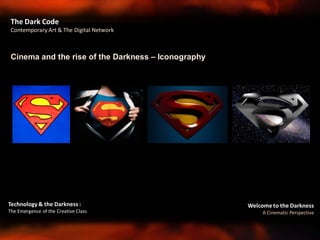
Superman (Jerry Siegel & Joe Shuster, Ohio, USA)
Superman first appeared in 1938 and in person at the New York World Fair in 1939. It drew influences from early science fiction pulp
novels (costume) and its location and modernist tendencies from Metropolis (Lang, 1930).
Welcome to the Darkness
A Cinematic Perspective
Technology & the Darkness :
The Emergence of the Creative Class
Cinema and the rise of the Darkness – Iconography
The Dark Code
Contemporary Art & The Digital Network
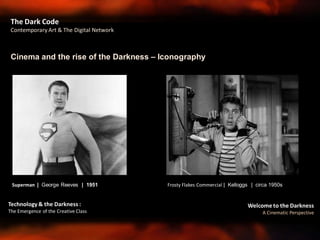
Frosty Flakes Commercial | Kelloggs | circa 1950sSuperman | George Reeves | 1951
Welcome to the Darkness
A Cinematic Perspective
Technology & the Darkness :
The Emergence of the Creative Class
Cinema and the rise of the Darkness – Iconography
The Dark Code
Contemporary Art & The Digital Network
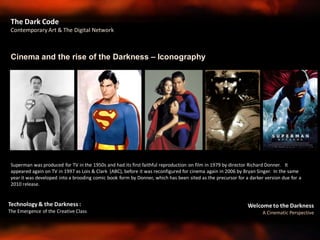
Superman was produced for TV in the 1950s and had its first faithful reproduction on film in 1979 by director Richard Donner. It
appeared again on TV in 1997 as Lois & Clark (ABC), before it was reconfigured for cinema again in 2006 by Bryan Singer. In the same
year it was developed into a brooding comic book form by Donner, which has been sited as the precursor for a darker version due for a
2010 release.
Welcome to the Darkness
A Cinematic Perspective
Technology & the Darkness :
The Emergence of the Creative Class
Cinema and the rise of the Darkness – Iconography
The Dark Code
Contemporary Art & The Digital Network
Welcome to the Darkness
A Cinematic Perspective
Technology & the Darkness :
The Emergence of the Creative Class
Cinema and the rise of the Darkness – Colour & Texture
The Dark Code
Contemporary Art & The Digital Network
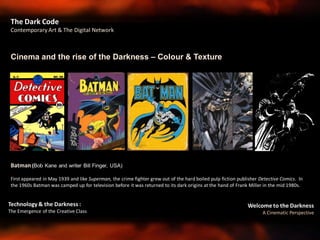
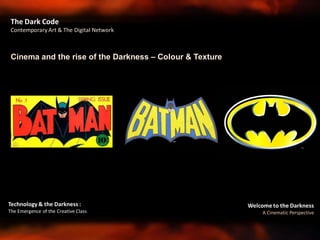
Batman (Bob Kane and writer Bill Finger, USA)
First appeared in May 1939 and like Superman, the crime fighter grew out of the hard boiled pulp fiction publisher Detective Comics. In
the 1960s Batman was camped up for television before it was returned to its dark origins at the hand of Frank Miller in the mid 1980s.
Welcome to the Darkness
A Cinematic Perspective
Technology & the Darkness :
The Emergence of the Creative Class
Cinema and the rise of the Darkness – Colour & Texture
The Dark Code
Contemporary Art & The Digital Network
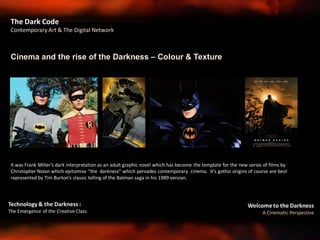
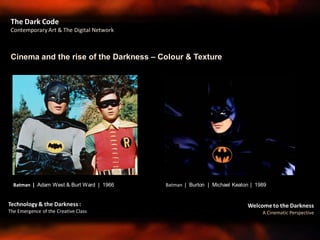
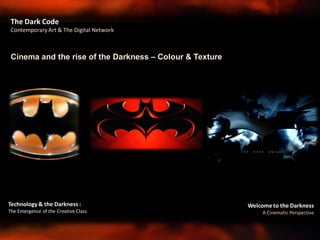
It was Frank Miller’s dark interpretation as an adult graphic novel which has become the template for the new series of films by
Christopher Nolan which epitomise “the darkness” which pervades contemporary cinema. It’s gothic origins of course are best
represented by Tim Burton’s classic telling of the Batman saga in his 1989 version.
Welcome to the Darkness
A Cinematic Perspective
Technology & the Darkness :
The Emergence of the Creative Class
Cinema and the rise of the Darkness – Colour & Texture
The Dark Code
Contemporary Art & The Digital Network
Batman | Adam West & Burt Ward | 1966 Batman | Burton | Michael Keaton | 1989
Welcome to the Darkness
A Cinematic Perspective
Technology & the Darkness :
The Emergence of the Creative Class
Cinema and the rise of the Darkness – Colour & Texture
The Dark Code
Contemporary Art & The Digital Network
Welcome to the Darkness
A Cinematic Perspective
Technology & the Darkness :
The Emergence of the Creative Class
Cinema and the rise of the Darkness – Colour & Texture
The Dark Code
Contemporary Art & The Digital Network
Welcome to the Darkness
A Cinematic Perspective
Technology & the Darkness :
The Emergence of the Creative Class
The Dark Code
Contemporary Art & The Digital Network
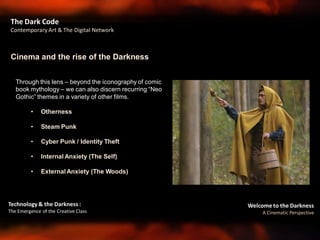
Through this lens – beyond the iconography of comic
book mythology – we can also discern recurring “Neo
Gothic” themes in a variety of other films.
• Otherness
• Steam Punk
• Cyber Punk / Identity Theft
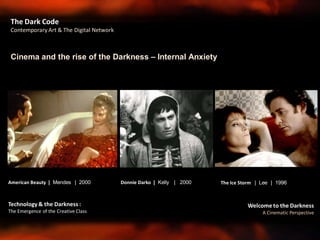
• Internal Anxiety (The Self)
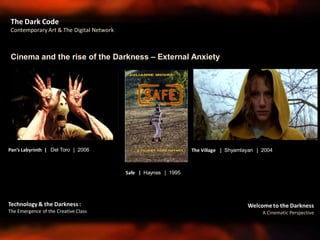
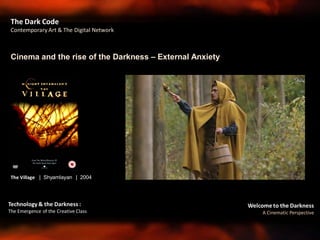
• External Anxiety (The Woods)
Cinema and the rise of the Darkness
Welcome to the Darkness
A Cinematic Perspective
Technology & the Darkness :
The Emergence of the Creative Class
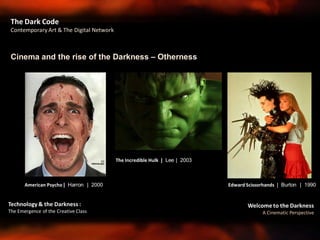
Cinema and the rise of the Darkness – Otherness
The Dark Code
Contemporary Art & The Digital Network
American Psycho | Harron | 2000 Edward Scissorhands | Burton | 1990
The Incredible Hulk | Lee | 2003
Welcome to the Darkness
A Cinematic Perspective
Technology & the Darkness :
The Emergence of the Creative Class
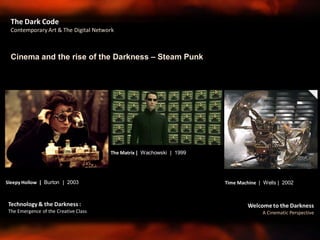
Cinema and the rise of the Darkness – Steam Punk
The Dark Code
Contemporary Art & The Digital Network
Sleepy Hollow | Burton | 2003 Time Machine | Wells | 2002
The Matrix | Wachowski | 1999
Welcome to the Darkness
A Cinematic Perspective
Technology & the Darkness :
The Emergence of the Creative Class
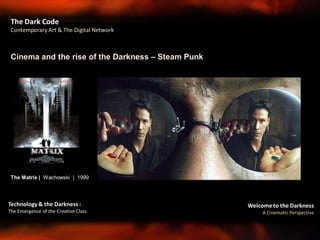
Cinema and the rise of the Darkness – Steam Punk
The Dark Code
Contemporary Art & The Digital Network
The Matrix | Wachowski | 1999
Welcome to the Darkness
A Cinematic Perspective
Technology & the Darkness :
The Emergence of the Creative Class
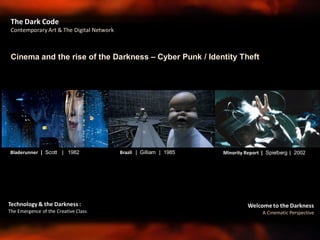
Cinema and the rise of the Darkness – Cyber Punk / Identity Theft
The Dark Code
Contemporary Art & The Digital Network
Minority Report | Spielberg | 2002Bladerunner | Scott | 1982 Brazil | Gilliam | 1985
Welcome to the Darkness
A Cinematic Perspective
Technology & the Darkness :
The Emergence of the Creative Class
The Dark Code
Contemporary Art & The Digital Network
“No longer concerned with the production of grand or majestic terror, the Gothic sublime today reflects a
hesitant and apprehensive state of mind obscured by a deep fear of the unfamiliar future:
'It is the threat of the apocalypse that is the spectacle of the sublime; it is the threat of self extinction and
"self-dissolution" that forces the subject to retreat back into the comfortable frame of the beautiful'.
In a final ecstatic danse macabre. we are slowly waltzing towards the end of the millennium, verging upon
the edge of an eternal abyss, closer and closer until swallowed by an all-consuming vortex. It is the year
2000 - and we are still here.”
Grunberg, C 1997, Gothic - Transmutations of Horror in Late 21st Century Art in The Gothic, (p38-44)
Welcome to the Darkness
A Cinematic Perspective
Technology & the Darkness :
The Emergence of the Creative Class
Cinema and the rise of the Darkness – Internal Anxiety
The Dark Code
Contemporary Art & The Digital Network
Donnie Darko | Kelly | 2000American Beauty | Mendes | 2000 The Ice Storm | Lee | 1996
Welcome to the Darkness
A Cinematic Perspective
Technology & the Darkness :
The Emergence of the Creative Class
Cinema and the rise of the Darkness – External Anxiety
The Dark Code
Contemporary Art & The Digital Network
The Village | Shyamlayan | 2004
Safe | Haynes | 1995
Pan’s Labyrinth | Del Toro | 2006
Welcome to the Darkness
A Cinematic Perspective
Technology & the Darkness :
The Emergence of the Creative Class
Cinema and the rise of the Darkness – External Anxiety
The Dark Code
Contemporary Art & The Digital Network
The Village | Shyamlayan | 2004
Welcome to the Darkness
A Cinematic Perspective
Technology & the Darkness :
The Emergence of the Creative Class
The Dark Code
Contemporary Art & The Digital Network
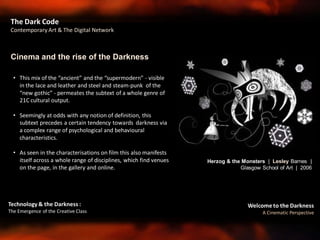
• This mix of the “ancient” and the “supermodern” - visible
in the lace and leather and steel and steam-punk of the
“new gothic” - permeates the subtext of a whole genre of
21C cultural output.
• Seemingly at odds with any notion of definition, this
subtext precedes a certain tendency towards darkness via
a complex range of psychological and behavioural
characteristics.
• As seen in the characterisations on film this also manifests
itself across a whole range of disciplines, which find venues
on the page, in the gallery and online.
Cinema and the rise of the Darkness
Herzog & the Monsters | Lesley Barnes |
Glasgow School of Art | 2006
Welcome to the Darkness
A Cinematic Perspective
Technology & the Darkness :
The Emergence of the Creative Class
The Dark Code
Contemporary Art & The Digital Network
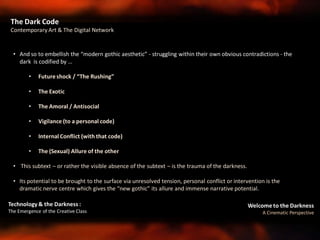
• And so to embellish the “modern gothic aesthetic” - struggling within their own obvious contradictions - the
dark is codified by …
• Futureshock / “The Rushing”
• The Exotic
• The Amoral / Antisocial
• Vigilance (to a personal code)
• Internal Conflict (with that code)
• The (Sexual) Allure of the other
• This subtext – or rather the visible absence of the subtext – is the trauma of the darkness.
• Its potential to be brought to the surface via unresolved tension, personal conflict or intervention is the
dramatic nerve centre which gives the “new gothic” its allure and immense narrative potential.
Welcome to the Darkness
A Cinematic Perspective
Technology & the Darkness :
The Emergence of the Creative Class
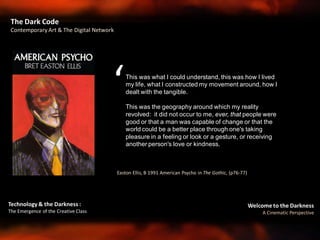
Easton Ellis, B 1991 American Psycho in The Gothic, (p76-77)
The Dark Code
Contemporary Art & The Digital Network
This was what I could understand, this was how I lived
my life, what I constructed my movement around, how I
dealt with the tangible.
This was the geography around which my reality
revolved: it did not occur to me, ever, that people were
good or that a man was capable of change or that the
world could be a better place through one's taking
pleasure in a feeling or look or a gesture, or receiving
another person's love or kindness.
‘
Welcome to the Darkness
A Cinematic Perspective
Technology & the Darkness :
The Emergence of the Creative Class
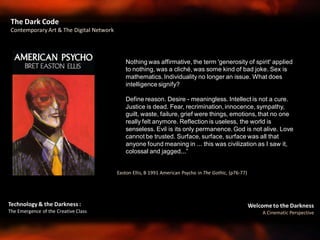
Easton Ellis, B 1991 American Psycho in The Gothic, (p76-77)
The Dark Code
Contemporary Art & The Digital Network
Nothing was affirmative, the term 'generosity of spirit' applied
to nothing, was a cliché, was some kind of bad joke. Sex is
mathematics. Individuality no longer an issue. What does
intelligence signify?
Define reason. Desire - meaningless. Intellect is not a cure.
Justice is dead. Fear, recrimination, innocence, sympathy,
guilt, waste, failure, grief were things, emotions, that no one
really felt anymore. Reflection is useless, the world is
senseless. Evil is its only permanence. God is not alive. Love
cannot be trusted. Surface, surface, surface was all that
anyone found meaning in ... this was civilization as I saw it,
colossal and jagged...”
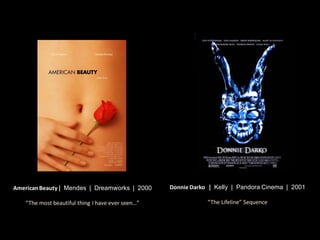
American Beauty | Mendes | Dreamworks | 2000
“The most beautiful thing I have ever seen…”
Donnie Darko | Kelly | Pandora Cinema | 2001
“The Lifeline” Sequence

Welcome to the Darkness

  • 1.
    Welcome To TheDarkness A Cinematic Perspective Technology & the Darkness : The Emergence of the Creative Class
  • 2.
    Welcome to theDarkness A Cinematic Perspective Technology & the Darkness : The Emergence of the Creative Class Grunberg, C 1997, Gothic - Transmutations of Horror in Late 21st Century Art in The Gothic, (p38-44) Gothic art today speaks of the subjects that transgress society's vague definitions of normality, discreetly peeling away the pretences of outmoded conventions and transversing the amorphous border between good and evil, sanity and madness, disinterested pleasure and visual offensiveness, The Gothic reacts aggressively against the current 'anti-intensity emotionology', as Peter N, Stearns has termed the protective withdrawal from authentic expression and display of profound affections. ‘ The Dark Code Contemporary Art & The Digital Network
  • 3.
    Welcome to theDarkness A Cinematic Perspective Technology & the Darkness : The Emergence of the Creative Class Grunberg, C 1997, Gothic - Transmutations of Horror in Late 21st Century Art in The Gothic, (p38-44) It challenges the anxious adherence to smooth operation and undisturbed functionality, and to 'the requirement of a corporate, service oriented economy and management structure; small-family size, with emphasis on leisure and sexual compatibility between spouses; consumerism; and anxiety about hidden forces within the body that might be disturbed by emotional excess‘. The Dark Code Contemporary Art & The Digital Network
  • 4.
    Welcome to theDarkness A Cinematic Perspective Technology & the Darkness The Emergence of the Creative Class The Dark Code Contemporary Art & The Digital Network Dark Exposure : Music, Fashion, Hair and the 1980’s Goth Scene Siouxsie & the Banshees Bromley London, 1976 The Cure Crawley, West Sussex, 1976 Joy Division Salford, Manchester, 1976
  • 5.
    Welcome to theDarkness A Cinematic Perspective Technology & the Darkness : The Emergence of the Creative Class • The movement away from the mainstream in the music scene created a niche of vital contextual elements that would later be picked up in other areas of popular culture. • In late 1970’s and early 1980’s cinema, as audiences expanded and the notion of the “blockbuster” was invented, the subtext of the mainstream fair was dark and the retro stylings of the “other” had an air of nostalgia. • References abound for the exploitation of the visual iconography of the “gothic”, of “horror”, and of the “surreal” and the “fantastic “. Cinema and the rise of the Darkness The Dark Code Contemporary Art & The Digital Network
  • 6.
    Welcome to theDarkness A Cinematic Perspective Technology & the Darkness The Emergence of the Creative Class The Dark Code Contemporary Art & The Digital Network Dark Reflections : Gothic Horror, Camp Nazi Regalia, Leather & Whips Jaws Spielberg, 1975 Raiders of the Lost Ark Speilberg, 1981 Star Wars Lucas, 1977 Mad Max Miller, 1979 Apocalypse Now, Coppola, 1979
  • 7.
    Welcome to theDarkness A Cinematic Perspective Technology & the Darkness : The Emergence of the Creative Class • This would be fabulously exploited two decades later by a much more pervasive and influential force : (Hollywood/ Blockbuster) cinema • The most obvious manifestation of this tendency can be seen in the “rebooted” comic strips produced by the Hollywood studio system of the early 21C • In particular the Batman & Superman franchises. However, this can also be seen in the more recent renderings of Spiderman & the Incredible Hulk Cinema and the rise of the Darkness The Dark Code Contemporary Art & The Digital Network
  • 8.
    Welcome to theDarkness A Cinematic Perspective Technology & the Darkness : The Emergence of the Creative Class • If we take for a moment this macro perspective on the comic book genre of Hollywood adaptation we will see some recurring elements which marked a distinct shift in style and the co-opting of “new gothic” properties : • Obvious “dark” colour & textureshadings to the production design • Gothic architecture, brooding locations and retro costuming • Character Introspectionresulting in self doubt and at times self loathing • Steam punk technology in science fiction and contemporary metaphysical settings • The anxiety attack - the recoil from the calamity of the modern well stitched urban environment and prosaic society Cinema and the rise of the Darkness The Dark Code Contemporary Art & The Digital Network
  • 9.
    Welcome to theDarkness A Cinematic Perspective Technology & the Darkness : The Emergence of the Creative Class Cinema and the rise of the Darkness – Iconography The Dark Code Contemporary Art & The Digital Network Superman (Jerry Siegel & Joe Shuster, Ohio, USA) Superman first appeared in 1938 and in person at the New York World Fair in 1939. It drew influences from early science fiction pulp novels (costume) and its location and modernist tendencies from Metropolis (Lang, 1930).
  • 10.
    Welcome to theDarkness A Cinematic Perspective Technology & the Darkness : The Emergence of the Creative Class Cinema and the rise of the Darkness – Iconography The Dark Code Contemporary Art & The Digital Network Frosty Flakes Commercial | Kelloggs | circa 1950sSuperman | George Reeves | 1951
  • 11.
    Welcome to theDarkness A Cinematic Perspective Technology & the Darkness : The Emergence of the Creative Class Cinema and the rise of the Darkness – Iconography The Dark Code Contemporary Art & The Digital Network Superman was produced for TV in the 1950s and had its first faithful reproduction on film in 1979 by director Richard Donner. It appeared again on TV in 1997 as Lois & Clark (ABC), before it was reconfigured for cinema again in 2006 by Bryan Singer. In the same year it was developed into a brooding comic book form by Donner, which has been sited as the precursor for a darker version due for a 2010 release.
  • 12.
    Welcome to theDarkness A Cinematic Perspective Technology & the Darkness : The Emergence of the Creative Class Cinema and the rise of the Darkness – Iconography The Dark Code Contemporary Art & The Digital Network
  • 13.
    Welcome to theDarkness A Cinematic Perspective Technology & the Darkness : The Emergence of the Creative Class Cinema and the rise of the Darkness – Colour & Texture The Dark Code Contemporary Art & The Digital Network Batman (Bob Kane and writer Bill Finger, USA) First appeared in May 1939 and like Superman, the crime fighter grew out of the hard boiled pulp fiction publisher Detective Comics. In the 1960s Batman was camped up for television before it was returned to its dark origins at the hand of Frank Miller in the mid 1980s.
  • 14.
    Welcome to theDarkness A Cinematic Perspective Technology & the Darkness : The Emergence of the Creative Class Cinema and the rise of the Darkness – Colour & Texture The Dark Code Contemporary Art & The Digital Network It was Frank Miller’s dark interpretation as an adult graphic novel which has become the template for the new series of films by Christopher Nolan which epitomise “the darkness” which pervades contemporary cinema. It’s gothic origins of course are best represented by Tim Burton’s classic telling of the Batman saga in his 1989 version.
  • 15.
    Welcome to theDarkness A Cinematic Perspective Technology & the Darkness : The Emergence of the Creative Class Cinema and the rise of the Darkness – Colour & Texture The Dark Code Contemporary Art & The Digital Network Batman | Adam West & Burt Ward | 1966 Batman | Burton | Michael Keaton | 1989
  • 16.
    Welcome to theDarkness A Cinematic Perspective Technology & the Darkness : The Emergence of the Creative Class Cinema and the rise of the Darkness – Colour & Texture The Dark Code Contemporary Art & The Digital Network
  • 17.
    Welcome to theDarkness A Cinematic Perspective Technology & the Darkness : The Emergence of the Creative Class Cinema and the rise of the Darkness – Colour & Texture The Dark Code Contemporary Art & The Digital Network
  • 18.
    Welcome to theDarkness A Cinematic Perspective Technology & the Darkness : The Emergence of the Creative Class The Dark Code Contemporary Art & The Digital Network Through this lens – beyond the iconography of comic book mythology – we can also discern recurring “Neo Gothic” themes in a variety of other films. • Otherness • Steam Punk • Cyber Punk / Identity Theft • Internal Anxiety (The Self) • External Anxiety (The Woods) Cinema and the rise of the Darkness
  • 19.
    Welcome to theDarkness A Cinematic Perspective Technology & the Darkness : The Emergence of the Creative Class Cinema and the rise of the Darkness – Otherness The Dark Code Contemporary Art & The Digital Network American Psycho | Harron | 2000 Edward Scissorhands | Burton | 1990 The Incredible Hulk | Lee | 2003
  • 20.
    Welcome to theDarkness A Cinematic Perspective Technology & the Darkness : The Emergence of the Creative Class Cinema and the rise of the Darkness – Steam Punk The Dark Code Contemporary Art & The Digital Network Sleepy Hollow | Burton | 2003 Time Machine | Wells | 2002 The Matrix | Wachowski | 1999
  • 21.
    Welcome to theDarkness A Cinematic Perspective Technology & the Darkness : The Emergence of the Creative Class Cinema and the rise of the Darkness – Steam Punk The Dark Code Contemporary Art & The Digital Network The Matrix | Wachowski | 1999
  • 22.
    Welcome to theDarkness A Cinematic Perspective Technology & the Darkness : The Emergence of the Creative Class Cinema and the rise of the Darkness – Cyber Punk / Identity Theft The Dark Code Contemporary Art & The Digital Network Minority Report | Spielberg | 2002Bladerunner | Scott | 1982 Brazil | Gilliam | 1985
  • 23.
    Welcome to theDarkness A Cinematic Perspective Technology & the Darkness : The Emergence of the Creative Class The Dark Code Contemporary Art & The Digital Network “No longer concerned with the production of grand or majestic terror, the Gothic sublime today reflects a hesitant and apprehensive state of mind obscured by a deep fear of the unfamiliar future: 'It is the threat of the apocalypse that is the spectacle of the sublime; it is the threat of self extinction and "self-dissolution" that forces the subject to retreat back into the comfortable frame of the beautiful'. In a final ecstatic danse macabre. we are slowly waltzing towards the end of the millennium, verging upon the edge of an eternal abyss, closer and closer until swallowed by an all-consuming vortex. It is the year 2000 - and we are still here.” Grunberg, C 1997, Gothic - Transmutations of Horror in Late 21st Century Art in The Gothic, (p38-44)
  • 24.
    Welcome to theDarkness A Cinematic Perspective Technology & the Darkness : The Emergence of the Creative Class Cinema and the rise of the Darkness – Internal Anxiety The Dark Code Contemporary Art & The Digital Network Donnie Darko | Kelly | 2000American Beauty | Mendes | 2000 The Ice Storm | Lee | 1996
  • 25.
    Welcome to theDarkness A Cinematic Perspective Technology & the Darkness : The Emergence of the Creative Class Cinema and the rise of the Darkness – External Anxiety The Dark Code Contemporary Art & The Digital Network The Village | Shyamlayan | 2004 Safe | Haynes | 1995 Pan’s Labyrinth | Del Toro | 2006
  • 26.
    Welcome to theDarkness A Cinematic Perspective Technology & the Darkness : The Emergence of the Creative Class Cinema and the rise of the Darkness – External Anxiety The Dark Code Contemporary Art & The Digital Network The Village | Shyamlayan | 2004
  • 27.
    Welcome to theDarkness A Cinematic Perspective Technology & the Darkness : The Emergence of the Creative Class The Dark Code Contemporary Art & The Digital Network • This mix of the “ancient” and the “supermodern” - visible in the lace and leather and steel and steam-punk of the “new gothic” - permeates the subtext of a whole genre of 21C cultural output. • Seemingly at odds with any notion of definition, this subtext precedes a certain tendency towards darkness via a complex range of psychological and behavioural characteristics. • As seen in the characterisations on film this also manifests itself across a whole range of disciplines, which find venues on the page, in the gallery and online. Cinema and the rise of the Darkness Herzog & the Monsters | Lesley Barnes | Glasgow School of Art | 2006
  • 28.
    Welcome to theDarkness A Cinematic Perspective Technology & the Darkness : The Emergence of the Creative Class The Dark Code Contemporary Art & The Digital Network • And so to embellish the “modern gothic aesthetic” - struggling within their own obvious contradictions - the dark is codified by … • Futureshock / “The Rushing” • The Exotic • The Amoral / Antisocial • Vigilance (to a personal code) • Internal Conflict (with that code) • The (Sexual) Allure of the other • This subtext – or rather the visible absence of the subtext – is the trauma of the darkness. • Its potential to be brought to the surface via unresolved tension, personal conflict or intervention is the dramatic nerve centre which gives the “new gothic” its allure and immense narrative potential.
  • 29.
    Welcome to theDarkness A Cinematic Perspective Technology & the Darkness : The Emergence of the Creative Class Easton Ellis, B 1991 American Psycho in The Gothic, (p76-77) The Dark Code Contemporary Art & The Digital Network This was what I could understand, this was how I lived my life, what I constructed my movement around, how I dealt with the tangible. This was the geography around which my reality revolved: it did not occur to me, ever, that people were good or that a man was capable of change or that the world could be a better place through one's taking pleasure in a feeling or look or a gesture, or receiving another person's love or kindness. ‘
  • 30.
    Welcome to theDarkness A Cinematic Perspective Technology & the Darkness : The Emergence of the Creative Class Easton Ellis, B 1991 American Psycho in The Gothic, (p76-77) The Dark Code Contemporary Art & The Digital Network Nothing was affirmative, the term 'generosity of spirit' applied to nothing, was a cliché, was some kind of bad joke. Sex is mathematics. Individuality no longer an issue. What does intelligence signify? Define reason. Desire - meaningless. Intellect is not a cure. Justice is dead. Fear, recrimination, innocence, sympathy, guilt, waste, failure, grief were things, emotions, that no one really felt anymore. Reflection is useless, the world is senseless. Evil is its only permanence. God is not alive. Love cannot be trusted. Surface, surface, surface was all that anyone found meaning in ... this was civilization as I saw it, colossal and jagged...”
  • 31.
    American Beauty |Mendes | Dreamworks | 2000 “The most beautiful thing I have ever seen…” Donnie Darko | Kelly | Pandora Cinema | 2001 “The Lifeline” Sequence