We
CSCC Scholar Network
CSCC Scholars
Preparation for D.C.
Federal Legislation: How It Works, and Two
Examples
► Family First Prevention Services Act
► Fostering Stable Housing Opportunities Act
Roles During Legislative Visits
► Role Play
► Circle Diagram
► Group Work and Reporting Out
Homework
► Strategic Sharing
Alumni of Care Together
Improving Outcomes Now
We bring together the voices of foster care youth,
alumni and allies, to create lasting change and
generate hope for current and former foster youth,
based on access to resources, ally support and alumni
expertise.
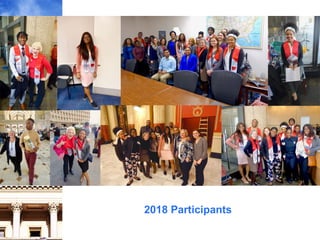
Six years of bringing
foster care youth and alumni
to DC
Three Days On the Hill
2018 Participants
Federal vs. State vs. Local Legislation
• Federal laws are rules that apply throughout the United
States. These laws apply in every state, such as
• Each state has its own system of laws and courts that
handle state matters, including welfare, public
assistance and Medicaid.
• Local laws: Counties, cities, and municipalities within a
state often have their own system of laws and courts that
handle rent laws, zoning and local safety.
Who Can Introduce a Bill?
A bill can come from a variety of sources:
• Individual citizens
• Special interest groups (lobbyists)
• Corporations (lobbyists)
• Non-governmental organizations
Only a member of Congress can introduce the bill.
A bill can start in either House.
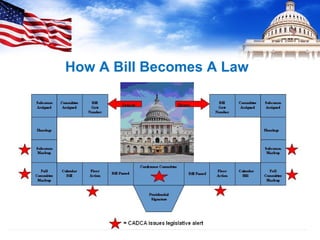
1. A bill is introduced
2. The bill is assigned to a committee for consideration.
3. A subcommittee considers the bill, marks it up and reports out, by
majority vote.
4. The full committee considers the bill, marks it up and reports out, by
majority vote.
5. The bill goes to the House floor for a vote by all members. Members can
offer amendments. A final majority vote passes or fails to pass the bill.
6. The bill is sent to the Senate where it goes through steps 2-5 as
outlined above.
7. After both houses of Congress pass their versions of the bill, a
Conference Committee is appointed to resolve the differences between the
House and Senate versions of the bill.
8. The Conference Committee’s version of the bill is reported back to the
House and Senate for their consideration.
9. After passage of the Conference bill, in identical form by both the House
and the Senate, the bill goes to the President for his consideration. The
president either signs or vetoes the bill.
10. Congress can override a Presidential veto by a 2/3 vote of both
houses.
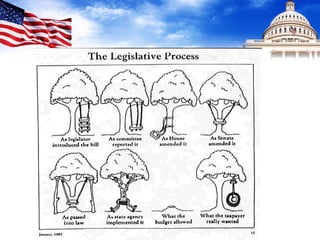
How A Bill Becomes A Law
Historic Child Welfare Reform Efforts
1997 Adoption and Safe
Families Act
• Clarified “reasonable efforts” by emphasizing
children’s health and safety
• Sets a time limit to avoid children languishing in
care (12 months, 24 months)
1999 Foster Care
Independence Act
• Chafee funding and independent living classes
• Requires states to contribute a 20% match for
Independent Living program funds, and use
federal training funds to prepare foster parents to
train teens for Independent Living
• Gives states the option to extend Medicaid for
foster youth until age 21
2008 Fostering Connections to
Success and Increasing
Adoptions Act
• Gives states the option to extend IV-E foster care
supports until age 21
• Mandates 90-day transition plan with youth input
• Requires that case plans include a plan for
ensuring the educational stability of the child in
foster care
Federal Funds for Child Welfare
Title IV-E
Foster Care Maintenance,
Adoption Assistance, and
Guardianship Assistance
• The Children’s Bureau provides these funds to states,
as an open-ended entitlement, on a formula basis to
provide reimbursement for a portion of the costs of
providing foster care, adoption assistance, and, if
elected by the State or Tribe, guardianship assistance
to eligible children
Chafee funds
Chafee Foster Care
Independence Program
(CFCIP)
• These programs are funded under Title IV-E on a
formula, fixed-grant basis to assist States in providing
services and supports that help foster youth acquire
the training and skills needed for self-sufficiency.
ETV
Education and Training
Voucher Program
• Ohio’s ETV funds are administered through Foster
Care 2 Success, but the funding ultimately comes
from Title IV-E.
Federal Financing for Child Welfare
1. Federal Registration is passed
2. Children’s Bureau provides guidance.
3. Children’s Bureau disperses funds.
4. States develop programs and policies.
5. Children’s Bureau monitors State service.
► The Adoption and Foster Care Analysis and Reporting
System (AFCARS): Annual Assessment Review
► National Youth in Transition Database (NYTD)
1. Children’s Bureau reports to Congress.
Two Bills to be Familiar With…
1. Family First Prevention Services Act:
This bill has been passed into law. Need to make sure our
voices are included in implementation.
2. Fostering Stable Housing Opportunities Act:
This bill was created BY Ohio foster care youth/alumni.
It hasn’t been passed into law yet. We are still fighting for it.
Family First Act (Law)
Extending
Eligibility for
Resources
This new federal law allows states to:
• Extend Chaffee funds until age 23
• ETV funds until age 26
Accountability
(or lose $$$)
This new federal law:
• Requires groups homes and residential
placements to be Qualified Residential Treatment
Programs in order to be eligible for Title IV-E
foster care maintenance payments
Fostering Stable Housing
Opportunities Act
This bill costs
nothing
If passed, this bill would do two things:
• Early Application: Youth in foster care would be
able to apply for housing assistance upon
reaching 16 years of age, prior to aging out of
foster care.
“Government created
homelessness
deserves a
government created
solution”
• Priority Preference: When a young person
reaches the point 6 months prior to aging out of
foster care, he or she would automatically jump
to the front of the waitlist for housing supports.
Roles During Legislative Visits
1. Introduce the Group: (name of group, name and county of
each youth, and which youth is that particular legislator’s
constituent)
2. Overview/Background Information: (the problem)
3. Personal Story: (why it matters to you)
4. Statistics: (how this story fits into the big picture)
5. What You Are Asking For: (simple, clear request)
6. Thanks for Your Time and Packet of Information (fact
sheets, talking points, contact information)
Circle
Diagram
Circle Diagram
Strategic Sharing:
Choose ~ Connect ~ Claim
1. Risks and benefits of sharing your personal story.
2. Self-disclosure is like clothing.
3. Risk of “sharer’s remorse”
4. Think of it like puzzle pieces, and decide which parts to
share, in order to make your case effectively.
5. Prepare, practice, and stay focused on the specific
message you want to bring home to your listeners.
6. Media: “if it bleeds, it leads”
7. How to redirect if needed (examples)
8. What to do if your emotions come to the surface.

2018 cscc prep for dc

  • 1.
  • 2.
    CSCC Scholars Preparation forD.C. Federal Legislation: How It Works, and Two Examples ► Family First Prevention Services Act ► Fostering Stable Housing Opportunities Act Roles During Legislative Visits ► Role Play ► Circle Diagram ► Group Work and Reporting Out Homework ► Strategic Sharing
  • 3.
    Alumni of CareTogether Improving Outcomes Now We bring together the voices of foster care youth, alumni and allies, to create lasting change and generate hope for current and former foster youth, based on access to resources, ally support and alumni expertise.
  • 4.
    Six years ofbringing foster care youth and alumni to DC Three Days On the Hill
  • 5.
  • 6.
    Federal vs. Statevs. Local Legislation • Federal laws are rules that apply throughout the United States. These laws apply in every state, such as • Each state has its own system of laws and courts that handle state matters, including welfare, public assistance and Medicaid. • Local laws: Counties, cities, and municipalities within a state often have their own system of laws and courts that handle rent laws, zoning and local safety.
  • 7.
    Who Can Introducea Bill? A bill can come from a variety of sources: • Individual citizens • Special interest groups (lobbyists) • Corporations (lobbyists) • Non-governmental organizations Only a member of Congress can introduce the bill. A bill can start in either House.
  • 8.
    1. A billis introduced 2. The bill is assigned to a committee for consideration. 3. A subcommittee considers the bill, marks it up and reports out, by majority vote. 4. The full committee considers the bill, marks it up and reports out, by majority vote. 5. The bill goes to the House floor for a vote by all members. Members can offer amendments. A final majority vote passes or fails to pass the bill. 6. The bill is sent to the Senate where it goes through steps 2-5 as outlined above. 7. After both houses of Congress pass their versions of the bill, a Conference Committee is appointed to resolve the differences between the House and Senate versions of the bill. 8. The Conference Committee’s version of the bill is reported back to the House and Senate for their consideration. 9. After passage of the Conference bill, in identical form by both the House and the Senate, the bill goes to the President for his consideration. The president either signs or vetoes the bill. 10. Congress can override a Presidential veto by a 2/3 vote of both houses. How A Bill Becomes A Law
  • 9.
    How A BillBecomes A Law
  • 11.
    Historic Child WelfareReform Efforts 1997 Adoption and Safe Families Act • Clarified “reasonable efforts” by emphasizing children’s health and safety • Sets a time limit to avoid children languishing in care (12 months, 24 months) 1999 Foster Care Independence Act • Chafee funding and independent living classes • Requires states to contribute a 20% match for Independent Living program funds, and use federal training funds to prepare foster parents to train teens for Independent Living • Gives states the option to extend Medicaid for foster youth until age 21 2008 Fostering Connections to Success and Increasing Adoptions Act • Gives states the option to extend IV-E foster care supports until age 21 • Mandates 90-day transition plan with youth input • Requires that case plans include a plan for ensuring the educational stability of the child in foster care
  • 12.
    Federal Funds forChild Welfare Title IV-E Foster Care Maintenance, Adoption Assistance, and Guardianship Assistance • The Children’s Bureau provides these funds to states, as an open-ended entitlement, on a formula basis to provide reimbursement for a portion of the costs of providing foster care, adoption assistance, and, if elected by the State or Tribe, guardianship assistance to eligible children Chafee funds Chafee Foster Care Independence Program (CFCIP) • These programs are funded under Title IV-E on a formula, fixed-grant basis to assist States in providing services and supports that help foster youth acquire the training and skills needed for self-sufficiency. ETV Education and Training Voucher Program • Ohio’s ETV funds are administered through Foster Care 2 Success, but the funding ultimately comes from Title IV-E.
  • 13.
    Federal Financing forChild Welfare 1. Federal Registration is passed 2. Children’s Bureau provides guidance. 3. Children’s Bureau disperses funds. 4. States develop programs and policies. 5. Children’s Bureau monitors State service. ► The Adoption and Foster Care Analysis and Reporting System (AFCARS): Annual Assessment Review ► National Youth in Transition Database (NYTD) 1. Children’s Bureau reports to Congress.
  • 15.
    Two Bills tobe Familiar With… 1. Family First Prevention Services Act: This bill has been passed into law. Need to make sure our voices are included in implementation. 2. Fostering Stable Housing Opportunities Act: This bill was created BY Ohio foster care youth/alumni. It hasn’t been passed into law yet. We are still fighting for it.
  • 16.
    Family First Act(Law) Extending Eligibility for Resources This new federal law allows states to: • Extend Chaffee funds until age 23 • ETV funds until age 26 Accountability (or lose $$$) This new federal law: • Requires groups homes and residential placements to be Qualified Residential Treatment Programs in order to be eligible for Title IV-E foster care maintenance payments
  • 17.
    Fostering Stable Housing OpportunitiesAct This bill costs nothing If passed, this bill would do two things: • Early Application: Youth in foster care would be able to apply for housing assistance upon reaching 16 years of age, prior to aging out of foster care. “Government created homelessness deserves a government created solution” • Priority Preference: When a young person reaches the point 6 months prior to aging out of foster care, he or she would automatically jump to the front of the waitlist for housing supports.
  • 18.
    Roles During LegislativeVisits 1. Introduce the Group: (name of group, name and county of each youth, and which youth is that particular legislator’s constituent) 2. Overview/Background Information: (the problem) 3. Personal Story: (why it matters to you) 4. Statistics: (how this story fits into the big picture) 5. What You Are Asking For: (simple, clear request) 6. Thanks for Your Time and Packet of Information (fact sheets, talking points, contact information)
  • 19.
  • 20.
  • 21.
    Strategic Sharing: Choose ~Connect ~ Claim 1. Risks and benefits of sharing your personal story. 2. Self-disclosure is like clothing. 3. Risk of “sharer’s remorse” 4. Think of it like puzzle pieces, and decide which parts to share, in order to make your case effectively. 5. Prepare, practice, and stay focused on the specific message you want to bring home to your listeners. 6. Media: “if it bleeds, it leads” 7. How to redirect if needed (examples) 8. What to do if your emotions come to the surface.

Editor's Notes

  • #5 Three Days On the Hill is an empowering and educational development opportunity for Ohio foster care teens and young adults. We know that our young people learn best from first-hand experience. This trip takes youth leaders out of a classroom setting, and relocates them to our nation's capital. Being able to dialogue and ask questions of federal decision-makers and national leaders in the housing and child welfare fields is invaluable to our young people. Through this interactive experience, participants increase their knowledge of our nation's policies and legislative processes.
  • #12 1997 Adoption and Safe Families Act 1999 Foster Care Independence Act2008 Fostering Connections to Success and Increasing Adoptions Act