Greg Connolly
September 2018
Targeted Assessment Program
Mechanical Update
Mechanical Engineering Safety Seminar
MESS 2018
Known Risk
Known Control
Overview of the Process
What is assessed?
• Principal Hazards identified in WHS(MPS) Regulations
– Fire and Explosions
• Hazards requiring Specific control measures in WHS(MPS)
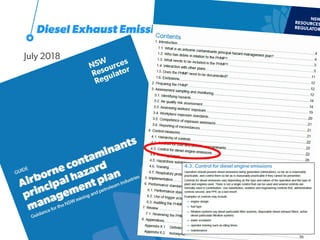
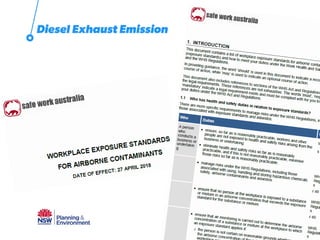
Regulations – Diesel exhaust emissions
• Incident identified hazards – CHPP Structural Integrity
2
Overview of the Process
Why is your mine or facility assessed?
o Mining Hazards risk assessment
oIdentify hazards
oRank hazards
o Bow tie assessment of the highest ranked hazards
o Prepare assessment template
o Nominate assessment span (all mines, UG mines, highest risk)
o Identify the mines that will be impacted by the hazard
3
Overview of the Process
What is the process?
o Review the mining hazard risk assessment (BBRA, principal
mining hazards, etc)
o Review the controls required to mitigate the hazard
o Review the management systems in place to control
o Review the standards in the workplace
o Workforce feedback
4
TAPS with Mechanical Focus
Concentrate on three Programs with mechanical focus:
• CHPP Structural Integrity
• Diesel Exhaust Emissions
• Fire and Explosions
5
CHPP Structural Integrity
Planned Inspection
Program
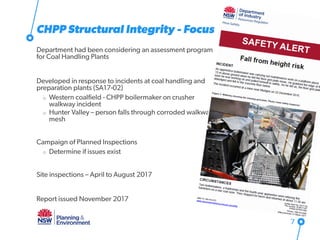
CHPP Structural Integrity - Focus
Department had been considering an assessment program
for Coal Handling Plants
Developed in response to incidents at coal handling and
preparation plants (SA17-02)
o Western coalfield - CHPP boilermaker on crusher
walkway incident
o Hunter Valley – person falls through corroded walkway
mesh
Campaign of Planned Inspections
o Determine if issues exist
Site inspections – April to August 2017
Report issued November 2017
7
• Criteria for prioritising inspection
o Older plant
o Inspectors had identified issues
o Previous incident
• 23 of the 46 facilities inspected
• Four sites considered satisfactory
• Six (6) facilities issued with Prohibition Notices, primarily
related to systemic absence of, or ineffective, guarding
8
CHPP Structural Integrity
Planned Inspection Program
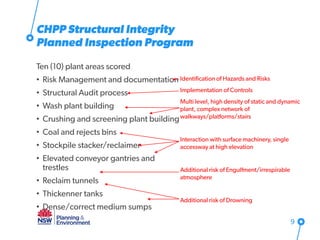
Ten (10) plant areas scored
• Risk Management and documentation
• Structural Audit process
• Wash plant building
• Crushing and screening plant building
• Coal and rejects bins
• Stockpile stacker/reclaimer
• Elevated conveyor gantries and
trestles
• Reclaim tunnels
• Thickenner tanks
• Dense/correct medium sumps
9
CHPP Structural Integrity
Planned Inspection Program
Identification of Hazards and Risks
Implementation of Controls
Multi level, high density of static and dynamic
plant, complex network of
walkways/platforms/stairs
Interaction with surface machinery, single
accessway at high elevation
Additional risk of Engulfment/irrespirable
atmosphere
Additional risk of Drowning
10
CHPP Structural Integrity
Planned Inspection Program
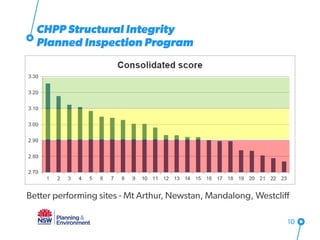
Better performing sites - Mt Arthur, Newstan, Mandalong, Westcliff
11
CHPP Structural Integrity
Planned Inspection Program
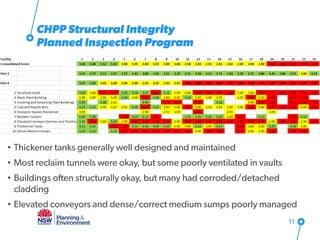
• Thickener tanks generally well designed and maintained
• Most reclaim tunnels were okay, but some poorly ventilated in vaults
• Buildings often structurally okay, but many had corroded/detached
cladding
• Elevated conveyors and dense/correct medium sumps poorly managed
• Most sites considered it a positive process - “Fresh set of eyes”
• Most facilities had a program for structural inspection, but not
always routine or systematic
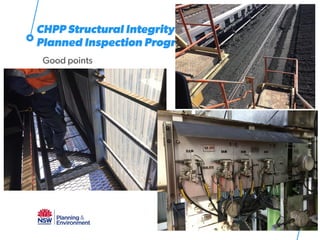
• Specific items of good practice:
o Mesh or handrails across sections of alsinite or polycarbonate wall
sheeting to prevent falling through
o Reclaim tunnels compliant, well laid out, clean, and easily
accessed
o Functional and effective isolation points for pneumatic isolation
o Well engineered harness attachment points
o Bin discharge gates upgraded to mechanical fail to safe
arrangement
o Well designed access walkway or platform
12
CHPP Structural Integrity
Planned Inspection Program
Good points
13
CHPP Structural Integrity
Planned Inspection Program
14
CHPP Structural Integrity
Planned Inspection Program
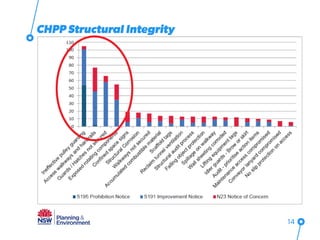
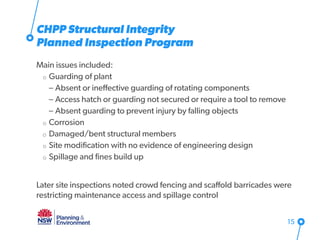
Main issues included:
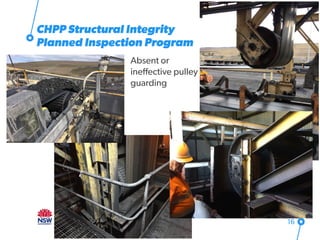
o Guarding of plant
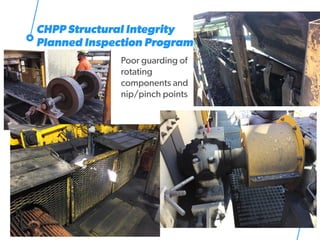
– Absent or ineffective guarding of rotating components
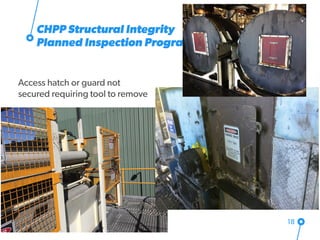
– Access hatch or guarding not secured or require a tool to remove
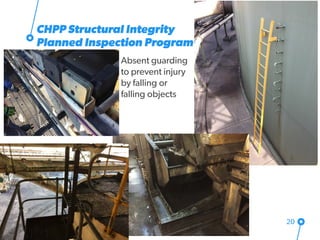
– Absent guarding to prevent injury by falling objects
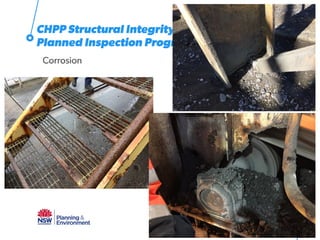
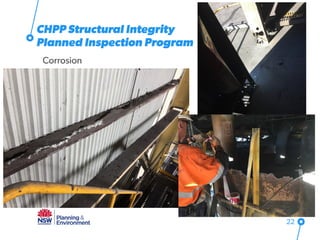
o Corrosion
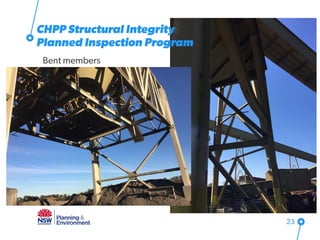
o Damaged/bent structural members
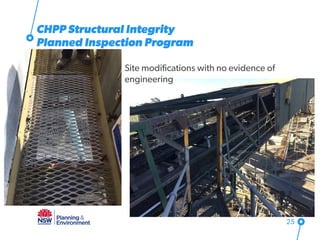
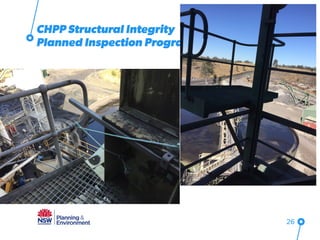
o Site modification with no evidence of engineering design
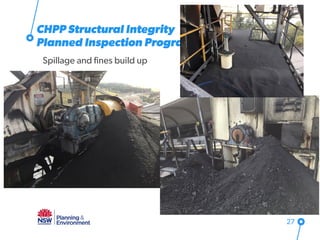
o Spillage and fines build up
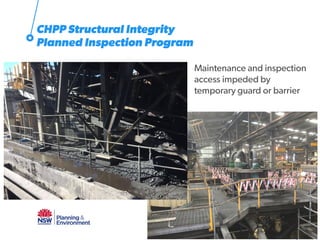
Later site inspections noted crowd fencing and scaffold barricades were
restricting maintenance access and spillage control
15
CHPP Structural Integrity
Planned Inspection Program
Absent or
ineffective pulley
guarding
16
CHPP Structural Integrity
Planned Inspection Program
Poor guarding of
rotating
components and
nip/pinch points
17
CHPP Structural Integrity
Planned Inspection Program
Access hatch or guard not
secured requiring tool to remove
18
CHPP Structural Integrity
Planned Inspection Program
19
CHPP Structural Integrity
Planned Inspection Program
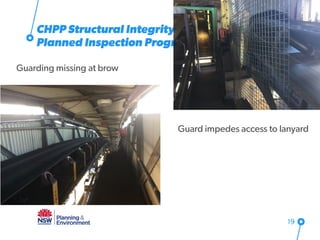
Guarding missing at brow
Guard impedes access to lanyard
Absent guarding
to prevent injury
by falling or
falling objects
20
CHPP Structural Integrity
Planned Inspection Program
Corrosion
21
CHPP Structural Integrity
Planned Inspection Program
Corrosion
22
CHPP Structural Integrity
Planned Inspection Program
Bent members
23
CHPP Structural Integrity
Planned Inspection Program
Maintenance and inspection
access impeded by
temporary guard or barrier
24
CHPP Structural Integrity
Planned Inspection Program
25
CHPP Structural Integrity
Planned Inspection Program
Site modifications with no evidence of
engineering
26
CHPP Structural Integrity
Planned Inspection Program
Spillage and fines build up
27
CHPP Structural Integrity
Planned Inspection Program
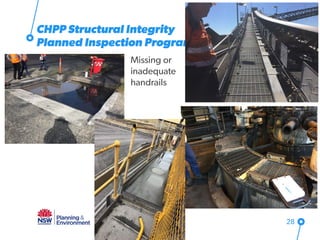
Missing or
inadequate
handrails
28
CHPP Structural Integrity
Planned Inspection Program
29
CHPP Structural Integrity
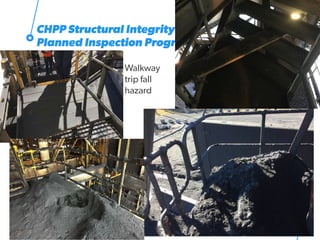
Planned Inspection Program
Walkway
trip fall
hazard
CHPP Structural Integrity
Have we improved?
30
CHPP Structural Integrity
Significant recent incidents
• 27th January, 2018, 30kg section of steel fell 4 metres in
concentrator building of surface mill. Group of three personnel
only 15 metres away
• 0500 hours Thursday 17th May, 2018, a pipe hatch in CHPP
weighing 10 kg was pushed off by pressure from a blockage in
the pipe, hit an adjacent pipe and fell 3 metres onto a walkway
near fine coal centrifuges. Investigation indicates securing bolts
on the hatch were missing
• 30th May, 2018, worker fell through grid mesh floor on first level
of CHPP resulting in broken leg. In response the site installed
1,100 fixing clips, 180 fixing discs, and replaced two corroded
areas
31
CHPP Structural Integrity
• 6th August in a processing plant an overhead crane catenary
bracket weighing 1.3kg fell 22 metres to the floor of the crane
bay
• Open Cut workshop overhead crane monorail bracket weighing
around 1.5 kg fell approximately 10 metres onto floor.
Investigation indicated bolts not secured
• Handrail approx. 3.5 metres above ground pivoted when
worker leaned on it. Fortunately worker landed on scrap metal
chute and was okay. Locking bolt not installed after
maintenance
• Syntron fell onto conveyor under 2000 tonne bin after restraints
broke
32
CHPP Structural Integrity
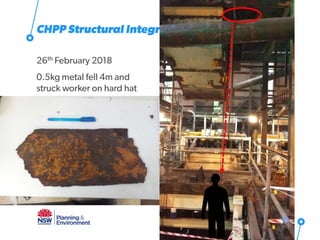
26th February 2018
0.5kg metal fell 4m and
struck worker on hard hat
33
CHPP Structural Integrity
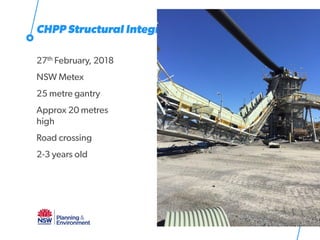
27th February, 2018
NSW Metex
25 metre gantry
Approx 20 metres
high
Road crossing
2-3 years old
34
CHPP Structural Integrity
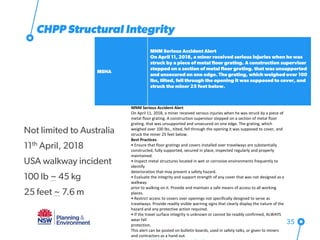
MSHA
MNM Serious Accident Alert
On April 11, 2018, a miner received serious injuries when he was
struck by a piece of metal floor grating. A construction supervisor
stepped on a section of metal floor grating. that was unsupported
and unsecured on one edge. The grating, which weighed over 100
lbs, tilted, fell through the opening it was supposed to cover, and
struck the miner 25 feet below.
Access the MNM Serious Accident Alert here
35
MNM Serious Accident Alert
On April 11, 2018, a miner received serious injuries when he was struck by a piece of
metal floor grating. A construction supervisor stepped on a section of metal floor
grating. that was unsupported and unsecured on one edge. The grating, which
weighed over 100 lbs., tilted, fell through the opening it was supposed to cover, and
struck the miner 25 feet below.
Best Practices
• Ensure that floor gratings and covers installed over travelways are substantially
constructed, fully supported, secured in place, inspected regularly and properly
maintained.
• Inspect metal structures located in wet or corrosive environments frequently to
identify
deterioration that may present a safety hazard.
• Evaluate the integrity and support strength of any cover that was not designed as a
walkway
prior to walking on it. Provide and maintain a safe means of access to all working
places.
• Restrict access to covers over openings not specifically designed to serve as
travelways. Provide readily visible warning signs that clearly display the nature of the
hazard and any protective action required.
• If the travel surface integrity is unknown or cannot be readily confirmed, ALWAYS
wear fall
protection.
This alert can be posted on bulletin boards, used in safety talks, or given to miners
and contractors as a hand out.
Not limited to Australia
11th April, 2018
USA walkway incident
100 lb ~ 45 kg
25 feet ~ 7.6 m
CHPP Structural Integrity
Does it take an incident for
sites to review control
measures?
Known Risk
Known Controls
36
Diesel Exhaust Emission
Targeted Assessment
Program
Diesel Exhaust Emission - Focus
38
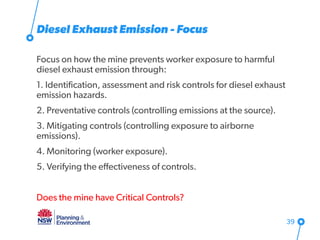
Diesel Exhaust Emission - Focus
Focus on how the mine prevents worker exposure to harmful
diesel exhaust emission through:
1. Identification, assessment and risk controls for diesel exhaust
emission hazards.
2. Preventative controls (controlling emissions at the source).
3. Mitigating controls (controlling exposure to airborne
emissions).
4. Monitoring (worker exposure).
5. Verifying the effectiveness of controls.
Does the mine have Critical Controls?
39
Diesel Exhaust Emission
Metex report findings
considered as
precursor to coal
campaign
40
Diesel Exhaust Emission
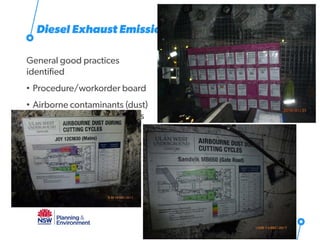
General good practices
identified
• Procedure/workorder board
• Airborne contaminants (dust)
board for continuous miners
41
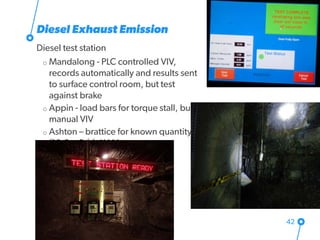
Diesel Exhaust Emission
Diesel test station
o Mandalong - PLC controlled VIV,
records automatically and results sent
to surface control room, but test
against brake
o Appin - load bars for torque stall, but
manual VIV
o Ashton – brattice for known quantity
(10.2 m3/s), XAM on rope
42
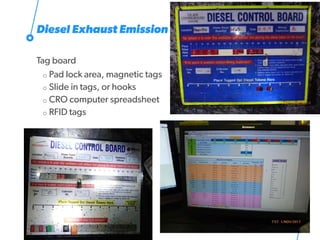
Diesel Exhaust Emission
Tag board
o Pad lock area, magnetic tags
o Slide in tags, or hooks
o CRO computer spreadsheet
o RFID tags
43
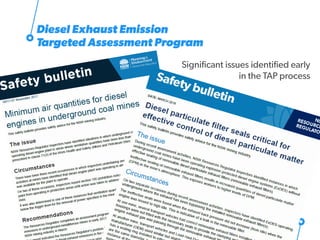
Diesel Exhaust Emission
Targeted Assessment Program
Significant issues identified early
in the TAP process
44
Diesel Exhaust Emission
Targeted Assessment Program
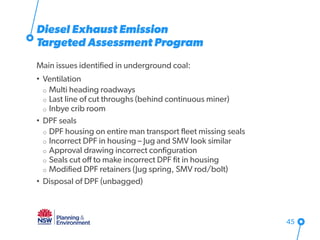
Main issues identified in underground coal:
• Ventilation
o Multi heading roadways
o Last line of cut throughs (behind continuous miner)
o Inbye crib room
• DPF seals
o DPF housing on entire man transport fleet missing seals
o Incorrect DPF in housing – Jug and SMV look similar
o Approval drawing incorrect configuration
o Seals cut off to make incorrect DPF fit in housing
o Modified DPF retainers (Jug spring, SMV rod/bolt)
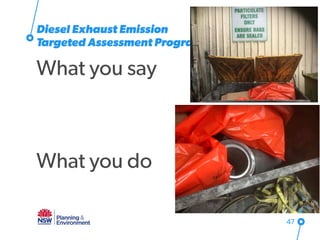
• Disposal of DPF (unbagged)
45
Diesel Exhaust Emission
Targeted Assessment Program
46
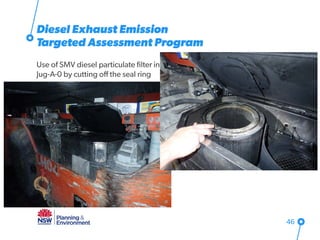
Use of SMV diesel particulate filter in
Jug-A-0 by cutting off the seal ring
Diesel Exhaust Emission
Targeted Assessment Program
47
What you say
What you do
Diesel Exhaust Emission
Targeted Assessment Program
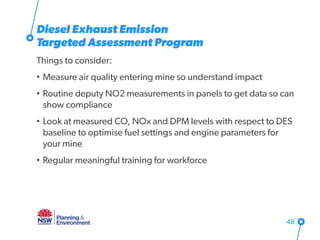
Things to consider:
• Measure air quality entering mine so understand impact
• Routine deputy NO2 measurements in panels to get data so can
show compliance
• Look at measured CO, NOx and DPM levels with respect to DES
baseline to optimise fuel settings and engine parameters for
your mine
• Regular meaningful training for workforce
48
Diesel Exhaust Emission
July 2018
49
Diesel Exhaust Emission
50
Diesel Exhaust Emissions
Do we need diesel mobile
plant?
Known Risk
Known Controls
51
Diesel Exhaust Emission
52
Fire and Explosions
Targeted Assessment
Program
Fire and Explosion - Focus
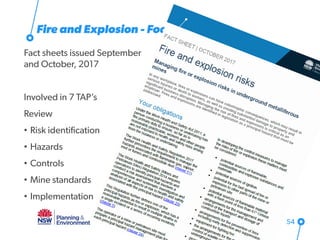
Fact sheets issued September
and October, 2017
Involved in 7 TAP’s
Review
• Risk identification
• Hazards
• Controls
• Mine standards
• Implementation
54
Fire and Explosion - Focus
Why assess the mine on fire and
explosion management?
Principal mining hazard
WHS (MPS) Regs Clause 5 (a) (ix)
55
Fire and Explosion
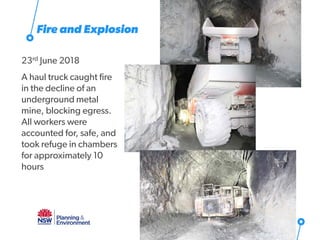
23rd June 2018
A haul truck caught fire
in the decline of an
underground metal
mine, blocking egress.
All workers were
accounted for, safe, and
took refuge in chambers
for approximately 10
hours
56
Fire and Explosion - Focus
Applicable Legislation – Mechanical Engineering Control Plan
WHS (MPS) Regulations Schedule 2 Clause 2
• (1) …“determining the means by which the mine operator will
manage the risks to health and safety from the mechanical
aspects of plant and structures”
• (2) …“ set out the control measures for…
o (b) the unintended initiation of explosions
o (f) uncontrolled fires being initiated or fuelled by plant
57
Fire and Explosion - Focus
Applicable Legislation – Mechanical Engineering Control Plan
WHS (MPS) Regulations Schedule 2 Clause 2
• (3) …”must be taken into account…
o (g) the risks associated with diesel engines
o (h) … face machines, mobile plant, drilling plant
o (j) … transfer and storage of combustible liquids
o (k) the prevention, detection and suppression of fires on
mobile plant and conveyors
o (m) the maintenance of explosion protected equipment in an
explosion protected state
o (n) undertaking of hot work
o (o) the use of fire resistant hydraulic fluids and materials…”
58
Fire and Explosion
Targeted Assessment Program
Mechanical Hazards
• Frictional ignition
– cutter drum picks and sprays
– drilling/bolting rigs water flow and tips
• Diesels
– explosion protection = over 3000 contained explosions per
minute (electrical and mining plans avoid one explosion in a
lifetime)
– fuel over hot engine components
– CAT3126 engine catastrophic failures
59
Fire and Explosion
Targeted Assessment Program
Mechanical Hazards
• Conveyor fires
– hot/collapsed bearings (grease/oil/fibres)
– belt tracking (friction, fibres)
• Hot works
• Flammable liquid use and storage
• Aluminium components
60
Fire and Explosion
Targeted Assessment Program
Repeated issues
• MECP does not reflect actual standards at mine – refuelling bays,
preuse inspections CM/diesels
• Conveyor standards -
spillage/clearance/tracking/fibres/fines/guarding/
housekeeping/valid inspections/verification of inspection standard.
Position of CO alarms
• Oil drums – not on bunds, damaged, positioned where can be
damaged
• Refuelling bay - Fuel pods spillage (200 litres), rubbish, lack of
preparation/standards for temporary bays (stonedust/shotcrete/
concrete/drainage/ventilation), is it a temporary bay? (6 months – 18
months)
61
Fire and Explosion
Targeted Assessment Program
Repeated issues
• Surface fuel tank – build up of combustible material around
• Aluminium – splice gear not stored in steel container
• Lack of fire fighting equipment to suit the risk at key
infrastructure locations. Working off old legislative
requirement and MDG1032 for minimum. Consider the hazard
and provision/locate accordingly
• Smoking paraphernalia in a hazardous goods shed
62
Fire and Explosion
Other issues
• Conveyor guarding – access to rotating equipment, area guards full of
spillage, underpass transitions so don’t walk into return belt, brow
points
• Lifting gear - inspections out of date (hoarding,
fitter/rigger/dogman, static loaded), damaged and in service, etc
• Scaf tags – inspection out of date, no barricade to prevent use
• Lack of ventilation in workshop/diesel bay. If don’t want to waste air
into return then use vent tubes and air fan. Lack of ventilation not
classed as a control measure in the fire triangle
• Sump handrails – drive in sump, surface dams
• Gas cylinders not restrained from falling
• MECP includes management of items in Schedule 2
63
Fire and Explosion - Fitters
Broad generalisation
• They have better understanding of fire risks and controls
associated with diesels, conveyors and frictional ignition
• Lesser understanding of fire fighting system, except around
conveyors (deluge systems)
• Reasonable inspections of picks/sprays, water flow/pressure.
Often not recorded in Deputy report
• Require maintenance and inspection standards, such as:
o rules for numbers of picks/sprays before stop and change
o curtains and additional throat sprays
• Inspection shift – If one shift is doing all the maintenance and
daily inspections then diminishing skills on other shifts =
reliance
64
Fire and Explosion
Controls
• Identify biggest hazard in mine – Conveyor fires, Frictional ignition
• Identification of critical controls – top of head examples
o Conveyor pulley RTD’s
o Conveyor wander switch
o Conveyor inspection (idler tags, spillage clearance, etc)
o Equipment preuse inspection
• Verification of controls
• Equipment designed to prevent oil spills (bunded oil pods) are
maintained
65
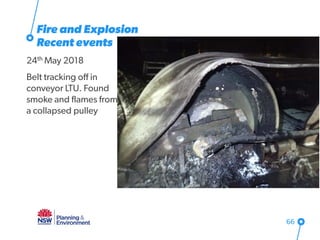
Fire and Explosion
Recent events
24th May 2018
Belt tracking off in
conveyor LTU. Found
smoke and flames from
a collapsed pulley
66
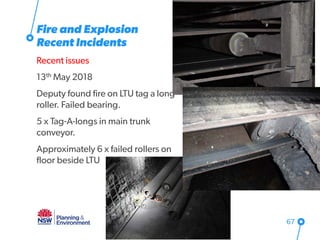
Fire and Explosion
Recent Incidents
Recent issues
13th May 2018
Deputy found fire on LTU tag a long
roller. Failed bearing.
5 x Tag-A-longs in main trunk
conveyor.
Approximately 6 x failed rollers on
floor beside LTU
67
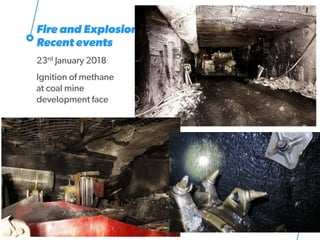
Fire and Explosion
Recent events
23rd January 2018
Ignition of methane
at coal mine
development face
68
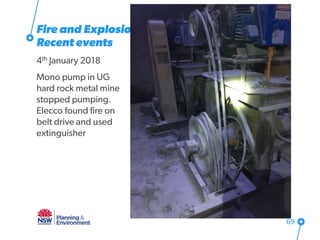
Fire and Explosion
Recent events
4th January 2018
Mono pump in UG
hard rock metal mine
stopped pumping.
Elecco found fire on
belt drive and used
extinguisher
69
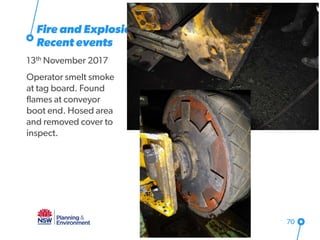
Fire and Explosion
Recent events
13th November 2017
Operator smelt smoke
at tag board. Found
flames at conveyor
boot end. Hosed area
and removed cover to
inspect.
70
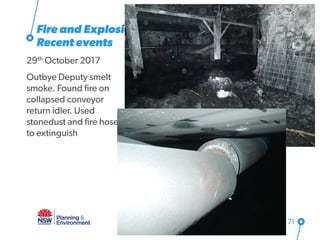
Fire and Explosion
Recent events
29th October 2017
Outbye Deputy smelt
smoke. Found fire on
collapsed conveyor
return idler. Used
stonedust and fire hose
to extinguish
71
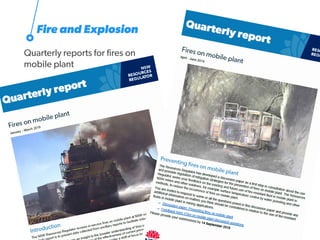
Fire and Explosion
Quarterly reports for fires on
mobile plant
72
Mechanical Engineering
Control Plan
Systematic approach
MECP - Configuration
• MECP – describes overall system and maintenance philosophy,
with subordinate docs describing how applied to specific issues
(North Wambo good example)
Versus
• MECP – Directory to subordinate systems, then area document
directory to specific items, then item details how managed.
74
MECP – Roles and Responsibilities
• Identifies all the Mechanical and associated roles (including
trades, leading hands, supervisors, coordinators, managers,
etc)
• Dictates the hierarchal relationship between roles
• Clearly describes the role and associated responsibilities
75
Questions

Targeted assessment program update Greg Connolly

  • 1.
    Greg Connolly September 2018 TargetedAssessment Program Mechanical Update Mechanical Engineering Safety Seminar MESS 2018 Known Risk Known Control
  • 2.
    Overview of theProcess What is assessed? • Principal Hazards identified in WHS(MPS) Regulations – Fire and Explosions • Hazards requiring Specific control measures in WHS(MPS) Regulations – Diesel exhaust emissions • Incident identified hazards – CHPP Structural Integrity 2
  • 3.
    Overview of theProcess Why is your mine or facility assessed? o Mining Hazards risk assessment oIdentify hazards oRank hazards o Bow tie assessment of the highest ranked hazards o Prepare assessment template o Nominate assessment span (all mines, UG mines, highest risk) o Identify the mines that will be impacted by the hazard 3
  • 4.
    Overview of theProcess What is the process? o Review the mining hazard risk assessment (BBRA, principal mining hazards, etc) o Review the controls required to mitigate the hazard o Review the management systems in place to control o Review the standards in the workplace o Workforce feedback 4
  • 5.
    TAPS with MechanicalFocus Concentrate on three Programs with mechanical focus: • CHPP Structural Integrity • Diesel Exhaust Emissions • Fire and Explosions 5
  • 6.
  • 7.
    CHPP Structural Integrity- Focus Department had been considering an assessment program for Coal Handling Plants Developed in response to incidents at coal handling and preparation plants (SA17-02) o Western coalfield - CHPP boilermaker on crusher walkway incident o Hunter Valley – person falls through corroded walkway mesh Campaign of Planned Inspections o Determine if issues exist Site inspections – April to August 2017 Report issued November 2017 7
  • 8.
    • Criteria forprioritising inspection o Older plant o Inspectors had identified issues o Previous incident • 23 of the 46 facilities inspected • Four sites considered satisfactory • Six (6) facilities issued with Prohibition Notices, primarily related to systemic absence of, or ineffective, guarding 8 CHPP Structural Integrity Planned Inspection Program
  • 9.
    Ten (10) plantareas scored • Risk Management and documentation • Structural Audit process • Wash plant building • Crushing and screening plant building • Coal and rejects bins • Stockpile stacker/reclaimer • Elevated conveyor gantries and trestles • Reclaim tunnels • Thickenner tanks • Dense/correct medium sumps 9 CHPP Structural Integrity Planned Inspection Program Identification of Hazards and Risks Implementation of Controls Multi level, high density of static and dynamic plant, complex network of walkways/platforms/stairs Interaction with surface machinery, single accessway at high elevation Additional risk of Engulfment/irrespirable atmosphere Additional risk of Drowning
  • 10.
    10 CHPP Structural Integrity PlannedInspection Program Better performing sites - Mt Arthur, Newstan, Mandalong, Westcliff
  • 11.
    11 CHPP Structural Integrity PlannedInspection Program • Thickener tanks generally well designed and maintained • Most reclaim tunnels were okay, but some poorly ventilated in vaults • Buildings often structurally okay, but many had corroded/detached cladding • Elevated conveyors and dense/correct medium sumps poorly managed
  • 12.
    • Most sitesconsidered it a positive process - “Fresh set of eyes” • Most facilities had a program for structural inspection, but not always routine or systematic • Specific items of good practice: o Mesh or handrails across sections of alsinite or polycarbonate wall sheeting to prevent falling through o Reclaim tunnels compliant, well laid out, clean, and easily accessed o Functional and effective isolation points for pneumatic isolation o Well engineered harness attachment points o Bin discharge gates upgraded to mechanical fail to safe arrangement o Well designed access walkway or platform 12 CHPP Structural Integrity Planned Inspection Program
  • 13.
    Good points 13 CHPP StructuralIntegrity Planned Inspection Program
  • 14.
  • 15.
    Main issues included: oGuarding of plant – Absent or ineffective guarding of rotating components – Access hatch or guarding not secured or require a tool to remove – Absent guarding to prevent injury by falling objects o Corrosion o Damaged/bent structural members o Site modification with no evidence of engineering design o Spillage and fines build up Later site inspections noted crowd fencing and scaffold barricades were restricting maintenance access and spillage control 15 CHPP Structural Integrity Planned Inspection Program
  • 16.
    Absent or ineffective pulley guarding 16 CHPPStructural Integrity Planned Inspection Program
  • 17.
    Poor guarding of rotating componentsand nip/pinch points 17 CHPP Structural Integrity Planned Inspection Program
  • 18.
    Access hatch orguard not secured requiring tool to remove 18 CHPP Structural Integrity Planned Inspection Program
  • 19.
    19 CHPP Structural Integrity PlannedInspection Program Guarding missing at brow Guard impedes access to lanyard
  • 20.
    Absent guarding to preventinjury by falling or falling objects 20 CHPP Structural Integrity Planned Inspection Program
  • 21.
  • 22.
  • 23.
    Bent members 23 CHPP StructuralIntegrity Planned Inspection Program
  • 24.
    Maintenance and inspection accessimpeded by temporary guard or barrier 24 CHPP Structural Integrity Planned Inspection Program
  • 25.
    25 CHPP Structural Integrity PlannedInspection Program Site modifications with no evidence of engineering
  • 26.
  • 27.
    Spillage and finesbuild up 27 CHPP Structural Integrity Planned Inspection Program
  • 28.
    Missing or inadequate handrails 28 CHPP StructuralIntegrity Planned Inspection Program
  • 29.
    29 CHPP Structural Integrity PlannedInspection Program Walkway trip fall hazard
  • 30.
  • 31.
    CHPP Structural Integrity Significantrecent incidents • 27th January, 2018, 30kg section of steel fell 4 metres in concentrator building of surface mill. Group of three personnel only 15 metres away • 0500 hours Thursday 17th May, 2018, a pipe hatch in CHPP weighing 10 kg was pushed off by pressure from a blockage in the pipe, hit an adjacent pipe and fell 3 metres onto a walkway near fine coal centrifuges. Investigation indicates securing bolts on the hatch were missing • 30th May, 2018, worker fell through grid mesh floor on first level of CHPP resulting in broken leg. In response the site installed 1,100 fixing clips, 180 fixing discs, and replaced two corroded areas 31
  • 32.
    CHPP Structural Integrity •6th August in a processing plant an overhead crane catenary bracket weighing 1.3kg fell 22 metres to the floor of the crane bay • Open Cut workshop overhead crane monorail bracket weighing around 1.5 kg fell approximately 10 metres onto floor. Investigation indicated bolts not secured • Handrail approx. 3.5 metres above ground pivoted when worker leaned on it. Fortunately worker landed on scrap metal chute and was okay. Locking bolt not installed after maintenance • Syntron fell onto conveyor under 2000 tonne bin after restraints broke 32
  • 33.
    CHPP Structural Integrity 26thFebruary 2018 0.5kg metal fell 4m and struck worker on hard hat 33
  • 34.
    CHPP Structural Integrity 27thFebruary, 2018 NSW Metex 25 metre gantry Approx 20 metres high Road crossing 2-3 years old 34
  • 35.
    CHPP Structural Integrity MSHA MNMSerious Accident Alert On April 11, 2018, a miner received serious injuries when he was struck by a piece of metal floor grating. A construction supervisor stepped on a section of metal floor grating. that was unsupported and unsecured on one edge. The grating, which weighed over 100 lbs, tilted, fell through the opening it was supposed to cover, and struck the miner 25 feet below. Access the MNM Serious Accident Alert here 35 MNM Serious Accident Alert On April 11, 2018, a miner received serious injuries when he was struck by a piece of metal floor grating. A construction supervisor stepped on a section of metal floor grating. that was unsupported and unsecured on one edge. The grating, which weighed over 100 lbs., tilted, fell through the opening it was supposed to cover, and struck the miner 25 feet below. Best Practices • Ensure that floor gratings and covers installed over travelways are substantially constructed, fully supported, secured in place, inspected regularly and properly maintained. • Inspect metal structures located in wet or corrosive environments frequently to identify deterioration that may present a safety hazard. • Evaluate the integrity and support strength of any cover that was not designed as a walkway prior to walking on it. Provide and maintain a safe means of access to all working places. • Restrict access to covers over openings not specifically designed to serve as travelways. Provide readily visible warning signs that clearly display the nature of the hazard and any protective action required. • If the travel surface integrity is unknown or cannot be readily confirmed, ALWAYS wear fall protection. This alert can be posted on bulletin boards, used in safety talks, or given to miners and contractors as a hand out. Not limited to Australia 11th April, 2018 USA walkway incident 100 lb ~ 45 kg 25 feet ~ 7.6 m
  • 36.
    CHPP Structural Integrity Doesit take an incident for sites to review control measures? Known Risk Known Controls 36
  • 37.
  • 38.
  • 39.
    Diesel Exhaust Emission- Focus Focus on how the mine prevents worker exposure to harmful diesel exhaust emission through: 1. Identification, assessment and risk controls for diesel exhaust emission hazards. 2. Preventative controls (controlling emissions at the source). 3. Mitigating controls (controlling exposure to airborne emissions). 4. Monitoring (worker exposure). 5. Verifying the effectiveness of controls. Does the mine have Critical Controls? 39
  • 40.
    Diesel Exhaust Emission Metexreport findings considered as precursor to coal campaign 40
  • 41.
    Diesel Exhaust Emission Generalgood practices identified • Procedure/workorder board • Airborne contaminants (dust) board for continuous miners 41
  • 42.
    Diesel Exhaust Emission Dieseltest station o Mandalong - PLC controlled VIV, records automatically and results sent to surface control room, but test against brake o Appin - load bars for torque stall, but manual VIV o Ashton – brattice for known quantity (10.2 m3/s), XAM on rope 42
  • 43.
    Diesel Exhaust Emission Tagboard o Pad lock area, magnetic tags o Slide in tags, or hooks o CRO computer spreadsheet o RFID tags 43
  • 44.
    Diesel Exhaust Emission TargetedAssessment Program Significant issues identified early in the TAP process 44
  • 45.
    Diesel Exhaust Emission TargetedAssessment Program Main issues identified in underground coal: • Ventilation o Multi heading roadways o Last line of cut throughs (behind continuous miner) o Inbye crib room • DPF seals o DPF housing on entire man transport fleet missing seals o Incorrect DPF in housing – Jug and SMV look similar o Approval drawing incorrect configuration o Seals cut off to make incorrect DPF fit in housing o Modified DPF retainers (Jug spring, SMV rod/bolt) • Disposal of DPF (unbagged) 45
  • 46.
    Diesel Exhaust Emission TargetedAssessment Program 46 Use of SMV diesel particulate filter in Jug-A-0 by cutting off the seal ring
  • 47.
    Diesel Exhaust Emission TargetedAssessment Program 47 What you say What you do
  • 48.
    Diesel Exhaust Emission TargetedAssessment Program Things to consider: • Measure air quality entering mine so understand impact • Routine deputy NO2 measurements in panels to get data so can show compliance • Look at measured CO, NOx and DPM levels with respect to DES baseline to optimise fuel settings and engine parameters for your mine • Regular meaningful training for workforce 48
  • 49.
  • 50.
  • 51.
    Diesel Exhaust Emissions Dowe need diesel mobile plant? Known Risk Known Controls 51
  • 52.
  • 53.
    Fire and Explosions TargetedAssessment Program
  • 54.
    Fire and Explosion- Focus Fact sheets issued September and October, 2017 Involved in 7 TAP’s Review • Risk identification • Hazards • Controls • Mine standards • Implementation 54
  • 55.
    Fire and Explosion- Focus Why assess the mine on fire and explosion management? Principal mining hazard WHS (MPS) Regs Clause 5 (a) (ix) 55
  • 56.
    Fire and Explosion 23rdJune 2018 A haul truck caught fire in the decline of an underground metal mine, blocking egress. All workers were accounted for, safe, and took refuge in chambers for approximately 10 hours 56
  • 57.
    Fire and Explosion- Focus Applicable Legislation – Mechanical Engineering Control Plan WHS (MPS) Regulations Schedule 2 Clause 2 • (1) …“determining the means by which the mine operator will manage the risks to health and safety from the mechanical aspects of plant and structures” • (2) …“ set out the control measures for… o (b) the unintended initiation of explosions o (f) uncontrolled fires being initiated or fuelled by plant 57
  • 58.
    Fire and Explosion- Focus Applicable Legislation – Mechanical Engineering Control Plan WHS (MPS) Regulations Schedule 2 Clause 2 • (3) …”must be taken into account… o (g) the risks associated with diesel engines o (h) … face machines, mobile plant, drilling plant o (j) … transfer and storage of combustible liquids o (k) the prevention, detection and suppression of fires on mobile plant and conveyors o (m) the maintenance of explosion protected equipment in an explosion protected state o (n) undertaking of hot work o (o) the use of fire resistant hydraulic fluids and materials…” 58
  • 59.
    Fire and Explosion TargetedAssessment Program Mechanical Hazards • Frictional ignition – cutter drum picks and sprays – drilling/bolting rigs water flow and tips • Diesels – explosion protection = over 3000 contained explosions per minute (electrical and mining plans avoid one explosion in a lifetime) – fuel over hot engine components – CAT3126 engine catastrophic failures 59
  • 60.
    Fire and Explosion TargetedAssessment Program Mechanical Hazards • Conveyor fires – hot/collapsed bearings (grease/oil/fibres) – belt tracking (friction, fibres) • Hot works • Flammable liquid use and storage • Aluminium components 60
  • 61.
    Fire and Explosion TargetedAssessment Program Repeated issues • MECP does not reflect actual standards at mine – refuelling bays, preuse inspections CM/diesels • Conveyor standards - spillage/clearance/tracking/fibres/fines/guarding/ housekeeping/valid inspections/verification of inspection standard. Position of CO alarms • Oil drums – not on bunds, damaged, positioned where can be damaged • Refuelling bay - Fuel pods spillage (200 litres), rubbish, lack of preparation/standards for temporary bays (stonedust/shotcrete/ concrete/drainage/ventilation), is it a temporary bay? (6 months – 18 months) 61
  • 62.
    Fire and Explosion TargetedAssessment Program Repeated issues • Surface fuel tank – build up of combustible material around • Aluminium – splice gear not stored in steel container • Lack of fire fighting equipment to suit the risk at key infrastructure locations. Working off old legislative requirement and MDG1032 for minimum. Consider the hazard and provision/locate accordingly • Smoking paraphernalia in a hazardous goods shed 62
  • 63.
    Fire and Explosion Otherissues • Conveyor guarding – access to rotating equipment, area guards full of spillage, underpass transitions so don’t walk into return belt, brow points • Lifting gear - inspections out of date (hoarding, fitter/rigger/dogman, static loaded), damaged and in service, etc • Scaf tags – inspection out of date, no barricade to prevent use • Lack of ventilation in workshop/diesel bay. If don’t want to waste air into return then use vent tubes and air fan. Lack of ventilation not classed as a control measure in the fire triangle • Sump handrails – drive in sump, surface dams • Gas cylinders not restrained from falling • MECP includes management of items in Schedule 2 63
  • 64.
    Fire and Explosion- Fitters Broad generalisation • They have better understanding of fire risks and controls associated with diesels, conveyors and frictional ignition • Lesser understanding of fire fighting system, except around conveyors (deluge systems) • Reasonable inspections of picks/sprays, water flow/pressure. Often not recorded in Deputy report • Require maintenance and inspection standards, such as: o rules for numbers of picks/sprays before stop and change o curtains and additional throat sprays • Inspection shift – If one shift is doing all the maintenance and daily inspections then diminishing skills on other shifts = reliance 64
  • 65.
    Fire and Explosion Controls •Identify biggest hazard in mine – Conveyor fires, Frictional ignition • Identification of critical controls – top of head examples o Conveyor pulley RTD’s o Conveyor wander switch o Conveyor inspection (idler tags, spillage clearance, etc) o Equipment preuse inspection • Verification of controls • Equipment designed to prevent oil spills (bunded oil pods) are maintained 65
  • 66.
    Fire and Explosion Recentevents 24th May 2018 Belt tracking off in conveyor LTU. Found smoke and flames from a collapsed pulley 66
  • 67.
    Fire and Explosion RecentIncidents Recent issues 13th May 2018 Deputy found fire on LTU tag a long roller. Failed bearing. 5 x Tag-A-longs in main trunk conveyor. Approximately 6 x failed rollers on floor beside LTU 67
  • 68.
    Fire and Explosion Recentevents 23rd January 2018 Ignition of methane at coal mine development face 68
  • 69.
    Fire and Explosion Recentevents 4th January 2018 Mono pump in UG hard rock metal mine stopped pumping. Elecco found fire on belt drive and used extinguisher 69
  • 70.
    Fire and Explosion Recentevents 13th November 2017 Operator smelt smoke at tag board. Found flames at conveyor boot end. Hosed area and removed cover to inspect. 70
  • 71.
    Fire and Explosion Recentevents 29th October 2017 Outbye Deputy smelt smoke. Found fire on collapsed conveyor return idler. Used stonedust and fire hose to extinguish 71
  • 72.
    Fire and Explosion Quarterlyreports for fires on mobile plant 72
  • 73.
  • 74.
    MECP - Configuration •MECP – describes overall system and maintenance philosophy, with subordinate docs describing how applied to specific issues (North Wambo good example) Versus • MECP – Directory to subordinate systems, then area document directory to specific items, then item details how managed. 74
  • 75.
    MECP – Rolesand Responsibilities • Identifies all the Mechanical and associated roles (including trades, leading hands, supervisors, coordinators, managers, etc) • Dictates the hierarchal relationship between roles • Clearly describes the role and associated responsibilities 75
  • 76.