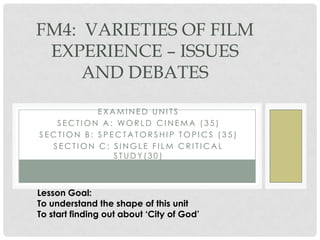
E X A M I N E D U N I T S
S E C T I O N A : WO R L D C I N E M A ( 3 5 )
S E C T I O N B : S P E C T A T O R S H I P T O P I C S ( 3 5 )
S E C T I O N C : S I N G L E F I L M C R I T I C A L
S T U D Y (3 0 )
FM4: VARIETIES OF FILM
EXPERIENCE – ISSUES
AND DEBATES
Lesson Goal:
To understand the shape of this unit
To start finding out about ‘City of God’
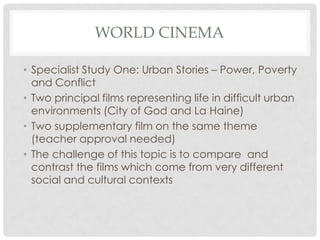
WORLD CINEMA
• Specialist Study One: Urban Stories – Power, Poverty
and Conflict
• Two principal films representing life in difficult urban
environments (City of God and La Haine)
• Two supplementary film on the same theme
(teacher approval needed)
• The challenge of this topic is to compare and
contrast the films which come from very different
social and cultural contexts
THE EXAM – SUMMER 2012
• Your answer should be based on a minimum of two
films.
• Either,
• 5. Explore how the representation of urban
environments contributes to the key themes of your
chosen films [35]
• OR,
• 6. „The stylistic choices made by filmmakers define
not just the look but also the meaning of the film.‟
How far is this true of the films you have studied for
this topic? [35]
THE EXAM – WINTER 2011
• Your answer should be based on a minimum of two
films.
• Either,
• 5. Compare the attitudes to poverty conveyed in
the films you have studied for this topic. [35]
• Or,
• 6. Explore how stylistic choices contribute to the
representation of the urban experience in the
• films you have studied for this topic. [35]
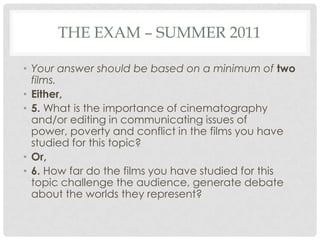
THE EXAM – SUMMER 2011
• Your answer should be based on a minimum of two
films.
• Either,
• 5. What is the importance of cinematography
and/or editing in communicating issues of
power, poverty and conflict in the films you have
studied for this topic?
• Or,
• 6. How far do the films you have studied for this
topic challenge the audience, generate debate
about the worlds they represent?
THE EXAM - SUMMER 2010
• Your answer should be based on a minimum of two
films.
• Either
• 5. How far does the impact of the films you have
studied for this topic depend on distinctive uses of
film techniques? [35]
• Or,
• 6. How far do the films you have studied for this
topic offer an analysis of the social issues they
present? [35]
THE EXAM – STYLE OF QUESTIONS
• One question looks at film style and techniques
(micro features, narrative) and will focus on the
means by which the film makers utilise film
techniques in order to achieve their effects – and
on how far artistic decisions determine the overall
impact of the films studied.
• The other on contexts of production – „urban stories‟
or key themes.
• There will be a very heavy emphasis on comparing
and contrasting the films
• So you must be able to recall very specific details.
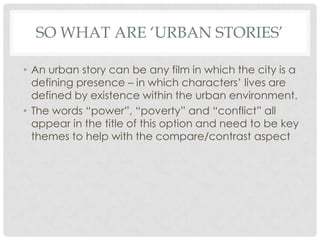
SO WHAT ARE ‘URBAN STORIES’
• An urban story can be any film in which the city is a
defining presence – in which characters‟ lives are
defined by existence within the urban environment.
• The words “power”, “poverty” and “conflict” all
appear in the title of this option and need to be key
themes to help with the compare/contrast aspect
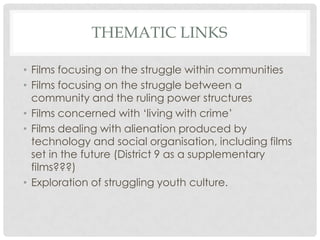
THEMATIC LINKS
• Films focusing on the struggle within communities
• Films focusing on the struggle between a
community and the ruling power structures
• Films concerned with „living with crime‟
• Films dealing with alienation produced by
technology and social organisation, including films
set in the future (District 9 as a supplementary
films???)
• Exploration of struggling youth culture.
STYLISTIC LINKS
• The films may also be linked by stylistic approach:
• Films working from a neo-realist / documentary
aesthetic
• Films working with new wave / experimental
techniques
• Films based on genre cinema
CITY OF GOD
• Based on the book of the same name by writer Paulo
Lins, (based on a true story), City of God(Cidade de
Deus) is a violent, fast-paced movie that tells the tale of
the residents of this Brazilian favela (slum).
• Events are seen through the eyes of Rocket, a poor
black youth who is too scared to become an outlaw but
too smart to get saddled with an underpaid, menial job.
He grows up in an extremely violent environment and
watches as many of his peers are easily sucked into a life
of crime and drugs. It seems the odds are against him.
• The film follows the lives of many characters that live
within this small, ramshackle shantytown. In particular we
see two small boys grow up to take two very different
paths: one a photographer, the other a drug dealer.
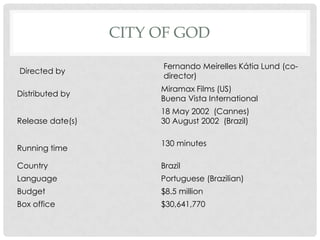
CITY OF GOD
Directed by
Fernando Meirelles Kátia Lund (co-
director)
Distributed by
Miramax Films (US)
Buena Vista International
Release date(s)
18 May 2002 (Cannes)
30 August 2002 (Brazil)
Running time
130 minutes
Country Brazil
Language Portuguese (Brazilian)
Budget $8.5 million
Box office $30,641,770
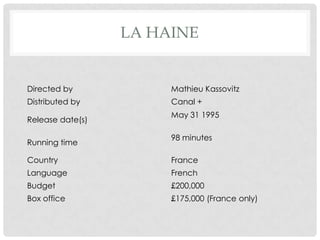
LA HAINE
• La Haine is a 1995 French black-and-white drama/suspense
film written, co-edited, and directed by Mathieu Kassovitz
• It is about three young friends and their struggle to live in the
banlieues of Paris. The title derives from a line spoken by one
of them, Hubert: "La haine attire la haine!", "hatred breeds
hatred.
• The film depicts approximately 19 consecutive hours in the
lives of three friends in their early twenties from immigrant
families Vinz (Vincent Cassel), who is Jewish, is filled with rage.
He sees himself as a gangster ready to win respect by killing a
cop. Hubert (Hubert Koundé) is an Afro-French boxer and
small time drug dealer, the most mature of the three, whose
gymnasium was burned in the riots. Saïd - Sayid in some English
subtitles - (Saïd Taghmaoui) is a Maghrebin who inhabits the
middle ground between his two friends' responses to their
place in life.
LA HAINE
Directed by Mathieu Kassovitz
Distributed by Canal +
Release date(s)
May 31 1995
Running time
98 minutes
Country France
Language French
Budget £200,000
Box office £175,000 (France only)
REVIEWS
• Using the internet (but not in here….) find and read at
least five reviews of City of God. Print off the reviews
and highlight interesting points.
• Try to get some reviews from these people/magazines
• James Berardinelli Peter Bradshaw (The Guardian) Ty Burr
(Boston Globe) Justin Chang (Variety) New York Times
The New Yorker New York Observer Roger Ebert
(Chicago Sun Times) Washington Post Hollywood
Reporter Entertainment Weekly Leonard Maltin (USA
Today) Andrew Sarris Rolling Stone Empire Los Angeles
Times
• Be prepared to discuss your findings in the next class….

Intro to world cinema

  • 1.
    E X AM I N E D U N I T S S E C T I O N A : WO R L D C I N E M A ( 3 5 ) S E C T I O N B : S P E C T A T O R S H I P T O P I C S ( 3 5 ) S E C T I O N C : S I N G L E F I L M C R I T I C A L S T U D Y (3 0 ) FM4: VARIETIES OF FILM EXPERIENCE – ISSUES AND DEBATES Lesson Goal: To understand the shape of this unit To start finding out about ‘City of God’
  • 2.
    WORLD CINEMA • SpecialistStudy One: Urban Stories – Power, Poverty and Conflict • Two principal films representing life in difficult urban environments (City of God and La Haine) • Two supplementary film on the same theme (teacher approval needed) • The challenge of this topic is to compare and contrast the films which come from very different social and cultural contexts
  • 3.
    THE EXAM –SUMMER 2012 • Your answer should be based on a minimum of two films. • Either, • 5. Explore how the representation of urban environments contributes to the key themes of your chosen films [35] • OR, • 6. „The stylistic choices made by filmmakers define not just the look but also the meaning of the film.‟ How far is this true of the films you have studied for this topic? [35]
  • 4.
    THE EXAM –WINTER 2011 • Your answer should be based on a minimum of two films. • Either, • 5. Compare the attitudes to poverty conveyed in the films you have studied for this topic. [35] • Or, • 6. Explore how stylistic choices contribute to the representation of the urban experience in the • films you have studied for this topic. [35]
  • 5.
    THE EXAM –SUMMER 2011 • Your answer should be based on a minimum of two films. • Either, • 5. What is the importance of cinematography and/or editing in communicating issues of power, poverty and conflict in the films you have studied for this topic? • Or, • 6. How far do the films you have studied for this topic challenge the audience, generate debate about the worlds they represent?
  • 6.
    THE EXAM -SUMMER 2010 • Your answer should be based on a minimum of two films. • Either • 5. How far does the impact of the films you have studied for this topic depend on distinctive uses of film techniques? [35] • Or, • 6. How far do the films you have studied for this topic offer an analysis of the social issues they present? [35]
  • 7.
    THE EXAM –STYLE OF QUESTIONS • One question looks at film style and techniques (micro features, narrative) and will focus on the means by which the film makers utilise film techniques in order to achieve their effects – and on how far artistic decisions determine the overall impact of the films studied. • The other on contexts of production – „urban stories‟ or key themes. • There will be a very heavy emphasis on comparing and contrasting the films • So you must be able to recall very specific details.
  • 8.
    SO WHAT ARE‘URBAN STORIES’ • An urban story can be any film in which the city is a defining presence – in which characters‟ lives are defined by existence within the urban environment. • The words “power”, “poverty” and “conflict” all appear in the title of this option and need to be key themes to help with the compare/contrast aspect
  • 9.
    THEMATIC LINKS • Filmsfocusing on the struggle within communities • Films focusing on the struggle between a community and the ruling power structures • Films concerned with „living with crime‟ • Films dealing with alienation produced by technology and social organisation, including films set in the future (District 9 as a supplementary films???) • Exploration of struggling youth culture.
  • 10.
    STYLISTIC LINKS • Thefilms may also be linked by stylistic approach: • Films working from a neo-realist / documentary aesthetic • Films working with new wave / experimental techniques • Films based on genre cinema
  • 11.
    CITY OF GOD •Based on the book of the same name by writer Paulo Lins, (based on a true story), City of God(Cidade de Deus) is a violent, fast-paced movie that tells the tale of the residents of this Brazilian favela (slum). • Events are seen through the eyes of Rocket, a poor black youth who is too scared to become an outlaw but too smart to get saddled with an underpaid, menial job. He grows up in an extremely violent environment and watches as many of his peers are easily sucked into a life of crime and drugs. It seems the odds are against him. • The film follows the lives of many characters that live within this small, ramshackle shantytown. In particular we see two small boys grow up to take two very different paths: one a photographer, the other a drug dealer.
  • 12.
    CITY OF GOD Directedby Fernando Meirelles Kátia Lund (co- director) Distributed by Miramax Films (US) Buena Vista International Release date(s) 18 May 2002 (Cannes) 30 August 2002 (Brazil) Running time 130 minutes Country Brazil Language Portuguese (Brazilian) Budget $8.5 million Box office $30,641,770
  • 13.
    LA HAINE • LaHaine is a 1995 French black-and-white drama/suspense film written, co-edited, and directed by Mathieu Kassovitz • It is about three young friends and their struggle to live in the banlieues of Paris. The title derives from a line spoken by one of them, Hubert: "La haine attire la haine!", "hatred breeds hatred. • The film depicts approximately 19 consecutive hours in the lives of three friends in their early twenties from immigrant families Vinz (Vincent Cassel), who is Jewish, is filled with rage. He sees himself as a gangster ready to win respect by killing a cop. Hubert (Hubert Koundé) is an Afro-French boxer and small time drug dealer, the most mature of the three, whose gymnasium was burned in the riots. Saïd - Sayid in some English subtitles - (Saïd Taghmaoui) is a Maghrebin who inhabits the middle ground between his two friends' responses to their place in life.
  • 14.
    LA HAINE Directed byMathieu Kassovitz Distributed by Canal + Release date(s) May 31 1995 Running time 98 minutes Country France Language French Budget £200,000 Box office £175,000 (France only)
  • 15.
    REVIEWS • Using theinternet (but not in here….) find and read at least five reviews of City of God. Print off the reviews and highlight interesting points. • Try to get some reviews from these people/magazines • James Berardinelli Peter Bradshaw (The Guardian) Ty Burr (Boston Globe) Justin Chang (Variety) New York Times The New Yorker New York Observer Roger Ebert (Chicago Sun Times) Washington Post Hollywood Reporter Entertainment Weekly Leonard Maltin (USA Today) Andrew Sarris Rolling Stone Empire Los Angeles Times • Be prepared to discuss your findings in the next class….