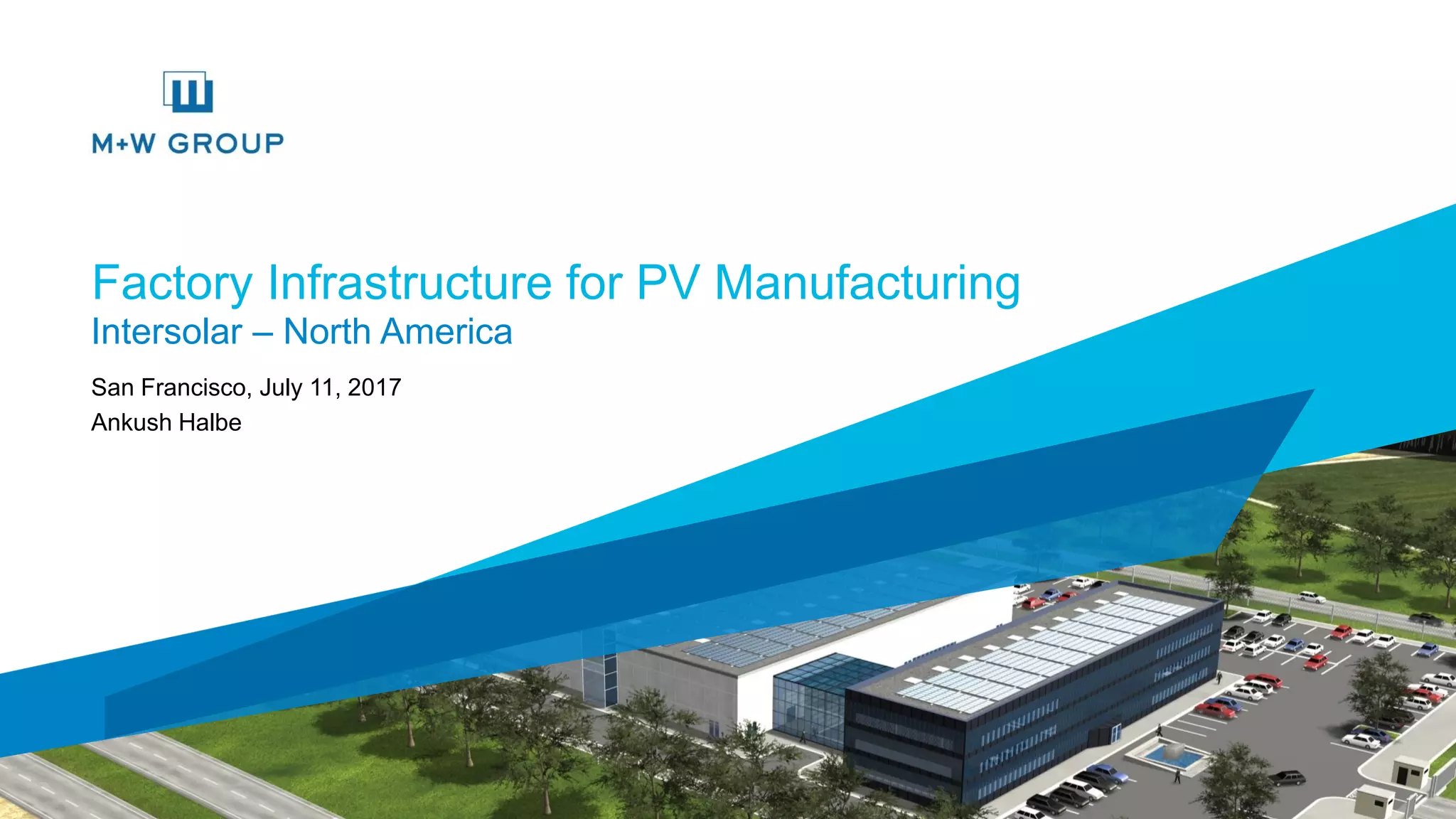
Factory Infrastructure for PV Manufacturing
San Francisco, July 11, 2017
Ankush Halbe
Intersolar – North America
© M+W U.S., Inc. I July 2017 2
Contents
• Company Overview
• PV Capacity Drivers
• Fab Design Concepts
• Environmental Considerations
• Safety Considerations
• Fab Statistics
• Fab Energy Management
• Summary
© M+W U.S., Inc. I July 2017 3
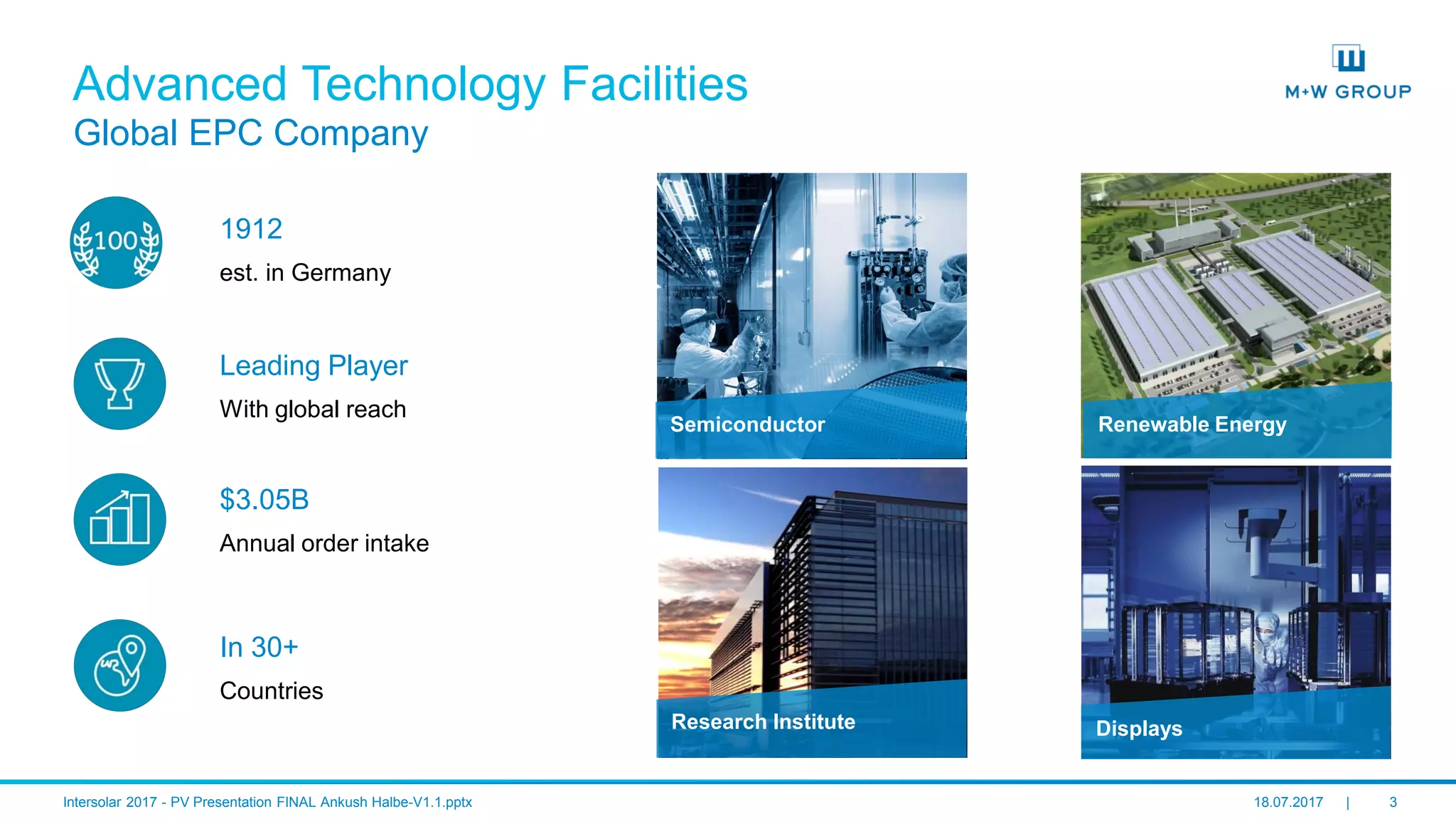
Advanced Technology Facilities
Global EPC Company
Semiconductor
Leading Player
With global reach
$3.05B
Annual order intake
In 30+
Countries
Renewable Energy
Research Institute Displays
1912
est. in Germany
© M+W U.S., Inc. I July 2017 4
Advanced Technology Facilities
Track Record
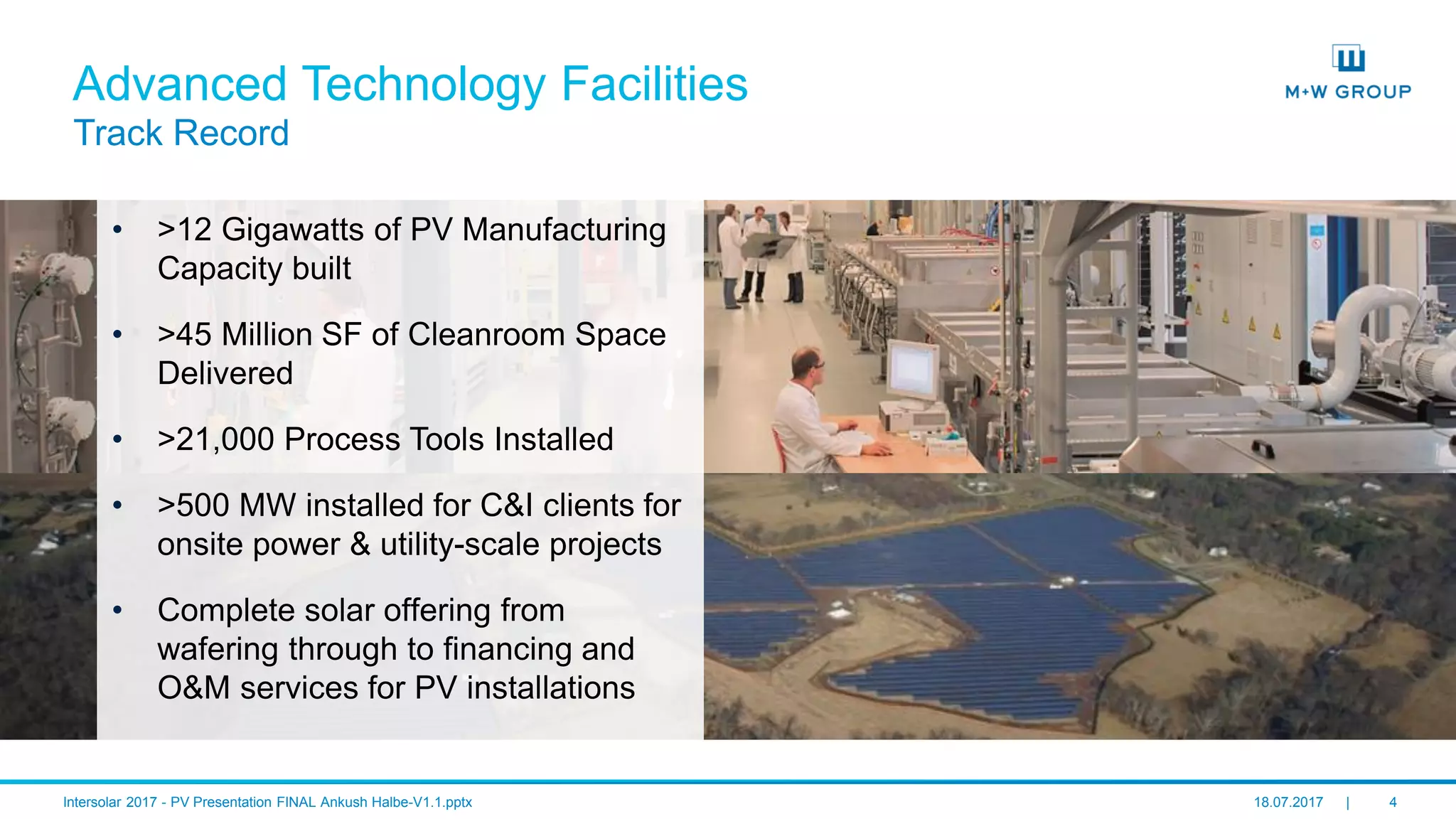
• >12 Gigawatts of PV Manufacturing
Capacity built
• >45 Million SF of Cleanroom Space
Delivered
• >21,000 Process Tools Installed
• >500 MW installed for C&I clients for
onsite power & utility-scale projects
• Complete solar offering from
wafering through to financing and
O&M services for PV installations
© M+W U.S., Inc. I July 2017 5
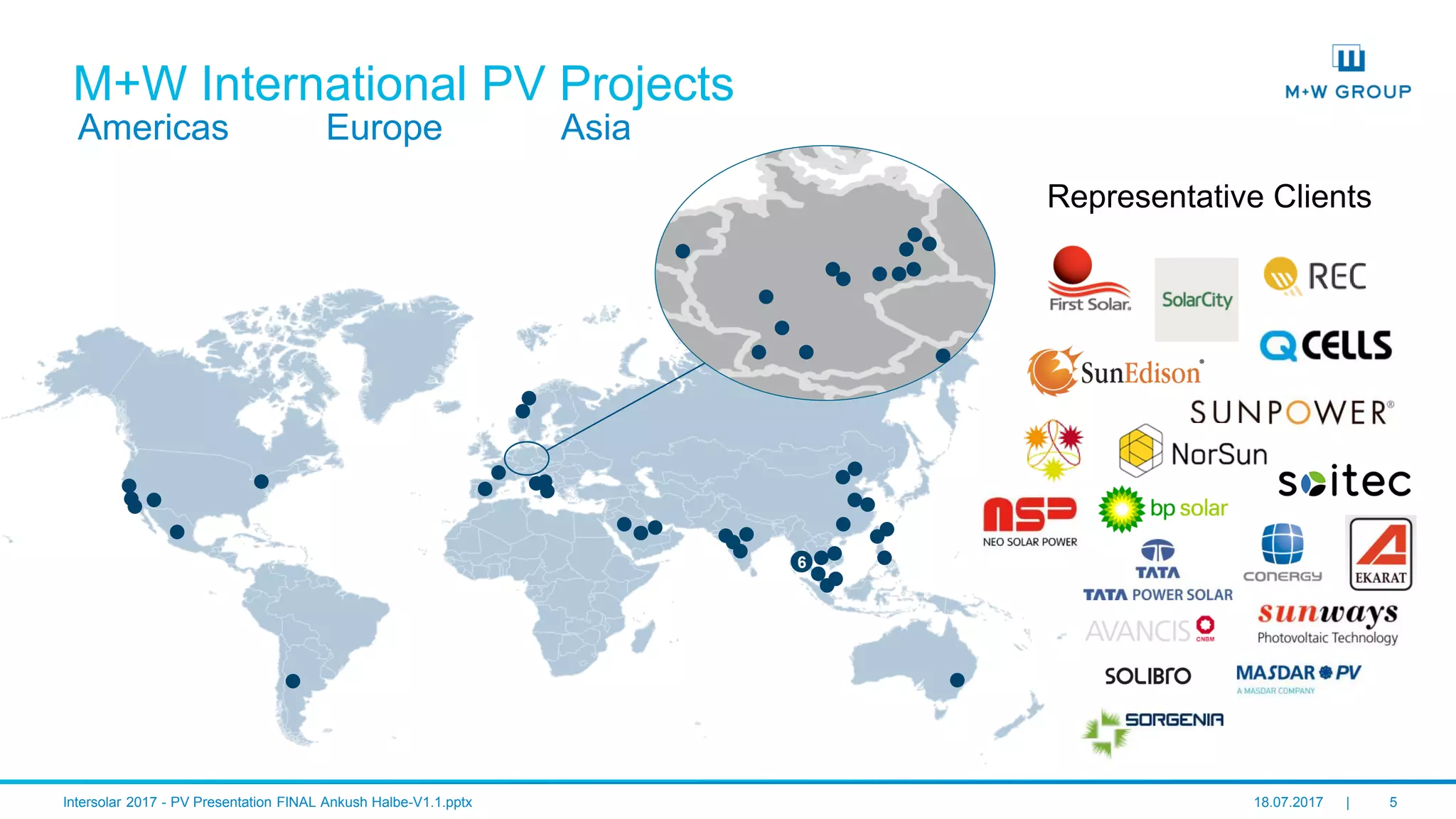
M+W International PV Projects
Europe AsiaAmericas
Representative Clients
6
© M+W U.S., Inc. I July 2017 6
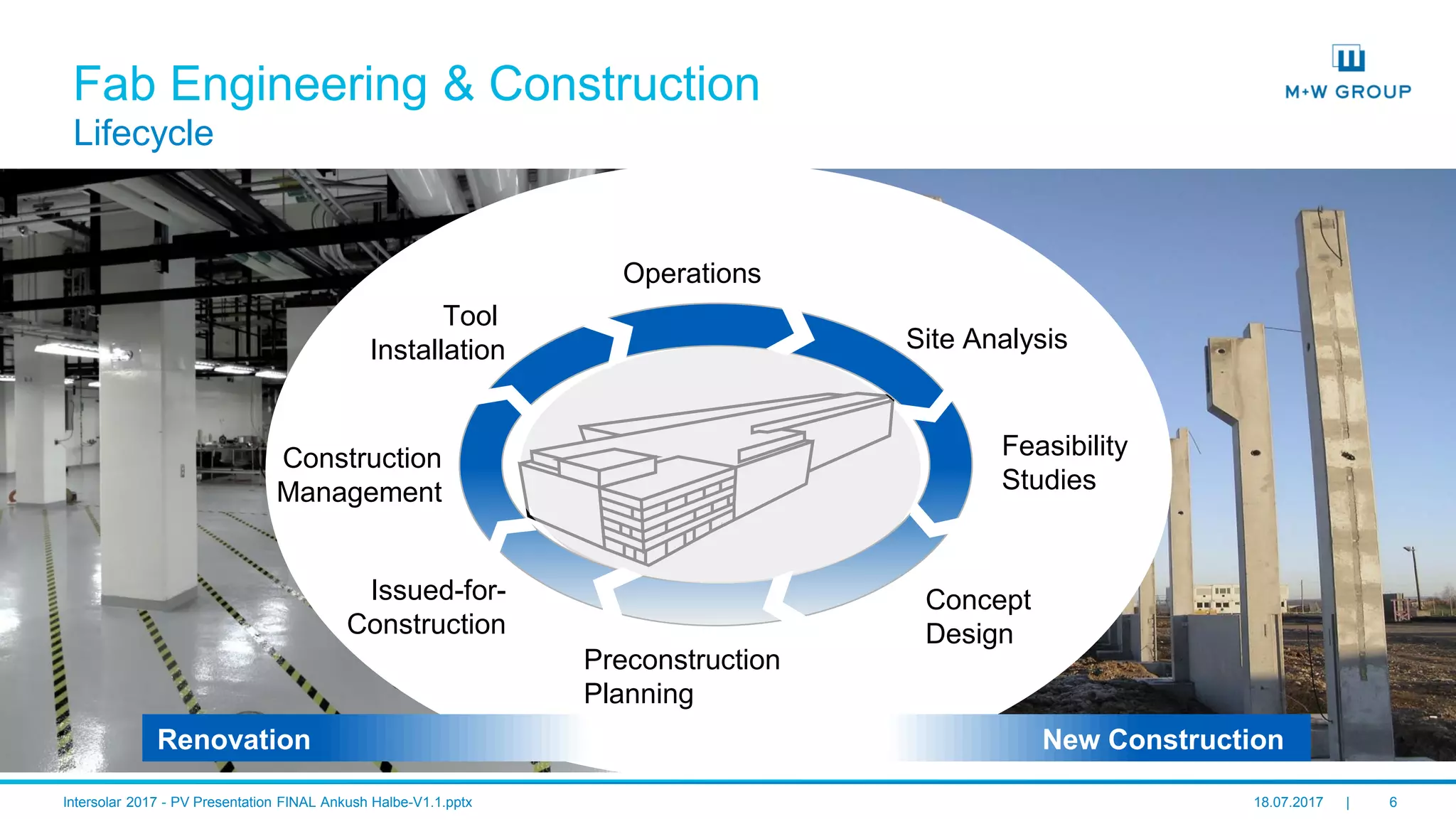
Fab Engineering & Construction
Lifecycle
Site Analysis
Concept
Design
Preconstruction
Planning
Feasibility
Studies
Issued-for-
Construction
Construction
Management
Tool
Installation
Operations
Renovation New Construction
© M+W U.S., Inc. I July 2017 7
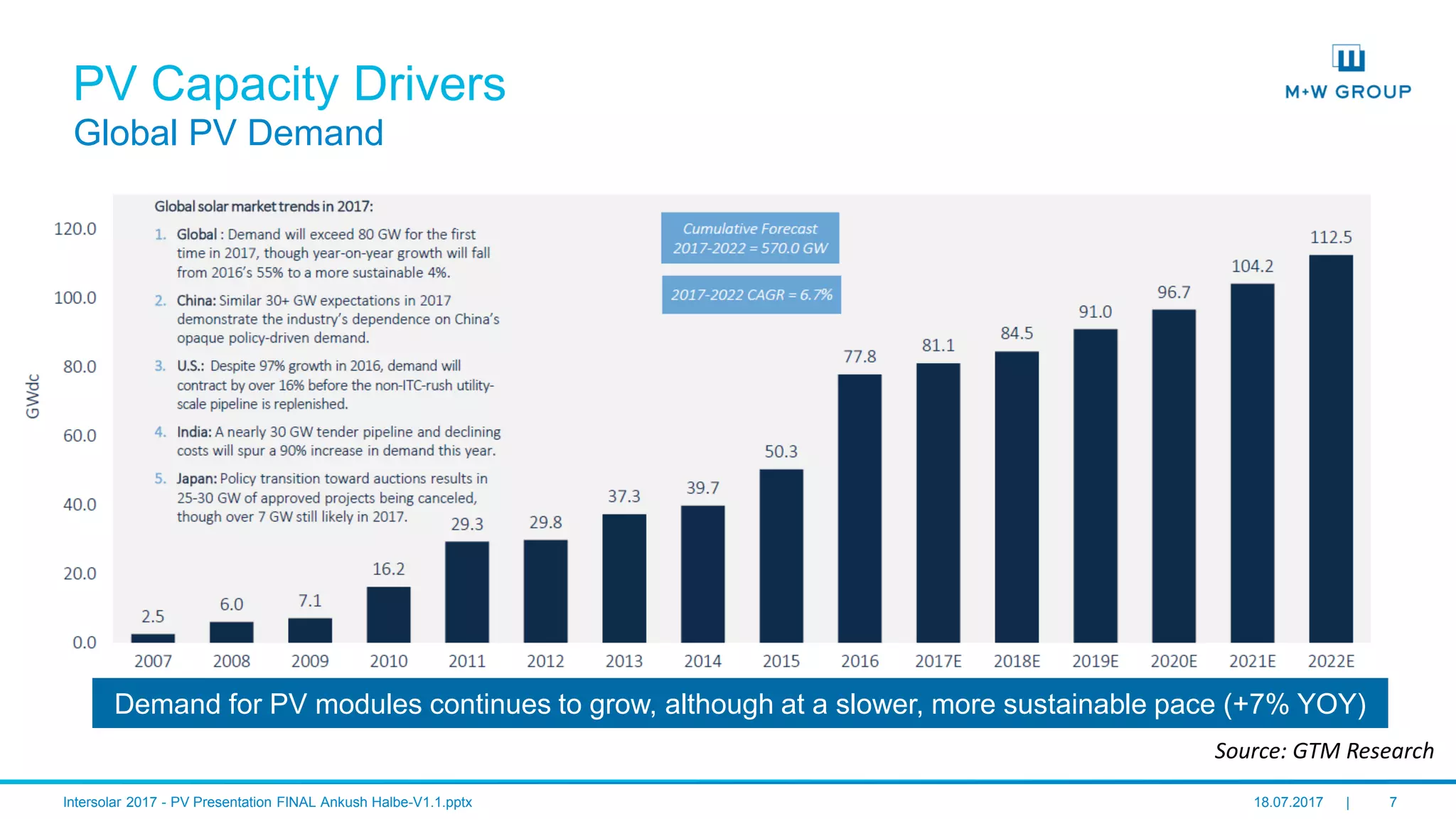
PV Capacity Drivers
Global PV Demand
Source: GTM Research
Demand for PV modules continues to grow, although at a slower, more sustainable pace (+7% YOY)
© M+W U.S., Inc. I July 2017 8
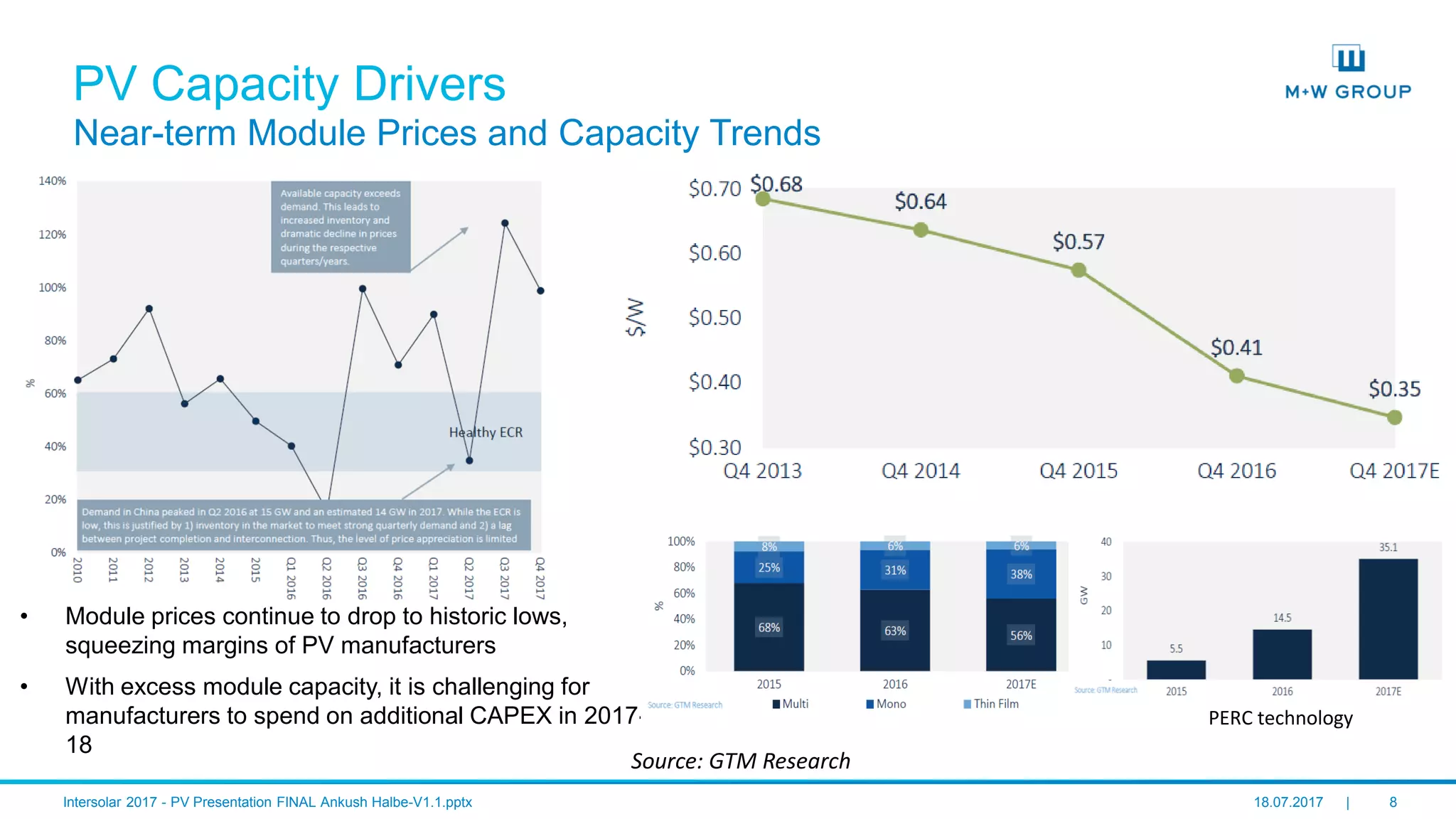
PV Capacity Drivers
Near-term Module Prices and Capacity Trends
• Module prices continue to drop to historic lows,
squeezing margins of PV manufacturers
• With excess module capacity, it is challenging
for manufacturers to spend on additional
CAPEX in 2017-18 Source: GTM Research
PERC technology
© M+W U.S., Inc. I July 2017 9
PV Capacity Drivers
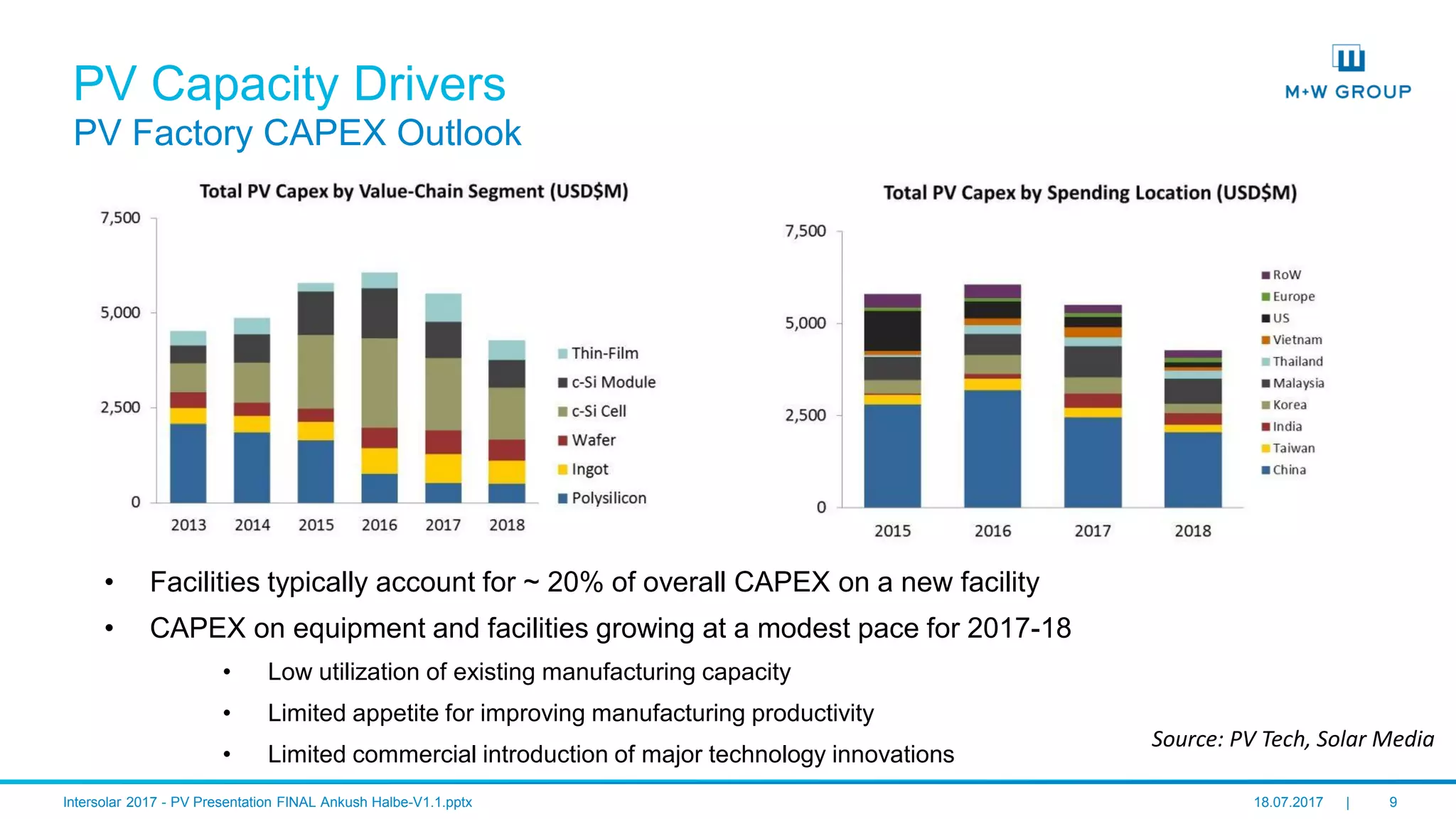
PV Factory CAPEX Outlook
• Facilities typically account for ~ 20% of overall CAPEX on a new facility
• CAPEX on equipment and facilities growing at a modest pace for 2017-18
• Low utilization of existing manufacturing capacity
• Limited appetite for improving manufacturing productivity
• Limited commercial introduction of major technology innovations
Source: PV Tech, Solar Media
© M+W U.S., Inc. I July 2017 10
PV Cell Manufacturing
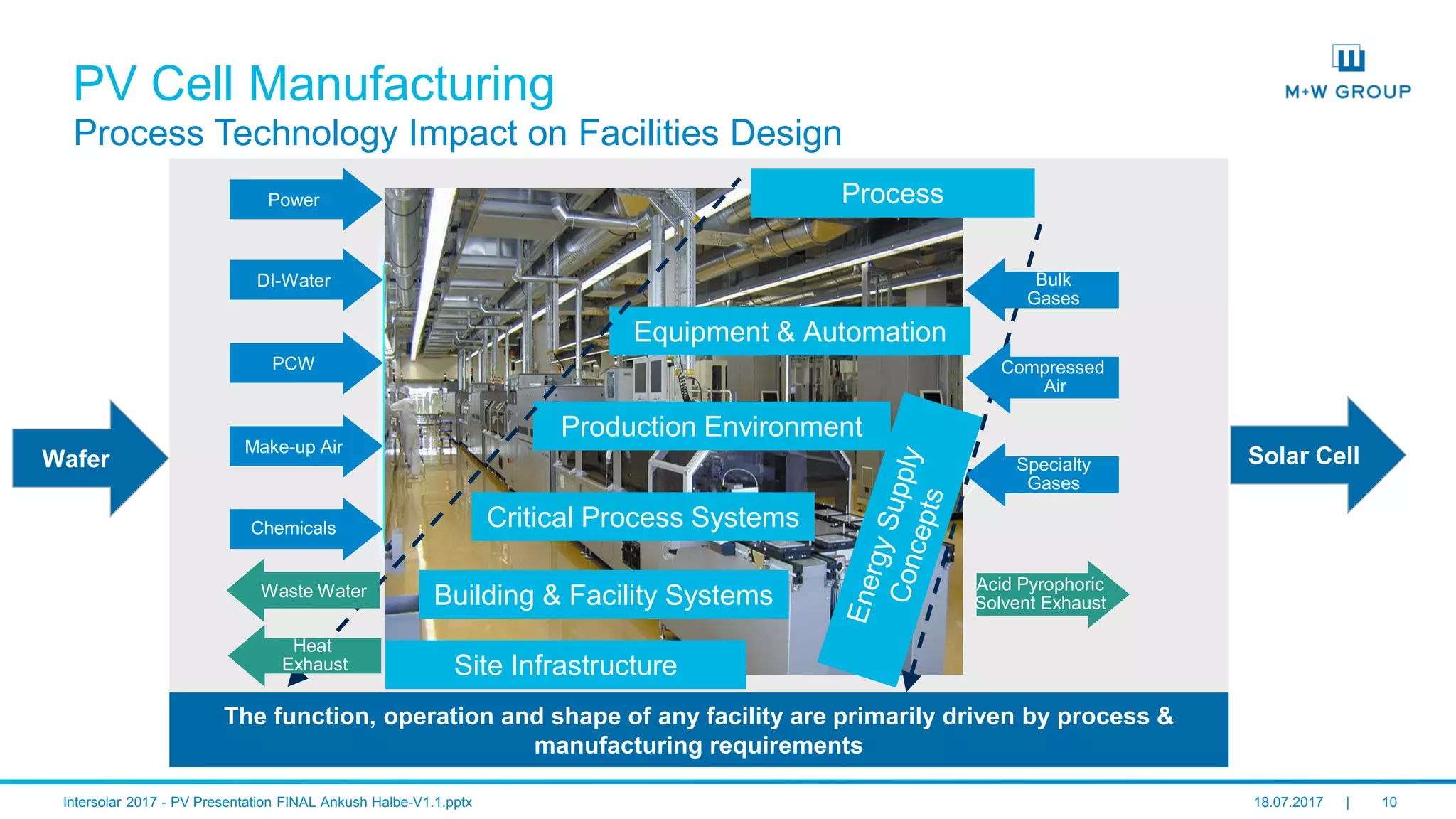
Process Technology Impact on Facilities Design
The function, operation and shape of any facility are primarily driven by process &
manufacturing requirements
Equipment & Automation
Production Environment
Critical Process Systems
Site Infrastructure
Building & Facility Systems
ProcessPower
DI-Water
PCW
Make-up Air
Chemicals
Specialty
Gases
Acid Pyrophoric
Solvent Exhaust
Wafer Solar Cell
Compressed
Air
Bulk
Gases
Waste Water
Heat
Exhaust
© M+W U.S., Inc. I July 2017 11
PV Cell Manufacturing
Sample Tool Utility Matrix
Utility consumption from process tools determines the type and capacity of facility systems for the
fab (e.g. for exhaust, abatement, water, bulk-gases, power, etc.)
Process
Category AF MF [kW] AF MF [kW] AF MF AF MF AF MF AF MF AF MF AF MF AF MF AF MF AF MF AF MF AF MF AF MF AF MF AF MF
Glass clean - substrate
20.00 230.00 0.5 1.0 2,500 2,500
3.0 3.0 12.2 0.50 2.00 15 50 2 10
0.50 2.00 10 30
3.0 3.0 12.2 2.00 500.00 0.50 2.00 15 50
15.80 80.00 20.00 230.00 0.5 1.0 2,500 2,500
3.0 3.0 12.2 0.50 2.00 15 50 2 10
0.50 2.00 10 30
3.0 3.0 12.2 2.00 500.00 0.50 2.00 15 50 2.00 500.00 2 10
Mo Sputter 12.0 12.0 41.8 1.00 3.00 50 250
400.00 400.00
18.5 18.5 107.4 1.00 3.00 20 80
12.0 12.0 41.8 1.00 3.00 50 250
11.0 11.0 63.9 1.00 3.00 20 80 600 600
P1-Laser 6 22 500 500
6 22 500 500
CIG Sputter 2.00 7.00 700.00 700.00 15 50 500 500
2.00 7.00 15 50 500 500
Selenization 12.00 12.00 41.8 28.00 40.00 50 80
12.00 12.00 41.8 28.00 40.00 0.06 0.12 50 80 1,000 1,000
0.06 0.12
CdS 1.00 1.00 24 70 n.a. n.a.
1.00 1.00 24 70 2.00 500.00 n.a. n.a.
1.50 1.50 28 82 2.00 500.00 n.a. n.a.
Exhaust
PCW 1
[m3/h]
Liquids
IWD
[l/h]
Drain
CDA
Dew.P < -50°C
[Nm3/h]
SLA-D
[l/h]
Drain-OtherIndustrial Waste Drain
Electrical
CDA
Dew.P < -70°C
[Nm3/h]
NPS 220
[kVA]
General Exhaust
from Laser
N2
4.5
[Nm3/h]
Ar
5.0
[Nm3/h]
DI Water
< 10 µS/cm
[l/h]
Potable Water
[l/h]
General Exhaust
Bulkgases
GEEX
[Nm3/h]
H2S
5.0
[Nm3/h]
PCW 2
T in = 5°C (41°F)
[m3/h]
DEZ
5.0
[Nm3/h]
NPS 480
[kVA]
Laser-EX
[Nm3/h]
© M+W U.S., Inc. I July 2017 12
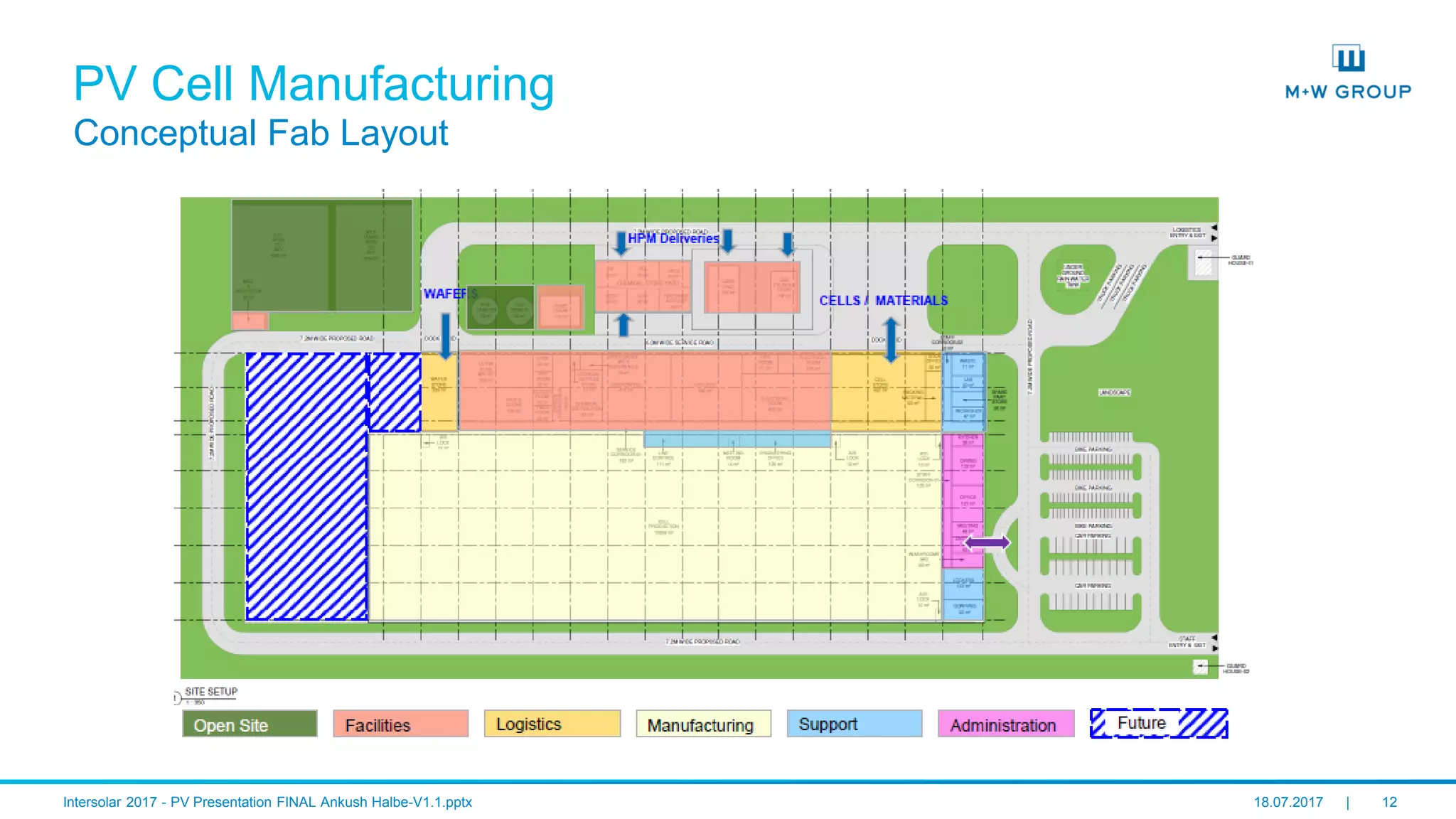
PV Cell Manufacturing
Conceptual Fab Layout
© M+W U.S., Inc. I July 2017 13
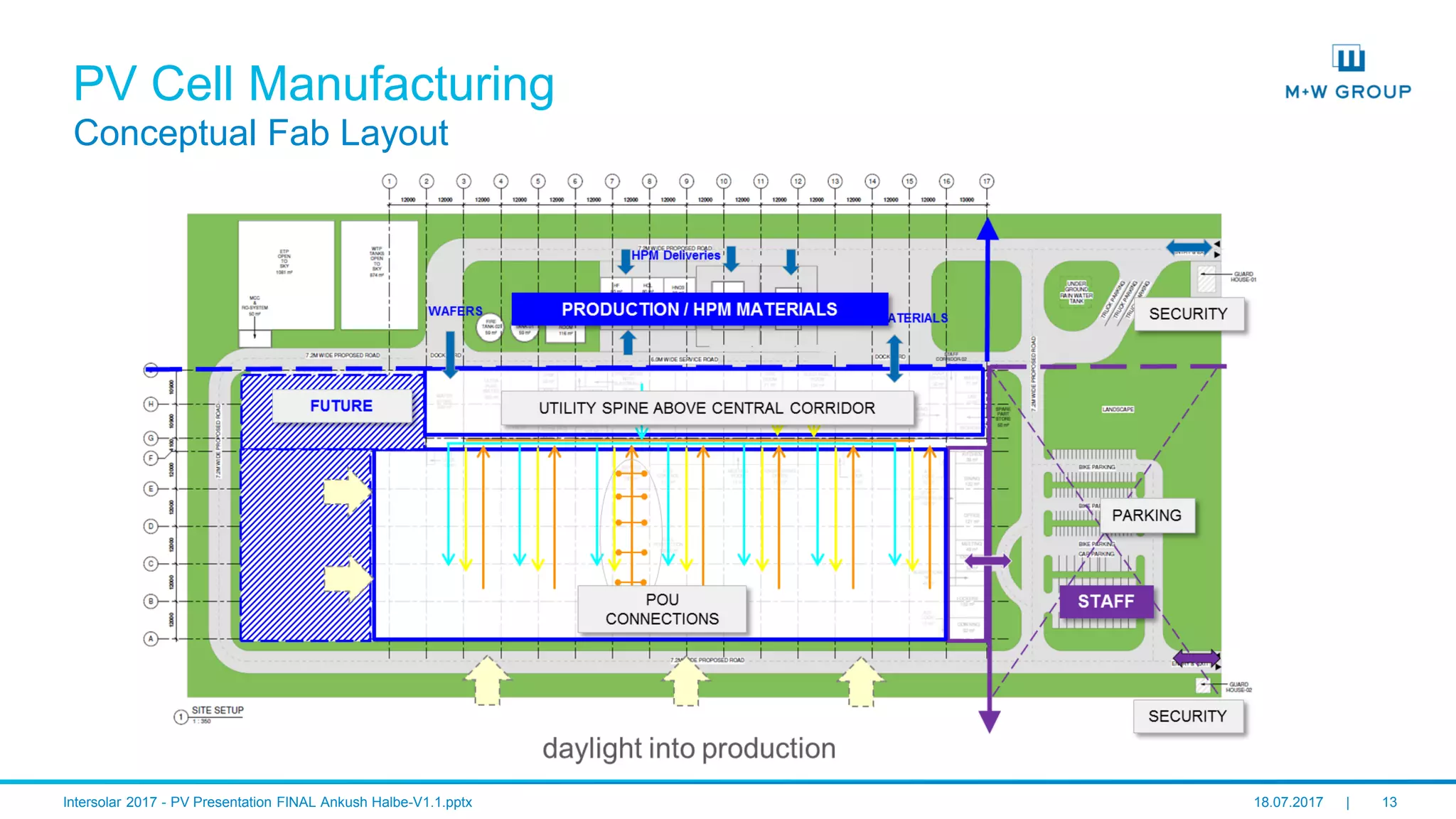
PV Cell Manufacturing
Conceptual Fab Layout
© M+W U.S., Inc. I July 2017 14
PV Cell Fab
Production Environment
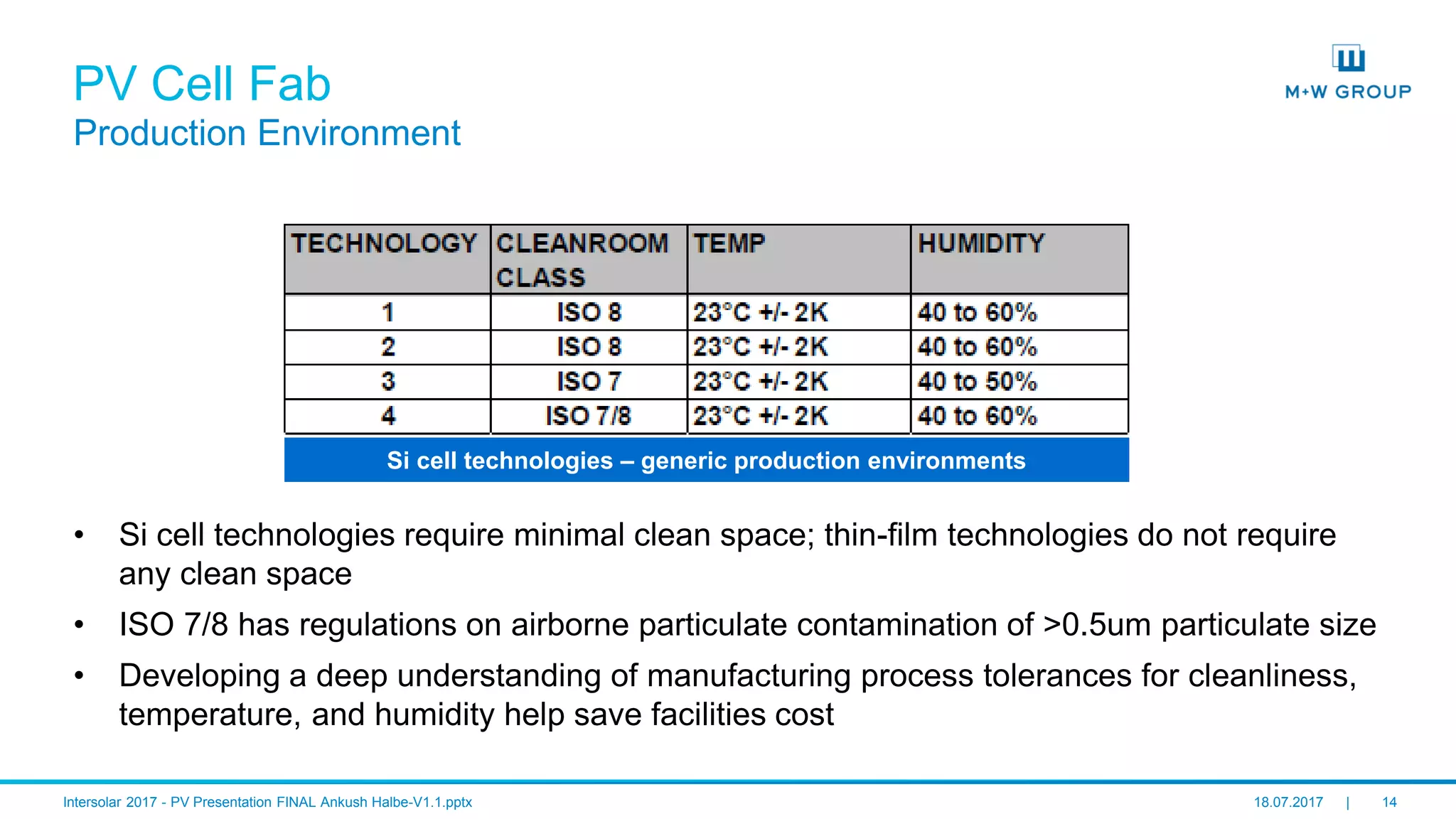
• Si cell technologies require minimal clean space; thin-film technologies do not require
any clean space
• ISO 7/8 has regulations on airborne particulate contamination of >0.5um particulate size
• Developing a deep understanding of manufacturing process tolerances for cleanliness,
temperature, and humidity help save facilities cost
Si cell technologies – generic production environments
© M+W U.S., Inc. I July 2017 15
PV Cell Fab
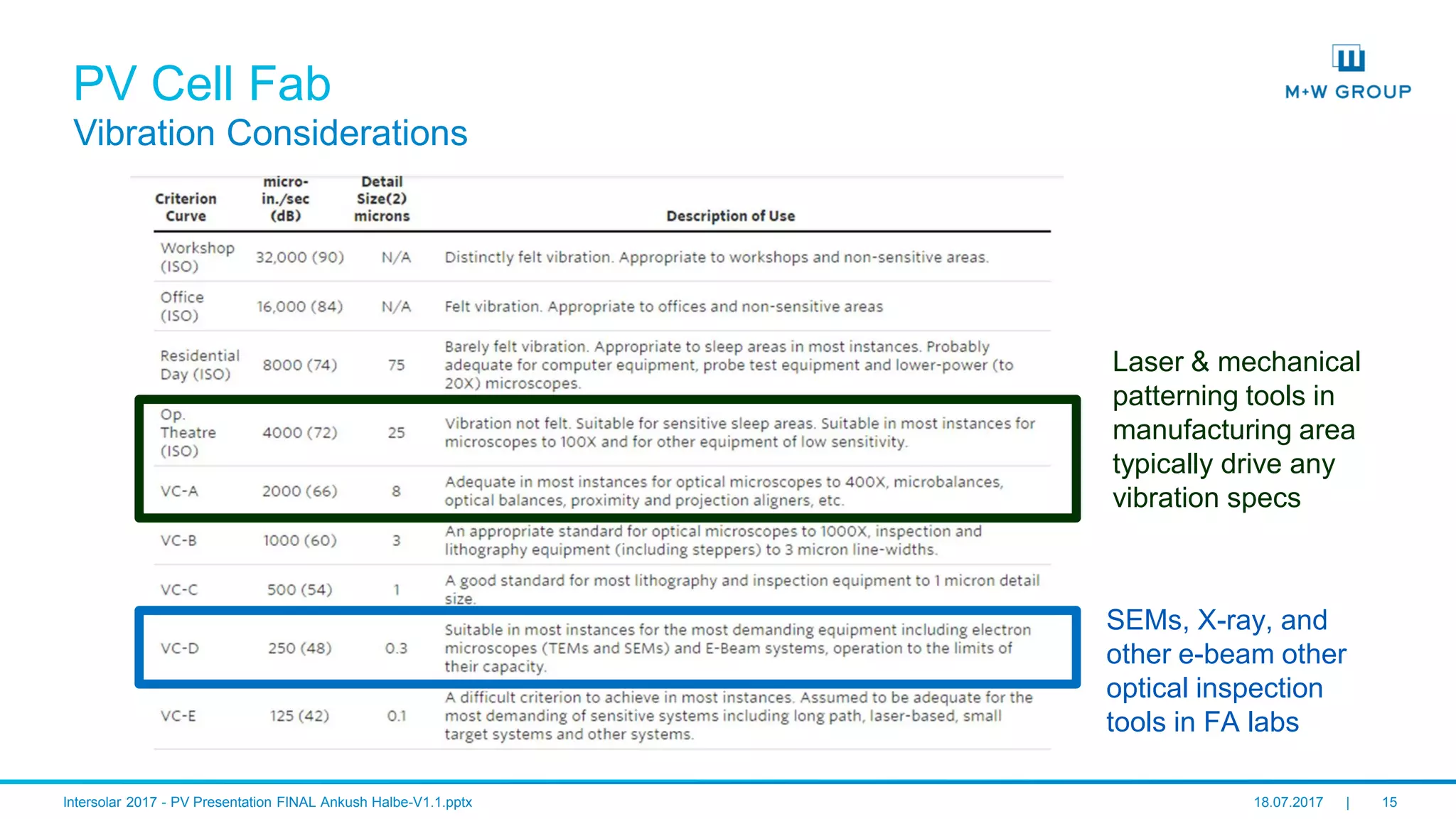
Vibration Considerations
Laser & mechanical
patterning tools in
manufacturing area
typically drive any
vibration specs
SEMs, X-ray, and
other e-beam other
optical inspection
tools in FA labs
© M+W U.S., Inc. I July 2017 16
PV Manufacturing
Safety Considerations
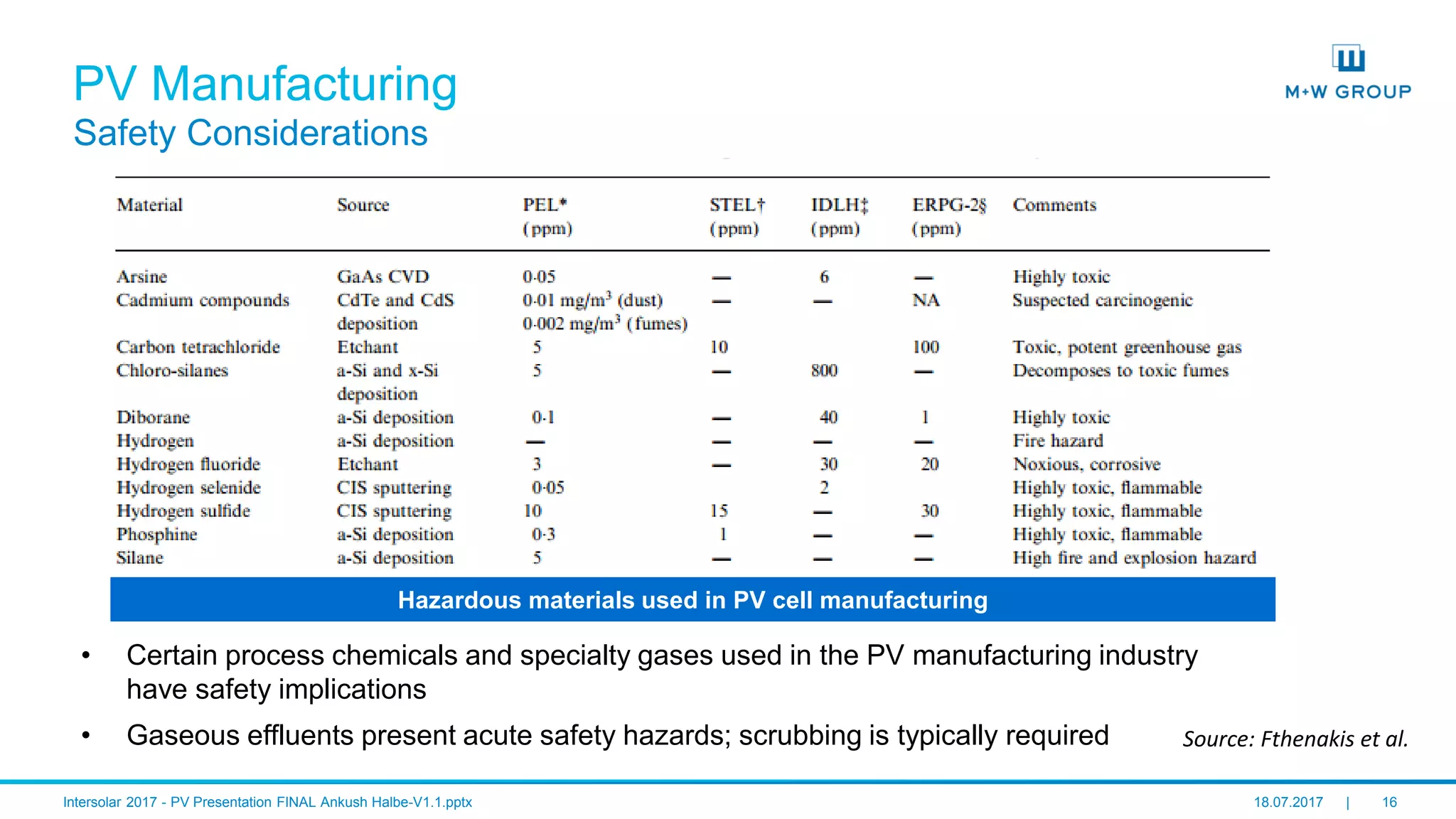
Source: Fthenakis et al.
• Certain process chemicals and specialty gases used in the PV manufacturing industry
have safety implications
• Gaseous effluents present acute safety hazards; scrubbing is typically required
Hazardous materials used in PV cell manufacturing
© M+W U.S., Inc. I July 2017 17
Safety Considerations
Example-Silane Containment Strategies
• ICC (International code council) – CGA G13 determines storage and handling code for Silanes and
mixtures in PV facilities
• Store as minimum volumes as possible
• Store Silane cylinders separately from toxic, corrosive, flammable, oxidizing, and water-reactive
materials
• Locate scrubber for SiH4 outdoors, or in a very ventilated area
• Purge storage cabinets continuously with N2, with highly velocity airflow through several ports
• Consider explosion resistant cabinets with pads, roof, double fences, and fire protection sprinklers
• Install gas monitors, flame detectors with automatic shut-off valves at the cylinder
• Dilute the SiH4/H2 effluent from the process or the scrubber with N2 to lower the SiH4 concentration to
<0.5% before it mixes with air
• Make all exhaust lines of non-combustible material
© M+W U.S., Inc. I July 2017 18
PV Cell Fab
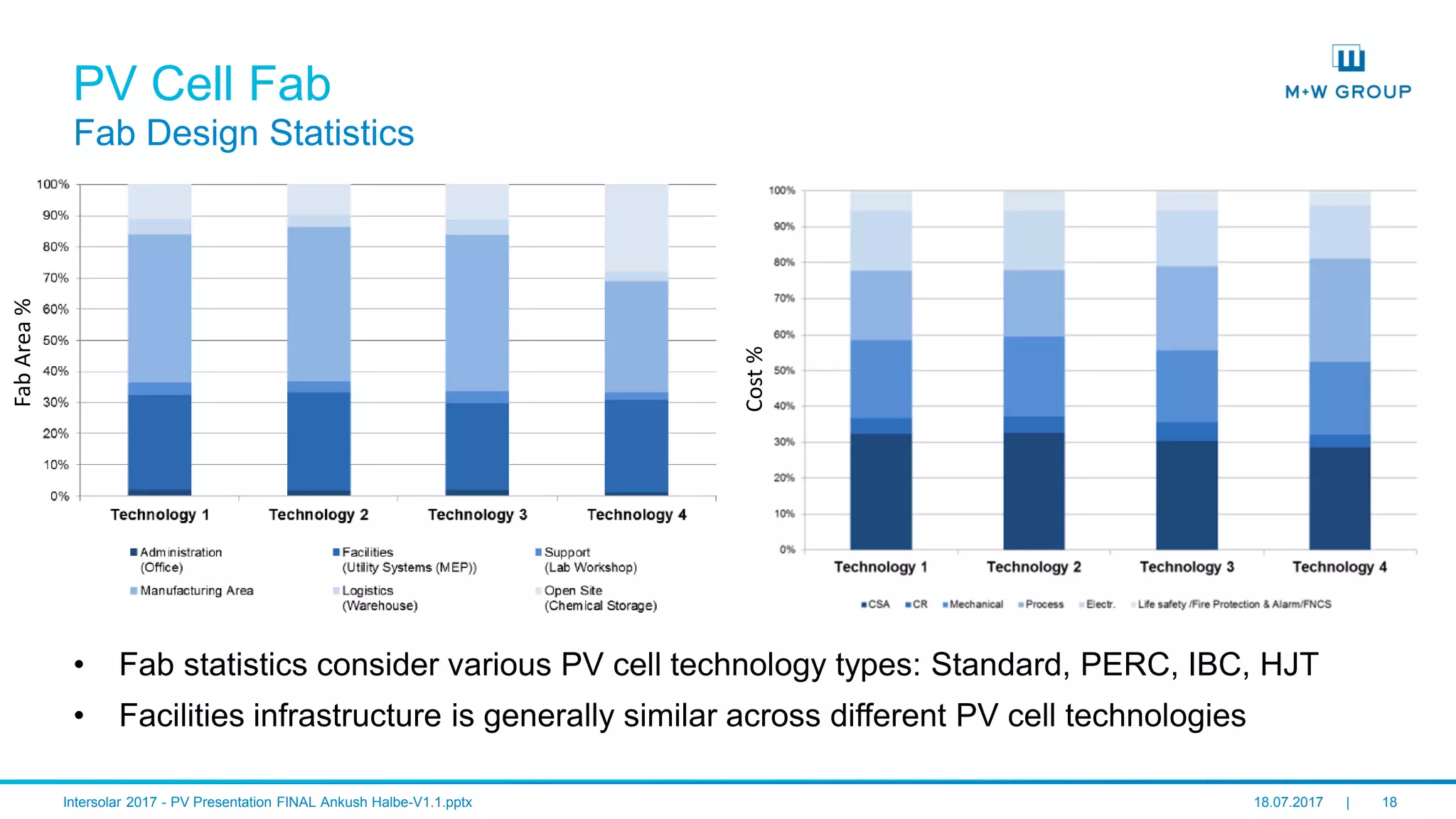
Fab Design Statistics
• Fab statistics consider various PV cell technology types
• Facilities infrastructure is generally similar across different PV cell technologies
Cost%
FabArea%
© M+W U.S., Inc. I July 2017 19
PV Fab
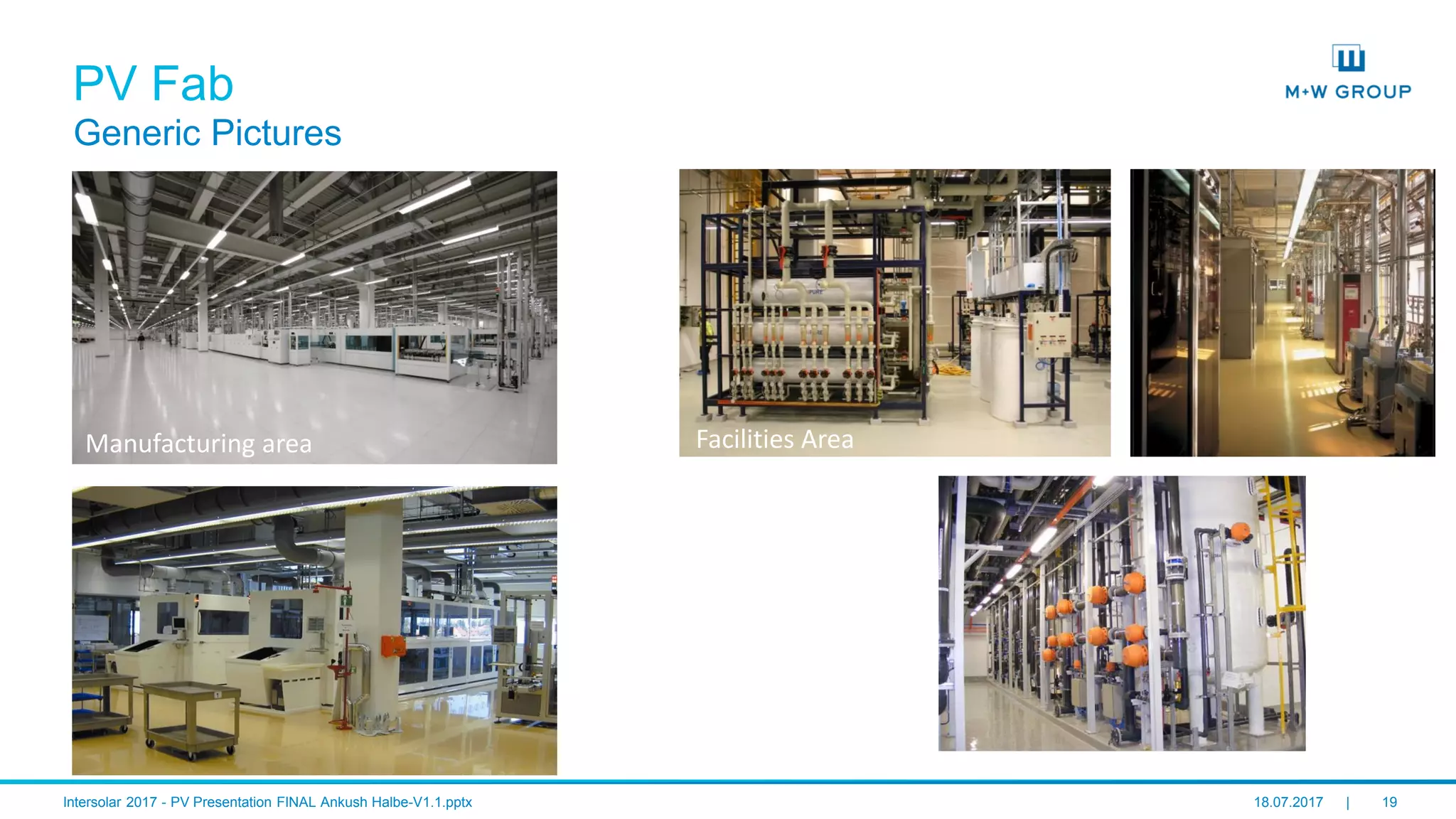
Generic Pictures
Manufacturing area Facilities Area
© M+W U.S., Inc. I July 2017 20
PV Fab
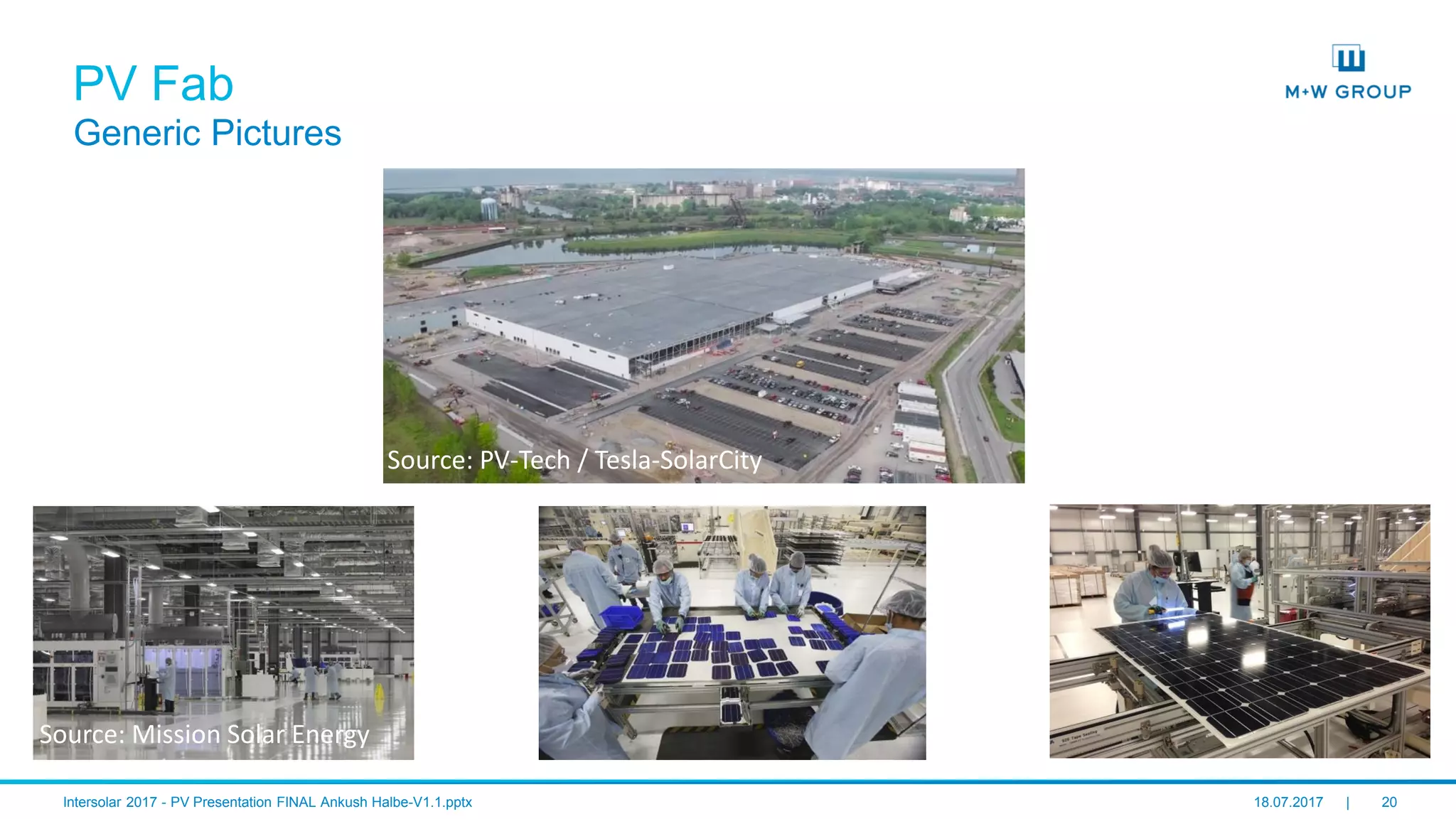
Generic Pictures
Source: PV-Tech / Tesla-SolarCity
Source: Mission Solar Energy
© M+W U.S., Inc. I July 2017 21
PV Cell Fab
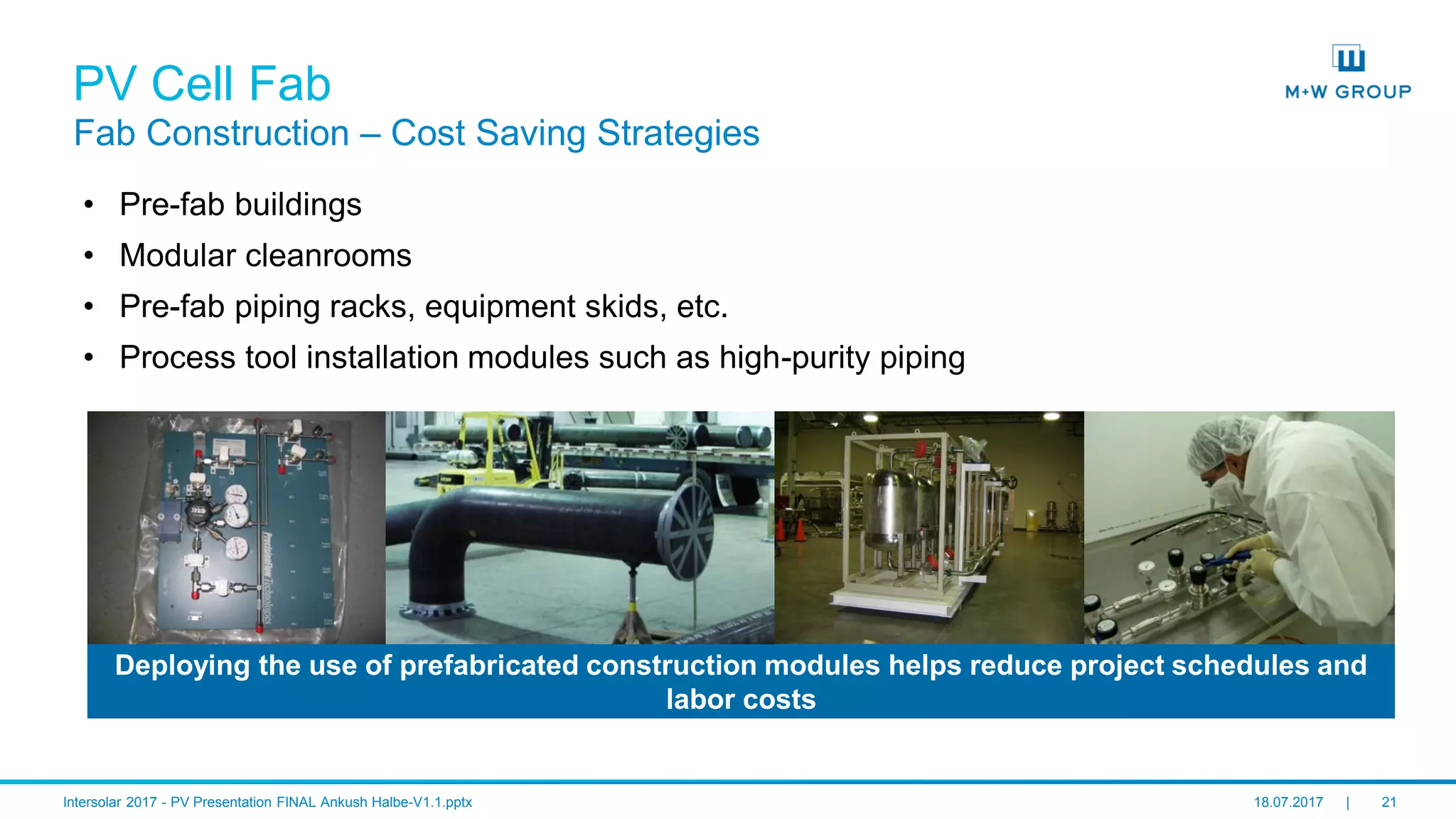
Fab Construction – Cost Saving Strategies
• Pre-fab buildings
• Modular cleanrooms
• Pre-fab piping racks, equipment skids, etc.
• Process tool installation modules such as high-purity piping
Deploying the use of prefabricated construction modules helps reduce project schedules and
labor costs
© M+W U.S., Inc. I July 2017 22
Fab Energy Management
Case Study: Hi-tech Manufacturing Fab
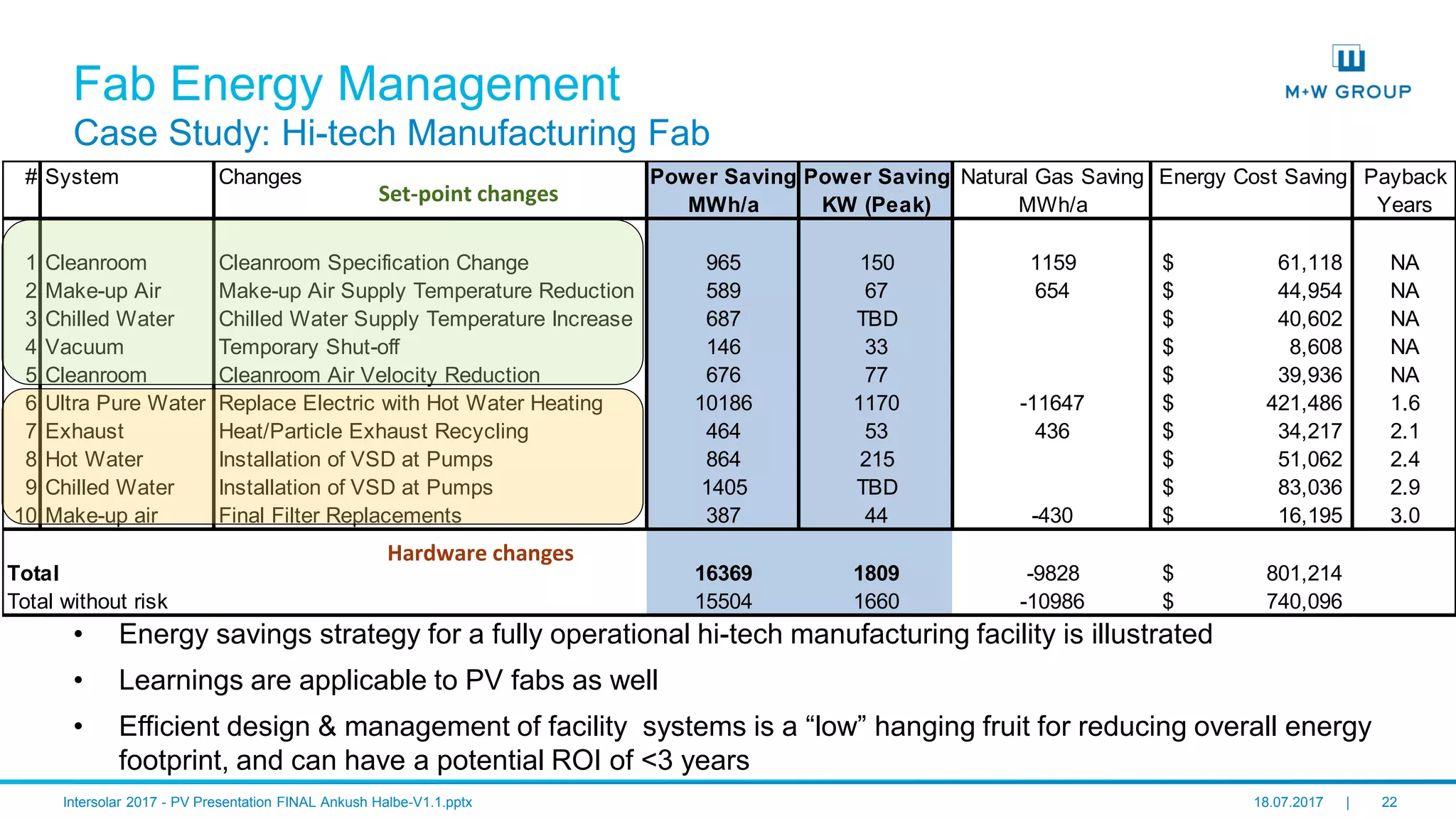
• Energy savings strategy for a fully operational hi-tech manufacturing facility is illustrated
• Learnings are applicable to PV fabs as well
• Efficient design & management of facility systems is a “low” hanging fruit for reducing overall energy
footprint, and can have a potential ROI of <3 years
# System Changes Power Saving Power Saving Natural Gas Saving Energy Cost Saving Payback
MWh/a KW (Peak) MWh/a Years
1 Cleanroom Cleanroom Specification Change 965 150 1159 61,118$ NA
2 Make-up Air Make-up Air Supply Temperature Reduction 589 67 654 44,954$ NA
3 Chilled Water Chilled Water Supply Temperature Increase 687 TBD 40,602$ NA
4 Vacuum Temporary Shut-off 146 33 8,608$ NA
5 Cleanroom Cleanroom Air Velocity Reduction 676 77 39,936$ NA
6 Ultra Pure Water Replace Electric with Hot Water Heating 10186 1170 -11647 421,486$ 1.6
7 Exhaust Heat/Particle Exhaust Recycling 464 53 436 34,217$ 2.1
8 Hot Water Installation of VSD at Pumps 864 215 51,062$ 2.4
9 Chilled Water Installation of VSD at Pumps 1405 TBD 83,036$ 2.9
10 Make-up air Final Filter Replacements 387 44 -430 16,195$ 3.0
Total 16369 1809 -9828 801,214$
Total without risk 15504 1660 -10986 740,096$
Set-point changes
Hardware changes
© M+W U.S., Inc. I July 2017 23
PV Manufacturing Facility
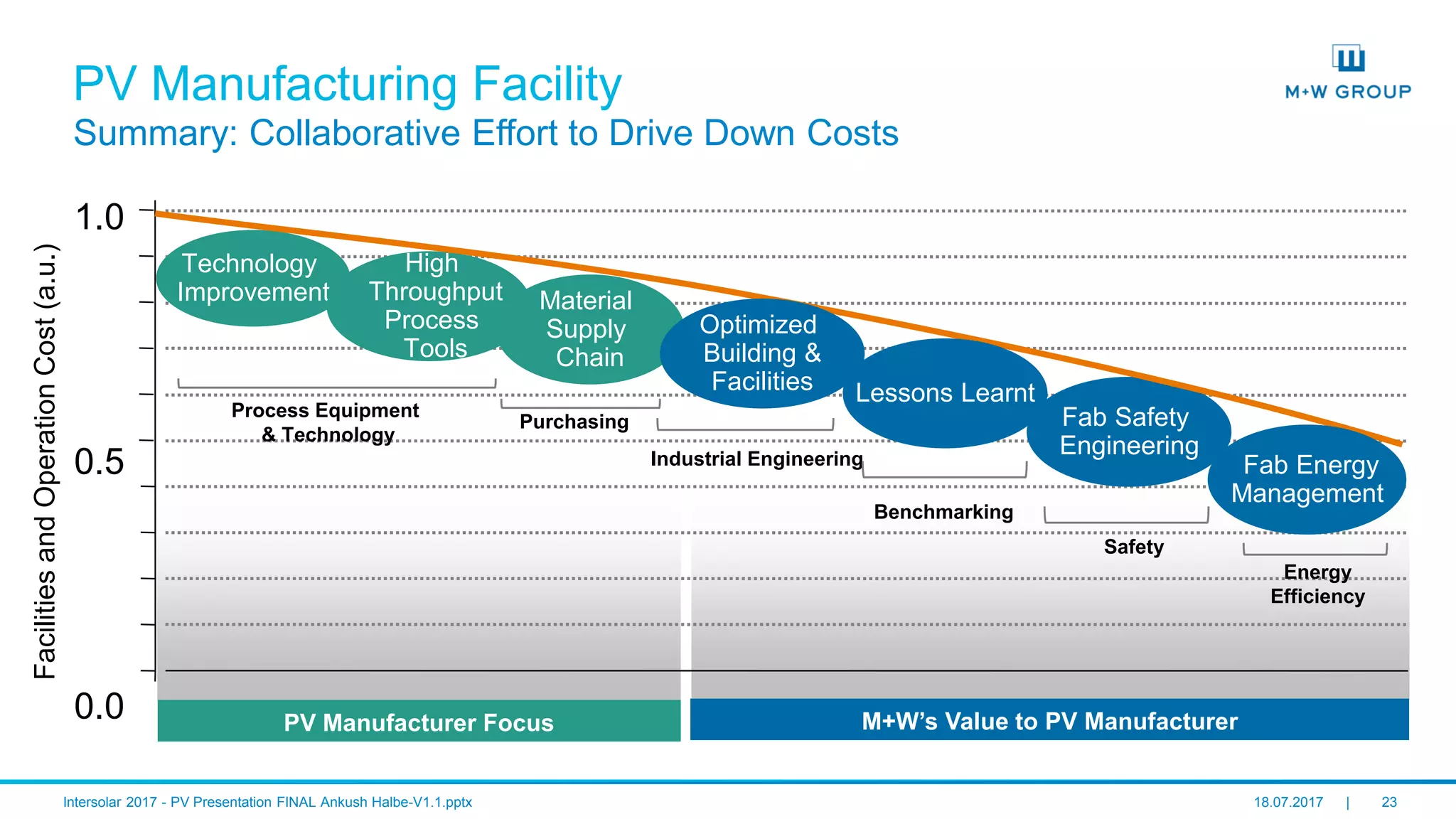
Summary: Collaborative Effort to Drive Down Costs
1.0
0.5
0.0
FacilitiesandOperationCost(a.u.)
Technology
Improvement
Fab Safety
Engineering
High
Throughput
Process
Tools
Material
Supply
Chain
Process Equipment
& Technology
Safety
Purchasing
PV Manufacturer Focus M+W’s Value to PV Manufacturer
Fab Energy
Management
Lessons Learnt
Optimized
Building &
Facilities
Industrial Engineering
Energy
Efficiency
Benchmarking
www.mwgroup.net
Contact
Ankush Halbe
Ankush.Halbe@mwgroup.net
M+W U.S., Inc.
201 Fuller Road, Suite 401
Albany, NY 12210
518.450.9924
THANK YOU
Visit us at Impress Lounge (Moscone Center Rooftop)!

Factory Infrastructure for PV Manufacturing

  • 1.
    Factory Infrastructure forPV Manufacturing San Francisco, July 11, 2017 Ankush Halbe Intersolar – North America
  • 2.
    © M+W U.S.,Inc. I July 2017 2 Contents • Company Overview • PV Capacity Drivers • Fab Design Concepts • Environmental Considerations • Safety Considerations • Fab Statistics • Fab Energy Management • Summary
  • 3.
    © M+W U.S.,Inc. I July 2017 3 Advanced Technology Facilities Global EPC Company Semiconductor Leading Player With global reach $3.05B Annual order intake In 30+ Countries Renewable Energy Research Institute Displays 1912 est. in Germany
  • 4.
    © M+W U.S.,Inc. I July 2017 4 Advanced Technology Facilities Track Record • >12 Gigawatts of PV Manufacturing Capacity built • >45 Million SF of Cleanroom Space Delivered • >21,000 Process Tools Installed • >500 MW installed for C&I clients for onsite power & utility-scale projects • Complete solar offering from wafering through to financing and O&M services for PV installations
  • 5.
    © M+W U.S.,Inc. I July 2017 5 M+W International PV Projects Europe AsiaAmericas Representative Clients 6
  • 6.
    © M+W U.S.,Inc. I July 2017 6 Fab Engineering & Construction Lifecycle Site Analysis Concept Design Preconstruction Planning Feasibility Studies Issued-for- Construction Construction Management Tool Installation Operations Renovation New Construction
  • 7.
    © M+W U.S.,Inc. I July 2017 7 PV Capacity Drivers Global PV Demand Source: GTM Research Demand for PV modules continues to grow, although at a slower, more sustainable pace (+7% YOY)
  • 8.
    © M+W U.S.,Inc. I July 2017 8 PV Capacity Drivers Near-term Module Prices and Capacity Trends • Module prices continue to drop to historic lows, squeezing margins of PV manufacturers • With excess module capacity, it is challenging for manufacturers to spend on additional CAPEX in 2017-18 Source: GTM Research PERC technology
  • 9.
    © M+W U.S.,Inc. I July 2017 9 PV Capacity Drivers PV Factory CAPEX Outlook • Facilities typically account for ~ 20% of overall CAPEX on a new facility • CAPEX on equipment and facilities growing at a modest pace for 2017-18 • Low utilization of existing manufacturing capacity • Limited appetite for improving manufacturing productivity • Limited commercial introduction of major technology innovations Source: PV Tech, Solar Media
  • 10.
    © M+W U.S.,Inc. I July 2017 10 PV Cell Manufacturing Process Technology Impact on Facilities Design The function, operation and shape of any facility are primarily driven by process & manufacturing requirements Equipment & Automation Production Environment Critical Process Systems Site Infrastructure Building & Facility Systems ProcessPower DI-Water PCW Make-up Air Chemicals Specialty Gases Acid Pyrophoric Solvent Exhaust Wafer Solar Cell Compressed Air Bulk Gases Waste Water Heat Exhaust
  • 11.
    © M+W U.S.,Inc. I July 2017 11 PV Cell Manufacturing Sample Tool Utility Matrix Utility consumption from process tools determines the type and capacity of facility systems for the fab (e.g. for exhaust, abatement, water, bulk-gases, power, etc.) Process Category AF MF [kW] AF MF [kW] AF MF AF MF AF MF AF MF AF MF AF MF AF MF AF MF AF MF AF MF AF MF AF MF AF MF AF MF Glass clean - substrate 20.00 230.00 0.5 1.0 2,500 2,500 3.0 3.0 12.2 0.50 2.00 15 50 2 10 0.50 2.00 10 30 3.0 3.0 12.2 2.00 500.00 0.50 2.00 15 50 15.80 80.00 20.00 230.00 0.5 1.0 2,500 2,500 3.0 3.0 12.2 0.50 2.00 15 50 2 10 0.50 2.00 10 30 3.0 3.0 12.2 2.00 500.00 0.50 2.00 15 50 2.00 500.00 2 10 Mo Sputter 12.0 12.0 41.8 1.00 3.00 50 250 400.00 400.00 18.5 18.5 107.4 1.00 3.00 20 80 12.0 12.0 41.8 1.00 3.00 50 250 11.0 11.0 63.9 1.00 3.00 20 80 600 600 P1-Laser 6 22 500 500 6 22 500 500 CIG Sputter 2.00 7.00 700.00 700.00 15 50 500 500 2.00 7.00 15 50 500 500 Selenization 12.00 12.00 41.8 28.00 40.00 50 80 12.00 12.00 41.8 28.00 40.00 0.06 0.12 50 80 1,000 1,000 0.06 0.12 CdS 1.00 1.00 24 70 n.a. n.a. 1.00 1.00 24 70 2.00 500.00 n.a. n.a. 1.50 1.50 28 82 2.00 500.00 n.a. n.a. 1.50 1.50 28 82 2.00 500.00 n.a. n.a. Exhaust PCW 1 [m3/h] Liquids IWD [l/h] Drain CDA Dew.P < -50°C [Nm3/h] SLA-D [l/h] Drain-OtherIndustrial Waste Drain Electrical CDA Dew.P < -70°C [Nm3/h] NPS 220 [kVA] General Exhaust from Laser N2 4.5 [Nm3/h] Ar 5.0 [Nm3/h] DI Water < 10 µS/cm [l/h] Potable Water [l/h] General Exhaust Bulkgases GEEX [Nm3/h] H2S 5.0 [Nm3/h] PCW 2 T in = 5°C (41°F) [m3/h] DEZ 5.0 [Nm3/h] NPS 480 [kVA] Laser-EX [Nm3/h]
  • 12.
    © M+W U.S.,Inc. I July 2017 12 PV Cell Manufacturing Conceptual Fab Layout
  • 13.
    © M+W U.S.,Inc. I July 2017 13 PV Cell Manufacturing Conceptual Fab Layout
  • 14.
    © M+W U.S.,Inc. I July 2017 14 PV Cell Fab Production Environment • Si cell technologies require minimal clean space; thin-film technologies do not require any clean space • ISO 7/8 has regulations on airborne particulate contamination of >0.5um particulate size • Developing a deep understanding of manufacturing process tolerances for cleanliness, temperature, and humidity help save facilities cost Si cell technologies – generic production environments
  • 15.
    © M+W U.S.,Inc. I July 2017 15 PV Cell Fab Vibration Considerations Laser & mechanical patterning tools in manufacturing area typically drive any vibration specs SEMs, X-ray, and other e-beam other optical inspection tools in FA labs
  • 16.
    © M+W U.S.,Inc. I July 2017 16 PV Manufacturing Safety Considerations Source: Fthenakis et al. • Certain process chemicals and specialty gases used in the PV manufacturing industry have safety implications • Gaseous effluents present acute safety hazards; scrubbing is typically required Hazardous materials used in PV cell manufacturing
  • 17.
    © M+W U.S.,Inc. I July 2017 17 Safety Considerations Example-Silane Containment Strategies • ICC (International code council) – CGA G13 determines storage and handling code for Silanes and mixtures in PV facilities • Store as minimum volumes as possible • Store Silane cylinders separately from toxic, corrosive, flammable, oxidizing, and water-reactive materials • Locate scrubber for SiH4 outdoors, or in a very ventilated area • Purge storage cabinets continuously with N2, with highly velocity airflow through several ports • Consider explosion resistant cabinets with pads, roof, double fences, and fire protection sprinklers • Install gas monitors, flame detectors with automatic shut-off valves at the cylinder • Dilute the SiH4/H2 effluent from the process or the scrubber with N2 to lower the SiH4 concentration to <0.5% before it mixes with air • Make all exhaust lines of non-combustible material
  • 18.
    © M+W U.S.,Inc. I July 2017 18 PV Cell Fab Fab Design Statistics • Fab statistics consider various PV cell technology types • Facilities infrastructure is generally similar across different PV cell technologies Cost% FabArea%
  • 19.
    © M+W U.S.,Inc. I July 2017 19 PV Fab Generic Pictures Manufacturing area Facilities Area
  • 20.
    © M+W U.S.,Inc. I July 2017 20 PV Fab Generic Pictures Source: PV-Tech / Tesla-SolarCity Source: Mission Solar Energy
  • 21.
    © M+W U.S.,Inc. I July 2017 21 PV Cell Fab Fab Construction – Cost Saving Strategies • Pre-fab buildings • Modular cleanrooms • Pre-fab piping racks, equipment skids, etc. • Process tool installation modules such as high-purity piping Deploying the use of prefabricated construction modules helps reduce project schedules and labor costs
  • 22.
    © M+W U.S.,Inc. I July 2017 22 Fab Energy Management Case Study: Hi-tech Manufacturing Fab • Energy savings strategy for a fully operational hi-tech manufacturing facility is illustrated • Learnings are applicable to PV fabs as well • Efficient design & management of facility systems is a “low” hanging fruit for reducing overall energy footprint, and can have a potential ROI of <3 years # System Changes Power Saving Power Saving Natural Gas Saving Energy Cost Saving Payback MWh/a KW (Peak) MWh/a Years 1 Cleanroom Cleanroom Specification Change 965 150 1159 61,118$ NA 2 Make-up Air Make-up Air Supply Temperature Reduction 589 67 654 44,954$ NA 3 Chilled Water Chilled Water Supply Temperature Increase 687 TBD 40,602$ NA 4 Vacuum Temporary Shut-off 146 33 8,608$ NA 5 Cleanroom Cleanroom Air Velocity Reduction 676 77 39,936$ NA 6 Ultra Pure Water Replace Electric with Hot Water Heating 10186 1170 -11647 421,486$ 1.6 7 Exhaust Heat/Particle Exhaust Recycling 464 53 436 34,217$ 2.1 8 Hot Water Installation of VSD at Pumps 864 215 51,062$ 2.4 9 Chilled Water Installation of VSD at Pumps 1405 TBD 83,036$ 2.9 10 Make-up air Final Filter Replacements 387 44 -430 16,195$ 3.0 Total 16369 1809 -9828 801,214$ Total without risk 15504 1660 -10986 740,096$ Set-point changes Hardware changes
  • 23.
    © M+W U.S.,Inc. I July 2017 23 PV Manufacturing Facility Summary: Collaborative Effort to Drive Down Costs 1.0 0.5 0.0 FacilitiesandOperationCost(a.u.) Technology Improvement Fab Safety Engineering High Throughput Process Tools Material Supply Chain Process Equipment & Technology Safety Purchasing PV Manufacturer Focus M+W’s Value to PV Manufacturer Fab Energy Management Lessons Learnt Optimized Building & Facilities Industrial Engineering Energy Efficiency Benchmarking
  • 24.
    www.mwgroup.net Contact Ankush Halbe Ankush.Halbe@mwgroup.net M+W U.S.,Inc. 201 Fuller Road, Suite 401 Albany, NY 12210 518.450.9924 THANK YOU Visit us at Impress Lounge (Moscone Center Rooftop)!