Values from
“Victorian naturalists”
Shyamal Lakshminarayanan
Researcher-at-large
http://en.wikipedia.org/wiki/User:Shyamal
http://muscicapa.blogspot.com
Notes and disclaimers
• “Victorian” as a genre rather than period
• Values ~ convictions ~ ideals ~ principles
• Proximate and ultimate motivations can differ
• Very subjective - but being explicit helps
• The cases here are cherry-picked
• The values mentioned here do not necessarily
originate in the cases mentioned
Motivations
• A growing view that many old institutions like
the ZSI, BSI, GSI, Forest Departments are
losing relevance for citizens
• As a compiler of content including biographies
on Wikipedia related to India’s environment, I
am asked - Why bother about the lives of
people long gone?
Why bother about people who were part of a
rapacious system?
Learning disability
• Knowing history ≠ applying learnings
– The BNHS prides W. S. Millard for showing Salim
Ali as a young boy around the collections and
instilling interest in birds!
– The BNHS however is known to shoo away visitors
interested in the collections (even established
Indian ornithologists!)
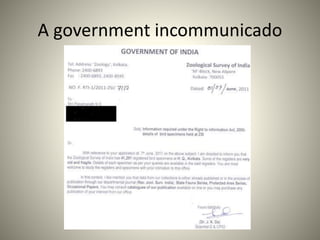
A government incommunicado
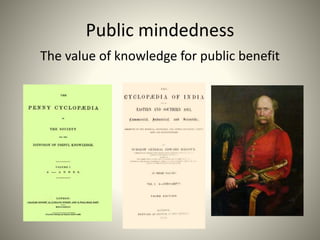
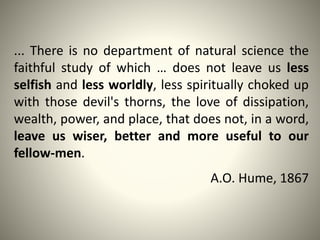
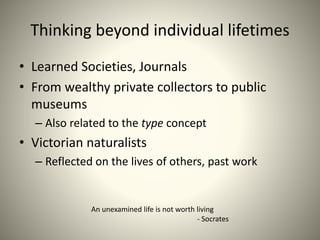
Public mindedness
The value of knowledge for public benefit
... There is no department of natural science the
faithful study of which … does not leave us less
selfish and less worldly, less spiritually choked up
with those devil's thorns, the love of dissipation,
wealth, power, and place, that does not, in a word,
leave us wiser, better and more useful to our
fellow-men.
A.O. Hume, 1867
Thinking beyond individual lifetimes
• Learned Societies, Journals
• From wealthy private collectors to public
museums
– Also related to the type concept
• Victorian naturalists
– Reflected on the lives of others, past work
An unexamined life is not worth living
- Socrates
Empowering individuals
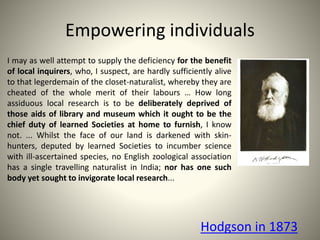
I may as well attempt to supply the deficiency for the benefit
of local inquirers, who, I suspect, are hardly sufficiently alive
to that legerdemain of the closet-naturalist, whereby they are
cheated of the whole merit of their labours … How long
assiduous local research is to be deliberately deprived of
those aids of library and museum which it ought to be the
chief duty of learned Societies at home to furnish, I know
not. ... Whilst the face of our land is darkened with skin-
hunters, deputed by learned Societies to incumber science
with ill-ascertained species, no English zoological association
has a single travelling naturalist in India; nor has one such
body yet sought to invigorate local research...
Hodgson in 1873
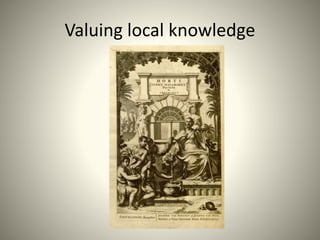
Valuing local knowledge
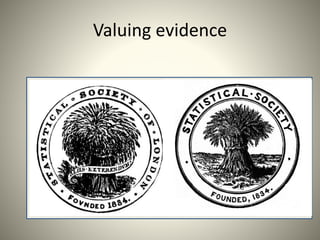
Valuing evidence
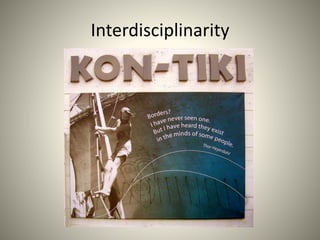
Interdisciplinarity
Valuing skills and interest
I notice that in India a new caste system is
developing before the old one has
disappeared. The new system is based on
academic degrees. One cannot teach Bengali,
chemistry, history, or what you will, without a
degree in that subject.
Haldane, 1965
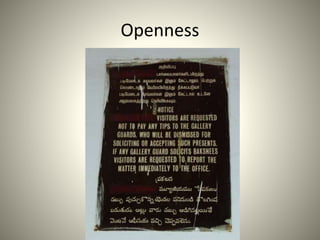
Openness
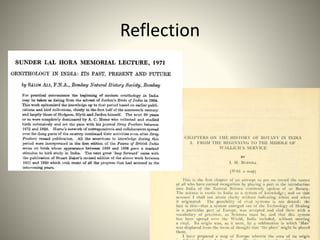
Reflection
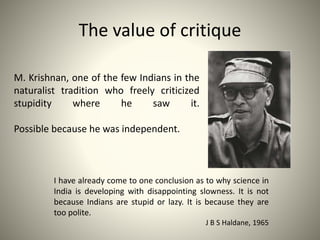
The value of critique
I have already come to one conclusion as to why science in
India is developing with disappointing slowness. It is not
because Indians are stupid or lazy. It is because they are
too polite.
J B S Haldane, 1965
M. Krishnan, one of the few Indians in the
naturalist tradition who freely criticized
stupidity where he saw it.
Possible because he was independent.
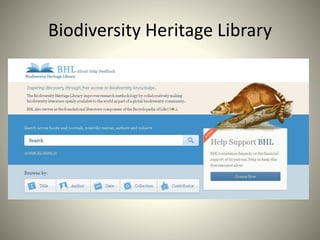
Biodiversity Heritage Library
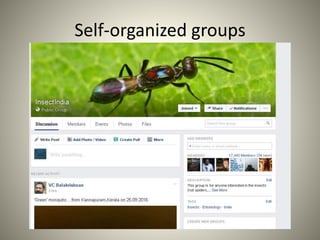
Self-organized groups
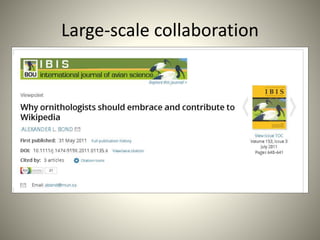
Large-scale collaboration
Can we learn from the past?
What values do you think
are worth keeping?

Values from Victorians

  • 1.
    Values from “Victorian naturalists” ShyamalLakshminarayanan Researcher-at-large http://en.wikipedia.org/wiki/User:Shyamal http://muscicapa.blogspot.com
  • 5.
    Notes and disclaimers •“Victorian” as a genre rather than period • Values ~ convictions ~ ideals ~ principles • Proximate and ultimate motivations can differ • Very subjective - but being explicit helps • The cases here are cherry-picked • The values mentioned here do not necessarily originate in the cases mentioned
  • 6.
    Motivations • A growingview that many old institutions like the ZSI, BSI, GSI, Forest Departments are losing relevance for citizens • As a compiler of content including biographies on Wikipedia related to India’s environment, I am asked - Why bother about the lives of people long gone? Why bother about people who were part of a rapacious system?
  • 7.
    Learning disability • Knowinghistory ≠ applying learnings – The BNHS prides W. S. Millard for showing Salim Ali as a young boy around the collections and instilling interest in birds! – The BNHS however is known to shoo away visitors interested in the collections (even established Indian ornithologists!)
  • 8.
  • 9.
    Public mindedness The valueof knowledge for public benefit
  • 10.
    ... There isno department of natural science the faithful study of which … does not leave us less selfish and less worldly, less spiritually choked up with those devil's thorns, the love of dissipation, wealth, power, and place, that does not, in a word, leave us wiser, better and more useful to our fellow-men. A.O. Hume, 1867
  • 11.
    Thinking beyond individuallifetimes • Learned Societies, Journals • From wealthy private collectors to public museums – Also related to the type concept • Victorian naturalists – Reflected on the lives of others, past work An unexamined life is not worth living - Socrates
  • 12.
    Empowering individuals I mayas well attempt to supply the deficiency for the benefit of local inquirers, who, I suspect, are hardly sufficiently alive to that legerdemain of the closet-naturalist, whereby they are cheated of the whole merit of their labours … How long assiduous local research is to be deliberately deprived of those aids of library and museum which it ought to be the chief duty of learned Societies at home to furnish, I know not. ... Whilst the face of our land is darkened with skin- hunters, deputed by learned Societies to incumber science with ill-ascertained species, no English zoological association has a single travelling naturalist in India; nor has one such body yet sought to invigorate local research... Hodgson in 1873
  • 13.
  • 14.
  • 15.
  • 16.
    Valuing skills andinterest I notice that in India a new caste system is developing before the old one has disappeared. The new system is based on academic degrees. One cannot teach Bengali, chemistry, history, or what you will, without a degree in that subject. Haldane, 1965
  • 17.
  • 18.
  • 19.
    The value ofcritique I have already come to one conclusion as to why science in India is developing with disappointing slowness. It is not because Indians are stupid or lazy. It is because they are too polite. J B S Haldane, 1965 M. Krishnan, one of the few Indians in the naturalist tradition who freely criticized stupidity where he saw it. Possible because he was independent.
  • 20.
  • 21.
  • 22.
  • 23.
    Can we learnfrom the past? What values do you think are worth keeping?

Editor's Notes

  • #2 I was only supposed to be a chaffeur for two of the conference participants here but a couple of weeks ago an invitation was made to me and I have made this hasty attempt to put some thoughts together that may be relevant to this gathering. My interest is in the natural world around me and I am always shocked by the lack of interest among others in it. India was once the land that everyone sought and it was largely because of its natural resources. Today that is largely under destruction and the average person is dreams of going and settling elsewhere. Santosh Patel: We will sail like Columbus. Pi Patel: But Columbus was looking for India! (From Life of Pi by Yann Martel)
  • #3 This talk is not about the Victorian age as much as it is about Victorian science and its innovations. We are of course not recommending many Victorian ideas, many behaviours and most certainly not corsets. So this is really a cherry-picked, opinionated list of things we ought to keep from the past. Sadly, it appears that we in India are especially good at picking the very worst aspects.
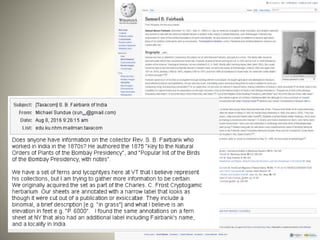
  • #4 To introduce myself, I am interested the world around me which is mostly here in southern India. I am also interested in the characters from the past that have also looked around at this part of the world. Unlike most of you at this conference, I am an independent (also known as “unemployed”) researcher. I am not a big fan of academia the way it has panned out in India – as a system for a few to appear to be superior to others. I am instead one of millions of information foragers, when we find information as part of day-to-day research we put back little trails back for subsequent searchers to find thing more easily on the Internet. Wikipedia is a great tool for this and here is an example of something I did recently – someone on an email list “Taxacom” was looking for information on S.B. Fairbank and had made a request for information. I had some inkling of this character – as a correspondent of Allan Octavian Hume and after whom Trochalopteron fairbanki is named. Instead of responding to the email, I put together an entry on Wikipedia with footnotes to the original sources and then responded to the list email with a link to the Wikipedia article.
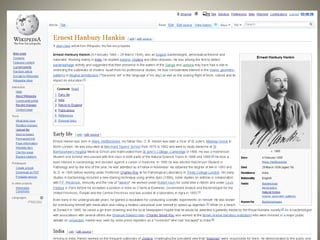
  • #5 Here is another biography of a naturalist who worked in India. This is probably the only biography and certainly the only portrait of him online and we (several wikipedia editors) contributed to the content and were helped by a Cambridge librarian who kindly located the portrait photograph for use here.
  • #6 Before I list out the values I should clarify a few points. Victorian science as a genre can be identified by being curiosity driven rather than pursued as a profession - in other words they were “amateurs” apart from being “independent”.
  • #7 My motivations for listing Victorian values is to point out that these values have been lost while the very worst habits of “Colonialism” are instead served to Indian citizens today. There are so many organizations in India that have lost sight of their original spirit. I am also forced to think about this because as an unpaid volunteer, I often end up working on Wikipedia biographies of people who studied the natural world in India. Being unpaid, we are asked why we “waste our time” with such pursuits. Sometimes the question is loaded with adjectives describing the Colonial system, adjectives that perhaps apply very well to today’s power system as well but arguing that is a different story.
  • #8 Knowing history does not necessarily help in understanding principles! Cultural values are not easily inculcated.
  • #9 Government “servants” these days attempt to do as little work as possible. There is a fear that they might do something wrong. They have no principles to interpret and help them decide on their own. Long reporting hierarchies ensure that actual workers do no work. Diplomatic letters are written by the powers-that-be and the end result is that tax-payer money is squandered.
  • #10 This contrasts very much with the colonial mindset. Many of them were products of the enlightenment and were extremely “public minded” although the definition of “public” was slightly different for that period. The idea that knowledge was not to be monopolized seems to have generally had a strong footing even if it was created under the aegis of a predatory system. Public museums and libraries were promoted in India by people like Edward Balfour, (Hume’s cousin) and it was perhaps important to someone like him with a background in public health, knowing that one cannot separate the concerns of peoples living together. George King and his work on cinchona – hardly written about. People like Joseph Hume (AO Hume’s father) fought for public accountability in government. India only got its Right to Information Act in 2005! And even that is under attack. Even now, there is no easy way for the ordinary Indian citizen to obtain quality service from government bodies.
  • #11 Allan Octavian Hume, 1867 quoted in Edward Moulton (2003) “Petronia”. I have trimmed out some theism.
  • #12 James Prinsep, Edward Balfour, I.H. Burkill on botany, George Watt How many Indian scientists write obituaries reviews of past workers in their field? How many Indian scientists write comprehensive reviews of work in their field? How many are capable of placing their work in context for a reading audience?
  • #13 If we think of government bodies as public-funded replacements of the Learned Societies, Indian organizations like the ZSI or BSI have managed to keep Indians in the same state as “local” amateurs in the 1870s. The power differences between those with the means and those without and seek to ameliorate the situation. Hodgson represents the liberal mindset, not only did he look at empowering local research but argued for local language use in education, and was among the few that made use of (“barbaric”) local names in his binomials.
  • #14 Hodgson used the local names for birds both in his publications and for binomials, a habit for which he was castigated by some. Walter Elliot, Sykes and several French authors seem to have genuinely respected local knowledge. Balfour, Cullen established public libraries, museums.
  • #15 And documenting it. W H Sykes was among the founders of the Statistical Society. He pioneered the idea, using actuarial data, that the army soldiers could easily be covered by insurance. Sykes was a pioneer data collector apart from looking at biodiversity, he looked at insurance and health. Balfour also collected data on public health. Watt - "Very effectual in relieving the true leprosy" (Thomas Ward, Apothecary, Cuddappah); "Garjan Oil is of undoubted efficacy in tuberculous leprosy" (G. A. Watson, Allahabad); “I used this oil for two years in the treatment of leprosy, but found it perfectly useless” (Brigade Surgeon C. Joyut, Poona); "It is useless as a specific which it was claimed to be" (Civil Surgeon C. H. Joubert, Darjeeling). The original logo of the Statistical Society included the motto “Aliis exterendum” which means “for others to thresh” and the idea was that data should be collected and independently analyzed. This motto was dropped subsequently but perhaps with the movement for open-data allowing analyses to be redone and be repeatable and verifiable we have a resurgence of the original idea.
  • #16 Asiatic Society Journal. The Madras Journal of Literature and Science. How many journals now carry articles across disciplines? What opportunities exist to interact with people from multiple disciplines?
  • #17 Recruitment into organizations. W R Davison, R E Moreau – cases of people from other fields who did well. Sir Gilbert Walker. Cleghorn on the recruitment of forest officers – above all they were naturalists.
  • #18 Balfour crowd-sourced his museum and felt it inappropriate to charge the audience. This board from the Madras Government Museum has the “Admission free” covered over.
  • #19 Victorian natural history is filled with examples of reviews and obituaries. How many modern researchers write obituaries or reviews.
  • #20 There is much to be said for being able to write and speak freely. Criticism and debate are natural selection for memes and essential to improving ideas.
  • #21 So while we in India are forced to accept a system and culture that cannot be changed, there are worldwide movements that have empowered ordinary researchers with access to the Internet. As can be imagined, there is NO Indian organization that has considered joining the Biodiversity Heritage Library – instead nice collections of books such as those in the National Museum of Natural History at New Delhi go up in flames.
  • #22 Thanks to online forums, interested people have organized themselves and with the help of experts from across the world are able to obtain information that Government bodies in India will either not do or require one to fill half a dozen forms, pay a fee and then obtain poor quality information from very poorly qualified personnel.
  • #23 There have been pleas for academics to join these large scale research collaborations and maybe therein lies hope for the ordinary Indian citizen. Maybe once the ordinary citizen can find information on the value of the world around them, they will be less motivated to destroy the heritage around them.