1
Fundamentals of Microelectronics
 CH1 Why Microelectronics?
 CH2 Basic Physics of Semiconductors
 CH3 Diode Circuits
 CH4 Physics of Bipolar Transistors
 CH5 Bipolar Amplifiers
 CH6 Physics of MOS Transistors
 CH7 CMOS Amplifiers
 CH8 Operational Amplifier As A Black Box
2
Chapter 3 Diode Circuits
 3.1 Ideal Diode
 3.2 PN Junction as a Diode
 3.3 Applications of Diodes
CH3 Diode Circuits 3
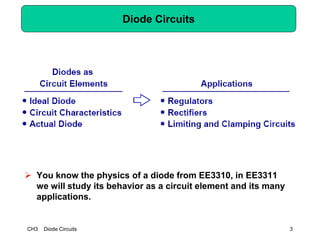
Diode Circuits
 You know the physics of a diode from EE3310, in EE3311
we will study its behavior as a circuit element and its many
applications.
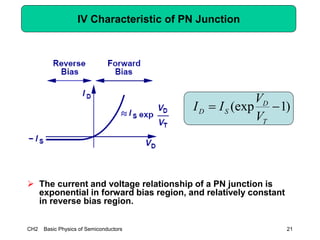
CH3 Diode Circuits 4
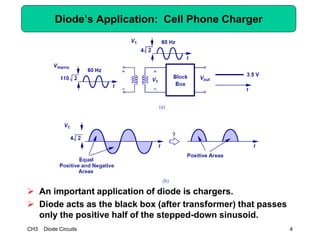
Diode’s Application: Cell Phone Charger
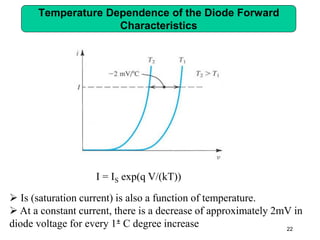
 An important application of diode is chargers.
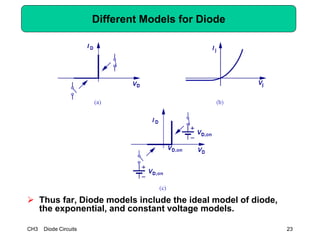
 Diode acts as the black box (after transformer) that passes
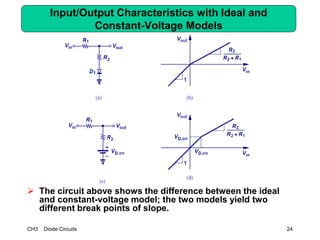
only the positive half of the stepped-down sinusoid.
CH3 Diode Circuits 5
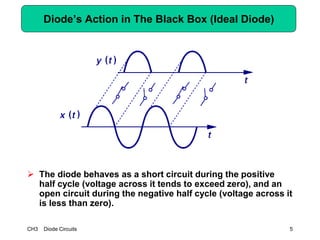
Diode’s Action in The Black Box (Ideal Diode)
 The diode behaves as a short circuit during the positive
half cycle (voltage across it tends to exceed zero), and an
open circuit during the negative half cycle (voltage across it
is less than zero).
CH3 Diode Circuits 6
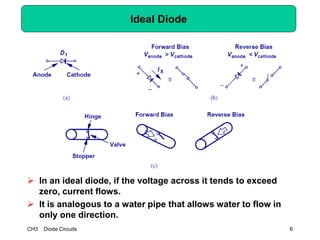
Ideal Diode
 In an ideal diode, if the voltage across it tends to exceed
zero, current flows.
 It is analogous to a water pipe that allows water to flow in
only one direction.
CH3 Diode Circuits 7
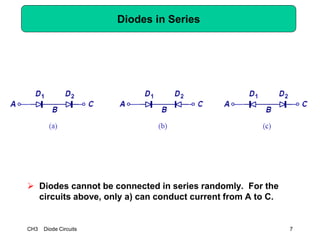
Diodes in Series
 Diodes cannot be connected in series randomly. For the
circuits above, only a) can conduct current from A to C.
CH3 Diode Circuits 8
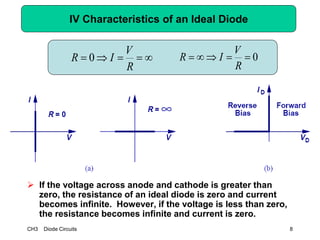
IV Characteristics of an Ideal Diode
 If the voltage across anode and cathode is greater than
zero, the resistance of an ideal diode is zero and current
becomes infinite. However, if the voltage is less than zero,
the resistance becomes infinite and current is zero.

R
V
IR 0 0
R
V
IR
CH3 Diode Circuits 9
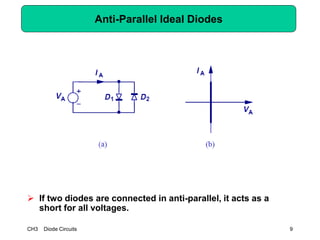
Anti-Parallel Ideal Diodes
 If two diodes are connected in anti-parallel, it acts as a
short for all voltages.
CH3 Diode Circuits 10
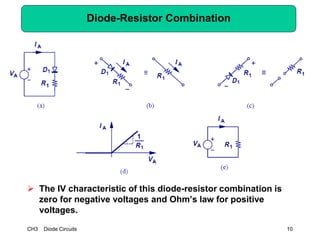
Diode-Resistor Combination
 The IV characteristic of this diode-resistor combination is
zero for negative voltages and Ohm’s law for positive
voltages.
CH3 Diode Circuits 11
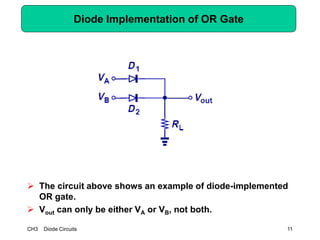
Diode Implementation of OR Gate
 The circuit above shows an example of diode-implemented
OR gate.
 Vout can only be either VA or VB, not both.
CH3 Diode Circuits 12
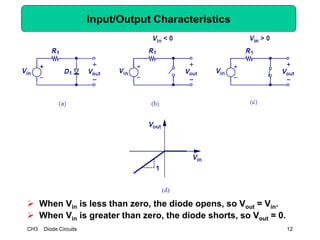
Input/Output Characteristics
 When Vin is less than zero, the diode opens, so Vout = Vin.
 When Vin is greater than zero, the diode shorts, so Vout = 0.
CH3 Diode Circuits 13
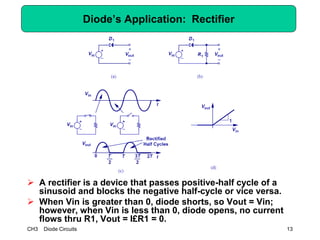
Diode’s Application: Rectifier
 A rectifier is a device that passes positive-half cycle of a
sinusoid and blocks the negative half-cycle or vice versa.
 When Vin is greater than 0, diode shorts, so Vout = Vin;
however, when Vin is less than 0, diode opens, no current
flows thru R1, Vout = I£R1 = 0.
CH3 Diode Circuits 14
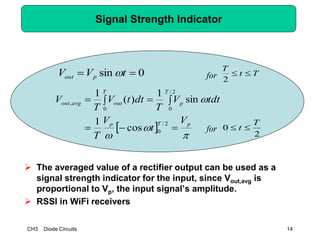
Signal Strength Indicator
 The averaged value of a rectifier output can be used as a
signal strength indicator for the input, since Vout,avg is
proportional to Vp, the input signal’s amplitude.
 RSSI in WiFi receivers
 




pTp
T
p
T
outavgout
V
t
V
T
tdtV
T
dttV
T
V


2/
0
2/
00
,
cos
1
sin
1
)(
1
Tt
T

2
for
2
0
T
t 
for0sin  tVV pout 
CH3 Diode Circuits 15
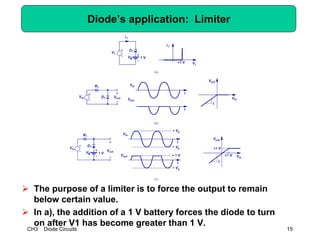
Diode’s application: Limiter
 The purpose of a limiter is to force the output to remain
below certain value.
 In a), the addition of a 1 V battery forces the diode to turn
on after V1 has become greater than 1 V.
CH3 Diode Circuits 16
Limiter: When Battery Varies
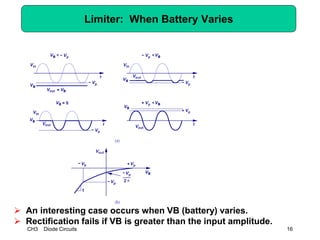
 An interesting case occurs when VB (battery) varies.
 Rectification fails if VB is greater than the input amplitude.
Complex Diode Circuit Examples
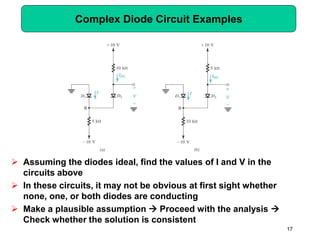
 Assuming the diodes ideal, find the values of I and V in the
circuits above
 In these circuits, it may not be obvious at first sight whether
none, one, or both diodes are conducting
 Make a plausible assumption  Proceed with the analysis 
Check whether the solution is consistent
17
Diode Examples
18
CH2 Basic Physics of Semiconductors 19
Diode’s Three Operation Regions
 In order to understand the operation of a diode, it is
necessary to study its three operation regions: equilibrium,
reverse bias, and forward bias.
Terminal Characteristics of Junction Diodes
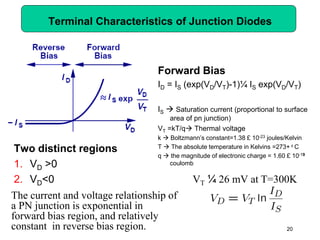
Two distinct regions
1. VD >0
2. VD<0
Forward Bias
ID = IS (exp(VD/VT)-1)¼ IS exp(VD/VT)
IS  Saturation current (proportional to surface
area of pn junction)
VT =kT/q Thermal voltage
k  Boltzmann’s constant=1.38 £ 10-23 joules/Kelvin
T  The absolute temperature in Kelvins =273+ ± C
q  the magnitude of electronic charge = 1.60 £ 10-19
coulomb
20
VT ¼ 26 mV at T=300K
The current and voltage relationship of
a PN junction is exponential in
forward bias region, and relatively
constant in reverse bias region.
CH2 Basic Physics of Semiconductors 21
IV Characteristic of PN Junction
 The current and voltage relationship of a PN junction is
exponential in forward bias region, and relatively constant
in reverse bias region.
)1(exp 
T
D
SD
V
V
II
Temperature Dependence of the Diode Forward
Characteristics
22
I = IS exp(q V/(kT))
 Is (saturation current) is also a function of temperature.
 At a constant current, there is a decrease of approximately 2mV in
diode voltage for every 1± C degree increase
CH3 Diode Circuits 23
Different Models for Diode
 Thus far, Diode models include the ideal model of diode,
the exponential, and constant voltage models.
CH3 Diode Circuits 24
Input/Output Characteristics with Ideal and
Constant-Voltage Models
 The circuit above shows the difference between the ideal
and constant-voltage model; the two models yield two
different break points of slope.
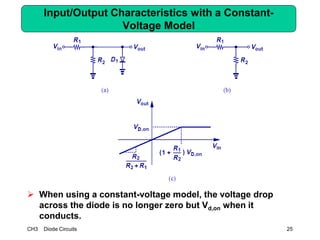
CH3 Diode Circuits 25
Input/Output Characteristics with a Constant-
Voltage Model
 When using a constant-voltage model, the voltage drop
across the diode is no longer zero but Vd,on when it
conducts.
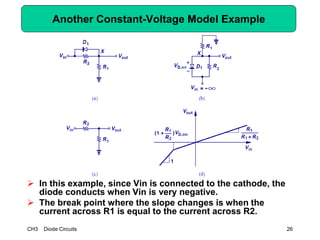
CH3 Diode Circuits 26
Another Constant-Voltage Model Example
 In this example, since Vin is connected to the cathode, the
diode conducts when Vin is very negative.
 The break point where the slope changes is when the
current across R1 is equal to the current across R2.
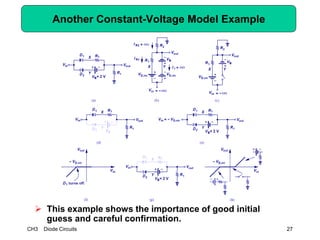
CH3 Diode Circuits 27
Another Constant-Voltage Model Example
 This example shows the importance of good initial
guess and careful confirmation.
Example: Constant Voltage Model
28
Example: Constant Voltage Model
29
CH3 Diode Circuits 30
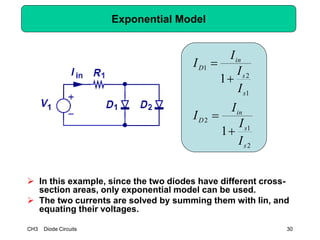
Exponential Model
 In this example, since the two diodes have different cross-
section areas, only exponential model can be used.
 The two currents are solved by summing them with Iin, and
equating their voltages.
2
1
2
1
2
1
1
1
s
s
in
D
s
s
in
D
I
I
I
I
I
I
I
I




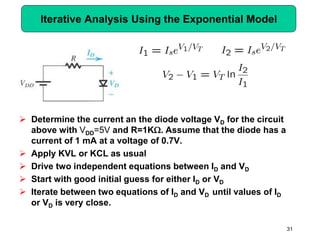
Iterative Analysis Using the Exponential Model
 Determine the current an the diode voltage VD for the circuit
above with VDD=5V and R=1K. Assume that the diode has a
current of 1 mA at a voltage of 0.7V.
 Apply KVL or KCL as usual
 Drive two independent equations between ID and VD
 Start with good initial guess for either ID or VD
 Iterate between two equations of ID and VD until values of ID
or VD is very close.
31
How to choose a diode model to utilize?
 Utilize the ideal model so as to develop a quick understanding of
the circuit
 If the ideal model is insufficient, employ the constant-voltage
model
 For more accurate analysis with smaller signal levels, we need to
resort to the exponential model.
– Exponential model is often complicated.
– Thus, we do first approximation to exponential
model  Small-signal model
32
Exp[x] ¼ 1+x +x2/2 + …
HOT for abs(x)<<1
CH3 Diode Circuits 33
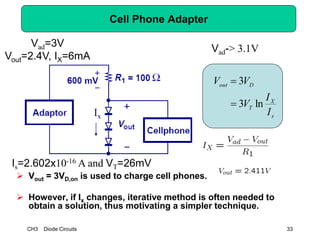
Cell Phone Adapter
 Vout = 3VD,on is used to charge cell phones.
 However, if Ix changes, iterative method is often needed to
obtain a solution, thus motivating a simpler technique.
s
X
T
Dout
I
I
V
VV
ln3
3


Ix
Vad=3V
Vout=2.4V, IX=6mA
Is=2.602x10⁻¹⁶ A and VT=26mV
Vad-> 3.1V
Large-Signal and Small-Signal Operations
 Large-Signal Operation
– “General Model” such as exponential I/V
characteristics
– Arbitrarily large voltage and current changes
– Complicates the analysis
 Small-Signal Operation
34
Exp[x] ¼ 1+x +x2/2 + …
HOT for abs(x)<<1
CH3 Diode Circuits 35
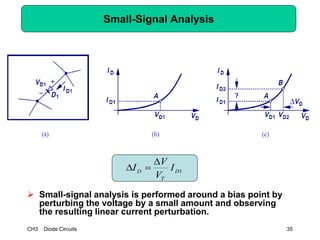
Small-Signal Analysis
 Small-signal analysis is performed around a bias point by
perturbing the voltage by a small amount and observing
the resulting linear current perturbation.
1D
T
D I
V
V
I


CH3 Diode Circuits 36
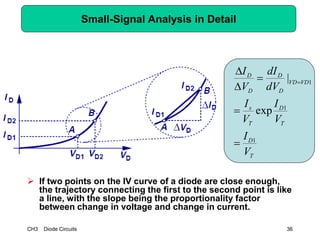
Small-Signal Analysis in Detail
 If two points on the IV curve of a diode are close enough,
the trajectory connecting the first to the second point is like
a line, with the slope being the proportionality factor
between change in voltage and change in current.
T
D
T
D
T
s
VDVD
D
D
D
D
V
I
V
I
V
I
dV
dI
V
I
1
1
1
exp
|






CH3 Diode Circuits 37
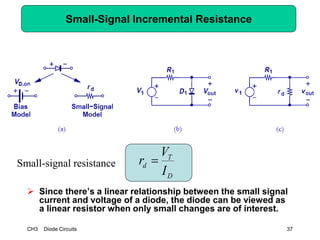
Small-Signal Incremental Resistance
 Since there’s a linear relationship between the small signal
current and voltage of a diode, the diode can be viewed as
a linear resistor when only small changes are of interest.
D
T
d
I
V
r Small-signal resistance
CH3 Diode Circuits 38
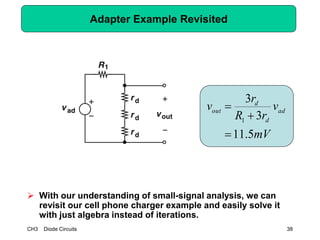
Adapter Example Revisited
 With our understanding of small-signal analysis, we can
revisit our cell phone charger example and easily solve it
with just algebra instead of iterations.
mV
v
rR
r
v ad
d
d
out
5.11
3
3
1



CH3 Diode Circuits 39
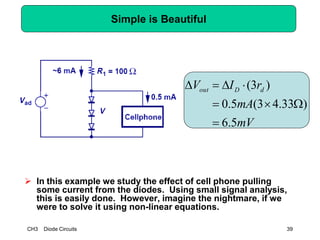
Simple is Beautiful
 In this example we study the effect of cell phone pulling
some current from the diodes. Using small signal analysis,
this is easily done. However, imagine the nightmare, if we
were to solve it using non-linear equations.
mV
mA
rIV dDout
5.6
)33.43(5.0
)3(



CH3 Diode Circuits 40
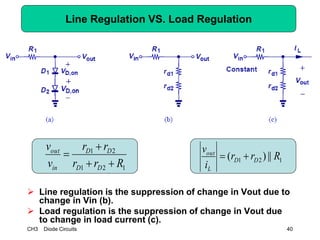
Line Regulation VS. Load Regulation
 Line regulation is the suppression of change in Vout due to
change in Vin (b).
 Load regulation is the suppression of change in Vout due
to change in load current (c).
121
21
Rrr
rr
v
v
DD
DD
in
out


 121 ||)( Rrr
i
v
DD
L
out

CH3 Diode Circuits 41
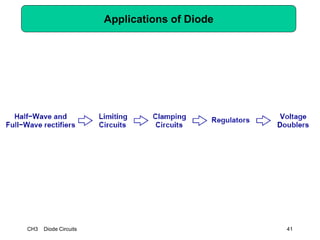
Applications of Diode
CH3 Diode Circuits 42
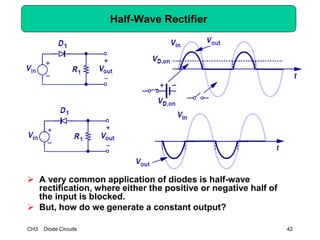
Half-Wave Rectifier
 A very common application of diodes is half-wave
rectification, where either the positive or negative half of
the input is blocked.
 But, how do we generate a constant output?
CH3 Diode Circuits 43
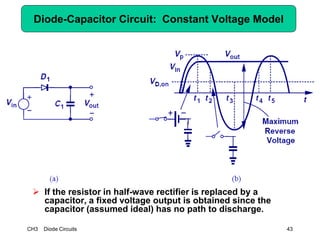
Diode-Capacitor Circuit: Constant Voltage Model
 If the resistor in half-wave rectifier is replaced by a
capacitor, a fixed voltage output is obtained since the
capacitor (assumed ideal) has no path to discharge.
CH3 Diode Circuits 44
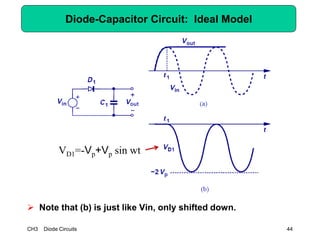
Diode-Capacitor Circuit: Ideal Model
 Note that (b) is just like Vin, only shifted down.
VD1=-Vp+Vp sin wt
CH3 Diode Circuits 45
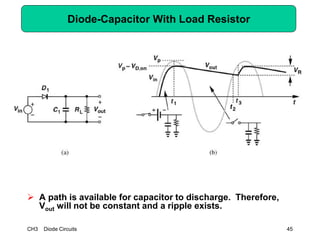
Diode-Capacitor With Load Resistor
 A path is available for capacitor to discharge. Therefore,
Vout will not be constant and a ripple exists.
CH3 Diode Circuits 46
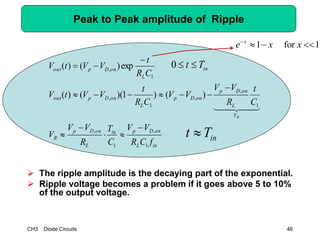
Peak to Peak amplitude of Ripple
 The ripple amplitude is the decaying part of the exponential.
 Ripple voltage becomes a problem if it goes above 5 to 10%
of the output voltage.
inL
onDpin
L
onDp
R
V
L
onDp
onDp
L
onDpout
L
onDpout
fCR
VV
C
T
R
VV
V
C
t
R
VV
VV
CR
t
VVtV
CR
t
VVtV
R
1
,
1
,
1
,
,
1
,
1
,
)()1)(()(
exp)()(









inTt 0
1for1 
xxe x
inTt 
CH3 Diode Circuits 47
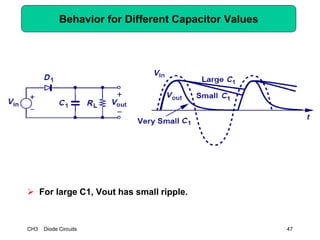
Behavior for Different Capacitor Values
 For large C1, Vout has small ripple.
CH3 Diode Circuits 48
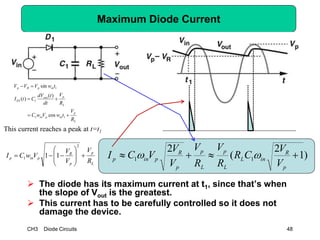
Maximum Diode Current
 The diode has its maximum current at t1, since that’s when
the slope of Vout is the greatest.
 This current has to be carefully controlled so it does not
damage the device.
)1
2
(
2
11 
p
R
inL
L
p
L
p
p
R
pinp
V
V
CR
R
V
R
V
V
V
VCI 
L
p
inpin
L
pout
D
inpRp
R
V
twVwC
R
V
dt
tdV
CtI
twVVV



11
11
1
cos
)(
)(
sin
This current reaches a peak at t=t1
L
p
p
R
pinp
R
V
V
V
VwCI 









2
1 11
CH3 Diode Circuits 49
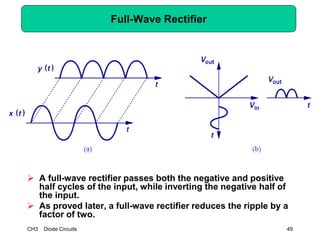
Full-Wave Rectifier
 A full-wave rectifier passes both the negative and positive
half cycles of the input, while inverting the negative half of
the input.
 As proved later, a full-wave rectifier reduces the ripple by a
factor of two.
CH3 Diode Circuits 50
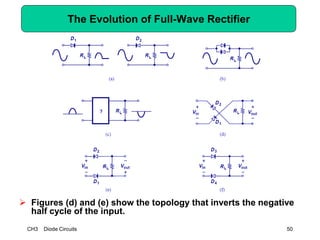
The Evolution of Full-Wave Rectifier
 Figures (d) and (e) show the topology that inverts the negative
half cycle of the input.
CH3 Diode Circuits 51
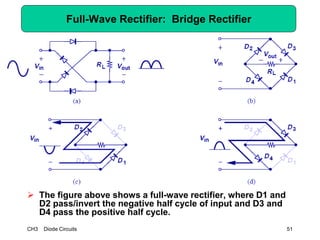
Full-Wave Rectifier: Bridge Rectifier
 The figure above shows a full-wave rectifier, where D1 and
D2 pass/invert the negative half cycle of input and D3 and
D4 pass the positive half cycle.
CH3 Diode Circuits 52
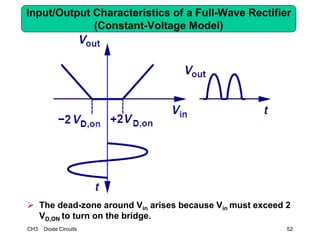
Input/Output Characteristics of a Full-Wave Rectifier
(Constant-Voltage Model)
 The dead-zone around Vin arises because Vin must exceed 2
VD,ON to turn on the bridge.
CH3 Diode Circuits 53
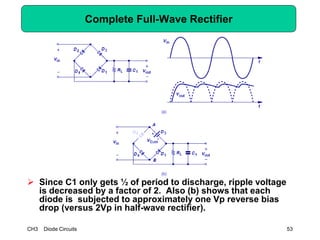
Complete Full-Wave Rectifier
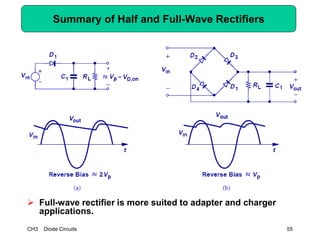
 Since C1 only gets ½ of period to discharge, ripple voltage
is decreased by a factor of 2. Also (b) shows that each
diode is subjected to approximately one Vp reverse bias
drop (versus 2Vp in half-wave rectifier).
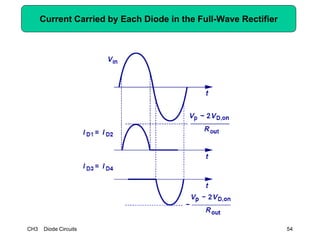
CH3 Diode Circuits 54
Current Carried by Each Diode in the Full-Wave Rectifier
CH3 Diode Circuits 55
Summary of Half and Full-Wave Rectifiers
 Full-wave rectifier is more suited to adapter and charger
applications.
CH3 Diode Circuits 56
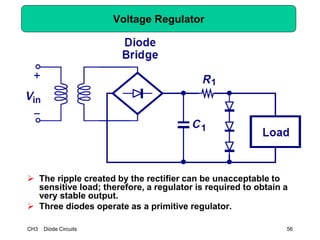
Voltage Regulator
 The ripple created by the rectifier can be unacceptable to
sensitive load; therefore, a regulator is required to obtain a
very stable output.
 Three diodes operate as a primitive regulator.
CH3 Diode Circuits 57
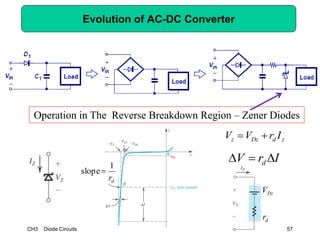
Evolution of AC-DC Converter
Operation in The Reverse Breakdown Region – Zener Diodes
zdDzz IrVV 
dr
1
slope
IrV d 
d
Dz
r
V
CH3 Diode Circuits 58
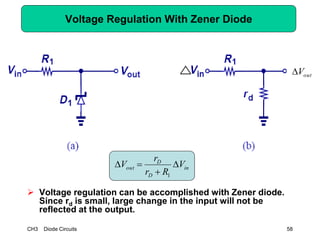
Voltage Regulation With Zener Diode
 Voltage regulation can be accomplished with Zener diode.
Since rd is small, large change in the input will not be
reflected at the output.
in
D
D
out V
Rr
r
V 


1
outV
CH3 Diode Circuits 59
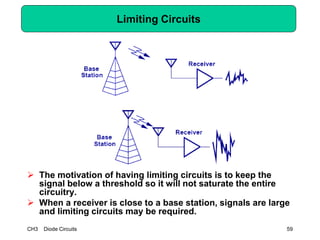
Limiting Circuits
 The motivation of having limiting circuits is to keep the
signal below a threshold so it will not saturate the entire
circuitry.
 When a receiver is close to a base station, signals are large
and limiting circuits may be required.
CH3 Diode Circuits 60
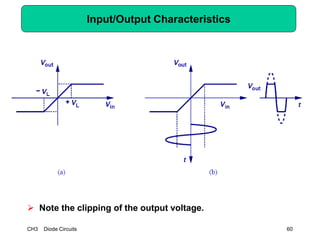
Input/Output Characteristics
 Note the clipping of the output voltage.
CH3 Diode Circuits 61
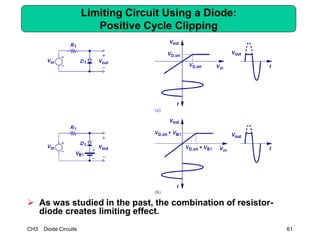
Limiting Circuit Using a Diode:
Positive Cycle Clipping
 As was studied in the past, the combination of resistor-
diode creates limiting effect.
CH3 Diode Circuits 62
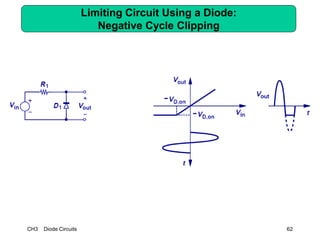
Limiting Circuit Using a Diode:
Negative Cycle Clipping
CH3 Diode Circuits 63
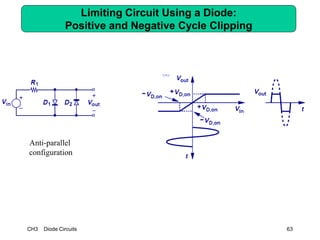
Limiting Circuit Using a Diode:
Positive and Negative Cycle Clipping
Anti-parallel
configuration
CH3 Diode Circuits 64
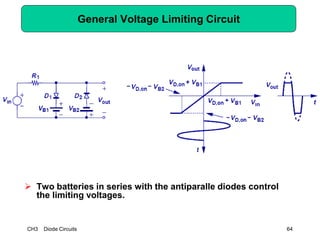
General Voltage Limiting Circuit
 Two batteries in series with the antiparalle diodes control
the limiting voltages.
CH3 Diode Circuits 65
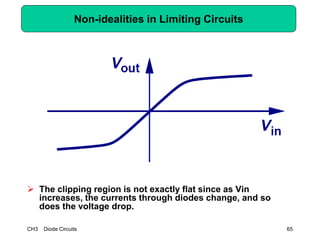
Non-idealities in Limiting Circuits
 The clipping region is not exactly flat since as Vin
increases, the currents through diodes change, and so
does the voltage drop.
CH3 Diode Circuits 66
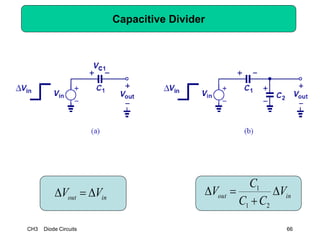
Capacitive Divider
inout VV  inout V
CC
C
V 


21
1
CH3 Diode Circuits 67
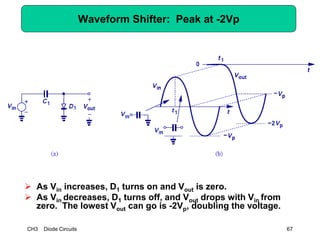
Waveform Shifter: Peak at -2Vp
 As Vin increases, D1 turns on and Vout is zero.
 As Vin decreases, D1 turns off, and Vout drops with Vin from
zero. The lowest Vout can go is -2Vp, doubling the voltage.
CH3 Diode Circuits 68
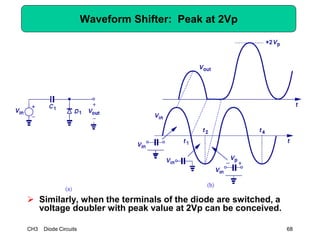
Waveform Shifter: Peak at 2Vp
 Similarly, when the terminals of the diode are switched, a
voltage doubler with peak value at 2Vp can be conceived.
CH3 Diode Circuits 69
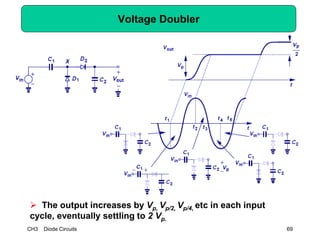
Voltage Doubler
 The output increases by Vp, Vp/2, Vp/4, etc in each input
cycle, eventually settling to 2 Vp.
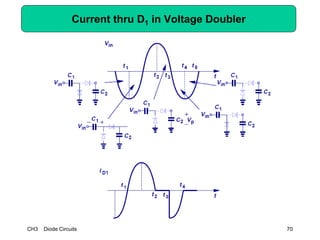
CH3 Diode Circuits 70
Current thru D1 in Voltage Doubler
CH3 Diode Circuits 71
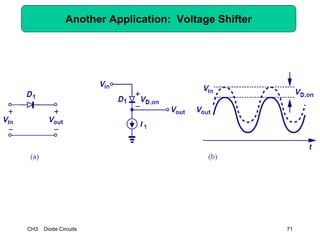
Another Application: Voltage Shifter
CH3 Diode Circuits 72
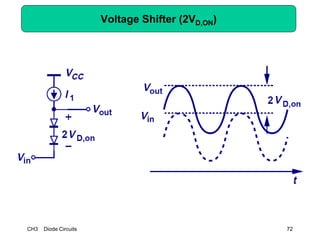
Voltage Shifter (2VD,ON)
CH3 Diode Circuits 73
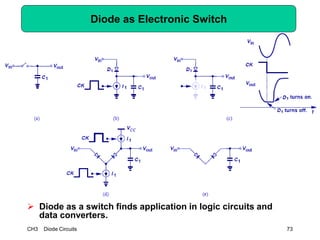
Diode as Electronic Switch
 Diode as a switch finds application in logic circuits and
data converters.
CH3 Diode Circuits 74
Junction Feedthrough
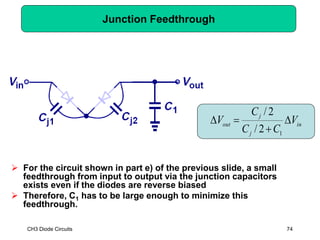
 For the circuit shown in part e) of the previous slide, a small
feedthrough from input to output via the junction capacitors
exists even if the diodes are reverse biased
 Therefore, C1 has to be large enough to minimize this
feedthrough.
in
j
j
out V
CC
C
V 


12/
2/
CH3 Diode Circuits 75
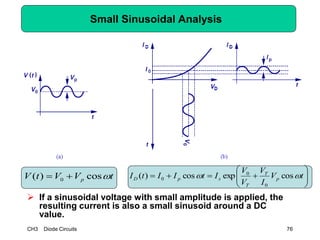
Small Sinusoidal Analysis
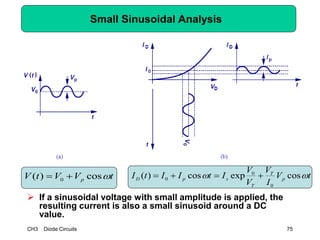
 If a sinusoidal voltage with small amplitude is applied, the
resulting current is also a small sinusoid around a DC
value.
tV
I
V
V
V
ItIItI p
T
T
spD  cosexpcos)(
0
0
0 tVVtV p cos)( 0 
CH3 Diode Circuits 76
Small Sinusoidal Analysis
 If a sinusoidal voltage with small amplitude is applied, the
resulting current is also a small sinusoid around a DC
value.






 tV
I
V
V
V
ItIItI p
T
T
spD  cosexpcos)(
0
0
0tVVtV p cos)( 0 
CH3 Diode Circuits 77
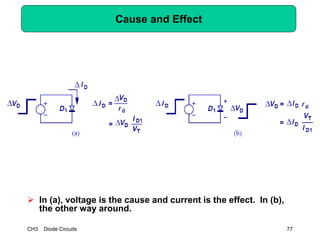
Cause and Effect
 In (a), voltage is the cause and current is the effect. In (b),
the other way around.

Ch03updated

  • 1.
    1 Fundamentals of Microelectronics CH1 Why Microelectronics?  CH2 Basic Physics of Semiconductors  CH3 Diode Circuits  CH4 Physics of Bipolar Transistors  CH5 Bipolar Amplifiers  CH6 Physics of MOS Transistors  CH7 CMOS Amplifiers  CH8 Operational Amplifier As A Black Box
  • 2.
    2 Chapter 3 DiodeCircuits  3.1 Ideal Diode  3.2 PN Junction as a Diode  3.3 Applications of Diodes
  • 3.
    CH3 Diode Circuits3 Diode Circuits  You know the physics of a diode from EE3310, in EE3311 we will study its behavior as a circuit element and its many applications.
  • 4.
    CH3 Diode Circuits4 Diode’s Application: Cell Phone Charger  An important application of diode is chargers.  Diode acts as the black box (after transformer) that passes only the positive half of the stepped-down sinusoid.
  • 5.
    CH3 Diode Circuits5 Diode’s Action in The Black Box (Ideal Diode)  The diode behaves as a short circuit during the positive half cycle (voltage across it tends to exceed zero), and an open circuit during the negative half cycle (voltage across it is less than zero).
  • 6.
    CH3 Diode Circuits6 Ideal Diode  In an ideal diode, if the voltage across it tends to exceed zero, current flows.  It is analogous to a water pipe that allows water to flow in only one direction.
  • 7.
    CH3 Diode Circuits7 Diodes in Series  Diodes cannot be connected in series randomly. For the circuits above, only a) can conduct current from A to C.
  • 8.
    CH3 Diode Circuits8 IV Characteristics of an Ideal Diode  If the voltage across anode and cathode is greater than zero, the resistance of an ideal diode is zero and current becomes infinite. However, if the voltage is less than zero, the resistance becomes infinite and current is zero.  R V IR 0 0 R V IR
  • 9.
    CH3 Diode Circuits9 Anti-Parallel Ideal Diodes  If two diodes are connected in anti-parallel, it acts as a short for all voltages.
  • 10.
    CH3 Diode Circuits10 Diode-Resistor Combination  The IV characteristic of this diode-resistor combination is zero for negative voltages and Ohm’s law for positive voltages.
  • 11.
    CH3 Diode Circuits11 Diode Implementation of OR Gate  The circuit above shows an example of diode-implemented OR gate.  Vout can only be either VA or VB, not both.
  • 12.
    CH3 Diode Circuits12 Input/Output Characteristics  When Vin is less than zero, the diode opens, so Vout = Vin.  When Vin is greater than zero, the diode shorts, so Vout = 0.
  • 13.
    CH3 Diode Circuits13 Diode’s Application: Rectifier  A rectifier is a device that passes positive-half cycle of a sinusoid and blocks the negative half-cycle or vice versa.  When Vin is greater than 0, diode shorts, so Vout = Vin; however, when Vin is less than 0, diode opens, no current flows thru R1, Vout = I£R1 = 0.
  • 14.
    CH3 Diode Circuits14 Signal Strength Indicator  The averaged value of a rectifier output can be used as a signal strength indicator for the input, since Vout,avg is proportional to Vp, the input signal’s amplitude.  RSSI in WiFi receivers       pTp T p T outavgout V t V T tdtV T dttV T V   2/ 0 2/ 00 , cos 1 sin 1 )( 1 Tt T  2 for 2 0 T t  for0sin  tVV pout 
  • 15.
    CH3 Diode Circuits15 Diode’s application: Limiter  The purpose of a limiter is to force the output to remain below certain value.  In a), the addition of a 1 V battery forces the diode to turn on after V1 has become greater than 1 V.
  • 16.
    CH3 Diode Circuits16 Limiter: When Battery Varies  An interesting case occurs when VB (battery) varies.  Rectification fails if VB is greater than the input amplitude.
  • 17.
    Complex Diode CircuitExamples  Assuming the diodes ideal, find the values of I and V in the circuits above  In these circuits, it may not be obvious at first sight whether none, one, or both diodes are conducting  Make a plausible assumption  Proceed with the analysis  Check whether the solution is consistent 17
  • 18.
  • 19.
    CH2 Basic Physicsof Semiconductors 19 Diode’s Three Operation Regions  In order to understand the operation of a diode, it is necessary to study its three operation regions: equilibrium, reverse bias, and forward bias.
  • 20.
    Terminal Characteristics ofJunction Diodes Two distinct regions 1. VD >0 2. VD<0 Forward Bias ID = IS (exp(VD/VT)-1)¼ IS exp(VD/VT) IS  Saturation current (proportional to surface area of pn junction) VT =kT/q Thermal voltage k  Boltzmann’s constant=1.38 £ 10-23 joules/Kelvin T  The absolute temperature in Kelvins =273+ ± C q  the magnitude of electronic charge = 1.60 £ 10-19 coulomb 20 VT ¼ 26 mV at T=300K The current and voltage relationship of a PN junction is exponential in forward bias region, and relatively constant in reverse bias region.
  • 21.
    CH2 Basic Physicsof Semiconductors 21 IV Characteristic of PN Junction  The current and voltage relationship of a PN junction is exponential in forward bias region, and relatively constant in reverse bias region. )1(exp  T D SD V V II
  • 22.
    Temperature Dependence ofthe Diode Forward Characteristics 22 I = IS exp(q V/(kT))  Is (saturation current) is also a function of temperature.  At a constant current, there is a decrease of approximately 2mV in diode voltage for every 1± C degree increase
  • 23.
    CH3 Diode Circuits23 Different Models for Diode  Thus far, Diode models include the ideal model of diode, the exponential, and constant voltage models.
  • 24.
    CH3 Diode Circuits24 Input/Output Characteristics with Ideal and Constant-Voltage Models  The circuit above shows the difference between the ideal and constant-voltage model; the two models yield two different break points of slope.
  • 25.
    CH3 Diode Circuits25 Input/Output Characteristics with a Constant- Voltage Model  When using a constant-voltage model, the voltage drop across the diode is no longer zero but Vd,on when it conducts.
  • 26.
    CH3 Diode Circuits26 Another Constant-Voltage Model Example  In this example, since Vin is connected to the cathode, the diode conducts when Vin is very negative.  The break point where the slope changes is when the current across R1 is equal to the current across R2.
  • 27.
    CH3 Diode Circuits27 Another Constant-Voltage Model Example  This example shows the importance of good initial guess and careful confirmation.
  • 28.
  • 29.
  • 30.
    CH3 Diode Circuits30 Exponential Model  In this example, since the two diodes have different cross- section areas, only exponential model can be used.  The two currents are solved by summing them with Iin, and equating their voltages. 2 1 2 1 2 1 1 1 s s in D s s in D I I I I I I I I    
  • 31.
    Iterative Analysis Usingthe Exponential Model  Determine the current an the diode voltage VD for the circuit above with VDD=5V and R=1K. Assume that the diode has a current of 1 mA at a voltage of 0.7V.  Apply KVL or KCL as usual  Drive two independent equations between ID and VD  Start with good initial guess for either ID or VD  Iterate between two equations of ID and VD until values of ID or VD is very close. 31
  • 32.
    How to choosea diode model to utilize?  Utilize the ideal model so as to develop a quick understanding of the circuit  If the ideal model is insufficient, employ the constant-voltage model  For more accurate analysis with smaller signal levels, we need to resort to the exponential model. – Exponential model is often complicated. – Thus, we do first approximation to exponential model  Small-signal model 32 Exp[x] ¼ 1+x +x2/2 + … HOT for abs(x)<<1
  • 33.
    CH3 Diode Circuits33 Cell Phone Adapter  Vout = 3VD,on is used to charge cell phones.  However, if Ix changes, iterative method is often needed to obtain a solution, thus motivating a simpler technique. s X T Dout I I V VV ln3 3   Ix Vad=3V Vout=2.4V, IX=6mA Is=2.602x10⁻¹⁶ A and VT=26mV Vad-> 3.1V
  • 34.
    Large-Signal and Small-SignalOperations  Large-Signal Operation – “General Model” such as exponential I/V characteristics – Arbitrarily large voltage and current changes – Complicates the analysis  Small-Signal Operation 34 Exp[x] ¼ 1+x +x2/2 + … HOT for abs(x)<<1
  • 35.
    CH3 Diode Circuits35 Small-Signal Analysis  Small-signal analysis is performed around a bias point by perturbing the voltage by a small amount and observing the resulting linear current perturbation. 1D T D I V V I  
  • 36.
    CH3 Diode Circuits36 Small-Signal Analysis in Detail  If two points on the IV curve of a diode are close enough, the trajectory connecting the first to the second point is like a line, with the slope being the proportionality factor between change in voltage and change in current. T D T D T s VDVD D D D D V I V I V I dV dI V I 1 1 1 exp |      
  • 37.
    CH3 Diode Circuits37 Small-Signal Incremental Resistance  Since there’s a linear relationship between the small signal current and voltage of a diode, the diode can be viewed as a linear resistor when only small changes are of interest. D T d I V r Small-signal resistance
  • 38.
    CH3 Diode Circuits38 Adapter Example Revisited  With our understanding of small-signal analysis, we can revisit our cell phone charger example and easily solve it with just algebra instead of iterations. mV v rR r v ad d d out 5.11 3 3 1   
  • 39.
    CH3 Diode Circuits39 Simple is Beautiful  In this example we study the effect of cell phone pulling some current from the diodes. Using small signal analysis, this is easily done. However, imagine the nightmare, if we were to solve it using non-linear equations. mV mA rIV dDout 5.6 )33.43(5.0 )3(   
  • 40.
    CH3 Diode Circuits40 Line Regulation VS. Load Regulation  Line regulation is the suppression of change in Vout due to change in Vin (b).  Load regulation is the suppression of change in Vout due to change in load current (c). 121 21 Rrr rr v v DD DD in out    121 ||)( Rrr i v DD L out 
  • 41.
    CH3 Diode Circuits41 Applications of Diode
  • 42.
    CH3 Diode Circuits42 Half-Wave Rectifier  A very common application of diodes is half-wave rectification, where either the positive or negative half of the input is blocked.  But, how do we generate a constant output?
  • 43.
    CH3 Diode Circuits43 Diode-Capacitor Circuit: Constant Voltage Model  If the resistor in half-wave rectifier is replaced by a capacitor, a fixed voltage output is obtained since the capacitor (assumed ideal) has no path to discharge.
  • 44.
    CH3 Diode Circuits44 Diode-Capacitor Circuit: Ideal Model  Note that (b) is just like Vin, only shifted down. VD1=-Vp+Vp sin wt
  • 45.
    CH3 Diode Circuits45 Diode-Capacitor With Load Resistor  A path is available for capacitor to discharge. Therefore, Vout will not be constant and a ripple exists.
  • 46.
    CH3 Diode Circuits46 Peak to Peak amplitude of Ripple  The ripple amplitude is the decaying part of the exponential.  Ripple voltage becomes a problem if it goes above 5 to 10% of the output voltage. inL onDpin L onDp R V L onDp onDp L onDpout L onDpout fCR VV C T R VV V C t R VV VV CR t VVtV CR t VVtV R 1 , 1 , 1 , , 1 , 1 , )()1)(()( exp)()(          inTt 0 1for1  xxe x inTt 
  • 47.
    CH3 Diode Circuits47 Behavior for Different Capacitor Values  For large C1, Vout has small ripple.
  • 48.
    CH3 Diode Circuits48 Maximum Diode Current  The diode has its maximum current at t1, since that’s when the slope of Vout is the greatest.  This current has to be carefully controlled so it does not damage the device. )1 2 ( 2 11  p R inL L p L p p R pinp V V CR R V R V V V VCI  L p inpin L pout D inpRp R V twVwC R V dt tdV CtI twVVV    11 11 1 cos )( )( sin This current reaches a peak at t=t1 L p p R pinp R V V V VwCI           2 1 11
  • 49.
    CH3 Diode Circuits49 Full-Wave Rectifier  A full-wave rectifier passes both the negative and positive half cycles of the input, while inverting the negative half of the input.  As proved later, a full-wave rectifier reduces the ripple by a factor of two.
  • 50.
    CH3 Diode Circuits50 The Evolution of Full-Wave Rectifier  Figures (d) and (e) show the topology that inverts the negative half cycle of the input.
  • 51.
    CH3 Diode Circuits51 Full-Wave Rectifier: Bridge Rectifier  The figure above shows a full-wave rectifier, where D1 and D2 pass/invert the negative half cycle of input and D3 and D4 pass the positive half cycle.
  • 52.
    CH3 Diode Circuits52 Input/Output Characteristics of a Full-Wave Rectifier (Constant-Voltage Model)  The dead-zone around Vin arises because Vin must exceed 2 VD,ON to turn on the bridge.
  • 53.
    CH3 Diode Circuits53 Complete Full-Wave Rectifier  Since C1 only gets ½ of period to discharge, ripple voltage is decreased by a factor of 2. Also (b) shows that each diode is subjected to approximately one Vp reverse bias drop (versus 2Vp in half-wave rectifier).
  • 54.
    CH3 Diode Circuits54 Current Carried by Each Diode in the Full-Wave Rectifier
  • 55.
    CH3 Diode Circuits55 Summary of Half and Full-Wave Rectifiers  Full-wave rectifier is more suited to adapter and charger applications.
  • 56.
    CH3 Diode Circuits56 Voltage Regulator  The ripple created by the rectifier can be unacceptable to sensitive load; therefore, a regulator is required to obtain a very stable output.  Three diodes operate as a primitive regulator.
  • 57.
    CH3 Diode Circuits57 Evolution of AC-DC Converter Operation in The Reverse Breakdown Region – Zener Diodes zdDzz IrVV  dr 1 slope IrV d  d Dz r V
  • 58.
    CH3 Diode Circuits58 Voltage Regulation With Zener Diode  Voltage regulation can be accomplished with Zener diode. Since rd is small, large change in the input will not be reflected at the output. in D D out V Rr r V    1 outV
  • 59.
    CH3 Diode Circuits59 Limiting Circuits  The motivation of having limiting circuits is to keep the signal below a threshold so it will not saturate the entire circuitry.  When a receiver is close to a base station, signals are large and limiting circuits may be required.
  • 60.
    CH3 Diode Circuits60 Input/Output Characteristics  Note the clipping of the output voltage.
  • 61.
    CH3 Diode Circuits61 Limiting Circuit Using a Diode: Positive Cycle Clipping  As was studied in the past, the combination of resistor- diode creates limiting effect.
  • 62.
    CH3 Diode Circuits62 Limiting Circuit Using a Diode: Negative Cycle Clipping
  • 63.
    CH3 Diode Circuits63 Limiting Circuit Using a Diode: Positive and Negative Cycle Clipping Anti-parallel configuration
  • 64.
    CH3 Diode Circuits64 General Voltage Limiting Circuit  Two batteries in series with the antiparalle diodes control the limiting voltages.
  • 65.
    CH3 Diode Circuits65 Non-idealities in Limiting Circuits  The clipping region is not exactly flat since as Vin increases, the currents through diodes change, and so does the voltage drop.
  • 66.
    CH3 Diode Circuits66 Capacitive Divider inout VV  inout V CC C V    21 1
  • 67.
    CH3 Diode Circuits67 Waveform Shifter: Peak at -2Vp  As Vin increases, D1 turns on and Vout is zero.  As Vin decreases, D1 turns off, and Vout drops with Vin from zero. The lowest Vout can go is -2Vp, doubling the voltage.
  • 68.
    CH3 Diode Circuits68 Waveform Shifter: Peak at 2Vp  Similarly, when the terminals of the diode are switched, a voltage doubler with peak value at 2Vp can be conceived.
  • 69.
    CH3 Diode Circuits69 Voltage Doubler  The output increases by Vp, Vp/2, Vp/4, etc in each input cycle, eventually settling to 2 Vp.
  • 70.
    CH3 Diode Circuits70 Current thru D1 in Voltage Doubler
  • 71.
    CH3 Diode Circuits71 Another Application: Voltage Shifter
  • 72.
    CH3 Diode Circuits72 Voltage Shifter (2VD,ON)
  • 73.
    CH3 Diode Circuits73 Diode as Electronic Switch  Diode as a switch finds application in logic circuits and data converters.
  • 74.
    CH3 Diode Circuits74 Junction Feedthrough  For the circuit shown in part e) of the previous slide, a small feedthrough from input to output via the junction capacitors exists even if the diodes are reverse biased  Therefore, C1 has to be large enough to minimize this feedthrough. in j j out V CC C V    12/ 2/
  • 75.
    CH3 Diode Circuits75 Small Sinusoidal Analysis  If a sinusoidal voltage with small amplitude is applied, the resulting current is also a small sinusoid around a DC value. tV I V V V ItIItI p T T spD  cosexpcos)( 0 0 0 tVVtV p cos)( 0 
  • 76.
    CH3 Diode Circuits76 Small Sinusoidal Analysis  If a sinusoidal voltage with small amplitude is applied, the resulting current is also a small sinusoid around a DC value.        tV I V V V ItIItI p T T spD  cosexpcos)( 0 0 0tVVtV p cos)( 0 
  • 77.
    CH3 Diode Circuits77 Cause and Effect  In (a), voltage is the cause and current is the effect. In (b), the other way around.