Understanding Drug Classifications
Drug Classifications Drugs can be classified by their  therapeutic   use  (e.g., antidepressants) or by their  pharmacologic profile  (e.g., selective serotonin reuptake inhibitors).
Drug Classifications (Cont’d) Most texts use a combination of therapeutic and pharmaceutical classifications Healthcare workers use both terms when discussing medications Other methods of classification are used for various purposes For example, the Schedule of Controlled Substances that classifies drugs by risk for abuse
Therapeutic Classifications Therapeutic classes are broad categories based on therapeutic intent  Antianginals, sedatives, and analgesics are examples of therapeutic classes Therapeutic classes include several pharmacologic classes The therapeutic class  antihypertensives  has at least 13 pharmacologic classes
Therapeutic Classifications (Cont’d) Drugs grouped by therapeutic class work in very different ways They are  not chemically similar   They have  different mechanisms of action Therapeutic class is useful when speaking of drugs in a general way “ Antihypertensive drugs save lives”  “ You will need antihypertensive medication”
Pharmacologic Classifications Pharmacologic classification is based on  mechanism of action  and includes only those drugs that have the  same or similar mechanism of action For example, “angiotensin-converting enzyme inhibitors” (ACE inhibitors) tell you exactly how the drugs works—they inhibit the enzyme that converts angiotensin I to angiotensin II
Pharmacologic Classifications (Cont’d) Pharmacologic classifications describe a drug’s properties in a specific way Pharmacologic class is necessary when determining treatment; a nurse might say “ An ACE inhibitor is more desirable than a beta blocker”  “ Your heart won’t race as much because the beta blocker prevents beta-adrenergic receptors in the heart from being stimulated”
Clues to Pharmacologic Class   Generic   names  of drugs in the same pharmacologic class often have the  same suffix Beta blockers , the pharmacologic class of medications in the therapeutic class of antihypertensives, end in “- olol ”
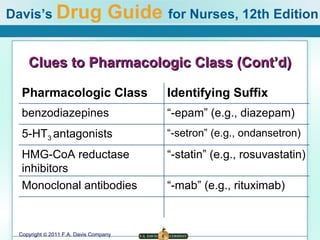
Clues to Pharmacologic Class (Cont’d) Pharmacologic Class Identifying Suffix benzodiazepines “ -epam” (e.g., diazepam) 5-HT 3  antagonists “ -setron” (e.g., ondansetron) HMG-CoA reductase inhibitors “ -statin” (e.g., rosuvastatin) Monoclonal antibodies “ -mab” (e.g., rituximab)
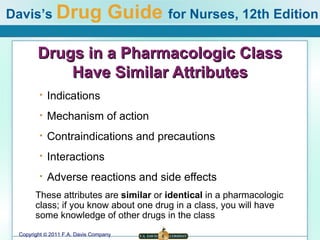
Drugs in a Pharmacologic Class Have Similar Attributes Indications Mechanism of action Contraindications and precautions Interactions Adverse reactions and side effects These attributes are  similar  or  identical  in a pharmacologic class; if you know about one drug in a class, you will have some knowledge of other drugs in the class
Drugs in a Pharmacologic Class  May Differ Dosages Time action profile Availability
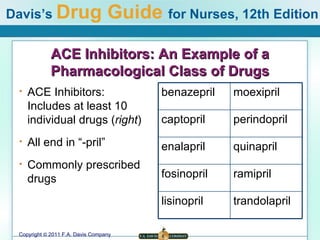
ACE Inhibitors: An Example of a Pharmacological Class of Drugs ACE Inhibitors: Includes at least 10 individual drugs ( right ) All end in “-pril” Commonly prescribed drugs benazepril moexipril captopril perindopril enalapril quinapril fosinopril ramipril lisinopril trandolapril
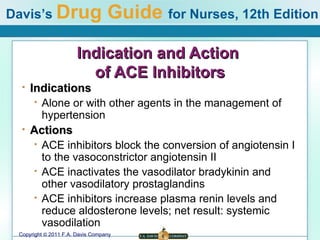
Indication and Action  of ACE Inhibitors Indications Alone or with other agents in the management of hypertension Actions ACE inhibitors block the conversion of angiotensin I to the vasoconstrictor angiotensin II ACE inactivates the vasodilator bradykinin and other vasodilatory prostaglandins ACE inhibitors increase plasma renin levels and reduce aldosterone levels; net result: systemic vasodilation
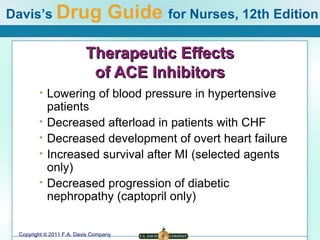
Therapeutic Effects of ACE Inhibitors Lowering of blood pressure in hypertensive patients Decreased afterload in patients with CHF Decreased development of overt heart failure Increased survival after MI (selected agents only) Decreased progression of diabetic nephropathy (captopril only)
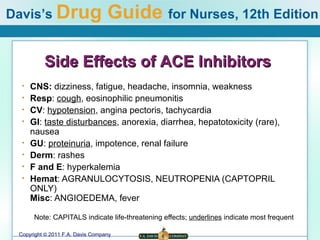
Side Effects of   ACE Inhibitors  CNS:  dizziness, fatigue, headache, insomnia, weakness Resp :  cough , eosinophilic pneumonitis CV :  hypotension , angina pectoris, tachycardia GI :  taste disturbances , anorexia, diarrhea, hepatotoxicity (rare), nausea GU :  proteinuria , impotence, renal failure Derm : rashes F and E : hyperkalemia Hemat : AGRANULOCYTOSIS, NEUTROPENIA (CAPTOPRIL ONLY)  Misc : ANGIOEDEMA, fever Note: CAPITALS   indicate life-threatening effects;  underlines  indicate most frequent
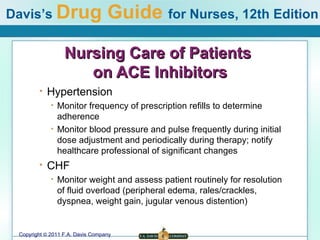
Nursing Care o f Patients  on ACE Inhibitors Hypertension  Monitor frequency of prescription refills to determine adherence Monitor blood pressure and pulse frequently during initial dose adjustment and periodically during therapy; notify healthcare professional of significant changes  CHF  Monitor weight and assess patient routinely for resolution of fluid overload (peripheral edema, rales/crackles, dyspnea, weight gain, jugular venous distention)
Patient Safety Always check other sources if you are uncertain about a medication’s Use Effect Side effects Dosage Route of administration Monitoring criteria Any other parameter of safe and responsible medication administration

Drug classifications

  • 1.
  • 2.
    Drug Classifications Drugscan be classified by their therapeutic use (e.g., antidepressants) or by their pharmacologic profile (e.g., selective serotonin reuptake inhibitors).
  • 3.
    Drug Classifications (Cont’d)Most texts use a combination of therapeutic and pharmaceutical classifications Healthcare workers use both terms when discussing medications Other methods of classification are used for various purposes For example, the Schedule of Controlled Substances that classifies drugs by risk for abuse
  • 4.
    Therapeutic Classifications Therapeuticclasses are broad categories based on therapeutic intent Antianginals, sedatives, and analgesics are examples of therapeutic classes Therapeutic classes include several pharmacologic classes The therapeutic class antihypertensives has at least 13 pharmacologic classes
  • 5.
    Therapeutic Classifications (Cont’d)Drugs grouped by therapeutic class work in very different ways They are not chemically similar They have different mechanisms of action Therapeutic class is useful when speaking of drugs in a general way “ Antihypertensive drugs save lives” “ You will need antihypertensive medication”
  • 6.
    Pharmacologic Classifications Pharmacologicclassification is based on mechanism of action and includes only those drugs that have the same or similar mechanism of action For example, “angiotensin-converting enzyme inhibitors” (ACE inhibitors) tell you exactly how the drugs works—they inhibit the enzyme that converts angiotensin I to angiotensin II
  • 7.
    Pharmacologic Classifications (Cont’d)Pharmacologic classifications describe a drug’s properties in a specific way Pharmacologic class is necessary when determining treatment; a nurse might say “ An ACE inhibitor is more desirable than a beta blocker” “ Your heart won’t race as much because the beta blocker prevents beta-adrenergic receptors in the heart from being stimulated”
  • 8.
    Clues to PharmacologicClass Generic names of drugs in the same pharmacologic class often have the same suffix Beta blockers , the pharmacologic class of medications in the therapeutic class of antihypertensives, end in “- olol ”
  • 9.
    Clues to PharmacologicClass (Cont’d) Pharmacologic Class Identifying Suffix benzodiazepines “ -epam” (e.g., diazepam) 5-HT 3 antagonists “ -setron” (e.g., ondansetron) HMG-CoA reductase inhibitors “ -statin” (e.g., rosuvastatin) Monoclonal antibodies “ -mab” (e.g., rituximab)
  • 10.
    Drugs in aPharmacologic Class Have Similar Attributes Indications Mechanism of action Contraindications and precautions Interactions Adverse reactions and side effects These attributes are similar or identical in a pharmacologic class; if you know about one drug in a class, you will have some knowledge of other drugs in the class
  • 11.
    Drugs in aPharmacologic Class May Differ Dosages Time action profile Availability
  • 12.
    ACE Inhibitors: AnExample of a Pharmacological Class of Drugs ACE Inhibitors: Includes at least 10 individual drugs ( right ) All end in “-pril” Commonly prescribed drugs benazepril moexipril captopril perindopril enalapril quinapril fosinopril ramipril lisinopril trandolapril
  • 13.
    Indication and Action of ACE Inhibitors Indications Alone or with other agents in the management of hypertension Actions ACE inhibitors block the conversion of angiotensin I to the vasoconstrictor angiotensin II ACE inactivates the vasodilator bradykinin and other vasodilatory prostaglandins ACE inhibitors increase plasma renin levels and reduce aldosterone levels; net result: systemic vasodilation
  • 14.
    Therapeutic Effects ofACE Inhibitors Lowering of blood pressure in hypertensive patients Decreased afterload in patients with CHF Decreased development of overt heart failure Increased survival after MI (selected agents only) Decreased progression of diabetic nephropathy (captopril only)
  • 15.
    Side Effects of ACE Inhibitors CNS: dizziness, fatigue, headache, insomnia, weakness Resp : cough , eosinophilic pneumonitis CV : hypotension , angina pectoris, tachycardia GI : taste disturbances , anorexia, diarrhea, hepatotoxicity (rare), nausea GU : proteinuria , impotence, renal failure Derm : rashes F and E : hyperkalemia Hemat : AGRANULOCYTOSIS, NEUTROPENIA (CAPTOPRIL ONLY) Misc : ANGIOEDEMA, fever Note: CAPITALS indicate life-threatening effects; underlines indicate most frequent
  • 16.
    Nursing Care of Patients on ACE Inhibitors Hypertension  Monitor frequency of prescription refills to determine adherence Monitor blood pressure and pulse frequently during initial dose adjustment and periodically during therapy; notify healthcare professional of significant changes CHF Monitor weight and assess patient routinely for resolution of fluid overload (peripheral edema, rales/crackles, dyspnea, weight gain, jugular venous distention)
  • 17.
    Patient Safety Alwayscheck other sources if you are uncertain about a medication’s Use Effect Side effects Dosage Route of administration Monitoring criteria Any other parameter of safe and responsible medication administration