Decoding Pharmacy Credentials 
     

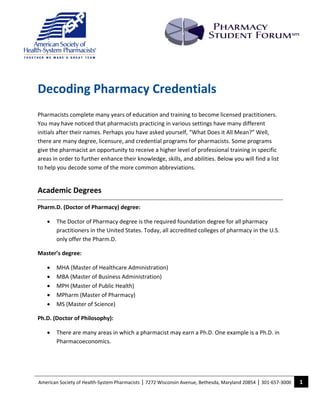
    Pharmacists complete many years of education and training to become licensed practitioners. 
    You may have noticed that pharmacists practicing in various settings have many different 
    initials after their names. Perhaps you have asked yourself, “What Does it All Mean?” Well, 
    there are many degree, licensure, and credential programs for pharmacists. Some programs 
    give the pharmacist an opportunity to receive a higher level of professional training in specific 
    areas in order to further enhance their knowledge, skills, and abilities. Below you will find a list 
    to help you decode some of the more common abbreviations. 


    Academic Degrees 
    Pharm.D. (Doctor of Pharmacy) degree:  

        •   The Doctor of Pharmacy degree is the required foundation degree for all pharmacy 
            practitioners in the United States. Today, all accredited colleges of pharmacy in the U.S. 
            only offer the Pharm.D.  

    Master’s degree: 

        •   MHA (Master of Healthcare Administration) 
        •   MBA (Master of Business Administration) 
        •   MPH (Master of Public Health) 
        •   MPharm (Master of Pharmacy) 
        •   MS (Master of Science) 

    Ph.D. (Doctor of Philosophy):  

        •   There are many areas in which a pharmacist may earn a Ph.D. One example is a Ph.D. in 
            Pharmacoeconomics. 


    American Society of Health‐System Pharmacists | 7272 Wisconsin Avenue, Bethesda, Maryland 20854 | 301‐657‐3000    1 


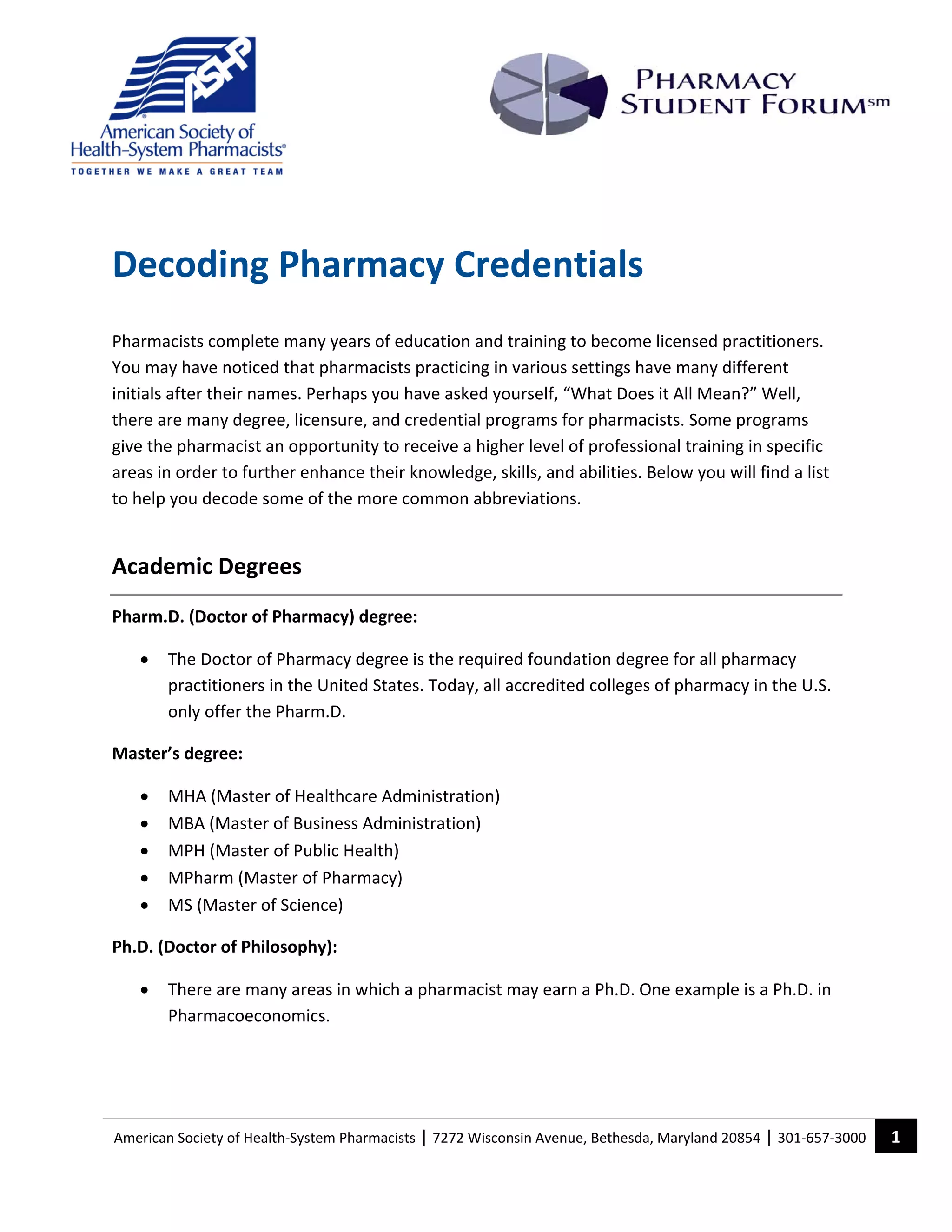
State Licensure 
R.Ph. (Registered Pharmacist): 

    •   Every pharmacist, regardless of their practice setting, must be licensed by the state 
        board of pharmacy, after passing the state licensure examination, and abide by the rules 
        and regulations of the state in which they practice. 


Certificate Training Programs 
Several certificate training programs for pharmacists exist in different areas of practice. The 
credentials are listed below followed by the credentialing agency of each program. 

    •   CDE (Certified Diabetes Educator): National Certification Board for Diabetes Educators 
        (NCBDE)  
    •   CGP (Certified Geriatric Pharmacist): Commission for Certification in Geriatric Pharmacy 
        (CCGP) 
    •   AE‐C (Certified Asthma Educator): National Asthma Educator Certification Board 
        (NAECB) 
    •   CACP (Certified Anticoagulation Care Provider): National Certification Board for 
        Anticoagulation Providers (NCBAP) 
    •   Credentialed Pain Practitioner (CPP): American Academy of Pain Management (AAPM) 
    •   Certified Specialist in Poison Information (CSPI): American Association of Poison Control 
        Centers 
    •   Diplomat of the American Board of Applied Toxicology (DABAT): American Board of 
        Applied Toxicology  


Fellow Programs and Fellowships 
Pharmacists can complete fellowships as a form of post‐doctoral training to become more 
specialized in a certain area of research or in the pharmaceutical industry. You typically will not 
see any titles after the names of these pharmacists other than "fellow" while they are in the 
fellowship program. However, there is another type of fellow. Professional organizations award 
the honorary title of “fellow” to pharmacists who have made significant contributions to the 
profession. A pharmacist does not have to complete a fellowship to become a “fellow” of a 
American Society of Health‐System Pharmacists | 7272 Wisconsin Avenue, Bethesda, Maryland 20854 | 301‐657‐3000    2 
 
 
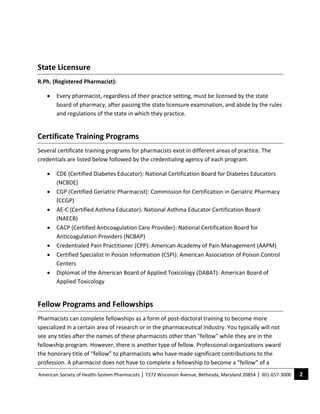
professional organization. Here are some of the more common "fellow programs" that 
pharmacists may be involved in through the organizations to which they belong: 

    •    FASHP (Fellow of the American Society of Health‐System Pharmacists) 
    •    FACCP (Fellow of the American College of Clinical Pharmacy) 
    •    FASCP (Fellow of the American Society of Consultant Pharmacists) 
    •    FCCM (Fellow of the American College of Critical Care Medicine) 


Board Certification 
The Board of Pharmaceutical Specialties (BPS) offers pharmacists the opportunity to become 
board certified in several specialty areas. For more information, please visit 
http://www.bpsweb.org/index.cfm. 

    •    BCNP (Board Certified Nuclear Pharmacist) 
    •    BCNSP (Board Certified Nutrition Support Pharmacist) 
    •    BCOP (Board Certified Oncology Pharmacist) 
    •    BCPS (Board Certified Pharmacotherapy Specialist) 
    •    BCPP (Board Certified Psychiatric Pharmacist) 


Disease Management Certification 
The credentialing program offered by the National Institute for Standards in Pharmacist 
Credentialing (NISPC)* allows a pharmacist to earn the credentials of a Certified Disease 
Manager (CDM). A pharmacist may become a Certified Disease Manager in the following four 
specialty areas:   

    •    CDM‐ Anticoagulation (Certified Disease Manager of Anticoagulation) 
    •    CDM‐ Asthma (Certified Disease Manager of Asthma) 
    •    CDM‐ Diabetes (Certified Disease Manager of Diabetes) 
    •    CDM‐ Dyslipidemia (Certified Disease Manager of Dyslipidemia) 

*The Disease management certification program offered by NISPC expired on December 31, 2008. 


American Society of Health‐System Pharmacists | 7272 Wisconsin Avenue, Bethesda, Maryland 20854 | 301‐657‐3000    3 


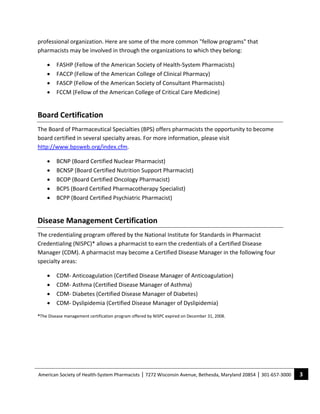
Residency Training 
PGY‐1 (Post‐Graduate Year 1): 

     •   A PGY‐1 residency is a one year pharmacy practice residency that provides generalized 
         experience in a variety of areas within the pharmacy profession in order to enhance a 
         pharmacist’s clinical competency.     

PGY‐2 (Post‐Graduate Year 2): 

     •   A PGY‐2 residency is also a one year residency but requires the completion of a PGY‐1 
         residency prior to entering the PGY‐2 program. The PGY‐2 residency is a residency that 
         builds on the clinical competencies established in the PGY‐1 year and focuses on a 
         specific area of practice throughout the program such as pediatric pharmacy, oncology 
         pharmacy, or pharmacokinetics.  


American Society of Health‐System Pharmacists | 7272 Wisconsin Avenue, Bethesda, Maryland 20854 | 301‐657‐3000    4 


Decoding pharm credentials

  • 1.
                      Decoding Pharmacy Credentials    Pharmacists complete many years of education and training to become licensed practitioners.  You may have noticed that pharmacists practicing in various settings have many different  initials after their names. Perhaps you have asked yourself, “What Does it All Mean?” Well,  there are many degree, licensure, and credential programs for pharmacists. Some programs  give the pharmacist an opportunity to receive a higher level of professional training in specific  areas in order to further enhance their knowledge, skills, and abilities. Below you will find a list  to help you decode some of the more common abbreviations.  Academic Degrees  Pharm.D. (Doctor of Pharmacy) degree:   • The Doctor of Pharmacy degree is the required foundation degree for all pharmacy  practitioners in the United States. Today, all accredited colleges of pharmacy in the U.S.  only offer the Pharm.D.   Master’s degree:  • MHA (Master of Healthcare Administration)  • MBA (Master of Business Administration)  • MPH (Master of Public Health)  • MPharm (Master of Pharmacy)  • MS (Master of Science)  Ph.D. (Doctor of Philosophy):   • There are many areas in which a pharmacist may earn a Ph.D. One example is a Ph.D. in  Pharmacoeconomics.  American Society of Health‐System Pharmacists | 7272 Wisconsin Avenue, Bethesda, Maryland 20854 | 301‐657‐3000  1   
  • 2.
      State Licensure  R.Ph. (Registered Pharmacist):  • Every pharmacist, regardless of their practice setting, must be licensed by the state  board of pharmacy, after passing the state licensure examination, and abide by the rules  and regulations of the state in which they practice.  Certificate Training Programs  Several certificate training programs for pharmacists exist in different areas of practice. The  credentials are listed below followed by the credentialing agency of each program.  • CDE (Certified Diabetes Educator): National Certification Board for Diabetes Educators  (NCBDE)   • CGP (Certified Geriatric Pharmacist): Commission for Certification in Geriatric Pharmacy  (CCGP)  • AE‐C (Certified Asthma Educator): National Asthma Educator Certification Board  (NAECB)  • CACP (Certified Anticoagulation Care Provider): National Certification Board for  Anticoagulation Providers (NCBAP)  • Credentialed Pain Practitioner (CPP): American Academy of Pain Management (AAPM)  • Certified Specialist in Poison Information (CSPI): American Association of Poison Control  Centers  • Diplomat of the American Board of Applied Toxicology (DABAT): American Board of  Applied Toxicology   Fellow Programs and Fellowships  Pharmacists can complete fellowships as a form of post‐doctoral training to become more  specialized in a certain area of research or in the pharmaceutical industry. You typically will not  see any titles after the names of these pharmacists other than "fellow" while they are in the  fellowship program. However, there is another type of fellow. Professional organizations award  the honorary title of “fellow” to pharmacists who have made significant contributions to the  profession. A pharmacist does not have to complete a fellowship to become a “fellow” of a  American Society of Health‐System Pharmacists | 7272 Wisconsin Avenue, Bethesda, Maryland 20854 | 301‐657‐3000  2     
  • 3.
    professional organization. Here are some of the more common "fellow programs" that  pharmacists may be involved in through the organizations to which they belong:  • FASHP (Fellow of the American Society of Health‐System Pharmacists)  • FACCP (Fellow of the American College of Clinical Pharmacy)  • FASCP (Fellow of the American Society of Consultant Pharmacists)  • FCCM (Fellow of the American College of Critical Care Medicine)  Board Certification  The Board of Pharmaceutical Specialties (BPS) offers pharmacists the opportunity to become  board certified in several specialty areas. For more information, please visit  http://www.bpsweb.org/index.cfm.  • BCNP (Board Certified Nuclear Pharmacist)  • BCNSP (Board Certified Nutrition Support Pharmacist)  • BCOP (Board Certified Oncology Pharmacist)  • BCPS (Board Certified Pharmacotherapy Specialist)  • BCPP (Board Certified Psychiatric Pharmacist)  Disease Management Certification  The credentialing program offered by the National Institute for Standards in Pharmacist  Credentialing (NISPC)* allows a pharmacist to earn the credentials of a Certified Disease  Manager (CDM). A pharmacist may become a Certified Disease Manager in the following four  specialty areas:    • CDM‐ Anticoagulation (Certified Disease Manager of Anticoagulation)  • CDM‐ Asthma (Certified Disease Manager of Asthma)  • CDM‐ Diabetes (Certified Disease Manager of Diabetes)  • CDM‐ Dyslipidemia (Certified Disease Manager of Dyslipidemia)  *The Disease management certification program offered by NISPC expired on December 31, 2008.  American Society of Health‐System Pharmacists | 7272 Wisconsin Avenue, Bethesda, Maryland 20854 | 301‐657‐3000  3     
  • 4.
      Residency Training  PGY‐1 (Post‐Graduate Year 1):  • A PGY‐1 residency is a one year pharmacy practice residency that provides generalized  experience in a variety of areas within the pharmacy profession in order to enhance a  pharmacist’s clinical competency.      PGY‐2 (Post‐Graduate Year 2):  • A PGY‐2 residency is also a one year residency but requires the completion of a PGY‐1  residency prior to entering the PGY‐2 program. The PGY‐2 residency is a residency that  builds on the clinical competencies established in the PGY‐1 year and focuses on a  specific area of practice throughout the program such as pediatric pharmacy, oncology  pharmacy, or pharmacokinetics.      American Society of Health‐System Pharmacists | 7272 Wisconsin Avenue, Bethesda, Maryland 20854 | 301‐657‐3000  4