PHYSICAL PHARMACY
3011-T
CHAPTER 1
PHARMACY ORIENTATION
Lecture Content
• Pharmacy
• Physical Pharmacy
• Orientation of Pharmacy
• Pharmacist
• Hospital Pharmacy
• Industrial Pharmacy
• Clinical Pharmacy
• Retail Pharmacy
• Community Pharmacy
• Forensic Pharmacy
• Nuclear Pharmacy
Pharmacy
• Pharmacy is the art and science of preparing and dispensing
medications and the provision of drug related information to the
public.
• It involves the following tasks:
1. Interpretation of prescription orders,
2. The compounding,
3. Labelling,
4. Dispensing of drugs and devices;
5. Drug product selection
6. Drug utilization reviews;
7. Patient monitoring and intervention; and
8. The provision of cognitive services related to use of medications
and devices.
Physical Pharmacy
• Physical pharmacy is the branch of pharmacy that concentrates on
the application of physics and chemistry to the study of pharmacy.
• Physical pharmacy has been associated with the area of pharmacy
that dealt with the quantitative and theoretical principles of
physicochemical science as they applied to the practice of
pharmacy.
• Physical pharmacy attempted to integrate the factual knowledge of
pharmacy through the development of broad principles of its own,
and it aided the pharmacist and the pharmaceutical scientist in their
attempt to predict the solubility, stability, compatibility and
Pharmacist
• A pharmacist is one who is educated and licensed to prepare
and dispense drugs and to provide drug and related
information to the public. An expert on drugs.
• A drug is any substance that acts on the living body to alter
the physiological process and are used for the prevention,
diagnosis and treatment of diseases.
• A medicine is any drug which has a definite form & dose and
are therapeutically used for the treatment of diseases of living
subjects.
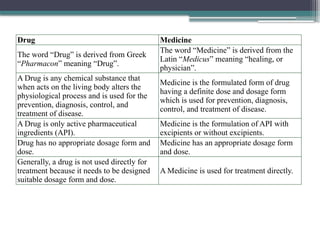
Drug Medicine
The word “Drug” is derived from Greek
“Pharmacon” meaning “Drug”.
The word “Medicine” is derived from the
Latin “Medicus” meaning “healing, or
physician”.
A Drug is any chemical substance that
when acts on the living body alters the
physiological process and is used for the
prevention, diagnosis, control, and
treatment of disease.
Medicine is the formulated form of drug
having a definite dose and dosage form
which is used for prevention, diagnosis,
control, and treatment of disease.
A Drug is only active pharmaceutical
ingredients (API).
Medicine is the formulation of API with
excipients or without excipients.
Drug has no appropriate dosage form and
dose.
Medicine has an appropriate dosage form
and dose.
Generally, a drug is not used directly for
treatment because it needs to be designed
suitable dosage form and dose.
A Medicine is used for treatment directly.
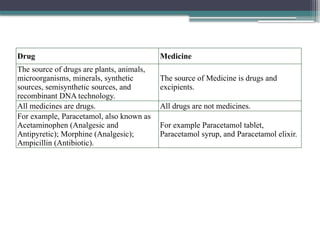
Drug Medicine
The source of drugs are plants, animals,
microorganisms, minerals, synthetic
sources, semisynthetic sources, and
recombinant DNA technology.
The source of Medicine is drugs and
excipients.
All medicines are drugs. All drugs are not medicines.
For example, Paracetamol, also known as
Acetaminophen (Analgesic and
Antipyretic); Morphine (Analgesic);
Ampicillin (Antibiotic).
For example Paracetamol tablet,
Paracetamol syrup, and Paracetamol elixir.
A pharmacist can serve in many areas:
• Hospital Pharmacy
• Industrial Pharmacy
• Community Pharmacy
• Clinical Pharmacy
• Retail Pharmacy
• Forensic Pharmacy
• Nuclear Pharmacy
• Education and Research
• Government Services
Hospital Pharmacy
• Hospital Pharmacy is the practice of pharmacy
mainly in the hospital setting, and in clinics or
nursing homes.
• In these settings, pharmacists dispense medications,
prepare sterile preparations, advise other health care
professionals and patients on the use of drugs,
monitor drug regimen and evaluate drug use.
Hospital Pharmacy
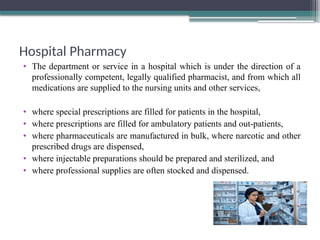
• The department or service in a hospital which is under the direction of a
professionally competent, legally qualified pharmacist, and from which all
medications are supplied to the nursing units and other services,
• where special prescriptions are filled for patients in the hospital,
• where prescriptions are filled for ambulatory patients and out-patients,
• where pharmaceuticals are manufactured in bulk, where narcotic and other
prescribed drugs are dispensed,
• where injectable preparations should be prepared and sterilized, and
• where professional supplies are often stocked and dispensed.
Hospital Pharmacy Cont..
A hospital pharmacy department typically comprises
of pharmacists and pharmacy technicians, who undertake a variety of
clinical and non-clinical tasks including:
• procuring, compounding and dispensing medicines
• advising healthcare professionals and patients on safe, effective and
quality use of medicines.
Hospital pharmacy departments usually consist of:
• inpatient and outpatient dispensaries
• manufacturing and compounding facilities
• drug information services
• Quality use of Medicine services
• stewardship services
• clinical trial services
In-Patient Services
• Inpatient pharmacy provides services to the wards,
clinics, and other units in the hospital through the unit
dose supply system
• It includes services like dispensing of all medications,
orders screening for drug-drug interactions, routine
quality assurance, pharmacokinetic services, etc.
• Inpatient
pharmacist plays a key role in the hospital pharmacy.
They collaborate with all members of the health care
team, patients, and their caregivers to provide patient
care services.
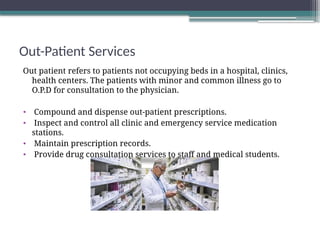
Out-Patient Services
Out patient refers to patients not occupying beds in a hospital, clinics,
health centers. The patients with minor and common illness go to
O.P.D for consultation to the physician.
• Compound and dispense out-patient prescriptions.
• Inspect and control all clinic and emergency service medication
stations.
• Maintain prescription records.
• Provide drug consultation services to staff and medical students.
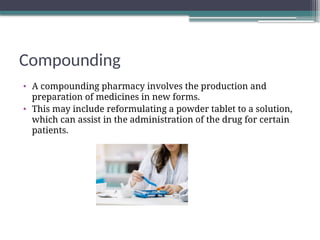
Compounding
• A compounding pharmacy involves the production and
preparation of medicines in new forms.
• This may include reformulating a powder tablet to a solution,
which can assist in the administration of the drug for certain
patients.
Drug Information Services
• Provide drug information on drugs and drug therapy to
doctors, nurses, medical and nursing students .
• Maintain the drug information center.
• Prepare the hospital's pharmacy newsletter.
• Maintain literature files.
Industrial Pharmacy
• In pharmaceutical industry pharmacist can serve in a number
of different departments including the following major areas
• Production and Quality Control
• Sales
• Marketing
• Research and Development
• Regulatory Affairs Department
• Management and Administration
Industrial Pharmacy
• Industrial pharmacy: the largest number of pharmacists is
involved in marketing and administration.
• Pharmacist work in different areas of industry including
production, quality control, quality assurance, packaging,
procurement, warehouse, marketing etc.
• Pharmaceutical industries employ pharmacist as their
professional service representatives (sales), who educate
physicians and pharmacists about the manufacturer’s
products.
• Multinational companies employ higher degree pharmacy
professionals in research and development, production and
quality control as supervisor and trainee at the initial stage
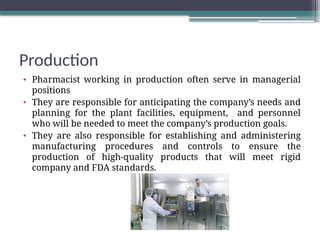
Production
• Pharmacist working in production often serve in managerial
positions
• They are responsible for anticipating the company’s needs and
planning for the plant facilities, equipment, and personnel
who will be needed to meet the company’s production goals.
• They are also responsible for establishing and administering
manufacturing procedures and controls to ensure the
production of high-quality products that will meet rigid
company and FDA standards.
Quality Control and Quality Assurance (QC & QA)
• Research-intensive pharmaceutical companies constantly
conduct thousands of assays and quality assurance (QA)
tests each year to maintain the quality of their products.
• The R & D, manufacturing, and QA departments of the
company jointly establish final production and QA
specifications for a new product.
• The QA deprtment establishes sampling and testing
procedures to make certain that each lot of a product
meets both company and FDA specifications.
• The QC and QA system also ensures the potency, purity,
and dose-to-dose uniformity of the product, in addition to
the chemical, physical, and biological data; stability of the
finished trade packages; and appropriate expiration dates.
• The QA department also checks not only for the quality
Sales and Marketing
• The sales area is one of the ways for pharmacist to get
into the pharmaceutical industry.
• The sales representative usually calls upon physicians,
pharmacists, and nurses.
• The objective of these calls is to provide the various
professional audiences with enough comprehensive
information on a product to encourage the product’s
appropriate use by the health care providers.
• The marketing department is responsible for developing
and implementing marketing plans to promote the
Research and Development
• Pharmacist in the industry are engaged in R
& D of new drugs or new indications or
dosage forms for existing products.
• Requires strong scientific background.
• PhDs are often required to progress in the
area of dosage form development.
Regulatory Affairs Department
• Handles the interaction between the
company and medicines regulatory body of
the country in which the company is located.
• In Pakistan this authority is “ Drug
Regualtory Authority of Pakistan”. In United
States this authority is Food and Drug
administration (FDA)
Management and Administration
• Pharmacist working in this area ensures that
the department functions smoothly and
achieves its objectives.
• Pharmacy training provides a good basis for
management and administration, but on the
job experience is usually the key to success
in management.
Retail Pharmacy
The term “retail community pharmacy” means an independent pharmacy, a chain
pharmacy, a supermarket pharmacy, or a mass merchandiser pharmacy that is
licensed as a pharmacy by the State and that dispenses medications to the
general public at retail prices.
Retail pharmacists are responsible for dispensing and controlling both prescription
and non-prescription medicine. They also advise customers on general
healthcare. Retail pharmacists must work to legal and ethical guidelines.
• Employment as a retail pharmacist involves:
• providing advice about health issues, symptoms and medications in response to
customer enquiries
• recruiting, training and managing staff
• processing prescriptions and dispensing medication
• ordering and selling medicines and other stock
• meeting medical representatives
• managing budgets
• keeping statistical and financial records
• preparing publicity materials and displays
• marketing services
• Some evening and weekend work may be required.
Retail Pharmacy Cont..
Typical employers of retail pharmacists
• Independent pharmacies
• Supermarket pharmacies
• Pharmacy chains
Role of a retail pharmacist
• providing advice about health issues, symptoms and medications in response
to customer enquiries.
• recruiting, training and managing staff
• processing prescriptions and dispensing medication
• ordering and selling medicines and other stock
• meeting medical representatives
• managing budgets
• keeping statistical and financial records
• preparing publicity materials and displays
• marketing services
Forensic Pharmacy
• Forensic pharmacy is application of the
sciences of drugs to legal issues.
• Forensic pharmacists engage in work
relating to litigation (the process of taking
legal action), the regulatory process, and the
criminal justice system.
• Forensic pharmacists often serve as officers
on drug-testing assignments.
Nuclear pharmacy
• Nuclear pharmacy applies the principles and
practices of pharmacy and nuclear chemistry
to produce radioactive drugs used for
diagnosis and therapy. Some of these
pharmacists work in hospitals and others
work for private nuclear pharmacies that
provide radioactive drugs to hospitals.
Education and Research
• A career in academia allows pharmacists to conduct
research and work in the highly advanced
pharmaceutical science.
• Pharmaceutical education offers opportunities to
pharmacists with advanced degrees in any of the
professional specialities.
• Areas of graduate study include pharmaceutics,
pharmaceutical/medicinal chemistry, pharmacognosy,
and social and administrative pharmacy.
• A master’s or PhD degree is necessary for research,
administrative or faculty positions.
Government Services
• Pharmacists in government/federal pharmacy are
employees of local, state, or federal government
agencies. These could include government units
such as municipal health clinics, government
hospitals, branches of the Military including the
Army, Navy, and Air Force, the Public Health
Service (PHS), and other related organizations.
• Opportunities for pharmacists in the government
are varied and cover a wide scope of practices
including clinical, research, and administrative
roles.
Community Pharmacy
• Community Pharmacy is the practice of
pharmacy in the community setting. It
required professional skills and in many
cases management abilities.
• In addition to dispensing pharmaceuticals,
community pharmacists answer questions
about prescription and over the counter
(OTC) drugs and give advice on health care
supplies and durable medical equipment.
Community Pharmacy
• Community pharmacy is a hybrid practice
requiring well-developed professional skills
and, in many cases, management abilities.
• Success in community pharmacy practice
depends on business management skills
because a pharmacy is a business, and on
clinical and therapeutic knowledge because a
pharmacist is also a healthcare provider.
• People skills are also important because of the
direct patient contact in a community
pharmacy.
Duties of a Community Pharmacist
• Collaborate with Physicians to Receive Prescriptions
In today’s age, many prescriptions are sent digitally straight to a patient’s
pharmacy of choice. It is the responsibility of the community pharmacist to
develop and maintain relationships with local physicians.
• Fill Patient Prescriptions and Instruct Customers on How to Use Medications
Community pharmacists fill prescriptions for customers. They often delegate tasks
like pill counting to interns or pharmacy technicians. Their main focus is educating
patients on how to use medications and efficiently answering their questions.
• Advise Customers on Minor Ailments and General Health Topics
Many people go to their local community pharmacist for advice on what to take
for minor ailments, such as colds, as well as how to treat minor abrasions. They
recommend non-prescription medication when possible, and refer customers to a
physician when necessary.
• Work with Insurance Companies and Complete Corresponding Paperwork
Community pharmacists depend on insurance companies to get paid. They have to
stay on top of all the paperwork necessary to get customers their medication,
otherwise, they do not get paid.
• Administer Flu Shots and Other Minor Vaccinations
Community pharmacists administer thousands of flu shots around the globe each
flu season.
Clinical Pharmacy
• Clinical pharmacy is one of the services provided by
pharmacists in an attempt to promote rational drug
therapy that is safe, appropriate, and cost-effective.
• Clinical pharmacists work directly with physicians, other
health professionals, and patients to ensure that the
medications prescribed for patients contribute to the
best possible health outcomes.
• Clinical pharmacists practice in health care settings
where they have frequent and regular interactions with
physicians and other health professionals, contributing
to better coordination of care.
• Clinical pharmacists are educated and trained in
many direct patient care environments,
including medical centers, clinics, and a variety
of other health care settings.
• Clinical pharmacists are frequently granted
patient care privileges by collaborating
physicians and/or health systems that allow
them to perform a full range of medication
decision-making functions as part of the
patient’s health care team.
• These privileges are granted on the basis of the
clinical pharmacist’s demonstrated knowledge
of medication therapy and record of clinical
experience. This specialized knowledge and
clinical experience is usually gained through
residency training and specialist board
Clinical Pharmacy
• The ideal pharmacist-controlled hospital pharmacy
practice is still not implemented in Pakistan. At
present, there are only two hospitals in Pakistan
where clinical pharmacy services are not mixed
with other aspects of hospital pharmacy practice:
Shaukat Khanum and Agha Khan; here, pharmacists
focus on clinical pharmacy practices along with the
distributive and administrative aspects of pharmacy
practice.
• However, practice of the subspecialties of clinical
pharmacy (i.e., oncology, infectious diseases, critical
care, pediatrics and geriatrics, cardiology, family
medicine, pain and palliative care, renal and
transplant, drug information, and internal medicine)
Lecture Summary
• Community pharmacy is a hybrid practice requiring well-developed
professional skills and, in many cases, management abilities.
• Some of the duties of a Community Pharmacist include collaborate with
physicians to receive prescriptions, fill patient prescriptions and instruct
customers on how to use medications, advise customers on minor ailments and
general health topics, work with insurance companies and complete
corresponding paperwork, and administer flu shots and other minor
vaccinations.
• The term “retail community pharmacy” means an independent pharmacy, a
chain pharmacy, a supermarket pharmacy, or a mass merchandiser pharmacy
that is licensed as a pharmacy by the State and that dispenses medications to the
general public at retail prices.
• Forensic pharmacy is application of the sciences of drugs to legal issues.
• Nuclear pharmacy applies the principles and practices of pharmacy and nuclear
chemistry to produce radioactive drugs used for diagnosis and therapy.
• A career in academia allows pharmacists to conduct research and work in the
highly advanced pharmaceutical science.
• Pharmacists in government/federal pharmacy are employees of local, state, or
federal government agencies.
Lecture Summary
• Hospital pharmacy is the department or service in a hospital which is
under the direction of a professionally competent, legally qualified
pharmacist.
• Inpatient pharmacy provides services to the wards, clinics, and other
units in the hospital through the unit dose supply system.
• Out patient refers to patients not occupying beds in a hospital, clinics,
health centers.
• In DPIC, pharmacist provide drug information on drugs and drug
therapy to doctors, nurses, medical and nursing students.
Lecture Summary Cont..
• In pharmaceutical industry pharmacist can serve in a number of different departments
including the following major areas such as Production and Quality Control, Sales,
Marketing, Research and Development, Regulatory Affairs Department, and
Management and Administration.
• In pharmaceutical industry pharmacist can serve in a number of different departments
such as production, QC, QA, Research etc.
• Pharmacist working in production often serve in managerial positions.
• Research-intensive pharmaceutical companies constantly conduct thousands of assays
and quality assurance (QA) tests each year to maintain the quality of their products.
• Pharmacist in the industry are engaged in R & D of new drugs or new indications or
dosage forms for existing products.
• Community pharmacy is the type of pharmacy that allows the public access to their
medications and advice about their health.
• Pharmacist do research in advance areas of pharmacy and acquire postgraduate
education including masters and doctorate degrees.
Reference
• Sinko PJ, Martin AN. Martin's physical pharmacy and
pharmaceutical sciences: physical chemical and
biopharmaceutical principles in the pharmaceutical
sciences. 5 th Ed. Lippincott Williams & Wilkins;
2006.
• Zinc G. Remington: The Science and Practice of
Pharmacy. Philadelphia College of Pharmacy and
Science; 2005.

chapter 1 PHYSICAL PHARMACY ORIENTATION.pptx

  • 1.
  • 2.
  • 3.
    Lecture Content • Pharmacy •Physical Pharmacy • Orientation of Pharmacy • Pharmacist • Hospital Pharmacy • Industrial Pharmacy • Clinical Pharmacy • Retail Pharmacy • Community Pharmacy • Forensic Pharmacy • Nuclear Pharmacy
  • 4.
    Pharmacy • Pharmacy isthe art and science of preparing and dispensing medications and the provision of drug related information to the public. • It involves the following tasks: 1. Interpretation of prescription orders, 2. The compounding, 3. Labelling, 4. Dispensing of drugs and devices; 5. Drug product selection 6. Drug utilization reviews; 7. Patient monitoring and intervention; and 8. The provision of cognitive services related to use of medications and devices.
  • 5.
    Physical Pharmacy • Physicalpharmacy is the branch of pharmacy that concentrates on the application of physics and chemistry to the study of pharmacy. • Physical pharmacy has been associated with the area of pharmacy that dealt with the quantitative and theoretical principles of physicochemical science as they applied to the practice of pharmacy. • Physical pharmacy attempted to integrate the factual knowledge of pharmacy through the development of broad principles of its own, and it aided the pharmacist and the pharmaceutical scientist in their attempt to predict the solubility, stability, compatibility and
  • 6.
    Pharmacist • A pharmacistis one who is educated and licensed to prepare and dispense drugs and to provide drug and related information to the public. An expert on drugs. • A drug is any substance that acts on the living body to alter the physiological process and are used for the prevention, diagnosis and treatment of diseases. • A medicine is any drug which has a definite form & dose and are therapeutically used for the treatment of diseases of living subjects.
  • 7.
    Drug Medicine The word“Drug” is derived from Greek “Pharmacon” meaning “Drug”. The word “Medicine” is derived from the Latin “Medicus” meaning “healing, or physician”. A Drug is any chemical substance that when acts on the living body alters the physiological process and is used for the prevention, diagnosis, control, and treatment of disease. Medicine is the formulated form of drug having a definite dose and dosage form which is used for prevention, diagnosis, control, and treatment of disease. A Drug is only active pharmaceutical ingredients (API). Medicine is the formulation of API with excipients or without excipients. Drug has no appropriate dosage form and dose. Medicine has an appropriate dosage form and dose. Generally, a drug is not used directly for treatment because it needs to be designed suitable dosage form and dose. A Medicine is used for treatment directly.
  • 8.
    Drug Medicine The sourceof drugs are plants, animals, microorganisms, minerals, synthetic sources, semisynthetic sources, and recombinant DNA technology. The source of Medicine is drugs and excipients. All medicines are drugs. All drugs are not medicines. For example, Paracetamol, also known as Acetaminophen (Analgesic and Antipyretic); Morphine (Analgesic); Ampicillin (Antibiotic). For example Paracetamol tablet, Paracetamol syrup, and Paracetamol elixir.
  • 9.
    A pharmacist canserve in many areas: • Hospital Pharmacy • Industrial Pharmacy • Community Pharmacy • Clinical Pharmacy • Retail Pharmacy • Forensic Pharmacy • Nuclear Pharmacy • Education and Research • Government Services
  • 10.
    Hospital Pharmacy • HospitalPharmacy is the practice of pharmacy mainly in the hospital setting, and in clinics or nursing homes. • In these settings, pharmacists dispense medications, prepare sterile preparations, advise other health care professionals and patients on the use of drugs, monitor drug regimen and evaluate drug use.
  • 11.
    Hospital Pharmacy • Thedepartment or service in a hospital which is under the direction of a professionally competent, legally qualified pharmacist, and from which all medications are supplied to the nursing units and other services, • where special prescriptions are filled for patients in the hospital, • where prescriptions are filled for ambulatory patients and out-patients, • where pharmaceuticals are manufactured in bulk, where narcotic and other prescribed drugs are dispensed, • where injectable preparations should be prepared and sterilized, and • where professional supplies are often stocked and dispensed.
  • 12.
    Hospital Pharmacy Cont.. Ahospital pharmacy department typically comprises of pharmacists and pharmacy technicians, who undertake a variety of clinical and non-clinical tasks including: • procuring, compounding and dispensing medicines • advising healthcare professionals and patients on safe, effective and quality use of medicines. Hospital pharmacy departments usually consist of: • inpatient and outpatient dispensaries • manufacturing and compounding facilities • drug information services • Quality use of Medicine services • stewardship services • clinical trial services
  • 13.
    In-Patient Services • Inpatientpharmacy provides services to the wards, clinics, and other units in the hospital through the unit dose supply system • It includes services like dispensing of all medications, orders screening for drug-drug interactions, routine quality assurance, pharmacokinetic services, etc. • Inpatient pharmacist plays a key role in the hospital pharmacy. They collaborate with all members of the health care team, patients, and their caregivers to provide patient care services.
  • 14.
    Out-Patient Services Out patientrefers to patients not occupying beds in a hospital, clinics, health centers. The patients with minor and common illness go to O.P.D for consultation to the physician. • Compound and dispense out-patient prescriptions. • Inspect and control all clinic and emergency service medication stations. • Maintain prescription records. • Provide drug consultation services to staff and medical students.
  • 15.
    Compounding • A compoundingpharmacy involves the production and preparation of medicines in new forms. • This may include reformulating a powder tablet to a solution, which can assist in the administration of the drug for certain patients.
  • 16.
    Drug Information Services •Provide drug information on drugs and drug therapy to doctors, nurses, medical and nursing students . • Maintain the drug information center. • Prepare the hospital's pharmacy newsletter. • Maintain literature files.
  • 17.
    Industrial Pharmacy • Inpharmaceutical industry pharmacist can serve in a number of different departments including the following major areas • Production and Quality Control • Sales • Marketing • Research and Development • Regulatory Affairs Department • Management and Administration
  • 18.
    Industrial Pharmacy • Industrialpharmacy: the largest number of pharmacists is involved in marketing and administration. • Pharmacist work in different areas of industry including production, quality control, quality assurance, packaging, procurement, warehouse, marketing etc. • Pharmaceutical industries employ pharmacist as their professional service representatives (sales), who educate physicians and pharmacists about the manufacturer’s products. • Multinational companies employ higher degree pharmacy professionals in research and development, production and quality control as supervisor and trainee at the initial stage
  • 19.
    Production • Pharmacist workingin production often serve in managerial positions • They are responsible for anticipating the company’s needs and planning for the plant facilities, equipment, and personnel who will be needed to meet the company’s production goals. • They are also responsible for establishing and administering manufacturing procedures and controls to ensure the production of high-quality products that will meet rigid company and FDA standards.
  • 20.
    Quality Control andQuality Assurance (QC & QA) • Research-intensive pharmaceutical companies constantly conduct thousands of assays and quality assurance (QA) tests each year to maintain the quality of their products. • The R & D, manufacturing, and QA departments of the company jointly establish final production and QA specifications for a new product. • The QA deprtment establishes sampling and testing procedures to make certain that each lot of a product meets both company and FDA specifications. • The QC and QA system also ensures the potency, purity, and dose-to-dose uniformity of the product, in addition to the chemical, physical, and biological data; stability of the finished trade packages; and appropriate expiration dates. • The QA department also checks not only for the quality
  • 21.
    Sales and Marketing •The sales area is one of the ways for pharmacist to get into the pharmaceutical industry. • The sales representative usually calls upon physicians, pharmacists, and nurses. • The objective of these calls is to provide the various professional audiences with enough comprehensive information on a product to encourage the product’s appropriate use by the health care providers. • The marketing department is responsible for developing and implementing marketing plans to promote the
  • 22.
    Research and Development •Pharmacist in the industry are engaged in R & D of new drugs or new indications or dosage forms for existing products. • Requires strong scientific background. • PhDs are often required to progress in the area of dosage form development.
  • 23.
    Regulatory Affairs Department •Handles the interaction between the company and medicines regulatory body of the country in which the company is located. • In Pakistan this authority is “ Drug Regualtory Authority of Pakistan”. In United States this authority is Food and Drug administration (FDA)
  • 24.
    Management and Administration •Pharmacist working in this area ensures that the department functions smoothly and achieves its objectives. • Pharmacy training provides a good basis for management and administration, but on the job experience is usually the key to success in management.
  • 25.
    Retail Pharmacy The term“retail community pharmacy” means an independent pharmacy, a chain pharmacy, a supermarket pharmacy, or a mass merchandiser pharmacy that is licensed as a pharmacy by the State and that dispenses medications to the general public at retail prices. Retail pharmacists are responsible for dispensing and controlling both prescription and non-prescription medicine. They also advise customers on general healthcare. Retail pharmacists must work to legal and ethical guidelines. • Employment as a retail pharmacist involves: • providing advice about health issues, symptoms and medications in response to customer enquiries • recruiting, training and managing staff • processing prescriptions and dispensing medication • ordering and selling medicines and other stock • meeting medical representatives • managing budgets • keeping statistical and financial records • preparing publicity materials and displays • marketing services • Some evening and weekend work may be required.
  • 26.
    Retail Pharmacy Cont.. Typicalemployers of retail pharmacists • Independent pharmacies • Supermarket pharmacies • Pharmacy chains Role of a retail pharmacist • providing advice about health issues, symptoms and medications in response to customer enquiries. • recruiting, training and managing staff • processing prescriptions and dispensing medication • ordering and selling medicines and other stock • meeting medical representatives • managing budgets • keeping statistical and financial records • preparing publicity materials and displays • marketing services
  • 27.
    Forensic Pharmacy • Forensicpharmacy is application of the sciences of drugs to legal issues. • Forensic pharmacists engage in work relating to litigation (the process of taking legal action), the regulatory process, and the criminal justice system. • Forensic pharmacists often serve as officers on drug-testing assignments.
  • 28.
    Nuclear pharmacy • Nuclearpharmacy applies the principles and practices of pharmacy and nuclear chemistry to produce radioactive drugs used for diagnosis and therapy. Some of these pharmacists work in hospitals and others work for private nuclear pharmacies that provide radioactive drugs to hospitals.
  • 29.
    Education and Research •A career in academia allows pharmacists to conduct research and work in the highly advanced pharmaceutical science. • Pharmaceutical education offers opportunities to pharmacists with advanced degrees in any of the professional specialities. • Areas of graduate study include pharmaceutics, pharmaceutical/medicinal chemistry, pharmacognosy, and social and administrative pharmacy. • A master’s or PhD degree is necessary for research, administrative or faculty positions.
  • 30.
    Government Services • Pharmacistsin government/federal pharmacy are employees of local, state, or federal government agencies. These could include government units such as municipal health clinics, government hospitals, branches of the Military including the Army, Navy, and Air Force, the Public Health Service (PHS), and other related organizations. • Opportunities for pharmacists in the government are varied and cover a wide scope of practices including clinical, research, and administrative roles.
  • 31.
    Community Pharmacy • CommunityPharmacy is the practice of pharmacy in the community setting. It required professional skills and in many cases management abilities. • In addition to dispensing pharmaceuticals, community pharmacists answer questions about prescription and over the counter (OTC) drugs and give advice on health care supplies and durable medical equipment.
  • 32.
    Community Pharmacy • Communitypharmacy is a hybrid practice requiring well-developed professional skills and, in many cases, management abilities. • Success in community pharmacy practice depends on business management skills because a pharmacy is a business, and on clinical and therapeutic knowledge because a pharmacist is also a healthcare provider. • People skills are also important because of the direct patient contact in a community pharmacy.
  • 33.
    Duties of aCommunity Pharmacist • Collaborate with Physicians to Receive Prescriptions In today’s age, many prescriptions are sent digitally straight to a patient’s pharmacy of choice. It is the responsibility of the community pharmacist to develop and maintain relationships with local physicians. • Fill Patient Prescriptions and Instruct Customers on How to Use Medications Community pharmacists fill prescriptions for customers. They often delegate tasks like pill counting to interns or pharmacy technicians. Their main focus is educating patients on how to use medications and efficiently answering their questions. • Advise Customers on Minor Ailments and General Health Topics Many people go to their local community pharmacist for advice on what to take for minor ailments, such as colds, as well as how to treat minor abrasions. They recommend non-prescription medication when possible, and refer customers to a physician when necessary. • Work with Insurance Companies and Complete Corresponding Paperwork Community pharmacists depend on insurance companies to get paid. They have to stay on top of all the paperwork necessary to get customers their medication, otherwise, they do not get paid. • Administer Flu Shots and Other Minor Vaccinations Community pharmacists administer thousands of flu shots around the globe each flu season.
  • 34.
    Clinical Pharmacy • Clinicalpharmacy is one of the services provided by pharmacists in an attempt to promote rational drug therapy that is safe, appropriate, and cost-effective. • Clinical pharmacists work directly with physicians, other health professionals, and patients to ensure that the medications prescribed for patients contribute to the best possible health outcomes. • Clinical pharmacists practice in health care settings where they have frequent and regular interactions with physicians and other health professionals, contributing to better coordination of care.
  • 35.
    • Clinical pharmacistsare educated and trained in many direct patient care environments, including medical centers, clinics, and a variety of other health care settings. • Clinical pharmacists are frequently granted patient care privileges by collaborating physicians and/or health systems that allow them to perform a full range of medication decision-making functions as part of the patient’s health care team. • These privileges are granted on the basis of the clinical pharmacist’s demonstrated knowledge of medication therapy and record of clinical experience. This specialized knowledge and clinical experience is usually gained through residency training and specialist board
  • 36.
    Clinical Pharmacy • Theideal pharmacist-controlled hospital pharmacy practice is still not implemented in Pakistan. At present, there are only two hospitals in Pakistan where clinical pharmacy services are not mixed with other aspects of hospital pharmacy practice: Shaukat Khanum and Agha Khan; here, pharmacists focus on clinical pharmacy practices along with the distributive and administrative aspects of pharmacy practice. • However, practice of the subspecialties of clinical pharmacy (i.e., oncology, infectious diseases, critical care, pediatrics and geriatrics, cardiology, family medicine, pain and palliative care, renal and transplant, drug information, and internal medicine)
  • 37.
    Lecture Summary • Communitypharmacy is a hybrid practice requiring well-developed professional skills and, in many cases, management abilities. • Some of the duties of a Community Pharmacist include collaborate with physicians to receive prescriptions, fill patient prescriptions and instruct customers on how to use medications, advise customers on minor ailments and general health topics, work with insurance companies and complete corresponding paperwork, and administer flu shots and other minor vaccinations. • The term “retail community pharmacy” means an independent pharmacy, a chain pharmacy, a supermarket pharmacy, or a mass merchandiser pharmacy that is licensed as a pharmacy by the State and that dispenses medications to the general public at retail prices. • Forensic pharmacy is application of the sciences of drugs to legal issues. • Nuclear pharmacy applies the principles and practices of pharmacy and nuclear chemistry to produce radioactive drugs used for diagnosis and therapy. • A career in academia allows pharmacists to conduct research and work in the highly advanced pharmaceutical science. • Pharmacists in government/federal pharmacy are employees of local, state, or federal government agencies.
  • 38.
    Lecture Summary • Hospitalpharmacy is the department or service in a hospital which is under the direction of a professionally competent, legally qualified pharmacist. • Inpatient pharmacy provides services to the wards, clinics, and other units in the hospital through the unit dose supply system. • Out patient refers to patients not occupying beds in a hospital, clinics, health centers. • In DPIC, pharmacist provide drug information on drugs and drug therapy to doctors, nurses, medical and nursing students.
  • 39.
    Lecture Summary Cont.. •In pharmaceutical industry pharmacist can serve in a number of different departments including the following major areas such as Production and Quality Control, Sales, Marketing, Research and Development, Regulatory Affairs Department, and Management and Administration. • In pharmaceutical industry pharmacist can serve in a number of different departments such as production, QC, QA, Research etc. • Pharmacist working in production often serve in managerial positions. • Research-intensive pharmaceutical companies constantly conduct thousands of assays and quality assurance (QA) tests each year to maintain the quality of their products. • Pharmacist in the industry are engaged in R & D of new drugs or new indications or dosage forms for existing products. • Community pharmacy is the type of pharmacy that allows the public access to their medications and advice about their health. • Pharmacist do research in advance areas of pharmacy and acquire postgraduate education including masters and doctorate degrees.
  • 40.
    Reference • Sinko PJ,Martin AN. Martin's physical pharmacy and pharmaceutical sciences: physical chemical and biopharmaceutical principles in the pharmaceutical sciences. 5 th Ed. Lippincott Williams & Wilkins; 2006. • Zinc G. Remington: The Science and Practice of Pharmacy. Philadelphia College of Pharmacy and Science; 2005.