Socrates as
educator
Review of Socrates’s life
Some of his educational
dialogues
Approaching the Laches
Life of Socrates
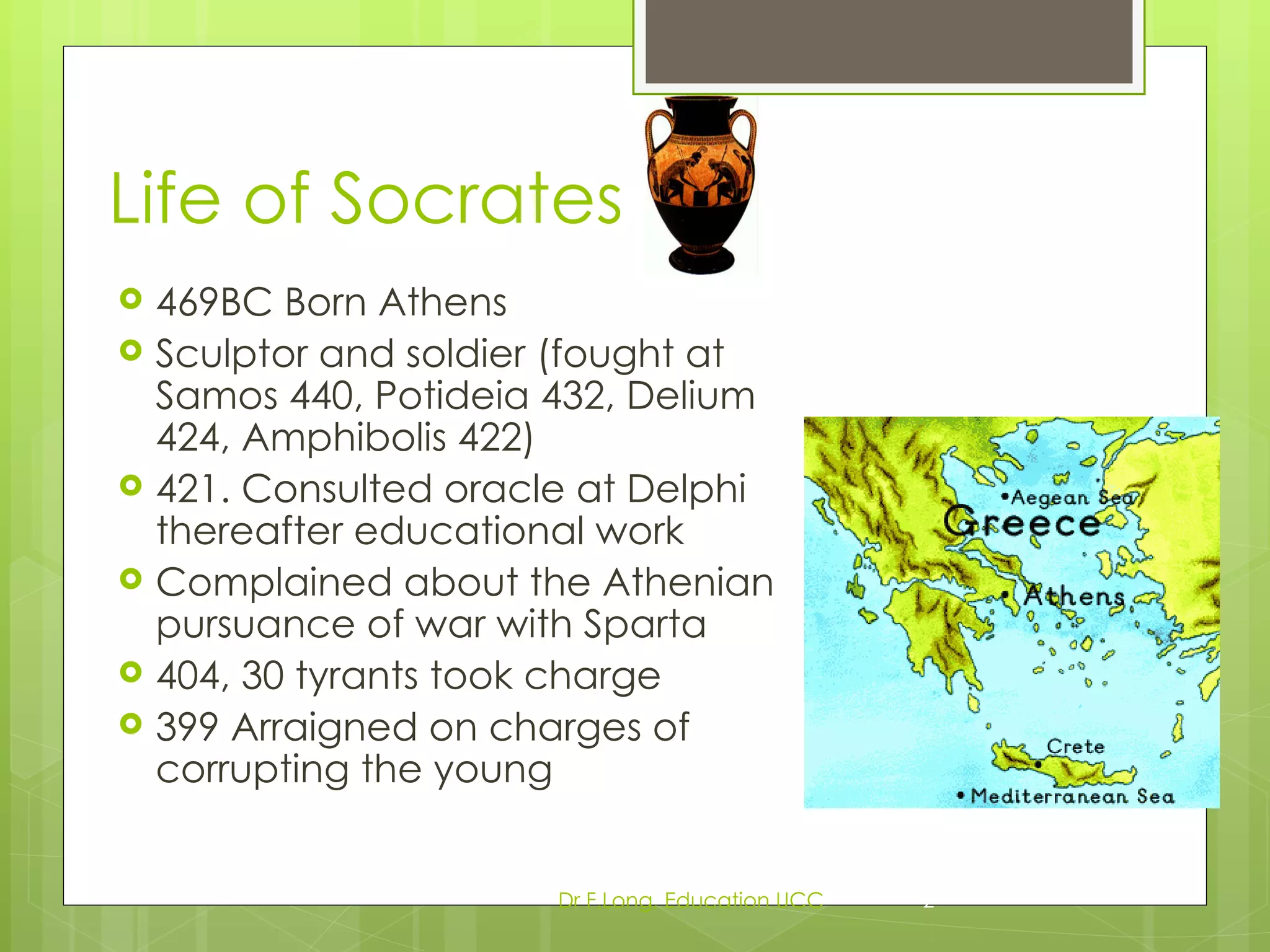
   469BC Born Athens
   Sculptor and soldier (fought at
    Samos 440, Potideia 432, Delium
    424, Amphibolis 422)
   421. Consulted oracle at Delphi
    thereafter educational work
   Complained about the Athenian
    pursuance of war with Sparta
   404, 30 tyrants took charge
   399 Arraigned on charges of
    corrupting the young


                        Dr F.Long, Education UCC   2
3


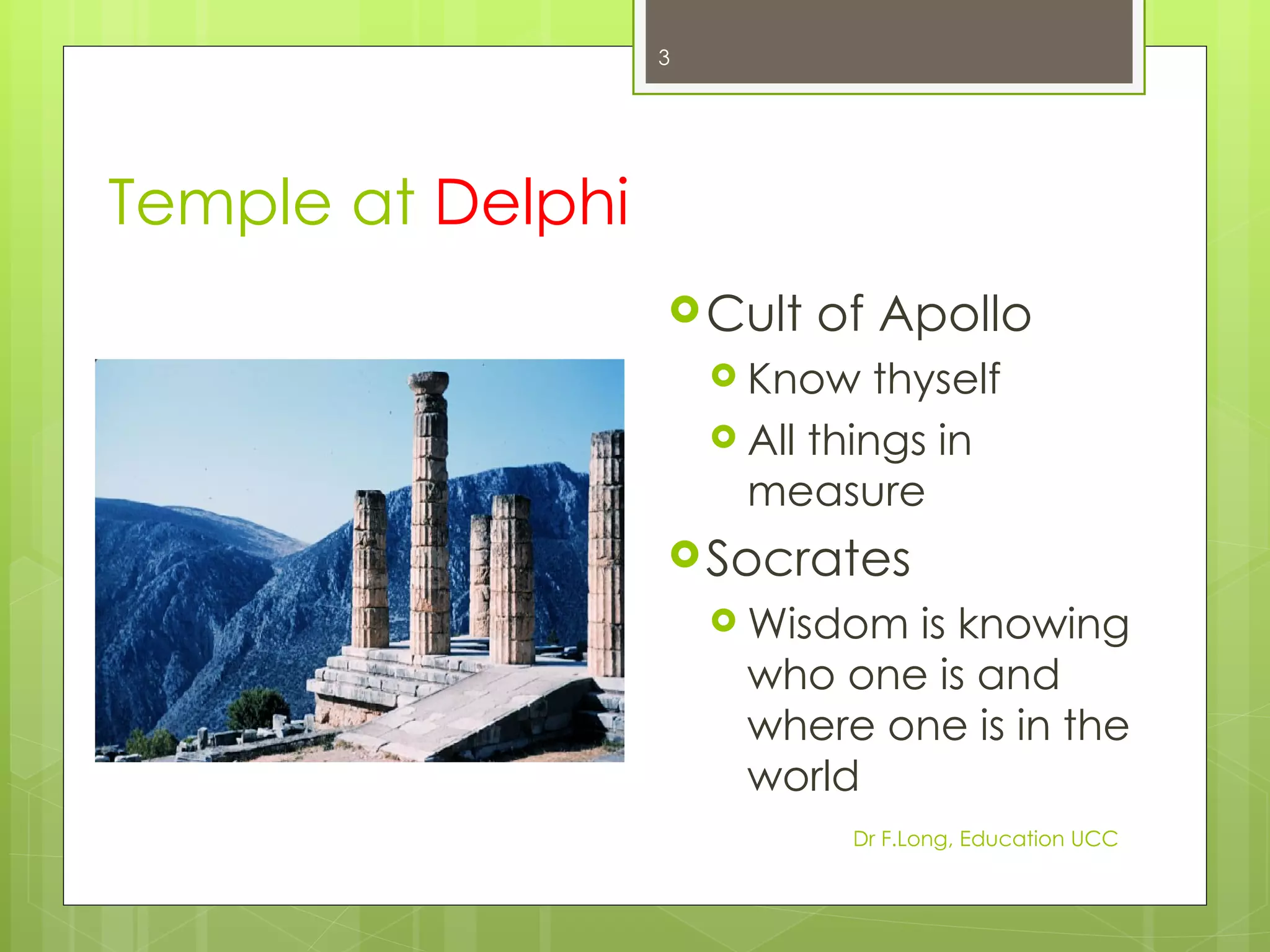
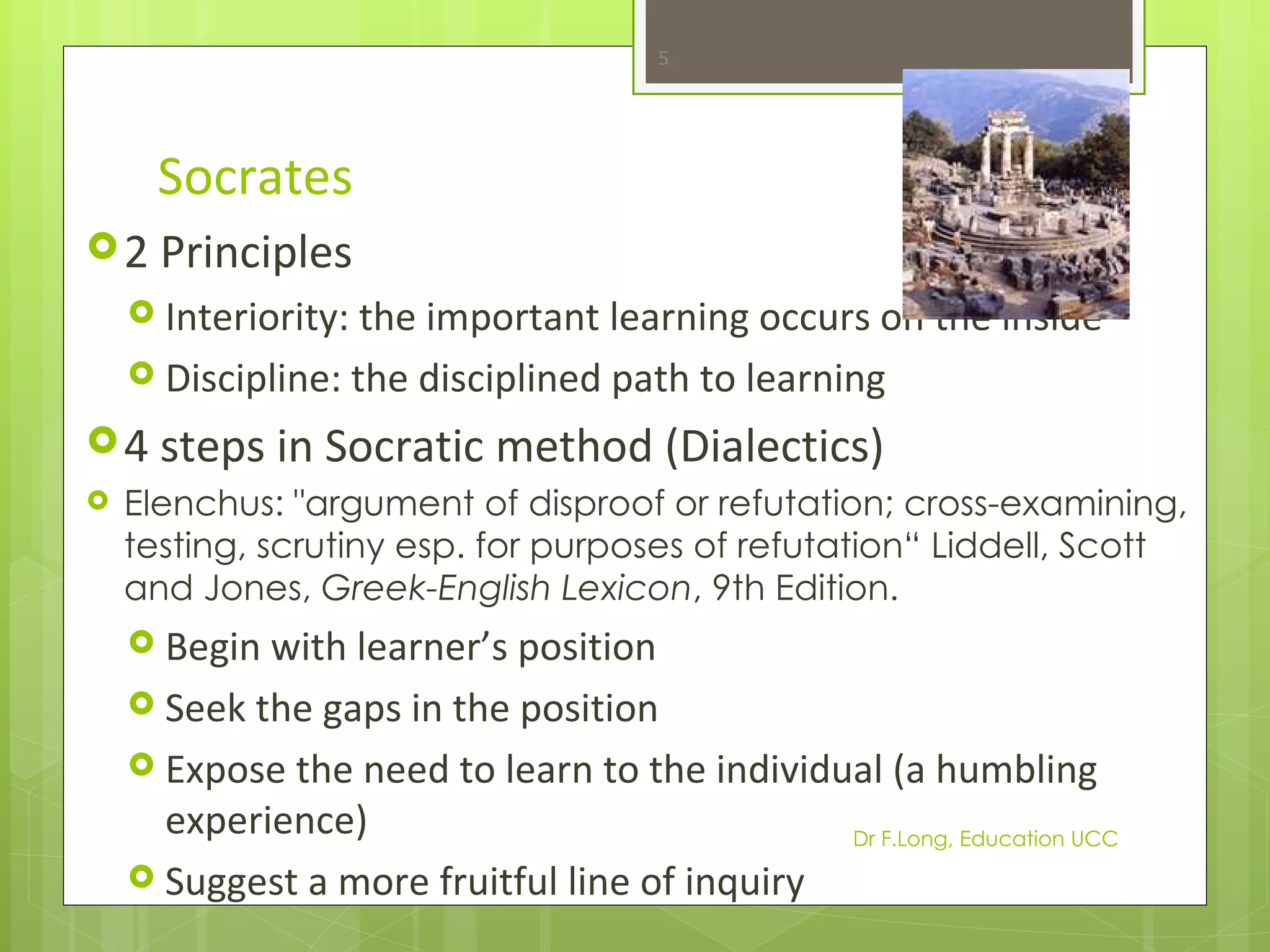
Temple at Delphi
                    Cult    of Apollo
                        Know    thyself
                        All things in
                         measure
                    Socrates
                        Wisdom is knowing
                         who one is and
                         where one is in the
                         world
                               Dr F.Long, Education UCC
4


Protagoras 490-420BCE versus Socrates 469-399
    see http://www.iep.utm.edu/p/           Socrates
     protagor.htm

  paid teacher/educator                     non-paid
  the art of speech teaches the             An art does not necessarily do
   bearer to be good                          the person any good. The art of
                                              education claims to do the
  The ‘interior’ is visible in the           learner some good
   performance                               Doing someone good is
  Concentrates on the                        primarily a moral action
   perfection of the technique
                                             Socrates concentrates primarily
                                              on the interior effect of the
   of speech                                  techne of speech on the soul of
                                              speaker and listener
                                                          Dr F.Long, Education
5


      Socrates
 2 Principles
     Interiority: the important learning occurs on the inside
     Discipline: the disciplined path to learning

 4 steps in Socratic       method (Dialectics)
   Elenchus: "argument of disproof or refutation; cross-examining,
    testing, scrutiny esp. for purposes of refutation“ Liddell, Scott
    and Jones, Greek-English Lexicon, 9th Edition.
     Begin with learner’s position
     Seek the gaps in the position
     Expose the need to learn to the individual (a humbling
      experience)                             Dr F.Long, Education UCC
     Suggest a more fruitful line of inquiry
The educational work of Socrates
 Alcibiades
 Charmides
 Ion
 Laches
     Laches, Nicias, Socrates
     Lysimachus and Melesias
7


Alcibiades speaks of Socrates in Symposium:
    Socrates was worth seeing, gentlemen, when
    the army retreated in flight from Delium… First
    of all, he was more self-possessed than
    Laches. And he seemed to me, as you put it,
    Aristophanes, to advance there just as he does
    here, “holding his head high and looking from
    side to side,” calmly watching both his friends
    and the enemy. It was clear to everyone even
    from far off that if anyone laid a hand on him,
    he would fight back with everything he had.
    And, for that reason, he got away safely, both
    he and Laches. For pursuers do not touch the
    ones who act like that in a battle. Instead, they
    go after those who are in headlong flight.
                                    Dr F.Long, Education UCC
8


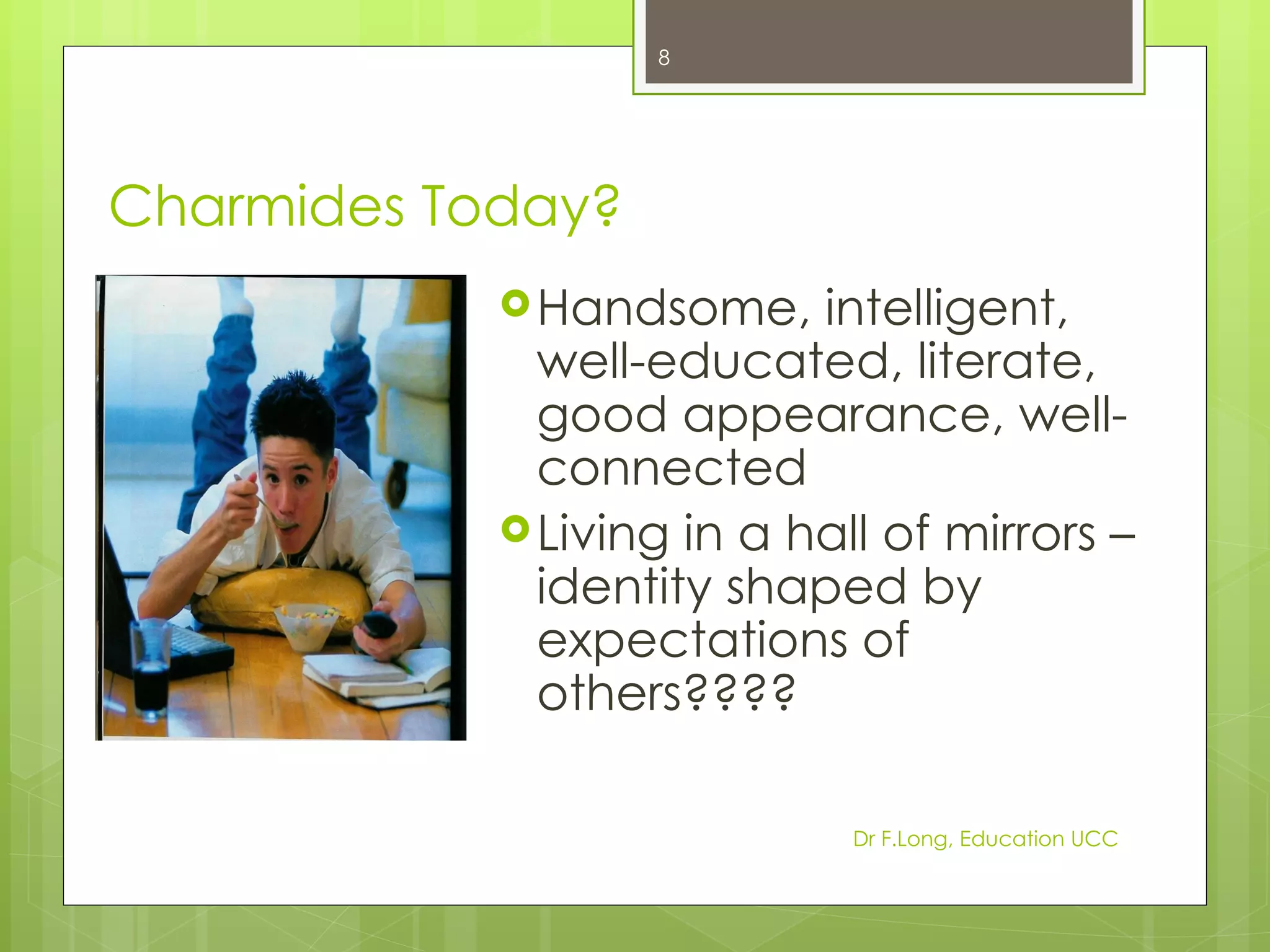
Charmides Today?
             Handsome,    intelligent,
              well-educated, literate,
              good appearance, well-
              connected
             Living in a hall of mirrors –
              identity shaped by
              expectations of
              others????

                             Dr F.Long, Education UCC
9


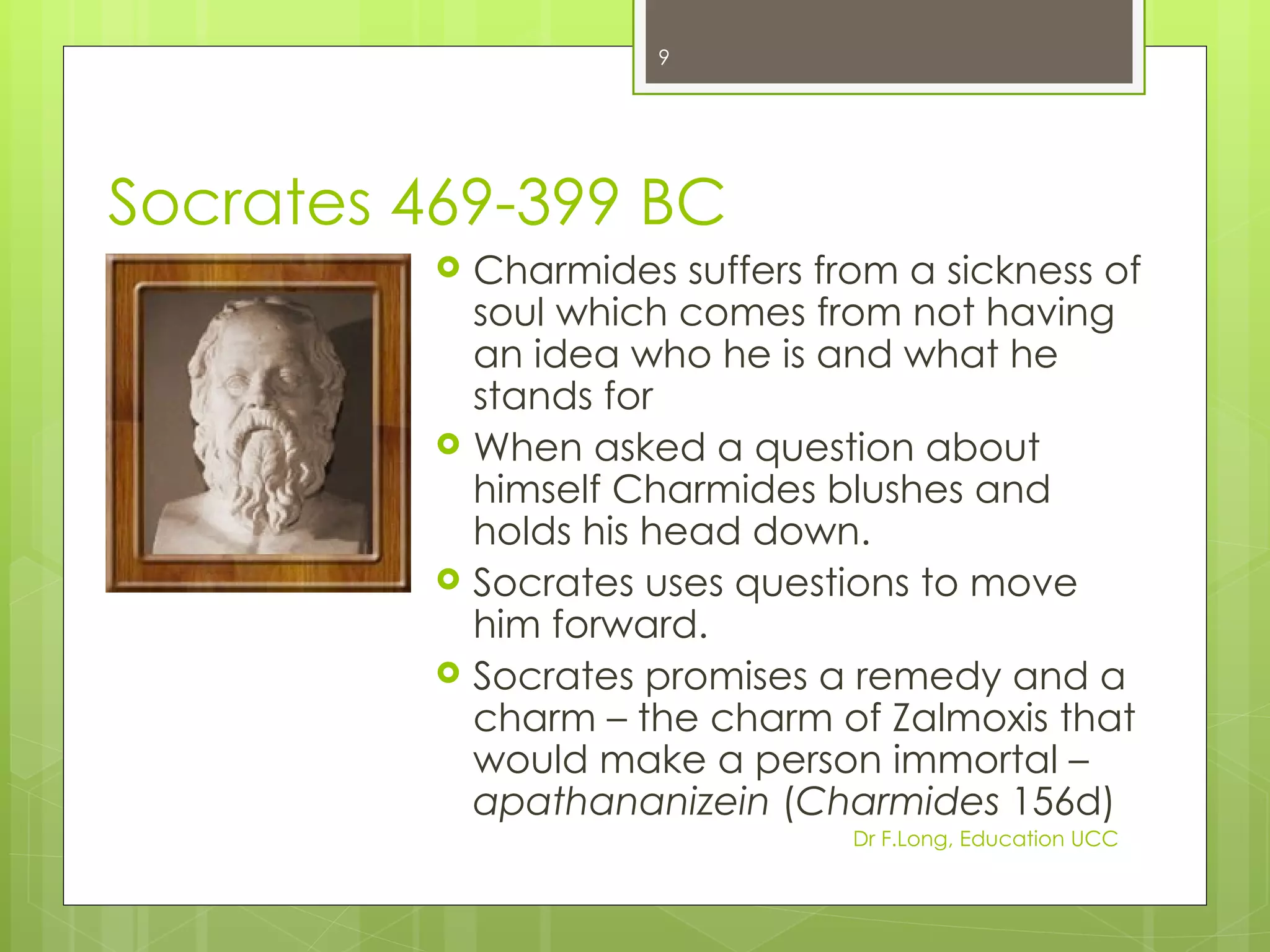
Socrates 469-399 BC
             Charmides suffers from a sickness of
              soul which comes from not having
              an idea who he is and what he
              stands for
             When asked a question about
              himself Charmides blushes and
              holds his head down.
             Socrates uses questions to move
              him forward.
             Socrates promises a remedy and a
              charm – the charm of Zalmoxis that
              would make a person immortal –
              apathananizein (Charmides 156d)
                                  Dr F.Long, Education UCC
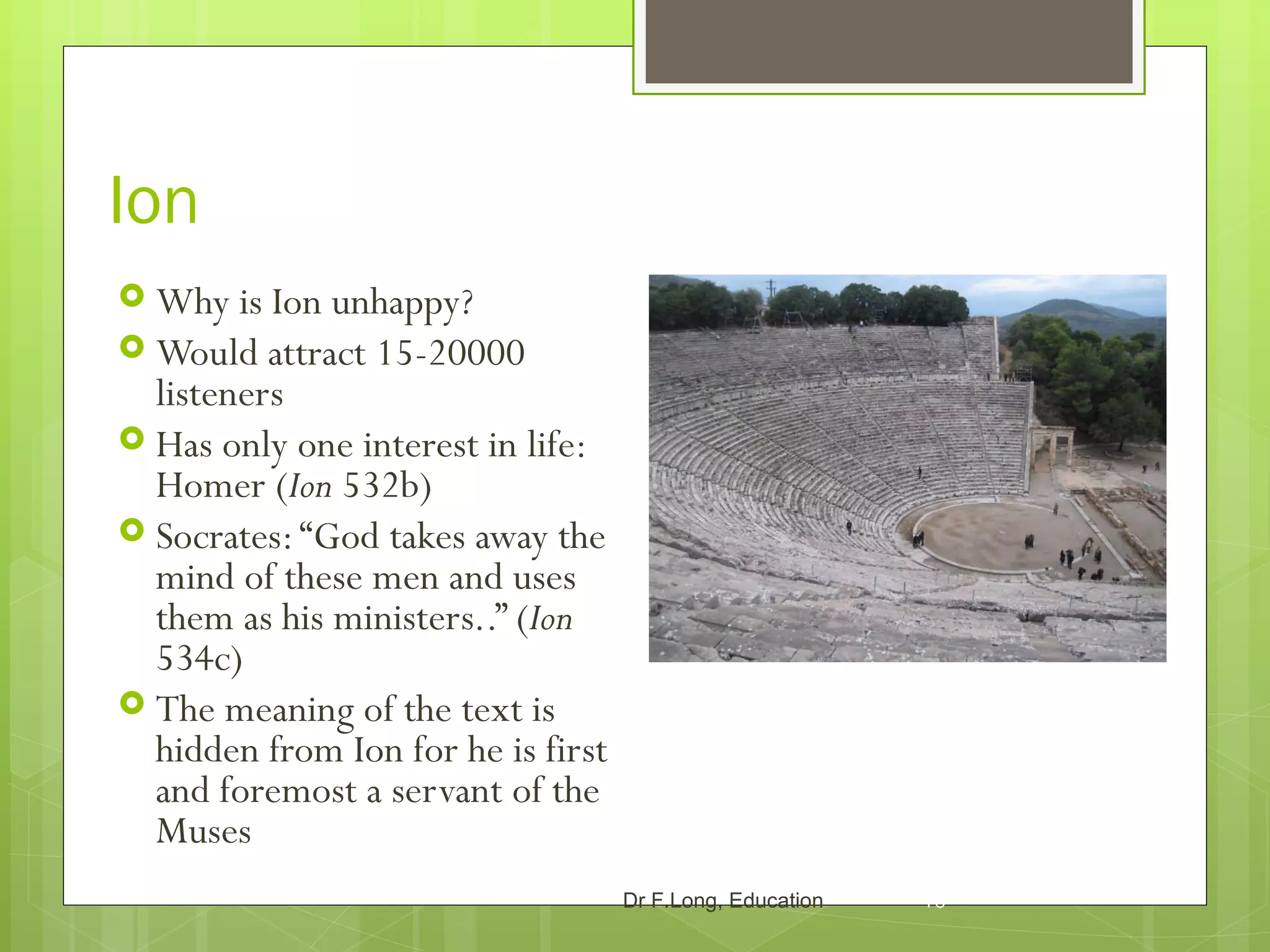
Ion
 Why is  Ion unhappy?
 Would attract 15-20000
  listeners
 Has only one interest in life:
  Homer (Ion 532b)
 Socrates: “God takes away the
  mind of these men and uses
  them as his ministers..” (Ion
  534c)
 The meaning of the text is
  hidden from Ion for he is first
  and foremost a servant of the
  Muses
                                    Dr F.Long, Education   10
Interest?
    By a rule of art?                 By inspiration
   Interested in all poetry         Only interested in Homer
   Leads to a generalised view      Leads to a very individual
    that is communicable              view that is not particularly
    according to rules of art         communicable
   Leads to humanly structured      Leads to divinely structured
    knowledge which can be            knowledge which can be
    taught                            performed
Laches: The parents’ concern
 we urge all this upon the lads, pointing out
 to them that they will not grow up to
 honour if they are rebellious and take no
 pains about themselves; but that if they
 take pains they may, perhaps, become
 worthy of the names which they bear.
 Plato, Laches 179d, translated by B.
 Jowett
13


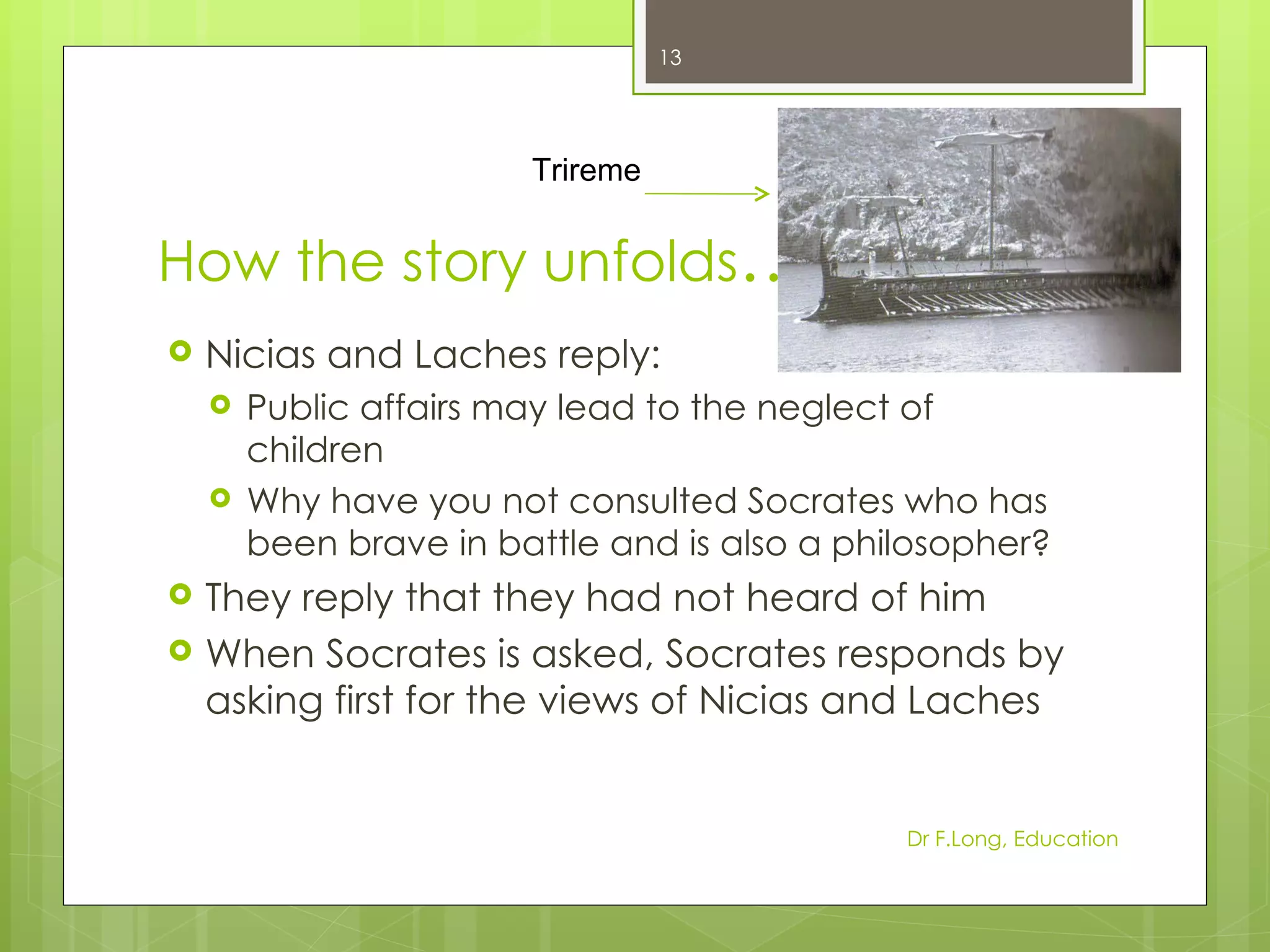
                        Trireme


How the story unfolds…
   Nicias and Laches reply:
       Public affairs may lead to the neglect of
        children
       Why have you not consulted Socrates who has
        been brave in battle and is also a philosopher?
   They reply that they had not heard of him
   When Socrates is asked, Socrates responds by
    asking first for the views of Nicias and Laches


                                              Dr F.Long, Education
14


Answering the parents’ worry
 Nicias
      suggests that the wearing of
 armour is very important
    Notice: parents’ hunch is reinforced by this
     suggestion but it is not realistic
 Laches
    Debunks the suggestion by telling a story
     about the soldier whose lance caught in a
     sail
    Conclusion is that unless a person is already
     brave, the wearing of armour will not make
     him so
    Notice: parents’ hunch is not reinforced…
     parents are puzzled...Socrates is called
     upon

                                         Dr F.Long, Education
15


Socrates’ response
 Whoseopinion would you follow on any
 matter?
    He sets aside the hearsay knowledge of
     “youth bearing arms”
    He looks for knowledge that reflects the
     “soul of the youth”
    Bravery is a virtue and can only be
     developed using educational not
     technique
    Need for interiority
                                        Dr F.Long, Education
Socrates condemned
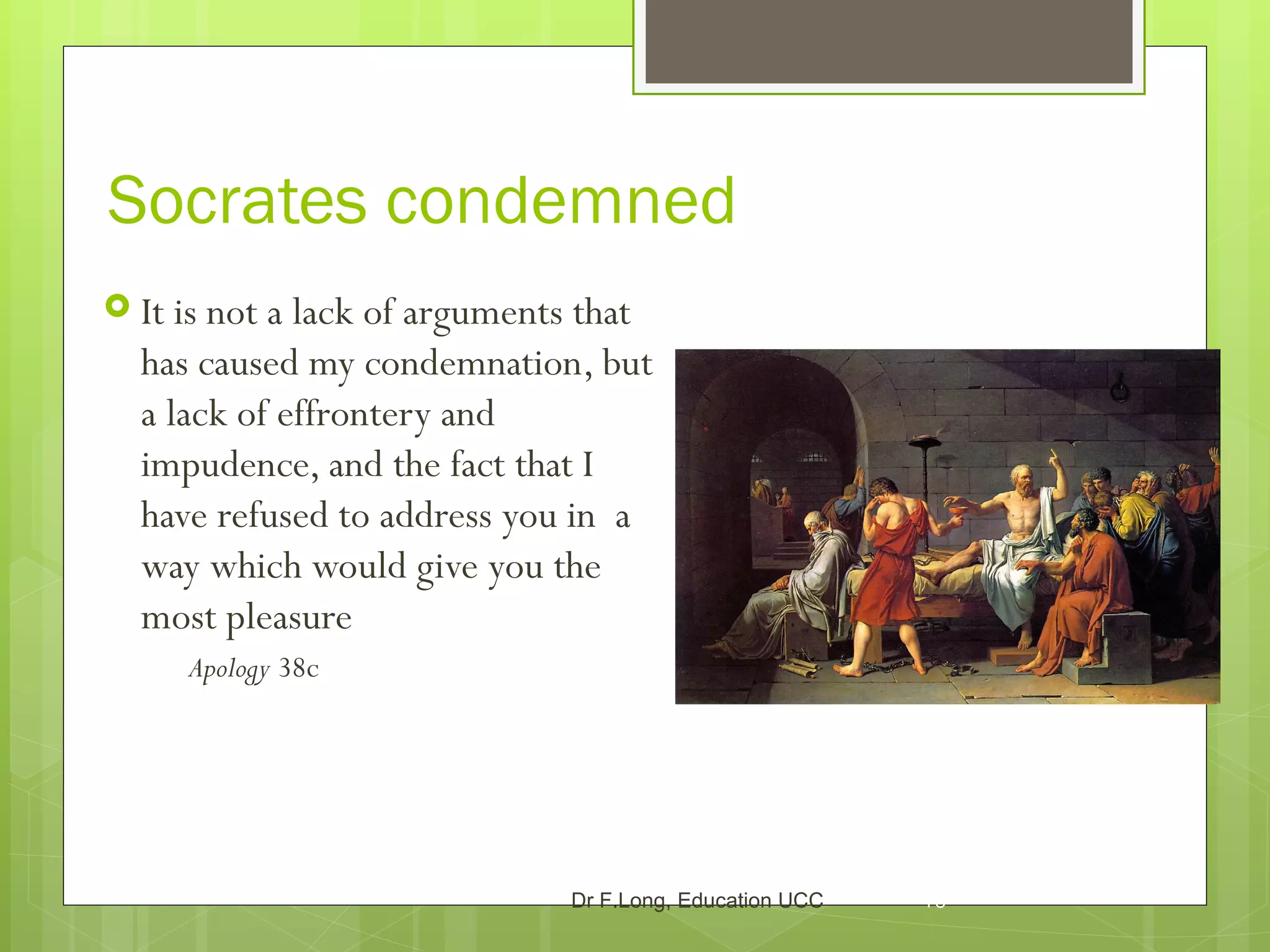
 It isnot a lack of arguments that
  has caused my condemnation, but
  a lack of effrontery and
  impudence, and the fact that I
  have refused to address you in a
  way which would give you the
  most pleasure
      Apology 38c


                             Dr F.Long, Education UCC   16
17


Socrates’s defence
   He was only ever a minor influence
   That he feared untruth more than death
   That he operated on a divine mission for the good of
    humanity not just the good of Athens
   He objected to the idea that the jury should dispense
    justice as a favour
   He proclaimed his justice against their injustice
    (Apology 32b, his wakefulness against their slumber
    (Apology30e), his concern for virtue against their all
    too human cares (Apology 23c), his wisdom against
    their ignorance (Apology 29a)
   IN short, he made an ‘outrageous’ defence. Why?

                                             Dr F.Long, Education UCC
Links
 http://classics.mit.edu/Plato/laches.html
 http://classics.mit.edu/Plato/ion.html
 http://classics.mit.edu/Plato/charmides.html

Pde2012l9 socrates

  • 1.
    Socrates as educator Review ofSocrates’s life Some of his educational dialogues Approaching the Laches
  • 2.
    Life of Socrates  469BC Born Athens  Sculptor and soldier (fought at Samos 440, Potideia 432, Delium 424, Amphibolis 422)  421. Consulted oracle at Delphi thereafter educational work  Complained about the Athenian pursuance of war with Sparta  404, 30 tyrants took charge  399 Arraigned on charges of corrupting the young Dr F.Long, Education UCC 2
  • 3.
    3 Temple at Delphi  Cult of Apollo  Know thyself  All things in measure  Socrates  Wisdom is knowing who one is and where one is in the world Dr F.Long, Education UCC
  • 4.
    4 Protagoras 490-420BCE versusSocrates 469-399  see http://www.iep.utm.edu/p/  Socrates protagor.htm  paid teacher/educator  non-paid  the art of speech teaches the  An art does not necessarily do bearer to be good the person any good. The art of education claims to do the  The ‘interior’ is visible in the learner some good performance  Doing someone good is  Concentrates on the primarily a moral action perfection of the technique  Socrates concentrates primarily on the interior effect of the of speech techne of speech on the soul of speaker and listener Dr F.Long, Education
  • 5.
    5 Socrates  2 Principles  Interiority: the important learning occurs on the inside  Discipline: the disciplined path to learning  4 steps in Socratic method (Dialectics)  Elenchus: "argument of disproof or refutation; cross-examining, testing, scrutiny esp. for purposes of refutation“ Liddell, Scott and Jones, Greek-English Lexicon, 9th Edition.  Begin with learner’s position  Seek the gaps in the position  Expose the need to learn to the individual (a humbling experience) Dr F.Long, Education UCC  Suggest a more fruitful line of inquiry
  • 6.
    The educational workof Socrates  Alcibiades  Charmides  Ion  Laches  Laches, Nicias, Socrates  Lysimachus and Melesias
  • 7.
    7 Alcibiades speaks ofSocrates in Symposium: Socrates was worth seeing, gentlemen, when the army retreated in flight from Delium… First of all, he was more self-possessed than Laches. And he seemed to me, as you put it, Aristophanes, to advance there just as he does here, “holding his head high and looking from side to side,” calmly watching both his friends and the enemy. It was clear to everyone even from far off that if anyone laid a hand on him, he would fight back with everything he had. And, for that reason, he got away safely, both he and Laches. For pursuers do not touch the ones who act like that in a battle. Instead, they go after those who are in headlong flight. Dr F.Long, Education UCC
  • 8.
    8 Charmides Today?  Handsome, intelligent, well-educated, literate, good appearance, well- connected  Living in a hall of mirrors – identity shaped by expectations of others???? Dr F.Long, Education UCC
  • 9.
    9 Socrates 469-399 BC  Charmides suffers from a sickness of soul which comes from not having an idea who he is and what he stands for  When asked a question about himself Charmides blushes and holds his head down.  Socrates uses questions to move him forward.  Socrates promises a remedy and a charm – the charm of Zalmoxis that would make a person immortal – apathananizein (Charmides 156d) Dr F.Long, Education UCC
  • 10.
    Ion  Why is Ion unhappy?  Would attract 15-20000 listeners  Has only one interest in life: Homer (Ion 532b)  Socrates: “God takes away the mind of these men and uses them as his ministers..” (Ion 534c)  The meaning of the text is hidden from Ion for he is first and foremost a servant of the Muses Dr F.Long, Education 10
  • 11.
    Interest? By a rule of art? By inspiration  Interested in all poetry  Only interested in Homer  Leads to a generalised view  Leads to a very individual that is communicable view that is not particularly according to rules of art communicable  Leads to humanly structured  Leads to divinely structured knowledge which can be knowledge which can be taught performed
  • 12.
    Laches: The parents’concern  we urge all this upon the lads, pointing out to them that they will not grow up to honour if they are rebellious and take no pains about themselves; but that if they take pains they may, perhaps, become worthy of the names which they bear. Plato, Laches 179d, translated by B. Jowett
  • 13.
    13 Trireme How the story unfolds…  Nicias and Laches reply:  Public affairs may lead to the neglect of children  Why have you not consulted Socrates who has been brave in battle and is also a philosopher?  They reply that they had not heard of him  When Socrates is asked, Socrates responds by asking first for the views of Nicias and Laches Dr F.Long, Education
  • 14.
    14 Answering the parents’worry  Nicias suggests that the wearing of armour is very important  Notice: parents’ hunch is reinforced by this suggestion but it is not realistic  Laches  Debunks the suggestion by telling a story about the soldier whose lance caught in a sail  Conclusion is that unless a person is already brave, the wearing of armour will not make him so  Notice: parents’ hunch is not reinforced… parents are puzzled...Socrates is called upon Dr F.Long, Education
  • 15.
    15 Socrates’ response  Whoseopinionwould you follow on any matter?  He sets aside the hearsay knowledge of “youth bearing arms”  He looks for knowledge that reflects the “soul of the youth”  Bravery is a virtue and can only be developed using educational not technique  Need for interiority Dr F.Long, Education
  • 16.
    Socrates condemned  Itisnot a lack of arguments that has caused my condemnation, but a lack of effrontery and impudence, and the fact that I have refused to address you in a way which would give you the most pleasure Apology 38c Dr F.Long, Education UCC 16
  • 17.
    17 Socrates’s defence  He was only ever a minor influence  That he feared untruth more than death  That he operated on a divine mission for the good of humanity not just the good of Athens  He objected to the idea that the jury should dispense justice as a favour  He proclaimed his justice against their injustice (Apology 32b, his wakefulness against their slumber (Apology30e), his concern for virtue against their all too human cares (Apology 23c), his wisdom against their ignorance (Apology 29a)  IN short, he made an ‘outrageous’ defence. Why? Dr F.Long, Education UCC
  • 18.