IKMZ – Department of Communications and Media Research
THE FUTURE OF
SCIENCE COMMUNICATION?
PERSPECTIVES FROM
RESEARCH ON SCICOMM
Mike S. Schäfer
mss7676 - @: m.schaefer@ikmz.uzh.ch
IKMZ – Department of Communications and Media Research
ROADMAP OF THE TALK
IKMZ – Department of Communications and Media Research
WHAT‘S GOING WELL?
IKMZ – Department of Communications and Media Research
WHAT‘S GOING WELL?
WIB-D 2020
[How much do you trust science and research?]
IKMZ – Department of Communications and Media Research
WHAT‘S GOING WELL?
IKMZ – Department of Communications and Media Research
WHAT‘S GOING WELL?
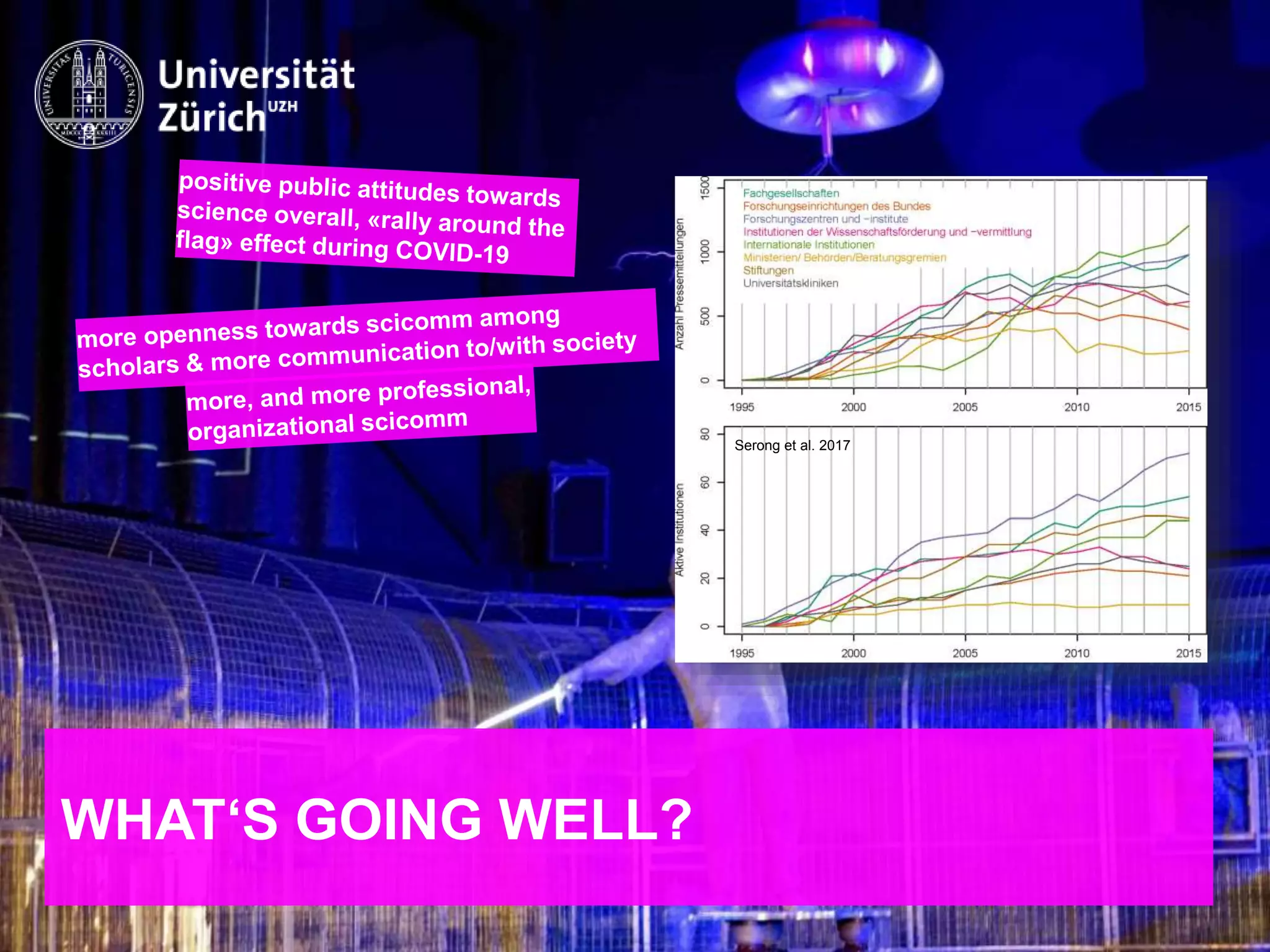
Serong et al. 2017
IKMZ – Department of Communications and Media Research
WHAT‘S GOING WELL?
IKMZ – Department of Communications and Media Research
WHAT‘S GOING WELL?
emergence, consolidation & diversification
of research on science communication &
public engagement with science
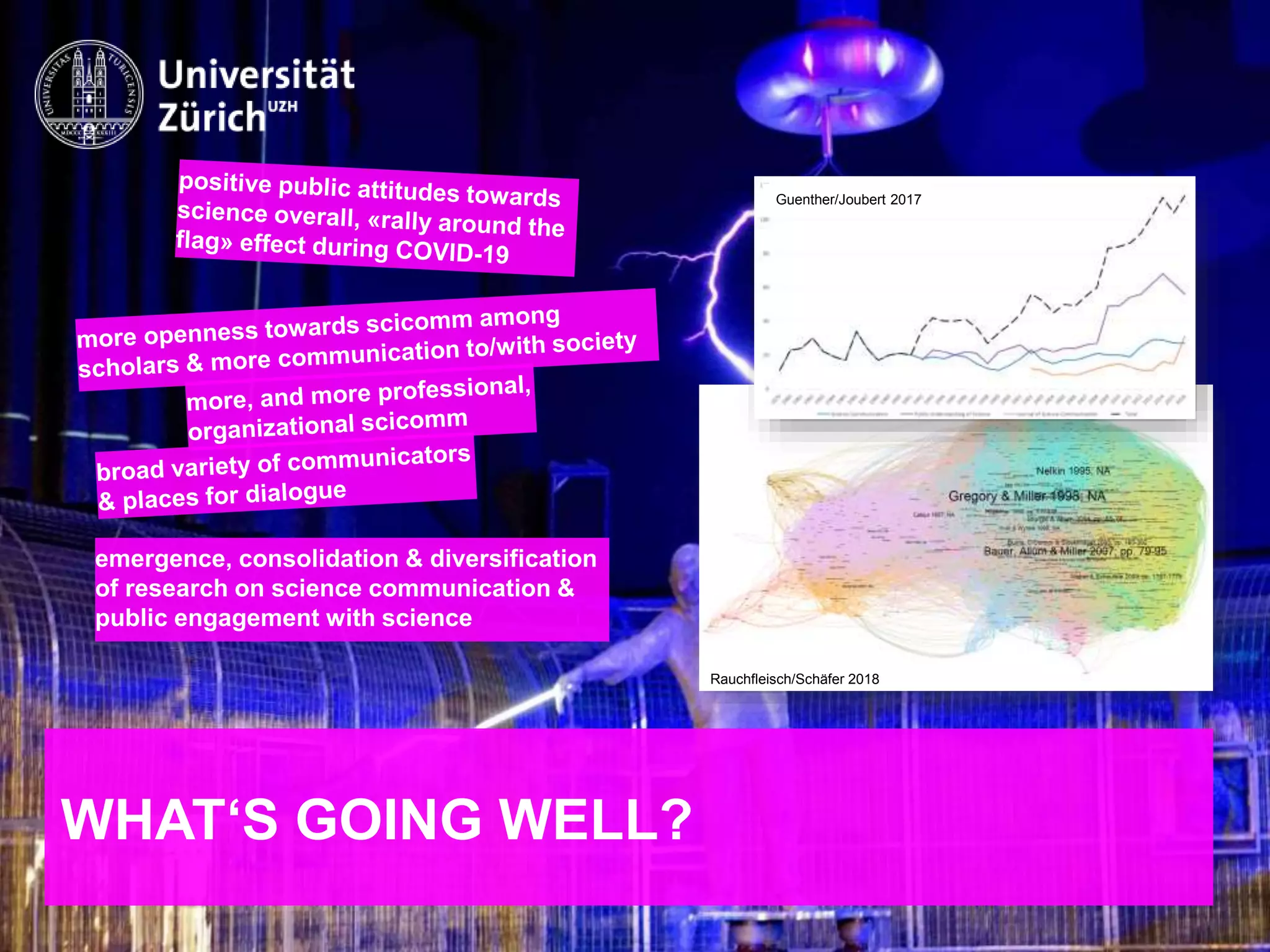
Guenther/Joubert 2017
IKMZ – Department of Communications and Media Research
WHAT‘S GOING WELL?
emergence, consolidation & diversification
of research on science communication &
public engagement with science
Guenther/Joubert 2017
Rauchfleisch/Schäfer 2018
IKMZ – Department of Communications and Media Research
WHAT‘S GOING WELL?
emergence, consolidation & diversification
of research on science communication &
public engagement with science
increasing recognition of practical & policy
demands in scicomm scholarship
IKMZ – Department of Communications and Media Research
WHAT‘S GOING NOT SO WELL?
rise & increased visibility of contrarian
attitudes; hardening counter-publics
IKMZ – Department of Communications and Media Research
WHAT‘S GOING NOT SO WELL?
rise & increased visibility of contrarian
attitudes; hardening counter-publics
Williams et al. 2016
IKMZ – Department of Communications and Media Research
WHAT‘S GOING NOT SO WELL?
rise & increased visibility of contrarian
attitudes; hardening counter-publics
IKMZ – Department of Communications and Media Research
WHAT‘S GOING NOT SO WELL?
rise & increased visibility of contrarian
attitudes; hardening counter-publics
organizational competition can lead to
overt focus on image/reputation building
IKMZ – Department of Communications and Media Research
WHAT‘S GOING NOT SO WELL?
rise & increased visibility of contrarian
attitudes; hardening counter-publics
organizational competition can lead to
overt focus on image/reputation building
IKMZ – Department of Communications and Media Research
WHAT‘S GOING NOT SO WELL?
rise & increased visibility of contrarian
attitudes; hardening counter-publics
organizational competition can lead to
overt focus on image/reputation building
gaps & biases in research on scicomm
Schäfer 2014
IKMZ – Department of Communications and Media Research
WHAT‘S GOING NOT SO WELL?
rise & increased visibility of contrarian
attitudes; hardening counter-publics
organizational competition can lead to
overt focus on image/reputation building
insufficient link between scicomm
scholarship & practice
gaps & biases in research on scicomm
IKMZ – Department of Communications and Media Research
HOW CAN WE MOVE FORWARD?
IKMZ – Department of Communications and Media Research
HOW CAN WE MOVE FORWARD?
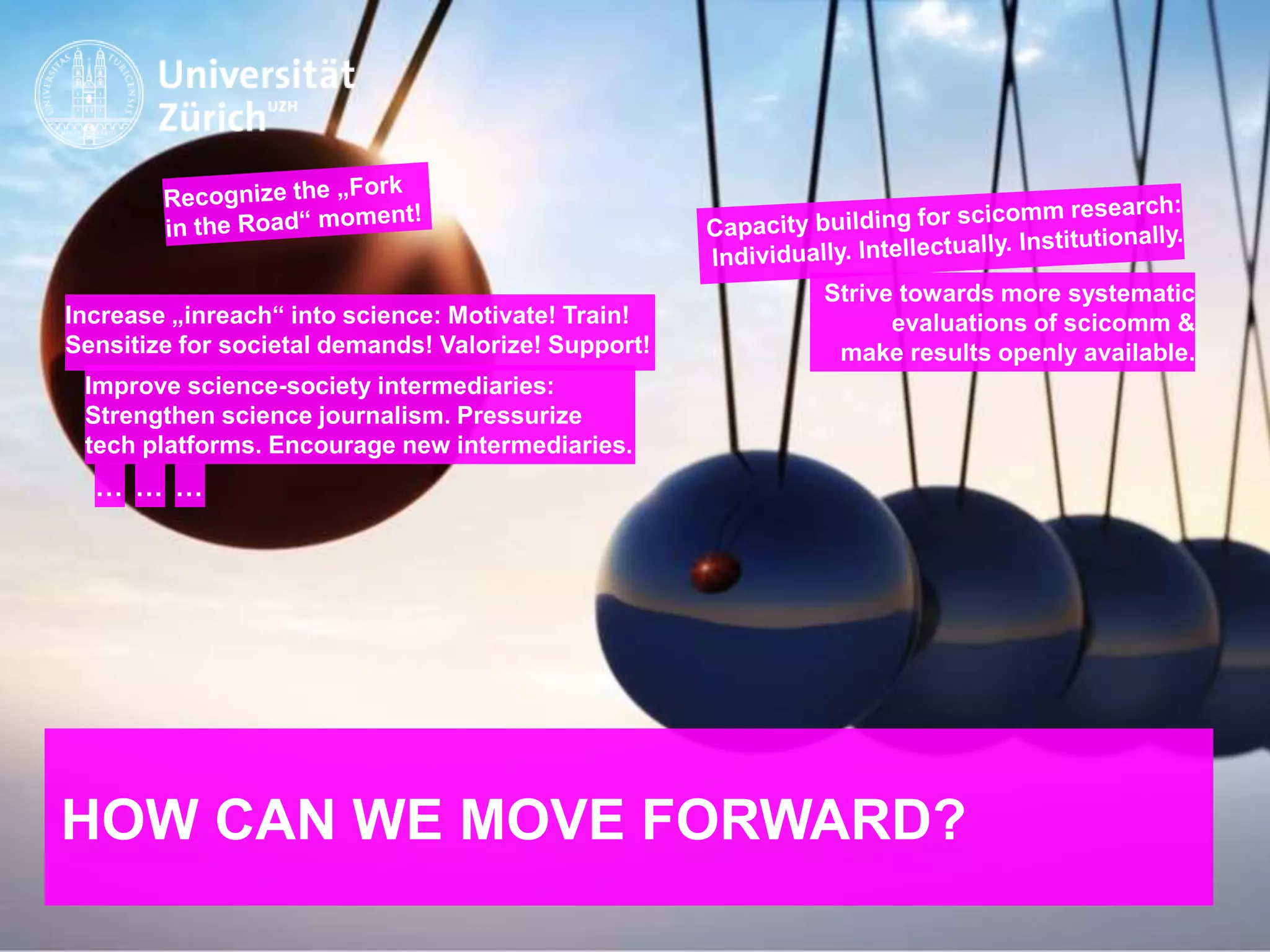
Increase „inreach“ into science: Motivate! Train!
Sensitize for societal demands! Valorize! Support!
IKMZ – Department of Communications and Media Research
HOW CAN WE MOVE FORWARD?
Improve science-society intermediaries:
Strengthen science journalism. Pressurize
tech platforms. Encourage new intermediaries.
Increase „inreach“ into science: Motivate! Train!
Sensitize for societal demands! Valorize! Support!
… … …
IKMZ – Department of Communications and Media Research
HOW CAN WE MOVE FORWARD?
Improve science-society intermediaries:
Strengthen science journalism. Pressurize
tech platforms. Encourage new intermediaries.
Increase „inreach“ into science: Motivate! Train!
Sensitize for societal demands! Valorize! Support!
… … …
IKMZ – Department of Communications and Media Research
HOW CAN WE MOVE FORWARD?
Improve science-society intermediaries:
Strengthen science journalism. Pressurize
tech platforms. Encourage new intermediaries.
Increase „inreach“ into science: Motivate! Train!
Sensitize for societal demands! Valorize! Support!
… … …
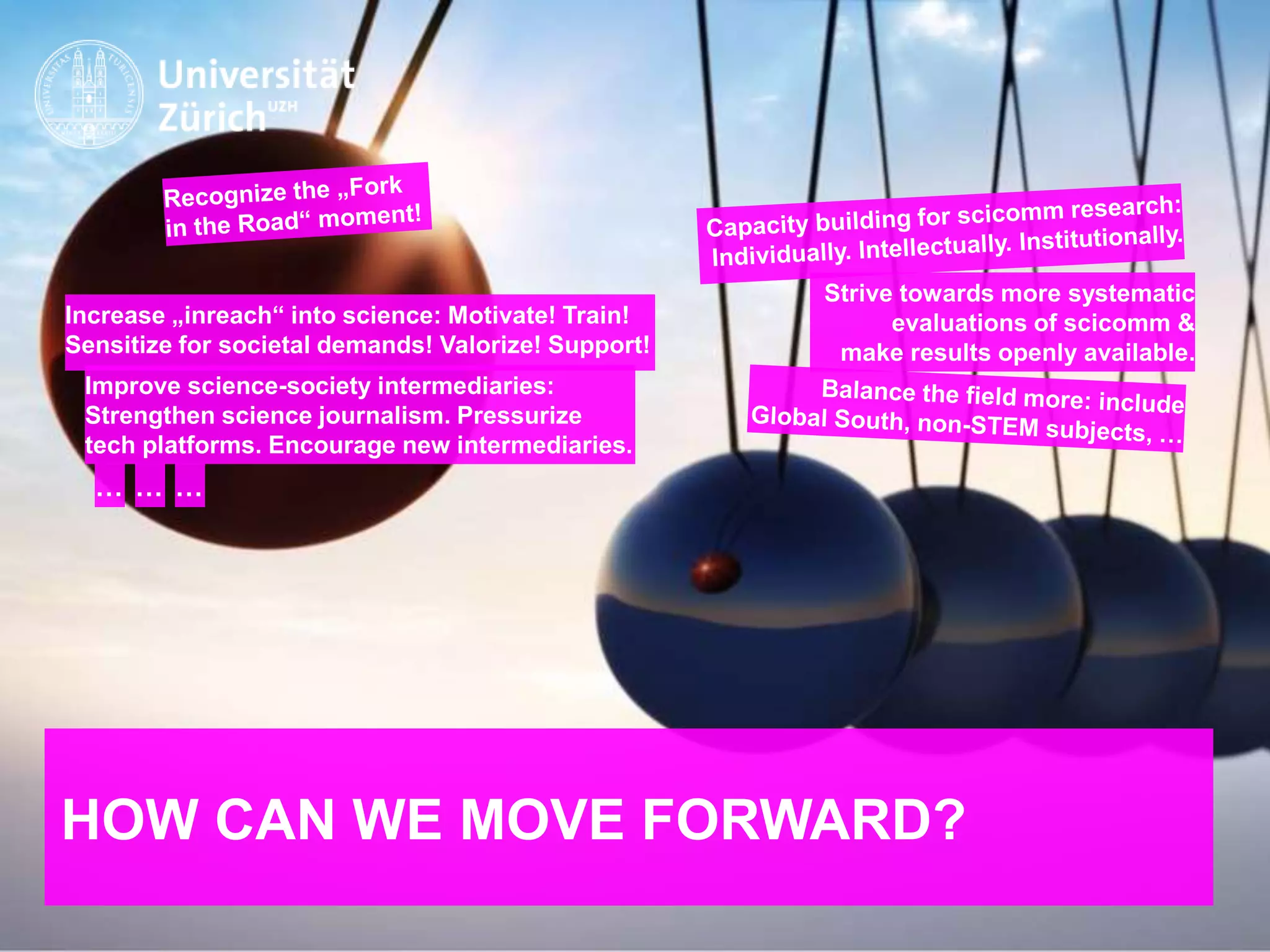
Strive towards more systematic
evaluations of scicomm &
make results openly available.
IKMZ – Department of Communications and Media Research
HOW CAN WE MOVE FORWARD?
Improve science-society intermediaries:
Strengthen science journalism. Pressurize
tech platforms. Encourage new intermediaries.
Increase „inreach“ into science: Motivate! Train!
Sensitize for societal demands! Valorize! Support!
… … …
Strive towards more systematic
evaluations of scicomm &
make results openly available.
IKMZ – Department of Communications and Media Research
HOW CAN WE MOVE FORWARD?
Strive towards more systematic
evaluations of scicomm &
make results openly available.
Improve science-society intermediaries:
Strengthen science journalism. Pressurize
tech platforms. Encourage new intermediaries.
Increase „inreach“ into science: Motivate! Train!
Sensitize for societal demands! Valorize! Support!
… … …
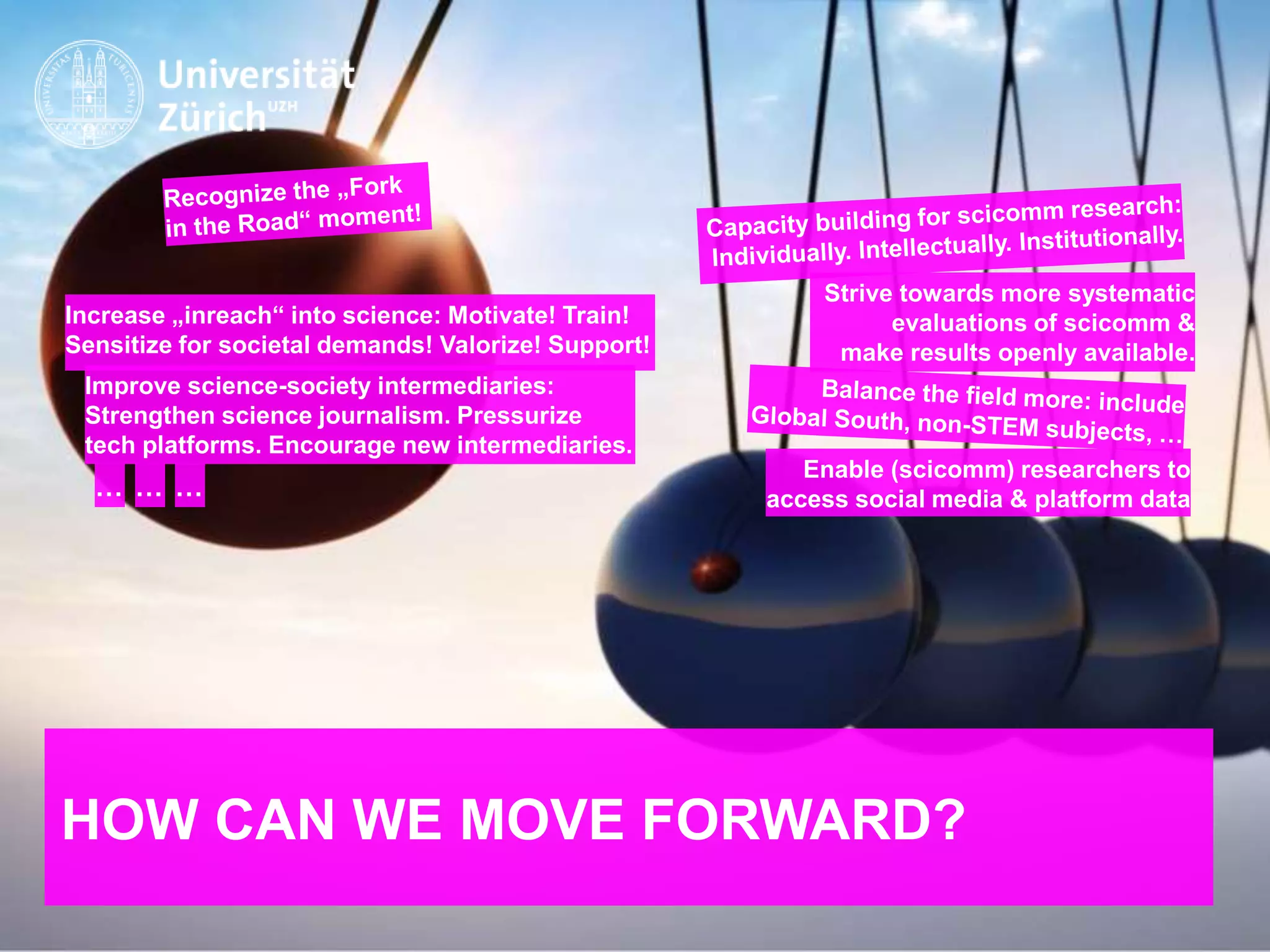
Enable (scicomm) researchers to
access social media & platform data
IKMZ – Department of Communications and Media Research
HOW CAN WE MOVE FORWARD?
Strive towards more systematic
evaluations of scicomm &
make results openly available.
Improve science-society intermediaries:
Strengthen science journalism. Pressurize
tech platforms. Encourage new intermediaries.
Increase „inreach“ into science: Motivate! Train!
Sensitize for societal demands! Valorize! Support!
… … …
Enable (scicomm) researchers to
access social media & platform data
IKMZ – Department of Communications and Media Research
THANK YOU FOR
YOUR ATTENTION!
Mike S. Schäfer
mss7676 - @: m.schaefer@ikmz.uzh.ch

The Future of Science Communication? Perspectives from SciComm Research

  • 1.
    IKMZ – Departmentof Communications and Media Research THE FUTURE OF SCIENCE COMMUNICATION? PERSPECTIVES FROM RESEARCH ON SCICOMM Mike S. Schäfer mss7676 - @: m.schaefer@ikmz.uzh.ch
  • 2.
    IKMZ – Departmentof Communications and Media Research ROADMAP OF THE TALK
  • 3.
    IKMZ – Departmentof Communications and Media Research WHAT‘S GOING WELL?
  • 4.
    IKMZ – Departmentof Communications and Media Research WHAT‘S GOING WELL? WIB-D 2020 [How much do you trust science and research?]
  • 5.
    IKMZ – Departmentof Communications and Media Research WHAT‘S GOING WELL?
  • 6.
    IKMZ – Departmentof Communications and Media Research WHAT‘S GOING WELL? Serong et al. 2017
  • 7.
    IKMZ – Departmentof Communications and Media Research WHAT‘S GOING WELL?
  • 8.
    IKMZ – Departmentof Communications and Media Research WHAT‘S GOING WELL? emergence, consolidation & diversification of research on science communication & public engagement with science Guenther/Joubert 2017
  • 9.
    IKMZ – Departmentof Communications and Media Research WHAT‘S GOING WELL? emergence, consolidation & diversification of research on science communication & public engagement with science Guenther/Joubert 2017 Rauchfleisch/Schäfer 2018
  • 10.
    IKMZ – Departmentof Communications and Media Research WHAT‘S GOING WELL? emergence, consolidation & diversification of research on science communication & public engagement with science increasing recognition of practical & policy demands in scicomm scholarship
  • 11.
    IKMZ – Departmentof Communications and Media Research WHAT‘S GOING NOT SO WELL? rise & increased visibility of contrarian attitudes; hardening counter-publics
  • 12.
    IKMZ – Departmentof Communications and Media Research WHAT‘S GOING NOT SO WELL? rise & increased visibility of contrarian attitudes; hardening counter-publics Williams et al. 2016
  • 13.
    IKMZ – Departmentof Communications and Media Research WHAT‘S GOING NOT SO WELL? rise & increased visibility of contrarian attitudes; hardening counter-publics
  • 14.
    IKMZ – Departmentof Communications and Media Research WHAT‘S GOING NOT SO WELL? rise & increased visibility of contrarian attitudes; hardening counter-publics organizational competition can lead to overt focus on image/reputation building
  • 15.
    IKMZ – Departmentof Communications and Media Research WHAT‘S GOING NOT SO WELL? rise & increased visibility of contrarian attitudes; hardening counter-publics organizational competition can lead to overt focus on image/reputation building
  • 16.
    IKMZ – Departmentof Communications and Media Research WHAT‘S GOING NOT SO WELL? rise & increased visibility of contrarian attitudes; hardening counter-publics organizational competition can lead to overt focus on image/reputation building gaps & biases in research on scicomm Schäfer 2014
  • 17.
    IKMZ – Departmentof Communications and Media Research WHAT‘S GOING NOT SO WELL? rise & increased visibility of contrarian attitudes; hardening counter-publics organizational competition can lead to overt focus on image/reputation building insufficient link between scicomm scholarship & practice gaps & biases in research on scicomm
  • 18.
    IKMZ – Departmentof Communications and Media Research HOW CAN WE MOVE FORWARD?
  • 19.
    IKMZ – Departmentof Communications and Media Research HOW CAN WE MOVE FORWARD? Increase „inreach“ into science: Motivate! Train! Sensitize for societal demands! Valorize! Support!
  • 20.
    IKMZ – Departmentof Communications and Media Research HOW CAN WE MOVE FORWARD? Improve science-society intermediaries: Strengthen science journalism. Pressurize tech platforms. Encourage new intermediaries. Increase „inreach“ into science: Motivate! Train! Sensitize for societal demands! Valorize! Support! … … …
  • 21.
    IKMZ – Departmentof Communications and Media Research HOW CAN WE MOVE FORWARD? Improve science-society intermediaries: Strengthen science journalism. Pressurize tech platforms. Encourage new intermediaries. Increase „inreach“ into science: Motivate! Train! Sensitize for societal demands! Valorize! Support! … … …
  • 22.
    IKMZ – Departmentof Communications and Media Research HOW CAN WE MOVE FORWARD? Improve science-society intermediaries: Strengthen science journalism. Pressurize tech platforms. Encourage new intermediaries. Increase „inreach“ into science: Motivate! Train! Sensitize for societal demands! Valorize! Support! … … … Strive towards more systematic evaluations of scicomm & make results openly available.
  • 23.
    IKMZ – Departmentof Communications and Media Research HOW CAN WE MOVE FORWARD? Improve science-society intermediaries: Strengthen science journalism. Pressurize tech platforms. Encourage new intermediaries. Increase „inreach“ into science: Motivate! Train! Sensitize for societal demands! Valorize! Support! … … … Strive towards more systematic evaluations of scicomm & make results openly available.
  • 24.
    IKMZ – Departmentof Communications and Media Research HOW CAN WE MOVE FORWARD? Strive towards more systematic evaluations of scicomm & make results openly available. Improve science-society intermediaries: Strengthen science journalism. Pressurize tech platforms. Encourage new intermediaries. Increase „inreach“ into science: Motivate! Train! Sensitize for societal demands! Valorize! Support! … … … Enable (scicomm) researchers to access social media & platform data
  • 25.
    IKMZ – Departmentof Communications and Media Research HOW CAN WE MOVE FORWARD? Strive towards more systematic evaluations of scicomm & make results openly available. Improve science-society intermediaries: Strengthen science journalism. Pressurize tech platforms. Encourage new intermediaries. Increase „inreach“ into science: Motivate! Train! Sensitize for societal demands! Valorize! Support! … … … Enable (scicomm) researchers to access social media & platform data
  • 26.
    IKMZ – Departmentof Communications and Media Research THANK YOU FOR YOUR ATTENTION! Mike S. Schäfer mss7676 - @: m.schaefer@ikmz.uzh.ch

Editor's Notes

  • #2 Thank you happy to be invited not only bc its an honor to speak at such a conference but also bc it is a good time to talk about science communication. The COVID 19 pandemic has shown impressively and across the world how important science and science communication are. I was asked here to provide a research perspective on the trends in and future of science communication, and I took this in 2 ways: I will present you some findings from research on science communication But I will also present you findings about research on science communication – so a meta perspective about the research field I will do that in 3 steps:
  • #3 As I have only 15 mins, I’ll try to be succinct
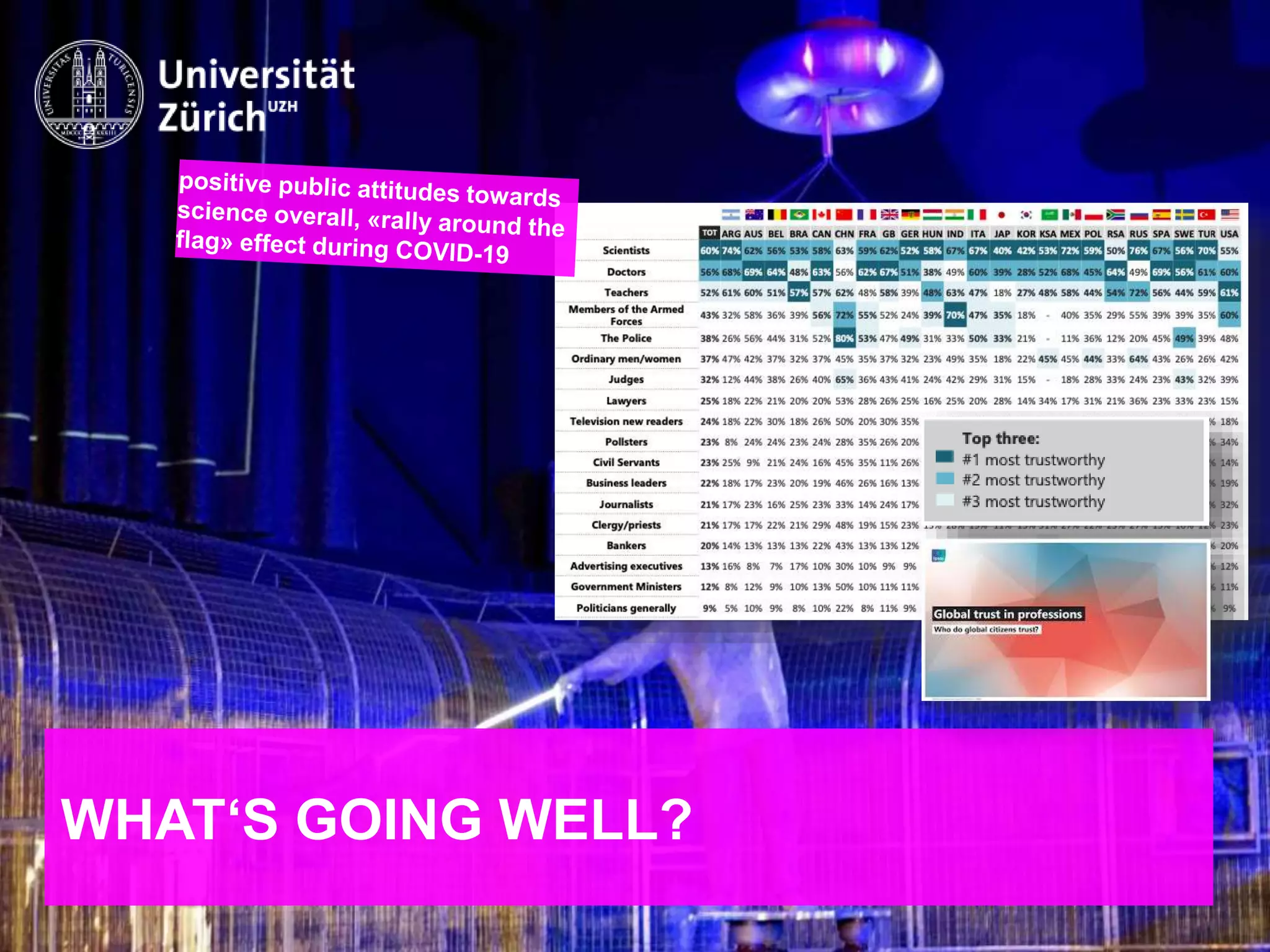
  • #4 In many countries - and a little contrary to the tenor of debates in public and also the scholarly community - we find generally positive attitudes towards sci Example: high degree of trust, exemplified here in the Ipsos «Global trust in professions study» which showed in 2019 for 22 countries that scientists and also doctors are the most trusted professions
  • #5 In addition, we have see whats called a «rally around the flag»-effect during the COVID19 pandemic in many countries: in times of crisis, ppl turn towards established authorities and trust in science has risen – here you see the data from the German Science Barometer survey
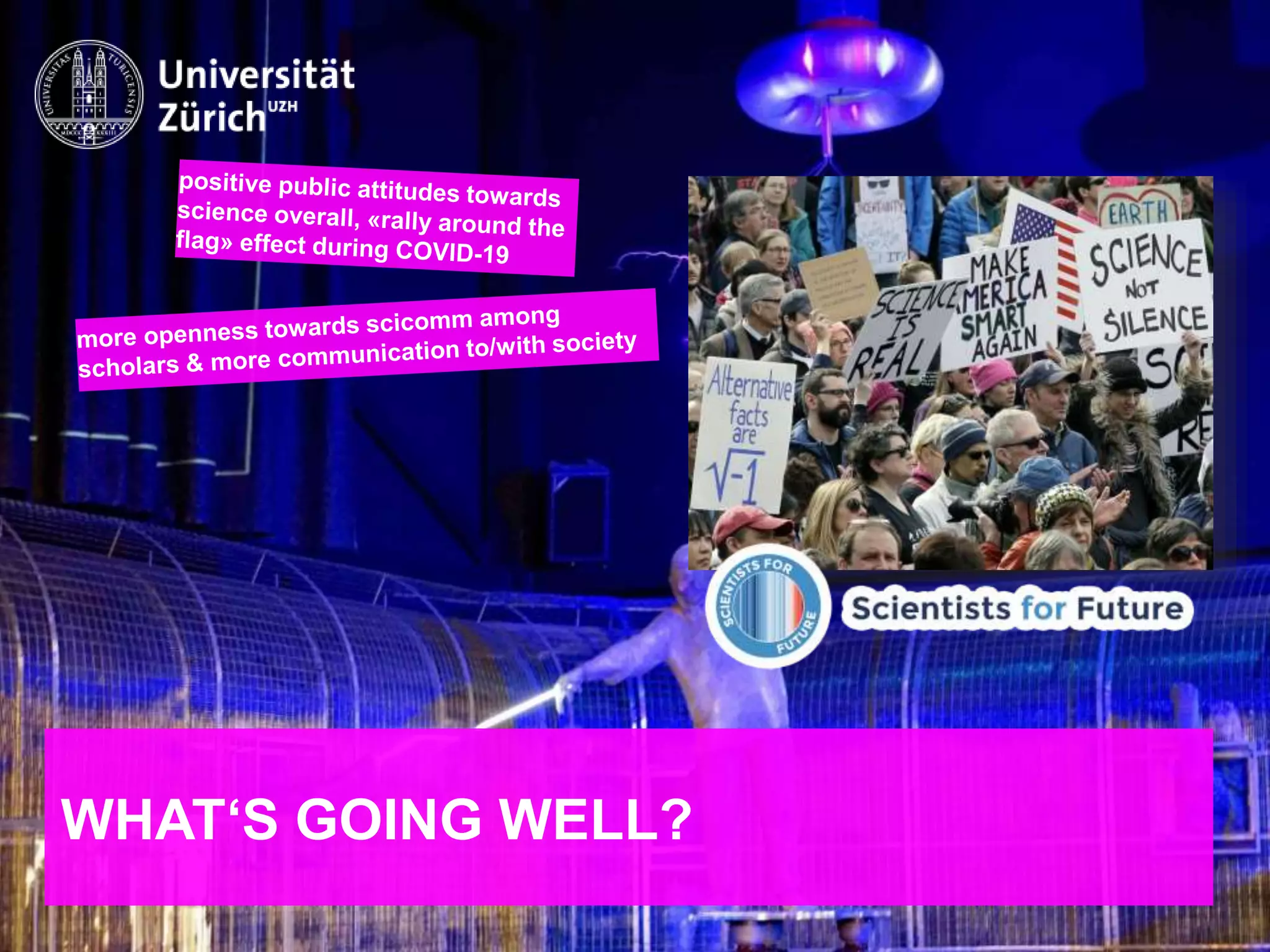
  • #6 We see more openness among scientists towards communication, and also see more scientists who engage in public and communicate even though we also see that way fewer scientists engage in communication compared to those who think it is important and would like to do it
  • #7 We see more extensive and more professional institutional scicomm With more resources and more personell producing more output (as seen in this longitudinal study of Higher Education and scientific institutions by Serong et al.) catering to more channels and audiences
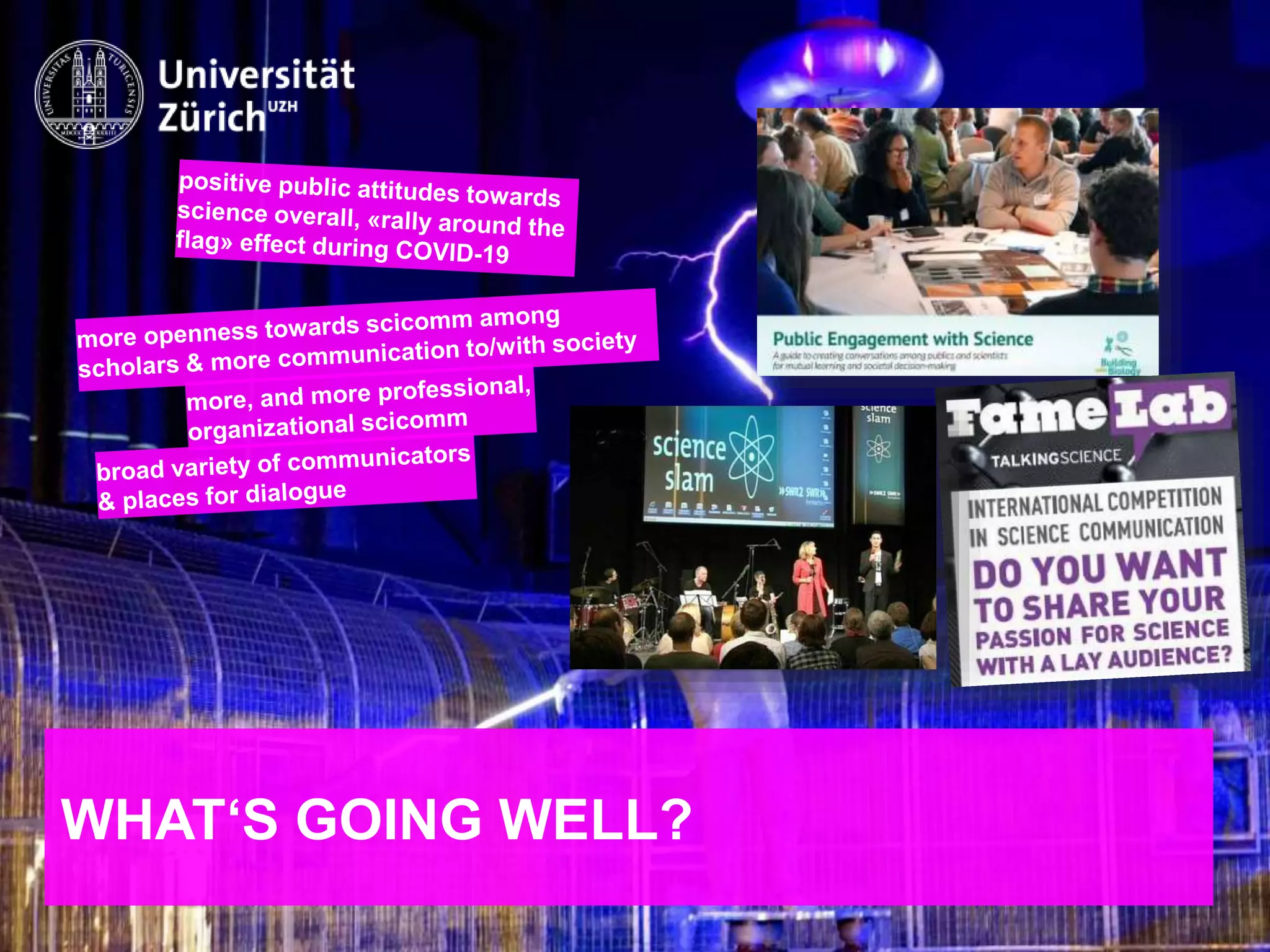
  • #8 And generally, we see a broad variety of sources and places of science communication and dialogue from museums and science centers over fame labs and science slams to legacy media and social media So, good developments here …
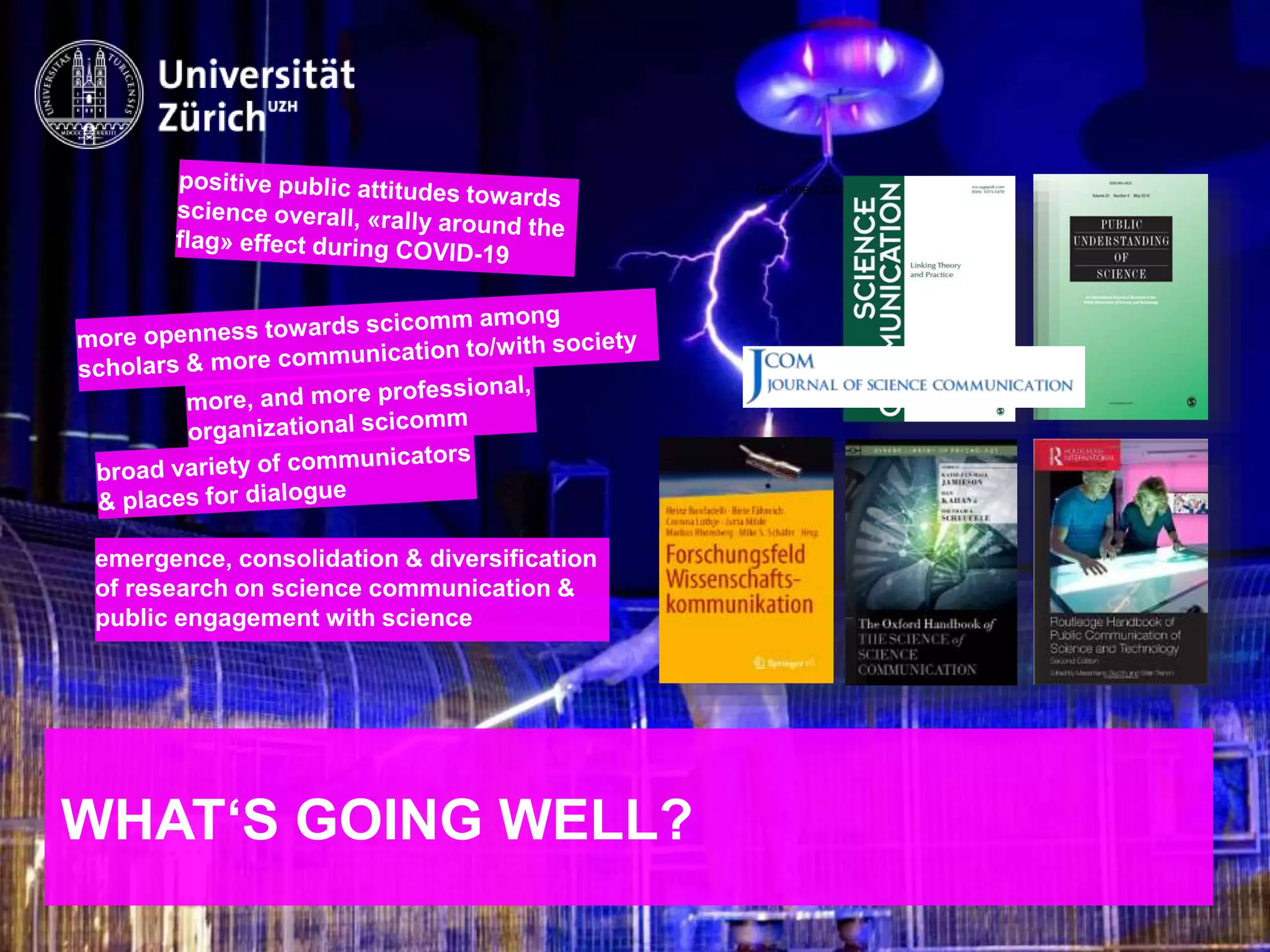
  • #9 Another great development – I think – is the emergence and consolidation of research on science communication – a field that has been institutionalized in recent years There are many indicators of this institutionalization: journals which have become established, such as “Public Understanding of Science”, “Science Communication” or the “Journal of Science Communication” a number of introductory text- and handbooks synthesizing knowledge from the field for other scholars established professional associations and conferences, like the PCST, the Public Communication of Science and Technology Network founded in the 1980s whose conferences attract hundreds of people
  • #10 There also is a clear rise in scholarly publications, especially since the mid-2000s And there is a pronounced diversification of the field, which now encapsulates many topics, foci and disciplines From public science communication over science education to scholarly communication and the role of open science
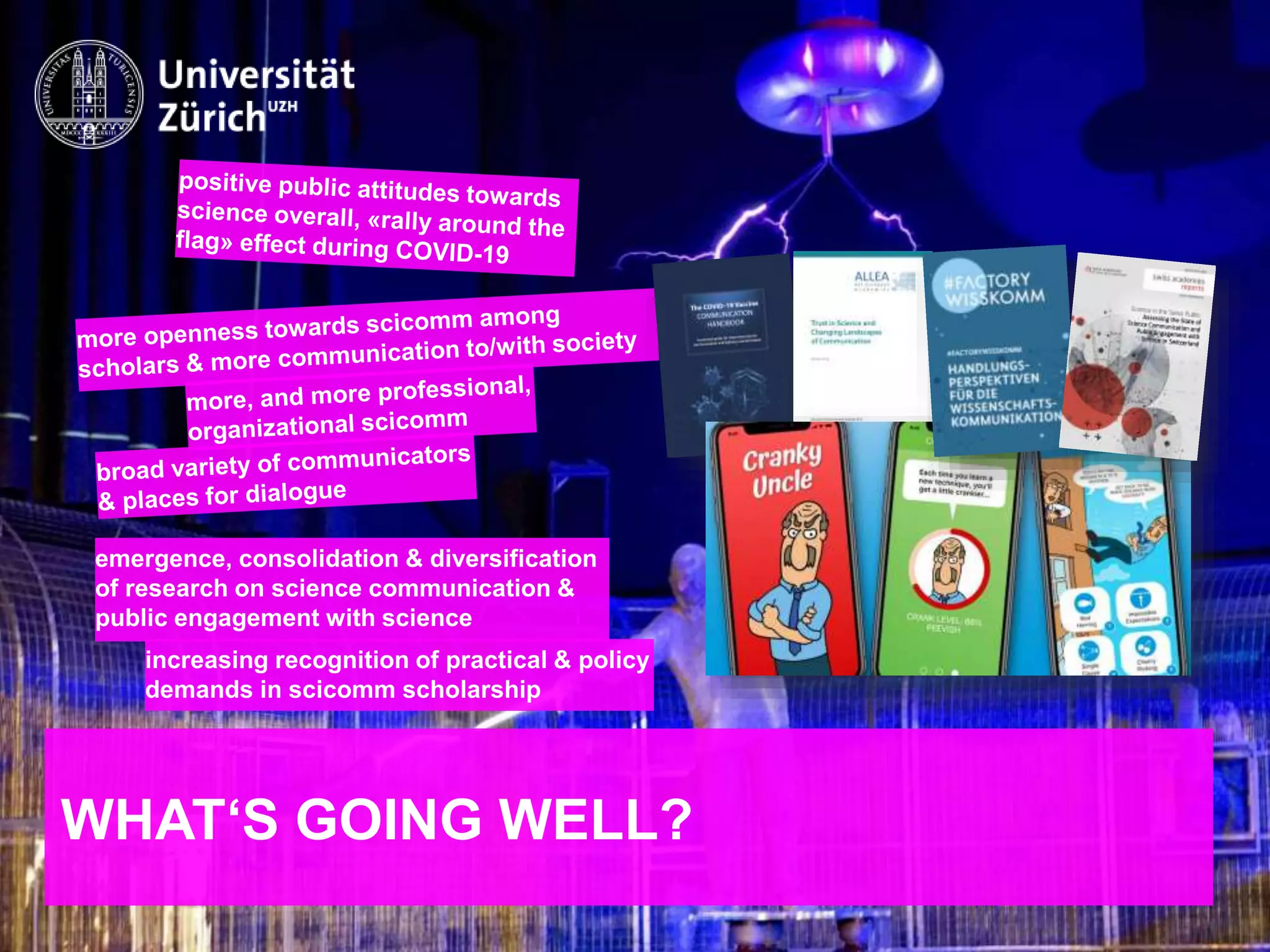
  • #11 And there seems to be an increased recognition within the field that it is necessary to communicate our own findings as well There are reports in many countries by Scientific Academies and others which translate findings from scicomm research into recommendations for action on specific topics (like «COVID19 vaccination communication handbook») or on scicomm more generally And there are other communication efforts from the scicomm research community like participatory formats, exhibitions, websites, social media campaigns or games like the Cranky Uncle App aiming to counteract climate change-related dis- and misinformation
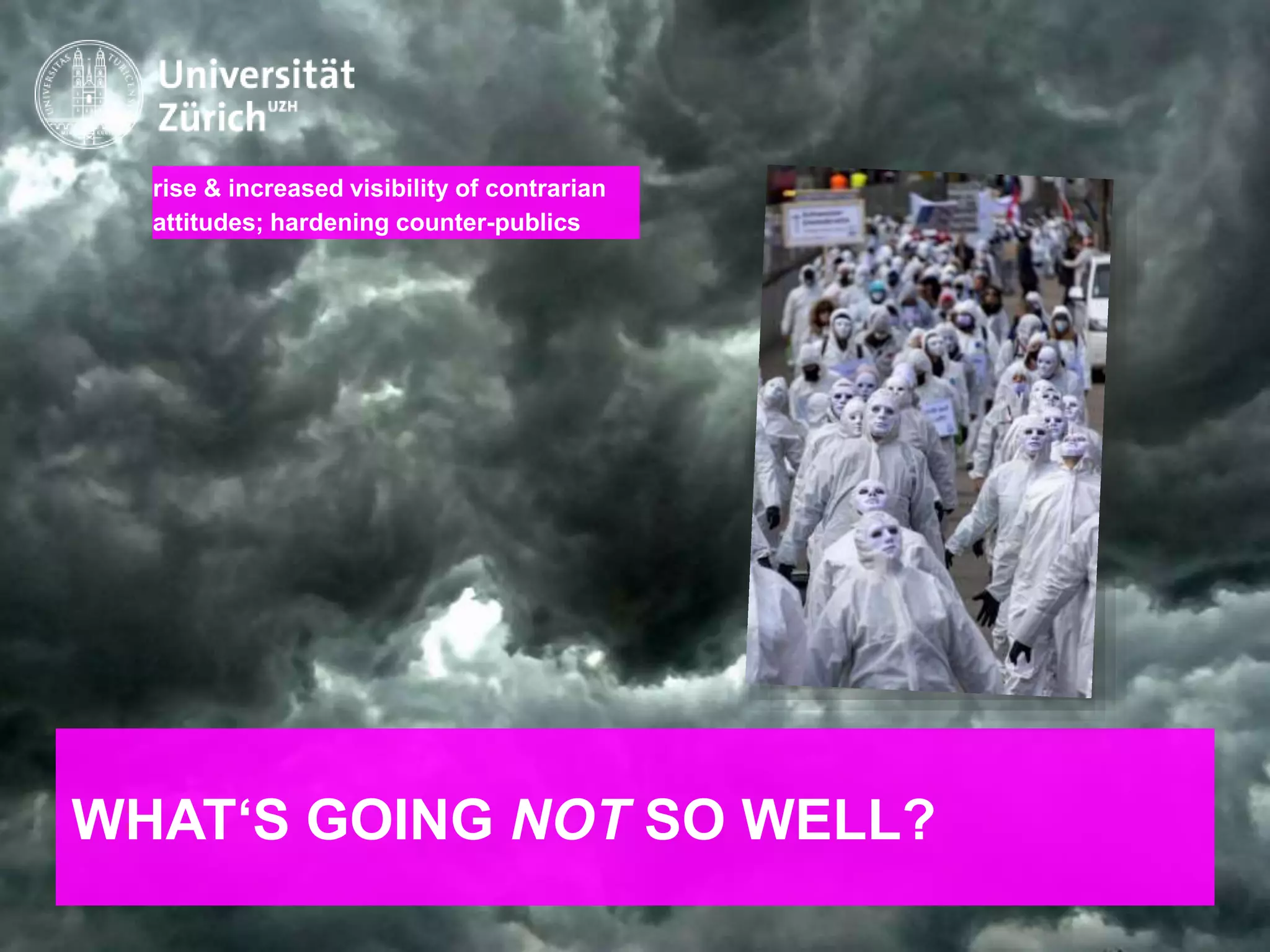
  • #12 rise of contrarian and conspirational attitudes (pictured here is the Swiss variant of «Cross-Thinkers» who have criticized anti-Covid-measures) These attitudes have become more visible, and maybe more accepted, in different countries even though they still seem to be clearly a minority position
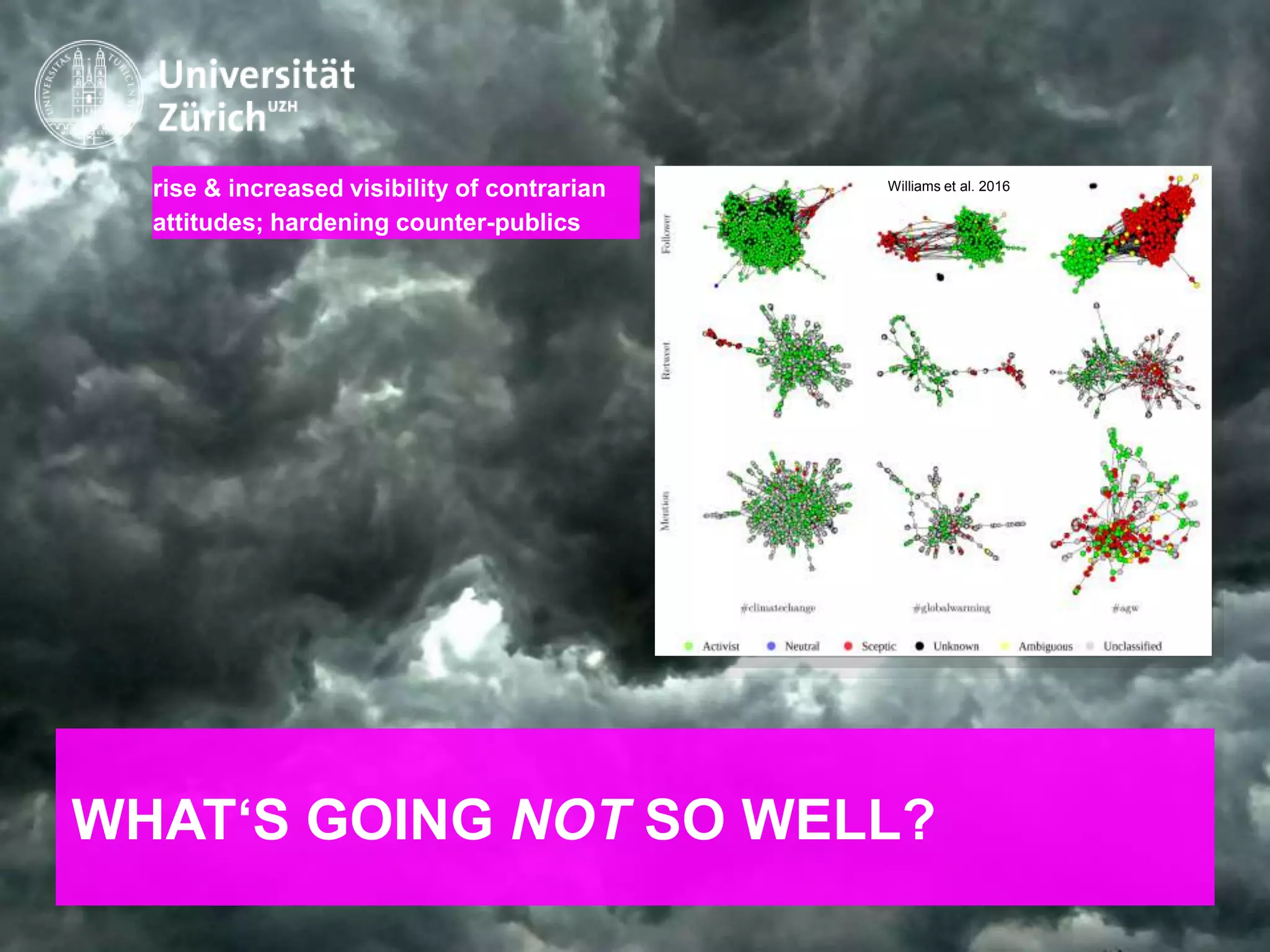
  • #13 There is also some evidence that around certain science-related issues, a fragmentation of public and online debates has occured that we do find echo chambers around issues like COVID19, vaccination, 5G or climate change
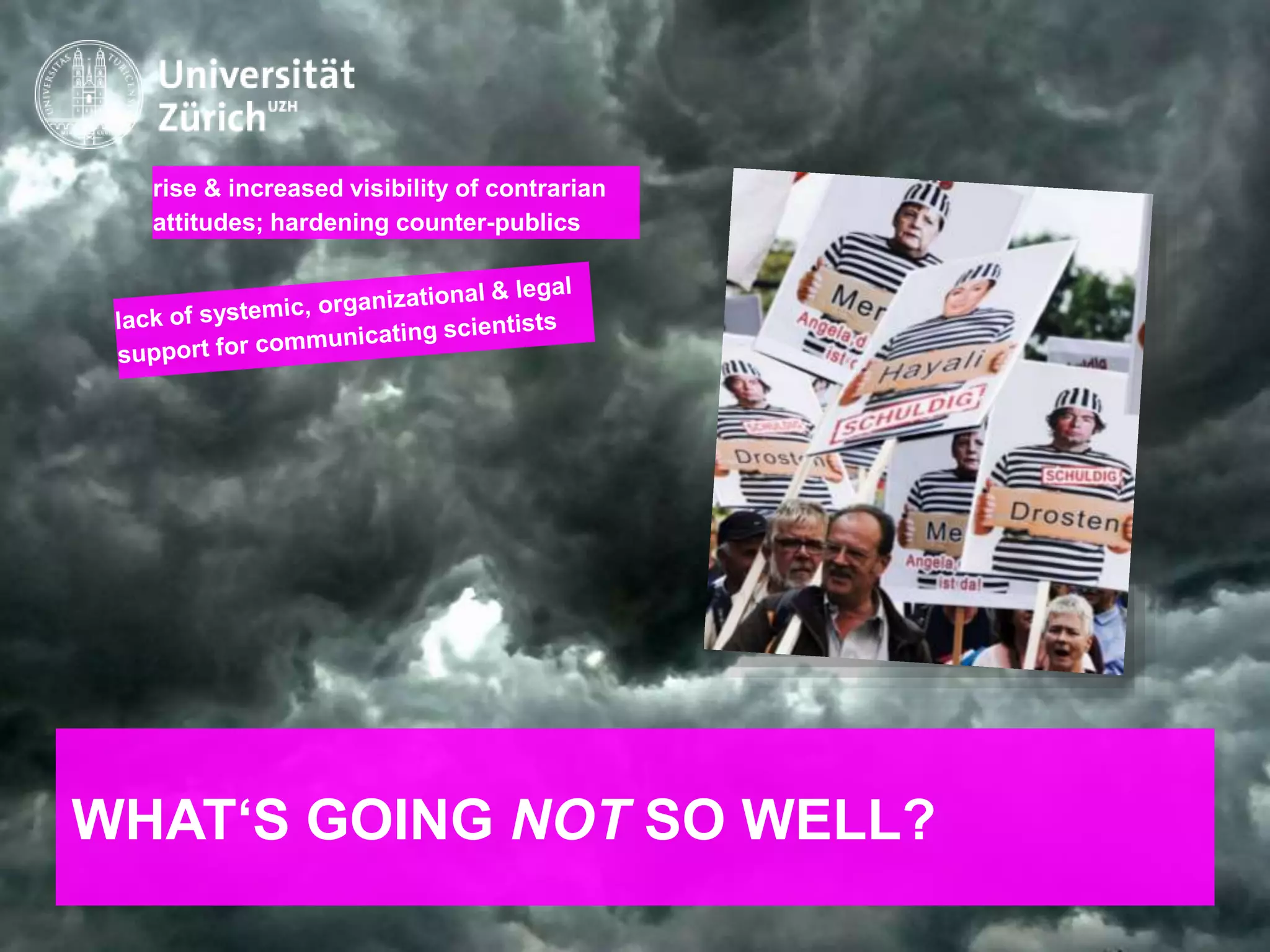
  • #14 We have seen that controversies around such issues have resulted in personal attacks on scholars, particularly on female scholars. And this has highlighted a lack of systemic, organizational, peer and also legal support for communicating scientists. And in studies some scientists do say that they are not communicating publicly for fear of backlash and personal attacks
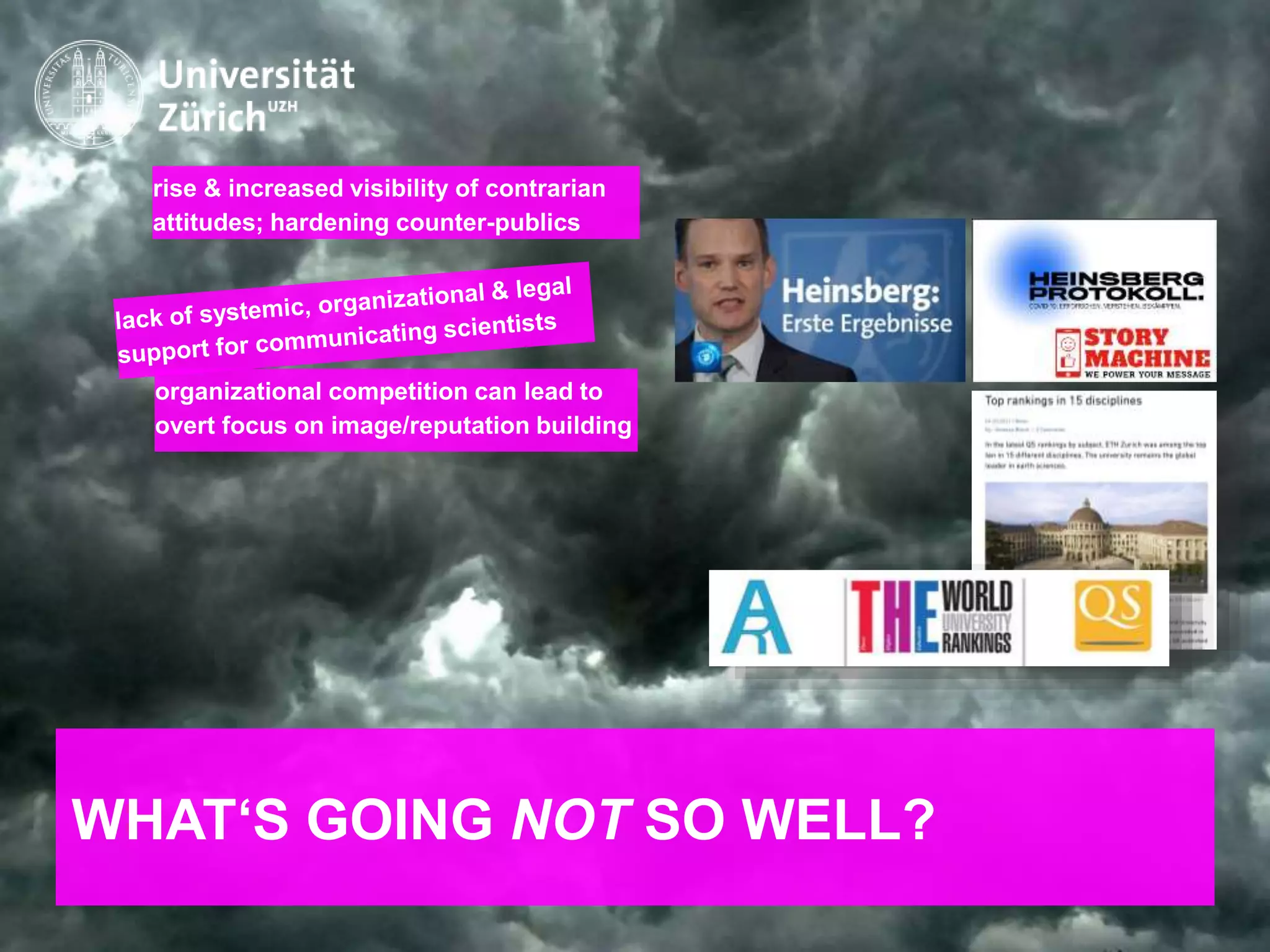
  • #15 We have seen that organizational communication sometimes focus strongly – maybe overtly strong – on building their profile, image and reputation There was a GER case where a research team hired a PR agency to improve visilibity – very sucessfully – for a study which was later strongly criticized and in many countries, there are university and departments using ranking results to boost their public profiles while knowing about the methodological shortcomings of such rankings
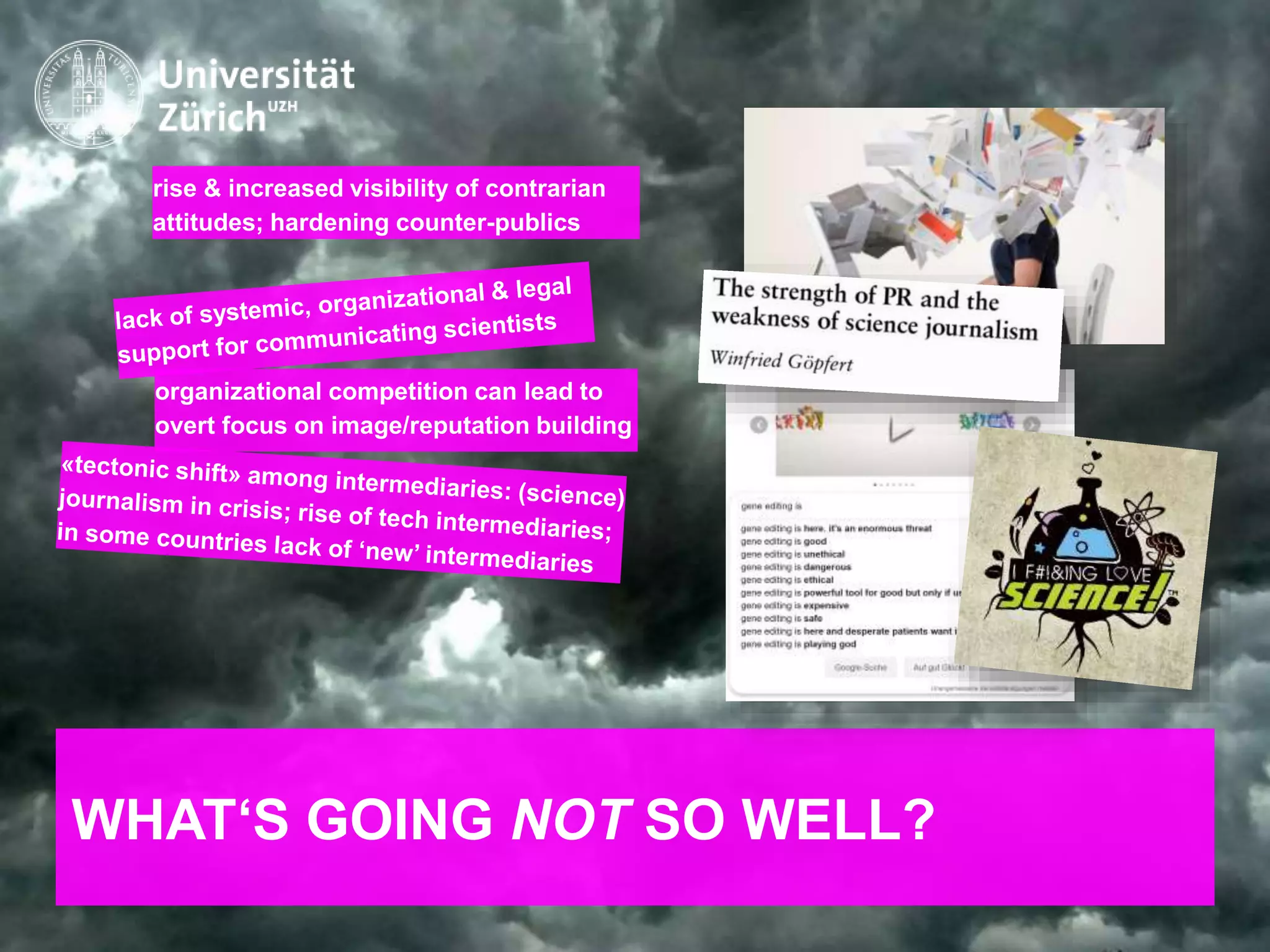
  • #16 And research has shown a «tectonic shift», and a crisis, of intermediaries between science and society: science journalism in an economic crisis that impacts, and worsens, working conditions tech platforms have become much more important intermediaries, also for science-related issues. But they don’t curate information according to quality or accuracy – they focus on maximizing attention and time-spent on the platform And ‚new‘ intermediaries – like online-born media, successful social media campaigns such as „I fucking love science“ or social media influencers – exist in some, but by far not in all countries and languages
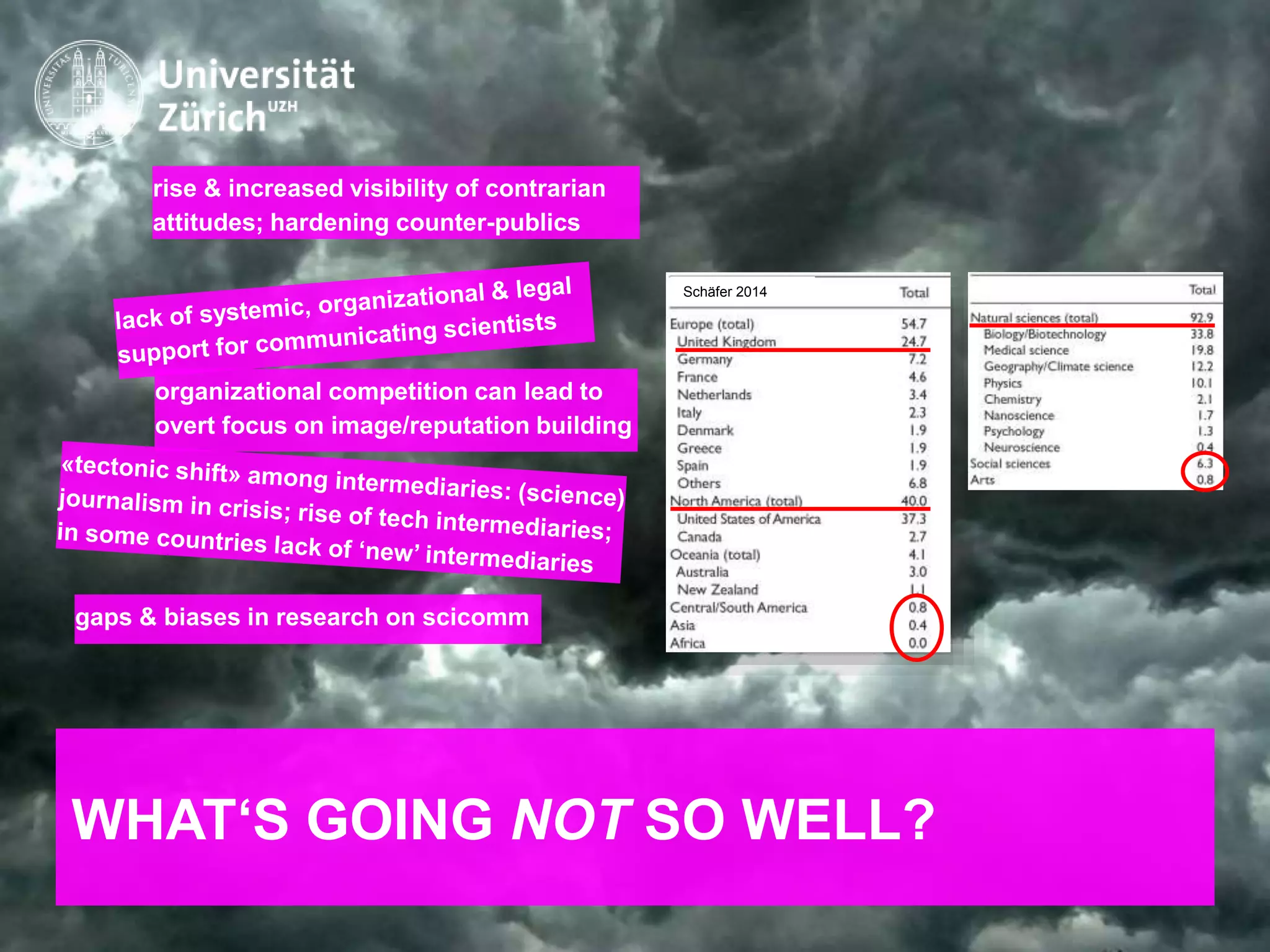
  • #17 And if we look at research on scicomm, we find some things that are not going well, too While we have a burgeoning research on scicomm, this scholarship has gaps and biases Focuses strongly on some, particularly Anglophone countries whose results may not fully apply to other countries Focuses strongly on STEM disciplines, and only rarely on communication about the social sciences and arts There are other gaps as well: E.g. among social media, most studies focus on Twitter because it is easily available – but other relevant platforms are neglected or inaccessible
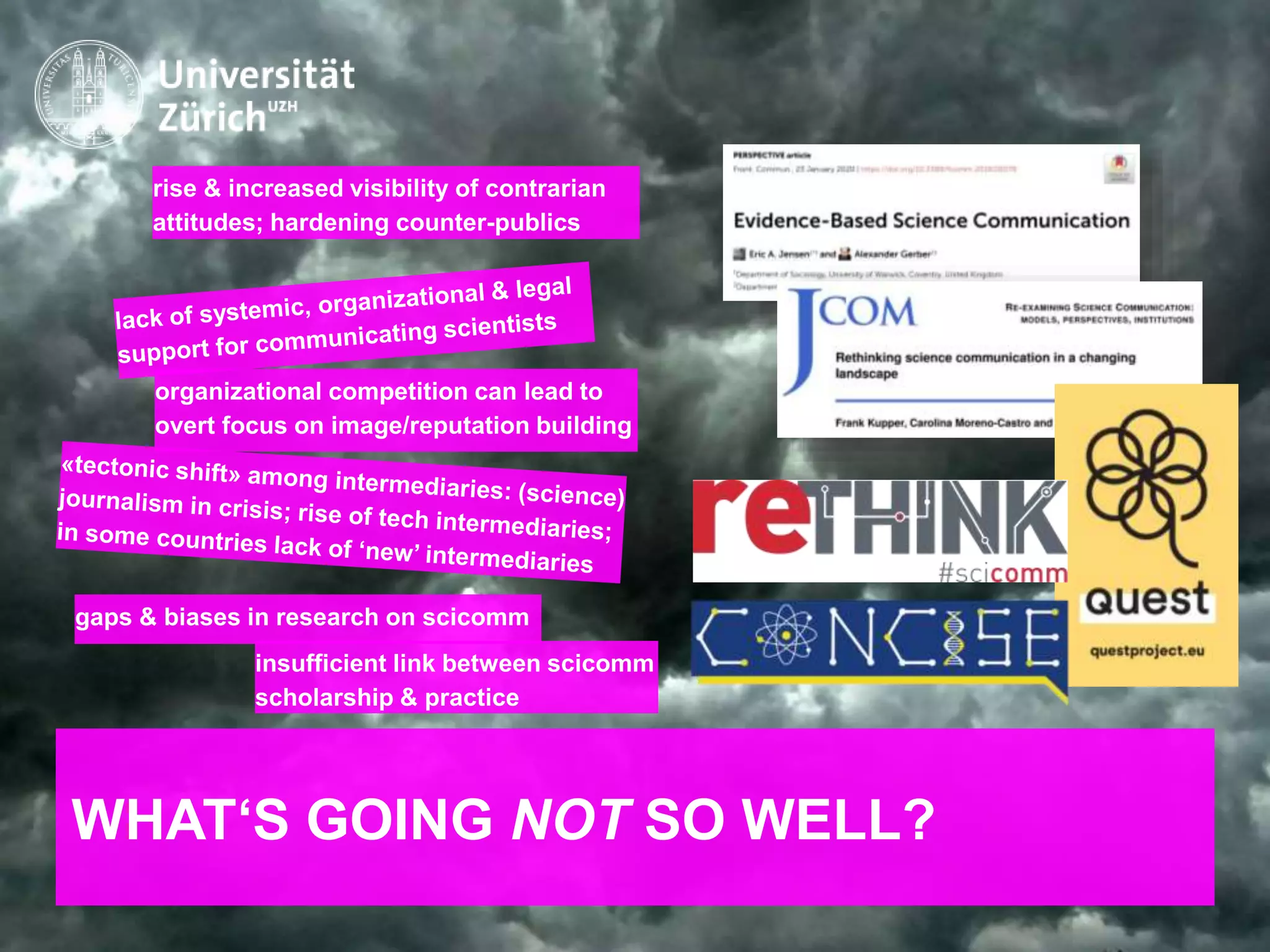
  • #18 And there is an insufficient link between research and practice something that is habitually and often diagnosed from researchers and practicioners It is of course good to see that some funders – among them the EU – try to address this & that this has resulted in several large-scale projects working on it You see three examples here But it is also worth noting that these projects all have a limited time span which makes it more difficult to have a sustainable impact
  • #19 First, it is important to recognize this as a „Fork in the Road“ moment! Right now, we have a moment where we can try to leverage the high current public interest and trust into better science communication! On the one hand, this has implications for the practice of science communication. Others can speak more competently on this, but just to give you two examples:
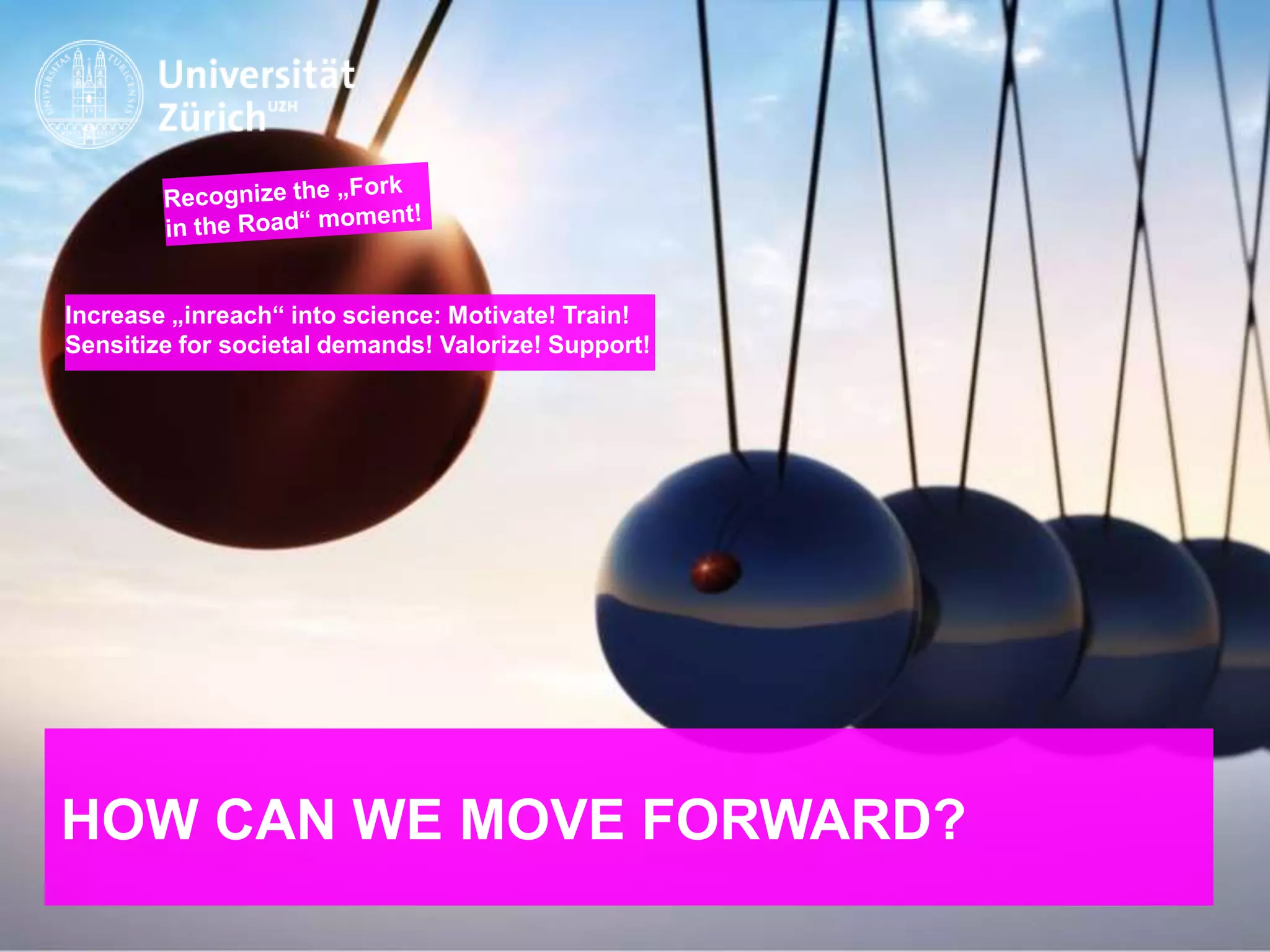
  • #20 I think it is clear that we need more „inreach“ into the scientific community Motivate! Train! Sensitize for societal demands – „listen“! Valorize scicomm in the system! Support!
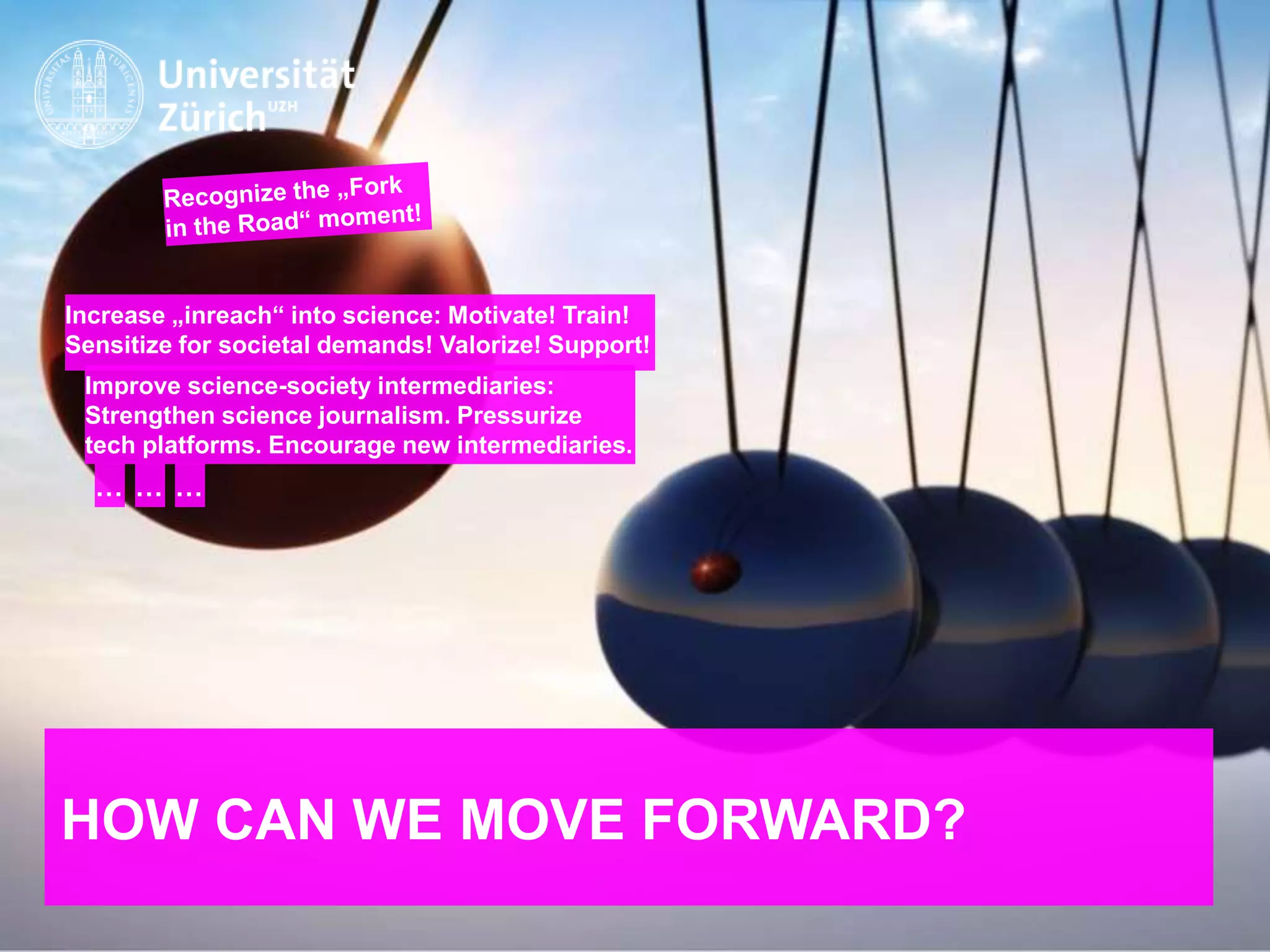
  • #21 We should also use this moment to improve the situation of science-society intermediaries: This means strengthening science journalism and thinking about new funding models that may include institutional and public funding It means putting pressure on tech platforms to curate science-related (and other, for that matter) content responsibly And it means encouraging new intermediaries to step forward There are practical measures but I would rather focus on how to move scicomm research forward …
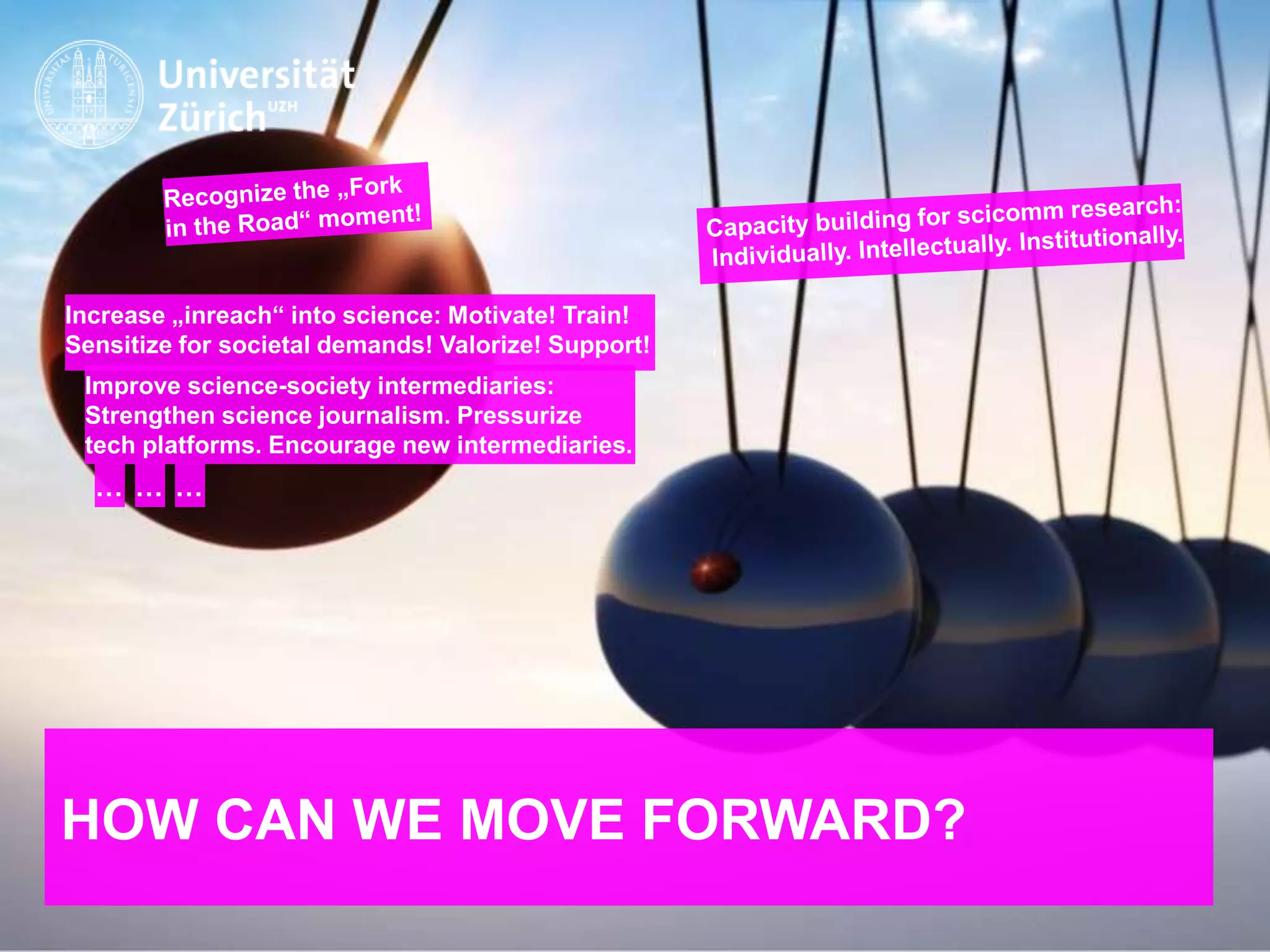
  • #22 Apart from these practical steps forward, on the other hand - and this is my last focus – we should strengthen research on science communication. I think it’s important to improve capacity building for scicomm research: individually: we need to encourage young scholars to engage in scicomm research – and to provide them with career paths in this field which lead to academic positions and professorships in scicomm research. Intellectually: we need regular efforts to assess research on scicomm, to systematically aggregate it and to make core findings available to the scholarly community Institutionally: we need long-term observations and organizational structures that support these long-term assessment. We do not only need 1-, 2- or 3-year projects that end and peter out, but continuous efforts to strengthen scicomm research.
  • #23 We need more, and more systematic, evaluations of scicomm efforts to broaden the evidence base of scicomm research These evaluations should also explicitly assess potentially negative effects of science communication And we need to make the data and results of these efforts openly available for researchers, for meta-analyses, replication studies etc. to consolidate what we know
  • #24 We should balance the field more: We need more research on the Global South and on the communication about social science and humanities, for example and we should make them more visible in the journals and publications of our field
  • #25 We should – and this is a broader issue that goes beyond scicomm and beyond individual countries – try hard to get access to platform and social media data to assess digital science communication more broadly and more appropriately
  • #26 And maybe a bit tongue-in-cheek: We should apply the principles of scicomm to scicomm research itself: communicate our findings to the public, to stakeholders and policymakers regularly establish dialogue with and participation of practicioners when it comes to pressing questions, creating research designs etc. I am aware, of course, that these are big question. Therefore, I am thankful that some of these issues will be taken up here at the „Future of Science Communication“conference – and I look forward to it.