© Mike Rother TOYOTA KATA
1
Mike Rother
December 2011
1
2345
Coaching
Kata
Questions
The
© Mike Rother TOYOTA KATA
2
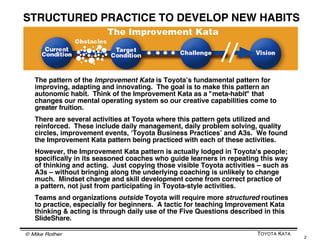
STRUCTURED PRACTICE TO DEVELOP NEW HABITS
The pattern of the Improvement Kata is Toyotaʼs fundamental pattern for
improving, adapting and innovating. The goal is to make this pattern an
autonomic habit. Think of the Improvement Kata as a "meta-habit" that can be
applied to an infinite number of goals.
There are several activities at Toyota where this pattern gets utilized and
reinforced. These include daily management, daily problem solving, quality
circles, improvement events, ʻToyota Business Practicesʼ and A3s. We found
the Improvement Kata pattern being practiced with each of these activities.
However, the Improvement Kata pattern is actually lodged in Toyota's people;
specifically in its seasoned coaches (managers) who guide learners in
repeating this way of thinking and acting. Just copyingToyotaʼs visible
activities, such as A3s, without bringing along the coaching is unlikely to
change much. Mindset change and skill development come from correct
practice of a pattern, not just from implementing Toyota-style tools.
Teams and organizations outside Toyota will require more structured routines
to practice, especially for beginners. A tactic for teaching Improvement Kata
thinking & acting is through daily use of the Five Questions described in this
SlideShare.
© Mike Rother TOYOTA KATA
3
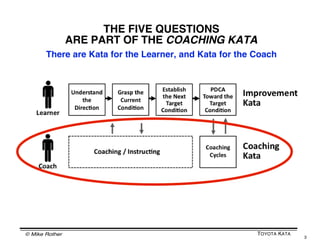
THE FIVE QUESTIONS
ARE PART OF THE COACHING KATA
There are Kata for the Learner, and Kata for the Coach
© Mike Rother TOYOTA KATA
4
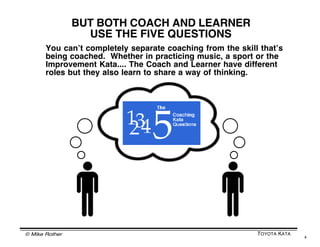
You canʼt completely separate coaching from the skill thatʼs
being coached. Whether in practicing music, a sport or the
Improvement Kata.... The Coach and Learner have different
roles but they also learn to share a way of thinking.
BUT BOTH COACH AND LEARNER
REFER TO THE FIVE QUESTIONS
© Mike Rother TOYOTA KATA
5
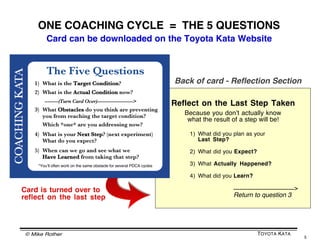
ONE COACHING CYCLE = THE 5 QUESTIONS
------------------------------>
Return to question 3
1) What is the Target Condition?
2) What is the Actual Condition now?
--------(Turn Card Over)--------------------->
3) What Obstacles do you think are preventing
you from reaching the target condition?
Which *one* are you addressing now?
4) What is your Next Step? (next PDCA /
experiment) What do you expect?
5) When can we go and see what we
Have Learned from taking that step?
The Five Questions
*Youʼll often work on the same obstacle for several PDCA cycles
Reflect on the Last Step Taken
Because you donʼt actually know
what the result of a step will be!
1) What did you plan as your
Last Step?
2) What did you Expect?
3) What Actually Happened?
4) What did you Learn?
The card is turned
over to reflect on
the Learnerʼs last step
The power of the Five Questions is great, when you know how
to ask them and how to respond to the answers you get.
Get the card at: http://tinyurl.com/katacard
© Mike Rother TOYOTA KATA
6
PURPOSE OF THE FIVE QUESTIONS
The Five Coaching Kata Questions
help the Coach see how the Learner is thinking
The Coachʼs job is to provide corrective procedural inputs, to
ensure that the Learner is proceeding (practicing) according to
the scientific pattern of the Improvement Kata.
However, the Coach cannot provide such input until the Learner
has said or done something, which shows how the Learner is
currently thinking. It works like this:
The Coach
asks a
question
The Learner
responds and the
Coach listens
The Coach sees
how the Learner
is thinking
A focused, corrective
procedural input is given if
necessary (what the Learner
should practice next)
© Mike Rother TOYOTA KATA
7
ITʼS THE SAME AS IN SPORTS AND MUSIC
The 5Q process is analogous to a Golf coach saying, “Please
swing the golf club a few times so I can see what you are doing,”
or a Music teacher saying, “Please play a bit so I can see.”
However, since the Improvement Kata pattern is a mental
process, the Coaching Kata Five Question approach is: “Iʼm
going to ask you these questions. How you respond will help me
to understand how you are thinking.”
The Coach
asks a
question
The Learner
responds and the
Coach listens
The Coach sees
how the Learner
is thinking
A focused, corrective
procedural input is given if
necessary (what the Learner
should practice next)
© Mike Rother TOYOTA KATA
8
THE FIVE QUESTIONS HELP THE COACH TEACH
A SYSTEMATIC SCIENTIFIC WAY OF THINKING
The Coach uses the same pattern of questioning
in every coaching cycle
. . ...
.
. . . .
. ..Current
Condition
Learnerʼs
Target
Condition
Unclear
Territory
Obstacles
Coaching
Cycles
with the 5
Questions
5Q
5Q
5Q
5Q
5Q
5Q
5Q
5Q
5Q
5Q
5Q
5Q
5Q
The pattern of questioning stays
the same and repeats. This is the
pattern the Coach is teaching.
Coach
Learner
The content and obstacles
the Learner works on are
situational & vary
IK-Skill
Target
Condition
© Mike Rother TOYOTA KATA
9
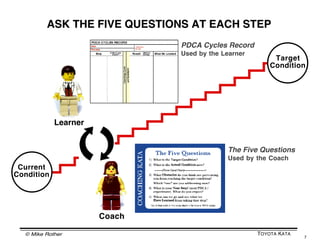
ASK THE FIVE QUESTIONS AT EACH STEP
Current
Condition
Target
Condition
Learner
Coach
PDCA Cycles Record
Used by the Learner
The Five Questions
Used by the Coach
© Mike Rother TOYOTA KATA
10
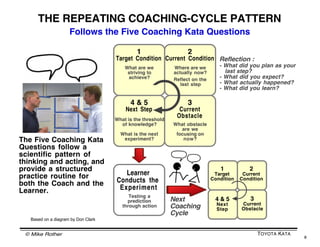
THE REPEATING COACHING-CYCLE PATTERN
Follows the Five Coaching Kata Questions
Based on a diagram by Don Clark
1
Target Condition
1
Target
Condition
2
Current
Condition
3
Current
Obstacle
Next
Coaching
Cycle
4 & 5
Next
Step
Reflection :
- What did you plan as your
last step?
- What did you expect?
- What actually happened?
- What did you learn?
2
Current Condition
What are we
striving to
achieve?
Where are we
actually now?
Reflect on the
last step
3
Current
Obstacle
What obstacle
are we
focusing on
now?
4 & 5
Next Step
What is the threshold
of knowledge?
What is the next
experiment?
Learner
Conducts the
Experiment
Testing a
prediction
through action
The Five Coaching Kata
Questions follow a
scientific pattern of
thinking and acting, and
provide a structured
practice routine for
both the Coach and the
Learner.
© Mike Rother TOYOTA KATA
11
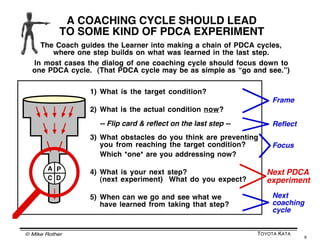
Next
coaching
cycle
1) What is the target condition?
2) What is the actual condition now?
-- Flip card & reflect on the last step --
3) What obstacles do you think are preventing
you from reaching the target condition?
Which *one* are you addressing now?
4) What is your next step?
(next experiment) What do you expect?
5) When can we go and see what we
have learned from taking that step?
P
DC
A
Frame
Next PDCA
experiment
Focus
Next
coaching
cycle
Reflect
A COACHING CYCLE SHOULD LEAD
TO SOME KIND OF PDCA EXPERIMENT
The Coach guides the Learner into making a chain of PDCA cycles,
where one step builds on what was learned in the last step.
In most cases the dialog of one coaching cycle should focus down to
one PDCA cycle. (That PDCA cycle may be as simple as “go and see.”)
© Mike Rother TOYOTA KATA
12
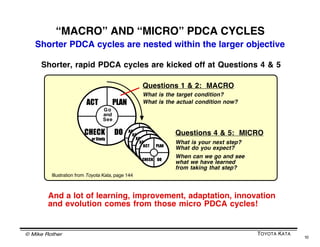
PLAN
DOCHECK
or Study
ACT
Go
and
See
PLAN
DOCHECK
ACT
PLAN
DOCHECK
ACT
PLAN
DOCHECK
ACT
PLAN
DOCHECK
ACT
PLAN
DOCHECK
ACT
And a lot of learning, improvement, adaptation, innovation
and evolution comes from those micro PDCA cycles!
Shorter, rapid PDCA cycles are kicked off at Questions 4 & 5
“MACRO” AND “MICRO” PDCA CYCLES
Shorter PDCA cycles are nested within the larger objective
Questions 1 & 2: MACRO
What is the target condition?
What is the actual condition now?
Questions 4 & 5: MICRO
What is your next step?
What do you expect?
When can we go and see
what we have learned
from taking that step?
Illustration from Toyota Kata, page 144
© Mike Rother TOYOTA KATA
13
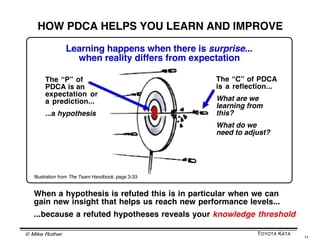
The “P” of
PDCA is an
expectation or
a prediction...
...a hypothesis
HOW PDCA HELPS YOU LEARN AND IMPROVE
Learning happens when there is surprise...
when reality differs from expectation
When a hypothesis is refuted this is in particular when we can
gain new insight that helps us reach new performance levels...
...because a refuted hypotheses reveals your knowledge threshold
Illustration from The Team Handbook, page 3-33
The “C” of PDCA
is a reflection...
What are we
learning from
this?
What do we
need to adjust?
© Mike Rother TOYOTA KATA
14
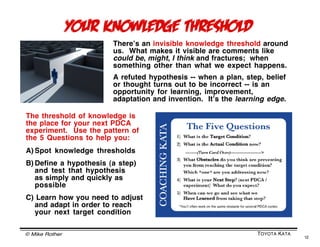
Thereʼs an invisible knowledge threshold around
us. What makes it visible are comments like
could be, might, I think and fractures; when
something other than what we expect happens.
A refuted hypothesis -- when a plan, step, belief
or thought turns out to be incorrect -- is an
opportunity for learning, improvement,
adaptation and invention. Itʼs the learning edge.
YOUR KNOWLEDGE THRESHOLD
The threshold of knowledge is
the place for your next PDCA
experiment. Use the pattern of
the 5 Questions to help you:
A) Spot knowledge thresholds
B) Define a hypothesis (a step)
and test that hypothesis
as simply and quickly as
possible
C) Learn how you need to adjust
and adapt in order to reach
your next target condition
© Mike Rother TOYOTA KATA
15
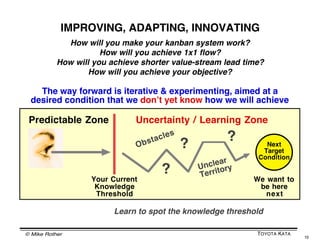
Predictable Zone Uncertainty / Learning Zone
Next
Target
Condition
Your Current
Knowledge
Threshold
IMPROVING, ADAPTING, INNOVATING
How will you make your kanban system work?
How will you achieve 1x1 flow?
How will you achieve shorter value-stream lead time?
How will you achieve your objective?
The way forward is iterative & experimenting, aimed at a
desired condition that we donʼt yet know how we will achieve
Learn to spot the knowledge threshold
We want to
be here
next
Obstacles
Unclear
Territory
?
?
?
© Mike Rother TOYOTA KATA
16
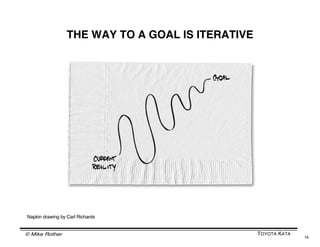
THE WAY TO A GOAL IS ITERATIVE
Napkin drawing by Carl Richards
© Mike Rother TOYOTA KATA
17
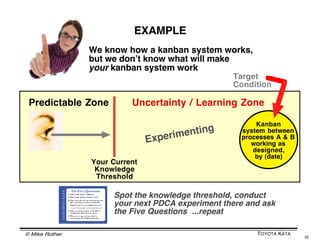
EXAMPLE
Predictable Zone Uncertainty / Learning Zone
Kanban
system between
processes A & B
working as
designed,
by (date)
Your Current
Knowledge
Threshold
Target
Condition
Spot the knowledge threshold, conduct
your next PDCA experiment there and ask
the Five Questions ...repeat
We know how a kanban system works,
but we donʼt know what will make
your kanban system work
Experimenting
© Mike Rother TOYOTA KATA
18
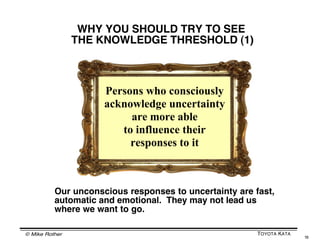
WHY YOU SHOULD TRY TO SEE
THE KNOWLEDGE THRESHOLD (1)
Our unconscious responses to uncertainty are fast,
automatic and emotional. They may not lead us
where we want to go.
Persons who consciously
acknowledge uncertainty
are more able
to influence their
responses to it
© Mike Rother TOYOTA KATA
19
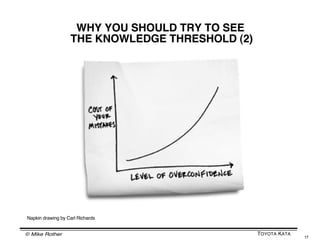
WHY YOU SHOULD TRY TO SEE
THE KNOWLEDGE THRESHOLD (2)
Napkin drawing by Carl Richards
© Mike Rother TOYOTA KATA
20
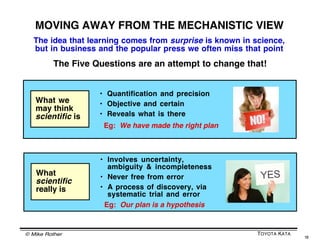
The Five Questions are an attempt to change that!
MOVING AWAY FROM THE MECHANISTIC VIEW
The idea that learning comes from surprise is known in science,
but in business and the popular press we often miss that point
What we
may think
scientific is
What
scientific
really is
• Quantification and precision
• Objective and certain
• Reveals what is there
Eg: We have made the right plan
• Involves uncertainty,
ambiguity & incompleteness
• Never free from error
• A process of discovery, via
systematic trial and error
Eg: Our plan is a hypothesis
© Mike Rother TOYOTA KATA
21
COACHING
Corrective
feedback
KATA
Structured routine
to practice
MASTERY
Overcoming
obstacles
PRACTICE
Daily
3
4
1
2
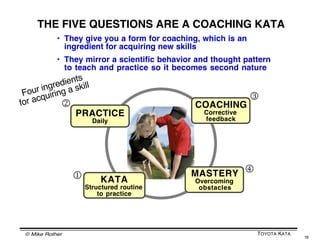
THE FIVE QUESTIONS ARE A COACHING KATA
Four ingredients
for acquiring a skill
• They give you a form for coaching, which is an
ingredient for acquiring new skills
• They mirror a scientific behavior and thought pattern
to teach and practice so it becomes second nature
© Mike Rother TOYOTA KATA
22
YOU CAN PRACTICE SCIENTIFIC THINKING
EVERYWHERE EVERY DAY
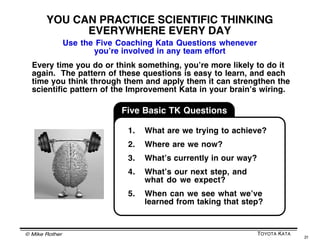
Use the 5 Coaching Kata Questions in any team effort
Every time you do or think something, youʼre
more likely to do it again. The pattern of
these questions is easy to learn, and each
time you think through them and apply them
it can strengthen the scientific pattern of the
Improvement Kata in your brainʼs wiring.
1. What are we trying to achieve?
2. Where are we now?
3. Whatʼs currently in our way?
4. Whatʼs our next experiment,
and what do we expect?
5. When can we see what weʼve
learned from taking that step?
Five Coaching Questions
© Mike Rother TOYOTA KATA
23
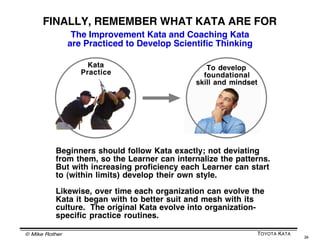
JUST REMEMBER WHAT KATA ARE FOR!
The Improvement Kata and Coaching Kata are Practice Routines
to Develop Scientific Thinking. Theyʼre “Starter Kata.”
Kata
Practice
To develop
foundational
skill and mindset
Beginners should follow Starter Kata exactly; not deviating from
them in order to internalize and understand their patterns. But
with increasing proficiency each Learner can start to develop
their own style, as long as the principles remain the same.
Likewise, over time each organization can evolve the Kata it
began with to better suit and mesh with its culture. The original
Kata evolve into organization-specific practice routines.
© Mike Rother TOYOTA KATA
24
Best wishes for fostering more
systematic & scientific thinking
with the Five Coaching Kata Questions!
Bill
Costantino
Mike
Rother

The Five Coaching Kata Questions

  • 1.
    © Mike RotherTOYOTA KATA 1 Mike Rother December 2011 1 2345 Coaching Kata Questions The
  • 2.
    © Mike RotherTOYOTA KATA 2 STRUCTURED PRACTICE TO DEVELOP NEW HABITS The pattern of the Improvement Kata is Toyotaʼs fundamental pattern for improving, adapting and innovating. The goal is to make this pattern an autonomic habit. Think of the Improvement Kata as a "meta-habit" that can be applied to an infinite number of goals. There are several activities at Toyota where this pattern gets utilized and reinforced. These include daily management, daily problem solving, quality circles, improvement events, ʻToyota Business Practicesʼ and A3s. We found the Improvement Kata pattern being practiced with each of these activities. However, the Improvement Kata pattern is actually lodged in Toyota's people; specifically in its seasoned coaches (managers) who guide learners in repeating this way of thinking and acting. Just copyingToyotaʼs visible activities, such as A3s, without bringing along the coaching is unlikely to change much. Mindset change and skill development come from correct practice of a pattern, not just from implementing Toyota-style tools. Teams and organizations outside Toyota will require more structured routines to practice, especially for beginners. A tactic for teaching Improvement Kata thinking & acting is through daily use of the Five Questions described in this SlideShare.
  • 3.
    © Mike RotherTOYOTA KATA 3 THE FIVE QUESTIONS ARE PART OF THE COACHING KATA There are Kata for the Learner, and Kata for the Coach
  • 4.
    © Mike RotherTOYOTA KATA 4 You canʼt completely separate coaching from the skill thatʼs being coached. Whether in practicing music, a sport or the Improvement Kata.... The Coach and Learner have different roles but they also learn to share a way of thinking. BUT BOTH COACH AND LEARNER REFER TO THE FIVE QUESTIONS
  • 5.
    © Mike RotherTOYOTA KATA 5 ONE COACHING CYCLE = THE 5 QUESTIONS ------------------------------> Return to question 3 1) What is the Target Condition? 2) What is the Actual Condition now? --------(Turn Card Over)---------------------> 3) What Obstacles do you think are preventing you from reaching the target condition? Which *one* are you addressing now? 4) What is your Next Step? (next PDCA / experiment) What do you expect? 5) When can we go and see what we Have Learned from taking that step? The Five Questions *Youʼll often work on the same obstacle for several PDCA cycles Reflect on the Last Step Taken Because you donʼt actually know what the result of a step will be! 1) What did you plan as your Last Step? 2) What did you Expect? 3) What Actually Happened? 4) What did you Learn? The card is turned over to reflect on the Learnerʼs last step The power of the Five Questions is great, when you know how to ask them and how to respond to the answers you get. Get the card at: http://tinyurl.com/katacard
  • 6.
    © Mike RotherTOYOTA KATA 6 PURPOSE OF THE FIVE QUESTIONS The Five Coaching Kata Questions help the Coach see how the Learner is thinking The Coachʼs job is to provide corrective procedural inputs, to ensure that the Learner is proceeding (practicing) according to the scientific pattern of the Improvement Kata. However, the Coach cannot provide such input until the Learner has said or done something, which shows how the Learner is currently thinking. It works like this: The Coach asks a question The Learner responds and the Coach listens The Coach sees how the Learner is thinking A focused, corrective procedural input is given if necessary (what the Learner should practice next)
  • 7.
    © Mike RotherTOYOTA KATA 7 ITʼS THE SAME AS IN SPORTS AND MUSIC The 5Q process is analogous to a Golf coach saying, “Please swing the golf club a few times so I can see what you are doing,” or a Music teacher saying, “Please play a bit so I can see.” However, since the Improvement Kata pattern is a mental process, the Coaching Kata Five Question approach is: “Iʼm going to ask you these questions. How you respond will help me to understand how you are thinking.” The Coach asks a question The Learner responds and the Coach listens The Coach sees how the Learner is thinking A focused, corrective procedural input is given if necessary (what the Learner should practice next)
  • 8.
    © Mike RotherTOYOTA KATA 8 THE FIVE QUESTIONS HELP THE COACH TEACH A SYSTEMATIC SCIENTIFIC WAY OF THINKING The Coach uses the same pattern of questioning in every coaching cycle . . ... . . . . . . ..Current Condition Learnerʼs Target Condition Unclear Territory Obstacles Coaching Cycles with the 5 Questions 5Q 5Q 5Q 5Q 5Q 5Q 5Q 5Q 5Q 5Q 5Q 5Q 5Q The pattern of questioning stays the same and repeats. This is the pattern the Coach is teaching. Coach Learner The content and obstacles the Learner works on are situational & vary IK-Skill Target Condition
  • 9.
    © Mike RotherTOYOTA KATA 9 ASK THE FIVE QUESTIONS AT EACH STEP Current Condition Target Condition Learner Coach PDCA Cycles Record Used by the Learner The Five Questions Used by the Coach
  • 10.
    © Mike RotherTOYOTA KATA 10 THE REPEATING COACHING-CYCLE PATTERN Follows the Five Coaching Kata Questions Based on a diagram by Don Clark 1 Target Condition 1 Target Condition 2 Current Condition 3 Current Obstacle Next Coaching Cycle 4 & 5 Next Step Reflection : - What did you plan as your last step? - What did you expect? - What actually happened? - What did you learn? 2 Current Condition What are we striving to achieve? Where are we actually now? Reflect on the last step 3 Current Obstacle What obstacle are we focusing on now? 4 & 5 Next Step What is the threshold of knowledge? What is the next experiment? Learner Conducts the Experiment Testing a prediction through action The Five Coaching Kata Questions follow a scientific pattern of thinking and acting, and provide a structured practice routine for both the Coach and the Learner.
  • 11.
    © Mike RotherTOYOTA KATA 11 Next coaching cycle 1) What is the target condition? 2) What is the actual condition now? -- Flip card & reflect on the last step -- 3) What obstacles do you think are preventing you from reaching the target condition? Which *one* are you addressing now? 4) What is your next step? (next experiment) What do you expect? 5) When can we go and see what we have learned from taking that step? P DC A Frame Next PDCA experiment Focus Next coaching cycle Reflect A COACHING CYCLE SHOULD LEAD TO SOME KIND OF PDCA EXPERIMENT The Coach guides the Learner into making a chain of PDCA cycles, where one step builds on what was learned in the last step. In most cases the dialog of one coaching cycle should focus down to one PDCA cycle. (That PDCA cycle may be as simple as “go and see.”)
  • 12.
    © Mike RotherTOYOTA KATA 12 PLAN DOCHECK or Study ACT Go and See PLAN DOCHECK ACT PLAN DOCHECK ACT PLAN DOCHECK ACT PLAN DOCHECK ACT PLAN DOCHECK ACT And a lot of learning, improvement, adaptation, innovation and evolution comes from those micro PDCA cycles! Shorter, rapid PDCA cycles are kicked off at Questions 4 & 5 “MACRO” AND “MICRO” PDCA CYCLES Shorter PDCA cycles are nested within the larger objective Questions 1 & 2: MACRO What is the target condition? What is the actual condition now? Questions 4 & 5: MICRO What is your next step? What do you expect? When can we go and see what we have learned from taking that step? Illustration from Toyota Kata, page 144
  • 13.
    © Mike RotherTOYOTA KATA 13 The “P” of PDCA is an expectation or a prediction... ...a hypothesis HOW PDCA HELPS YOU LEARN AND IMPROVE Learning happens when there is surprise... when reality differs from expectation When a hypothesis is refuted this is in particular when we can gain new insight that helps us reach new performance levels... ...because a refuted hypotheses reveals your knowledge threshold Illustration from The Team Handbook, page 3-33 The “C” of PDCA is a reflection... What are we learning from this? What do we need to adjust?
  • 14.
    © Mike RotherTOYOTA KATA 14 Thereʼs an invisible knowledge threshold around us. What makes it visible are comments like could be, might, I think and fractures; when something other than what we expect happens. A refuted hypothesis -- when a plan, step, belief or thought turns out to be incorrect -- is an opportunity for learning, improvement, adaptation and invention. Itʼs the learning edge. YOUR KNOWLEDGE THRESHOLD The threshold of knowledge is the place for your next PDCA experiment. Use the pattern of the 5 Questions to help you: A) Spot knowledge thresholds B) Define a hypothesis (a step) and test that hypothesis as simply and quickly as possible C) Learn how you need to adjust and adapt in order to reach your next target condition
  • 15.
    © Mike RotherTOYOTA KATA 15 Predictable Zone Uncertainty / Learning Zone Next Target Condition Your Current Knowledge Threshold IMPROVING, ADAPTING, INNOVATING How will you make your kanban system work? How will you achieve 1x1 flow? How will you achieve shorter value-stream lead time? How will you achieve your objective? The way forward is iterative & experimenting, aimed at a desired condition that we donʼt yet know how we will achieve Learn to spot the knowledge threshold We want to be here next Obstacles Unclear Territory ? ? ?
  • 16.
    © Mike RotherTOYOTA KATA 16 THE WAY TO A GOAL IS ITERATIVE Napkin drawing by Carl Richards
  • 17.
    © Mike RotherTOYOTA KATA 17 EXAMPLE Predictable Zone Uncertainty / Learning Zone Kanban system between processes A & B working as designed, by (date) Your Current Knowledge Threshold Target Condition Spot the knowledge threshold, conduct your next PDCA experiment there and ask the Five Questions ...repeat We know how a kanban system works, but we donʼt know what will make your kanban system work Experimenting
  • 18.
    © Mike RotherTOYOTA KATA 18 WHY YOU SHOULD TRY TO SEE THE KNOWLEDGE THRESHOLD (1) Our unconscious responses to uncertainty are fast, automatic and emotional. They may not lead us where we want to go. Persons who consciously acknowledge uncertainty are more able to influence their responses to it
  • 19.
    © Mike RotherTOYOTA KATA 19 WHY YOU SHOULD TRY TO SEE THE KNOWLEDGE THRESHOLD (2) Napkin drawing by Carl Richards
  • 20.
    © Mike RotherTOYOTA KATA 20 The Five Questions are an attempt to change that! MOVING AWAY FROM THE MECHANISTIC VIEW The idea that learning comes from surprise is known in science, but in business and the popular press we often miss that point What we may think scientific is What scientific really is • Quantification and precision • Objective and certain • Reveals what is there Eg: We have made the right plan • Involves uncertainty, ambiguity & incompleteness • Never free from error • A process of discovery, via systematic trial and error Eg: Our plan is a hypothesis
  • 21.
    © Mike RotherTOYOTA KATA 21 COACHING Corrective feedback KATA Structured routine to practice MASTERY Overcoming obstacles PRACTICE Daily 3 4 1 2 THE FIVE QUESTIONS ARE A COACHING KATA Four ingredients for acquiring a skill • They give you a form for coaching, which is an ingredient for acquiring new skills • They mirror a scientific behavior and thought pattern to teach and practice so it becomes second nature
  • 22.
    © Mike RotherTOYOTA KATA 22 YOU CAN PRACTICE SCIENTIFIC THINKING EVERYWHERE EVERY DAY Use the 5 Coaching Kata Questions in any team effort Every time you do or think something, youʼre more likely to do it again. The pattern of these questions is easy to learn, and each time you think through them and apply them it can strengthen the scientific pattern of the Improvement Kata in your brainʼs wiring. 1. What are we trying to achieve? 2. Where are we now? 3. Whatʼs currently in our way? 4. Whatʼs our next experiment, and what do we expect? 5. When can we see what weʼve learned from taking that step? Five Coaching Questions
  • 23.
    © Mike RotherTOYOTA KATA 23 JUST REMEMBER WHAT KATA ARE FOR! The Improvement Kata and Coaching Kata are Practice Routines to Develop Scientific Thinking. Theyʼre “Starter Kata.” Kata Practice To develop foundational skill and mindset Beginners should follow Starter Kata exactly; not deviating from them in order to internalize and understand their patterns. But with increasing proficiency each Learner can start to develop their own style, as long as the principles remain the same. Likewise, over time each organization can evolve the Kata it began with to better suit and mesh with its culture. The original Kata evolve into organization-specific practice routines.
  • 24.
    © Mike RotherTOYOTA KATA 24 Best wishes for fostering more systematic & scientific thinking with the Five Coaching Kata Questions! Bill Costantino Mike Rother