CL 380
Construction Technology
Credits and Hour
Teaching
Scheme
Theory Practical Total Credit
Hours/
week
3 2 5
4
Marks 100 50 150
Pedagogy
Continuous
Evaluation Details Marks Equivalent Marks
Unit Test Unit test will be conducted
after completion of each
unit
10/ test 15
Presentation and
report
Select anyone topic from
latest material used in
construction , present it
and submit the report
10 10
Presentation Select anyone topic from
latest equipment ot
technique used in
construction , present it
05 05
Reference books:
 “Construction planning, equipment and
methods” by Peurifoy
 “Construction engineering and management”
by S. Seetharaman.
 “Construction Management and equipments”
by A. S. Kotadia
 “Construction Project Management”
by Kumar Neeraj Jha
Introduction
“Construction Technology involves study of methods of
construction to carry out planned production safely,
maintaining quality conforming to the specifications,
standards and codes.”
 It also includes study of construction equipments, and
temporary works required to facilitate the construction
process.
 The modern trend is towards constructing lighter and taller
buildings which is always a big challenge in an era of
financial crunch.
To achieve it successfully, there is a need of have
sophisticated equipments employed in the construction
process.
4
Requirement of Construction
Equipments…
 In the case of huge construction projects; Proper use of
the appropriate equipment contributes to economy,
quality, safety, speed and timely completion of a project.
 Good project management in construction must
vigorously pursue the efficient utilization of labor,
material and equipment.
 The use of modern equipment and innovative methods
has made possible wholesale changes in construction
technologies in recent decades.
5
The construction equipment is deployed on
the construction projects for various
reasons..
 Larger output
 Large output can be maintained, even if there
is a shortage of skilled and semi skilled
manpower.
 Cost effective implementation
 For execution of certain construction work that
cannot be executed through manual operation
 Precision of implementation is done by
modern construction equipment equipped with
software controls.
6
 The selection of the appropriate type and size of
construction equipment often affects the required
amount of time and effort and thus the job-site
productivity of a project.
 15-30% of total project cost has been accounted
towards equipment and machinery.
 It is therefore important for site managers and
construction planners to be familiar with the
characteristics of the major types of equipment most
commonly used in construction.
7
General Consideration for
Selection of Equipment:
 Suitability for job condition, soil condition etc.
 time constraints
 Space constraints
 Economic factors: Economic considerations such as the cost of owning
the equipment and operation and fuel costs are some of the most
important factors that play a deciding role in selecting the equipment.
Besides, consideration over resale value is also very important.
 Availability of equipment: selection has to be made from the available
equipment held with manufacture or dealers.
 Utilization of equipment: Degree of utilization in future projects to be
evaluated. Depreciation is very high in new equipment. Compare it with
use of old equipment which has high operating cost.
8
 Uniformity in type: Desirable to have minimum number of types.
Common type of engine for different machines.
 Size of equipment: Large equipment require large matching
equipment, high operating cost, uneconomical if not utilized to its full
capacity
 Use of standard equipment: Commonly manufactured, repair parts are
easily available, minimum resale problems.
 Country of origin: Import/Currency problems, availability of spare parts
 Versatility – more functions/inter-convertibility
 Operating facility: the equipment chosen for project should be such
that trained operators for the machine are available.
9
Classification of equipment
based on type of work
 Intermittent type:
 This type of equipment have the intermittent cycle of work. They
can be operated on series of work cycle and each cycle complete
in itself.
 Ex. Dragline, backhoe, power shovel etc.
 Continuous flow type:
 This type of equipment have Continuous flow of work.
 Ex. Belt conveyor, air compressor etc.
 Mixed type:
 This type of equipment have characteristics of both.
 Ex. Bulldozer, scraper
10
Classification of equipment
based on function
 Excavating Equipments
 Hauling Equipments
 Placing (dumping & spreading)
 Boring or tunneling Equipments
 Compacting Equipments
 Lifting Equipments
 Pile driving equipments
11
Classification of equipment
based on availability
Depending upon their availability, commercial
sizes and specifications, the equipment can
be classified into following types:
(i)Standard Equipment
(ii)Special Equipment
12
Standard Eqipments:
 The standard equipments are commonly manufactured and are
easily available to the prospective purchasers.
 They can be used for variety of construction operations without
any difficulty and they are available in standard commercial
sizes. The initial investment is less as compared to a special
equipment.
 The delivery of standard equipments is very quick, as it is
readily available in the market.
 The repair parts for standard equipment can be obtained more
quickly in short period.
 If the contractor no longer needs a unit of standard equipment,
he can usually dispose of it more easily and at a more favorable
13
Special Equipments
 The special equipments are those which are manufactured for
a specific project or which does not have readily accessible
spare parts.
 The selection of special equipments should be made carefully
after proper financial analysis.
 The initial investment in case of special equipment is very high
and there is risk of change in design, it cannot be used
economically on the other project.
 A special order is to be given to the manufacturer of special
equipments and a special price is to be given and therefore the
delivery of special equipments can be obtained after long period.
 Examples of special equipment include tunnel boring machines,
large hauling units and very large shovels, such as a 70 to 80
cubic meter shovel used to strip-mine coal.
14
Engineering fundamentals of
construction material(soil & rock)
 Soil and rocks are the principal components of
many construction projects.
 Required to support structures; to support
pavements for highway; in dam and canal
construction project.
 Most of the soils must be excavated,
processed and compacted to meet
engineering requirements of the project.
Thus knowledge of properties, characteristics and
behaviour of different soil and rock is important to
all person involve in construction projects.
The Phase Diagram
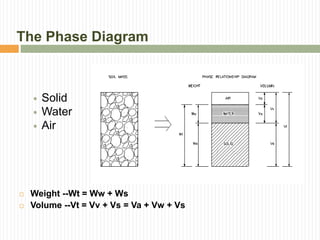
 Solid
 Water
 Air
 Weight --Wt = Ww + Ws
 Volume --Vt = Vv + Vs = Va + Vw + Vs
 Unit Weight (Density)
 This is also known as (same thing by different names)
- Bulk Density
- Soil Density
- Unit Weight
- Wet Density
 Dry Unit Weight
gd = Wsolids
Vtotal
Basic Relationships for Calculating Phase Diagram
Components
Relation between dry density & bulk den
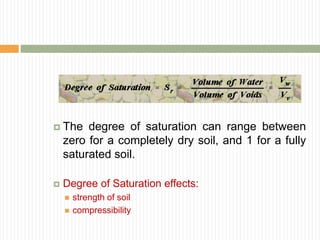
 The degree of saturation can range between
zero for a completely dry soil, and 1 for a fully
saturated soil.
 Degree of Saturation effects:
 strength of soil
 compressibility
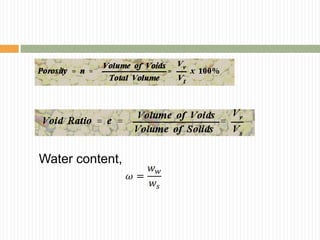
Water content,
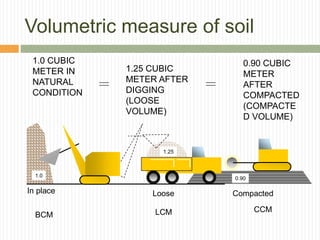
Volumetric measure of soil
1.0
1.25
0.90
1.0 CUBIC
METER IN
NATURAL
CONDITION
1.25 CUBIC
METER AFTER
DIGGING
(LOOSE
VOLUME)
0.90 CUBIC
METER
AFTER
COMPACTED
(COMPACTE
D VOLUME)
In place Compacted
Loose
BCM LCM CCM
 Bank Cubic Metre (BCM) Bank Cubic Metre
(BCM) - A volumetric term commonly used to
represent in situ volume of soil before it is
processed.
 Loose Cubic Meters (LCM): volume occupy
by Material which has been excavated in some
way and swelled as a result of the space that
now exist between its elements.
 Compact Cubic Meters (CCM): volume
occupy by Material which has
been compacted and become more dense as
a result.
Continue…
 For bulk materials, volumetric measure varies
with the material's position in the construction
process.
 The same weight of a material will occupy
different volumes as handled on the project.
 In planning or estimating of earth work job, the
engineer must use a consistent volumetric
measure in any set of calculation.
 The necessary consistency of units is
achieved by use of shrinkage and swell
factors.
Machine Power
 General Information
 Pay load
 Required power
 Available power
 Usable power
Power requirement for construction
equipments(Machine Power):
 The constructor must select the proper
equipment to relocate and process material
economically.
 The analysis procedure for matching the best
possible machine to the project task requires
information of machine’s mechanical
capability.
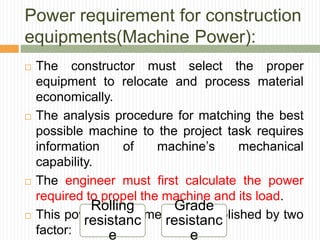
 The engineer must first calculate the power
required to propel the machine and its load.
 This power requirements is established by two
factor:
Rolling
resistanc
e
Grade
resistanc
e
 The decision process for matching the best
possible machine to the project task requires
that the engineer take into account both
 Material properties
 Mechanical properties of machine
 When the engineer considers the material
handling problem of a project, there are three
crucial material considerations:
 Total quantity of material
 Rate at which it must be moved
 Size of individual pieces
 The selection of machine in terms of type, size
and number to be employed is depend on
quantity of material, expected weather
condition, time constraints.
Payload:
 The payload is carrying capacity of construction
excavation and hauling equipment can be expressed
either volumetrically(BCM, LCM, CCM) or
gravimetrically.
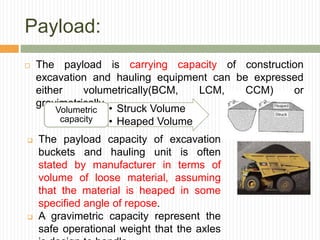
• Struck Volume
• Heaped Volume
Volumetric
capacity
 The payload capacity of excavation
buckets and hauling unit is often
stated by manufacturer in terms of
volume of loose material, assuming
that the material is heaped in some
specified angle of repose.
 A gravimetric capacity represent the
safe operational weight that the axles
 Struck capacity: The capacity of bucket to the
flat surface at the edges.
 The Heaped Capacity is the amount of
material inside the bucket plus the amount
piled on top as per its angle of repose.
Machine Performance
Cycle time and payload determine a machine’s
production rate, and machine travel speed directly
affects cycle time.
The three power :
1. Required Power
2. Available Power
3. Usable Power
Required Power
Power required is the power needed to overcome
resisting forces and cause machine motion.
The forces resisting the movement of mobile equipment
are:
1. Rolling Resistance
2. Grade Resistance
Therefore, power required is the power necessary to overcome the
total resistance to machine movement, which is the sum of rolling
and grade resistance.
Total Resistance(TR) = Rolling Resistance(RR) + Grade Resistance
Rolling Resistance
The resistance of a level surface to constant-velocity motion
across it.
Or
Rolling resistance, sometimes called rolling friction or
rolling drag, is the force resisting the motion when a body
(such as a ball, tire, or wheel) rolls on a level surface.
Rolling Resistance
 Rolling Resistance Varies with the type & Condition of the
Surface; Soft earth offers a more resistance than hard
surface road.
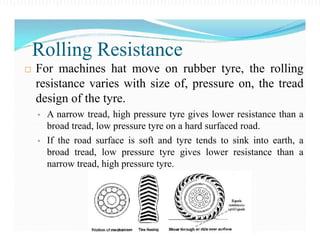
 For machines hat move on rubber tyre, the rolling
resistance varies with size of, pressure on, the tread
design of the tyre.
 A narrow tread, high pressure tyre gives lower resistance than a
broad tread, low pressure tyre on a hard surfaced road.
 If the road surface is soft and tyre tends to sink into earth, a
broad tread, low pressure tyre gives lower resistance than a
narrow tread, high pressure tyre.
Rolling Resistance
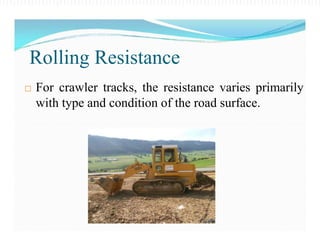
 For crawler tracks, the resistance varies primarily
with type and condition of the road surface.
Rolling Resistance
 For machine that move on rubber tyres, the
rolling resistance varies with size of,
pressure on and tread design of the tyre.
 Narrow tread, high pressure tyre gives lower rolling
resistance than a broad tread, low pressure tyre on
hard surface road.
 If the road surface is soft and tyre tend to sink into
earth, a broad tread, low pressure tyre will offer
lower rolling resistance than a narrow tread, high
pressure tyre
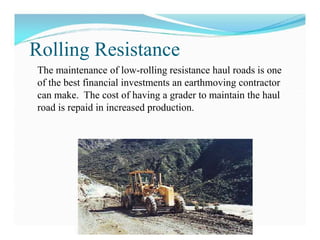
The maintenance of low-rolling resistance haul roads is one
of the best financial investments an earthmoving contractor
can make. The cost of having a grader to maintain the haul
road is repaid in increased production.
Rolling Resistance
Rolling Resistance
The rolling resistance in kg per gross ton is . . .
R = P (kg)
W (tons)
Where:
R = Rolling resistance factor in kg. per ton
P = Total tension in tow cable in kg
W = Gross weight of mobile vehicle in tons
R.R(kg) = R.R. factor (kg/ton) * Weight of vehicle
Rolling Resistance
When tire penetration is known, an approximate
rolling resistance value for a wheeled vehicle can be
calculated . . .
RR = [20 + (6* TP)] * GVW
Where:
RR = Rolling resistance in kg
TP = Tire penetration in cm
GVW = Gross vehicle weight in kg
Grade Resistance/Assistance
Grade Assistance
The effect of gravitational force in aiding movement of
a vehicle down a slope.
Grade Resistance
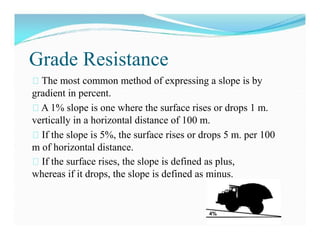
The most common method of expressing a slope is by
gradient in percent.
A 1% slope is one where the surface rises or drops 1 m.
vertically in a horizontal distance of 100 m.
If the slope is 5%, the surface rises or drops 5 m. per 100
m of horizontal distance.
If the surface rises, the slope is defined as plus,
whereas if it drops, the slope is defined as minus.
Frictionless Slope-Force
Relationships
Frictionless Slope-Force
Relationships
F = W sin α
N = W cos α
For angles less than 10°, sin α ≈ tan α (the small -angle
assumption); with that substitution:
F = W tan α
tan α = V = G%
H 100
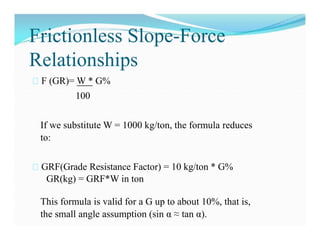
Frictionless Slope-Force
Relationships
F (GR)= W * G%
100
If we substitute W = 1000 kg/ton, the formula reduces
to:
GRF(Grade Resistance Factor) = 10 kg/ton * G%
GR(kg) = GRF*W in ton
This formula is valid for a G up to about 10%, that is,
the small angle assumption (sin α ≈ tan α).
Total Resistance
Total resistance equals rolling resistance plus grade
resistance or rolling resistance minus grade assistance.
It can also be expressed as an effective grade.
Rolling resistance expressed in lb/ton = G%
20 lb/ton
Haul Routes
Hauling efficiency is achieved by careful planning of
haul routes.
Available Power
Internal combustion engines power most construction
equipment.
Because diesel engines perform better under heavy-
duty applications than gasoline engines, diesel
powered machines are the workhorses of the
construction industry.
Diesel engines have longer service lives and lower fuel
consumption.
Diesel fuel presents less of a fire hazard.
Rim pull
Rim pull is a term that is used to designate the tractive
force between the tires of machine’s driving wheels
and the surface on which they travel.
If the coefficient of traction is sufficiently high there
will be no tire slippage, in which case maximum rim
pull is a function of the power of the engine and the
gear ratios between the engine and the driving wheels.
If the driving wheels slip on the supporting surface,
the maximum effective rim pull will be equal to the
total pressure the tires exert on the surface multiplied
by the coefficient of traction.
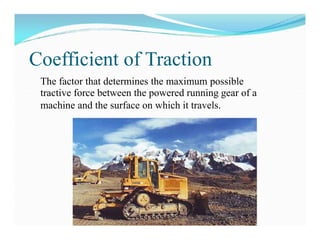
Coefficient of Traction
The factor that determines the maximum possible
tractive force between the powered running gear of a
machine and the surface on which it travels.
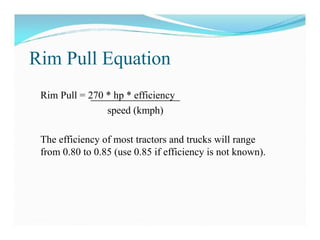
Rim Pull Equation
Rim Pull = 270 * hp * efficiency
speed (kmph)
The efficiency of most tractors and trucks will range
from 0.80 to 0.85 (use 0.85 if efficiency is not known).
Drawbar Pull
The towing force a crawler tractor can exert on a load is
referred to as drawbar pull.
Drawbar pull is typically expressed in pounds.
To determine the drawbar pull available for towing a
load it is necessary to subtract from the total pulling
force available at the engine the force required to
overcome the total resistance imposed by the haul
conditions.
If a crawler tractor tows a load up a slope, its drawbar
pull will be reduced by 20 lb for each ton of weight of
the tractor for each 1% slope.
Usable Power
Usable power depends on project conditions:
primarily, haul-road surface condition, altitude, and
temperature.
Usable force = Coefficient of traction * Weight on driving wheel in
powered running gear
Effect of Altitude on usable Power
of IC engine
 When a manufacture provides a Horsepower
rating, it is based on standard condition(T=60 ͦ
F) and barometric pressure at seal Level(76.99 cm)
 For natural operation at altitudes above sea level
will cause significant decrease in available engine
power as the barometric pressure decrease.
 air density decrease; affect combustion fuel to air
ratio
 Turbocharger supercharger.
CL 380_Unit-1 (1).pptx

CL 380_Unit-1 (1).pptx

  • 1.
  • 2.
    Credits and Hour Teaching Scheme TheoryPractical Total Credit Hours/ week 3 2 5 4 Marks 100 50 150 Pedagogy Continuous Evaluation Details Marks Equivalent Marks Unit Test Unit test will be conducted after completion of each unit 10/ test 15 Presentation and report Select anyone topic from latest material used in construction , present it and submit the report 10 10 Presentation Select anyone topic from latest equipment ot technique used in construction , present it 05 05
  • 3.
    Reference books:  “Constructionplanning, equipment and methods” by Peurifoy  “Construction engineering and management” by S. Seetharaman.  “Construction Management and equipments” by A. S. Kotadia  “Construction Project Management” by Kumar Neeraj Jha
  • 4.
    Introduction “Construction Technology involvesstudy of methods of construction to carry out planned production safely, maintaining quality conforming to the specifications, standards and codes.”  It also includes study of construction equipments, and temporary works required to facilitate the construction process.  The modern trend is towards constructing lighter and taller buildings which is always a big challenge in an era of financial crunch. To achieve it successfully, there is a need of have sophisticated equipments employed in the construction process. 4
  • 5.
    Requirement of Construction Equipments… In the case of huge construction projects; Proper use of the appropriate equipment contributes to economy, quality, safety, speed and timely completion of a project.  Good project management in construction must vigorously pursue the efficient utilization of labor, material and equipment.  The use of modern equipment and innovative methods has made possible wholesale changes in construction technologies in recent decades. 5
  • 6.
    The construction equipmentis deployed on the construction projects for various reasons..  Larger output  Large output can be maintained, even if there is a shortage of skilled and semi skilled manpower.  Cost effective implementation  For execution of certain construction work that cannot be executed through manual operation  Precision of implementation is done by modern construction equipment equipped with software controls. 6
  • 7.
     The selectionof the appropriate type and size of construction equipment often affects the required amount of time and effort and thus the job-site productivity of a project.  15-30% of total project cost has been accounted towards equipment and machinery.  It is therefore important for site managers and construction planners to be familiar with the characteristics of the major types of equipment most commonly used in construction. 7
  • 8.
    General Consideration for Selectionof Equipment:  Suitability for job condition, soil condition etc.  time constraints  Space constraints  Economic factors: Economic considerations such as the cost of owning the equipment and operation and fuel costs are some of the most important factors that play a deciding role in selecting the equipment. Besides, consideration over resale value is also very important.  Availability of equipment: selection has to be made from the available equipment held with manufacture or dealers.  Utilization of equipment: Degree of utilization in future projects to be evaluated. Depreciation is very high in new equipment. Compare it with use of old equipment which has high operating cost. 8
  • 9.
     Uniformity intype: Desirable to have minimum number of types. Common type of engine for different machines.  Size of equipment: Large equipment require large matching equipment, high operating cost, uneconomical if not utilized to its full capacity  Use of standard equipment: Commonly manufactured, repair parts are easily available, minimum resale problems.  Country of origin: Import/Currency problems, availability of spare parts  Versatility – more functions/inter-convertibility  Operating facility: the equipment chosen for project should be such that trained operators for the machine are available. 9
  • 10.
    Classification of equipment basedon type of work  Intermittent type:  This type of equipment have the intermittent cycle of work. They can be operated on series of work cycle and each cycle complete in itself.  Ex. Dragline, backhoe, power shovel etc.  Continuous flow type:  This type of equipment have Continuous flow of work.  Ex. Belt conveyor, air compressor etc.  Mixed type:  This type of equipment have characteristics of both.  Ex. Bulldozer, scraper 10
  • 11.
    Classification of equipment basedon function  Excavating Equipments  Hauling Equipments  Placing (dumping & spreading)  Boring or tunneling Equipments  Compacting Equipments  Lifting Equipments  Pile driving equipments 11
  • 12.
    Classification of equipment basedon availability Depending upon their availability, commercial sizes and specifications, the equipment can be classified into following types: (i)Standard Equipment (ii)Special Equipment 12
  • 13.
    Standard Eqipments:  Thestandard equipments are commonly manufactured and are easily available to the prospective purchasers.  They can be used for variety of construction operations without any difficulty and they are available in standard commercial sizes. The initial investment is less as compared to a special equipment.  The delivery of standard equipments is very quick, as it is readily available in the market.  The repair parts for standard equipment can be obtained more quickly in short period.  If the contractor no longer needs a unit of standard equipment, he can usually dispose of it more easily and at a more favorable 13
  • 14.
    Special Equipments  Thespecial equipments are those which are manufactured for a specific project or which does not have readily accessible spare parts.  The selection of special equipments should be made carefully after proper financial analysis.  The initial investment in case of special equipment is very high and there is risk of change in design, it cannot be used economically on the other project.  A special order is to be given to the manufacturer of special equipments and a special price is to be given and therefore the delivery of special equipments can be obtained after long period.  Examples of special equipment include tunnel boring machines, large hauling units and very large shovels, such as a 70 to 80 cubic meter shovel used to strip-mine coal. 14
  • 15.
    Engineering fundamentals of constructionmaterial(soil & rock)  Soil and rocks are the principal components of many construction projects.  Required to support structures; to support pavements for highway; in dam and canal construction project.  Most of the soils must be excavated, processed and compacted to meet engineering requirements of the project. Thus knowledge of properties, characteristics and behaviour of different soil and rock is important to all person involve in construction projects.
  • 16.
    The Phase Diagram Solid  Water  Air  Weight --Wt = Ww + Ws  Volume --Vt = Vv + Vs = Va + Vw + Vs
  • 17.
     Unit Weight(Density)  This is also known as (same thing by different names) - Bulk Density - Soil Density - Unit Weight - Wet Density  Dry Unit Weight gd = Wsolids Vtotal Basic Relationships for Calculating Phase Diagram Components Relation between dry density & bulk den
  • 18.
     The degreeof saturation can range between zero for a completely dry soil, and 1 for a fully saturated soil.  Degree of Saturation effects:  strength of soil  compressibility
  • 19.
  • 20.
    Volumetric measure ofsoil 1.0 1.25 0.90 1.0 CUBIC METER IN NATURAL CONDITION 1.25 CUBIC METER AFTER DIGGING (LOOSE VOLUME) 0.90 CUBIC METER AFTER COMPACTED (COMPACTE D VOLUME) In place Compacted Loose BCM LCM CCM
  • 21.
     Bank CubicMetre (BCM) Bank Cubic Metre (BCM) - A volumetric term commonly used to represent in situ volume of soil before it is processed.  Loose Cubic Meters (LCM): volume occupy by Material which has been excavated in some way and swelled as a result of the space that now exist between its elements.  Compact Cubic Meters (CCM): volume occupy by Material which has been compacted and become more dense as a result.
  • 22.
    Continue…  For bulkmaterials, volumetric measure varies with the material's position in the construction process.  The same weight of a material will occupy different volumes as handled on the project.  In planning or estimating of earth work job, the engineer must use a consistent volumetric measure in any set of calculation.  The necessary consistency of units is achieved by use of shrinkage and swell factors.
  • 23.
    Machine Power  GeneralInformation  Pay load  Required power  Available power  Usable power
  • 24.
    Power requirement forconstruction equipments(Machine Power):  The constructor must select the proper equipment to relocate and process material economically.  The analysis procedure for matching the best possible machine to the project task requires information of machine’s mechanical capability.  The engineer must first calculate the power required to propel the machine and its load.  This power requirements is established by two factor: Rolling resistanc e Grade resistanc e
  • 25.
     The decisionprocess for matching the best possible machine to the project task requires that the engineer take into account both  Material properties  Mechanical properties of machine  When the engineer considers the material handling problem of a project, there are three crucial material considerations:  Total quantity of material  Rate at which it must be moved  Size of individual pieces  The selection of machine in terms of type, size and number to be employed is depend on quantity of material, expected weather condition, time constraints.
  • 26.
    Payload:  The payloadis carrying capacity of construction excavation and hauling equipment can be expressed either volumetrically(BCM, LCM, CCM) or gravimetrically. • Struck Volume • Heaped Volume Volumetric capacity  The payload capacity of excavation buckets and hauling unit is often stated by manufacturer in terms of volume of loose material, assuming that the material is heaped in some specified angle of repose.  A gravimetric capacity represent the safe operational weight that the axles
  • 27.
     Struck capacity:The capacity of bucket to the flat surface at the edges.  The Heaped Capacity is the amount of material inside the bucket plus the amount piled on top as per its angle of repose.
  • 28.
    Machine Performance Cycle timeand payload determine a machine’s production rate, and machine travel speed directly affects cycle time. The three power : 1. Required Power 2. Available Power 3. Usable Power
  • 29.
    Required Power Power requiredis the power needed to overcome resisting forces and cause machine motion. The forces resisting the movement of mobile equipment are: 1. Rolling Resistance 2. Grade Resistance Therefore, power required is the power necessary to overcome the total resistance to machine movement, which is the sum of rolling and grade resistance. Total Resistance(TR) = Rolling Resistance(RR) + Grade Resistance
  • 30.
    Rolling Resistance The resistanceof a level surface to constant-velocity motion across it. Or Rolling resistance, sometimes called rolling friction or rolling drag, is the force resisting the motion when a body (such as a ball, tire, or wheel) rolls on a level surface.
  • 31.
    Rolling Resistance  RollingResistance Varies with the type & Condition of the Surface; Soft earth offers a more resistance than hard surface road.
  • 32.
     For machineshat move on rubber tyre, the rolling resistance varies with size of, pressure on, the tread design of the tyre.  A narrow tread, high pressure tyre gives lower resistance than a broad tread, low pressure tyre on a hard surfaced road.  If the road surface is soft and tyre tends to sink into earth, a broad tread, low pressure tyre gives lower resistance than a narrow tread, high pressure tyre. Rolling Resistance
  • 33.
     For crawlertracks, the resistance varies primarily with type and condition of the road surface. Rolling Resistance
  • 34.
     For machinethat move on rubber tyres, the rolling resistance varies with size of, pressure on and tread design of the tyre.  Narrow tread, high pressure tyre gives lower rolling resistance than a broad tread, low pressure tyre on hard surface road.  If the road surface is soft and tyre tend to sink into earth, a broad tread, low pressure tyre will offer lower rolling resistance than a narrow tread, high pressure tyre The maintenance of low-rolling resistance haul roads is one of the best financial investments an earthmoving contractor can make. The cost of having a grader to maintain the haul road is repaid in increased production. Rolling Resistance
  • 35.
    Rolling Resistance The rollingresistance in kg per gross ton is . . . R = P (kg) W (tons) Where: R = Rolling resistance factor in kg. per ton P = Total tension in tow cable in kg W = Gross weight of mobile vehicle in tons R.R(kg) = R.R. factor (kg/ton) * Weight of vehicle
  • 36.
    Rolling Resistance When tirepenetration is known, an approximate rolling resistance value for a wheeled vehicle can be calculated . . . RR = [20 + (6* TP)] * GVW Where: RR = Rolling resistance in kg TP = Tire penetration in cm GVW = Gross vehicle weight in kg
  • 37.
  • 38.
    Grade Assistance The effectof gravitational force in aiding movement of a vehicle down a slope.
  • 39.
    Grade Resistance The mostcommon method of expressing a slope is by gradient in percent. A 1% slope is one where the surface rises or drops 1 m. vertically in a horizontal distance of 100 m. If the slope is 5%, the surface rises or drops 5 m. per 100 m of horizontal distance. If the surface rises, the slope is defined as plus, whereas if it drops, the slope is defined as minus.
  • 40.
  • 41.
    Frictionless Slope-Force Relationships F =W sin α N = W cos α For angles less than 10°, sin α ≈ tan α (the small -angle assumption); with that substitution: F = W tan α tan α = V = G% H 100
  • 42.
    Frictionless Slope-Force Relationships F (GR)=W * G% 100 If we substitute W = 1000 kg/ton, the formula reduces to: GRF(Grade Resistance Factor) = 10 kg/ton * G% GR(kg) = GRF*W in ton This formula is valid for a G up to about 10%, that is, the small angle assumption (sin α ≈ tan α).
  • 43.
    Total Resistance Total resistanceequals rolling resistance plus grade resistance or rolling resistance minus grade assistance. It can also be expressed as an effective grade. Rolling resistance expressed in lb/ton = G% 20 lb/ton
  • 44.
    Haul Routes Hauling efficiencyis achieved by careful planning of haul routes.
  • 45.
    Available Power Internal combustionengines power most construction equipment. Because diesel engines perform better under heavy- duty applications than gasoline engines, diesel powered machines are the workhorses of the construction industry. Diesel engines have longer service lives and lower fuel consumption. Diesel fuel presents less of a fire hazard.
  • 46.
    Rim pull Rim pullis a term that is used to designate the tractive force between the tires of machine’s driving wheels and the surface on which they travel. If the coefficient of traction is sufficiently high there will be no tire slippage, in which case maximum rim pull is a function of the power of the engine and the gear ratios between the engine and the driving wheels. If the driving wheels slip on the supporting surface, the maximum effective rim pull will be equal to the total pressure the tires exert on the surface multiplied by the coefficient of traction.
  • 47.
    Coefficient of Traction Thefactor that determines the maximum possible tractive force between the powered running gear of a machine and the surface on which it travels.
  • 48.
    Rim Pull Equation RimPull = 270 * hp * efficiency speed (kmph) The efficiency of most tractors and trucks will range from 0.80 to 0.85 (use 0.85 if efficiency is not known).
  • 49.
    Drawbar Pull The towingforce a crawler tractor can exert on a load is referred to as drawbar pull. Drawbar pull is typically expressed in pounds. To determine the drawbar pull available for towing a load it is necessary to subtract from the total pulling force available at the engine the force required to overcome the total resistance imposed by the haul conditions. If a crawler tractor tows a load up a slope, its drawbar pull will be reduced by 20 lb for each ton of weight of the tractor for each 1% slope.
  • 50.
    Usable Power Usable powerdepends on project conditions: primarily, haul-road surface condition, altitude, and temperature. Usable force = Coefficient of traction * Weight on driving wheel in powered running gear
  • 51.
    Effect of Altitudeon usable Power of IC engine  When a manufacture provides a Horsepower rating, it is based on standard condition(T=60 ͦ F) and barometric pressure at seal Level(76.99 cm)  For natural operation at altitudes above sea level will cause significant decrease in available engine power as the barometric pressure decrease.  air density decrease; affect combustion fuel to air ratio  Turbocharger supercharger.

Editor's Notes