The Balanced Scorecard

Maximizing Performance and
Maintaining Results For
Your Medical Practice


                             1
What Is A Balanced Scorecard?

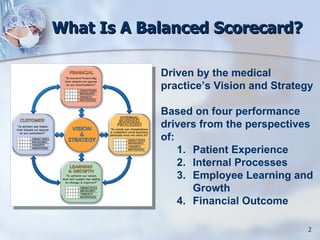
            Driven by the medical
            practice’s Vision and Strategy

            Based on four performance
            drivers from the perspectives
            of:
                1. Patient Experience
                2. Internal Processes
                3. Employee Learning and
                   Growth
                4. Financial Outcome

                                         2
What Is The Purpose of A
 Balanced Scorecard?

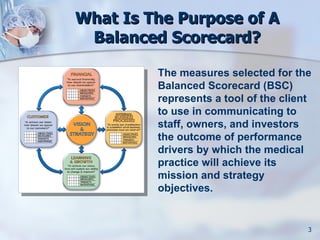
         The measures selected for the
         Balanced Scorecard (BSC)
         represents a tool of the client
         to use in communicating to
         staff, owners, and investors
         the outcome of performance
         drivers by which the medical
         practice will achieve its
         mission and strategy
         objectives.


                                       3
The Patient Perspective

When choosing methods and measures for the patient
perspective of the BSC, the client should answer three critical
questions:

 Who are our target patients?
 What is our value proposition in servicing them?
 What do our patients expect from our practice?

Measures for the patient perspective typically are:
                  Patient Satisfaction
                  Patient Retention
                  Market Share
                  Patient Acquisition.
                                                                  4
The Internal Process
                    Perspective

The business owner should identify the key processes the
practice must excel at in order to continue adding value for
patients and ultimately practice owner(s).

The task here is to identify processes that add to the value
proposition and develop the best possible objectives and
measures with which to track progress:

                Cycle-time improvement
                Efficiencies in workflow
                Optimization of patient-facing time

                                                               5
The Employee Learning and
             Growth Perspective

The objectives and measures of the Employee Learning and
Growth Perspective of the BSC are really the enablers of the
other three perspectives.

Identify the gaps between the current organizational
infrastructure:
           Staff skills (human capital)
           Information systems (informational capital)
           The practice environment required to
            achieve success (organizational capital)

                                                               6
The Financial Perspective


The objectives and measures in this perspective will
tell the business owner whether the strategy
execution is leading to improved bottom-line results.

Classic lagging measures are reported in the
Financial Perspective. Typical examples include:


                 Profitability
                 Revenue growth
                 Asset utilization

                                                        7
What Is A Dashboard?

Name derived from the instrumentation of a car dashboard


                                                       8
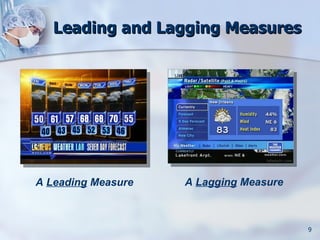
Leading and Lagging Measures


A Leading Measure   A Lagging Measure


                                        9
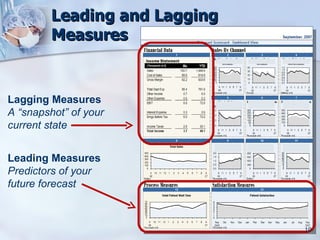
Leading and Lagging
         Measures


Lagging Measures
A “snapshot” of your
current state


Leading Measures
Predictors of your
future forecast


                               10
Maintaining The
              Balanced Scorecard

Establishing Balanced Scorecard Policies, Procedures,
and Processes

   Long-range strategic planning
   Reporting timeframes
   Roles and responsibilities
   Thresholds of performance
   Changing objectives, measures, and targets

     The Balanced Scorecard Is Never “Complete”


                                                        11
Maintaining The
                  Balanced Scorecard

Long-range Strategic Planning

The scorecard should be at the forefront of strategic planning
After the initial development of a scorecard,
some organizations tend to revert back to
their previous methods. The business owner
should continue to work with the developer
to define the scorecard’s role in the process
on an on-going basis, ensuring that it will
remain the key tool in the effective execution
of strategy


                                                                 12
Maintaining The
                   Balanced Scorecard

Scorecard Timeframes

Data will need to be collected and entered into the
scorecard whether it is automated or not. Those
responsible for providing data must be aware of the
timeliness associated with reporting and the importance of
timely and accurate data submission.


                                                             13
Maintaining The
                   Balanced Scorecard

Roles and Responsibilities

Determine who is accountable for administering the scorecard
system in the practice and what their responsibilities are. Someone
in the practice must be seen as the scorecard’s “owner.”

In the case of a medical practice, this should ideally be the Practice
Administrator. Whoever the owner is, that person must be able to
coordinate the collection of data, summarize and analyze the data,
and ultimately report the practice’s performance to the business
owner on a monthly basis.


                                                                         14
Maintaining The
                   Balanced Scorecard

Changing Objectives, Measures, and Targets
Should you allow a mid-year change in any of the performance
indicators?

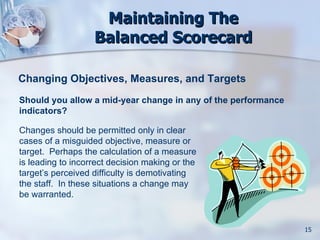
Changes should be permitted only in clear
cases of a misguided objective, measure or
target. Perhaps the calculation of a measure
is leading to incorrect decision making or the
target’s perceived difficulty is demotivating
the staff. In these situations a change may
be warranted.


                                                               15
The Balanced Scorecard - Recap

Driven by the medical
practice’s Vision and      The measures selected for
Strategy                   the Balanced Scorecard
                           represents a tool of the
Based on four              client to use in
performance drivers from   communicating to staff,
the perspectives of:       owners, and investors the
   • Patient Experience    outcome of performance
   • Internal Processes    drivers by which the
   • Employee Learning     medical practice will
       and Growth          achieve its mission and
   • Financial Outcome     strategy objectives.
                                                  16
The Balanced Scorecard


     Questions


                         17

Medical Practice Balanced Scorecard

  • 1.
    The Balanced Scorecard MaximizingPerformance and Maintaining Results For Your Medical Practice 1
  • 2.
    What Is ABalanced Scorecard? Driven by the medical practice’s Vision and Strategy Based on four performance drivers from the perspectives of: 1. Patient Experience 2. Internal Processes 3. Employee Learning and Growth 4. Financial Outcome 2
  • 3.
    What Is ThePurpose of A Balanced Scorecard? The measures selected for the Balanced Scorecard (BSC) represents a tool of the client to use in communicating to staff, owners, and investors the outcome of performance drivers by which the medical practice will achieve its mission and strategy objectives. 3
  • 4.
    The Patient Perspective Whenchoosing methods and measures for the patient perspective of the BSC, the client should answer three critical questions:  Who are our target patients?  What is our value proposition in servicing them?  What do our patients expect from our practice? Measures for the patient perspective typically are:  Patient Satisfaction  Patient Retention  Market Share  Patient Acquisition. 4
  • 5.
    The Internal Process Perspective The business owner should identify the key processes the practice must excel at in order to continue adding value for patients and ultimately practice owner(s). The task here is to identify processes that add to the value proposition and develop the best possible objectives and measures with which to track progress:  Cycle-time improvement  Efficiencies in workflow  Optimization of patient-facing time 5
  • 6.
    The Employee Learningand Growth Perspective The objectives and measures of the Employee Learning and Growth Perspective of the BSC are really the enablers of the other three perspectives. Identify the gaps between the current organizational infrastructure:  Staff skills (human capital)  Information systems (informational capital)  The practice environment required to achieve success (organizational capital) 6
  • 7.
    The Financial Perspective Theobjectives and measures in this perspective will tell the business owner whether the strategy execution is leading to improved bottom-line results. Classic lagging measures are reported in the Financial Perspective. Typical examples include:  Profitability  Revenue growth  Asset utilization 7
  • 8.
    What Is ADashboard? Name derived from the instrumentation of a car dashboard 8
  • 9.
    Leading and LaggingMeasures A Leading Measure A Lagging Measure 9
  • 10.
    Leading and Lagging Measures Lagging Measures A “snapshot” of your current state Leading Measures Predictors of your future forecast 10
  • 11.
    Maintaining The Balanced Scorecard Establishing Balanced Scorecard Policies, Procedures, and Processes  Long-range strategic planning  Reporting timeframes  Roles and responsibilities  Thresholds of performance  Changing objectives, measures, and targets The Balanced Scorecard Is Never “Complete” 11
  • 12.
    Maintaining The Balanced Scorecard Long-range Strategic Planning The scorecard should be at the forefront of strategic planning After the initial development of a scorecard, some organizations tend to revert back to their previous methods. The business owner should continue to work with the developer to define the scorecard’s role in the process on an on-going basis, ensuring that it will remain the key tool in the effective execution of strategy 12
  • 13.
    Maintaining The Balanced Scorecard Scorecard Timeframes Data will need to be collected and entered into the scorecard whether it is automated or not. Those responsible for providing data must be aware of the timeliness associated with reporting and the importance of timely and accurate data submission. 13
  • 14.
    Maintaining The Balanced Scorecard Roles and Responsibilities Determine who is accountable for administering the scorecard system in the practice and what their responsibilities are. Someone in the practice must be seen as the scorecard’s “owner.” In the case of a medical practice, this should ideally be the Practice Administrator. Whoever the owner is, that person must be able to coordinate the collection of data, summarize and analyze the data, and ultimately report the practice’s performance to the business owner on a monthly basis. 14
  • 15.
    Maintaining The Balanced Scorecard Changing Objectives, Measures, and Targets Should you allow a mid-year change in any of the performance indicators? Changes should be permitted only in clear cases of a misguided objective, measure or target. Perhaps the calculation of a measure is leading to incorrect decision making or the target’s perceived difficulty is demotivating the staff. In these situations a change may be warranted. 15
  • 16.
    The Balanced Scorecard- Recap Driven by the medical practice’s Vision and The measures selected for Strategy the Balanced Scorecard represents a tool of the Based on four client to use in performance drivers from communicating to staff, the perspectives of: owners, and investors the • Patient Experience outcome of performance • Internal Processes drivers by which the • Employee Learning medical practice will and Growth achieve its mission and • Financial Outcome strategy objectives. 16
  • 17.