Statistical Reasoning 

about Programs
Marcel Böhme, Max Planck Institute for Security and Privacy & Monash University · ICSE’22 · Statistical Reasoning about Programs
Program Analysis Problem
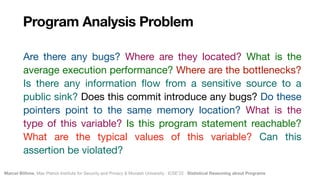
Are there any bugs? Where are they located? What is the
average execution performance? Where are the bottlenecks?
Is there any information
fl
ow from a sensitive source to a
public sink? Does this commit introduce any bugs? Do these
pointers point to the same memory location? What is the
type of this variable? Is this program statement reachable?
What are the typical values of this variable? Can this
assertion be violated?
Marcel Böhme, Max Planck Institute for Security and Privacy & Monash University · ICSE’22 · Statistical Reasoning about Programs
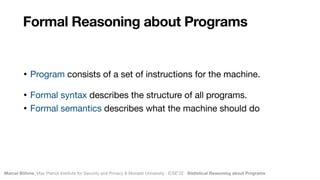
• Program consists of a set of instructions for the machine.

• Formal syntax describes the structure of all programs.

• Formal semantics describes what the machine should do
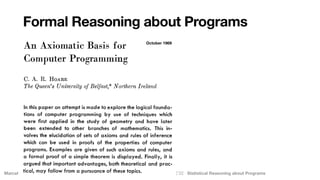
Formal Reasoning about Programs
Marcel Böhme, Max Planck Institute for Security and Privacy & Monash University · ICSE’22 · Statistical Reasoning about Programs
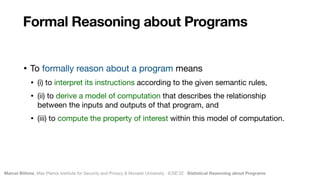
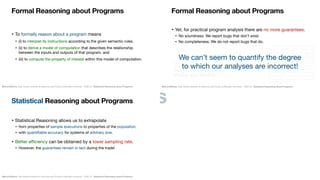
• To formally reason about a program means 

• (i) to interpret its instructions according to the given semantic rules, 

• (ii) to derive a model of computation that describes the relationship
between the inputs and outputs of that program, and 

• (iii) to compute the property of interest within this model of computation.
Formal Reasoning about Programs
Marcel Böhme, Max Planck Institute for Security and Privacy & Monash University · ICSE’22 · Statistical Reasoning about Programs
Formal Reasoning about Programs
October 1969
Marcel Böhme, Max Planck Institute for Security and Privacy & Monash University · ICSE’22 · Statistical Reasoning about Programs
Formal Reasoning about Programs
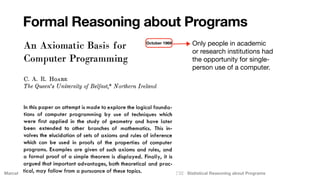
October 1969 Only people in academic
or research institutions had
the opportunity for single-
person use of a computer.
Marcel Böhme, Max Planck Institute for Security and Privacy & Monash University · ICSE’22 · Statistical Reasoning about Programs
• Advantages

• Analyze and formally guarantee universal properties that hold for all inputs.

• Analyze the program irrespective of the machine it is running on.

• Analyze the program at any level of abstraction (need not be executable).
Formal Reasoning about Programs
Marcel Böhme, Max Planck Institute for Security and Privacy & Monash University · ICSE’22 · Statistical Reasoning about Programs
Formal Reasoning about Programs
Marcel Böhme, Max Planck Institute for Security and Privacy & Monash University · ICSE’22 · Statistical Reasoning about Programs
Formal Reasoning about Programs
Marcel Böhme, Max Planck Institute for Security and Privacy & Monash University · ICSE’22 · Statistical Reasoning about Programs
Formal Reasoning about Programs
Marcel Böhme, Max Planck Institute for Security and Privacy & Monash University · ICSE’22 · Statistical Reasoning about Programs
Formal Reasoning about Programs
Marcel Böhme, Max Planck Institute for Security and Privacy & Monash University · ICSE’22 · Statistical Reasoning about Programs
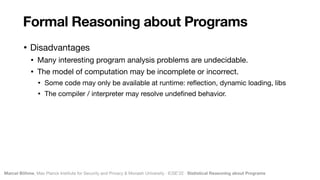
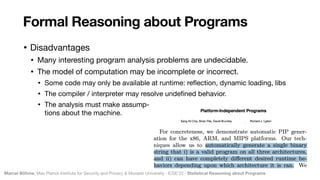
• Disadvantages

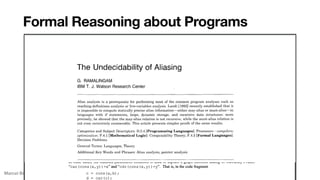
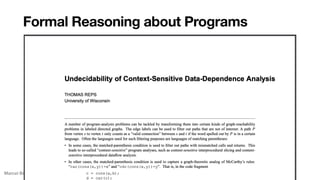
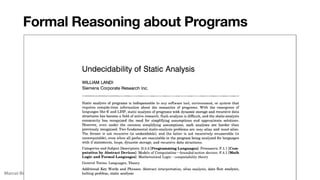
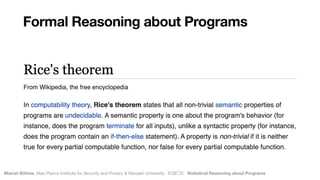
• Many interesting program analysis problems are undecidable.

• The model of computation may be incomplete or incorrect.

• Some code may only be available at runtime: re
fl
ection, dynamic loading, libs

• The compiler / interpreter may resolve unde
fi
ned behavior.
Formal Reasoning about Programs
Marcel Böhme, Max Planck Institute for Security and Privacy & Monash University · ICSE’22 · Statistical Reasoning about Programs
• Disadvantages

• Many interesting program analysis problems are undecidable.

• The model of computation may be incomplete or incorrect.

• Some code may only be available at runtime: re
fl
ection, dynamic loading, libs

• The compiler / interpreter may resolve unde
fi
ned behavior.

• The analysis must make assump-

tions about the machine.
Formal Reasoning about Programs
Marcel Böhme, Max Planck Institute for Security and Privacy & Monash University · ICSE’22 · Statistical Reasoning about Programs
• Disadvantages

• Many interesting program analysis problems are undecidable.

• The model of computation may be incomplete or incorrect.

• Some code may only be available at runtime: re
fl
ection, dynamic loading, libs

• The compiler / interpreter may resolve unde
fi
ned behavior.

• The analysis must make assumptions about the machine.

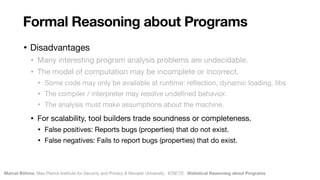
• For scalability, tool builders trade soundness or completeness.

• False positives: Reports bugs (properties) that do not exist.

• False negatives: Fails to report bugs (properties) that do exist.
Formal Reasoning about Programs
Marcel Böhme, Max Planck Institute for Security and Privacy & Monash University · ICSE’22 · Statistical Reasoning about Programs
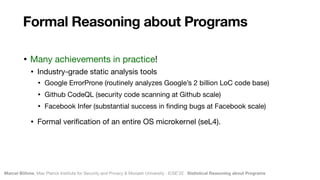
• Many achievements in practice!

• Industry-grade static analysis tools

• Google ErrorProne (routinely analyzes Google’s 2 billion LoC code base)

• Github CodeQL (security code scanning at Github scale)

• Facebook Infer (substantial success in
fi
nding bugs at Facebook scale)

• Formal veri
fi
cation of an entire OS microkernel (seL4).
Formal Reasoning about Programs
Marcel Böhme, Max Planck Institute for Security and Privacy & Monash University · ICSE’22 · Statistical Reasoning about Programs
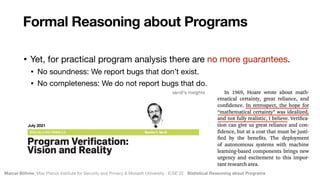
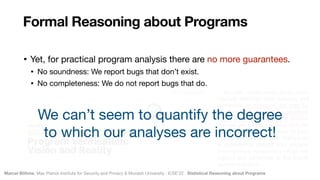
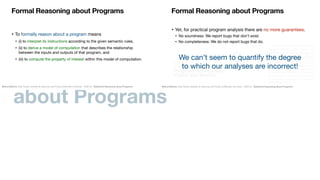
• Yet, for practical program analysis there are no more guarantees.

• No soundness: We report bugs that don’t exist.

• No completeness: We do not report bugs that do.
Formal Reasoning about Programs
July 2021
Marcel Böhme, Max Planck Institute for Security and Privacy & Monash University · ICSE’22 · Statistical Reasoning about Programs
July 2021
• Yet, for practical program analysis there are no more guarantees.

• No soundness: We report bugs that don’t exist.

• No completeness: We do not report bugs that do.
Formal Reasoning about Programs
We can’t seem to quantify the degree 

to which our analyses are incorrect!
Marcel Böhme, Max Planck Institute for Security and Privacy & Monash University · ICSE’22 · Statistical Reasoning about Programs
• Scale-oblivious, sampling-based, in vivo program analysis.

• Observational setting: 

• Observe the program property for a random sample of executions.

• Experimental setting:

• Iteratively generate and validate hypotheses about the property 

by modifying & comparing “copies” of a random sample of executions.
Statistical Reasoning about Programs
Marcel Böhme, Max Planck Institute for Security and Privacy & Monash University · ICSE’22 · Statistical Reasoning about Programs
• Statistical Reasoning allows us to extrapolate

• from properties of sample executions to properties of the population.

• with quanti
fi
able accuracy for systems of arbitrary size.

• Better e
ffi
ciency can be obtained by a lower sampling rate.

• However, the guarantees remain in tact during the trade!
Statistical Reasoning about Programs
Marcel Böhme, Max Planck Institute for Security and Privacy & Monash University · ICSE’22 · Statistical Reasoning about Programs
• To be clear, there are many statistical challenges to be tackled!

• Provides us with a new lens for the program analysis problem.

• Measuring properties of systems of arbitrary size and measuring the
degree of uncertainty is the backbone of any statistical analysis.
Statistical Reasoning about Programs
Marcel Böhme, Max Planck Institute for Security and Privacy & Monash University · ICSE’22 · Statistical Reasoning about Programs
• Today, we have the technology:

• Virtualization (hypervisors): Google-wide pro
fi
ling (GWP), GWP-ASAN.
Statistical Reasoning about Programs
Marcel Böhme, Max Planck Institute for Security and Privacy & Monash University · ICSE’22 · Statistical Reasoning about Programs
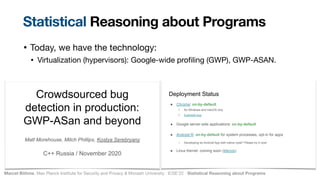
• Today, we have the technology:

• Virtualization (hypervisors): Google-wide pro
fi
ling (GWP), GWP-ASAN.
Statistical Reasoning about Programs
Marcel Böhme, Max Planck Institute for Security and Privacy & Monash University · ICSE’22 · Statistical Reasoning about Programs
• Today, we have the technology:

• Virtualization (hypervisors): Google-wide pro
fi
ling (GWP), GWP-ASAN.

• Compiler passes: instrument any program you compile (e.g., ASAN)

• Open-source OS kernel (e.g., ecosystem-wide bug
fi
nding; KFence).

• Hardware-assisted program analysis (ARM memory tagging).
Statistical Reasoning about Programs
Marcel Böhme, Max Planck Institute for Security and Privacy & Monash University · ICSE’22 · Statistical Reasoning about Programs
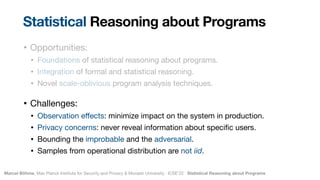
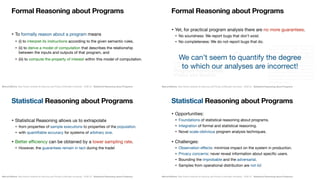
• Opportunities:

• Foundations of statistical reasoning about programs.

• Integration of formal and statistical reasoning.

• Novel scale-oblivious program analysis techniques.
Statistical Reasoning about Programs
Marcel Böhme, Max Planck Institute for Security and Privacy & Monash University · ICSE’22 · Statistical Reasoning about Programs
• Opportunities:

• Foundations of statistical reasoning about programs.

• Integration of formal and statistical reasoning.

• Novel scale-oblivious program analysis techniques.

• Challenges:

• Observation e
ff
ects: minimize impact on the system in production.

• Privacy concerns: never reveal information about speci
fi
c users.

• Bounding the improbable and the adversarial.

• Samples from operational distribution are not iid.
Statistical Reasoning about Programs
Statistical Reasoning 

about Programs
Statistical Reasoning 

about Programs
Marcel Böhme, Max Planck Institute for Security and Privacy & Monash University · ICSE’22 · Statistical Reasoning about Programs
• To formally reason about a program means 

• (i) to interpret its instructions according to the given semantic rules, 

• (ii) to derive a model of computation that describes the relationship
between the inputs and outputs of that program, and 

• (iii) to compute the property of interest within this model of computation.
Formal Reasoning about Programs
Statistical Reasoning 

about Programs
Marcel Böhme, Max Planck Institute for Security and Privacy & Monash University · ICSE’22 · Statistical Reasoning about Programs
• To formally reason about a program means 

• (i) to interpret its instructions according to the given semantic rules, 

• (ii) to derive a model of computation that describes the relationship
between the inputs and outputs of that program, and 

• (iii) to compute the property of interest within this model of computation.
Formal Reasoning about Programs
Marcel Böhme, Max Planck Institute for Security and Privacy & Monash University · ICSE’22 · Statistical Reasoning about Programs
July 2021
• Yet, for practical program analysis there are no more guarantees.

• No soundness: We report bugs that don’t exist.

• No completeness: We do not report bugs that do.
Formal Reasoning about Programs
We can’t seem to quantify the degree 

to which our analyses are incorrect!
Statistical Reasoning 

about Programs
Marcel Böhme, Max Planck Institute for Security and Privacy & Monash University · ICSE’22 · Statistical Reasoning about Programs
• To formally reason about a program means 

• (i) to interpret its instructions according to the given semantic rules, 

• (ii) to derive a model of computation that describes the relationship
between the inputs and outputs of that program, and 

• (iii) to compute the property of interest within this model of computation.
Formal Reasoning about Programs
Marcel Böhme, Max Planck Institute for Security and Privacy & Monash University · ICSE’22 · Statistical Reasoning about Programs
July 2021
• Yet, for practical program analysis there are no more guarantees.

• No soundness: We report bugs that don’t exist.

• No completeness: We do not report bugs that do.
Formal Reasoning about Programs
We can’t seem to quantify the degree 

to which our analyses are incorrect!
Marcel Böhme, Max Planck Institute for Security and Privacy & Monash University · ICSE’22 · Statistical Reasoning about Programs
• Statistical Reasoning allows us to extrapolate

• from properties of sample executions to properties of the population.

• with quantifiable accuracy for systems of arbitrary size.

• Better efficiency can be obtained by a lower sampling rate.

• However, the guarantees remain in tact during the trade!
Statistical Reasoning about Programs
Statistical Reasoning 

about Programs
Marcel Böhme, Max Planck Institute for Security and Privacy & Monash University · ICSE’22 · Statistical Reasoning about Programs
• To formally reason about a program means 

• (i) to interpret its instructions according to the given semantic rules, 

• (ii) to derive a model of computation that describes the relationship
between the inputs and outputs of that program, and 

• (iii) to compute the property of interest within this model of computation.
Formal Reasoning about Programs
Marcel Böhme, Max Planck Institute for Security and Privacy & Monash University · ICSE’22 · Statistical Reasoning about Programs
July 2021
• Yet, for practical program analysis there are no more guarantees.

• No soundness: We report bugs that don’t exist.

• No completeness: We do not report bugs that do.
Formal Reasoning about Programs
We can’t seem to quantify the degree 

to which our analyses are incorrect!
Marcel Böhme, Max Planck Institute for Security and Privacy & Monash University · ICSE’22 · Statistical Reasoning about Programs
• Statistical Reasoning allows us to extrapolate

• from properties of sample executions to properties of the population.

• with quantifiable accuracy for systems of arbitrary size.

• Better efficiency can be obtained by a lower sampling rate.

• However, the guarantees remain in tact during the trade!
Statistical Reasoning about Programs
Marcel Böhme, Max Planck Institute for Security and Privacy & Monash University · ICSE’22 · Statistical Reasoning about Programs
• Opportunities:

• Foundations of statistical reasoning about programs.

• Integration of formal and statistical reasoning.

• Novel scale-oblivious program analysis techniques.

• Challenges:

• Observation effects: minimize impact on the system in production.

• Privacy concerns: never reveal information about specific users.

• Bounding the improbable and the adversarial.

• Samples from operational distribution are not iid.
Statistical Reasoning about Programs

Statistical Reasoning About Programs

  • 1.
  • 2.
    Marcel Böhme, MaxPlanck Institute for Security and Privacy & Monash University · ICSE’22 · Statistical Reasoning about Programs Program Analysis Problem Are there any bugs? Where are they located? What is the average execution performance? Where are the bottlenecks? Is there any information fl ow from a sensitive source to a public sink? Does this commit introduce any bugs? Do these pointers point to the same memory location? What is the type of this variable? Is this program statement reachable? What are the typical values of this variable? Can this assertion be violated?
  • 3.
    Marcel Böhme, MaxPlanck Institute for Security and Privacy & Monash University · ICSE’22 · Statistical Reasoning about Programs • Program consists of a set of instructions for the machine. • Formal syntax describes the structure of all programs. • Formal semantics describes what the machine should do Formal Reasoning about Programs
  • 4.
    Marcel Böhme, MaxPlanck Institute for Security and Privacy & Monash University · ICSE’22 · Statistical Reasoning about Programs • To formally reason about a program means • (i) to interpret its instructions according to the given semantic rules, • (ii) to derive a model of computation that describes the relationship between the inputs and outputs of that program, and • (iii) to compute the property of interest within this model of computation. Formal Reasoning about Programs
  • 5.
    Marcel Böhme, MaxPlanck Institute for Security and Privacy & Monash University · ICSE’22 · Statistical Reasoning about Programs Formal Reasoning about Programs October 1969
  • 6.
    Marcel Böhme, MaxPlanck Institute for Security and Privacy & Monash University · ICSE’22 · Statistical Reasoning about Programs Formal Reasoning about Programs October 1969 Only people in academic or research institutions had the opportunity for single- person use of a computer.
  • 7.
    Marcel Böhme, MaxPlanck Institute for Security and Privacy & Monash University · ICSE’22 · Statistical Reasoning about Programs • Advantages • Analyze and formally guarantee universal properties that hold for all inputs. • Analyze the program irrespective of the machine it is running on. • Analyze the program at any level of abstraction (need not be executable). Formal Reasoning about Programs
  • 8.
    Marcel Böhme, MaxPlanck Institute for Security and Privacy & Monash University · ICSE’22 · Statistical Reasoning about Programs Formal Reasoning about Programs
  • 9.
    Marcel Böhme, MaxPlanck Institute for Security and Privacy & Monash University · ICSE’22 · Statistical Reasoning about Programs Formal Reasoning about Programs
  • 10.
    Marcel Böhme, MaxPlanck Institute for Security and Privacy & Monash University · ICSE’22 · Statistical Reasoning about Programs Formal Reasoning about Programs
  • 11.
    Marcel Böhme, MaxPlanck Institute for Security and Privacy & Monash University · ICSE’22 · Statistical Reasoning about Programs Formal Reasoning about Programs
  • 12.
    Marcel Böhme, MaxPlanck Institute for Security and Privacy & Monash University · ICSE’22 · Statistical Reasoning about Programs • Disadvantages • Many interesting program analysis problems are undecidable. • The model of computation may be incomplete or incorrect. • Some code may only be available at runtime: re fl ection, dynamic loading, libs • The compiler / interpreter may resolve unde fi ned behavior. Formal Reasoning about Programs
  • 13.
    Marcel Böhme, MaxPlanck Institute for Security and Privacy & Monash University · ICSE’22 · Statistical Reasoning about Programs • Disadvantages • Many interesting program analysis problems are undecidable. • The model of computation may be incomplete or incorrect. • Some code may only be available at runtime: re fl ection, dynamic loading, libs • The compiler / interpreter may resolve unde fi ned behavior. • The analysis must make assump-
 tions about the machine. Formal Reasoning about Programs
  • 14.
    Marcel Böhme, MaxPlanck Institute for Security and Privacy & Monash University · ICSE’22 · Statistical Reasoning about Programs • Disadvantages • Many interesting program analysis problems are undecidable. • The model of computation may be incomplete or incorrect. • Some code may only be available at runtime: re fl ection, dynamic loading, libs • The compiler / interpreter may resolve unde fi ned behavior. • The analysis must make assumptions about the machine. • For scalability, tool builders trade soundness or completeness. • False positives: Reports bugs (properties) that do not exist. • False negatives: Fails to report bugs (properties) that do exist. Formal Reasoning about Programs
  • 15.
    Marcel Böhme, MaxPlanck Institute for Security and Privacy & Monash University · ICSE’22 · Statistical Reasoning about Programs • Many achievements in practice! • Industry-grade static analysis tools • Google ErrorProne (routinely analyzes Google’s 2 billion LoC code base) • Github CodeQL (security code scanning at Github scale) • Facebook Infer (substantial success in fi nding bugs at Facebook scale) • Formal veri fi cation of an entire OS microkernel (seL4). Formal Reasoning about Programs
  • 16.
    Marcel Böhme, MaxPlanck Institute for Security and Privacy & Monash University · ICSE’22 · Statistical Reasoning about Programs • Yet, for practical program analysis there are no more guarantees. • No soundness: We report bugs that don’t exist. • No completeness: We do not report bugs that do. Formal Reasoning about Programs July 2021
  • 17.
    Marcel Böhme, MaxPlanck Institute for Security and Privacy & Monash University · ICSE’22 · Statistical Reasoning about Programs July 2021 • Yet, for practical program analysis there are no more guarantees. • No soundness: We report bugs that don’t exist. • No completeness: We do not report bugs that do. Formal Reasoning about Programs We can’t seem to quantify the degree 
 to which our analyses are incorrect!
  • 18.
    Marcel Böhme, MaxPlanck Institute for Security and Privacy & Monash University · ICSE’22 · Statistical Reasoning about Programs • Scale-oblivious, sampling-based, in vivo program analysis. • Observational setting: • Observe the program property for a random sample of executions. • Experimental setting: • Iteratively generate and validate hypotheses about the property 
 by modifying & comparing “copies” of a random sample of executions. Statistical Reasoning about Programs
  • 19.
    Marcel Böhme, MaxPlanck Institute for Security and Privacy & Monash University · ICSE’22 · Statistical Reasoning about Programs • Statistical Reasoning allows us to extrapolate • from properties of sample executions to properties of the population. • with quanti fi able accuracy for systems of arbitrary size. • Better e ffi ciency can be obtained by a lower sampling rate. • However, the guarantees remain in tact during the trade! Statistical Reasoning about Programs
  • 20.
    Marcel Böhme, MaxPlanck Institute for Security and Privacy & Monash University · ICSE’22 · Statistical Reasoning about Programs • To be clear, there are many statistical challenges to be tackled! • Provides us with a new lens for the program analysis problem. • Measuring properties of systems of arbitrary size and measuring the degree of uncertainty is the backbone of any statistical analysis. Statistical Reasoning about Programs
  • 21.
    Marcel Böhme, MaxPlanck Institute for Security and Privacy & Monash University · ICSE’22 · Statistical Reasoning about Programs • Today, we have the technology: • Virtualization (hypervisors): Google-wide pro fi ling (GWP), GWP-ASAN. Statistical Reasoning about Programs
  • 22.
    Marcel Böhme, MaxPlanck Institute for Security and Privacy & Monash University · ICSE’22 · Statistical Reasoning about Programs • Today, we have the technology: • Virtualization (hypervisors): Google-wide pro fi ling (GWP), GWP-ASAN. Statistical Reasoning about Programs
  • 23.
    Marcel Böhme, MaxPlanck Institute for Security and Privacy & Monash University · ICSE’22 · Statistical Reasoning about Programs • Today, we have the technology: • Virtualization (hypervisors): Google-wide pro fi ling (GWP), GWP-ASAN. • Compiler passes: instrument any program you compile (e.g., ASAN) • Open-source OS kernel (e.g., ecosystem-wide bug fi nding; KFence). • Hardware-assisted program analysis (ARM memory tagging). Statistical Reasoning about Programs
  • 24.
    Marcel Böhme, MaxPlanck Institute for Security and Privacy & Monash University · ICSE’22 · Statistical Reasoning about Programs • Opportunities: • Foundations of statistical reasoning about programs. • Integration of formal and statistical reasoning. • Novel scale-oblivious program analysis techniques. Statistical Reasoning about Programs
  • 25.
    Marcel Böhme, MaxPlanck Institute for Security and Privacy & Monash University · ICSE’22 · Statistical Reasoning about Programs • Opportunities: • Foundations of statistical reasoning about programs. • Integration of formal and statistical reasoning. • Novel scale-oblivious program analysis techniques. • Challenges: • Observation e ff ects: minimize impact on the system in production. • Privacy concerns: never reveal information about speci fi c users. • Bounding the improbable and the adversarial. • Samples from operational distribution are not iid. Statistical Reasoning about Programs
  • 26.
  • 27.
    Statistical Reasoning 
 aboutPrograms Marcel Böhme, Max Planck Institute for Security and Privacy & Monash University · ICSE’22 · Statistical Reasoning about Programs • To formally reason about a program means • (i) to interpret its instructions according to the given semantic rules, • (ii) to derive a model of computation that describes the relationship between the inputs and outputs of that program, and • (iii) to compute the property of interest within this model of computation. Formal Reasoning about Programs
  • 28.
    Statistical Reasoning 
 aboutPrograms Marcel Böhme, Max Planck Institute for Security and Privacy & Monash University · ICSE’22 · Statistical Reasoning about Programs • To formally reason about a program means • (i) to interpret its instructions according to the given semantic rules, • (ii) to derive a model of computation that describes the relationship between the inputs and outputs of that program, and • (iii) to compute the property of interest within this model of computation. Formal Reasoning about Programs Marcel Böhme, Max Planck Institute for Security and Privacy & Monash University · ICSE’22 · Statistical Reasoning about Programs July 2021 • Yet, for practical program analysis there are no more guarantees. • No soundness: We report bugs that don’t exist. • No completeness: We do not report bugs that do. Formal Reasoning about Programs We can’t seem to quantify the degree 
 to which our analyses are incorrect!
  • 29.
    Statistical Reasoning 
 aboutPrograms Marcel Böhme, Max Planck Institute for Security and Privacy & Monash University · ICSE’22 · Statistical Reasoning about Programs • To formally reason about a program means • (i) to interpret its instructions according to the given semantic rules, • (ii) to derive a model of computation that describes the relationship between the inputs and outputs of that program, and • (iii) to compute the property of interest within this model of computation. Formal Reasoning about Programs Marcel Böhme, Max Planck Institute for Security and Privacy & Monash University · ICSE’22 · Statistical Reasoning about Programs July 2021 • Yet, for practical program analysis there are no more guarantees. • No soundness: We report bugs that don’t exist. • No completeness: We do not report bugs that do. Formal Reasoning about Programs We can’t seem to quantify the degree 
 to which our analyses are incorrect! Marcel Böhme, Max Planck Institute for Security and Privacy & Monash University · ICSE’22 · Statistical Reasoning about Programs • Statistical Reasoning allows us to extrapolate • from properties of sample executions to properties of the population. • with quantifiable accuracy for systems of arbitrary size. • Better efficiency can be obtained by a lower sampling rate. • However, the guarantees remain in tact during the trade! Statistical Reasoning about Programs
  • 30.
    Statistical Reasoning 
 aboutPrograms Marcel Böhme, Max Planck Institute for Security and Privacy & Monash University · ICSE’22 · Statistical Reasoning about Programs • To formally reason about a program means • (i) to interpret its instructions according to the given semantic rules, • (ii) to derive a model of computation that describes the relationship between the inputs and outputs of that program, and • (iii) to compute the property of interest within this model of computation. Formal Reasoning about Programs Marcel Böhme, Max Planck Institute for Security and Privacy & Monash University · ICSE’22 · Statistical Reasoning about Programs July 2021 • Yet, for practical program analysis there are no more guarantees. • No soundness: We report bugs that don’t exist. • No completeness: We do not report bugs that do. Formal Reasoning about Programs We can’t seem to quantify the degree 
 to which our analyses are incorrect! Marcel Böhme, Max Planck Institute for Security and Privacy & Monash University · ICSE’22 · Statistical Reasoning about Programs • Statistical Reasoning allows us to extrapolate • from properties of sample executions to properties of the population. • with quantifiable accuracy for systems of arbitrary size. • Better efficiency can be obtained by a lower sampling rate. • However, the guarantees remain in tact during the trade! Statistical Reasoning about Programs Marcel Böhme, Max Planck Institute for Security and Privacy & Monash University · ICSE’22 · Statistical Reasoning about Programs • Opportunities: • Foundations of statistical reasoning about programs. • Integration of formal and statistical reasoning. • Novel scale-oblivious program analysis techniques. • Challenges: • Observation effects: minimize impact on the system in production. • Privacy concerns: never reveal information about specific users. • Bounding the improbable and the adversarial. • Samples from operational distribution are not iid. Statistical Reasoning about Programs