Architecture Haiku


   George Fairbanks

   3 August 2010

   Rhino Research
   Software Architecture Consulting and Training
   http://RhinoResearch.com
Talk overview

•  Architecture descriptions tend to be verbose
     •  E.g.: Documentation package
     •  Complete, rather than suggestive

•  Problem: We have caviar taste; McDonald’s budget

•  Q: What if we only use one page?
    •  Must use concise language
    •  High power-to-weight ideas

•  A: Architecture Haiku
     •  Tradeoffs, quality attribute priorities, drivers, design rationales,
        constraints, architectural styles

•  Future
     •  Requires shared knowledge: terms, styles
     •  Will Haiku help architecture education?

21 July 2010             George Fairbanks – RhinoResearch.com                  2
Talk outline

•  Introduction
     •  About me, software architecture, documentation packages, agile,
        forces, concision
•  Haiku How-To
•  Haiku Example: Apache
•  Group exercise
•  Future


21 July 2010          George Fairbanks – RhinoResearch.com                3
What is software architecture?

  The software architecture of a computing system is the set of
  structures needed to reason about the system, which comprise
  software elements, relations among them, and properties of both.
  [Clements et al., DSA2, 2010]


•  In loose language:
     •  It’s the macroscopic organization of the system

•  Must keep these ideas separate:
    Χ  The job title/role “architect”
    Χ  The process of architecting/designing (also: when)
     The engineering artifact called the architecture

•  Every system has an architecture
    •  Identify it by looking back (avoids tangling with process & roles)
    •  E.g., “Aha, I see it is a 3-tier architecture”

21 July 2010           George Fairbanks – RhinoResearch.com                 4
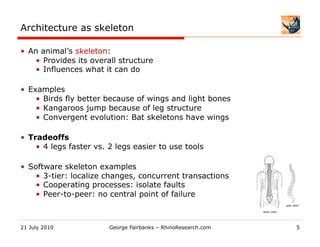
Architecture as skeleton

•  An animal’s skeleton:
    •  Provides its overall structure
    •  Influences what it can do

•  Examples
     •  Birds fly better because of wings and light bones
     •  Kangaroos jump because of leg structure
     •  Convergent evolution: Bat skeletons have wings

•  Tradeoffs
     •  4 legs faster vs. 2 legs easier to use tools

•  Software skeleton examples
     •  3-tier: localize changes, concurrent transactions
     •  Cooperating processes: isolate faults
     •  Peer-to-peer: no central point of failure


21 July 2010             George Fairbanks – RhinoResearch.com   5
Architecture influences quality attributes

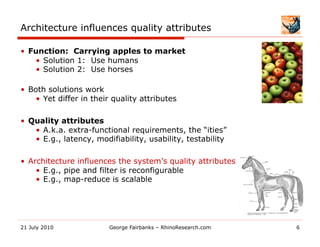
•  Function: Carrying apples to market
    •  Solution 1: Use humans
    •  Solution 2: Use horses

•  Both solutions work
     •  Yet differ in their quality attributes

•  Quality attributes
    •  A.k.a. extra-functional requirements, the “ities”
    •  E.g., latency, modifiability, usability, testability

•  Architecture influences the system’s quality attributes
     •  E.g., pipe and filter is reconfigurable
     •  E.g., map-reduce is scalable


21 July 2010              George Fairbanks – RhinoResearch.com   6
Architecture orthogonal to functionality

•  Architecture orthogonal to functionality
     •  Can mix-and-match architecture and functionality
     •  Can (mostly) build any system with any architecture

•  Shift in thinking
    •  No: good or bad architectures
    •  Yes: suitable or unsuitable to supporting the functions

•  Architecture can help or hurt you achieve functionality
     •  Help example: use horses to transport apples
     •  Hurt example: use horses to stack apples


21 July 2010           George Fairbanks – RhinoResearch.com      7
Documentation packages

 •  What is a documentation package?
     •  Complete architecture description
     •  See Documenting Software Architectures, 2nd Ed, 2010

 •  But:
     •  Hard to reconcile with Agile processes
     •  Expensive
     •  Not terse examples


Image CC license Indogen Jonesfr

 21 July 2010                      George Fairbanks – RhinoResearch.com   8
Talk outline

•  Introduction
•  Haiku How-To
     •  Tradeoffs, quality attribute priorities, drivers, design decisions,
        constraints, architectural styles
•  Haiku Example: Apache
•  Group exercise
•  Future


21 July 2010             George Fairbanks – RhinoResearch.com                 9
Idea: Architecture Haiku

•  Goal: Best 1-page architecture description

•  What to include?
    •  High power-to-weight items
    •  Items that promote insight, not comprehensiveness

•  Techniques
     •  Concise language (e.g., technical terms)
     •  Document differences
     •  Hints at critical junctions

•  Implications (i.e., who can read the haiku?)
     •  Need shared technical terms
     •  Need shared conceptual model


21 July 2010           George Fairbanks – RhinoResearch.com   10
Haiku Contents

1.    Solution description
2.    Tradeoffs
3.    Quality attribute priorities
4.    Architecture drivers (QA scenarios)
5.    Design rationales
6.    Constraints
7.    Architecture styles
8.    Diagrams


21 July 2010              George Fairbanks – RhinoResearch.com   11
1. Solution description

•  Simple text describing the system

•  Good to include:
    •  Most important functions
    •  Goals

•  Challenges
    •  Verbosity

•  Examples
     •  XBMC is a cross-platform music and video player that supports
        every major media format.
     •  LyX is a structured document processor, suitable for technical
        writing, that uses LaTeX to render professional-quality PDFs.


21 July 2010           George Fairbanks – RhinoResearch.com              12
2. Tradeoffs

•  Tradeoff: More of this  less of that

•  Examples

     •  Portability vs. playback efficiency. Platform-specific resources
        (e.g., dedicated hardware) often provide media playback
        benefits, including efficiency, yet using these resources ties the
        software to that platform

     •  Weight vs. speed. The heavier a car is, the slower it
        accelerates.

•  Everything trades off against cost


21 July 2010            George Fairbanks – RhinoResearch.com             13
QA tradeoffs

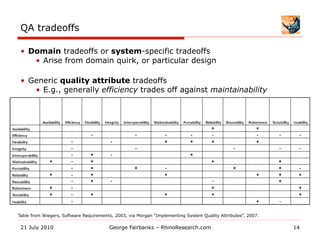
 •  Domain tradeoffs or system-specific tradeoffs
     •  Arise from domain quirk, or particular design

 •  Generic quality attribute tradeoffs
     •  E.g., generally efficiency trades off against maintainability


Table from Wiegers, Software Requirements, 2003, via Morgan “Implementing System Quality Attributes”, 2007.

 21 July 2010                           George Fairbanks – RhinoResearch.com                                  14
3. Quality attribute priorities

•  Goal: Prioritized list of quality attributes
    •  Some QA's likely not relevant, or very low priority
    •  Some QA's critical to project success

•  For credit card processing:
     •  Security > latency > throughput

•  For an MP3 player:
     •  Usability > audio fidelity > extensibility


•  Make an argument for different prioritizations
•  What factors influence the prioritization?


21 July 2010             George Fairbanks – RhinoResearch.com   15
4. QA scenario structure

 QA Scenario Templates                                                   QA Scenario Examples

 •  Basic template: stimulus and response                                •  Basic scenario: System allows
      •  Stimulus: agent or situation that                                  rapid scanning of book copies.
         triggers scenario
      •  Response: reaction to stimulus


 •  Ideal template: Add source,                                          •  Ideal scenario: Under normal
    environment, response measure                                           conditions, when a librarian
      •  Stimulus: as above                                                 scans a book copy for
      •  Response: as above                                                 checkout, the system updates
      •  Source: Who/what creates stimulus                                  its records and is ready to scan
      •  Environment: mode of the system.                                   the next one within 0.25
         E.g., normal or low demand.                                        seconds.
      •  Response measure: testable
         response (e.g., “happens in 2ms”)


QA scenarios from Bass et al., Software Architecture in Practice, 2003


 21 July 2010                             George Fairbanks – RhinoResearch.com                               16
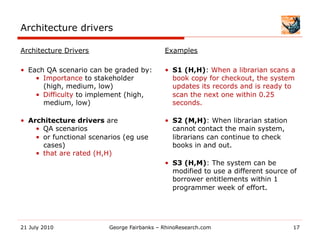
Architecture drivers

Architecture Drivers                          Examples

•  Each QA scenario can be graded by:         •  S1 (H,H): When a librarian scans a
     •  Importance to stakeholder                book copy for checkout, the system
        (high, medium, low)                      updates its records and is ready to
     •  Difficulty to implement (high,           scan the next one within 0.25
        medium, low)                             seconds.

•  Architecture drivers are                   •  S2 (M,H): When librarian station
     •  QA scenarios                             cannot contact the main system,
     •  or functional scenarios (eg use          librarians can continue to check
        cases)                                   books in and out.
     •  that are rated (H,H)
                                              •  S3 (H,M): The system can be
                                                 modified to use a different source of
                                                 borrower entitlements within 1
                                                 programmer week of effort.


21 July 2010               George Fairbanks – RhinoResearch.com                     17
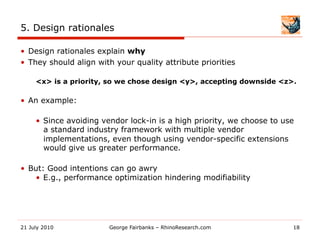
5. Design rationales

•  Design rationales explain why
•  They should align with your quality attribute priorities

     <x> is a priority, so we chose design <y>, accepting downside <z>.

•  An example:

     •  Since avoiding vendor lock-in is a high priority, we choose to use
        a standard industry framework with multiple vendor
        implementations, even though using vendor-specific extensions
        would give us greater performance.

•  But: Good intentions can go awry
    •  E.g., performance optimization hindering modifiability


21 July 2010            George Fairbanks – RhinoResearch.com             18
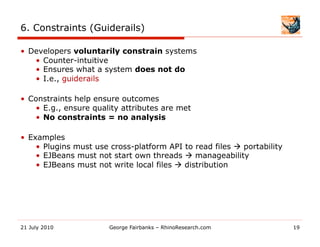
6. Constraints (Guiderails)

•  Developers voluntarily constrain systems
    •  Counter-intuitive
    •  Ensures what a system does not do
    •  I.e., guiderails

•  Constraints help ensure outcomes
    •  E.g., ensure quality attributes are met
    •  No constraints = no analysis

•  Examples
     •  Plugins must use cross-platform API to read files  portability
     •  EJBeans must not start own threads  manageability
     •  EJBeans must not write local files  distribution


21 July 2010            George Fairbanks – RhinoResearch.com              19
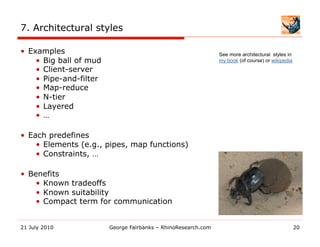
7. Architectural styles

•  Examples                                                      See more architectural styles in
     •  Big ball of mud                                          my book (of course) or wikipedia
     •  Client-server
     •  Pipe-and-filter
     •  Map-reduce
     •  N-tier
     •  Layered
     •  …

•  Each predefines
     •  Elements (e.g., pipes, map functions)
     •  Constraints, …

•  Benefits
     •  Known tradeoffs
     •  Known suitability
     •  Compact term for communication


21 July 2010              George Fairbanks – RhinoResearch.com                                      20
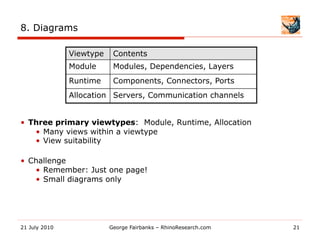
8. Diagrams

               Viewtype    Contents
               Module      Modules, Dependencies, Layers
               Runtime     Components, Connectors, Ports
               Allocation Servers, Communication channels


•  Three primary viewtypes: Module, Runtime, Allocation
    •  Many views within a viewtype
    •  View suitability

•  Challenge
    •  Remember: Just one page!
    •  Small diagrams only


21 July 2010              George Fairbanks – RhinoResearch.com   21
Talk outline

•    Introduction
•    Haiku How-To
•    Haiku Example: Apache
•    Group exercise
•    Future


21 July 2010         George Fairbanks – RhinoResearch.com   22
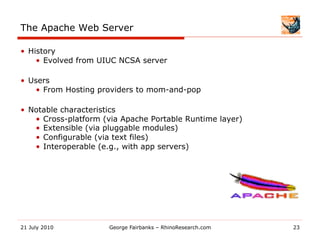
The Apache Web Server

•  History
     •  Evolved from UIUC NCSA server

•  Users
     •  From Hosting providers to mom-and-pop

•  Notable characteristics
    •  Cross-platform (via Apache Portable Runtime layer)
    •  Extensible (via pluggable modules)
    •  Configurable (via text files)
    •  Interoperable (e.g., with app servers)


21 July 2010          George Fairbanks – RhinoResearch.com   23
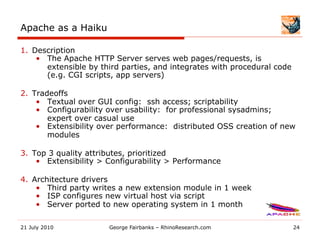
Apache as a Haiku

1.  Description
     •  The Apache HTTP Server serves web pages/requests, is
        extensible by third parties, and integrates with procedural code
        (e.g. CGI scripts, app servers)

2.  Tradeoffs
     •  Textual over GUI config: ssh access; scriptability
     •  Configurability over usability: for professional sysadmins;
        expert over casual use
     •  Extensibility over performance: distributed OSS creation of new
        modules

3.  Top 3 quality attributes, prioritized
     •  Extensibility > Configurability > Performance

4.  Architecture drivers
     •  Third party writes a new extension module in 1 week
     •  ISP configures new virtual host via script
     •  Server ported to new operating system in 1 month

21 July 2010           George Fairbanks – RhinoResearch.com                24
Apache as a Haiku

5.  Design rationales
     •  Since extensibility is more important than performance, modules
        are dynamically configured to process requests, potentially
        increasing latency

7.  Constraints (guide rails)
     •  All OS calls must go through Apache Portable Runtime layer

8.  Architectural styles
     •  Client-server: Browsers to main web server
     •  Pipe-and-filter: Requests and responses processed through
        network of filter modules (e.g., URL rewrite, compress)

9.  Diagrams
     •  Next pages


21 July 2010          George Fairbanks – RhinoResearch.com           25
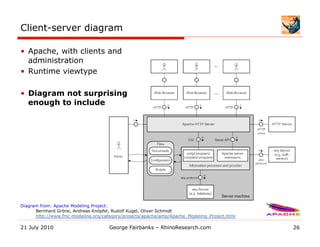
Client-server diagram

•  Apache, with clients and
   administration
•  Runtime viewtype

•  Diagram not surprising
   enough to include


Diagram from: Apache Modeling Project:
      Bernhard Gröne, Andreas Knöpfel, Rudolf Kugel, Oliver Schmidt
      http://www.fmc-modeling.org/category/projects/apache/amp/Apache_Modeling_Project.html

21 July 2010                         George Fairbanks – RhinoResearch.com                     26
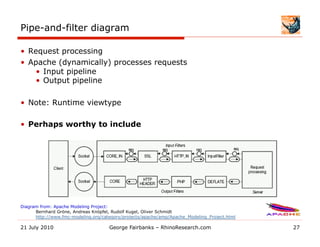
Pipe-and-filter diagram

•  Request processing
•  Apache (dynamically) processes requests
    •  Input pipeline
    •  Output pipeline

•  Note: Runtime viewtype

•  Perhaps worthy to include


Diagram from: Apache Modeling Project:
      Bernhard Gröne, Andreas Knöpfel, Rudolf Kugel, Oliver Schmidt
      http://www.fmc-modeling.org/category/projects/apache/amp/Apache_Modeling_Project.html

21 July 2010                         George Fairbanks – RhinoResearch.com                     27
Talk outline

•  Introduction
•  Haiku How-To
•  Haiku Example: Apache
•  Group exercise
     •  Airport screening
•  Future


21 July 2010          George Fairbanks – RhinoResearch.com   28
Airport screening exercise

•  Choose your descriptions from            •  Tips
   this list:

1. Solution description                     •  Incomplete descriptions
2. Tradeoffs                                •  Suggestive, not comprehensive
3. Quality attribute priorities             •  Hints at critical junctions
4. Architecture drivers (QA
  scenarios)
5. Design rationales
6. Constraints (guide rails)
7. Architecture styles
8. Diagrams


21 July 2010             George Fairbanks – RhinoResearch.com              29
Talk outline

•    Introduction
•    Haiku How-To
•    Haiku Example: Apache
•    Group exercise
•    Future
       •  Role of architecture, terminology, learn from (Haiku) examples,


21 July 2010              George Fairbanks – RhinoResearch.com              30
Implications & future

•  Role of architecture
    •  Acts as skeleton
    •  Makes QA’s easy or hard to achieve
    •  Today, often ignored

•  Assumed architectural knowledge
     •  Terminology (style names, components, connectors, …)
     •  Deltas

•  Learning from (Haiku) examples
     •  Imagine a book of Haiku examples
     •  OSS rarely documents architecture
     •  Let’s build a catalog (email me)

•  Candidate agile technical practice


21 July 2010           George Fairbanks – RhinoResearch.com    31
Conclusion

•  3 distinct ideas:
     •  The job title/role “architect”
     •  The process of architecting/designing
     •  The engineering artifact called the architecture

•  Architecture Haiku: 1-page description
    •  Incomplete, document deltas, hints at critical junctions
    •  High power-to-weight items that yield insight

•  Contents
    •  Tradeoffs, QA priorities, drivers, rationales, constraints, styles,
       and maybe diagrams


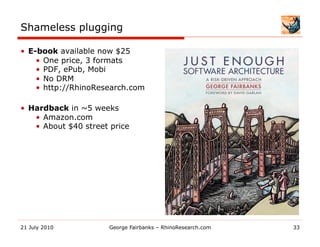
                            Parts of this talk are excerpted from my book
               Just Enough Software Architecture: A Risk-Driven Approach
                                             http://RhinoResearch.com


21 July 2010              George Fairbanks – RhinoResearch.com               32
Shameless plugging

•  E-book available now $25
     •  One price, 3 formats
     •  PDF, ePub, Mobi
     •  No DRM
     •  http://RhinoResearch.com

•  Hardback in ~5 weeks
    •  Amazon.com
    •  About $40 street price


21 July 2010           George Fairbanks – RhinoResearch.com   33

Architecture Haiku

  • 1.
    Architecture Haiku George Fairbanks 3 August 2010 Rhino Research Software Architecture Consulting and Training http://RhinoResearch.com
  • 2.
    Talk overview •  Architecturedescriptions tend to be verbose •  E.g.: Documentation package •  Complete, rather than suggestive •  Problem: We have caviar taste; McDonald’s budget •  Q: What if we only use one page? •  Must use concise language •  High power-to-weight ideas •  A: Architecture Haiku •  Tradeoffs, quality attribute priorities, drivers, design rationales, constraints, architectural styles •  Future •  Requires shared knowledge: terms, styles •  Will Haiku help architecture education? 21 July 2010 George Fairbanks – RhinoResearch.com 2
  • 3.
    Talk outline •  Introduction •  About me, software architecture, documentation packages, agile, forces, concision •  Haiku How-To •  Haiku Example: Apache •  Group exercise •  Future 21 July 2010 George Fairbanks – RhinoResearch.com 3
  • 4.
    What is softwarearchitecture? The software architecture of a computing system is the set of structures needed to reason about the system, which comprise software elements, relations among them, and properties of both. [Clements et al., DSA2, 2010] •  In loose language: •  It’s the macroscopic organization of the system •  Must keep these ideas separate: Χ  The job title/role “architect” Χ  The process of architecting/designing (also: when)  The engineering artifact called the architecture •  Every system has an architecture •  Identify it by looking back (avoids tangling with process & roles) •  E.g., “Aha, I see it is a 3-tier architecture” 21 July 2010 George Fairbanks – RhinoResearch.com 4
  • 5.
    Architecture as skeleton • An animal’s skeleton: •  Provides its overall structure •  Influences what it can do •  Examples •  Birds fly better because of wings and light bones •  Kangaroos jump because of leg structure •  Convergent evolution: Bat skeletons have wings •  Tradeoffs •  4 legs faster vs. 2 legs easier to use tools •  Software skeleton examples •  3-tier: localize changes, concurrent transactions •  Cooperating processes: isolate faults •  Peer-to-peer: no central point of failure 21 July 2010 George Fairbanks – RhinoResearch.com 5
  • 6.
    Architecture influences qualityattributes •  Function: Carrying apples to market •  Solution 1: Use humans •  Solution 2: Use horses •  Both solutions work •  Yet differ in their quality attributes •  Quality attributes •  A.k.a. extra-functional requirements, the “ities” •  E.g., latency, modifiability, usability, testability •  Architecture influences the system’s quality attributes •  E.g., pipe and filter is reconfigurable •  E.g., map-reduce is scalable 21 July 2010 George Fairbanks – RhinoResearch.com 6
  • 7.
    Architecture orthogonal tofunctionality •  Architecture orthogonal to functionality •  Can mix-and-match architecture and functionality •  Can (mostly) build any system with any architecture •  Shift in thinking •  No: good or bad architectures •  Yes: suitable or unsuitable to supporting the functions •  Architecture can help or hurt you achieve functionality •  Help example: use horses to transport apples •  Hurt example: use horses to stack apples 21 July 2010 George Fairbanks – RhinoResearch.com 7
  • 8.
    Documentation packages • What is a documentation package? •  Complete architecture description •  See Documenting Software Architectures, 2nd Ed, 2010 •  But: •  Hard to reconcile with Agile processes •  Expensive •  Not terse examples Image CC license Indogen Jonesfr 21 July 2010 George Fairbanks – RhinoResearch.com 8
  • 9.
    Talk outline •  Introduction • Haiku How-To •  Tradeoffs, quality attribute priorities, drivers, design decisions, constraints, architectural styles •  Haiku Example: Apache •  Group exercise •  Future 21 July 2010 George Fairbanks – RhinoResearch.com 9
  • 10.
    Idea: Architecture Haiku • Goal: Best 1-page architecture description •  What to include? •  High power-to-weight items •  Items that promote insight, not comprehensiveness •  Techniques •  Concise language (e.g., technical terms) •  Document differences •  Hints at critical junctions •  Implications (i.e., who can read the haiku?) •  Need shared technical terms •  Need shared conceptual model 21 July 2010 George Fairbanks – RhinoResearch.com 10
  • 11.
    Haiku Contents 1.  Solution description 2.  Tradeoffs 3.  Quality attribute priorities 4.  Architecture drivers (QA scenarios) 5.  Design rationales 6.  Constraints 7.  Architecture styles 8.  Diagrams 21 July 2010 George Fairbanks – RhinoResearch.com 11
  • 12.
    1. Solution description • Simple text describing the system •  Good to include: •  Most important functions •  Goals •  Challenges •  Verbosity •  Examples •  XBMC is a cross-platform music and video player that supports every major media format. •  LyX is a structured document processor, suitable for technical writing, that uses LaTeX to render professional-quality PDFs. 21 July 2010 George Fairbanks – RhinoResearch.com 12
  • 13.
    2. Tradeoffs •  Tradeoff:More of this  less of that •  Examples •  Portability vs. playback efficiency. Platform-specific resources (e.g., dedicated hardware) often provide media playback benefits, including efficiency, yet using these resources ties the software to that platform •  Weight vs. speed. The heavier a car is, the slower it accelerates. •  Everything trades off against cost 21 July 2010 George Fairbanks – RhinoResearch.com 13
  • 14.
    QA tradeoffs • Domain tradeoffs or system-specific tradeoffs •  Arise from domain quirk, or particular design •  Generic quality attribute tradeoffs •  E.g., generally efficiency trades off against maintainability Table from Wiegers, Software Requirements, 2003, via Morgan “Implementing System Quality Attributes”, 2007. 21 July 2010 George Fairbanks – RhinoResearch.com 14
  • 15.
    3. Quality attributepriorities •  Goal: Prioritized list of quality attributes •  Some QA's likely not relevant, or very low priority •  Some QA's critical to project success •  For credit card processing: •  Security > latency > throughput •  For an MP3 player: •  Usability > audio fidelity > extensibility •  Make an argument for different prioritizations •  What factors influence the prioritization? 21 July 2010 George Fairbanks – RhinoResearch.com 15
  • 16.
    4. QA scenariostructure QA Scenario Templates QA Scenario Examples •  Basic template: stimulus and response •  Basic scenario: System allows •  Stimulus: agent or situation that rapid scanning of book copies. triggers scenario •  Response: reaction to stimulus •  Ideal template: Add source, •  Ideal scenario: Under normal environment, response measure conditions, when a librarian •  Stimulus: as above scans a book copy for •  Response: as above checkout, the system updates •  Source: Who/what creates stimulus its records and is ready to scan •  Environment: mode of the system. the next one within 0.25 E.g., normal or low demand. seconds. •  Response measure: testable response (e.g., “happens in 2ms”) QA scenarios from Bass et al., Software Architecture in Practice, 2003 21 July 2010 George Fairbanks – RhinoResearch.com 16
  • 17.
    Architecture drivers Architecture Drivers Examples •  Each QA scenario can be graded by: •  S1 (H,H): When a librarian scans a •  Importance to stakeholder book copy for checkout, the system (high, medium, low) updates its records and is ready to •  Difficulty to implement (high, scan the next one within 0.25 medium, low) seconds. •  Architecture drivers are •  S2 (M,H): When librarian station •  QA scenarios cannot contact the main system, •  or functional scenarios (eg use librarians can continue to check cases) books in and out. •  that are rated (H,H) •  S3 (H,M): The system can be modified to use a different source of borrower entitlements within 1 programmer week of effort. 21 July 2010 George Fairbanks – RhinoResearch.com 17
  • 18.
    5. Design rationales • Design rationales explain why •  They should align with your quality attribute priorities <x> is a priority, so we chose design <y>, accepting downside <z>. •  An example: •  Since avoiding vendor lock-in is a high priority, we choose to use a standard industry framework with multiple vendor implementations, even though using vendor-specific extensions would give us greater performance. •  But: Good intentions can go awry •  E.g., performance optimization hindering modifiability 21 July 2010 George Fairbanks – RhinoResearch.com 18
  • 19.
    6. Constraints (Guiderails) • Developers voluntarily constrain systems •  Counter-intuitive •  Ensures what a system does not do •  I.e., guiderails •  Constraints help ensure outcomes •  E.g., ensure quality attributes are met •  No constraints = no analysis •  Examples •  Plugins must use cross-platform API to read files  portability •  EJBeans must not start own threads  manageability •  EJBeans must not write local files  distribution 21 July 2010 George Fairbanks – RhinoResearch.com 19
  • 20.
    7. Architectural styles • Examples See more architectural styles in •  Big ball of mud my book (of course) or wikipedia •  Client-server •  Pipe-and-filter •  Map-reduce •  N-tier •  Layered •  … •  Each predefines •  Elements (e.g., pipes, map functions) •  Constraints, … •  Benefits •  Known tradeoffs •  Known suitability •  Compact term for communication 21 July 2010 George Fairbanks – RhinoResearch.com 20
  • 21.
    8. Diagrams Viewtype Contents Module Modules, Dependencies, Layers Runtime Components, Connectors, Ports Allocation Servers, Communication channels •  Three primary viewtypes: Module, Runtime, Allocation •  Many views within a viewtype •  View suitability •  Challenge •  Remember: Just one page! •  Small diagrams only 21 July 2010 George Fairbanks – RhinoResearch.com 21
  • 22.
    Talk outline •  Introduction •  Haiku How-To •  Haiku Example: Apache •  Group exercise •  Future 21 July 2010 George Fairbanks – RhinoResearch.com 22
  • 23.
    The Apache WebServer •  History •  Evolved from UIUC NCSA server •  Users •  From Hosting providers to mom-and-pop •  Notable characteristics •  Cross-platform (via Apache Portable Runtime layer) •  Extensible (via pluggable modules) •  Configurable (via text files) •  Interoperable (e.g., with app servers) 21 July 2010 George Fairbanks – RhinoResearch.com 23
  • 24.
    Apache as aHaiku 1.  Description •  The Apache HTTP Server serves web pages/requests, is extensible by third parties, and integrates with procedural code (e.g. CGI scripts, app servers) 2.  Tradeoffs •  Textual over GUI config: ssh access; scriptability •  Configurability over usability: for professional sysadmins; expert over casual use •  Extensibility over performance: distributed OSS creation of new modules 3.  Top 3 quality attributes, prioritized •  Extensibility > Configurability > Performance 4.  Architecture drivers •  Third party writes a new extension module in 1 week •  ISP configures new virtual host via script •  Server ported to new operating system in 1 month 21 July 2010 George Fairbanks – RhinoResearch.com 24
  • 25.
    Apache as aHaiku 5.  Design rationales •  Since extensibility is more important than performance, modules are dynamically configured to process requests, potentially increasing latency 7.  Constraints (guide rails) •  All OS calls must go through Apache Portable Runtime layer 8.  Architectural styles •  Client-server: Browsers to main web server •  Pipe-and-filter: Requests and responses processed through network of filter modules (e.g., URL rewrite, compress) 9.  Diagrams •  Next pages 21 July 2010 George Fairbanks – RhinoResearch.com 25
  • 26.
    Client-server diagram •  Apache,with clients and administration •  Runtime viewtype •  Diagram not surprising enough to include Diagram from: Apache Modeling Project: Bernhard Gröne, Andreas Knöpfel, Rudolf Kugel, Oliver Schmidt http://www.fmc-modeling.org/category/projects/apache/amp/Apache_Modeling_Project.html 21 July 2010 George Fairbanks – RhinoResearch.com 26
  • 27.
    Pipe-and-filter diagram •  Requestprocessing •  Apache (dynamically) processes requests •  Input pipeline •  Output pipeline •  Note: Runtime viewtype •  Perhaps worthy to include Diagram from: Apache Modeling Project: Bernhard Gröne, Andreas Knöpfel, Rudolf Kugel, Oliver Schmidt http://www.fmc-modeling.org/category/projects/apache/amp/Apache_Modeling_Project.html 21 July 2010 George Fairbanks – RhinoResearch.com 27
  • 28.
    Talk outline •  Introduction • Haiku How-To •  Haiku Example: Apache •  Group exercise •  Airport screening •  Future 21 July 2010 George Fairbanks – RhinoResearch.com 28
  • 29.
    Airport screening exercise • Choose your descriptions from •  Tips this list: 1. Solution description •  Incomplete descriptions 2. Tradeoffs •  Suggestive, not comprehensive 3. Quality attribute priorities •  Hints at critical junctions 4. Architecture drivers (QA scenarios) 5. Design rationales 6. Constraints (guide rails) 7. Architecture styles 8. Diagrams 21 July 2010 George Fairbanks – RhinoResearch.com 29
  • 30.
    Talk outline •  Introduction •  Haiku How-To •  Haiku Example: Apache •  Group exercise •  Future •  Role of architecture, terminology, learn from (Haiku) examples, 21 July 2010 George Fairbanks – RhinoResearch.com 30
  • 31.
    Implications & future • Role of architecture •  Acts as skeleton •  Makes QA’s easy or hard to achieve •  Today, often ignored •  Assumed architectural knowledge •  Terminology (style names, components, connectors, …) •  Deltas •  Learning from (Haiku) examples •  Imagine a book of Haiku examples •  OSS rarely documents architecture •  Let’s build a catalog (email me) •  Candidate agile technical practice 21 July 2010 George Fairbanks – RhinoResearch.com 31
  • 32.
    Conclusion •  3 distinctideas: •  The job title/role “architect” •  The process of architecting/designing •  The engineering artifact called the architecture •  Architecture Haiku: 1-page description •  Incomplete, document deltas, hints at critical junctions •  High power-to-weight items that yield insight •  Contents •  Tradeoffs, QA priorities, drivers, rationales, constraints, styles, and maybe diagrams Parts of this talk are excerpted from my book Just Enough Software Architecture: A Risk-Driven Approach http://RhinoResearch.com 21 July 2010 George Fairbanks – RhinoResearch.com 32
  • 33.
    Shameless plugging •  E-bookavailable now $25 •  One price, 3 formats •  PDF, ePub, Mobi •  No DRM •  http://RhinoResearch.com •  Hardback in ~5 weeks •  Amazon.com •  About $40 street price 21 July 2010 George Fairbanks – RhinoResearch.com 33