








Your Exit Strategy:
Plan or Procrastinate, The Future is
Yours
Linnea Blair, Advisors On Target
PDCA Contractor College Webinar
December 11, 2013
Learning Objectives

Critical questions you need to answer before you can
start the transition process
The most common options for exiting your business
Key considerations when selecting the best exit
strategy for you
Specific variables that will add value to your business
in preparation for sale
Essential estate planning considerations for family
businesses
Why owners choose not to plan

Procrastination
Fear of the unknown
Fear of losing the familiar
Critical questions you need to
answer before you can start the
transition process
Begin with the end in mind
What are your business goals?

Where do you see your business 3 years from now?
5 years from now?
10 years from now?
20 years from now?
What are your life goals?

Where do you see yourself 3 years from now?
5 years from now?
10 years from now?
20 years from now?
The Evolving Relationship

How do you see your relationship to your business
evolving in those time frames?
Fewer hours in the business
A different role
Transfer more responsibility to others
More vacations
Critical Questions

Do you want to exit the business fully or partially?
When do you want to leave the business?
How much money will you need when you exit the
business?
Options for Business Exit

1.
2.
3.
4.
5.

Liquidation
Keep your business in the family
Sell to your employees
Sell to an outside buyer
Sell to another painting/home improvement
business
6. IPO – Initial Public Offering
Evolving Your Role

Several of the exit
options can involve a
gradual evolution of your
role in the company if it’s
your desire to stay in the
business to some degree
because you love it!
Choosing the best exit strategy
for YOU
What’s the best option for you?

Depends on your answers to the “critical questions”
Financial needs
Lifestyle desires
Family considerations
Availability of buyers
Choose your scenario

When do you want to leave the business?
Partially
Fully

How much money will you need when you leave?
Do you need a lump sum or an ongoing income?
Choose your successors

Who are your potential successors
Children
Employees
Management team of children and employees

What do you want to do for your successors?
What do you want to do for other children who are
not in the business?
Available Successors

Children
Do they want the business?
Can they operate it successfully?
Do you want to sell it to them or transfer it to them?

Employees
Do they want to buy the business?
Can they operate it successfully?
Will they stay with the business if you sell or transfer it to
someone else?

Are there other available buyers?
Is there a fit?

Does a transfer to your chosen successors allow you
to leave the business on your timetable?
Will this type of transfer give you the amount of
money you need to achieve your financial objectives
Are there other scenarios that would benefit yourself
and your family better?
Selling to an outside buyer
Tips for selling to an outside
buyer
Sell at the right time for the right reasons
Be clear about what you are selling
Determine what your business is actually worth
Make sure the business is in good order
Get professional help
Grooming your business for sale
or transfer
Grooming your business for sale

Determine your business value – Identify what you
will sell or transfer
Get rid of worthless inventory and long term debtors
Clean up your financial records
Strengthen legal and contractual affairs
Improve business systems
Prepare your management team
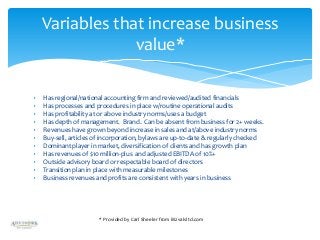
Variables that increase business
value*
Has regional/national accounting firm and reviewed/audited financials
Has processes and procedures in place w/routine operational audits
Has profitability at or above industry norms/uses a budget
Has depth of management. Brand. Can be absent from business for 2+ weeks.
Revenues have grown beyond increase in sales and at/above industry norms
Buy-sell, articles of incorporation, bylaws are up-to-date & regularly checked
Dominant player in market, diversification of clients and has growth plan
Has revenues of $10 million-plus and adjusted EBITDA of 10%+
Outside advisory board or respectable board of directors
Transition plan in place with measurable milestones
Business revenues and profits are consistent with years in business

* Provided by Carl Sheeler from Bizvalsltd.com
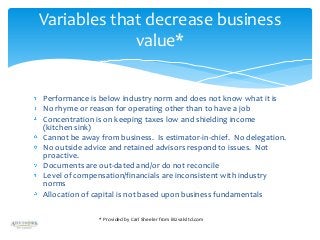
Variables that decrease business
value*
Performance is below industry norm and does not know what it is
No rhyme or reason for operating other than to have a job
Concentration is on keeping taxes low and shielding income
(kitchen sink)
Cannot be away from business. Is estimator-in-chief. No delegation.
No outside advice and retained advisors respond to issues. Not
proactive.
Documents are out-dated and/or do not reconcile
Level of compensation/financials are inconsistent with industry
norms
Allocation of capital is not based upon business fundamentals
* Provided by Carl Sheeler from Bizvalsltd.com
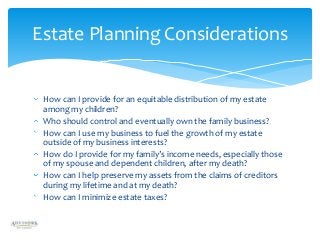
Estate Planning Considerations

How can I provide for an equitable distribution of my estate
among my children?
Who should control and eventually own the family business?
How can I use my business to fuel the growth of my estate
outside of my business interests?
How do I provide for my family’s income needs, especially those
of my spouse and dependent children, after my death?
How can I help preserve my assets from the claims of creditors
during my lifetime and at my death?
How can I minimize estate taxes?
Exit Planning Advisory Team
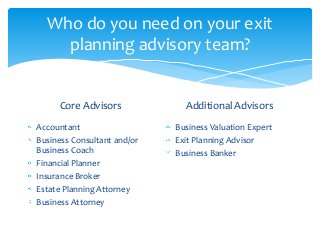
Who do you need on your exit
planning advisory team?

Core Advisors
Accountant
Business Consultant and/or
Business Coach
Financial Planner
Insurance Broker
Estate Planning Attorney
Business Attorney

Additional Advisors
Business Valuation Expert
Exit Planning Advisor
Business Banker
Exit Planning Timeline
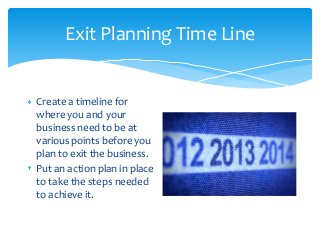
Exit Planning Time Line

Create a timeline for
where you and your
business need to be at
various points before you
plan to exit the business.
Put an action plan in place
to take the steps needed
to achieve it.
Not ready to plan your exit?

Think about these situations…
Voluntary or Involuntary Absence
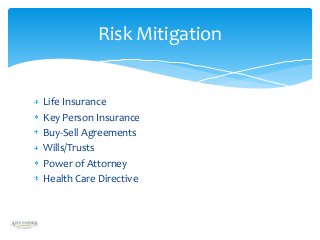
Risk Mitigation

Life Insurance
Key Person Insurance
Buy-Sell Agreements
Wills/Trusts
Power of Attorney
Health Care Directive
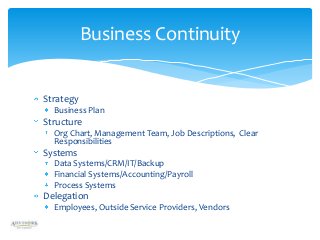
Business Continuity

Strategy
Business Plan

Structure
Org Chart, Management Team, Job Descriptions, Clear
Responsibilities

Systems
Data Systems/CRM/IT/Backup
Financial Systems/Accounting/Payroll
Process Systems

Delegation
Employees, Outside Service Providers, Vendors
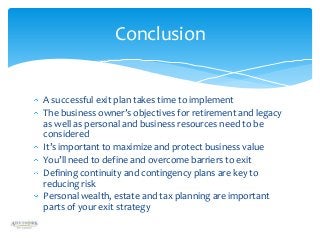
Conclusion

A successful exit plan takes time to implement
The business owner’s objectives for retirement and legacy
as well as personal and business resources need to be
considered
It’s important to maximize and protect business value
You’ll need to define and overcome barriers to exit
Defining continuity and contingency plans are key to
reducing risk
Personal wealth, estate and tax planning are important
parts of your exit strategy
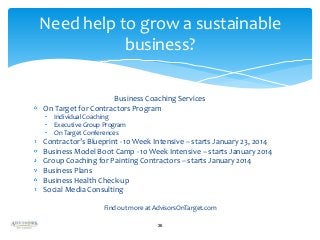
Need help to grow a sustainable
business?
Business Coaching Services
On Target for Contractors Program
Individual Coaching
Executive Group Program
On Target Conferences

Contractor’s Blueprint - 10 Week Intensive – starts January 23, 2014
Business Model Boot Camp - 10 Week Intensive – starts January 2014
Group Coaching for Painting Contractors – starts January 2014
Business Plans
Business Health Check-up
Social Media Consulting
Find out more at AdvisorsOnTarget.com
36
Contact and Connect!
Advisors On Target
Business Coaching & Marketing Consulting
Linnea Blair
Office: 619.291.3700
Email: Lblair@AdvisorsOnTarget.com
Web: AdvisorsOnTarget.com
Twitter: AdvisorOnTarget
Facebook: facebook.com/AdvisorsOnTarget
LinkedIn: linkedin.com/in/linneablair
37

Your exit strategy: Plan or Procrastinate - The Future is Yours

  • 1.
    Your Exit Strategy: Planor Procrastinate, The Future is Yours Linnea Blair, Advisors On Target PDCA Contractor College Webinar December 11, 2013
  • 2.
    Learning Objectives Critical questionsyou need to answer before you can start the transition process The most common options for exiting your business Key considerations when selecting the best exit strategy for you Specific variables that will add value to your business in preparation for sale Essential estate planning considerations for family businesses
  • 3.
    Why owners choosenot to plan Procrastination Fear of the unknown Fear of losing the familiar
  • 4.
    Critical questions youneed to answer before you can start the transition process
  • 5.
    Begin with theend in mind
  • 6.
    What are yourbusiness goals? Where do you see your business 3 years from now? 5 years from now? 10 years from now? 20 years from now?
  • 7.
    What are yourlife goals? Where do you see yourself 3 years from now? 5 years from now? 10 years from now? 20 years from now?
  • 8.
    The Evolving Relationship Howdo you see your relationship to your business evolving in those time frames? Fewer hours in the business A different role Transfer more responsibility to others More vacations
  • 9.
    Critical Questions Do youwant to exit the business fully or partially? When do you want to leave the business? How much money will you need when you exit the business?
  • 10.
  • 11.
    Options for BusinessExit 1. 2. 3. 4. 5. Liquidation Keep your business in the family Sell to your employees Sell to an outside buyer Sell to another painting/home improvement business 6. IPO – Initial Public Offering
  • 12.
    Evolving Your Role Severalof the exit options can involve a gradual evolution of your role in the company if it’s your desire to stay in the business to some degree because you love it!
  • 13.
    Choosing the bestexit strategy for YOU
  • 14.
    What’s the bestoption for you? Depends on your answers to the “critical questions” Financial needs Lifestyle desires Family considerations Availability of buyers
  • 15.
    Choose your scenario Whendo you want to leave the business? Partially Fully How much money will you need when you leave? Do you need a lump sum or an ongoing income?
  • 16.
    Choose your successors Whoare your potential successors Children Employees Management team of children and employees What do you want to do for your successors? What do you want to do for other children who are not in the business?
  • 17.
    Available Successors Children Do theywant the business? Can they operate it successfully? Do you want to sell it to them or transfer it to them? Employees Do they want to buy the business? Can they operate it successfully? Will they stay with the business if you sell or transfer it to someone else? Are there other available buyers?
  • 18.
    Is there afit? Does a transfer to your chosen successors allow you to leave the business on your timetable? Will this type of transfer give you the amount of money you need to achieve your financial objectives Are there other scenarios that would benefit yourself and your family better?
  • 19.
    Selling to anoutside buyer
  • 20.
    Tips for sellingto an outside buyer Sell at the right time for the right reasons Be clear about what you are selling Determine what your business is actually worth Make sure the business is in good order Get professional help
  • 21.
    Grooming your businessfor sale or transfer
  • 22.
    Grooming your businessfor sale Determine your business value – Identify what you will sell or transfer Get rid of worthless inventory and long term debtors Clean up your financial records Strengthen legal and contractual affairs Improve business systems Prepare your management team
  • 23.
    Variables that increasebusiness value* Has regional/national accounting firm and reviewed/audited financials Has processes and procedures in place w/routine operational audits Has profitability at or above industry norms/uses a budget Has depth of management. Brand. Can be absent from business for 2+ weeks. Revenues have grown beyond increase in sales and at/above industry norms Buy-sell, articles of incorporation, bylaws are up-to-date & regularly checked Dominant player in market, diversification of clients and has growth plan Has revenues of $10 million-plus and adjusted EBITDA of 10%+ Outside advisory board or respectable board of directors Transition plan in place with measurable milestones Business revenues and profits are consistent with years in business * Provided by Carl Sheeler from Bizvalsltd.com
  • 24.
    Variables that decreasebusiness value* Performance is below industry norm and does not know what it is No rhyme or reason for operating other than to have a job Concentration is on keeping taxes low and shielding income (kitchen sink) Cannot be away from business. Is estimator-in-chief. No delegation. No outside advice and retained advisors respond to issues. Not proactive. Documents are out-dated and/or do not reconcile Level of compensation/financials are inconsistent with industry norms Allocation of capital is not based upon business fundamentals * Provided by Carl Sheeler from Bizvalsltd.com
  • 25.
  • 26.
    Estate Planning Considerations Howcan I provide for an equitable distribution of my estate among my children? Who should control and eventually own the family business? How can I use my business to fuel the growth of my estate outside of my business interests? How do I provide for my family’s income needs, especially those of my spouse and dependent children, after my death? How can I help preserve my assets from the claims of creditors during my lifetime and at my death? How can I minimize estate taxes?
  • 27.
  • 28.
    Who do youneed on your exit planning advisory team? Core Advisors Accountant Business Consultant and/or Business Coach Financial Planner Insurance Broker Estate Planning Attorney Business Attorney Additional Advisors Business Valuation Expert Exit Planning Advisor Business Banker
  • 29.
  • 30.
    Exit Planning TimeLine Create a timeline for where you and your business need to be at various points before you plan to exit the business. Put an action plan in place to take the steps needed to achieve it.
  • 31.
    Not ready toplan your exit? Think about these situations…
  • 32.
  • 33.
    Risk Mitigation Life Insurance KeyPerson Insurance Buy-Sell Agreements Wills/Trusts Power of Attorney Health Care Directive
  • 34.
    Business Continuity Strategy Business Plan Structure OrgChart, Management Team, Job Descriptions, Clear Responsibilities Systems Data Systems/CRM/IT/Backup Financial Systems/Accounting/Payroll Process Systems Delegation Employees, Outside Service Providers, Vendors
  • 35.
    Conclusion A successful exitplan takes time to implement The business owner’s objectives for retirement and legacy as well as personal and business resources need to be considered It’s important to maximize and protect business value You’ll need to define and overcome barriers to exit Defining continuity and contingency plans are key to reducing risk Personal wealth, estate and tax planning are important parts of your exit strategy
  • 36.
    Need help togrow a sustainable business? Business Coaching Services On Target for Contractors Program Individual Coaching Executive Group Program On Target Conferences Contractor’s Blueprint - 10 Week Intensive – starts January 23, 2014 Business Model Boot Camp - 10 Week Intensive – starts January 2014 Group Coaching for Painting Contractors – starts January 2014 Business Plans Business Health Check-up Social Media Consulting Find out more at AdvisorsOnTarget.com 36
  • 37.
    Contact and Connect! AdvisorsOn Target Business Coaching & Marketing Consulting Linnea Blair Office: 619.291.3700 Email: Lblair@AdvisorsOnTarget.com Web: AdvisorsOnTarget.com Twitter: AdvisorOnTarget Facebook: facebook.com/AdvisorsOnTarget LinkedIn: linkedin.com/in/linneablair 37