DIY
3…2…1 LIFT-OFF!
Activity 1: Building your own paper rocket
The basic principles behind rocketry are the same for a simple paper rocket as for space rockets. In
this activity, you will design and build your own paper rocket and use it to investigate some of the
variables in the design that may affect the stability and performance of your rocket.
MATERIALS
•
•
•
•
•
•
•
•
PROCEDURE
1. Build a paper rocket using the equipment provided by your teacher. You can build your
rocket anyway you like, but be sure that it fits on the launch system that you will use (ask
your teacher)…DIAMETER!
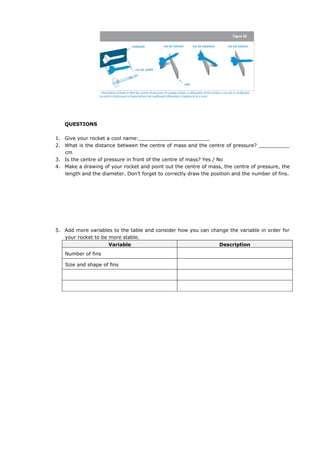
2. Find the centre of mass (CoM) of your rocket. This is the point representing the mean
position of the mass in a body or system. You can do this by tying a piece of thread around
your rocket and balancing it as shown on the drawing below. Mark where the CoM lies
with a pencil.
3. Find the centre of pressure (CoP) of your rocket. This is the average location of the
pressure acting on the rocket and, in this case, can be found by locating the balance of the
rocket’s projected area.
You can find the CoP by cutting out a silhouette of your rocket in cardboard and
balancing it on an edge. Mark the CoP on your rocket (homework)
Name: ____________________________________________ Tech: ___ Class nº:_____
QUESTIONS
1. Give your rocket a cool name:_______________________
2. What is the distance between the centre of mass and the centre of pressure? __________
cm
3. Is the centre of pressure in front of the centre of mass? Yes / No
4. Make a drawing of your rocket and point out the centre of mass, the centre of pressure, the
length and the diameter. Don’t forget to correctly draw the position and the number of fins.
5. Add more variables to the table and consider how you can change the variable in order for
your rocket to be more stable.
Variable Description
Number of fins
Size and shape of fins
Activity 2: Launch your rocket
You are now ready to launch your rocket! Did you know that a well-built paper rocket can
achieve flight distances of 30 m or more!? Let’s go!
MATERIAL
• Launch system (straw or cylinder, choose one) ___________
• Self-build paper rocket
• Measuring tape
To warm-up. Before launching…
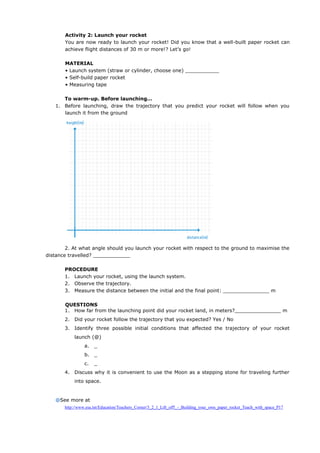
1. Before launching, draw the trajectory that you predict your rocket will follow when you
launch it from the ground
2. At what angle should you launch your rocket with respect to the ground to maximise the
distance travelled? ____________
PROCEDURE
1. Launch your rocket, using the launch system.
2. Observe the trajectory.
3. Measure the distance between the initial and the final point: _______________ m
QUESTIONS
1. How far from the launching point did your rocket land, in meters?_______________ m
2. Did your rocket follow the trajectory that you expected? Yes / No
3. Identify three possible initial conditions that affected the trajectory of your rocket
launch (@)
a. _
b. _
c. _
4. Discuss why it is convenient to use the Moon as a stepping stone for traveling further
into space.
@See more at
http://www.esa.int/Education/Teachers_Corner/3_2_1_Lift_off!_-_Building_your_own_paper_rocket_Teach_with_space_P17
ACTIVITIES SCHEDULE
Activity
Time expected at
home
Time expected
in class
I got it? Comments
Explanation, read the
worksheet, fill in the material
list.
15 minutes
Build the rocket. Determine
CoM and CoP. Answer the
questions 1, 2, 3 of activity 1.
Number 4 as well if you have
time.
30 minutes (CoP and
improve design)
50 minutes
Answer the warm-up question
of activity 2. Test your rocket,
choose one rocket per group,
launch it. Answer the questions
1 and 2 of this activity.
45 minutes
Answer the questions 4 and of
activity 1. Answer the
questions 3 and 4 of activity 2.
Review the worksheet, make
sure is completely filled in.
Metacognition and assessment
50 minutes
EVALUATION SCALE
ALWAYS, ALL THE
TIME!
3
ALMOST ALL THE
TIME!
2
BARELY...
1
NEVER
0
Rocket construction
I built the rocket in the expecting time.
20%
Worksheet instructions
I read the worksheet and I follow the
instructions.
20%
Activities
I did ALL the activities with interest, in the
expected time.
20%
Group
I collaborated with the group when it was
necessary, we chose a rocket with criteria.
20%
Involvement
I didn't waste time, I showed lots of
interest, I behave well all the time.
20%
Bonus point
I researched at home to improve my rocket
design. Explain it briefly.
Total points /18 Final score /10

3,2,1...Lift of!

  • 1.
    DIY 3…2…1 LIFT-OFF! Activity 1:Building your own paper rocket The basic principles behind rocketry are the same for a simple paper rocket as for space rockets. In this activity, you will design and build your own paper rocket and use it to investigate some of the variables in the design that may affect the stability and performance of your rocket. MATERIALS • • • • • • • • PROCEDURE 1. Build a paper rocket using the equipment provided by your teacher. You can build your rocket anyway you like, but be sure that it fits on the launch system that you will use (ask your teacher)…DIAMETER! 2. Find the centre of mass (CoM) of your rocket. This is the point representing the mean position of the mass in a body or system. You can do this by tying a piece of thread around your rocket and balancing it as shown on the drawing below. Mark where the CoM lies with a pencil. 3. Find the centre of pressure (CoP) of your rocket. This is the average location of the pressure acting on the rocket and, in this case, can be found by locating the balance of the rocket’s projected area. You can find the CoP by cutting out a silhouette of your rocket in cardboard and balancing it on an edge. Mark the CoP on your rocket (homework) Name: ____________________________________________ Tech: ___ Class nº:_____
  • 2.
    QUESTIONS 1. Give yourrocket a cool name:_______________________ 2. What is the distance between the centre of mass and the centre of pressure? __________ cm 3. Is the centre of pressure in front of the centre of mass? Yes / No 4. Make a drawing of your rocket and point out the centre of mass, the centre of pressure, the length and the diameter. Don’t forget to correctly draw the position and the number of fins. 5. Add more variables to the table and consider how you can change the variable in order for your rocket to be more stable. Variable Description Number of fins Size and shape of fins
  • 3.
    Activity 2: Launchyour rocket You are now ready to launch your rocket! Did you know that a well-built paper rocket can achieve flight distances of 30 m or more!? Let’s go! MATERIAL • Launch system (straw or cylinder, choose one) ___________ • Self-build paper rocket • Measuring tape To warm-up. Before launching… 1. Before launching, draw the trajectory that you predict your rocket will follow when you launch it from the ground 2. At what angle should you launch your rocket with respect to the ground to maximise the distance travelled? ____________ PROCEDURE 1. Launch your rocket, using the launch system. 2. Observe the trajectory. 3. Measure the distance between the initial and the final point: _______________ m QUESTIONS 1. How far from the launching point did your rocket land, in meters?_______________ m 2. Did your rocket follow the trajectory that you expected? Yes / No 3. Identify three possible initial conditions that affected the trajectory of your rocket launch (@) a. _ b. _ c. _ 4. Discuss why it is convenient to use the Moon as a stepping stone for traveling further into space. @See more at http://www.esa.int/Education/Teachers_Corner/3_2_1_Lift_off!_-_Building_your_own_paper_rocket_Teach_with_space_P17
  • 4.
    ACTIVITIES SCHEDULE Activity Time expectedat home Time expected in class I got it? Comments Explanation, read the worksheet, fill in the material list. 15 minutes Build the rocket. Determine CoM and CoP. Answer the questions 1, 2, 3 of activity 1. Number 4 as well if you have time. 30 minutes (CoP and improve design) 50 minutes Answer the warm-up question of activity 2. Test your rocket, choose one rocket per group, launch it. Answer the questions 1 and 2 of this activity. 45 minutes Answer the questions 4 and of activity 1. Answer the questions 3 and 4 of activity 2. Review the worksheet, make sure is completely filled in. Metacognition and assessment 50 minutes EVALUATION SCALE ALWAYS, ALL THE TIME! 3 ALMOST ALL THE TIME! 2 BARELY... 1 NEVER 0 Rocket construction I built the rocket in the expecting time. 20% Worksheet instructions I read the worksheet and I follow the instructions. 20% Activities I did ALL the activities with interest, in the expected time. 20% Group I collaborated with the group when it was necessary, we chose a rocket with criteria. 20% Involvement I didn't waste time, I showed lots of interest, I behave well all the time. 20% Bonus point I researched at home to improve my rocket design. Explain it briefly. Total points /18 Final score /10