Presentation Script: LiftOff! Igniting Science Learning with DIY Alcohol-
Powered Rockets
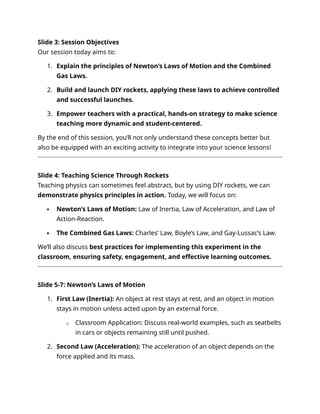
Slide 1: Title Slide
(Greeting)
Good [morning/afternoon] everyone! Welcome to "Lift Off! Igniting Science
Learning with DIY Alcohol-Powered Rockets." I am Ruel L. Carpon, and I am
excited to facilitate this professional development session for you, our fellow
educators.
Today, we’ll explore how Newton’s Laws of Motion and the Combined Gas Laws
come to life through hands-on rocketry. More importantly, we will discuss how to
integrate this engaging activity into our science teaching to make learning
more interactive and meaningful for students. Let’s get ready for lift-off!
Slide 2: Fun Facts About Rockets
Before we dive in, let’s warm up with some fascinating rocket facts:
Did you know that the first human-made rocket was created in China in the
13th century? They called them "fire arrows."
The Saturn V rocket remains the tallest, heaviest, and most powerful rocket
ever built.
The escape velocity needed to break free from Earth's gravity is about
25,000 mph (40,000 km/h)!
The first living creatures in space were not humans but fruit flies, launched
aboard a U.S. V-2 rocket in 1947!
And finally, rockets work based on Newton’s Third Law of Motion, which
states that for every action, there is an equal and opposite reaction.
These fun facts remind us that rocketry is a perfect way to make science fun,
engaging, and hands-on!
2.
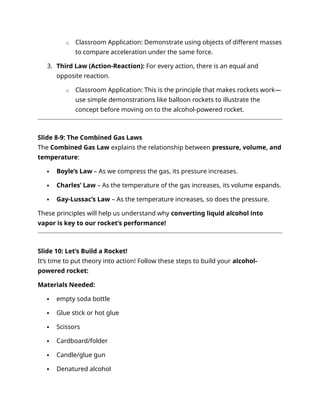
Slide 3: SessionObjectives
Our session today aims to:
1. Explain the principles of Newton’s Laws of Motion and the Combined
Gas Laws.
2. Build and launch DIY rockets, applying these laws to achieve controlled
and successful launches.
3. Empower teachers with a practical, hands-on strategy to make science
teaching more dynamic and student-centered.
By the end of this session, you’ll not only understand these concepts better but
also be equipped with an exciting activity to integrate into your science lessons!
Slide 4: Teaching Science Through Rockets
Teaching physics can sometimes feel abstract, but by using DIY rockets, we can
demonstrate physics principles in action. Today, we will focus on:
Newton’s Laws of Motion: Law of Inertia, Law of Acceleration, and Law of
Action-Reaction.
The Combined Gas Laws: Charles’ Law, Boyle’s Law, and Gay-Lussac’s Law.
We’ll also discuss best practices for implementing this experiment in the
classroom, ensuring safety, engagement, and effective learning outcomes.
Slide 5-7: Newton’s Laws of Motion
1. First Law (Inertia): An object at rest stays at rest, and an object in motion
stays in motion unless acted upon by an external force.
o Classroom Application: Discuss real-world examples, such as seatbelts
in cars or objects remaining still until pushed.
2. Second Law (Acceleration): The acceleration of an object depends on the
force applied and its mass.
3.
o Classroom Application:Demonstrate using objects of different masses
to compare acceleration under the same force.
3. Third Law (Action-Reaction): For every action, there is an equal and
opposite reaction.
o Classroom Application: This is the principle that makes rockets work—
use simple demonstrations like balloon rockets to illustrate the
concept before moving on to the alcohol-powered rocket.
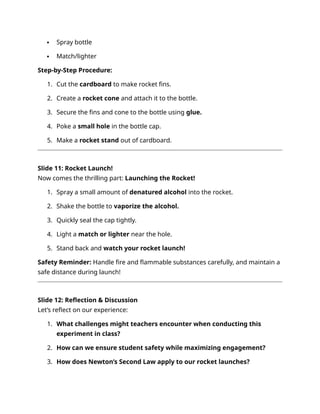
Slide 8-9: The Combined Gas Laws
The Combined Gas Law explains the relationship between pressure, volume, and
temperature:
Boyle’s Law – As we compress the gas, its pressure increases.
Charles’ Law – As the temperature of the gas increases, its volume expands.
Gay-Lussac’s Law – As the temperature increases, so does the pressure.
These principles will help us understand why converting liquid alcohol into
vapor is key to our rocket’s performance!
Slide 10: Let’s Build a Rocket!
It’s time to put theory into action! Follow these steps to build your alcohol-
powered rocket:
Materials Needed:
empty soda bottle
Glue stick or hot glue
Scissors
Cardboard/folder
Candle/glue gun
Denatured alcohol
4.
Spray bottle
Match/lighter
Step-by-Step Procedure:
1. Cut the cardboard to make rocket fins.
2. Create a rocket cone and attach it to the bottle.
3. Secure the fins and cone to the bottle using glue.
4. Poke a small hole in the bottle cap.
5. Make a rocket stand out of cardboard.
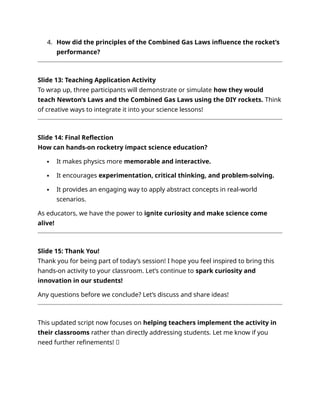
Slide 11: Rocket Launch!
Now comes the thrilling part: Launching the Rocket!
1. Spray a small amount of denatured alcohol into the rocket.
2. Shake the bottle to vaporize the alcohol.
3. Quickly seal the cap tightly.
4. Light a match or lighter near the hole.
5. Stand back and watch your rocket launch!
Safety Reminder: Handle fire and flammable substances carefully, and maintain a
safe distance during launch!
Slide 12: Reflection & Discussion
Let’s reflect on our experience:
1. What challenges might teachers encounter when conducting this
experiment in class?
2. How can we ensure student safety while maximizing engagement?
3. How does Newton’s Second Law apply to our rocket launches?
5.
4. How didthe principles of the Combined Gas Laws influence the rocket’s
performance?
Slide 13: Teaching Application Activity
To wrap up, three participants will demonstrate or simulate how they would
teach Newton’s Laws and the Combined Gas Laws using the DIY rockets. Think
of creative ways to integrate it into your science lessons!
Slide 14: Final Reflection
How can hands-on rocketry impact science education?
It makes physics more memorable and interactive.
It encourages experimentation, critical thinking, and problem-solving.
It provides an engaging way to apply abstract concepts in real-world
scenarios.
As educators, we have the power to ignite curiosity and make science come
alive!
Slide 15: Thank You!
Thank you for being part of today’s session! I hope you feel inspired to bring this
hands-on activity to your classroom. Let’s continue to spark curiosity and
innovation in our students!
Any questions before we conclude? Let’s discuss and share ideas!
This updated script now focuses on helping teachers implement the activity in
their classrooms rather than directly addressing students. Let me know if you
need further refinements! 🚀
![Presentation Script: Lift Off! Igniting Science Learning with DIY Alcohol-
Powered Rockets
Slide 1: Title Slide
(Greeting)
Good [morning/afternoon] everyone! Welcome to "Lift Off! Igniting Science
Learning with DIY Alcohol-Powered Rockets." I am Ruel L. Carpon, and I am
excited to facilitate this professional development session for you, our fellow
educators.
Today, we’ll explore how Newton’s Laws of Motion and the Combined Gas Laws
come to life through hands-on rocketry. More importantly, we will discuss how to
integrate this engaging activity into our science teaching to make learning
more interactive and meaningful for students. Let’s get ready for lift-off!
Slide 2: Fun Facts About Rockets
Before we dive in, let’s warm up with some fascinating rocket facts:
Did you know that the first human-made rocket was created in China in the
13th century? They called them "fire arrows."
The Saturn V rocket remains the tallest, heaviest, and most powerful rocket
ever built.
The escape velocity needed to break free from Earth's gravity is about
25,000 mph (40,000 km/h)!
The first living creatures in space were not humans but fruit flies, launched
aboard a U.S. V-2 rocket in 1947!
And finally, rockets work based on Newton’s Third Law of Motion, which
states that for every action, there is an equal and opposite reaction.
These fun facts remind us that rocketry is a perfect way to make science fun,
engaging, and hands-on!](https://image.slidesharecdn.com/presentationscript-250319044909-578338f2/85/Presentation-Script-for-science-intruction-1-320.jpg)
![Presentation Script: Lift Off! Igniting Science Learning with DIY Alcohol-
Powered Rockets
Slide 1: Title Slide
(Greeting)
Good [morning/afternoon] everyone! Welcome to "Lift Off! Igniting Science
Learning with DIY Alcohol-Powered Rockets." I am Ruel L. Carpon, and I am
excited to facilitate this professional development session for you, our fellow
educators.
Today, we’ll explore how Newton’s Laws of Motion and the Combined Gas Laws
come to life through hands-on rocketry. More importantly, we will discuss how to
integrate this engaging activity into our science teaching to make learning
more interactive and meaningful for students. Let’s get ready for lift-off!
Slide 2: Fun Facts About Rockets
Before we dive in, let’s warm up with some fascinating rocket facts:
Did you know that the first human-made rocket was created in China in the
13th century? They called them "fire arrows."
The Saturn V rocket remains the tallest, heaviest, and most powerful rocket
ever built.
The escape velocity needed to break free from Earth's gravity is about
25,000 mph (40,000 km/h)!
The first living creatures in space were not humans but fruit flies, launched
aboard a U.S. V-2 rocket in 1947!
And finally, rockets work based on Newton’s Third Law of Motion, which
states that for every action, there is an equal and opposite reaction.
These fun facts remind us that rocketry is a perfect way to make science fun,
engaging, and hands-on!](https://image.slidesharecdn.com/presentationscript-250319044909-578338f2/75/Presentation-Script-for-science-intruction-1-2048.jpg)