1
Market
The fabric wash market in India is estimated to be worth approximately Rs. 55 billion
with a volume turnover of 2.6 million tons. The market is primarily segmented on the
basis of product forms and price. The different product forms are powders, bars and
laundry soaps.
This is further sub-divided on the basis of price into concentrates (in the case of
powders), premium, mass-premium/mid-price and mass-market.
Fabric cleaning is a well-developed category in India with a penetration of 99% for
laundry products and a per capita consumption of 2.65 kgs per annum. Detergent
powder penetration is 86% while penetration of detergent bars is 64%. Laundry soap
has a much lower penetration at 33% and is restricted to select geographies. West and
South are detergent bar markets while North and East have a higher proportion of
laundry soap users. Most consumers use more than one product - a combination of
detergent powders and bars are the most prevalent - with about 82% preferring this
usage pattern.
The wash frequency per week in India is 6.9 and the incidence of any product usage is
almost 97%. Recent trends show an increase in the usage of detergent powders and a
decline in the usage of laundry soaps. This is a clear indication that the detergent
market in India is maturing and that consumers are moving up the price ladder.(Source
for all market data: Internal Panel Data)
Achievements
Rin was the face of detergent bars in India. For nearly twenty years, from 1969 to
1989, it reined the market, with a 40% market share. With superlative performance to
back it, Rin was synonymous with whiteness.


                                                                                        2
Rin has shown substantial growth over the years. In fact, its three variants - Rin
(Shakti) Powder, Rin Shakti bar and Rin Supreme bar, put together, make it amongst
the largest brands in the Hindustan Lever portfolio.
Rin also enjoys the status of being the Most Trusted Detergent Brand in the country
(Source: Brand Equity Survey 2003 on India's Most Trusted Brands).
History
Rin was launched in a bar form in a test market in 1969 and extended nationally in
1970. It was launched as the first detergent bar at a time and in a scenario where there
were stringent rules imposed on the organised sector manufacturing laundry soaps. It
was also realised at that time that powders would never completely replace laundry
soaps.
Initially, the brand was positioned as - 'Rin is not a soap, it is a totally new idea for
washing clothes'. The benefits clearly outlined that the bar had concentrated cleaning
power hence washed 50% more clothes. Moreover, it washed whiter than any other
bar.
The memorable baseline 'Whiteness strikes with Rin' was introduced and a strong
brand property - the mnemonic of the lightning flash was developed.
Once the detergent bar category was created and the consumers made aware of the
functional superiority of Rin bar, the subsequent task then was to build emotional
equity for the Rin brand. To meet this objective, Rin was positioned as the only way to
get superlative whites. Based on the powerful consumer insight of 'human envy' the
creative execution of 'white - off-white crossover' was developed. The idea being that
'with Rin you get striking whites that others can't help but envy'. This route was
hugely successful in establishing a superior brand image in the consumer's mind.
In the late 1980s, Rin faced its first real competition with the launch of low-price
discount detergent bars. At prices 60% lower than Rin, they were positioned as a low
sog product. They adopted a challenging note in their communication and took on the
perceived negatives of Rin bar. To counter their threat, the power and economy of Rin
was emphasised. Its communication now boldly stated that 'just a little of Rin'
achieves superlative whiteness. The advertising campaign 'Zara sa Rin' went on to
become a brand anthem.
The early 1990s also saw Rin successfully battling powder concentrate brands
attempting a foray into detergent bars. Rapid improvements were made to ensure
formulation superiority and Rin bar was re-launched as the Rin Supreme bar in 1995.
Positioned on 'less sog and more whiteness' it reinforced itself as the detergent bar that
washes whiter than any other detergent bar in the market.
To take advantage of the existing gap in the segment between premium powders and
mass-market powders - a powder variant - Rin Shakti powder was launched in 1995.
Priced at Rs. 25 per kg, it plugged the then wide price gap between premium powders
- average price Rs. 50 per kg - and mass-market powders - average price Rs. 14 per
kg. It capitalised on the brand equity that Rin enjoyed amongst consumers and was
strategically positioned on superior whiteness as compared to ordinary brands.


                                                                                             3
4
Thanks to the entry of Rin Shakti powder a highly aspirational brand was now
available at a very affordable price. Proof of performance in the communication
was depicted in the form of a wash-rewash test where the brand claimed to remove
dirt from clothes washed with ordinary bars. Since then a continuous programme of
product innovation and improvement has taken place on the brand.
Product
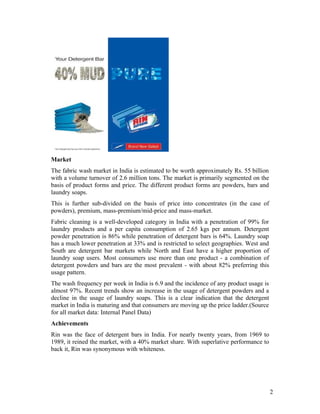
Today Rin has three variants: Rin Supreme bar, Rin Shakti bar and Rin powder.
Rin Supreme and Rin Shakti operate at two distinctly different price points. While
the Rin Shakti proposition is superior whiteness vis-à-vis mass- market, the Rin
Supreme proposition is superior performance to give whites that look like new.
Recent Developments
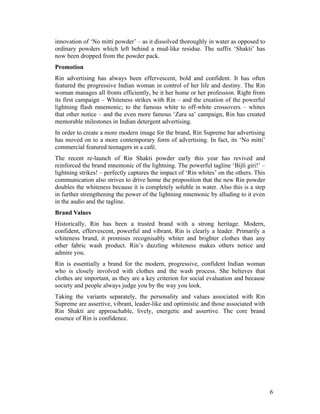
In keeping with the brand’s philosophy of continuous innovation the Rin Supreme
bar was launched in 2002 as the ‘No mud’ bar. While ordinary bars have up to 40%
mud-like ingredients, New Rin Supreme is made with patented Pure Clean
technology ‘to keep clothes looking white like new’ – for longer. Like a true
leader, Rin has been successful in implementing a technical breakthrough even in
the otherwise staid detergent bar market.
Early 2004 saw the advent of a brand new Rin Shakti powder. Rin Shakti paved the
way with a brand new proposition of double whiteness along with a powerful


                                                                                     5
innovation of ‘No mitti powder’ – as it dissolved thoroughly in water as opposed to
ordinary powders which left behind a mud-like residue. The suffix ‘Shakti’ has
now been dropped from the powder pack.
Promotion
Rin advertising has always been effervescent, bold and confident. It has often
featured the progressive Indian woman in control of her life and destiny. The Rin
woman manages all fronts efficiently, be it her home or her profession. Right from
its first campaign – Whiteness strikes with Rin – and the creation of the powerful
lightning flash mnemonic; to the famous white to off-white crossovers – whites
that other notice – and the even more famous ‘Zara sa’ campaign, Rin has created
memorable milestones in Indian detergent advertising.
In order to create a more modern image for the brand, Rin Supreme bar advertising
has moved on to a more contemporary form of advertising. In fact, its ‘No mitti’
commercial featured teenagers in a café.
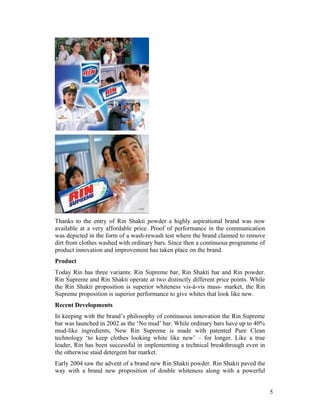
The recent re-launch of Rin Shakti powder early this year has revived and
reinforced the brand mnemonic of the lightning. The powerful tagline ‘Bijli giri!’ –
lightning strikes! – perfectly captures the impact of ‘Rin whites’ on the others. This
communication also strives to drive home the proposition that the new Rin powder
doubles the whiteness because it is completely soluble in water. Also this is a step
in further strengthening the power of the lightning mnemonic by alluding to it even
in the audio and the tagline.
Brand Values
Historically, Rin has been a trusted brand with a strong heritage. Modern,
confident, effervescent, powerful and vibrant, Rin is clearly a leader. Primarily a
whiteness brand, it promises recognisably whiter and brighter clothes than any
other fabric wash product. Rin’s dazzling whiteness makes others notice and
admire you.
Rin is essentially a brand for the modern, progressive, confident Indian woman
who is closely involved with clothes and the wash process. She believes that
clothes are important, as they are a key criterion for social evaluation and because
society and people always judge you by the way you look.
Taking the variants separately, the personality and values associated with Rin
Supreme are assertive, vibrant, leader-like and optimistic and those associated with
Rin Shakti are approachable, lively, energetic and assertive. The core brand
essence of Rin is confidence.


                                                                                         6
Things you didn't know about
                                      Rin

Rin was the first national detergent bar brand in India.
Several well-known people have endorsed Rin: Priya Tendulkar, television
personality known for her crusader-for-justice roles in television serials and
Tanvi Azmi, also a television personality.
Arguably the longest commercial ever was Rin’s ten-minute commercial which
ran in rural India.
The famous Rin white off-white cross over films ran on television with various
edits for almost nine years from 1975 to 1986.
Former Miss World, Lara Dutta, has appeared in a Rin television commercial.
Rin was the first detergent bar brand to be made available in a 400 gms SKU.
www.hll.com


                                                                                 7

Rin

  • 1.
  • 2.
    Market The fabric washmarket in India is estimated to be worth approximately Rs. 55 billion with a volume turnover of 2.6 million tons. The market is primarily segmented on the basis of product forms and price. The different product forms are powders, bars and laundry soaps. This is further sub-divided on the basis of price into concentrates (in the case of powders), premium, mass-premium/mid-price and mass-market. Fabric cleaning is a well-developed category in India with a penetration of 99% for laundry products and a per capita consumption of 2.65 kgs per annum. Detergent powder penetration is 86% while penetration of detergent bars is 64%. Laundry soap has a much lower penetration at 33% and is restricted to select geographies. West and South are detergent bar markets while North and East have a higher proportion of laundry soap users. Most consumers use more than one product - a combination of detergent powders and bars are the most prevalent - with about 82% preferring this usage pattern. The wash frequency per week in India is 6.9 and the incidence of any product usage is almost 97%. Recent trends show an increase in the usage of detergent powders and a decline in the usage of laundry soaps. This is a clear indication that the detergent market in India is maturing and that consumers are moving up the price ladder.(Source for all market data: Internal Panel Data) Achievements Rin was the face of detergent bars in India. For nearly twenty years, from 1969 to 1989, it reined the market, with a 40% market share. With superlative performance to back it, Rin was synonymous with whiteness. 2
  • 3.
    Rin has shownsubstantial growth over the years. In fact, its three variants - Rin (Shakti) Powder, Rin Shakti bar and Rin Supreme bar, put together, make it amongst the largest brands in the Hindustan Lever portfolio. Rin also enjoys the status of being the Most Trusted Detergent Brand in the country (Source: Brand Equity Survey 2003 on India's Most Trusted Brands). History Rin was launched in a bar form in a test market in 1969 and extended nationally in 1970. It was launched as the first detergent bar at a time and in a scenario where there were stringent rules imposed on the organised sector manufacturing laundry soaps. It was also realised at that time that powders would never completely replace laundry soaps. Initially, the brand was positioned as - 'Rin is not a soap, it is a totally new idea for washing clothes'. The benefits clearly outlined that the bar had concentrated cleaning power hence washed 50% more clothes. Moreover, it washed whiter than any other bar. The memorable baseline 'Whiteness strikes with Rin' was introduced and a strong brand property - the mnemonic of the lightning flash was developed. Once the detergent bar category was created and the consumers made aware of the functional superiority of Rin bar, the subsequent task then was to build emotional equity for the Rin brand. To meet this objective, Rin was positioned as the only way to get superlative whites. Based on the powerful consumer insight of 'human envy' the creative execution of 'white - off-white crossover' was developed. The idea being that 'with Rin you get striking whites that others can't help but envy'. This route was hugely successful in establishing a superior brand image in the consumer's mind. In the late 1980s, Rin faced its first real competition with the launch of low-price discount detergent bars. At prices 60% lower than Rin, they were positioned as a low sog product. They adopted a challenging note in their communication and took on the perceived negatives of Rin bar. To counter their threat, the power and economy of Rin was emphasised. Its communication now boldly stated that 'just a little of Rin' achieves superlative whiteness. The advertising campaign 'Zara sa Rin' went on to become a brand anthem. The early 1990s also saw Rin successfully battling powder concentrate brands attempting a foray into detergent bars. Rapid improvements were made to ensure formulation superiority and Rin bar was re-launched as the Rin Supreme bar in 1995. Positioned on 'less sog and more whiteness' it reinforced itself as the detergent bar that washes whiter than any other detergent bar in the market. To take advantage of the existing gap in the segment between premium powders and mass-market powders - a powder variant - Rin Shakti powder was launched in 1995. Priced at Rs. 25 per kg, it plugged the then wide price gap between premium powders - average price Rs. 50 per kg - and mass-market powders - average price Rs. 14 per kg. It capitalised on the brand equity that Rin enjoyed amongst consumers and was strategically positioned on superior whiteness as compared to ordinary brands. 3
  • 4.
  • 5.
    Thanks to theentry of Rin Shakti powder a highly aspirational brand was now available at a very affordable price. Proof of performance in the communication was depicted in the form of a wash-rewash test where the brand claimed to remove dirt from clothes washed with ordinary bars. Since then a continuous programme of product innovation and improvement has taken place on the brand. Product Today Rin has three variants: Rin Supreme bar, Rin Shakti bar and Rin powder. Rin Supreme and Rin Shakti operate at two distinctly different price points. While the Rin Shakti proposition is superior whiteness vis-à-vis mass- market, the Rin Supreme proposition is superior performance to give whites that look like new. Recent Developments In keeping with the brand’s philosophy of continuous innovation the Rin Supreme bar was launched in 2002 as the ‘No mud’ bar. While ordinary bars have up to 40% mud-like ingredients, New Rin Supreme is made with patented Pure Clean technology ‘to keep clothes looking white like new’ – for longer. Like a true leader, Rin has been successful in implementing a technical breakthrough even in the otherwise staid detergent bar market. Early 2004 saw the advent of a brand new Rin Shakti powder. Rin Shakti paved the way with a brand new proposition of double whiteness along with a powerful 5
  • 6.
    innovation of ‘Nomitti powder’ – as it dissolved thoroughly in water as opposed to ordinary powders which left behind a mud-like residue. The suffix ‘Shakti’ has now been dropped from the powder pack. Promotion Rin advertising has always been effervescent, bold and confident. It has often featured the progressive Indian woman in control of her life and destiny. The Rin woman manages all fronts efficiently, be it her home or her profession. Right from its first campaign – Whiteness strikes with Rin – and the creation of the powerful lightning flash mnemonic; to the famous white to off-white crossovers – whites that other notice – and the even more famous ‘Zara sa’ campaign, Rin has created memorable milestones in Indian detergent advertising. In order to create a more modern image for the brand, Rin Supreme bar advertising has moved on to a more contemporary form of advertising. In fact, its ‘No mitti’ commercial featured teenagers in a café. The recent re-launch of Rin Shakti powder early this year has revived and reinforced the brand mnemonic of the lightning. The powerful tagline ‘Bijli giri!’ – lightning strikes! – perfectly captures the impact of ‘Rin whites’ on the others. This communication also strives to drive home the proposition that the new Rin powder doubles the whiteness because it is completely soluble in water. Also this is a step in further strengthening the power of the lightning mnemonic by alluding to it even in the audio and the tagline. Brand Values Historically, Rin has been a trusted brand with a strong heritage. Modern, confident, effervescent, powerful and vibrant, Rin is clearly a leader. Primarily a whiteness brand, it promises recognisably whiter and brighter clothes than any other fabric wash product. Rin’s dazzling whiteness makes others notice and admire you. Rin is essentially a brand for the modern, progressive, confident Indian woman who is closely involved with clothes and the wash process. She believes that clothes are important, as they are a key criterion for social evaluation and because society and people always judge you by the way you look. Taking the variants separately, the personality and values associated with Rin Supreme are assertive, vibrant, leader-like and optimistic and those associated with Rin Shakti are approachable, lively, energetic and assertive. The core brand essence of Rin is confidence. 6
  • 7.
    Things you didn'tknow about Rin Rin was the first national detergent bar brand in India. Several well-known people have endorsed Rin: Priya Tendulkar, television personality known for her crusader-for-justice roles in television serials and Tanvi Azmi, also a television personality. Arguably the longest commercial ever was Rin’s ten-minute commercial which ran in rural India. The famous Rin white off-white cross over films ran on television with various edits for almost nine years from 1975 to 1986. Former Miss World, Lara Dutta, has appeared in a Rin television commercial. Rin was the first detergent bar brand to be made available in a 400 gms SKU. www.hll.com 7