What is a Blog? A Blog is a frequently updated online journal, in chronological order, used to post reflections, comments, pictures and hyperlinks  A Blog is really a weblog – an easy publishing tool used to: Create journals  Build resource sites with colleagues Filter the news of the day Comprised of reflections and conversations Engage readers with ideas and questions and links Demands interaction  Free
Blog Terminology Weblog-not a run of the mill website, but engages readers with ideas, reflections, & links RSS-Real Simple Syndication Aggregator sorts and collects RSS feeds into one central location  Google reader is a common aggregator www.Google.com/reader – use that section of Google to subscribe to your RSS feeds Avatar-A virtual representation of a person  Widgets-A mini application to be used in a blog
Pros  of blogging in educational settings Promote critical and analytical thinking Be a powerful promoter of creative, intuitive, and associational thinking Promote analogical thinking Be a powerful medium for increasing access and exposure to quality information Combine the best of solitary reflection and social interaction
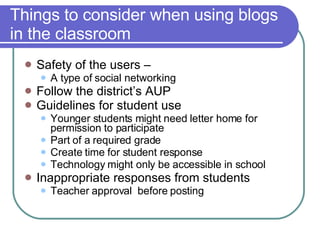
Things to consider when using blogs in the classroom Safety of the users –  A type of social networking Follow the district’s AUP  Guidelines for student use Younger students might need letter home for permission to participate Part of a required grade Create time for student response  Technology might only be accessible in school  Inappropriate responses from students Teacher approval  before posting
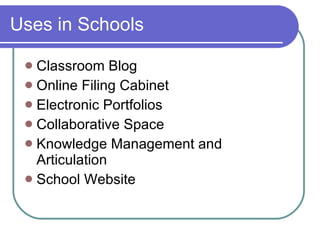
Uses in Schools Classroom Blog Online Filing Cabinet Electronic Portfolios Collaborative Space Knowledge Management and Articulation School Website
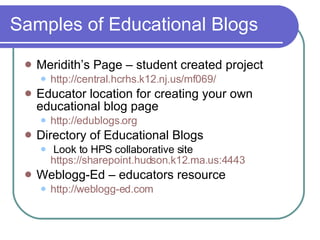
Samples of Educational Blogs Meridith’s Page – student created project http://central.hcrhs.k12.nj.us/mf069/ Educator location for creating your own educational blog page http:// edublogs.org Directory of Educational Blogs  Look to HPS collaborative site  https://sharepoint.hudson.k12.ma.us:4443 Weblogg-Ed – educators resource http://weblogg-ed.com
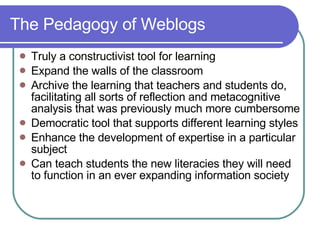
The Pedagogy of Weblogs Truly a constructivist tool for learning Expand the walls of the classroom Archive the learning that teachers and students do, facilitating all sorts of reflection and metacognitive analysis that was previously much more cumbersome Democratic tool that supports different learning styles Enhance the development of expertise in a particular subject Can teach students the new literacies they will need to function in an ever expanding information society

What Is A Blog

  • 1.
    What is aBlog? A Blog is a frequently updated online journal, in chronological order, used to post reflections, comments, pictures and hyperlinks A Blog is really a weblog – an easy publishing tool used to: Create journals Build resource sites with colleagues Filter the news of the day Comprised of reflections and conversations Engage readers with ideas and questions and links Demands interaction Free
  • 2.
    Blog Terminology Weblog-nota run of the mill website, but engages readers with ideas, reflections, & links RSS-Real Simple Syndication Aggregator sorts and collects RSS feeds into one central location Google reader is a common aggregator www.Google.com/reader – use that section of Google to subscribe to your RSS feeds Avatar-A virtual representation of a person Widgets-A mini application to be used in a blog
  • 3.
    Pros ofblogging in educational settings Promote critical and analytical thinking Be a powerful promoter of creative, intuitive, and associational thinking Promote analogical thinking Be a powerful medium for increasing access and exposure to quality information Combine the best of solitary reflection and social interaction
  • 4.
    Things to considerwhen using blogs in the classroom Safety of the users – A type of social networking Follow the district’s AUP Guidelines for student use Younger students might need letter home for permission to participate Part of a required grade Create time for student response Technology might only be accessible in school Inappropriate responses from students Teacher approval before posting
  • 5.
    Uses in SchoolsClassroom Blog Online Filing Cabinet Electronic Portfolios Collaborative Space Knowledge Management and Articulation School Website
  • 6.
    Samples of EducationalBlogs Meridith’s Page – student created project http://central.hcrhs.k12.nj.us/mf069/ Educator location for creating your own educational blog page http:// edublogs.org Directory of Educational Blogs Look to HPS collaborative site https://sharepoint.hudson.k12.ma.us:4443 Weblogg-Ed – educators resource http://weblogg-ed.com
  • 7.
    The Pedagogy ofWeblogs Truly a constructivist tool for learning Expand the walls of the classroom Archive the learning that teachers and students do, facilitating all sorts of reflection and metacognitive analysis that was previously much more cumbersome Democratic tool that supports different learning styles Enhance the development of expertise in a particular subject Can teach students the new literacies they will need to function in an ever expanding information society