Euler-Fermat theorem
Dr. Kuparala Venkata
Vidyasagar
Lecturer in Mathematics
SVLNS Govt. Degree
College,
Bheemunipatnam
LEARNING OUTCOMES
๏ƒผFermatโ€™s theorem
๏ƒผCorollary ON Fermatโ€™s theorem
๏ƒผSet of residues modulo ๐‘š
๏ƒผReduced set of residues modulo ๐‘š
๏ƒผTheorems based on residue modulo m
๏ƒผEuler's theorem or Euler's generalization of
Fermat's theorem
๏ƒผFermat's theorem from Euler's theorem
๏ƒผExamples
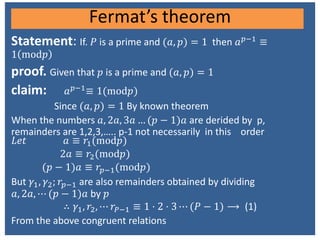
Fermatโ€™s theorem
Statement: If. ๐‘ƒ is a prime and (๐‘Ž, ๐‘) = 1 then ๐‘Ž๐‘โˆ’1 โ‰ก
1 mod๐‘
proof. Given that ๐‘ is a prime and (๐‘Ž, ๐‘) = 1
claim: ๐‘Ž๐‘โˆ’1
โ‰ก 1(mod๐‘)
Since (๐‘Ž, ๐‘) = 1 By known theorem
When the numbers ๐‘Ž, 2๐‘Ž, 3๐‘Ž โ€ฆ (๐‘ โˆ’ 1)๐‘Ž are derided by p,
remainders are 1,2,3,โ€ฆ.. p-1 not necessarily in this order
๐ฟ๐‘’๐‘ก ๐‘Ž โ‰ก ๐‘Ÿ1(mod๐‘)
2๐‘Ž โ‰ก ๐‘Ÿ2(mod๐‘)
(๐‘ โˆ’ 1)๐‘Ž โ‰ก ๐‘Ÿ๐‘โˆ’1(mod๐‘)
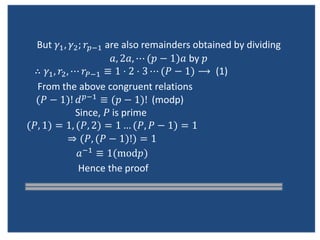
But ๐›พ1, ๐›พ2; ๐‘Ÿ๐‘โˆ’1 are also remainders obtained by dividing
๐‘Ž, 2๐‘Ž, โ‹ฏ (๐‘ โˆ’ 1)๐‘Ž by ๐‘
โˆด ๐›พ1, ๐‘Ÿ2, โ‹ฏ ๐‘Ÿ๐‘ƒโˆ’1 โ‰ก 1 โ‹… 2 โ‹… 3 โ‹ฏ (๐‘ƒ โˆ’ 1) โŸถ (1)
From the above congruent relations
But ๐›พ1, ๐›พ2; ๐‘Ÿ๐‘โˆ’1 are also remainders obtained by dividing
๐‘Ž, 2๐‘Ž, โ‹ฏ (๐‘ โˆ’ 1)๐‘Ž by ๐‘
โˆด ๐›พ1, ๐‘Ÿ2, โ‹ฏ ๐‘Ÿ๐‘ƒโˆ’1 โ‰ก 1 โ‹… 2 โ‹… 3 โ‹ฏ (๐‘ƒ โˆ’ 1) โŸถ (1)
From the above congruent relations
(๐‘ƒ โˆ’ 1)! ๐‘‘๐‘โˆ’1 โ‰ก (๐‘ โˆ’ 1)! (modp)
Since, ๐‘ƒ is prime
(๐‘ƒ, 1) = 1, (๐‘ƒ, 2) = 1 โ€ฆ (๐‘ƒ, ๐‘ƒ โˆ’ 1) = 1
โ‡’ (๐‘ƒ, (๐‘ƒ โˆ’ 1)!) = 1
๐‘Žโˆ’1 โ‰ก 1(mod๐‘)
Hence the proof
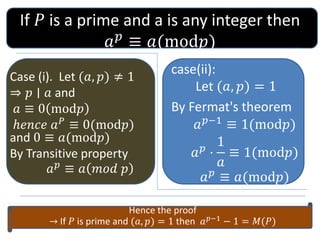
If ๐‘ƒ is a prime and a is any integer then
๐‘Ž๐‘
โ‰ก ๐‘Ž(mod๐‘)
Case (i). Let (๐‘Ž, ๐‘) โ‰  1
โ‡’ ๐‘ โˆฃ ๐‘Ž and
๐‘Ž โ‰ก 0 mod๐‘
โ„Ž๐‘’๐‘›๐‘๐‘’ ๐‘Ž๐‘ƒ
โ‰ก 0(mod๐‘)
and 0 โ‰ก ๐‘Ž(mod๐‘)
By Transitive property
๐‘Ž๐‘
โ‰ก ๐‘Ž ๐‘š๐‘œ๐‘‘ ๐‘
case(ii):
Let (๐‘Ž, ๐‘) = 1
By Fermat's theorem
๐‘Ž๐‘โˆ’1
โ‰ก 1(mod๐‘)
๐‘Ž๐‘
โ‹…
1
๐‘Ž
โ‰ก 1(mod๐‘)
๐‘Ž๐‘
โ‰ก ๐‘Ž(mod๐‘)
Hence the proof
โ†’ If ๐‘ƒ is prime and (๐‘Ž, ๐‘) = 1 then ๐‘Ž๐‘โˆ’1 โˆ’ 1 = ๐‘€(๐‘ƒ)
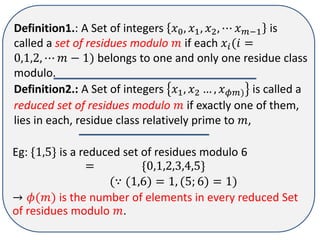
Definition1.: A Set of integers ๐‘ฅ0, ๐‘ฅ1, ๐‘ฅ2, โ‹ฏ ๐‘ฅ๐‘šโˆ’1 is
called a set of residues modulo ๐‘š if each ๐‘ฅ๐‘–(๐‘– =
0,1,2, โ‹ฏ ๐‘š โˆ’ 1) belongs to one and only one residue class
modulo.
Definition2.: A Set of integers ๐‘ฅ1, ๐‘ฅ2 โ€ฆ , ๐‘ฅ๐œ™๐‘š) is called a
reduced set of residues modulo ๐‘š if exactly one of them,
lies in each, residue class relatively prime to ๐‘š,
Eg: {1,5} is a reduced set of residues modulo 6
= {0,1,2,3,4,5}
(โˆต (1,6) = 1, (5; 6) = 1)
โ†’ ๐œ™(๐‘š) is the number of elements in every reduced Set
of residues modulo ๐‘š.
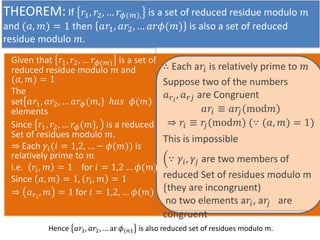
THEOREM: If ๐‘Ÿ1, ๐‘Ÿ2, โ€ฆ ๐‘Ÿ๐œ™(๐‘š), is a set of reduced residue modulo ๐‘š
and (๐‘Ž, ๐‘š) = 1 then ๐‘Ž๐‘Ÿ1, ๐‘Ž๐‘Ÿ2, โ€ฆ ๐‘Ž๐‘Ÿ๐œ™(๐‘š) is also a set of reduced
residue modulo ๐‘š.
Given that ๐‘Ÿ1, ๐‘Ÿ2, โ€ฆ ๐‘Ÿ๐œ™(๐‘š) is a set of
reduced residue modulo ๐‘š and
(๐‘Ž, ๐‘š) = 1
The
set ๐‘Ž๐‘Ÿ1, ๐‘Ž๐‘Ÿ2, โ€ฆ ๐‘Ž๐‘Ÿ๐œ™(๐‘š,} โ„Ž๐‘Ž๐‘  ๐œ™(๐‘š)
elements
Since ๐‘Ÿ1, ๐‘Ÿ2, โ€ฆ ๐‘Ÿ๐œ™(๐‘š}, is a reduced
Set of residues modulo ๐‘š.
โ‡’ Each ๐›พ๐‘–(๐‘– = 1,2, โ€ฆ โˆ’ ๐œ™(๐‘š)) is
relatively prime to ๐‘š
i.e. ๐‘Ÿ๐‘–, ๐‘š = 1 for ๐‘– = 1,2 โ€ฆ ๐œ™(๐‘š)
Since ๐‘Ž, ๐‘š = 1, ๐‘Ÿ๐‘–, ๐‘š = 1
โ‡’ ๐‘Ž๐‘Ÿ๐‘–
, ๐‘š = 1 for ๐‘– = 1,2, โ€ฆ ๐œ™(๐‘š)
โˆด Each a๐‘Ÿ๐‘– is relatively prime to ๐‘š
Suppose two of the numbers
๐‘Ž๐‘Ÿ๐‘–
, ๐‘Ž๐‘Ÿ๐‘— are Congruent
๐‘Ž๐‘Ÿ๐‘– โ‰ก ๐‘Ž๐‘Ÿ
๐‘—(mod๐‘š)
โ‡’ ๐‘Ÿ๐‘– โ‰ก ๐‘Ÿ
๐‘—(mod๐‘š) (โˆต (๐‘Ž, ๐‘š) = 1)
This is impossible
โˆต ๐›พ๐‘–, ๐›พ๐‘— are two members of
reduced Set of residues modulo m
{they are incongruent)
no two elements a๐‘Ÿ๐‘–, a๐‘Ÿ
๐‘— are
congruent
Hence ๐‘Ž๐‘Ÿ1, ๐‘Ž๐‘Ÿ2, โ€ฆ ar ๐œ™(๐‘›1 is also reduced set of residues modulo m.
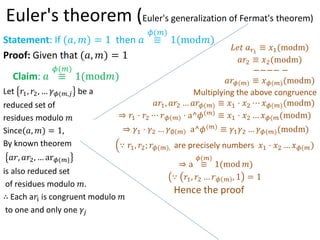
Euler's theorem (Euler's generalization of Fermat's theorem)
Statement: If (๐‘Ž, ๐‘š) = 1 then ๐‘Ž โ‰ก
๐œ™(๐‘š)
1(mod๐‘š)
Proof: Given that (๐‘Ž, ๐‘š) = 1
Claim: ๐‘Ž โ‰ก
๐œ™(๐‘š)
1(mod๐‘š)
Let ๐‘Ÿ1, ๐‘Ÿ2, โ€ฆ ๐›พ๐œ™(๐‘š,๐‘— be a
reduced set of
residues modulo ๐‘š
Since(๐‘Ž, ๐‘š) = 1,
By known theorem
๐‘Ž๐‘Ÿ, ๐‘Ž๐‘Ÿ2, โ€ฆ ar๐œ™(๐‘š}
is also reduced set
of residues modulo ๐‘š.
โˆด Each a๐‘Ÿi is congruent modulo ๐‘š
to one and only one ๐›พ๐‘—
๐ฟ๐‘’๐‘ก ๐‘Ž๐‘Ÿ1
โ‰ก ๐‘ฅ1(modm)
๐‘Ž๐‘Ÿ2 โ‰ก ๐‘ฅ2(modm)
โˆ’โˆ’โˆ’โˆ’ โˆ’
๐‘Ž๐‘Ÿ๐œ™(๐‘š) โ‰ก ๐‘ฅ๐œ™(๐‘š)(modm)
Multiplying the above congruence
๐‘Ž๐‘Ÿ1, ๐‘Ž๐‘Ÿ2 โ€ฆ ๐‘Ž๐‘Ÿ๐œ™(๐‘š) โ‰ก ๐‘ฅ1 โ‹… ๐‘ฅ2 โ‹ฏ ๐‘ฅ๐œ™(๐‘š)(modm)
โ‡’ ๐‘Ÿ1 โ‹… ๐‘Ÿ2 โ‹ฏ ๐‘Ÿ๐œ™ ๐‘š โ‹… a^๐œ™(๐‘š) โ‰ก ๐‘ฅ1 โ‹… ๐‘ฅ2 โ€ฆ ๐‘ฅ๐œ™(๐‘š(modm)
โ‡’ ๐›พ1 โ‹… ๐›พ2 โ€ฆ ๐›พโˆ… ๐‘š a^๐œ™(๐‘š) โ‰ก ๐›พ1๐›พ2 โ€ฆ ๐›พ๐œ™(๐‘š)(modm)
โˆต ๐‘Ÿ1, ๐‘Ÿ2; ๐‘Ÿ๐œ™(๐‘š), are precisely numbers ๐‘ฅ1 โ‹… ๐‘ฅ2 โ€ฆ ๐‘ฅ๐œ™(๐‘š)
โ‡’ a โ‰ก
๐œ™(๐‘š)
1(mod ๐‘š)
โˆต ๐‘Ÿ1, ๐‘Ÿ2 โ€ฆ ๐‘Ÿ๐œ™ ๐‘š , 1 = 1
Hence the proof
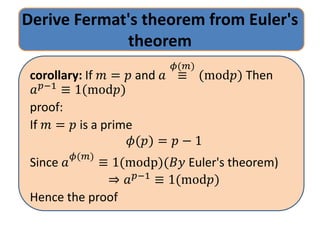
Derive Fermat's theorem from Euler's
theorem
corollary: If ๐‘š = ๐‘ and ๐‘Ž โ‰ก
๐œ™(๐‘š)
(mod๐‘) Then
๐‘Ž๐‘โˆ’1
โ‰ก 1(mod๐‘)
proof:
If ๐‘š = ๐‘ is a prime
๐œ™(๐‘) = ๐‘ โˆ’ 1
Since ๐‘Ž
๐œ™(๐‘š)
โ‰ก 1(modp)(๐ต๐‘ฆ Euler's theorem)
โ‡’ ๐‘Ž๐‘โˆ’1
โ‰ก 1(mod๐‘)
Hence the proof
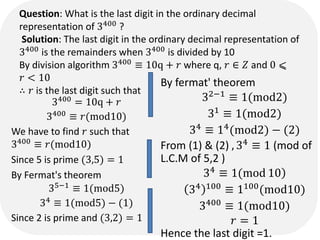
Question: What is the last digit in the ordinary decimal
representation of 3400
?
Solution: The last digit in the ordinary decimal representation of
3400
is the remainders when 3400
is divided by 10
By division algorithm 3400 โ‰ก 10q + ๐‘Ÿ where q, ๐‘Ÿ โˆˆ ๐‘ and 0 โฉฝ
๐‘Ÿ < 10
โˆด ๐‘Ÿ is the last digit such that
3400 = 10q + ๐‘Ÿ
3400
โ‰ก ๐‘Ÿ(mod10)
We have to find ๐‘Ÿ such that
3400 โ‰ก ๐‘Ÿ(mod10)
Since 5 is prime (3,5) = 1
By Fermat's theorem
35โˆ’1
โ‰ก 1(mod5)
34 โ‰ก 1(mod5) โˆ’ (1)
Since 2 is prime and (3,2) = 1
By fermat' theorem
32โˆ’1
โ‰ก 1(mod2)
31 โ‰ก 1(mod2)
34 โ‰ก 14(mod2) โˆ’ (2)
From (1) & (2) , 34
โ‰ก 1 (mod of
L.C.M of 5,2 )
)
34
โ‰ก 1(mod 10
34 100
โ‰ก 1100
(mod10)
3400
โ‰ก 1(mod10)
๐‘Ÿ = 1
Hence the last digit =1.
Euler-Fermat theorem.pptx

Euler-Fermat theorem.pptx

  • 1.
    Euler-Fermat theorem Dr. KuparalaVenkata Vidyasagar Lecturer in Mathematics SVLNS Govt. Degree College, Bheemunipatnam
  • 2.
    LEARNING OUTCOMES ๏ƒผFermatโ€™s theorem ๏ƒผCorollaryON Fermatโ€™s theorem ๏ƒผSet of residues modulo ๐‘š ๏ƒผReduced set of residues modulo ๐‘š ๏ƒผTheorems based on residue modulo m ๏ƒผEuler's theorem or Euler's generalization of Fermat's theorem ๏ƒผFermat's theorem from Euler's theorem ๏ƒผExamples
  • 3.
    Fermatโ€™s theorem Statement: If.๐‘ƒ is a prime and (๐‘Ž, ๐‘) = 1 then ๐‘Ž๐‘โˆ’1 โ‰ก 1 mod๐‘ proof. Given that ๐‘ is a prime and (๐‘Ž, ๐‘) = 1 claim: ๐‘Ž๐‘โˆ’1 โ‰ก 1(mod๐‘) Since (๐‘Ž, ๐‘) = 1 By known theorem When the numbers ๐‘Ž, 2๐‘Ž, 3๐‘Ž โ€ฆ (๐‘ โˆ’ 1)๐‘Ž are derided by p, remainders are 1,2,3,โ€ฆ.. p-1 not necessarily in this order ๐ฟ๐‘’๐‘ก ๐‘Ž โ‰ก ๐‘Ÿ1(mod๐‘) 2๐‘Ž โ‰ก ๐‘Ÿ2(mod๐‘) (๐‘ โˆ’ 1)๐‘Ž โ‰ก ๐‘Ÿ๐‘โˆ’1(mod๐‘) But ๐›พ1, ๐›พ2; ๐‘Ÿ๐‘โˆ’1 are also remainders obtained by dividing ๐‘Ž, 2๐‘Ž, โ‹ฏ (๐‘ โˆ’ 1)๐‘Ž by ๐‘ โˆด ๐›พ1, ๐‘Ÿ2, โ‹ฏ ๐‘Ÿ๐‘ƒโˆ’1 โ‰ก 1 โ‹… 2 โ‹… 3 โ‹ฏ (๐‘ƒ โˆ’ 1) โŸถ (1) From the above congruent relations
  • 4.
    But ๐›พ1, ๐›พ2;๐‘Ÿ๐‘โˆ’1 are also remainders obtained by dividing ๐‘Ž, 2๐‘Ž, โ‹ฏ (๐‘ โˆ’ 1)๐‘Ž by ๐‘ โˆด ๐›พ1, ๐‘Ÿ2, โ‹ฏ ๐‘Ÿ๐‘ƒโˆ’1 โ‰ก 1 โ‹… 2 โ‹… 3 โ‹ฏ (๐‘ƒ โˆ’ 1) โŸถ (1) From the above congruent relations (๐‘ƒ โˆ’ 1)! ๐‘‘๐‘โˆ’1 โ‰ก (๐‘ โˆ’ 1)! (modp) Since, ๐‘ƒ is prime (๐‘ƒ, 1) = 1, (๐‘ƒ, 2) = 1 โ€ฆ (๐‘ƒ, ๐‘ƒ โˆ’ 1) = 1 โ‡’ (๐‘ƒ, (๐‘ƒ โˆ’ 1)!) = 1 ๐‘Žโˆ’1 โ‰ก 1(mod๐‘) Hence the proof
  • 5.
    If ๐‘ƒ isa prime and a is any integer then ๐‘Ž๐‘ โ‰ก ๐‘Ž(mod๐‘) Case (i). Let (๐‘Ž, ๐‘) โ‰  1 โ‡’ ๐‘ โˆฃ ๐‘Ž and ๐‘Ž โ‰ก 0 mod๐‘ โ„Ž๐‘’๐‘›๐‘๐‘’ ๐‘Ž๐‘ƒ โ‰ก 0(mod๐‘) and 0 โ‰ก ๐‘Ž(mod๐‘) By Transitive property ๐‘Ž๐‘ โ‰ก ๐‘Ž ๐‘š๐‘œ๐‘‘ ๐‘ case(ii): Let (๐‘Ž, ๐‘) = 1 By Fermat's theorem ๐‘Ž๐‘โˆ’1 โ‰ก 1(mod๐‘) ๐‘Ž๐‘ โ‹… 1 ๐‘Ž โ‰ก 1(mod๐‘) ๐‘Ž๐‘ โ‰ก ๐‘Ž(mod๐‘) Hence the proof โ†’ If ๐‘ƒ is prime and (๐‘Ž, ๐‘) = 1 then ๐‘Ž๐‘โˆ’1 โˆ’ 1 = ๐‘€(๐‘ƒ)
  • 6.
    Definition1.: A Setof integers ๐‘ฅ0, ๐‘ฅ1, ๐‘ฅ2, โ‹ฏ ๐‘ฅ๐‘šโˆ’1 is called a set of residues modulo ๐‘š if each ๐‘ฅ๐‘–(๐‘– = 0,1,2, โ‹ฏ ๐‘š โˆ’ 1) belongs to one and only one residue class modulo. Definition2.: A Set of integers ๐‘ฅ1, ๐‘ฅ2 โ€ฆ , ๐‘ฅ๐œ™๐‘š) is called a reduced set of residues modulo ๐‘š if exactly one of them, lies in each, residue class relatively prime to ๐‘š, Eg: {1,5} is a reduced set of residues modulo 6 = {0,1,2,3,4,5} (โˆต (1,6) = 1, (5; 6) = 1) โ†’ ๐œ™(๐‘š) is the number of elements in every reduced Set of residues modulo ๐‘š.
  • 7.
    THEOREM: If ๐‘Ÿ1,๐‘Ÿ2, โ€ฆ ๐‘Ÿ๐œ™(๐‘š), is a set of reduced residue modulo ๐‘š and (๐‘Ž, ๐‘š) = 1 then ๐‘Ž๐‘Ÿ1, ๐‘Ž๐‘Ÿ2, โ€ฆ ๐‘Ž๐‘Ÿ๐œ™(๐‘š) is also a set of reduced residue modulo ๐‘š. Given that ๐‘Ÿ1, ๐‘Ÿ2, โ€ฆ ๐‘Ÿ๐œ™(๐‘š) is a set of reduced residue modulo ๐‘š and (๐‘Ž, ๐‘š) = 1 The set ๐‘Ž๐‘Ÿ1, ๐‘Ž๐‘Ÿ2, โ€ฆ ๐‘Ž๐‘Ÿ๐œ™(๐‘š,} โ„Ž๐‘Ž๐‘  ๐œ™(๐‘š) elements Since ๐‘Ÿ1, ๐‘Ÿ2, โ€ฆ ๐‘Ÿ๐œ™(๐‘š}, is a reduced Set of residues modulo ๐‘š. โ‡’ Each ๐›พ๐‘–(๐‘– = 1,2, โ€ฆ โˆ’ ๐œ™(๐‘š)) is relatively prime to ๐‘š i.e. ๐‘Ÿ๐‘–, ๐‘š = 1 for ๐‘– = 1,2 โ€ฆ ๐œ™(๐‘š) Since ๐‘Ž, ๐‘š = 1, ๐‘Ÿ๐‘–, ๐‘š = 1 โ‡’ ๐‘Ž๐‘Ÿ๐‘– , ๐‘š = 1 for ๐‘– = 1,2, โ€ฆ ๐œ™(๐‘š) โˆด Each a๐‘Ÿ๐‘– is relatively prime to ๐‘š Suppose two of the numbers ๐‘Ž๐‘Ÿ๐‘– , ๐‘Ž๐‘Ÿ๐‘— are Congruent ๐‘Ž๐‘Ÿ๐‘– โ‰ก ๐‘Ž๐‘Ÿ ๐‘—(mod๐‘š) โ‡’ ๐‘Ÿ๐‘– โ‰ก ๐‘Ÿ ๐‘—(mod๐‘š) (โˆต (๐‘Ž, ๐‘š) = 1) This is impossible โˆต ๐›พ๐‘–, ๐›พ๐‘— are two members of reduced Set of residues modulo m {they are incongruent) no two elements a๐‘Ÿ๐‘–, a๐‘Ÿ ๐‘— are congruent Hence ๐‘Ž๐‘Ÿ1, ๐‘Ž๐‘Ÿ2, โ€ฆ ar ๐œ™(๐‘›1 is also reduced set of residues modulo m.
  • 8.
    Euler's theorem (Euler'sgeneralization of Fermat's theorem) Statement: If (๐‘Ž, ๐‘š) = 1 then ๐‘Ž โ‰ก ๐œ™(๐‘š) 1(mod๐‘š) Proof: Given that (๐‘Ž, ๐‘š) = 1 Claim: ๐‘Ž โ‰ก ๐œ™(๐‘š) 1(mod๐‘š) Let ๐‘Ÿ1, ๐‘Ÿ2, โ€ฆ ๐›พ๐œ™(๐‘š,๐‘— be a reduced set of residues modulo ๐‘š Since(๐‘Ž, ๐‘š) = 1, By known theorem ๐‘Ž๐‘Ÿ, ๐‘Ž๐‘Ÿ2, โ€ฆ ar๐œ™(๐‘š} is also reduced set of residues modulo ๐‘š. โˆด Each a๐‘Ÿi is congruent modulo ๐‘š to one and only one ๐›พ๐‘— ๐ฟ๐‘’๐‘ก ๐‘Ž๐‘Ÿ1 โ‰ก ๐‘ฅ1(modm) ๐‘Ž๐‘Ÿ2 โ‰ก ๐‘ฅ2(modm) โˆ’โˆ’โˆ’โˆ’ โˆ’ ๐‘Ž๐‘Ÿ๐œ™(๐‘š) โ‰ก ๐‘ฅ๐œ™(๐‘š)(modm) Multiplying the above congruence ๐‘Ž๐‘Ÿ1, ๐‘Ž๐‘Ÿ2 โ€ฆ ๐‘Ž๐‘Ÿ๐œ™(๐‘š) โ‰ก ๐‘ฅ1 โ‹… ๐‘ฅ2 โ‹ฏ ๐‘ฅ๐œ™(๐‘š)(modm) โ‡’ ๐‘Ÿ1 โ‹… ๐‘Ÿ2 โ‹ฏ ๐‘Ÿ๐œ™ ๐‘š โ‹… a^๐œ™(๐‘š) โ‰ก ๐‘ฅ1 โ‹… ๐‘ฅ2 โ€ฆ ๐‘ฅ๐œ™(๐‘š(modm) โ‡’ ๐›พ1 โ‹… ๐›พ2 โ€ฆ ๐›พโˆ… ๐‘š a^๐œ™(๐‘š) โ‰ก ๐›พ1๐›พ2 โ€ฆ ๐›พ๐œ™(๐‘š)(modm) โˆต ๐‘Ÿ1, ๐‘Ÿ2; ๐‘Ÿ๐œ™(๐‘š), are precisely numbers ๐‘ฅ1 โ‹… ๐‘ฅ2 โ€ฆ ๐‘ฅ๐œ™(๐‘š) โ‡’ a โ‰ก ๐œ™(๐‘š) 1(mod ๐‘š) โˆต ๐‘Ÿ1, ๐‘Ÿ2 โ€ฆ ๐‘Ÿ๐œ™ ๐‘š , 1 = 1 Hence the proof
  • 9.
    Derive Fermat's theoremfrom Euler's theorem corollary: If ๐‘š = ๐‘ and ๐‘Ž โ‰ก ๐œ™(๐‘š) (mod๐‘) Then ๐‘Ž๐‘โˆ’1 โ‰ก 1(mod๐‘) proof: If ๐‘š = ๐‘ is a prime ๐œ™(๐‘) = ๐‘ โˆ’ 1 Since ๐‘Ž ๐œ™(๐‘š) โ‰ก 1(modp)(๐ต๐‘ฆ Euler's theorem) โ‡’ ๐‘Ž๐‘โˆ’1 โ‰ก 1(mod๐‘) Hence the proof
  • 10.
    Question: What isthe last digit in the ordinary decimal representation of 3400 ? Solution: The last digit in the ordinary decimal representation of 3400 is the remainders when 3400 is divided by 10 By division algorithm 3400 โ‰ก 10q + ๐‘Ÿ where q, ๐‘Ÿ โˆˆ ๐‘ and 0 โฉฝ ๐‘Ÿ < 10 โˆด ๐‘Ÿ is the last digit such that 3400 = 10q + ๐‘Ÿ 3400 โ‰ก ๐‘Ÿ(mod10) We have to find ๐‘Ÿ such that 3400 โ‰ก ๐‘Ÿ(mod10) Since 5 is prime (3,5) = 1 By Fermat's theorem 35โˆ’1 โ‰ก 1(mod5) 34 โ‰ก 1(mod5) โˆ’ (1) Since 2 is prime and (3,2) = 1 By fermat' theorem 32โˆ’1 โ‰ก 1(mod2) 31 โ‰ก 1(mod2) 34 โ‰ก 14(mod2) โˆ’ (2) From (1) & (2) , 34 โ‰ก 1 (mod of L.C.M of 5,2 ) ) 34 โ‰ก 1(mod 10 34 100 โ‰ก 1100 (mod10) 3400 โ‰ก 1(mod10) ๐‘Ÿ = 1 Hence the last digit =1.