












Async Code Reviews Are Killing
Your Company’s Throughput
● Principal@HelloFresh
● Ex: @Careem/Uber,
@GetYourGuide
● Rants on
○ draganstepanovic.com
○ @d_stepanovic
● I put mayo on 🍕 😱
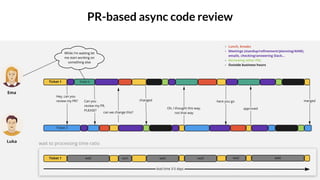
PR-based async code review
Meet people where they are
What was I curious to see?
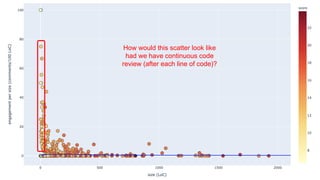
● Engagement
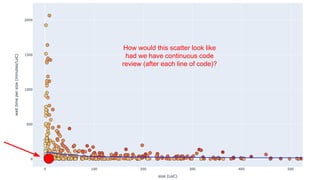
● Wait Time
● Size
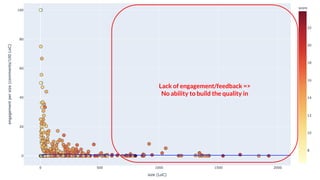
Engagement
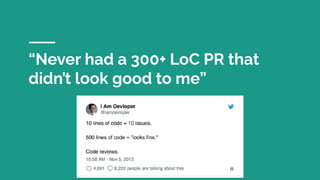
“Never had a 300+ LoC PR that
didn’t look good to me”
~ Anonymous Developer
Why was I curious about the engagement?
● Feedback delayed and ‘choked’ by the system
● High-latency, low-throughput feedback
vs
Low-latency, high-throughput feedback
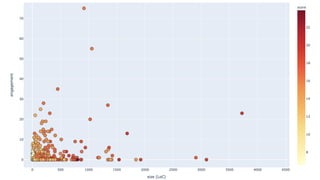
● Engagement by size?
○ Only counting non-trivial comments (no LGTM)
Lack of engagement/feedback =>
No ability to build the quality in
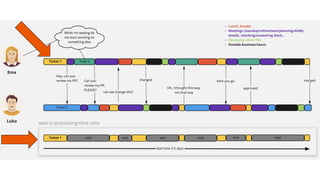
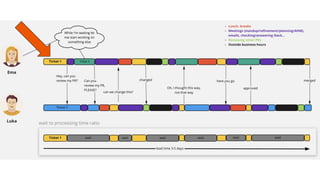
Wait time
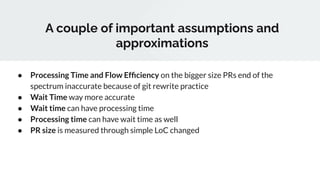
A couple of important assumptions and
approximations
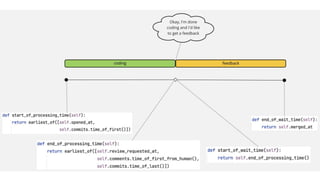
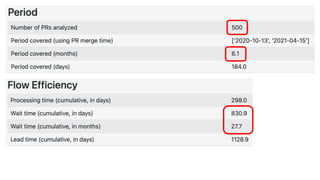
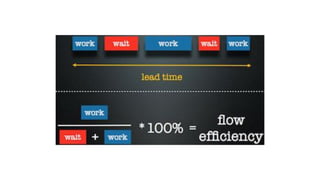
● Processing Time and Flow Efficiency on the bigger size PRs end of the
spectrum inaccurate because of git rewrite practice
● Wait Time way more accurate
● Wait time can have processing time
● Processing time can have wait time as well
● PR size is measured through simple LoC changed
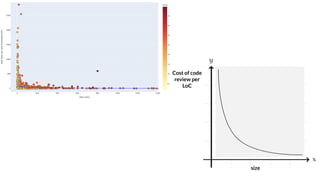
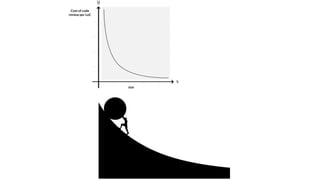
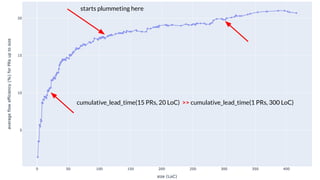
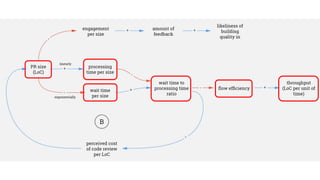
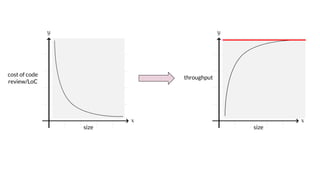
Cost of code
review per
LoC
size
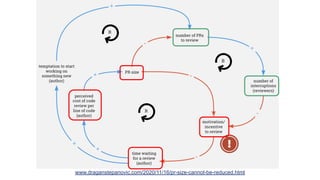
www.draganstepanovic.com/2020/11/16/pr-size-cannot-be-reduced.html
starts plummeting here
cumulative_lead_time(15 PRs, 20 LoC) >> cumulative_lead_time(1 PRs, 300 LoC)
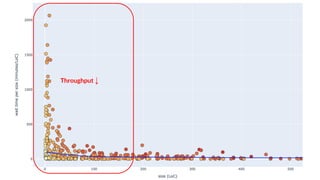
Throughput ↓
"A 100% utilized
highway is a
parking lot."
~ Mary Poppendieck
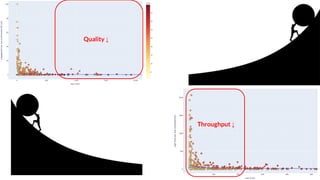
Throughput ↓
Quality ↓
https://lastcallmedia.com/blog/why-devops-most-important-tech-strategy-today
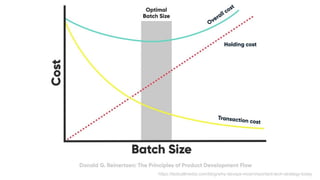
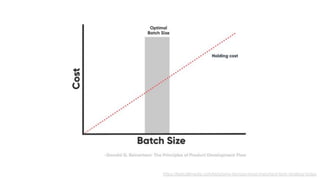
There’s always a trade-off
Some trade-offs exist only
because of a flawed underlying
assumption
https://sircharlescaryinc.com/having-your-cake-and-eating-it-too/
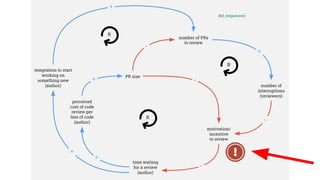
cost of code
review/LoC
size
throughput
size
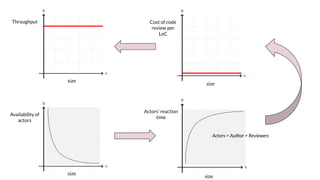
Cost of code
review per
LoC
size
Actors’ reaction
time
size
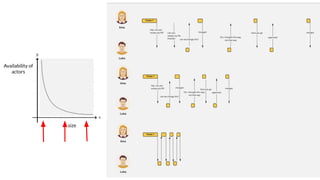
Availability of
actors
size
Actors = Author + Reviewers
Throughput
size
Availability of
actors
size
In order to not exponentially lose the
throughput while reducing the
average size of a PR
People need to get exponentially
closer and closer in time
You cannot be
interrupted if you’re not
doing anything else
https://i.ytimg.com/vi/2TUza5C2uJ8/maxresdefault.jpg
Enter Co-creation patterns
https://en.wikipedia.org/wiki/Mob_programming https://www.codefellows.org/blog/6-reasons-for-pair-programming/
https://lastcallmedia.com/blog/why-devops-most-important-tech-strategy-today
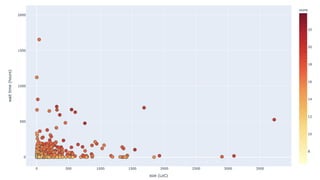
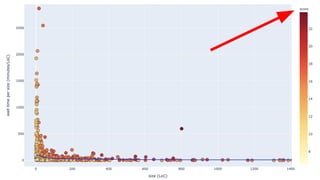
How would this scatter look like
had we have continuous code
review (after each line of code)?
How would this scatter look like
had we have continuous code
review (after each line of code)?
Both Throughput AND Quality
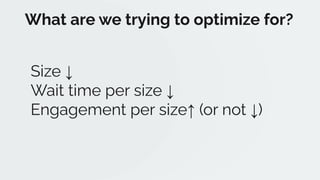
PR Score
Size ↓
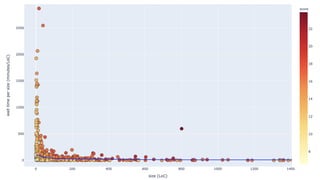
Wait time per size ↓
Engagement per size↑ (or not ↓)
What are we trying to optimize for?
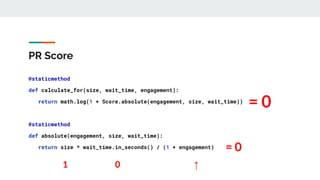
PR Score
@staticmethod
def calculate_for(size, wait_time, engagement):
return math.log(1 + Score.absolute(engagement, size, wait_time))
@staticmethod
def absolute(engagement, size, wait_time):
return size * wait_time.in_seconds() / (1 + engagement)
1 ↑
0
= 0
= 0
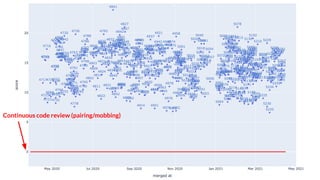
The optimal size of Pull Request is one
LoC that is reviewed immediately.
It's called Pair/Mob programming.
Continuous code review (pairing/mobbing)
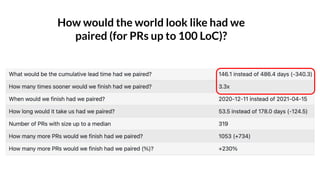
How would the world look like had we
paired (for PRs up to 100 LoC)?
We’ve been told all along that
we’ll achieve more if we limit
and delay our interactions
Hope you now have (also)
a data-informed reason to
not believe that
We’ve been told all along that
we’ll achieve more if we limit
and delay our interactions
● If you’re interested in trying out the tool for free drop me a line at:
dragan.stepanovic@gmail.com
○ The need for the tool is what is charged
○ Helps you change the process so you don’t have the need for the tool anymore
○ The same way that TDD renders obsolete the need for code coverage tools
● Only Github supported currently
● I’m writing a book (intersection of XP, Lean, ToC, Systems Thinking)
● If you’d like me to speak to your community about this topic, Small Batches and/or Intro to
ToC, Systemic Advantages of co-creation, feel free to reach out
@d_stepanovic

Async Code Reviews Are Killing Your Company’s Throughput - Dragan Stepanović