Protecting Artificial
Intelligence/Machine Learning
Inventions in the United States
Knobbe Japan Practice Series
November 19, 2021
Mauricio Uribe
mauricio.uribe@knobbe.com
Kenny Masaki
kenny.masaki@knobbe.com
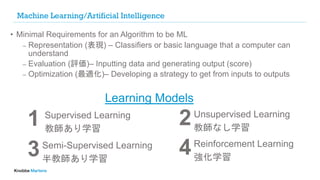
Machine Learning/Artificial Intelligence
• Minimal Requirements for an Algorithm to be ML
⎼ Representation (表現) – Classifiers or basic language that a computer can
understand
⎼ Evaluation (評価)– Inputting data and generating output (score)
⎼ Optimization (最適化)– Developing a strategy to get from inputs to outputs
1 Supervised Learning
教師あり学習
2Unsupervised Learning
教師なし学習
3Semi-Supervised Learning
半教師あり学習
4Reinforcement Learning
強化学習
Learning Models
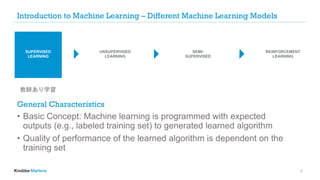
Introduction to Machine Learning – Different Machine Learning Models
General Characteristics
• Basic Concept: Machine learning is programmed with expected
outputs (e.g., labeled training set) to generated learned algorithm
• Quality of performance of the learned algorithm is dependent on the
training set
3
SUPERVISED
LEARNING
UNSUPERVISED
LEARNING
SEMI-
SUPERVISED
REINFORCEMENT
LEARNING
教師あり学習
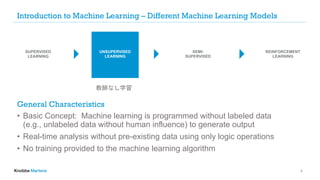
Introduction to Machine Learning – Different Machine Learning Models
General Characteristics
• Basic Concept: Machine learning is programmed without labeled data
(e.g., unlabeled data without human influence) to generate output
• Real-time analysis without pre-existing data using only logic operations
• No training provided to the machine learning algorithm
4
SUPERVISED
LEARNING
UNSUPERVISED
LEARNING
SEMI-
SUPERVISED
REINFORCEMENT
LEARNING
教師なし学習
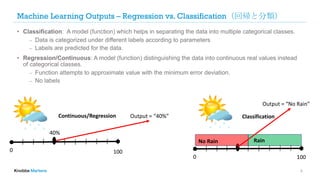
Machine Learning Outputs – Regression vs. Classification(回帰と分類)
• Classification: A model (function) which helps in separating the data into multiple categorical classes.
⎼ Data is categorized under different labels according to parameters
⎼ Labels are predicted for the data.
• Regression/Continuous: A model (function) distinguishing the data into continuous real values instead
of categorical classes.
⎼ Function attempts to approximate value with the minimum error deviation.
⎼ No labels
5
0 100
40%
0 100
Continuous/Regression Classification
No Rain Rain
Output = “40%”
Output = “No Rain”
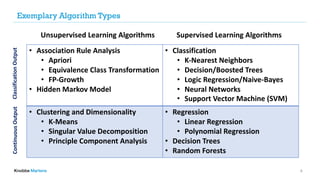
Exemplary Algorithm Types
6
• Association Rule Analysis
• Apriori
• Equivalence Class Transformation
• FP-Growth
• Hidden Markov Model
• Classification
• K-Nearest Neighbors
• Decision/Boosted Trees
• Logic Regression/Naive-Bayes
• Neural Networks
• Support Vector Machine (SVM)
• Clustering and Dimensionality
• K-Means
• Singular Value Decomposition
• Principle Component Analysis
• Regression
• Linear Regression
• Polynomial Regression
• Decision Trees
• Random Forests
Unsupervised Learning Algorithms Supervised Learning Algorithms
Classification
Output
Continuous
Output
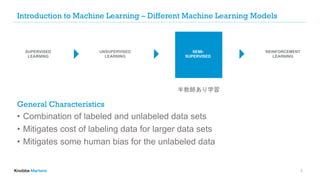
Introduction to Machine Learning – Different Machine Learning Models
General Characteristics
• Combination of labeled and unlabeled data sets
• Mitigates cost of labeling data for larger data sets
• Mitigates some human bias for the unlabeled data
7
SUPERVISED
LEARNING
UNSUPERVISED
LEARNING
SEMI-
SUPERVISED
REINFORCEMENT
LEARNING
半教師あり学習
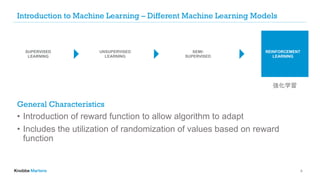
Introduction to Machine Learning – Different Machine Learning Models
General Characteristics
• Introduction of reward function to allow algorithm to adapt
• Includes the utilization of randomization of values based on reward
function
8
SUPERVISED
LEARNING
UNSUPERVISED
LEARNING
SEMI-
SUPERVISED
REINFORCEMENT
LEARNING
強化学習
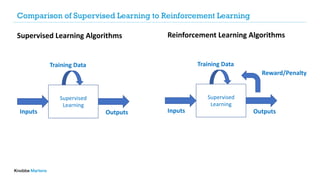
Comparison of Supervised Learning to Reinforcement Learning
Supervised Learning Algorithms Reinforcement Learning Algorithms
Supervised
Learning
Training Data
Inputs Outputs
Supervised
Learning
Training Data
Inputs Outputs
Reward/Penalty
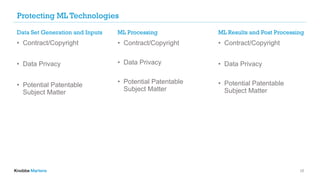
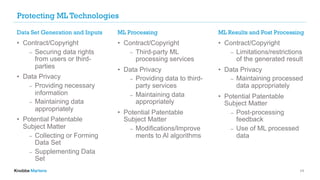
Protecting ML Technologies
10
• Contract/Copyright
• Data Privacy
• Potential Patentable
Subject Matter
• Contract/Copyright
• Data Privacy
• Potential Patentable
Subject Matter
• Contract/Copyright
• Data Privacy
• Potential Patentable
Subject Matter
Data Set Generation and Inputs ML Processing ML Results and Post Processing
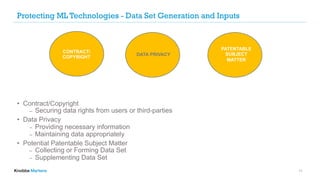
Protecting ML Technologies - Data Set Generation and Inputs
• Contract/Copyright
⎼ Securing data rights from users or third-parties
• Data Privacy
⎼ Providing necessary information
⎼ Maintaining data appropriately
• Potential Patentable Subject Matter
⎼ Collecting or Forming Data Set
⎼ Supplementing Data Set
11
CONTRACT/
COPYRIGHT
DATA PRIVACY
PATENTABLE
SUBJECT
MATTER
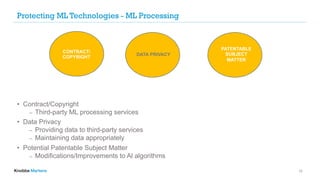
Protecting ML Technologies - ML Processing
• Contract/Copyright
⎼ Third-party ML processing services
• Data Privacy
⎼ Providing data to third-party services
⎼ Maintaining data appropriately
• Potential Patentable Subject Matter
⎼ Modifications/Improvements to Al algorithms
12
CONTRACT/
COPYRIGHT
DATA PRIVACY
PATENTABLE
SUBJECT
MATTER
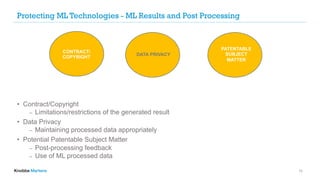
Protecting ML Technologies - ML Results and Post Processing
• Contract/Copyright
⎼ Limitations/restrictions of the generated result
• Data Privacy
⎼ Maintaining processed data appropriately
• Potential Patentable Subject Matter
⎼ Post-processing feedback
⎼ Use of ML processed data
13
CONTRACT/
COPYRIGHT
DATA PRIVACY
PATENTABLE
SUBJECT
MATTER
Protecting ML Technologies
14
• Contract/Copyright
⎼ Securing data rights
from users or third-
parties
• Data Privacy
⎼ Providing necessary
information
⎼ Maintaining data
appropriately
• Potential Patentable
Subject Matter
⎼ Collecting or Forming
Data Set
⎼ Supplementing Data
Set
• Contract/Copyright
⎼ Third-party ML
processing services
• Data Privacy
⎼ Providing data to third-
party services
⎼ Maintaining data
appropriately
• Potential Patentable
Subject Matter
⎼ Modifications/Improve
ments to Al algorithms
• Contract/Copyright
⎼ Limitations/restrictions
of the generated result
• Data Privacy
⎼ Maintaining processed
data appropriately
• Potential Patentable
Subject Matter
⎼ Post-processing
feedback
⎼ Use of ML processed
data
Data Set Generation and Inputs ML Processing ML Results and Post Processing
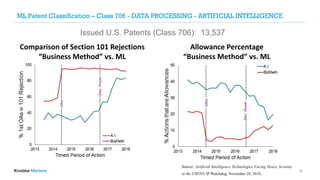
ML Patent Classification – Class 706 - DATA PROCESSING - ARTIFICIAL INTELLIGENCE
Issued U.S. Patents (Class 706): 13,537
15
Comparison of Section 101 Rejections
“Business Method” vs. ML
Allowance Percentage
“Business Method” vs. ML
Source: Artificial Intelligence Technologies Facing Heavy Scrutiny
at the USPTO, IP Watchdog, November 28, 2018.
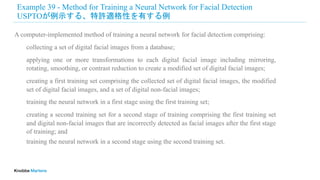
Example 39 - Method for Training a Neural Network for Facial Detection
USPTOが例示する、特許適格性を有する例
A computer-implemented method of training a neural network for facial detection comprising:
collecting a set of digital facial images from a database;
applying one or more transformations to each digital facial image including mirroring,
rotating, smoothing, or contrast reduction to create a modified set of digital facial images;
creating a first training set comprising the collected set of digital facial images, the modified
set of digital facial images, and a set of digital non-facial images;
training the neural network in a first stage using the first training set;
creating a second training set for a second stage of training comprising the first training set
and digital non-facial images that are incorrectly detected as facial images after the first stage
of training; and
training the neural network in a second stage using the second training set.
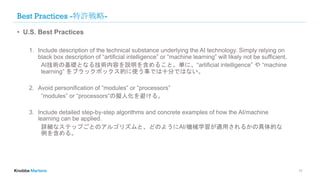
Best Practices -特許戦略-
• U.S. Best Practices
1. Include description of the technical substance underlying the AI technology. Simply relying on
black box description of “artificial intelligence” or “machine learning” will likely not be sufficient.
AI技術の基礎となる技術内容を説明を含めること。単に、“artificial intelligence” や “machine
learning” をブラックボックス的に使う事では十分ではない。
2. Avoid personification of “modules” or “processors”
“modules” or “processors”の擬人化を避ける。
3. Include detailed step-by-step algorithms and concrete examples of how the AI/machine
learning can be applied.
詳細なステップごとのアルゴリズムと、どのようにAI/機械学習が適用されるかの具体的な
例を含める。
17
Best Practices -特許戦略-
• Overlapping Best Practices Between the U.S. and Europe
1. Much of the above advice for U.S. patent applications also applies in Europe.
US特許出願に関するアドバイスの多くの部分は、欧州における出願にも当てはまる。
2. Identifying technical problems in the specification coupled with the specific, technical
solutions—and claiming those solutions—remain viable approaches for AI inventions in both
the U.S. and Europe.
明細書上、技術的な問題を、技術的な解決策と組み合わせて特定し、それらの解決策を請求
項とすることは、米国と欧州の両方において、AIの発明に対する実行可能なアプローチであ
る。
3. Describing improvements to how a computer performs machine learning or executes AI (e.g.,
by running faster, using less memory, etc.) helps both in the U.S. and Europe.
コンピューターが機械学習を実行する方法やAIを実行する方法を改善すること(たとえば、
高速で実行したり、メモリの使用量を減らすなど)は、米国と欧州の両方で役に立つ。
4. Reciting specific use cases may be specifically helpful in Europe
特定の使用例を引用することは、特に欧州においては、役に立つ。
18
Thank you!

Understanding and Protecting Artificial Intelligence Technology (Machine Learning) - Knobbe Practice Webinar Series

  • 1.
    Protecting Artificial Intelligence/Machine Learning Inventionsin the United States Knobbe Japan Practice Series November 19, 2021 Mauricio Uribe mauricio.uribe@knobbe.com Kenny Masaki kenny.masaki@knobbe.com
  • 2.
    Machine Learning/Artificial Intelligence •Minimal Requirements for an Algorithm to be ML ⎼ Representation (表現) – Classifiers or basic language that a computer can understand ⎼ Evaluation (評価)– Inputting data and generating output (score) ⎼ Optimization (最適化)– Developing a strategy to get from inputs to outputs 1 Supervised Learning 教師あり学習 2Unsupervised Learning 教師なし学習 3Semi-Supervised Learning 半教師あり学習 4Reinforcement Learning 強化学習 Learning Models
  • 3.
    Introduction to MachineLearning – Different Machine Learning Models General Characteristics • Basic Concept: Machine learning is programmed with expected outputs (e.g., labeled training set) to generated learned algorithm • Quality of performance of the learned algorithm is dependent on the training set 3 SUPERVISED LEARNING UNSUPERVISED LEARNING SEMI- SUPERVISED REINFORCEMENT LEARNING 教師あり学習
  • 4.
    Introduction to MachineLearning – Different Machine Learning Models General Characteristics • Basic Concept: Machine learning is programmed without labeled data (e.g., unlabeled data without human influence) to generate output • Real-time analysis without pre-existing data using only logic operations • No training provided to the machine learning algorithm 4 SUPERVISED LEARNING UNSUPERVISED LEARNING SEMI- SUPERVISED REINFORCEMENT LEARNING 教師なし学習
  • 5.
    Machine Learning Outputs– Regression vs. Classification(回帰と分類) • Classification: A model (function) which helps in separating the data into multiple categorical classes. ⎼ Data is categorized under different labels according to parameters ⎼ Labels are predicted for the data. • Regression/Continuous: A model (function) distinguishing the data into continuous real values instead of categorical classes. ⎼ Function attempts to approximate value with the minimum error deviation. ⎼ No labels 5 0 100 40% 0 100 Continuous/Regression Classification No Rain Rain Output = “40%” Output = “No Rain”
  • 6.
    Exemplary Algorithm Types 6 •Association Rule Analysis • Apriori • Equivalence Class Transformation • FP-Growth • Hidden Markov Model • Classification • K-Nearest Neighbors • Decision/Boosted Trees • Logic Regression/Naive-Bayes • Neural Networks • Support Vector Machine (SVM) • Clustering and Dimensionality • K-Means • Singular Value Decomposition • Principle Component Analysis • Regression • Linear Regression • Polynomial Regression • Decision Trees • Random Forests Unsupervised Learning Algorithms Supervised Learning Algorithms Classification Output Continuous Output
  • 7.
    Introduction to MachineLearning – Different Machine Learning Models General Characteristics • Combination of labeled and unlabeled data sets • Mitigates cost of labeling data for larger data sets • Mitigates some human bias for the unlabeled data 7 SUPERVISED LEARNING UNSUPERVISED LEARNING SEMI- SUPERVISED REINFORCEMENT LEARNING 半教師あり学習
  • 8.
    Introduction to MachineLearning – Different Machine Learning Models General Characteristics • Introduction of reward function to allow algorithm to adapt • Includes the utilization of randomization of values based on reward function 8 SUPERVISED LEARNING UNSUPERVISED LEARNING SEMI- SUPERVISED REINFORCEMENT LEARNING 強化学習
  • 9.
    Comparison of SupervisedLearning to Reinforcement Learning Supervised Learning Algorithms Reinforcement Learning Algorithms Supervised Learning Training Data Inputs Outputs Supervised Learning Training Data Inputs Outputs Reward/Penalty
  • 10.
    Protecting ML Technologies 10 •Contract/Copyright • Data Privacy • Potential Patentable Subject Matter • Contract/Copyright • Data Privacy • Potential Patentable Subject Matter • Contract/Copyright • Data Privacy • Potential Patentable Subject Matter Data Set Generation and Inputs ML Processing ML Results and Post Processing
  • 11.
    Protecting ML Technologies- Data Set Generation and Inputs • Contract/Copyright ⎼ Securing data rights from users or third-parties • Data Privacy ⎼ Providing necessary information ⎼ Maintaining data appropriately • Potential Patentable Subject Matter ⎼ Collecting or Forming Data Set ⎼ Supplementing Data Set 11 CONTRACT/ COPYRIGHT DATA PRIVACY PATENTABLE SUBJECT MATTER
  • 12.
    Protecting ML Technologies- ML Processing • Contract/Copyright ⎼ Third-party ML processing services • Data Privacy ⎼ Providing data to third-party services ⎼ Maintaining data appropriately • Potential Patentable Subject Matter ⎼ Modifications/Improvements to Al algorithms 12 CONTRACT/ COPYRIGHT DATA PRIVACY PATENTABLE SUBJECT MATTER
  • 13.
    Protecting ML Technologies- ML Results and Post Processing • Contract/Copyright ⎼ Limitations/restrictions of the generated result • Data Privacy ⎼ Maintaining processed data appropriately • Potential Patentable Subject Matter ⎼ Post-processing feedback ⎼ Use of ML processed data 13 CONTRACT/ COPYRIGHT DATA PRIVACY PATENTABLE SUBJECT MATTER
  • 14.
    Protecting ML Technologies 14 •Contract/Copyright ⎼ Securing data rights from users or third- parties • Data Privacy ⎼ Providing necessary information ⎼ Maintaining data appropriately • Potential Patentable Subject Matter ⎼ Collecting or Forming Data Set ⎼ Supplementing Data Set • Contract/Copyright ⎼ Third-party ML processing services • Data Privacy ⎼ Providing data to third- party services ⎼ Maintaining data appropriately • Potential Patentable Subject Matter ⎼ Modifications/Improve ments to Al algorithms • Contract/Copyright ⎼ Limitations/restrictions of the generated result • Data Privacy ⎼ Maintaining processed data appropriately • Potential Patentable Subject Matter ⎼ Post-processing feedback ⎼ Use of ML processed data Data Set Generation and Inputs ML Processing ML Results and Post Processing
  • 15.
    ML Patent Classification– Class 706 - DATA PROCESSING - ARTIFICIAL INTELLIGENCE Issued U.S. Patents (Class 706): 13,537 15 Comparison of Section 101 Rejections “Business Method” vs. ML Allowance Percentage “Business Method” vs. ML Source: Artificial Intelligence Technologies Facing Heavy Scrutiny at the USPTO, IP Watchdog, November 28, 2018.
  • 16.
    Example 39 -Method for Training a Neural Network for Facial Detection USPTOが例示する、特許適格性を有する例 A computer-implemented method of training a neural network for facial detection comprising: collecting a set of digital facial images from a database; applying one or more transformations to each digital facial image including mirroring, rotating, smoothing, or contrast reduction to create a modified set of digital facial images; creating a first training set comprising the collected set of digital facial images, the modified set of digital facial images, and a set of digital non-facial images; training the neural network in a first stage using the first training set; creating a second training set for a second stage of training comprising the first training set and digital non-facial images that are incorrectly detected as facial images after the first stage of training; and training the neural network in a second stage using the second training set.
  • 17.
    Best Practices -特許戦略- •U.S. Best Practices 1. Include description of the technical substance underlying the AI technology. Simply relying on black box description of “artificial intelligence” or “machine learning” will likely not be sufficient. AI技術の基礎となる技術内容を説明を含めること。単に、“artificial intelligence” や “machine learning” をブラックボックス的に使う事では十分ではない。 2. Avoid personification of “modules” or “processors” “modules” or “processors”の擬人化を避ける。 3. Include detailed step-by-step algorithms and concrete examples of how the AI/machine learning can be applied. 詳細なステップごとのアルゴリズムと、どのようにAI/機械学習が適用されるかの具体的な 例を含める。 17
  • 18.
    Best Practices -特許戦略- •Overlapping Best Practices Between the U.S. and Europe 1. Much of the above advice for U.S. patent applications also applies in Europe. US特許出願に関するアドバイスの多くの部分は、欧州における出願にも当てはまる。 2. Identifying technical problems in the specification coupled with the specific, technical solutions—and claiming those solutions—remain viable approaches for AI inventions in both the U.S. and Europe. 明細書上、技術的な問題を、技術的な解決策と組み合わせて特定し、それらの解決策を請求 項とすることは、米国と欧州の両方において、AIの発明に対する実行可能なアプローチであ る。 3. Describing improvements to how a computer performs machine learning or executes AI (e.g., by running faster, using less memory, etc.) helps both in the U.S. and Europe. コンピューターが機械学習を実行する方法やAIを実行する方法を改善すること(たとえば、 高速で実行したり、メモリの使用量を減らすなど)は、米国と欧州の両方で役に立つ。 4. Reciting specific use cases may be specifically helpful in Europe 特定の使用例を引用することは、特に欧州においては、役に立つ。 18
  • 19.