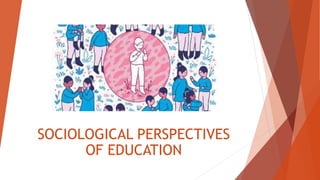
SOCIOLOGICAL PERSPECTIVES
OF EDUCATION
DEFINITION
A theory explains how society or
aspects of society work
Its defined as facts, ideas and
principles that attempt to explain
the nature of society
Principles of a theory , guide
observations and lay the foundation
for sociological description
SOCIOLOGICAL THEORIES OF EDUCATION
 STRUCTURAL FUNCTIONALISM/CONSENSUS THEORY
 CONFLICT THEORY
 SYMBOLIC INTERACTIONALISM THEORY
 LABELLING THEORY
• Educational sociologist utilize theories to examine how groups influence
individual leaners
Structural functionalism/consensus theory
Emphasis on the
contributions made by
individuals to the
society
Draws its explanatory
power from biological
working of an
organism
Explains how society is
maintained in a state
of consensus while
avoiding conflict
Compares the society
to the human body
and various
institutions that
function in harmony
Different parts of the
body perform different
functions which aim to
satisfy the basic needs
or organism
Each institution has
specific an different
functions that depend
upon one another
 Society is held together by value consensus
 This is agreement regarding the goals of a
system and the means to achieve them
 Every social structure of the society has a
purpose , various roles should be assigned to
qualified people e.g., teachers, doctors
 Society is bound by goals known to all regardless
of their status
 Effective control of disruptive behavior must be
put in place
 People must recognize legitimate authority and
obey willingly
Implication of
the functional
theory to
education
 Education is an integral and a recognized social
institution structured to carry out a specialized function
 It provides a suitable way of finding out whether certain
structures such as the school organization and learning
facilities are fulfilling their work to both themselves and
the education institution comprehensively.
 It explains why society selects and trains high
performers such as experts who serve it adequately and
thus serve to maintain the whole.
 It implies how /why society is a kin to giving out rewards
like jobs and higher social status using academic
qualifications only.
Criticism of
functionalism
theory
 Its preoccupied with maintenance of social stability at
the expense of innovation
 Human beings are approval seekers and resent and over
integrated view od the society
 Society rather than individual are said to have needs
motivation and requirements
 It eliminates conflicts as a possible alternative to social
order
 Society and culture are not seen as being shaped by
individuals
Conflict theory
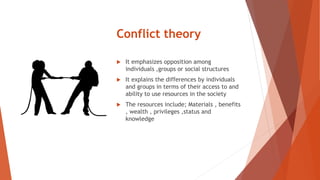
 It emphasizes opposition among
individuals ,groups or social structures
 It explains the differences by individuals
and groups in terms of their access to and
ability to use resources in the society
 The resources include; Materials , benefits
, wealth , privileges ,status and
knowledge
Functions of
conflict theory
 It prevents stagnation of society
 It stimulates interest and curiosity
 It prevents open war and social disintegration
 The process brings out personal and social change
 Helps to strengthen existing norms
Implications of
conflict theory
to education
 Conflict in education for instance due to student behavior
can breed conflict in other social institutions for example
the family.
 Reforms in education should come after change in other
institutions like economy and politics which have stronger
and firm foundations for cushioning against change and
conflict when they occur as it is a delicate institution.
 Education should be reviewed constantly to take into
consideration the views of other interested parties and
assist in minimizing instances of disagreement and conflict
among stakeholders.
 Dependence on academic examinations as the only
acceptable form of assessing a whole a person should be
discouraged as it encourages individuals to compete and
not co-operate as competition is a form of conflict.
 There should be equal provision of educational resources
for all learners to ensure harmonized achievement and
avoid conflict.
Criticism of
the conflict
theory
 Its overemphasis the influence of economic dimension
over other aspects of society
Symbolic interactionism theory
 The theory proposes that people are actors acting on a stage that is the social world or the human society.
Whatever each person is doing in society is likened to playing or performing a role in a play scene on that
stage.
 Human beings do not act individually on the social world stage, they interact between each other, reacting to
each other on that stage.
 To interact people use symbols. Symbols include both written and spoken language, gestures, art,(drawings,
paintings, carvings), signs, music and drama.
 Behaviors keep changing depending the social circumstances or situation people find themselves in. People
learn to modify, limit or change largely following their observations in society. These rules govern how we are
expected to behave and act in different situation and environments.
 For human beings to interact and communicate mutually, they must be able to recognize and interpret a
symbol(s) and place the right meaning on a them. People act and react in accordance with what they know
and understand.
 Since individuals are faced with such these symbols daily, they must be able to differentiate them so as to
interact and communicate with others mutually.
 Every society must have in place a maintained learning process that will enable its members acquire and
recognize the popular symbols of interaction .
 Social events and activities are only able to acquire their unique and desired characteristic and value in
society because of the type of symbols and interactions they are given for example a wedding ceremony is an
important social event because people associate it with procreation, children, family etc.
Implications to
education
 For the education activities to thrive well, the teachers and learners
must socially interact.
 This interaction is accomplished by use of symbols, e.g., language,
gesture, tools, rules and regulations which imply and lead to the
aspects of education.
 An education/school process should always be based on properly
thought-out symbols which can convey the correct meanings of the
social life in a particular society. This would guard against the
learners being handicapped in understanding what a teacher is saying.
 A schoolteacher, instructor etc. must be conversant with and be able
to use, interpret convey or transmit the symbols and their correct
meanings to the learners.
 A teacher must use constant evaluations in the class to determine
whether or how well the learners have internalized, interpreted and
applied the symbols correctly.
 All indicators of negative symbolic meanings should not be used as
part of the teaching learning activities.
Labelling theory
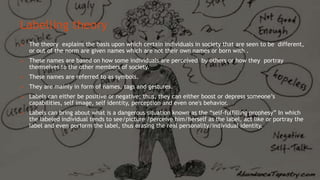
 The theory explains the basis upon which certain individuals in society that are seen to be different,
or out of the norm are given names which are not their own names or born with .
 These names are based on how some individuals are perceived by others or how they portray
themselves to the other members of society.
 These names are referred to as symbols.
 They are mainly in form of names, tags and gestures.
 Labels can either be positive or negative; thus, they can either boost or depress someone’s
capabilities, self image, self identity, perception and even one's behavior.
 Labels can bring about what is a dangerous situation known as the “self-fulfilling prophesy” In which
the labeled individual tends to see/picture /perceive him/herself as the label, act like or portray the
label and even perform the label, thus erasing the real personality/individual identity.
Implications to
education
 Implies the basis on which teachers can give labels to
certain students using factors like a student's academic
ability race or ethnic origins, character or behavior,
physical appearance etc.
 Implies the perceptions that students may use when
developing labels for certain teachers e.g. good versus
bad, a good versus a bad listener, the way a teacher
talks, laughs, dresses etc.
 Points to the potentially self-fulfilling prophesy, which
can develop if a student is, or certain students are
continuously called and referred to by the label by both
the teachers and students.
 Cautions and advises the school/class teachers to use
academic evaluations so that students’ academic ability
Is not used as means of giving students negative labels.

sociological perspectives.pptx

  • 1.
  • 2.
    DEFINITION A theory explainshow society or aspects of society work Its defined as facts, ideas and principles that attempt to explain the nature of society Principles of a theory , guide observations and lay the foundation for sociological description
  • 3.
    SOCIOLOGICAL THEORIES OFEDUCATION  STRUCTURAL FUNCTIONALISM/CONSENSUS THEORY  CONFLICT THEORY  SYMBOLIC INTERACTIONALISM THEORY  LABELLING THEORY • Educational sociologist utilize theories to examine how groups influence individual leaners
  • 4.
    Structural functionalism/consensus theory Emphasison the contributions made by individuals to the society Draws its explanatory power from biological working of an organism Explains how society is maintained in a state of consensus while avoiding conflict Compares the society to the human body and various institutions that function in harmony Different parts of the body perform different functions which aim to satisfy the basic needs or organism Each institution has specific an different functions that depend upon one another
  • 5.
     Society isheld together by value consensus  This is agreement regarding the goals of a system and the means to achieve them  Every social structure of the society has a purpose , various roles should be assigned to qualified people e.g., teachers, doctors  Society is bound by goals known to all regardless of their status  Effective control of disruptive behavior must be put in place  People must recognize legitimate authority and obey willingly
  • 6.
    Implication of the functional theoryto education  Education is an integral and a recognized social institution structured to carry out a specialized function  It provides a suitable way of finding out whether certain structures such as the school organization and learning facilities are fulfilling their work to both themselves and the education institution comprehensively.  It explains why society selects and trains high performers such as experts who serve it adequately and thus serve to maintain the whole.  It implies how /why society is a kin to giving out rewards like jobs and higher social status using academic qualifications only.
  • 7.
    Criticism of functionalism theory  Itspreoccupied with maintenance of social stability at the expense of innovation  Human beings are approval seekers and resent and over integrated view od the society  Society rather than individual are said to have needs motivation and requirements  It eliminates conflicts as a possible alternative to social order  Society and culture are not seen as being shaped by individuals
  • 8.
    Conflict theory  Itemphasizes opposition among individuals ,groups or social structures  It explains the differences by individuals and groups in terms of their access to and ability to use resources in the society  The resources include; Materials , benefits , wealth , privileges ,status and knowledge
  • 9.
    Functions of conflict theory It prevents stagnation of society  It stimulates interest and curiosity  It prevents open war and social disintegration  The process brings out personal and social change  Helps to strengthen existing norms
  • 10.
    Implications of conflict theory toeducation  Conflict in education for instance due to student behavior can breed conflict in other social institutions for example the family.  Reforms in education should come after change in other institutions like economy and politics which have stronger and firm foundations for cushioning against change and conflict when they occur as it is a delicate institution.  Education should be reviewed constantly to take into consideration the views of other interested parties and assist in minimizing instances of disagreement and conflict among stakeholders.  Dependence on academic examinations as the only acceptable form of assessing a whole a person should be discouraged as it encourages individuals to compete and not co-operate as competition is a form of conflict.  There should be equal provision of educational resources for all learners to ensure harmonized achievement and avoid conflict.
  • 11.
    Criticism of the conflict theory Its overemphasis the influence of economic dimension over other aspects of society
  • 12.
    Symbolic interactionism theory The theory proposes that people are actors acting on a stage that is the social world or the human society. Whatever each person is doing in society is likened to playing or performing a role in a play scene on that stage.  Human beings do not act individually on the social world stage, they interact between each other, reacting to each other on that stage.  To interact people use symbols. Symbols include both written and spoken language, gestures, art,(drawings, paintings, carvings), signs, music and drama.  Behaviors keep changing depending the social circumstances or situation people find themselves in. People learn to modify, limit or change largely following their observations in society. These rules govern how we are expected to behave and act in different situation and environments.  For human beings to interact and communicate mutually, they must be able to recognize and interpret a symbol(s) and place the right meaning on a them. People act and react in accordance with what they know and understand.  Since individuals are faced with such these symbols daily, they must be able to differentiate them so as to interact and communicate with others mutually.  Every society must have in place a maintained learning process that will enable its members acquire and recognize the popular symbols of interaction .  Social events and activities are only able to acquire their unique and desired characteristic and value in society because of the type of symbols and interactions they are given for example a wedding ceremony is an important social event because people associate it with procreation, children, family etc.
  • 13.
    Implications to education  Forthe education activities to thrive well, the teachers and learners must socially interact.  This interaction is accomplished by use of symbols, e.g., language, gesture, tools, rules and regulations which imply and lead to the aspects of education.  An education/school process should always be based on properly thought-out symbols which can convey the correct meanings of the social life in a particular society. This would guard against the learners being handicapped in understanding what a teacher is saying.  A schoolteacher, instructor etc. must be conversant with and be able to use, interpret convey or transmit the symbols and their correct meanings to the learners.  A teacher must use constant evaluations in the class to determine whether or how well the learners have internalized, interpreted and applied the symbols correctly.  All indicators of negative symbolic meanings should not be used as part of the teaching learning activities.
  • 14.
    Labelling theory  Thetheory explains the basis upon which certain individuals in society that are seen to be different, or out of the norm are given names which are not their own names or born with .  These names are based on how some individuals are perceived by others or how they portray themselves to the other members of society.  These names are referred to as symbols.  They are mainly in form of names, tags and gestures.  Labels can either be positive or negative; thus, they can either boost or depress someone’s capabilities, self image, self identity, perception and even one's behavior.  Labels can bring about what is a dangerous situation known as the “self-fulfilling prophesy” In which the labeled individual tends to see/picture /perceive him/herself as the label, act like or portray the label and even perform the label, thus erasing the real personality/individual identity.
  • 15.
    Implications to education  Impliesthe basis on which teachers can give labels to certain students using factors like a student's academic ability race or ethnic origins, character or behavior, physical appearance etc.  Implies the perceptions that students may use when developing labels for certain teachers e.g. good versus bad, a good versus a bad listener, the way a teacher talks, laughs, dresses etc.  Points to the potentially self-fulfilling prophesy, which can develop if a student is, or certain students are continuously called and referred to by the label by both the teachers and students.  Cautions and advises the school/class teachers to use academic evaluations so that students’ academic ability Is not used as means of giving students negative labels.