NURSING INFORMATICSTheories, Models, and Frameworks
NURSING INFORMATICSIs an established and growing area of specialization in nursingAll nurses employ information technologies in their practice.
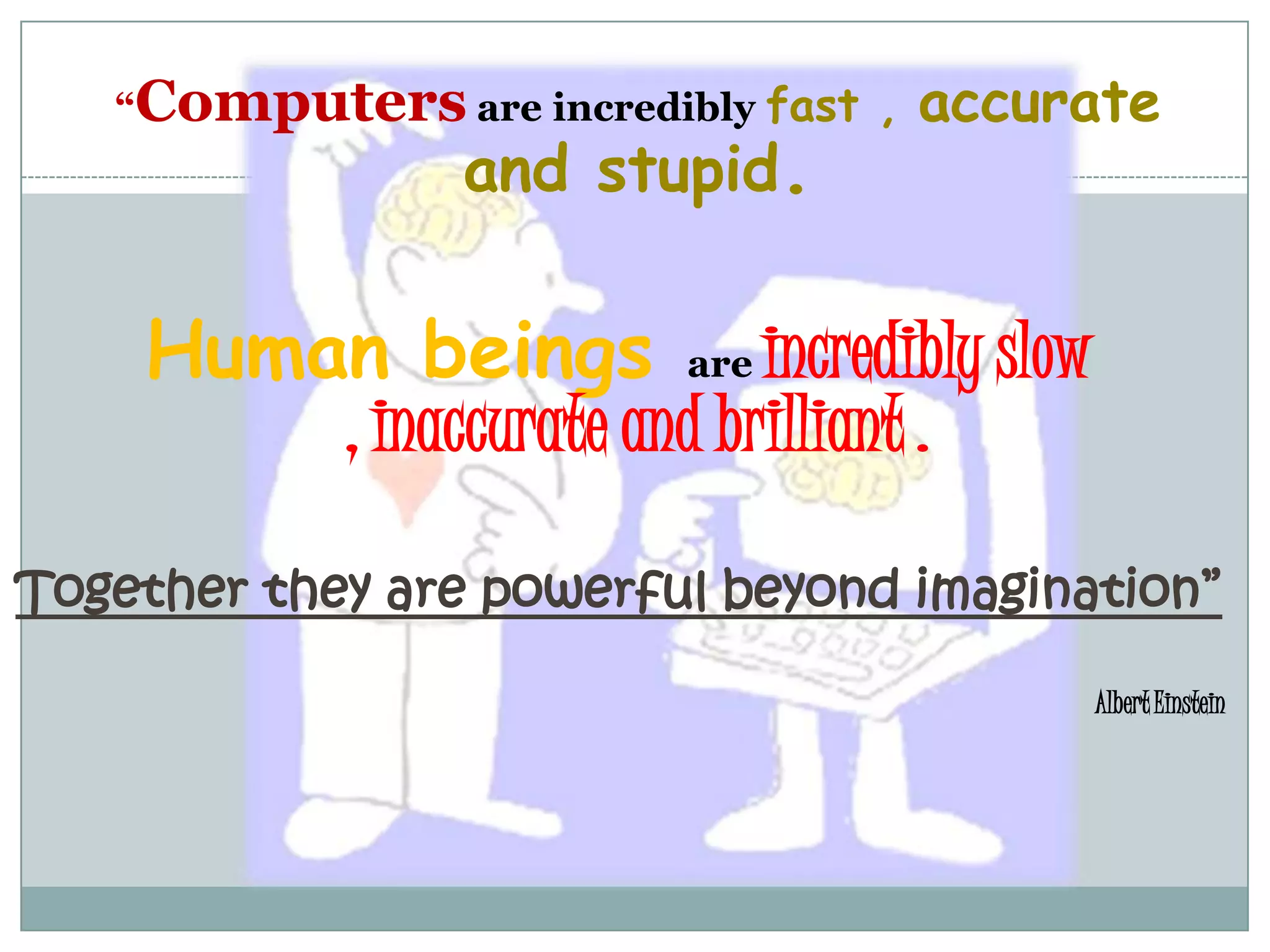
	“Computersare incredibly fast , accurate and stupid. Human beings are incredibly slow , inaccurate and brilliant . Together they are powerful beyond imagination”Albert Einstein
Why do we NEED to study N.I?In the 21st Century, information is	doubling every 5yrs , if not tripling in quantity and quality.Information is POWERTechnology also facilitates the creative process in nurses, affording amazing vehicles forpatient education , teaching and learning , and providing general health promotion and prevention information on a global scale.
“THE HIGH TECH AND THE HIGH TOUCH”This can only become a common reality if nurses are comfortable working with computers and advanced technology while providing evidence based care for their clients .The healthcare of our clients is largely dependent on information.Every action taken depends on previous information and knowledge.
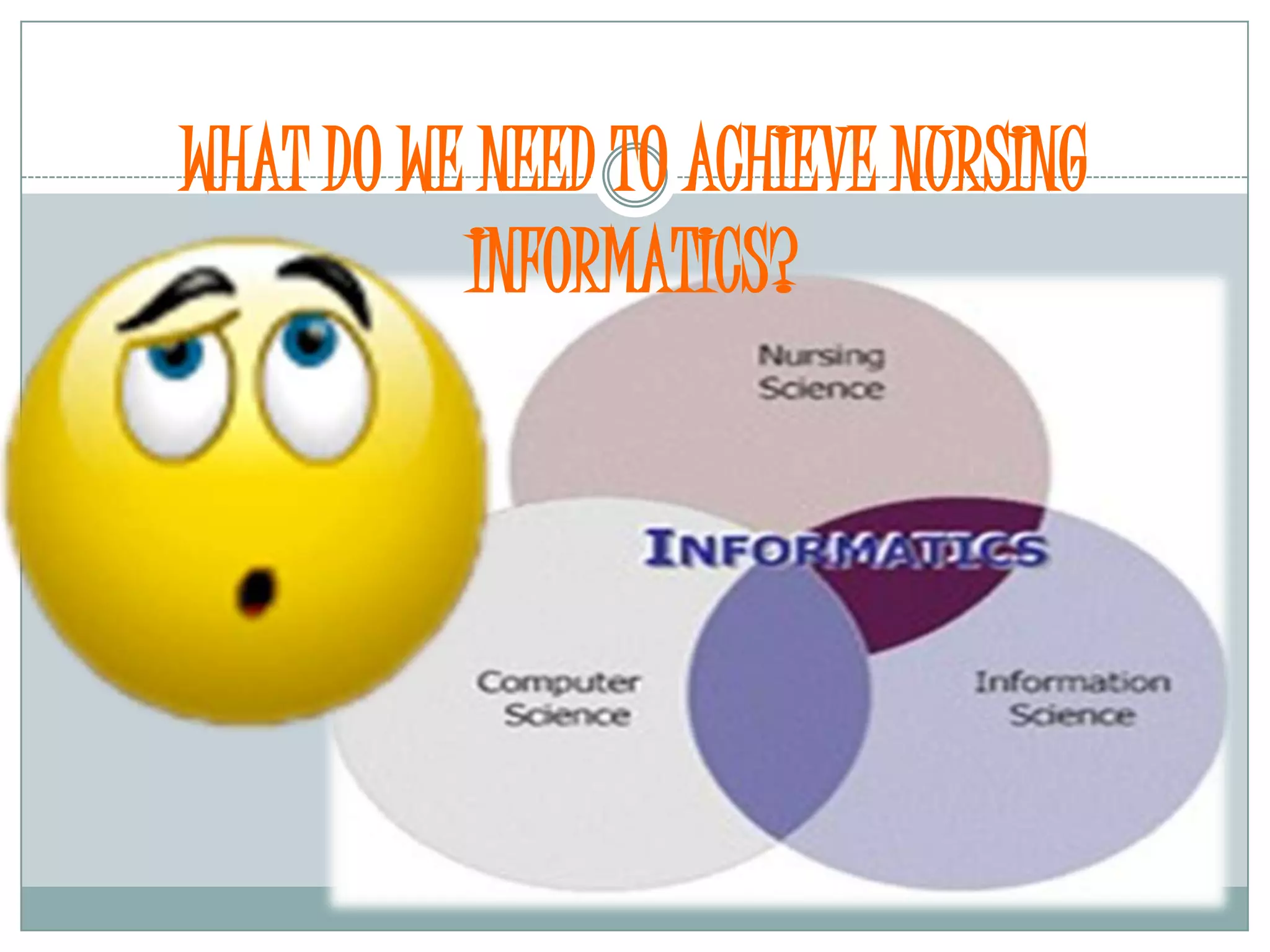
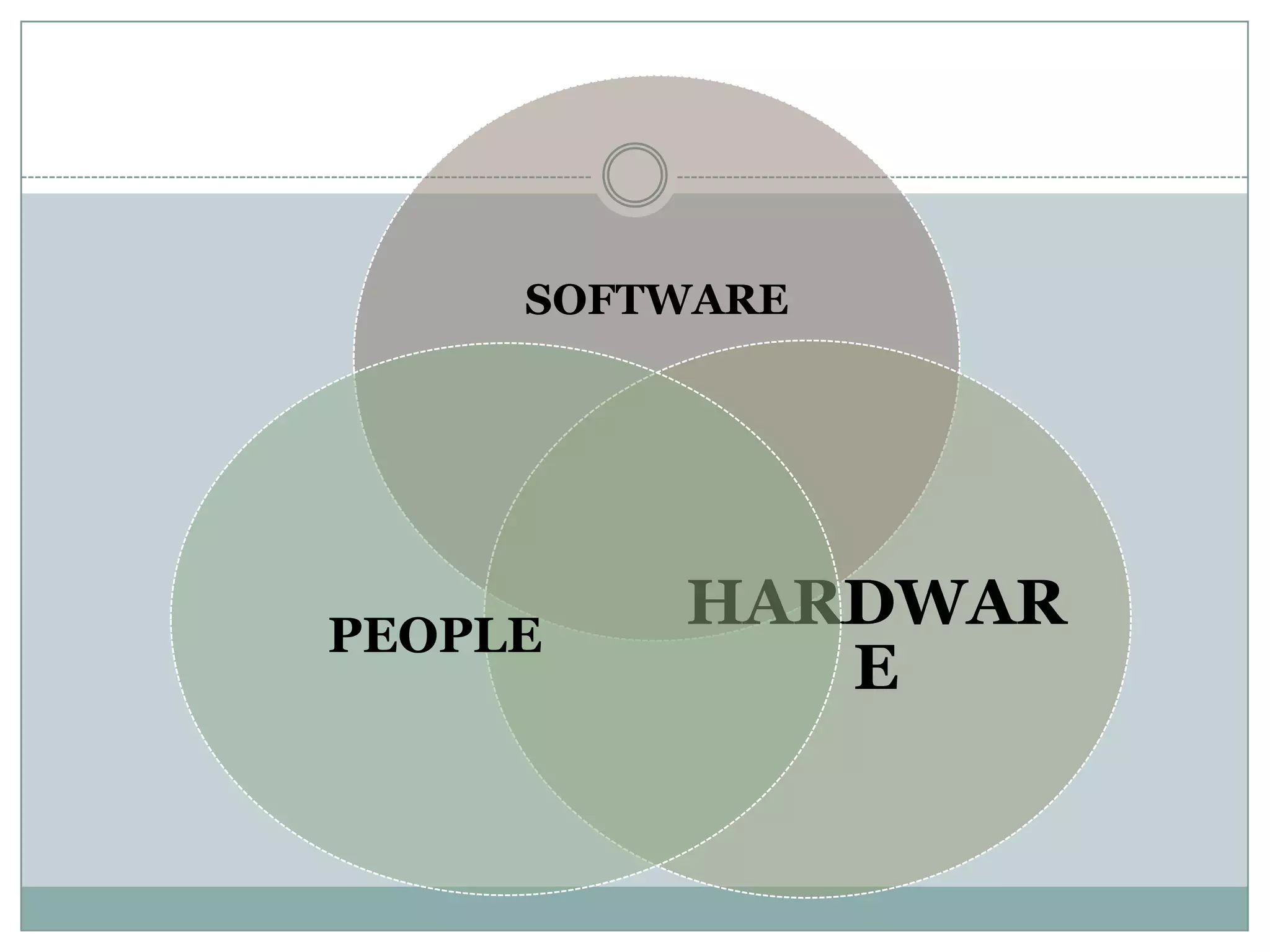
WHAT DO WE NEED TO ACHIEVE NURSING INFORMATICS?
“Nursing practice will be revolutionized and we will truly be a profession of nurses with our own classification systems, bibliographic systems, and payment systems .”
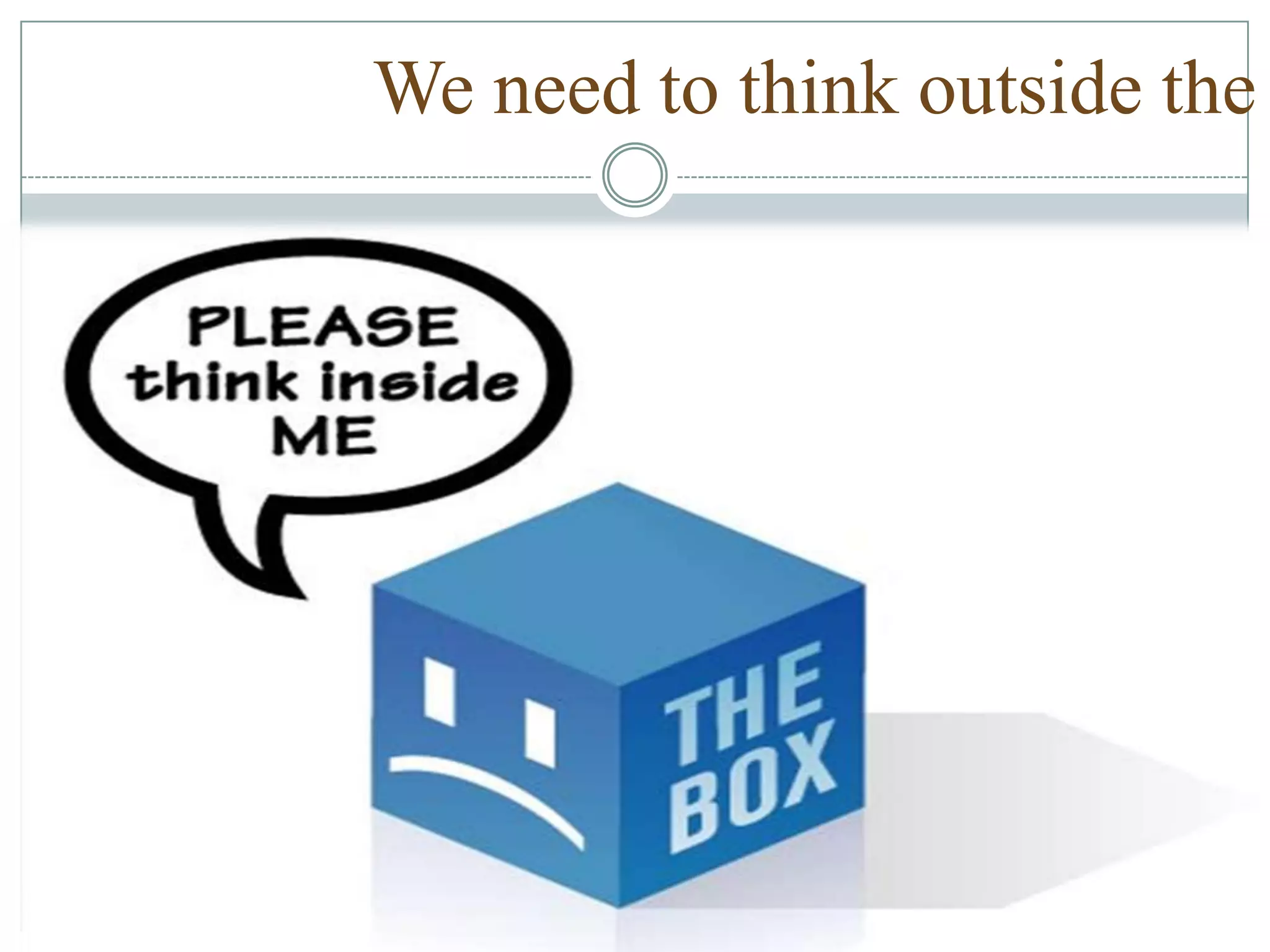
We need to think outside the box?
We need to use the Internet to enhance our practice and provide tele-nursing care . We need to become wireless and conduct our services using all the newer IT tools.“ We have a long way to go, but if we utilize information technology effectively, informatics will become an integral part of our profession and the health care industry. I do believe we have the knowledge and perseverance and I am convinced it will come to pass.”-Dr. Virginia Saba
INFORMATICS
What is informatics1957 - First coined by Karl Steinbuch as “informatiks”.1962 – Phillipe Dreyfus used “informatique”Walter Bauer – translated it into “informatics”
What is informaticsCombined the terms “information” and “automation” which means automatic information processing.
What is informaticsA science that combines a domain science, computer science, information science and cognitive science.Multidisciplinary science drawing from varied theories and knowledge applications.
What is informaticsa broad academic field encompassing human-computer interaction, information science, information technology, algorithms, and social science
What is informaticsComputer science, the study of complex systems, information and computation using applied mathematics, electrical engineering and software engineering techniques.
What is informaticsInformation science is the study of the processing, management, and retrieval of information
In 1980, Scholes and Barber applied this new term to the art and science of nursing, coining the term, “nursing informatics”, which they defined as “...the application of computer technology to all fields of nursing-- nursing services, nurse education, and nursing research”.
WHAT IS HEALTH INFORMATICS
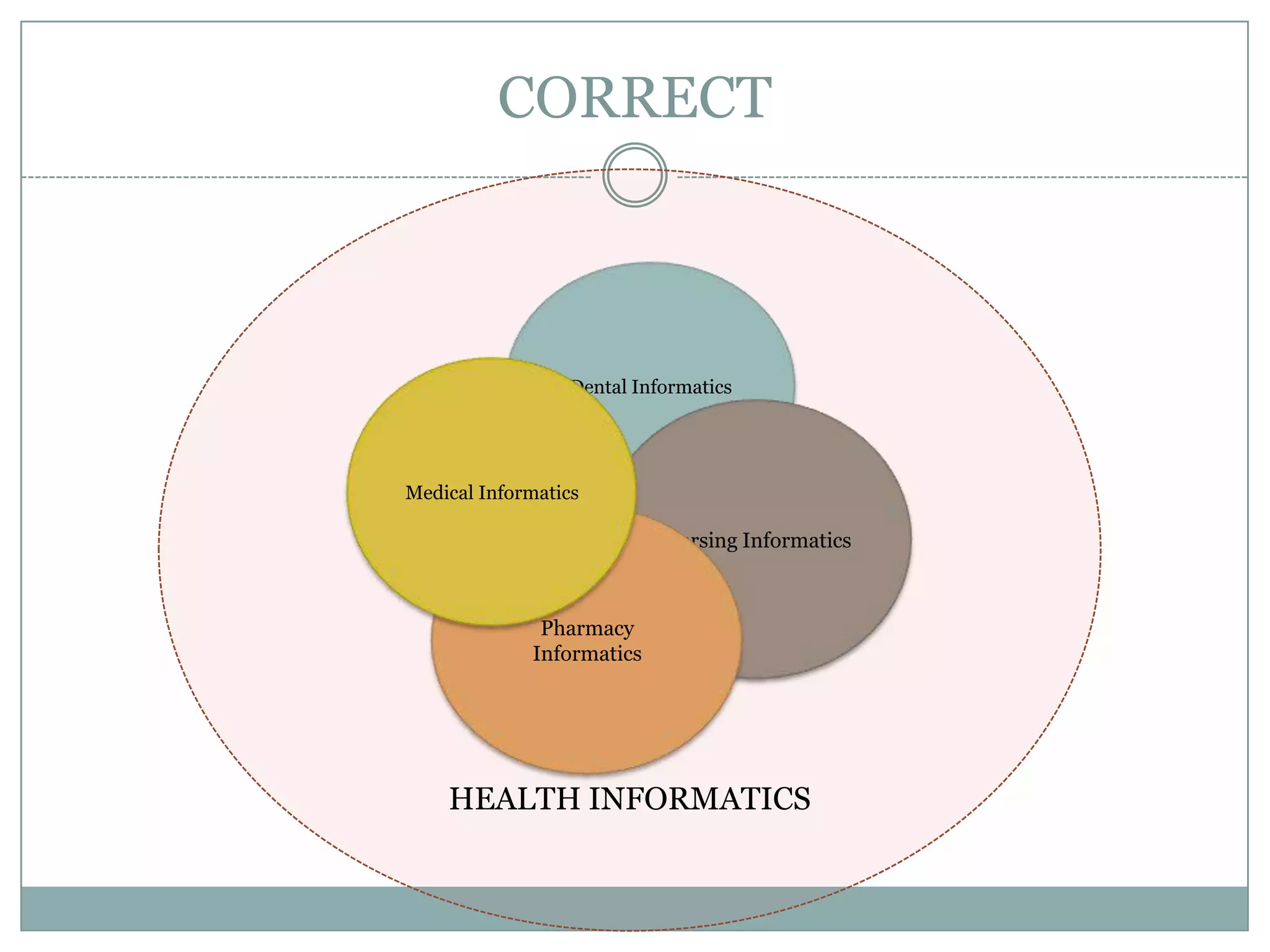
HEALTH INFORMATICSIntegration of healthcare sciences, computer science, information science, and cognitive science to assist in the management of healthcare information.A subdiscipline of informatics…
ACTIVITYPresent an illustration using the description delineating Health Informatics and its sub disciplines.Health informatics have subdomains such as medical informatics, dental informatics, pharmacy informatics, nursing informatics, etc.Each of these subdomains have integrated content and which are collaboratively working with each other.
ACTIVITYLimit your illustration using only circles, squares and arrows and texts.Use any application (paint, Msword, Ppt) in making your diagram.Finally present the illustration using powerpoint.Further explain your diagram.
CORRECT HEALTH INFORMATICSDental InformaticsMedical InformaticsNursing InformaticsPharmacy Informatics
NURSING INFORMATICS1985 – Kathryn Hannah;..is the use of information technologies in relation to any nursing functions.
NURSING INFORMATICS1989 – Graves & Corcoran .. Is a combination of computer science, information science and nursing science designed to assist management and processing of nursing data, information, and knowledge to support the practice of nursing and the delivery of nursing care.
NURSING INFORMATICS1994– ANA .. Specialty that integrates nursing science, computer science, and information science in identifying, collecting, processing, and managing data and information to support nursing practice, administration, education, research and the expansion of nursing knowledge.
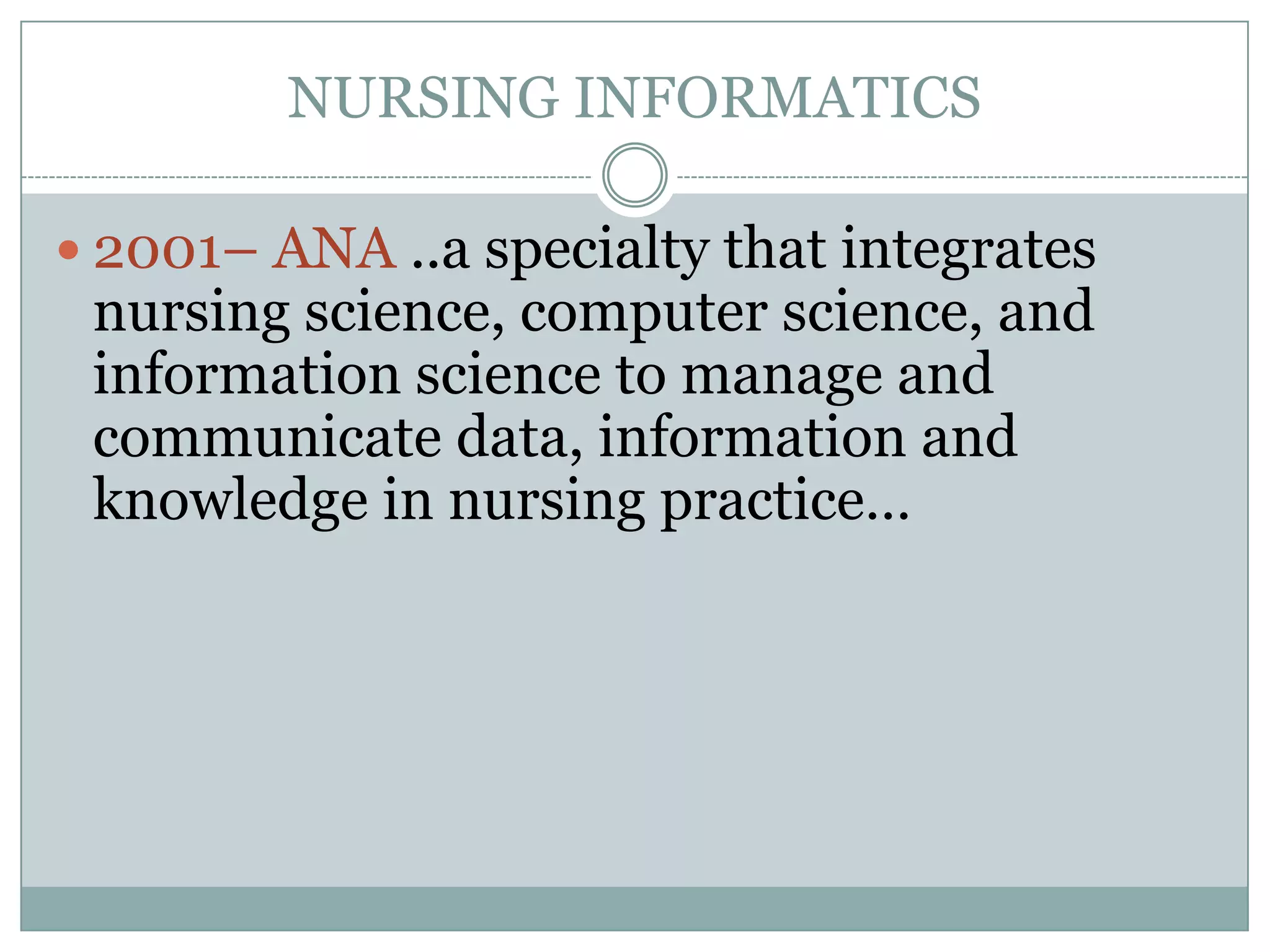
NURSING INFORMATICS2001– ANA ..a specialty that integrates nursing science, computer science, and information science to manage and communicate data, information and knowledge in nursing practice…
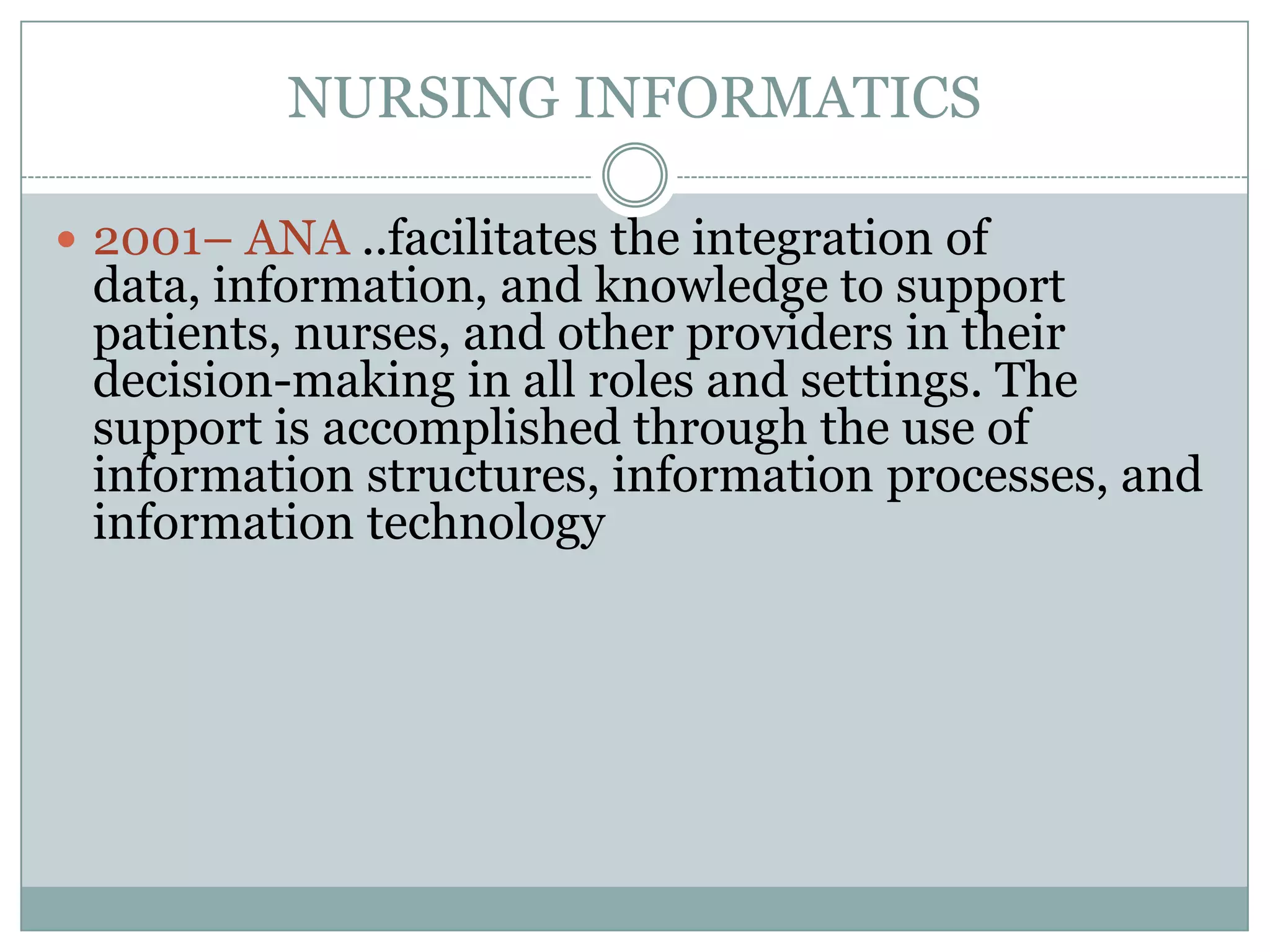
NURSING INFORMATICS2001– ANA ..facilitates the integration of data, information, and knowledge to support patients, nurses, and other providers in their decision-making in all roles and settings. The support is accomplished through the use of information structures, information processes, and information technology
Differentiate
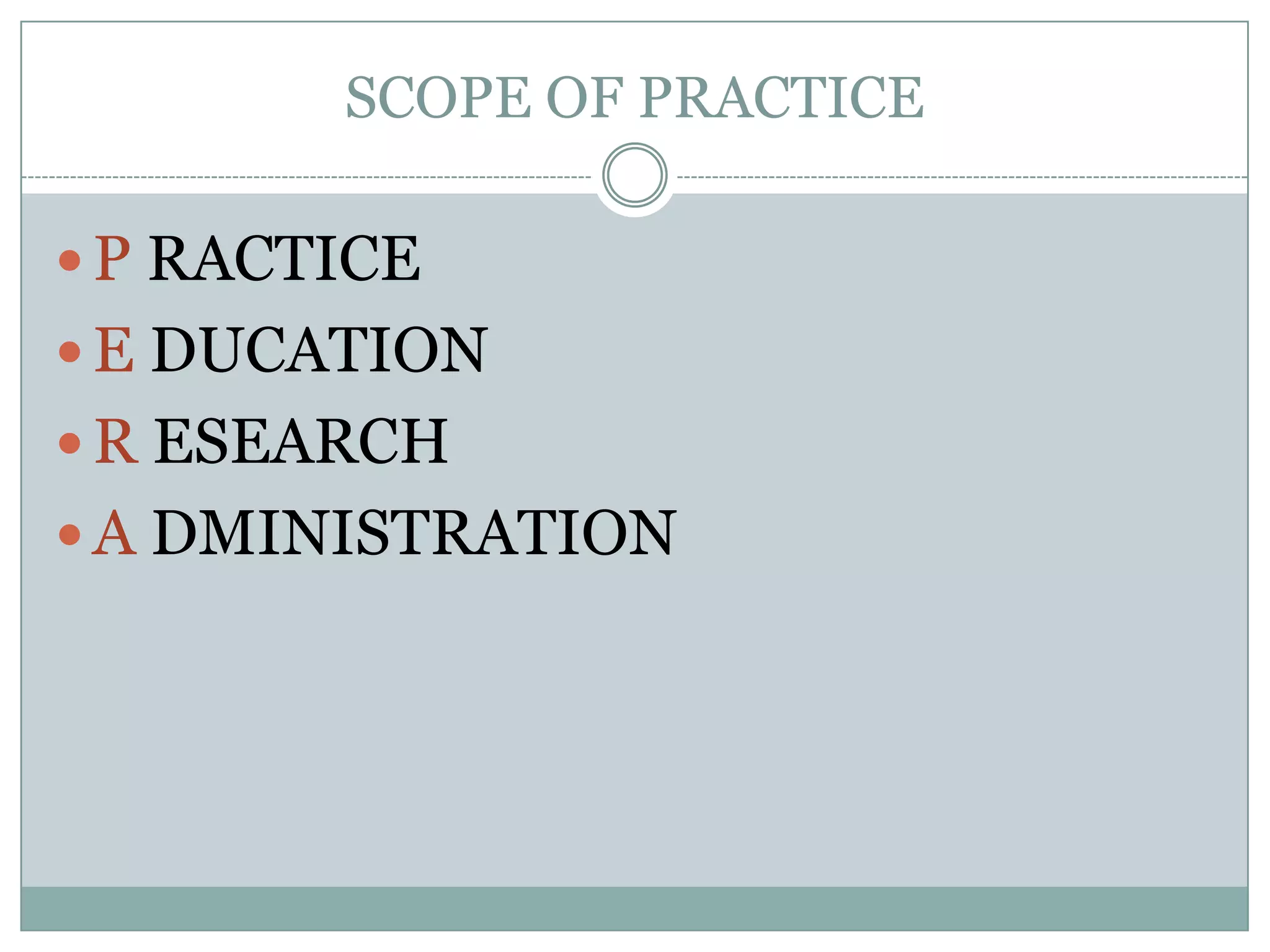
SCOPE OF PRACTICEP RACTICEE DUCATIONR ESEARCHA DMINISTRATION
NURSING INFORMATICSSCOPE
Standard Areas of NURSING:Nursing PracticeNursing EducationNursing R esearchNursingAdministration 
COMPUTERS IN NURSING EDUCATIONSCOMPUTER Assisted EducationPDA (Personal Digital Assistants)LCD ProjectorsWireless RoutersDesktopsLaptopsSmartphoneVIDEOS/ANIMATIONSDistance learningTesting (NCLEX)Student and course record management
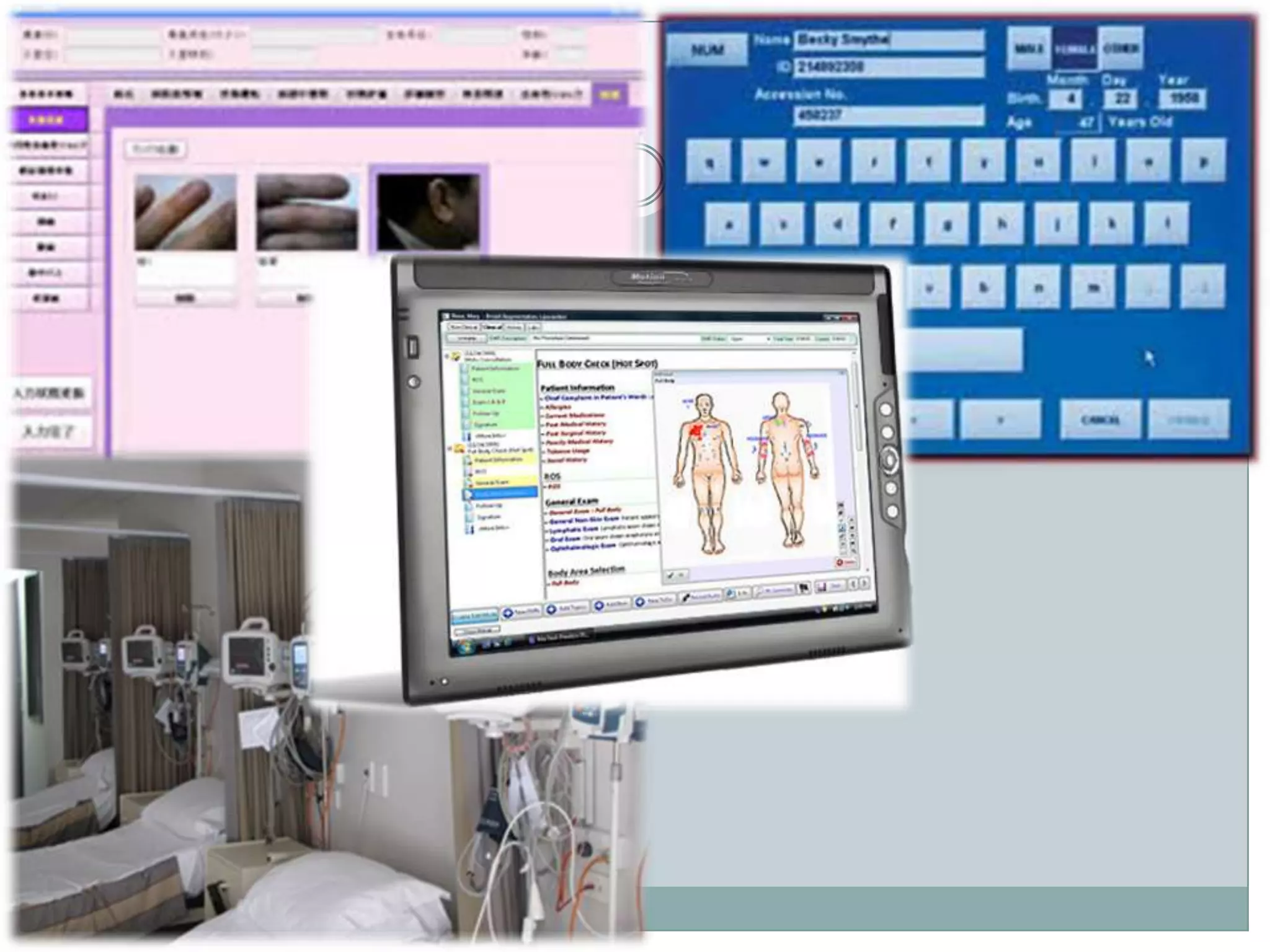
COMPUTERS IN NURSING PRACTICEFunctionsRecords client informationProvides access to other departmentsUsed to manage client schedulingDOCUMENTAION OF CLIENT STATUSAND MEDICAL RECORDS KEEPINGProvides access to standardized forms, policies and proceduresAccess data about client that may be somewhere in the medical record or elsewhere in health care agency.
BEDSIDE DATA ENTRYrecords clients assessments, medication administration, progress notes, care plan updating, client acuity and accrued chargesCOMPUTER BASED CLIENT RECORDEMRs/CPRsProvides easy retrieval of specific data such as trends in vital signs, immunization records, current problemsIt can be designed to work providers about conflicting medications or client parameters that indicate dangerous conditions
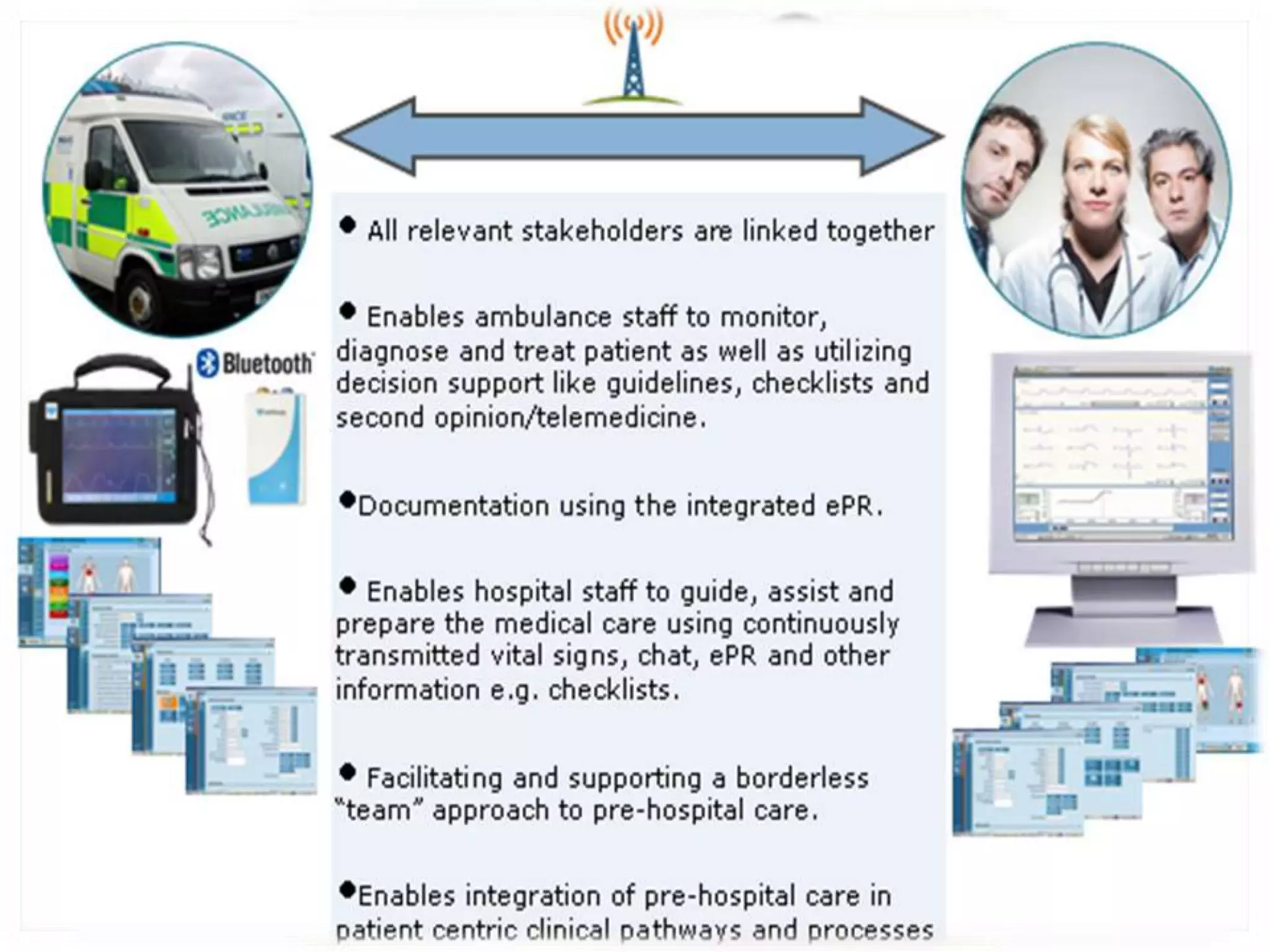
ELECTRONIC ACCESS TO CLIENTSUsed extensively in health care to assess and monitor clients conditionsData accumulated from various electronic devices are stored for research purposesCan monitor clientComputerized diagnosisTelemedicinePRACTICE MANAGEMENTUsed to order supplies, tests, meals, and services, from other departmentsAllows nursing service to determine the most costly items used by a particular nursing unit.May provide information or decisions to modify budget, provide different staffing, move supplies to different locations, or make other changes for more efficient and higher quality care
COMPUTERS IN NURSING PRACTICEA. Human resourcesAll employers must maintain a data a database on each employeeAdministrators can use this database to communicate with employees, examine staffing patterns, and create budget programsB. Medical records managementAllow client records to be searched for trends, number of cases, most expensive cases, and client outcomes.Nurse informaticist can assist administrators with the design and implementation of systems that allow such searches to be generated, analyzed, printed, and distributed.
COMPUTERS IN NURSING PRACTICE  C. Facilities managementheating, air conditioning, ventilation, alarm systems are computer controlled.D. Budget and financeclaims are transmitted much more quicklyCan also effect cost-savings by reducing the desired services time needed for accounts payable and receivables.
COMPUTERS IN NURSING PRACTICE1. problem identificationUseful in locating current literature about the problem and related conceptsHelps in searching for existing documents, and e-mail to colleagues.2. literature reviewSoftware facilitate searches, contains thesauruses so that the most appropriate terms can be selected.
COMPUTERS IN NURSING PRACTICE3. research designSearch literature for instruments that have already been established or to design and test instruments that need to be developed for past study.4. Data collection and analysisHelps create form for the collection of data such as informed consent, demographic data, and recording forms.Commonly used software for quantitative data analysis: SPSS ( statistical package for social sciences), SAS ( statistical analysis system), Sys STAT, MYSTAT5. Research disseminationcomputer word processing programs are used to author the final reports of research and send research to various readerships.Help speeds completion or research projects 
NI as a SPECIALTY1992 – ANA established nursing informatics as a distinct specialty in nursing with a distinct body of knowledge.
INDIVIDUAL ACTIVITYUse a Word ProcessorExplain how nursing informatics is considered as a distinct specialty.Specifically describe the role of informatics nurses compared to other fields of nursing.200 words minimum..
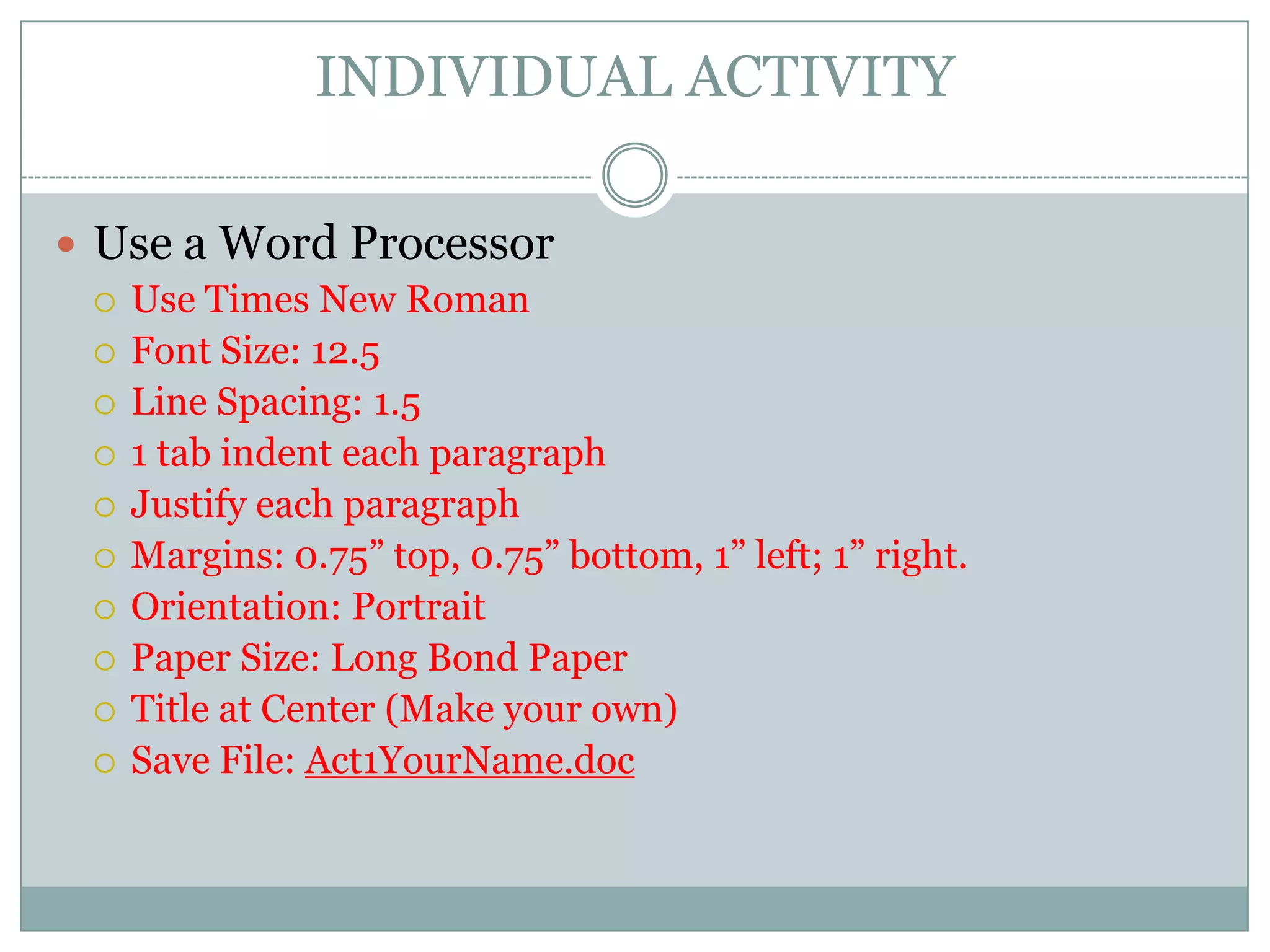
INDIVIDUAL ACTIVITYUse a Word ProcessorUse Times New Roman Font Size: 12.5Line Spacing: 1.51 tab indent each paragraphJustify each paragraphMargins: 0.75” top, 0.75” bottom, 1” left; 1” right.Orientation: PortraitPaper Size: Long Bond PaperTitle at Center (Make your own)Save File: Act1YourName.doc
Informatics Nurse SpecialistsIs a professional with a formal RN graduate degree and passed the credentialing in nursing informatics of a state.
Informatics Nurse SpecialistsNursing informatics specialists practice in a wide variety of roles that are ultimately aimed at improving patient care delivery and the nursing practice experience.
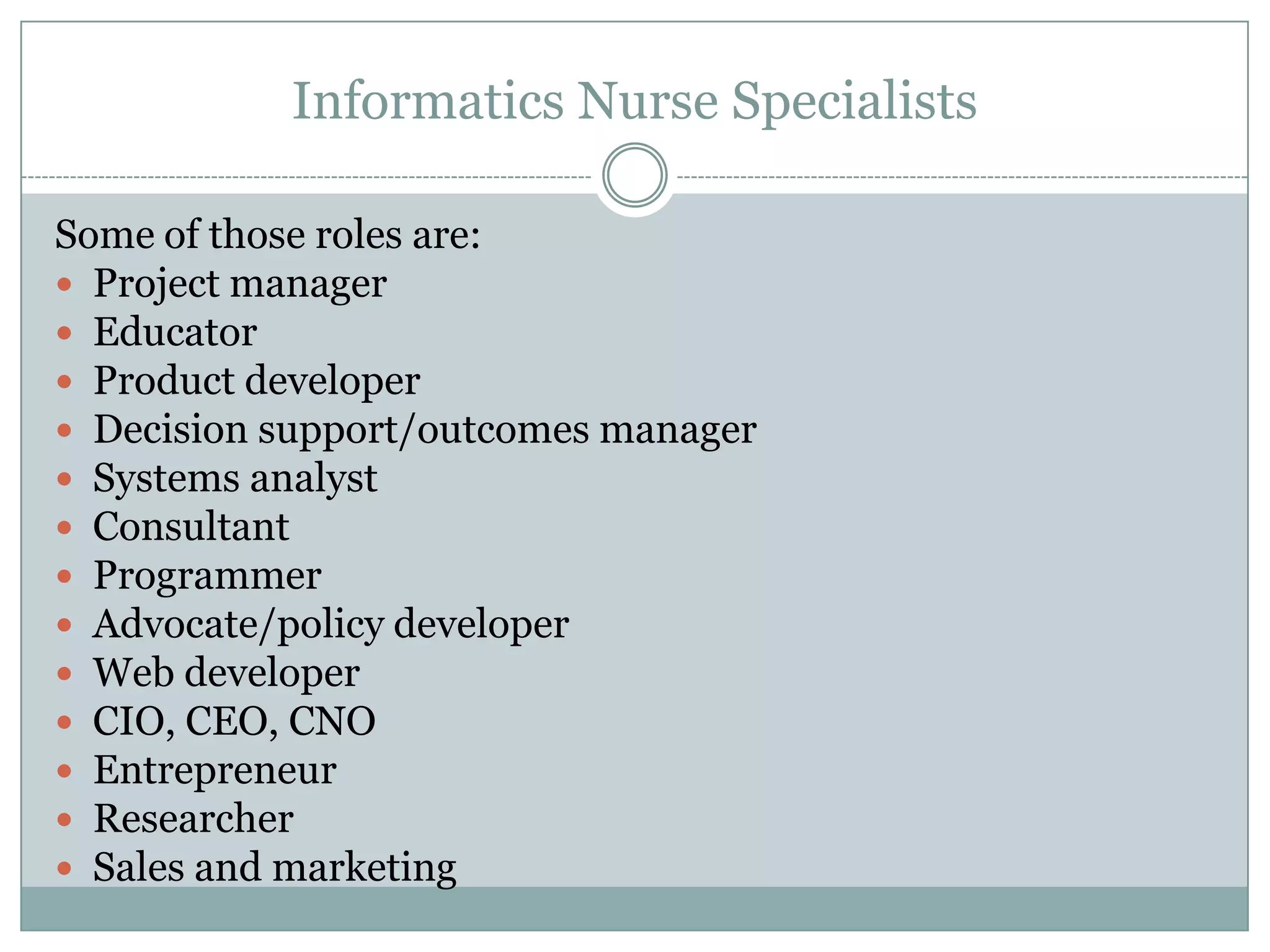
Informatics Nurse SpecialistsSome of those roles are:Project managerEducatorProduct developerDecision support/outcomes managerSystems analystConsultantProgrammerAdvocate/policy developerWeb developerCIO, CEO, CNOEntrepreneurResearcherSales and marketing
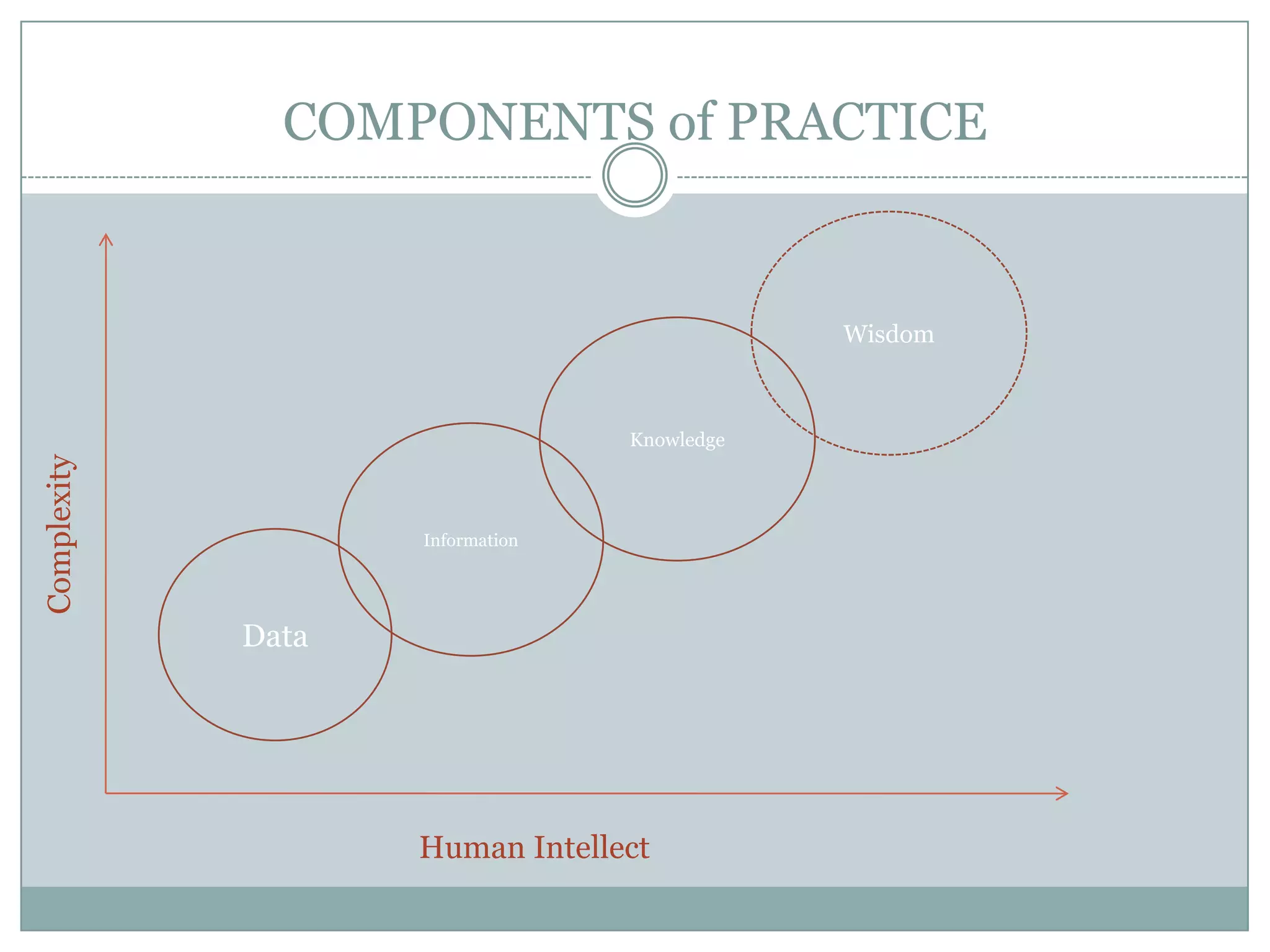
COMPONENTS of PRACTICETransformation of Data to WisdomData – discrete entities that are described objectively without interpretation.	ex. A systolic blood pressure, a nursing intervention, a patient problem, an outcome
COMPONENTS of PRACTICETransformation of Data to WisdomInformation– reflects interpretation, organization, or structuring of data. 	- are processed data  - data with meaning
COMPONENTS of PRACTICETransformation of Data to WisdomKnowledge–transformation of information.	- information that is synthesized so that relationships are identified and formalized
COMPONENTS of PRACTICETransformation of Data to WisdomWISDOM–highest form of data transformation.	- is the application of ethics in using knowledge.
COMPONENTS of PRACTICEWisdomKnowledgeInformationComplexityDataHuman Intellect
Group Activity
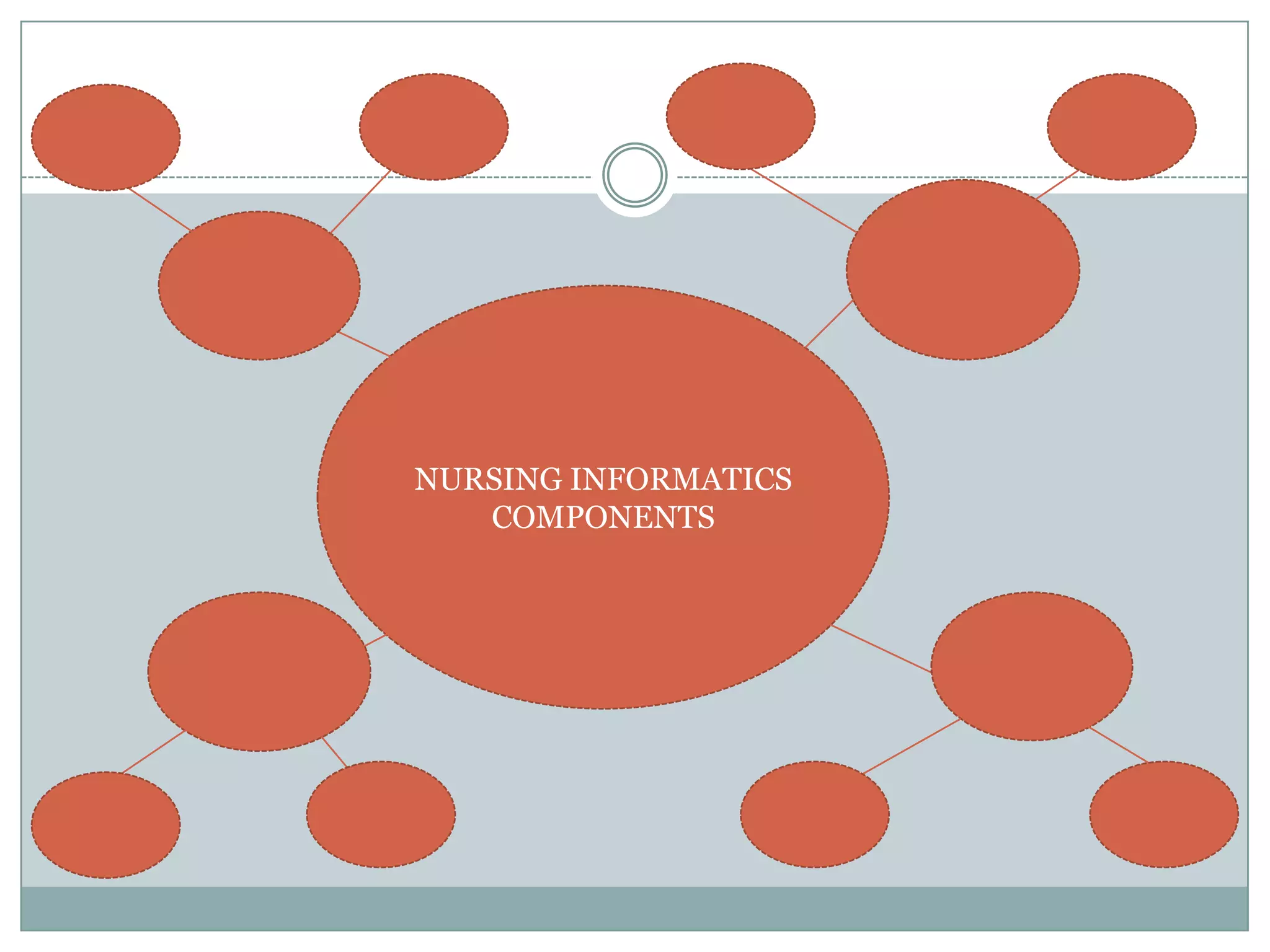
NURSING INFORMATICSCOMPONENTS
CORRECTAs an example, a single instance of vitals signs – heart rate, respirations, temperature and blood pressure – for a single patient can be considered a set of data.
CORRECTA series of vital signs taken over time, placed into a context, and compared is considered
CORRECTHowever, a dropping blood pressure, increasing heart rate, respiratory rate, and fever in an elderly, catheterized patient are recognized as being out of the norm. The recognition that this patient may be septic and in need of nursing and medical interventions reflects information synthesis (knowledge).

Nursing informatics theories, models, and frameworks

  • 1.
  • 3.
    NURSING INFORMATICSIs anestablished and growing area of specialization in nursingAll nurses employ information technologies in their practice.
  • 5.
    “Computersare incredibly fast, accurate and stupid. Human beings are incredibly slow , inaccurate and brilliant . Together they are powerful beyond imagination”Albert Einstein
  • 6.
    Why do weNEED to study N.I?In the 21st Century, information is doubling every 5yrs , if not tripling in quantity and quality.Information is POWERTechnology also facilitates the creative process in nurses, affording amazing vehicles forpatient education , teaching and learning , and providing general health promotion and prevention information on a global scale.
  • 7.
    “THE HIGH TECHAND THE HIGH TOUCH”This can only become a common reality if nurses are comfortable working with computers and advanced technology while providing evidence based care for their clients .The healthcare of our clients is largely dependent on information.Every action taken depends on previous information and knowledge.
  • 8.
    WHAT DO WENEED TO ACHIEVE NURSING INFORMATICS?
  • 10.
    “Nursing practice willbe revolutionized and we will truly be a profession of nurses with our own classification systems, bibliographic systems, and payment systems .”
  • 11.
    We need tothink outside the box?
  • 12.
    We need touse the Internet to enhance our practice and provide tele-nursing care . We need to become wireless and conduct our services using all the newer IT tools.“ We have a long way to go, but if we utilize information technology effectively, informatics will become an integral part of our profession and the health care industry. I do believe we have the knowledge and perseverance and I am convinced it will come to pass.”-Dr. Virginia Saba
  • 13.
  • 14.
    What is informatics1957- First coined by Karl Steinbuch as “informatiks”.1962 – Phillipe Dreyfus used “informatique”Walter Bauer – translated it into “informatics”
  • 15.
    What is informaticsCombinedthe terms “information” and “automation” which means automatic information processing.
  • 16.
    What is informaticsAscience that combines a domain science, computer science, information science and cognitive science.Multidisciplinary science drawing from varied theories and knowledge applications.
  • 17.
    What is informaticsabroad academic field encompassing human-computer interaction, information science, information technology, algorithms, and social science
  • 18.
    What is informaticsComputerscience, the study of complex systems, information and computation using applied mathematics, electrical engineering and software engineering techniques.
  • 19.
    What is informaticsInformationscience is the study of the processing, management, and retrieval of information
  • 20.
    In 1980, Scholesand Barber applied this new term to the art and science of nursing, coining the term, “nursing informatics”, which they defined as “...the application of computer technology to all fields of nursing-- nursing services, nurse education, and nursing research”.
  • 21.
    WHAT IS HEALTHINFORMATICS
  • 22.
    HEALTH INFORMATICSIntegration ofhealthcare sciences, computer science, information science, and cognitive science to assist in the management of healthcare information.A subdiscipline of informatics…
  • 23.
    ACTIVITYPresent an illustrationusing the description delineating Health Informatics and its sub disciplines.Health informatics have subdomains such as medical informatics, dental informatics, pharmacy informatics, nursing informatics, etc.Each of these subdomains have integrated content and which are collaboratively working with each other.
  • 24.
    ACTIVITYLimit your illustrationusing only circles, squares and arrows and texts.Use any application (paint, Msword, Ppt) in making your diagram.Finally present the illustration using powerpoint.Further explain your diagram.
  • 25.
    CORRECT HEALTH INFORMATICSDentalInformaticsMedical InformaticsNursing InformaticsPharmacy Informatics
  • 26.
    NURSING INFORMATICS1985 –Kathryn Hannah;..is the use of information technologies in relation to any nursing functions.
  • 27.
    NURSING INFORMATICS1989 –Graves & Corcoran .. Is a combination of computer science, information science and nursing science designed to assist management and processing of nursing data, information, and knowledge to support the practice of nursing and the delivery of nursing care.
  • 28.
    NURSING INFORMATICS1994– ANA.. Specialty that integrates nursing science, computer science, and information science in identifying, collecting, processing, and managing data and information to support nursing practice, administration, education, research and the expansion of nursing knowledge.
  • 29.
    NURSING INFORMATICS2001– ANA..a specialty that integrates nursing science, computer science, and information science to manage and communicate data, information and knowledge in nursing practice…
  • 30.
    NURSING INFORMATICS2001– ANA..facilitates the integration of data, information, and knowledge to support patients, nurses, and other providers in their decision-making in all roles and settings. The support is accomplished through the use of information structures, information processes, and information technology
  • 31.
  • 32.
    SCOPE OF PRACTICEPRACTICEE DUCATIONR ESEARCHA DMINISTRATION
  • 33.
  • 34.
    Standard Areas ofNURSING:Nursing PracticeNursing EducationNursing R esearchNursingAdministration 
  • 35.
    COMPUTERS IN NURSINGEDUCATIONSCOMPUTER Assisted EducationPDA (Personal Digital Assistants)LCD ProjectorsWireless RoutersDesktopsLaptopsSmartphoneVIDEOS/ANIMATIONSDistance learningTesting (NCLEX)Student and course record management
  • 36.
    COMPUTERS IN NURSINGPRACTICEFunctionsRecords client informationProvides access to other departmentsUsed to manage client schedulingDOCUMENTAION OF CLIENT STATUSAND MEDICAL RECORDS KEEPINGProvides access to standardized forms, policies and proceduresAccess data about client that may be somewhere in the medical record or elsewhere in health care agency.
  • 38.
    BEDSIDE DATA ENTRYrecordsclients assessments, medication administration, progress notes, care plan updating, client acuity and accrued chargesCOMPUTER BASED CLIENT RECORDEMRs/CPRsProvides easy retrieval of specific data such as trends in vital signs, immunization records, current problemsIt can be designed to work providers about conflicting medications or client parameters that indicate dangerous conditions
  • 39.
    ELECTRONIC ACCESS TOCLIENTSUsed extensively in health care to assess and monitor clients conditionsData accumulated from various electronic devices are stored for research purposesCan monitor clientComputerized diagnosisTelemedicinePRACTICE MANAGEMENTUsed to order supplies, tests, meals, and services, from other departmentsAllows nursing service to determine the most costly items used by a particular nursing unit.May provide information or decisions to modify budget, provide different staffing, move supplies to different locations, or make other changes for more efficient and higher quality care
  • 41.
    COMPUTERS IN NURSINGPRACTICEA. Human resourcesAll employers must maintain a data a database on each employeeAdministrators can use this database to communicate with employees, examine staffing patterns, and create budget programsB. Medical records managementAllow client records to be searched for trends, number of cases, most expensive cases, and client outcomes.Nurse informaticist can assist administrators with the design and implementation of systems that allow such searches to be generated, analyzed, printed, and distributed.
  • 42.
    COMPUTERS IN NURSINGPRACTICE C. Facilities managementheating, air conditioning, ventilation, alarm systems are computer controlled.D. Budget and financeclaims are transmitted much more quicklyCan also effect cost-savings by reducing the desired services time needed for accounts payable and receivables.
  • 43.
    COMPUTERS IN NURSINGPRACTICE1. problem identificationUseful in locating current literature about the problem and related conceptsHelps in searching for existing documents, and e-mail to colleagues.2. literature reviewSoftware facilitate searches, contains thesauruses so that the most appropriate terms can be selected.
  • 44.
    COMPUTERS IN NURSINGPRACTICE3. research designSearch literature for instruments that have already been established or to design and test instruments that need to be developed for past study.4. Data collection and analysisHelps create form for the collection of data such as informed consent, demographic data, and recording forms.Commonly used software for quantitative data analysis: SPSS ( statistical package for social sciences), SAS ( statistical analysis system), Sys STAT, MYSTAT5. Research disseminationcomputer word processing programs are used to author the final reports of research and send research to various readerships.Help speeds completion or research projects 
  • 45.
    NI as aSPECIALTY1992 – ANA established nursing informatics as a distinct specialty in nursing with a distinct body of knowledge.
  • 46.
    INDIVIDUAL ACTIVITYUse aWord ProcessorExplain how nursing informatics is considered as a distinct specialty.Specifically describe the role of informatics nurses compared to other fields of nursing.200 words minimum..
  • 47.
    INDIVIDUAL ACTIVITYUse aWord ProcessorUse Times New Roman Font Size: 12.5Line Spacing: 1.51 tab indent each paragraphJustify each paragraphMargins: 0.75” top, 0.75” bottom, 1” left; 1” right.Orientation: PortraitPaper Size: Long Bond PaperTitle at Center (Make your own)Save File: Act1YourName.doc
  • 48.
    Informatics Nurse SpecialistsIsa professional with a formal RN graduate degree and passed the credentialing in nursing informatics of a state.
  • 49.
    Informatics Nurse SpecialistsNursinginformatics specialists practice in a wide variety of roles that are ultimately aimed at improving patient care delivery and the nursing practice experience.
  • 50.
    Informatics Nurse SpecialistsSomeof those roles are:Project managerEducatorProduct developerDecision support/outcomes managerSystems analystConsultantProgrammerAdvocate/policy developerWeb developerCIO, CEO, CNOEntrepreneurResearcherSales and marketing
  • 51.
    COMPONENTS of PRACTICETransformationof Data to WisdomData – discrete entities that are described objectively without interpretation. ex. A systolic blood pressure, a nursing intervention, a patient problem, an outcome
  • 52.
    COMPONENTS of PRACTICETransformationof Data to WisdomInformation– reflects interpretation, organization, or structuring of data. - are processed data - data with meaning
  • 53.
    COMPONENTS of PRACTICETransformationof Data to WisdomKnowledge–transformation of information. - information that is synthesized so that relationships are identified and formalized
  • 54.
    COMPONENTS of PRACTICETransformationof Data to WisdomWISDOM–highest form of data transformation. - is the application of ethics in using knowledge.
  • 55.
  • 56.
  • 57.
  • 58.
    CORRECTAs an example,a single instance of vitals signs – heart rate, respirations, temperature and blood pressure – for a single patient can be considered a set of data.
  • 59.
    CORRECTA series ofvital signs taken over time, placed into a context, and compared is considered
  • 60.
    CORRECTHowever, a droppingblood pressure, increasing heart rate, respiratory rate, and fever in an elderly, catheterized patient are recognized as being out of the norm. The recognition that this patient may be septic and in need of nursing and medical interventions reflects information synthesis (knowledge).

Editor's Notes

  • #21 As information technology began tobe applied within various disciplines and social arenas, the term “informatics” was linked to the specific field in question, for instance, medical informatics, health informatics, business informatics, and so on.