 1907-1990 
 Psychiatrist in a Child 
Guidance Clinic in 
London 
 Caused him to think 
about the importance 
of relationship 
between a child and 
their mother 
 Shaped his belief 
about the link 
between infant 
separation with 
mother and later 
issues
 Children experience extreme distress 
when separated from their mothers 
 Even when taken care of by other 
caregivers, they still have anxiety 
 Contradicted behavioral theory of 
attachment by Dollard and Miller 
 Bowlby believed that infants have a 
universal need to be close to caregivers
 Babies are born pre-programmed to 
form attachments in order to survive 
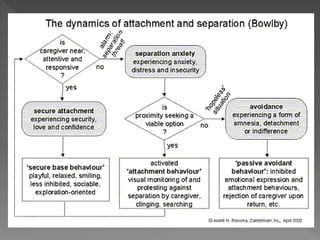
 Attachment is instinctive, but activated 
by distress 
 Fear of strangers represents healthy 
survival mechanism
 A child is born with the need to attach to 
one main person 
 Child should receive continuous care for 
this person for the first 2 years of life 
 Long term maternal deprivation has 
negative consequences 
 Short term separation leads to distress 
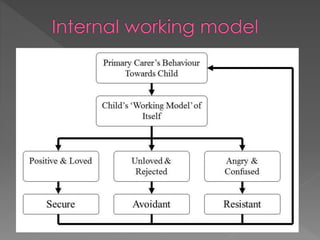
 Attachment relationship leads to internal 
working model
McLeod, S. (2007, January 1). John Bowlby | Maternal 
Deprivation Theory | Simply Psychology. Retrieved 
December 11, 2014, from 
http://www.simplypsychology.org/bowlby.html

Bowlby’s Attachment Theory

  • 2.
     1907-1990 Psychiatrist in a Child Guidance Clinic in London  Caused him to think about the importance of relationship between a child and their mother  Shaped his belief about the link between infant separation with mother and later issues
  • 3.
     Children experienceextreme distress when separated from their mothers  Even when taken care of by other caregivers, they still have anxiety  Contradicted behavioral theory of attachment by Dollard and Miller  Bowlby believed that infants have a universal need to be close to caregivers
  • 4.
     Babies areborn pre-programmed to form attachments in order to survive  Attachment is instinctive, but activated by distress  Fear of strangers represents healthy survival mechanism
  • 6.
     A childis born with the need to attach to one main person  Child should receive continuous care for this person for the first 2 years of life  Long term maternal deprivation has negative consequences  Short term separation leads to distress  Attachment relationship leads to internal working model
  • 8.
    McLeod, S. (2007,January 1). John Bowlby | Maternal Deprivation Theory | Simply Psychology. Retrieved December 11, 2014, from http://www.simplypsychology.org/bowlby.html