CAPACITOR
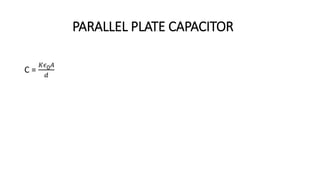
PARALLEL PLATE CAPACITOR
C =
𝐾𝜖0𝐴
𝑑
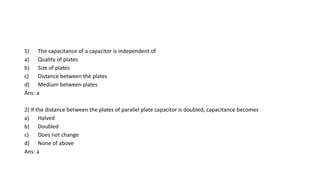
1) The capacitance of a capacitor is independent of
a) Quality of plates
b) Size of plates
c) Distance between the plates
d) Medium between plates
Ans: a
2) If the distance between the plates of parallel plate capacitor is doubled, capacitance becomes
a) Halved
b) Doubled
c) Does not change
d) None of above
Ans: a
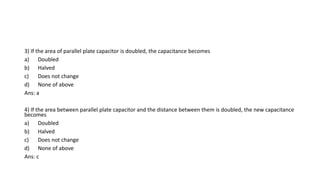
3) If the area of parallel plate capacitor is doubled, the capacitance becomes
a) Doubled
b) Halved
c) Does not change
d) None of above
Ans: a
4) If the area between parallel plate capacitor and the distance between them is doubled, the new capacitance
becomes
a) Doubled
b) Halved
c) Does not change
d) None of above
Ans: c
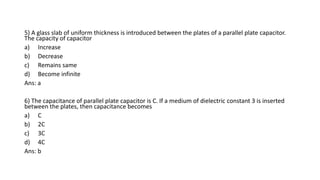
5) A glass slab of uniform thickness is introduced between the plates of a parallel plate capacitor.
The capacity of capacitor
a) Increase
b) Decrease
c) Remains same
d) Become infinite
Ans: a
6) The capacitance of parallel plate capacitor is C. If a medium of dielectric constant 3 is inserted
between the plates, then capacitance becomes
a) C
b) 2C
c) 3C
d) 4C
Ans: b
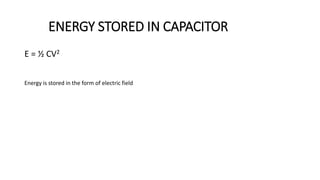
ENERGY STORED IN CAPACITOR
E = ½ CV2
Energy is stored in the form of electric field
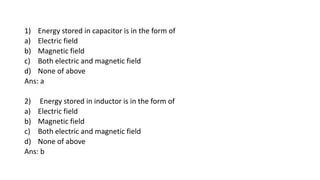
1) Energy stored in capacitor is in the form of
a) Electric field
b) Magnetic field
c) Both electric and magnetic field
d) None of above
Ans: a
2) Energy stored in inductor is in the form of
a) Electric field
b) Magnetic field
c) Both electric and magnetic field
d) None of above
Ans: b
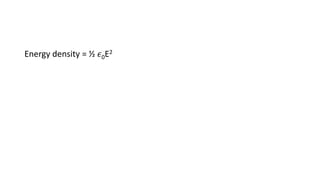
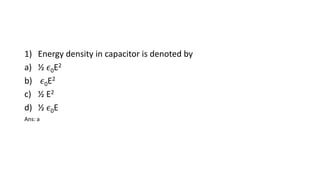
Energy density = ½ 𝜖0E2
1) Energy density in capacitor is denoted by
a) ½ 𝜖0E2
b) 𝜖0E2
c) ½ E2
d) ½ 𝜖0E
Ans: a
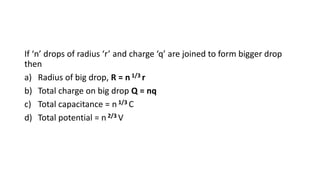
If ‘n’ drops of radius ‘r’ and charge ‘q’ are joined to form bigger drop
then
a) Radius of big drop, R = n 1/3 r
b) Total charge on big drop Q = nq
c) Total capacitance = n 1/3 C
d) Total potential = n 2/3 V
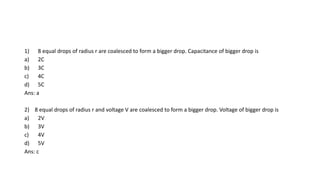
1) 8 equal drops of radius r are coalesced to form a bigger drop. Capacitance of bigger drop is
a) 2C
b) 3C
c) 4C
d) 5C
Ans: a
2) 8 equal drops of radius r and voltage V are coalesced to form a bigger drop. Voltage of bigger drop is
a) 2V
b) 3V
c) 4V
d) 5V
Ans: c
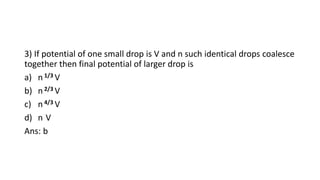
3) If potential of one small drop is V and n such identical drops coalesce
together then final potential of larger drop is
a) n 1/3 V
b) n 2/3 V
c) n 4/3 V
d) n V
Ans: b
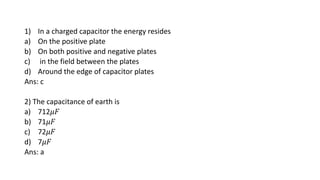
1) In a charged capacitor the energy resides
a) On the positive plate
b) On both positive and negative plates
c) in the field between the plates
d) Around the edge of capacitor plates
Ans: c
2) The capacitance of earth is
a) 712𝜇𝐹
b) 71𝜇𝐹
c) 72𝜇𝐹
d) 7𝜇𝐹
Ans: a
ELECTRIC FIELD AND POTENTIAL
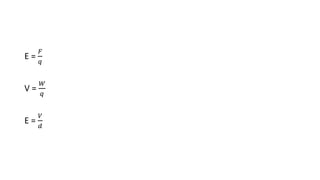
E =
𝐹
𝑞
V =
𝑊
𝑞
E =
𝑉
𝑑
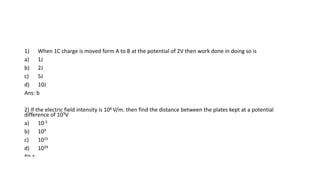
1) When 1C charge is moved form A to B at the potential of 2V then work done in doing so is
a) 1J
b) 2J
c) 5J
d) 10J
Ans: b
2) If the electric field intensity is 106 V/m. then find the distance between the plates kept at a potential
difference of 103V
a) 10-3
b) 109
c) 1015
d) 1039
Ans: a
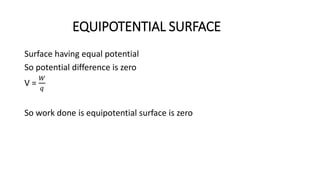
EQUIPOTENTIAL SURFACE
Surface having equal potential
So potential difference is zero
V =
𝑊
𝑞
So work done is equipotential surface is zero
1) Work done on equipotential surface is
a) Zero
b) Positive
c) Negative
d) Cannot be said
Ans: a
STATIC ELECTRICITY
1) A thin stream of water from a tap is attracted by placing a rod near it the rod is
a) The south pole of magnet
b) Charged with static electricity
c) The north pole of magnet
d) Any non magnetic substance
Ans: b
2) When a woolen sweater worn over a nylon shirt is removed, sparking is observed due to
a) Static electricity
b) Friction
c) Dynamic electricity
d) None of above
Ans: a
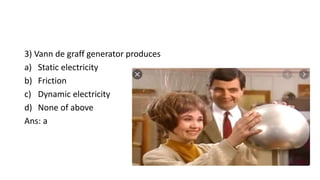
3) Vann de graff generator produces
a) Static electricity
b) Friction
c) Dynamic electricity
d) None of above
Ans: a
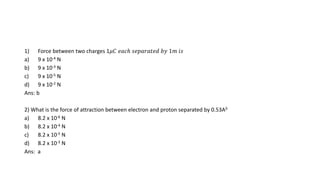
1) Force between two charges 1𝜇𝐶 𝑒𝑎𝑐ℎ 𝑠𝑒𝑝𝑎𝑟𝑎𝑡𝑒𝑑 𝑏𝑦 1𝑚 𝑖𝑠
a) 9 x 10⁻⁴ N
b) 9 x 10⁻³ N
c) 9 x 10⁻⁵ N
d) 9 x 10⁻² N
Ans: b
2) What is the force of attraction between electron and proton separated by 0.53A0
a) 8.2 x 10⁻⁶ N
b) 8.2 x 10⁻⁴ N
c) 8.2 x 10⁻⁵ N
d) 8.2 x 10⁻³ N
Ans: a
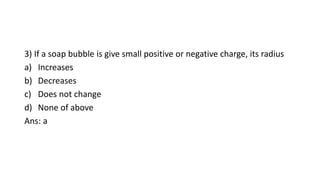
3) If a soap bubble is give small positive or negative charge, its radius
a) Increases
b) Decreases
c) Does not change
d) None of above
Ans: a
THANKYOU

Capacitor || Physics || B.Optom

  • 1.
  • 2.
    PARALLEL PLATE CAPACITOR C= 𝐾𝜖0𝐴 𝑑
  • 3.
    1) The capacitanceof a capacitor is independent of a) Quality of plates b) Size of plates c) Distance between the plates d) Medium between plates Ans: a 2) If the distance between the plates of parallel plate capacitor is doubled, capacitance becomes a) Halved b) Doubled c) Does not change d) None of above Ans: a
  • 4.
    3) If thearea of parallel plate capacitor is doubled, the capacitance becomes a) Doubled b) Halved c) Does not change d) None of above Ans: a 4) If the area between parallel plate capacitor and the distance between them is doubled, the new capacitance becomes a) Doubled b) Halved c) Does not change d) None of above Ans: c
  • 5.
    5) A glassslab of uniform thickness is introduced between the plates of a parallel plate capacitor. The capacity of capacitor a) Increase b) Decrease c) Remains same d) Become infinite Ans: a 6) The capacitance of parallel plate capacitor is C. If a medium of dielectric constant 3 is inserted between the plates, then capacitance becomes a) C b) 2C c) 3C d) 4C Ans: b
  • 6.
    ENERGY STORED INCAPACITOR E = ½ CV2 Energy is stored in the form of electric field
  • 7.
    1) Energy storedin capacitor is in the form of a) Electric field b) Magnetic field c) Both electric and magnetic field d) None of above Ans: a 2) Energy stored in inductor is in the form of a) Electric field b) Magnetic field c) Both electric and magnetic field d) None of above Ans: b
  • 8.
    Energy density =½ 𝜖0E2
  • 9.
    1) Energy densityin capacitor is denoted by a) ½ 𝜖0E2 b) 𝜖0E2 c) ½ E2 d) ½ 𝜖0E Ans: a
  • 10.
    If ‘n’ dropsof radius ‘r’ and charge ‘q’ are joined to form bigger drop then a) Radius of big drop, R = n 1/3 r b) Total charge on big drop Q = nq c) Total capacitance = n 1/3 C d) Total potential = n 2/3 V
  • 11.
    1) 8 equaldrops of radius r are coalesced to form a bigger drop. Capacitance of bigger drop is a) 2C b) 3C c) 4C d) 5C Ans: a 2) 8 equal drops of radius r and voltage V are coalesced to form a bigger drop. Voltage of bigger drop is a) 2V b) 3V c) 4V d) 5V Ans: c
  • 12.
    3) If potentialof one small drop is V and n such identical drops coalesce together then final potential of larger drop is a) n 1/3 V b) n 2/3 V c) n 4/3 V d) n V Ans: b
  • 13.
    1) In acharged capacitor the energy resides a) On the positive plate b) On both positive and negative plates c) in the field between the plates d) Around the edge of capacitor plates Ans: c 2) The capacitance of earth is a) 712𝜇𝐹 b) 71𝜇𝐹 c) 72𝜇𝐹 d) 7𝜇𝐹 Ans: a
  • 14.
  • 15.
  • 16.
    1) When 1Ccharge is moved form A to B at the potential of 2V then work done in doing so is a) 1J b) 2J c) 5J d) 10J Ans: b 2) If the electric field intensity is 106 V/m. then find the distance between the plates kept at a potential difference of 103V a) 10-3 b) 109 c) 1015 d) 1039 Ans: a
  • 17.
    EQUIPOTENTIAL SURFACE Surface havingequal potential So potential difference is zero V = 𝑊 𝑞 So work done is equipotential surface is zero
  • 18.
    1) Work doneon equipotential surface is a) Zero b) Positive c) Negative d) Cannot be said Ans: a
  • 19.
  • 20.
    1) A thinstream of water from a tap is attracted by placing a rod near it the rod is a) The south pole of magnet b) Charged with static electricity c) The north pole of magnet d) Any non magnetic substance Ans: b 2) When a woolen sweater worn over a nylon shirt is removed, sparking is observed due to a) Static electricity b) Friction c) Dynamic electricity d) None of above Ans: a
  • 21.
    3) Vann degraff generator produces a) Static electricity b) Friction c) Dynamic electricity d) None of above Ans: a
  • 22.
    1) Force betweentwo charges 1𝜇𝐶 𝑒𝑎𝑐ℎ 𝑠𝑒𝑝𝑎𝑟𝑎𝑡𝑒𝑑 𝑏𝑦 1𝑚 𝑖𝑠 a) 9 x 10⁻⁴ N b) 9 x 10⁻³ N c) 9 x 10⁻⁵ N d) 9 x 10⁻² N Ans: b 2) What is the force of attraction between electron and proton separated by 0.53A0 a) 8.2 x 10⁻⁶ N b) 8.2 x 10⁻⁴ N c) 8.2 x 10⁻⁵ N d) 8.2 x 10⁻³ N Ans: a
  • 23.
    3) If asoap bubble is give small positive or negative charge, its radius a) Increases b) Decreases c) Does not change d) None of above Ans: a
  • 24.