The Regulation of Gut Function and Motility Antonia Jameson Jordan, D.V.M., Ph.D.
Lecture outline: Overview of GI tract function Patterns of motility Control of GI motility Motility disorders
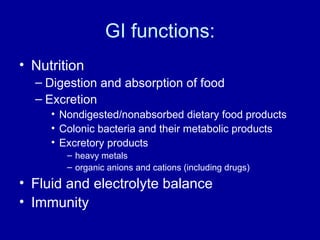
GI functions: Nutrition Digestion and absorption of food Excretion Nondigested/nonabsorbed dietary food products Colonic bacteria and their metabolic products Excretory products heavy metals organic anions and cations (including drugs) Fluid and electrolyte balance Immunity
input output
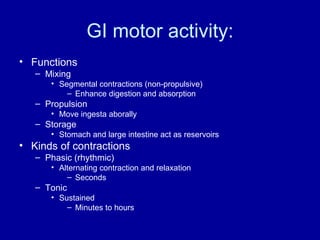
GI motor activity: Functions Mixing Segmental contractions (non-propulsive) Enhance digestion and absorption Propulsion Move ingesta aborally Storage Stomach and large intestine act as reservoirs Kinds of contractions Phasic (rhythmic) Alternating contraction and relaxation  Seconds Tonic Sustained Minutes to hours
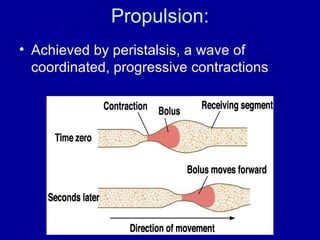
Propulsion: Achieved by peristalsis, a wave of coordinated, progressive contractions
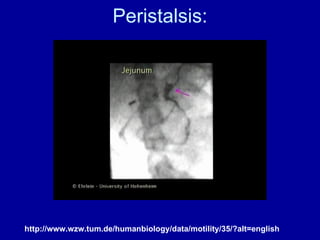
Peristalsis: http://www.wzw.tum.de/humanbiology/data/motility/35/?alt=english
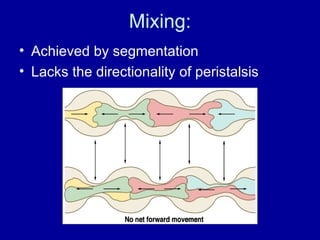
Mixing: Achieved by segmentation Lacks the directionality of peristalsis
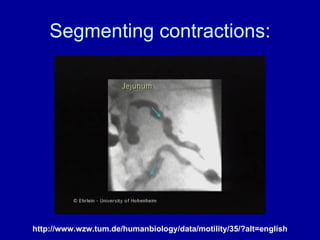
Segmenting contractions: http://www.wzw.tum.de/humanbiology/data/motility/35/?alt=english
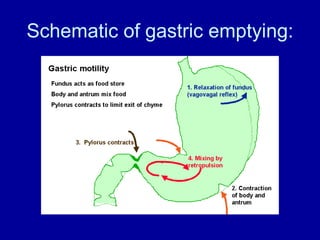
Schematic of gastric emptying:
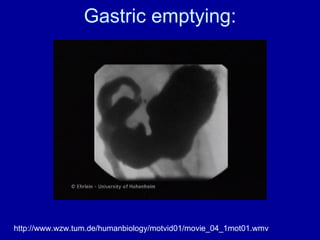
Gastric emptying: http://www.wzw.tum.de/humanbiology/motvid01/movie_04_1mot01.wmv
Control of gut motility: Myogenic GI smooth muscle has its own intrinsic rhythmicity Hormonal GI tract is the largest endocrine organ in the body Endocrine and paracrine GI hormones released from mucosa in response to:  Nervous stimulation Distention Chemical stimulation Gastrin, secretin, cholecystokinin, motilin, etc. Nervous Intrinsic enteric nervous system Extrinsic Parasympathetic Sympathetic
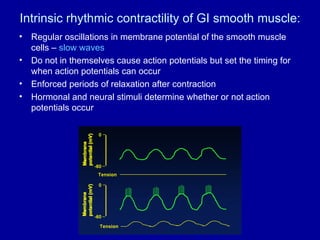
Intrinsic rhythmic contractility of GI smooth muscle: Regular oscillations in membrane potential of the smooth muscle cells –  slow waves Do not in themselves cause action potentials but set the timing for when action potentials can occur Enforced periods of relaxation after contraction Hormonal and neural stimuli determine whether or not action potentials occur
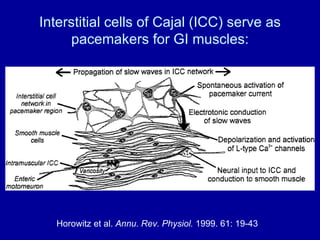
Interstitial cells of Cajal (ICC) serve as pacemakers for GI muscles: Horowitz et al.   Annu. Rev. Physiol.  1999. 61: 19-43
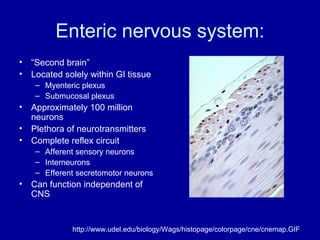
Enteric nervous system: “ Second brain”  Located solely within GI tissue Myenteric plexus Submucosal plexus Approximately 100 million neurons Plethora of neurotransmitters Complete reflex circuit Afferent sensory neurons Interneurons Efferent secretomotor neurons Can function independent of CNS http://www.udel.edu/biology/Wags/histopage/colorpage/cne/cnemap.GIF
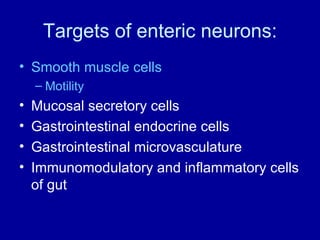
Targets of enteric neurons: Smooth muscle cells Motility Mucosal secretory cells Gastrointestinal endocrine cells Gastrointestinal microvasculature Immunomodulatory and inflammatory cells of gut
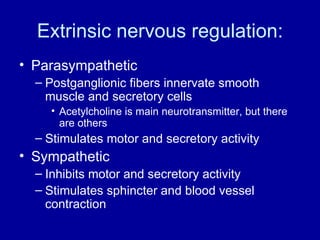
Extrinsic nervous regulation: Parasympathetic  Postganglionic fibers innervate smooth muscle and secretory cells Acetylcholine is main neurotransmitter, but there are others Stimulates motor and secretory activity Sympathetic Inhibits motor and secretory activity Stimulates sphincter and blood vessel contraction
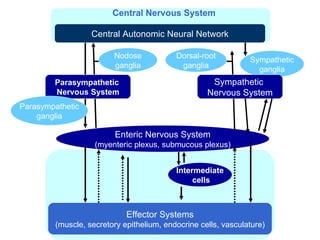
Central Autonomic Neural Network Effector Systems (muscle, secretory epithelium, endocrine cells, vasculature) Enteric Nervous System (myenteric plexus, submucous plexus) Parasympathetic  Nervous System Intermediate cells Parasympathetic ganglia Sympathetic ganglia Nodose ganglia Dorsal-root ganglia Sympathetic  Nervous System Central Nervous System
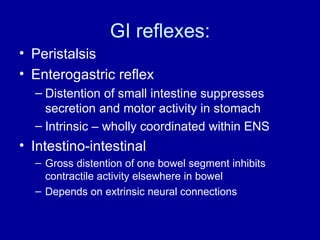
GI reflexes: Peristalsis Enterogastric reflex Distention of small intestine suppresses secretion and motor activity in stomach Intrinsic – wholly coordinated within ENS Intestino-intestinal Gross distention of one bowel segment inhibits contractile activity elsewhere in bowel Depends on extrinsic neural connections
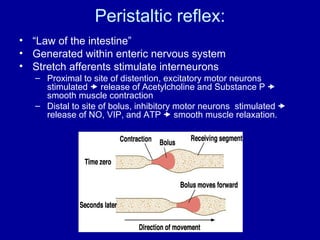
Peristaltic reflex: “ Law of the intestine” Generated within enteric nervous system Stretch afferents stimulate interneurons  Proximal to site of distention, excitatory motor neurons stimulated    release of Acetylcholine and Substance P    smooth muscle contraction Distal to site of bolus, inhibitory motor neurons  stimulated    release of NO, VIP, and ATP    smooth muscle relaxation.
Gastrointestinal motility disorders: Hypermotility   diarrhea Need to exclude other causes before assuming disordered motility is the cause Hypomotility Aganglionosis Ileus Megacolon
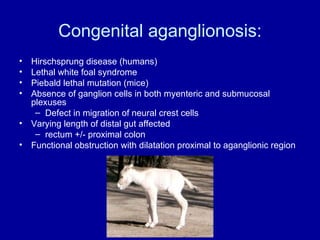
Congenital aganglionosis: Hirschsprung disease (humans) Lethal white foal syndrome Piebald lethal mutation (mice) Absence of ganglion cells in both myenteric and submucosal plexuses Defect in migration of neural crest cells Varying length of distal gut affected rectum +/- proximal colon Functional obstruction with dilatation proximal to aganglionic region
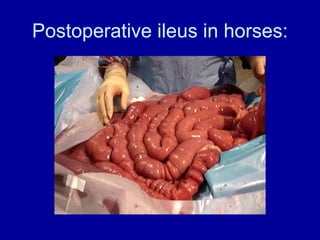
Postoperative ileus in horses:
Postoperative ileus (POI) in horses: Definition of ileus: Ineffective intestinal propulsion in the absence of a mechanical obstruction Consequence: Accumulation of gas and secretions   Overgrowth of small intestinal bacteria (SIBO) Ischemia and necrosis Dehydration Death Prevalence Between 9 and 43% of horses in post-operative period die from ileus
Pathophysiology of POI: Increased levels of circulation catecholamines from stress of surgery Parasympathetic hypo-activity Resection and anastamosis  Physical disruption of the ENS Absence of food in gut after surgery – decreased stimulus for motility Electrolyte imbalances Inflammation
Prevention and treatment of POI: Allow horse to eat as soon as possible after surgery Maintain fluid and electrolyte balance Parasympathetic stimulation Bethanecol – parasympathomimetic Neostigmine – cholinesterase inhibitor Sympathetic blockade Alpha-2 adrenergic antagonists Prokinetics Metaclopromide, cisapride
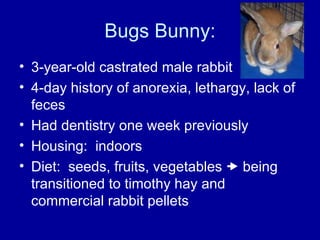
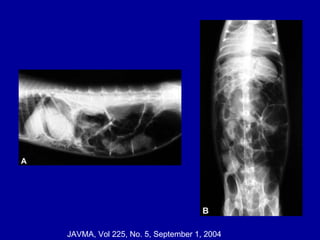
Bugs Bunny: 3-year-old castrated male rabbit 4-day history of anorexia, lethargy, lack of feces Had dentistry one week previously Housing:  indoors Diet:  seeds, fruits, vegetables    being transitioned to timothy hay and commercial rabbit pellets
Physical exam: Quiet, alert, 10% dehydrated Abdominal discomfort on palpation Intermittent bruxism during exam
JAVMA, Vol 225, No. 5, September 1, 2004
Gastrointestinal stasis syndrome: Pathophysiology Decreased GI motility  High-carbohydrate, low-fiber diet  Lack of exercise Anorexia due to other causes,  e.g.  dental problems Lack of motility can lead to fluid loss and the inability to pass hair out of stomach    trichobezoar
Gastrointestinal stasis syndrome: Treatment Rehydrate Force feeding  Analgesics Antimicrobials Prokinetic drugs Exercise
Key points: Control of GI motility Myogenic Intrinsic rhythmicity of GI smooth muscle Slow waves Interstitial cells of Cajal as pacemakers Hormonal Neural Intrinsic enteric nervous system Autonomic  Parasympathetic Sympathetic Disordered motility    pathology
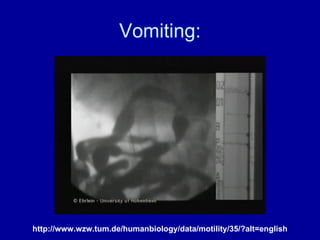
Vomiting: http://www.wzw.tum.de/humanbiology/data/motility/35/?alt=english

Gut motility lecture

  • 1.
    The Regulation ofGut Function and Motility Antonia Jameson Jordan, D.V.M., Ph.D.
  • 2.
    Lecture outline: Overviewof GI tract function Patterns of motility Control of GI motility Motility disorders
  • 3.
    GI functions: NutritionDigestion and absorption of food Excretion Nondigested/nonabsorbed dietary food products Colonic bacteria and their metabolic products Excretory products heavy metals organic anions and cations (including drugs) Fluid and electrolyte balance Immunity
  • 4.
  • 5.
    GI motor activity:Functions Mixing Segmental contractions (non-propulsive) Enhance digestion and absorption Propulsion Move ingesta aborally Storage Stomach and large intestine act as reservoirs Kinds of contractions Phasic (rhythmic) Alternating contraction and relaxation Seconds Tonic Sustained Minutes to hours
  • 6.
    Propulsion: Achieved byperistalsis, a wave of coordinated, progressive contractions
  • 7.
  • 8.
    Mixing: Achieved bysegmentation Lacks the directionality of peristalsis
  • 9.
  • 10.
  • 11.
  • 12.
    Control of gutmotility: Myogenic GI smooth muscle has its own intrinsic rhythmicity Hormonal GI tract is the largest endocrine organ in the body Endocrine and paracrine GI hormones released from mucosa in response to: Nervous stimulation Distention Chemical stimulation Gastrin, secretin, cholecystokinin, motilin, etc. Nervous Intrinsic enteric nervous system Extrinsic Parasympathetic Sympathetic
  • 13.
    Intrinsic rhythmic contractilityof GI smooth muscle: Regular oscillations in membrane potential of the smooth muscle cells – slow waves Do not in themselves cause action potentials but set the timing for when action potentials can occur Enforced periods of relaxation after contraction Hormonal and neural stimuli determine whether or not action potentials occur
  • 14.
    Interstitial cells ofCajal (ICC) serve as pacemakers for GI muscles: Horowitz et al. Annu. Rev. Physiol. 1999. 61: 19-43
  • 15.
    Enteric nervous system:“ Second brain” Located solely within GI tissue Myenteric plexus Submucosal plexus Approximately 100 million neurons Plethora of neurotransmitters Complete reflex circuit Afferent sensory neurons Interneurons Efferent secretomotor neurons Can function independent of CNS http://www.udel.edu/biology/Wags/histopage/colorpage/cne/cnemap.GIF
  • 16.
    Targets of entericneurons: Smooth muscle cells Motility Mucosal secretory cells Gastrointestinal endocrine cells Gastrointestinal microvasculature Immunomodulatory and inflammatory cells of gut
  • 17.
    Extrinsic nervous regulation:Parasympathetic Postganglionic fibers innervate smooth muscle and secretory cells Acetylcholine is main neurotransmitter, but there are others Stimulates motor and secretory activity Sympathetic Inhibits motor and secretory activity Stimulates sphincter and blood vessel contraction
  • 18.
    Central Autonomic NeuralNetwork Effector Systems (muscle, secretory epithelium, endocrine cells, vasculature) Enteric Nervous System (myenteric plexus, submucous plexus) Parasympathetic Nervous System Intermediate cells Parasympathetic ganglia Sympathetic ganglia Nodose ganglia Dorsal-root ganglia Sympathetic Nervous System Central Nervous System
  • 19.
    GI reflexes: PeristalsisEnterogastric reflex Distention of small intestine suppresses secretion and motor activity in stomach Intrinsic – wholly coordinated within ENS Intestino-intestinal Gross distention of one bowel segment inhibits contractile activity elsewhere in bowel Depends on extrinsic neural connections
  • 20.
    Peristaltic reflex: “Law of the intestine” Generated within enteric nervous system Stretch afferents stimulate interneurons Proximal to site of distention, excitatory motor neurons stimulated  release of Acetylcholine and Substance P  smooth muscle contraction Distal to site of bolus, inhibitory motor neurons stimulated  release of NO, VIP, and ATP  smooth muscle relaxation.
  • 21.
    Gastrointestinal motility disorders:Hypermotility  diarrhea Need to exclude other causes before assuming disordered motility is the cause Hypomotility Aganglionosis Ileus Megacolon
  • 22.
    Congenital aganglionosis: Hirschsprungdisease (humans) Lethal white foal syndrome Piebald lethal mutation (mice) Absence of ganglion cells in both myenteric and submucosal plexuses Defect in migration of neural crest cells Varying length of distal gut affected rectum +/- proximal colon Functional obstruction with dilatation proximal to aganglionic region
  • 23.
  • 24.
    Postoperative ileus (POI)in horses: Definition of ileus: Ineffective intestinal propulsion in the absence of a mechanical obstruction Consequence: Accumulation of gas and secretions  Overgrowth of small intestinal bacteria (SIBO) Ischemia and necrosis Dehydration Death Prevalence Between 9 and 43% of horses in post-operative period die from ileus
  • 25.
    Pathophysiology of POI:Increased levels of circulation catecholamines from stress of surgery Parasympathetic hypo-activity Resection and anastamosis Physical disruption of the ENS Absence of food in gut after surgery – decreased stimulus for motility Electrolyte imbalances Inflammation
  • 26.
    Prevention and treatmentof POI: Allow horse to eat as soon as possible after surgery Maintain fluid and electrolyte balance Parasympathetic stimulation Bethanecol – parasympathomimetic Neostigmine – cholinesterase inhibitor Sympathetic blockade Alpha-2 adrenergic antagonists Prokinetics Metaclopromide, cisapride
  • 27.
    Bugs Bunny: 3-year-oldcastrated male rabbit 4-day history of anorexia, lethargy, lack of feces Had dentistry one week previously Housing: indoors Diet: seeds, fruits, vegetables  being transitioned to timothy hay and commercial rabbit pellets
  • 28.
    Physical exam: Quiet,alert, 10% dehydrated Abdominal discomfort on palpation Intermittent bruxism during exam
  • 29.
    JAVMA, Vol 225,No. 5, September 1, 2004
  • 30.
    Gastrointestinal stasis syndrome:Pathophysiology Decreased GI motility High-carbohydrate, low-fiber diet Lack of exercise Anorexia due to other causes, e.g. dental problems Lack of motility can lead to fluid loss and the inability to pass hair out of stomach  trichobezoar
  • 31.
    Gastrointestinal stasis syndrome:Treatment Rehydrate Force feeding Analgesics Antimicrobials Prokinetic drugs Exercise
  • 32.
    Key points: Controlof GI motility Myogenic Intrinsic rhythmicity of GI smooth muscle Slow waves Interstitial cells of Cajal as pacemakers Hormonal Neural Intrinsic enteric nervous system Autonomic Parasympathetic Sympathetic Disordered motility  pathology
  • 33.

Editor's Notes

  • #2 Your schedule says the title of this lecture is the regulation of gut function and motility, But I will be focusing on the gi motility this is in itself a huge topic so I will be thinking of it from the perspective of clinical relevance THIS IS NOT THE MOST Palatable subject in veterinary medicine, but it may be one of the most relevant. Motility disorders can result diarrhea, constipation, vomiting, heartburn.