THE ECONOMY
MADE EASY
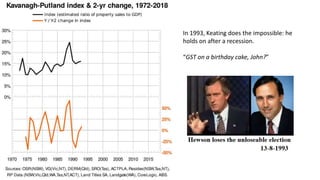
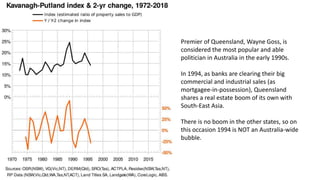
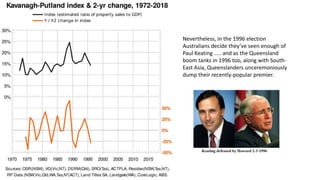
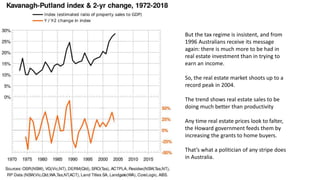
Kavanagh-Putland Index
Total real estate sales to GDP, Australia, 1972-2018
1
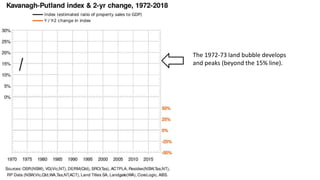
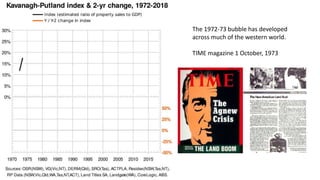
The 1972-73 land bubble develops
and peaks (beyond the 15% line).
1
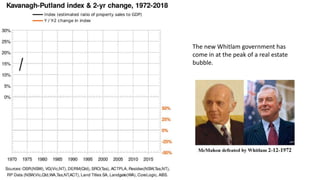
The new Whitlam government has
come in at the peak of a real estate
bubble.
1
The 1972-73 bubble has developed
across much of the western world.
TIME magazine 1 October, 1973
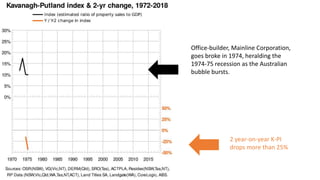
Office-builder, Mainline Corporation,
goes broke in 1974, heralding the
1974-75 recession as the Australian
bubble bursts.
2 year-on-year K-PI
drops more than 25%
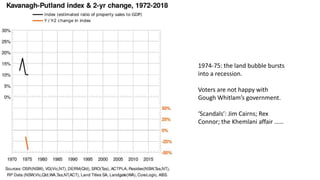
1974-75: the land bubble bursts
into a recession.
Voters are not happy with
Gough Whitlam’s government.
‘Scandals’: Jim Cairns; Rex
Connor; the Khemlani affair ……
But could it be that swinging voters are
carrying excessive debt, and need a
scapegoat when the 1974-5 recession
hits?
[The bubble has been all but written out
of economic history.]
The 1972-73 land bubble develops and
peaks, beyond the 15% line
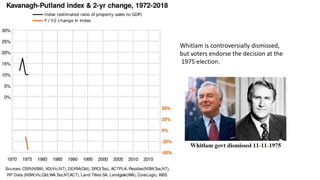
Whitlam is controversially dismissed,
but voters endorse the decision at the
1975 election.
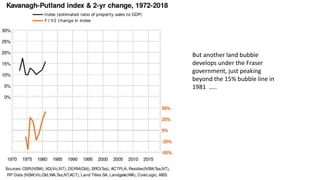
But another land bubble
develops under the Fraser
government, just peaking
beyond the 15% bubble line in
1981 …..
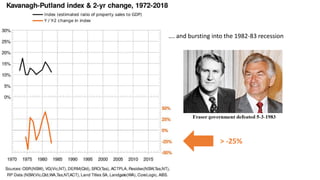
…. and bursting into the 1982-83 recession
> -25%
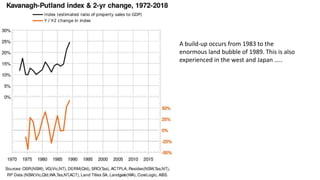
A build-up occurs from 1983 to the
enormous land bubble of 1989. This is also
experienced in the west and Japan …..
experienced in the west and Japan in 1989.
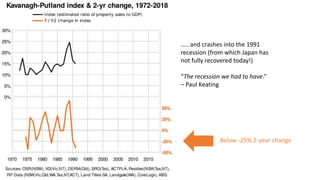
….. and crashes into the 1991
recession (from which Japan has
not fully recovered today!)
“The recession we had to have.”
– Paul Keating Japan in 1989.
Below -25% 2-year change
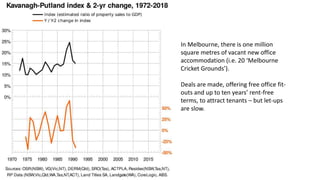
In Melbourne, there is one million
square metres of vacant new office
accommodation (i.e. 20 ‘Melbourne
Cricket Grounds’).
Deals are made, offering free office fit-
outs and up to ten years’ rent-free
terms, to attract tenants – but let-ups
are slow.
experienced in the west and Japan in 1989.
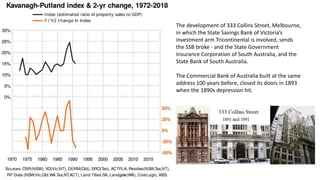
The development of 333 Collins Street, Melbourne,
in which the State Savings Bank of Victoria’s
investment arm Tricontinental is involved, sends
the SSB broke - and the State Government
Insurance Corporation of South Australia, and the
State Bank of South Australia.
The Commercial Bank of Australia built at the same
address 100 years before, closed its doors in 1893
when the 1890s depression hit.
experienced in the west and Japan in 1989.
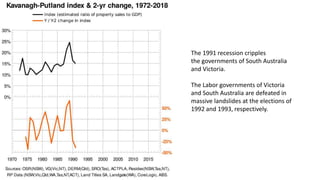
The 1991 recession cripples
the governments of South Australia
and Victoria.
The Labor governments of Victoria
and South Australia are defeated in
massive landslides at the elections of
1992 and 1993, respectively.
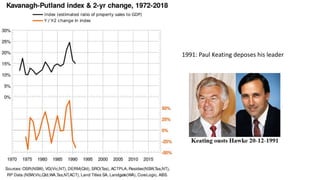
1991: Paul Keating deposes his leader
In 1993, Keating does the impossible: he
holds on after a recession.
“GST on a birthday cake, John?”
Premier of Queensland, Wayne Goss, is
considered the most popular and able
politician in Australia in the early 1990s.
In 1994, as banks are clearing their big
commercial and industrial sales (as
mortgagee-in-possession), Queensland
shares a real estate boom of its own with
South-East Asia.
There is no boom in the other states, so on
this occasion 1994 is NOT an Australia-wide
bubble.
Nevertheless, in the 1996 election
Australians decide they’ve seen enough of
Paul Keating ….. and as the Queensland
boom tanks in 1996 too, along with South-
East Asia, Queenslanders unceremoniously
dump their recently-popular premier.
But the tax regime is insistent, and from
1996 Australians receive its message
again: there is much more to be had in
real estate investment than in trying to
earn an income.
So, the real estate market shoots up to a
record peak in 2004.
The trend shows real estate sales to be
doing much better than productivity
Any time real estate prices look to falter,
the Howard government feeds them by
increasing the grants to home buyers.
That’s what a politician of any stripe does
in Australia.
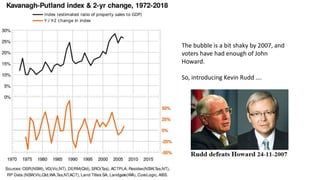
The bubble is a bit shaky by 2007, and
voters have had enough of John
Howard.
So, introducing Kevin Rudd ….
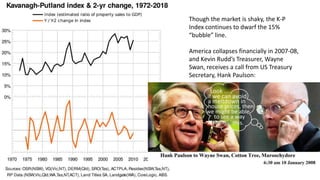
Though the market is shaky, the K-P
Index continues to dwarf the 15%
“bubble” line.
America collapses financially in 2007-08,
and Kevin Rudd’s Treasurer, Wayne
Swan, receives a call from US Treasury
Secretary, Hank Paulson:
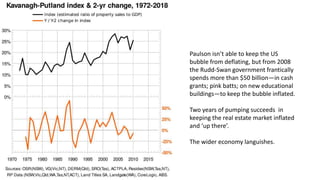
Paulson isn’t able to keep the US
bubble from deflating, but from 2008
the Rudd-Swan government frantically
spends more than $50 billion—in cash
grants; pink batts; on new educational
buildings—to keep the bubble inflated.
Two years of pumping succeeds in
keeping the real estate market inflated
and ‘up there’.
The wider economy languishes.
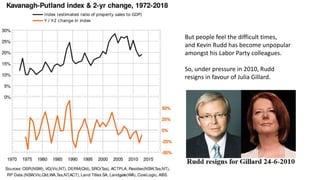
But people feel the difficult times,
and Kevin Rudd has become unpopular
amongst his Labor Party colleagues.
So, under pressure in 2010, Rudd
resigns in favour of Julia Gillard.
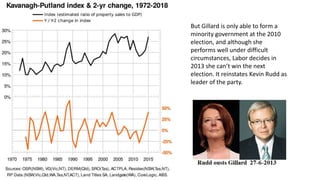
But Gillard is only able to form a
minority government at the 2010
election, and although she
performs well under difficult
circumstances, Labor decides in
2013 she can’t win the next
election. It reinstates Kevin Rudd as
leader of the party.
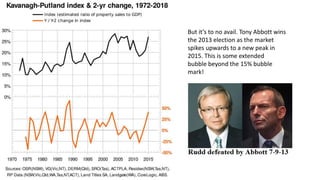
But it’s to no avail. Tony Abbott wins
the 2013 election as the market
spikes upwards to a new peak in
2015. This is some extended
bubble beyond the 15% bubble
mark!
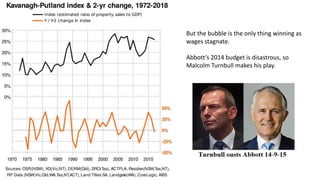
But the bubble is the only thing winning as
wages stagnate.
Abbott’s 2014 budget is disastrous, so
Malcolm Turnbull makes his play.
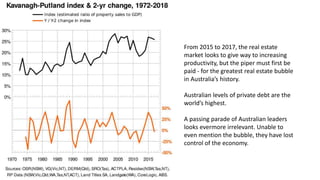
From 2015 to 2017, the real estate
market looks to give way to increasing
productivity, but the piper must first be
paid - for the greatest real estate bubble
in Australia’s history.
Australian levels of private debt are the
world’s highest.
A passing parade of Australian leaders
looks evermore irrelevant. Unable to
even mention the bubble, they have lost
control of the economy.
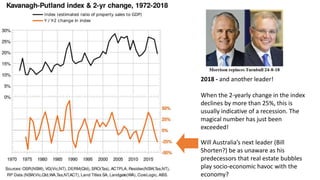
2018 - and another leader!
When the 2-yearly change in the index
declines by more than 25%, this is
usually indicative of a recession. The
magical number has just been
exceeded! more than 25% - and it did this
during 2
Will Australia’s next leader (Bill
Shorten?) be as unaware as his
predecessors that real estate bubbles
play socio-economic havoc with the
economy?
Kavanagh-Putland Index
Total real estate sales to GDP, Australia, 1972-2018

The Economy Made Easy

  • 1.
    THE ECONOMY MADE EASY Kavanagh-PutlandIndex Total real estate sales to GDP, Australia, 1972-2018
  • 2.
    1 The 1972-73 landbubble develops and peaks (beyond the 15% line).
  • 3.
    1 The new Whitlamgovernment has come in at the peak of a real estate bubble.
  • 4.
    1 The 1972-73 bubblehas developed across much of the western world. TIME magazine 1 October, 1973
  • 5.
    Office-builder, Mainline Corporation, goesbroke in 1974, heralding the 1974-75 recession as the Australian bubble bursts. 2 year-on-year K-PI drops more than 25%
  • 6.
    1974-75: the landbubble bursts into a recession. Voters are not happy with Gough Whitlam’s government. ‘Scandals’: Jim Cairns; Rex Connor; the Khemlani affair ……
  • 7.
    But could itbe that swinging voters are carrying excessive debt, and need a scapegoat when the 1974-5 recession hits? [The bubble has been all but written out of economic history.] The 1972-73 land bubble develops and peaks, beyond the 15% line
  • 8.
    Whitlam is controversiallydismissed, but voters endorse the decision at the 1975 election.
  • 9.
    But another landbubble develops under the Fraser government, just peaking beyond the 15% bubble line in 1981 …..
  • 10.
    …. and burstinginto the 1982-83 recession > -25%
  • 11.
    A build-up occursfrom 1983 to the enormous land bubble of 1989. This is also experienced in the west and Japan ….. experienced in the west and Japan in 1989.
  • 12.
    ….. and crashesinto the 1991 recession (from which Japan has not fully recovered today!) “The recession we had to have.” – Paul Keating Japan in 1989. Below -25% 2-year change
  • 13.
    In Melbourne, thereis one million square metres of vacant new office accommodation (i.e. 20 ‘Melbourne Cricket Grounds’). Deals are made, offering free office fit- outs and up to ten years’ rent-free terms, to attract tenants – but let-ups are slow. experienced in the west and Japan in 1989.
  • 14.
    The development of333 Collins Street, Melbourne, in which the State Savings Bank of Victoria’s investment arm Tricontinental is involved, sends the SSB broke - and the State Government Insurance Corporation of South Australia, and the State Bank of South Australia. The Commercial Bank of Australia built at the same address 100 years before, closed its doors in 1893 when the 1890s depression hit. experienced in the west and Japan in 1989.
  • 15.
    The 1991 recessioncripples the governments of South Australia and Victoria. The Labor governments of Victoria and South Australia are defeated in massive landslides at the elections of 1992 and 1993, respectively.
  • 16.
    1991: Paul Keatingdeposes his leader
  • 17.
    In 1993, Keatingdoes the impossible: he holds on after a recession. “GST on a birthday cake, John?”
  • 18.
    Premier of Queensland,Wayne Goss, is considered the most popular and able politician in Australia in the early 1990s. In 1994, as banks are clearing their big commercial and industrial sales (as mortgagee-in-possession), Queensland shares a real estate boom of its own with South-East Asia. There is no boom in the other states, so on this occasion 1994 is NOT an Australia-wide bubble.
  • 19.
    Nevertheless, in the1996 election Australians decide they’ve seen enough of Paul Keating ….. and as the Queensland boom tanks in 1996 too, along with South- East Asia, Queenslanders unceremoniously dump their recently-popular premier.
  • 20.
    But the taxregime is insistent, and from 1996 Australians receive its message again: there is much more to be had in real estate investment than in trying to earn an income. So, the real estate market shoots up to a record peak in 2004. The trend shows real estate sales to be doing much better than productivity Any time real estate prices look to falter, the Howard government feeds them by increasing the grants to home buyers. That’s what a politician of any stripe does in Australia.
  • 21.
    The bubble isa bit shaky by 2007, and voters have had enough of John Howard. So, introducing Kevin Rudd ….
  • 22.
    Though the marketis shaky, the K-P Index continues to dwarf the 15% “bubble” line. America collapses financially in 2007-08, and Kevin Rudd’s Treasurer, Wayne Swan, receives a call from US Treasury Secretary, Hank Paulson:
  • 23.
    Paulson isn’t ableto keep the US bubble from deflating, but from 2008 the Rudd-Swan government frantically spends more than $50 billion—in cash grants; pink batts; on new educational buildings—to keep the bubble inflated. Two years of pumping succeeds in keeping the real estate market inflated and ‘up there’. The wider economy languishes.
  • 24.
    But people feelthe difficult times, and Kevin Rudd has become unpopular amongst his Labor Party colleagues. So, under pressure in 2010, Rudd resigns in favour of Julia Gillard.
  • 25.
    But Gillard isonly able to form a minority government at the 2010 election, and although she performs well under difficult circumstances, Labor decides in 2013 she can’t win the next election. It reinstates Kevin Rudd as leader of the party.
  • 26.
    But it’s tono avail. Tony Abbott wins the 2013 election as the market spikes upwards to a new peak in 2015. This is some extended bubble beyond the 15% bubble mark!
  • 27.
    But the bubbleis the only thing winning as wages stagnate. Abbott’s 2014 budget is disastrous, so Malcolm Turnbull makes his play.
  • 28.
    From 2015 to2017, the real estate market looks to give way to increasing productivity, but the piper must first be paid - for the greatest real estate bubble in Australia’s history. Australian levels of private debt are the world’s highest. A passing parade of Australian leaders looks evermore irrelevant. Unable to even mention the bubble, they have lost control of the economy.
  • 29.
    2018 - andanother leader! When the 2-yearly change in the index declines by more than 25%, this is usually indicative of a recession. The magical number has just been exceeded! more than 25% - and it did this during 2 Will Australia’s next leader (Bill Shorten?) be as unaware as his predecessors that real estate bubbles play socio-economic havoc with the economy?
  • 30.
    Kavanagh-Putland Index Total realestate sales to GDP, Australia, 1972-2018