Moving from Actions & Behaviors to Microservices
Jeff Potts, Metaversant
@jeffpotts01
How do we make it easier to
integrate Alfresco with other
systems?
Learn. Connect. Collaborate.
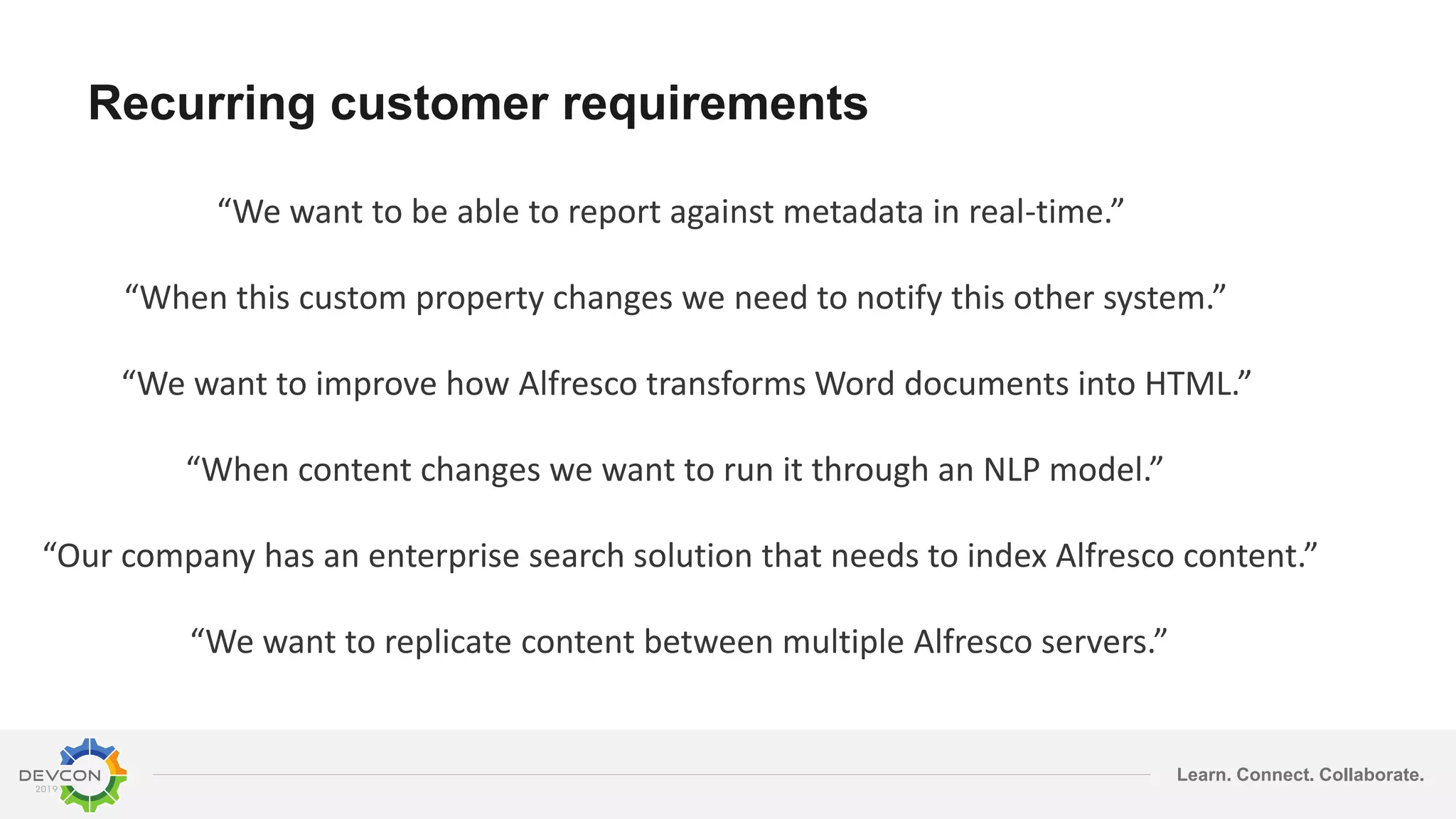
“We want to be able to report against metadata in real-time.”
“When this custom property changes we need to notify this other system.”
“We want to improve how Alfresco transforms Word documents into HTML.”
“When content changes we want to run it through an NLP model.”
“Our company has an enterprise search solution that needs to index Alfresco content.”
“We want to replicate content between multiple Alfresco servers.”
Recurring customer requirements
Learn. Connect. Collaborate.
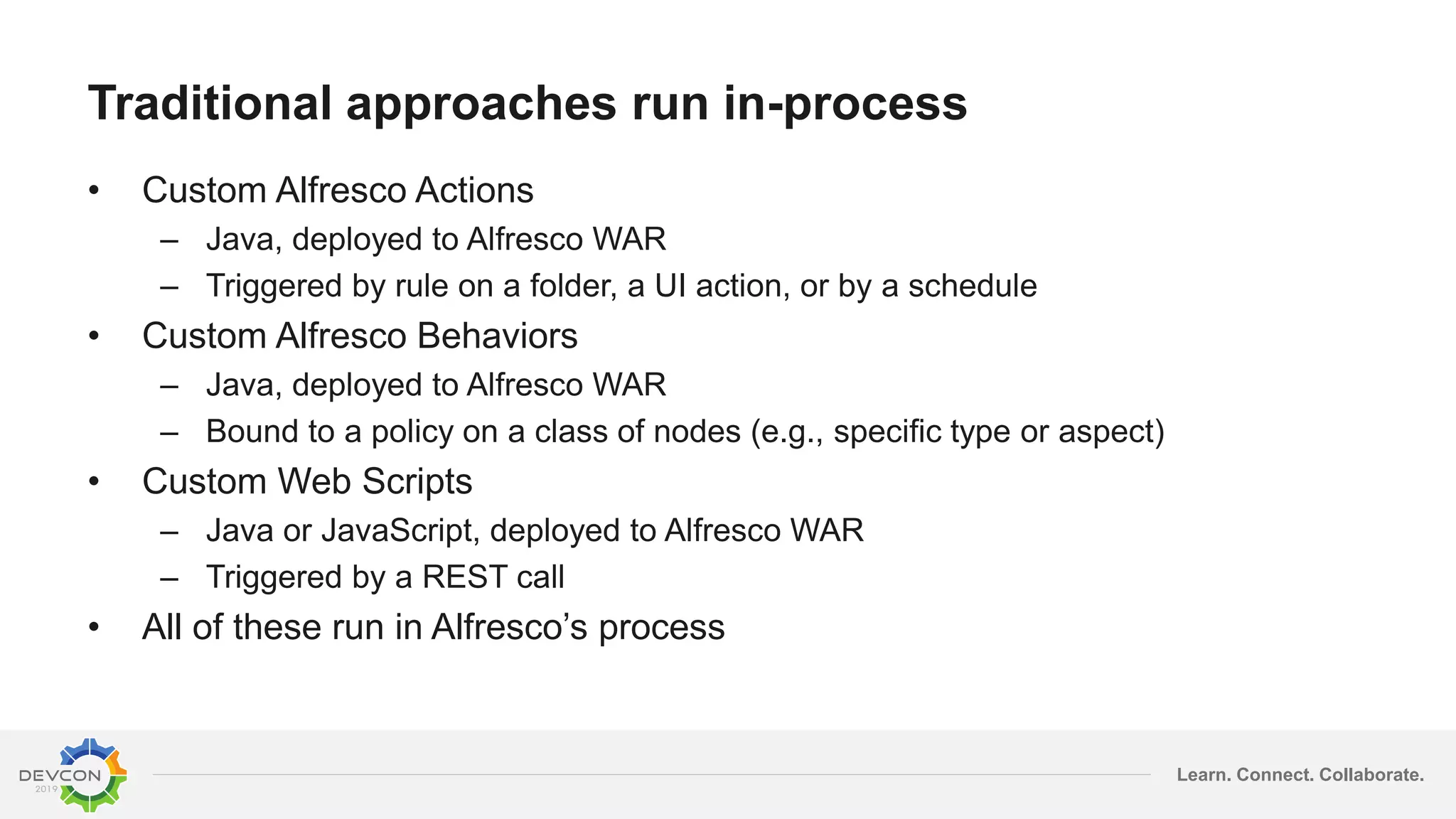
Traditional approaches run in-process
• Custom Alfresco Actions
– Java, deployed to Alfresco WAR
– Triggered by rule on a folder, a UI action, or by a schedule
• Custom Alfresco Behaviors
– Java, deployed to Alfresco WAR
– Bound to a policy on a class of nodes (e.g., specific type or aspect)
• Custom Web Scripts
– Java or JavaScript, deployed to Alfresco WAR
– Triggered by a REST call
• All of these run in Alfresco’s process
Learn. Connect. Collaborate.
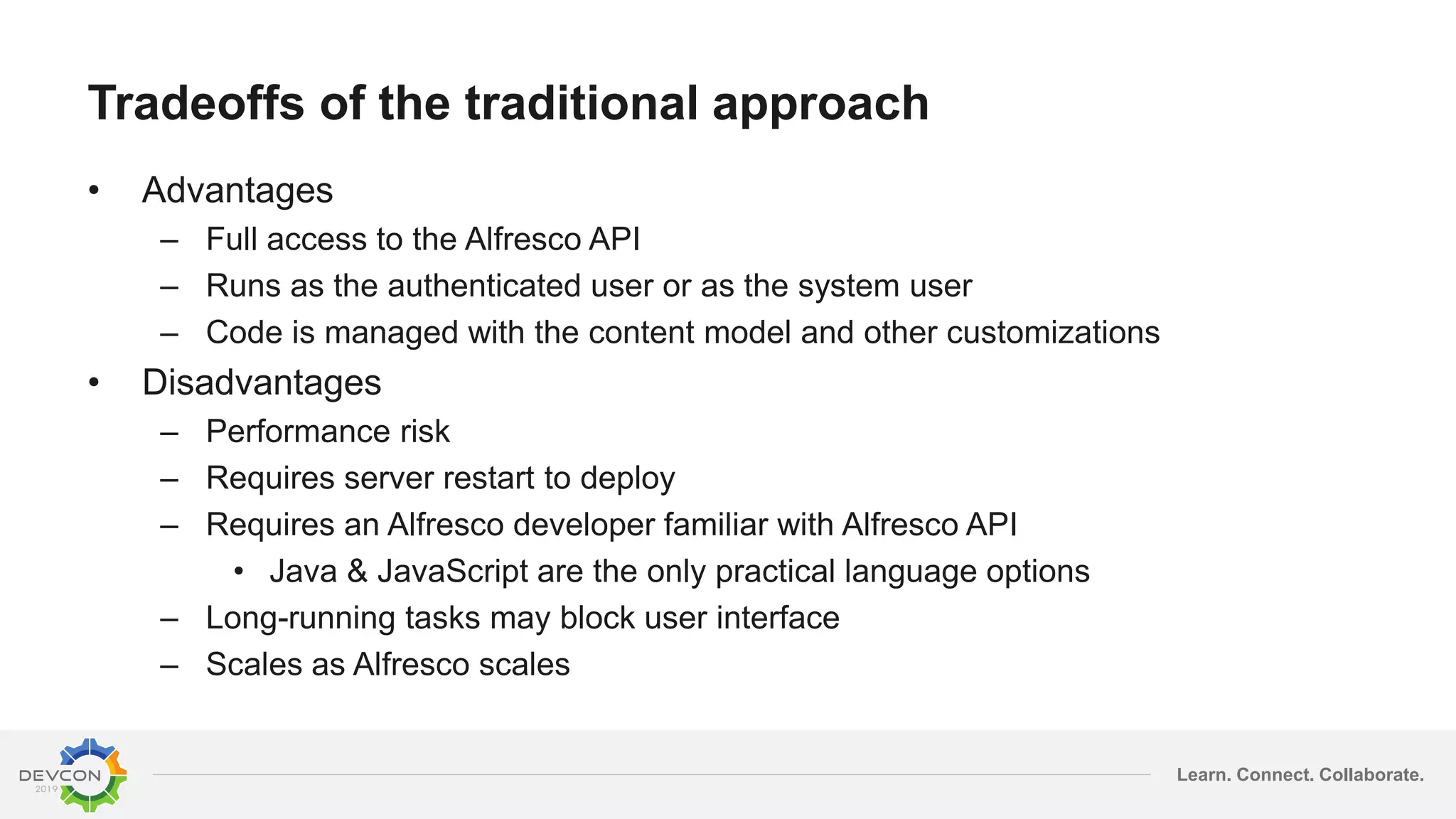
Tradeoffs of the traditional approach
• Advantages
– Full access to the Alfresco API
– Runs as the authenticated user or as the system user
– Code is managed with the content model and other customizations
• Disadvantages
– Performance risk
– Requires server restart to deploy
– Requires an Alfresco developer familiar with Alfresco API
• Java & JavaScript are the only practical language options
– Long-running tasks may block user interface
– Scales as Alfresco scales
An event-based approach
Learn. Connect. Collaborate.
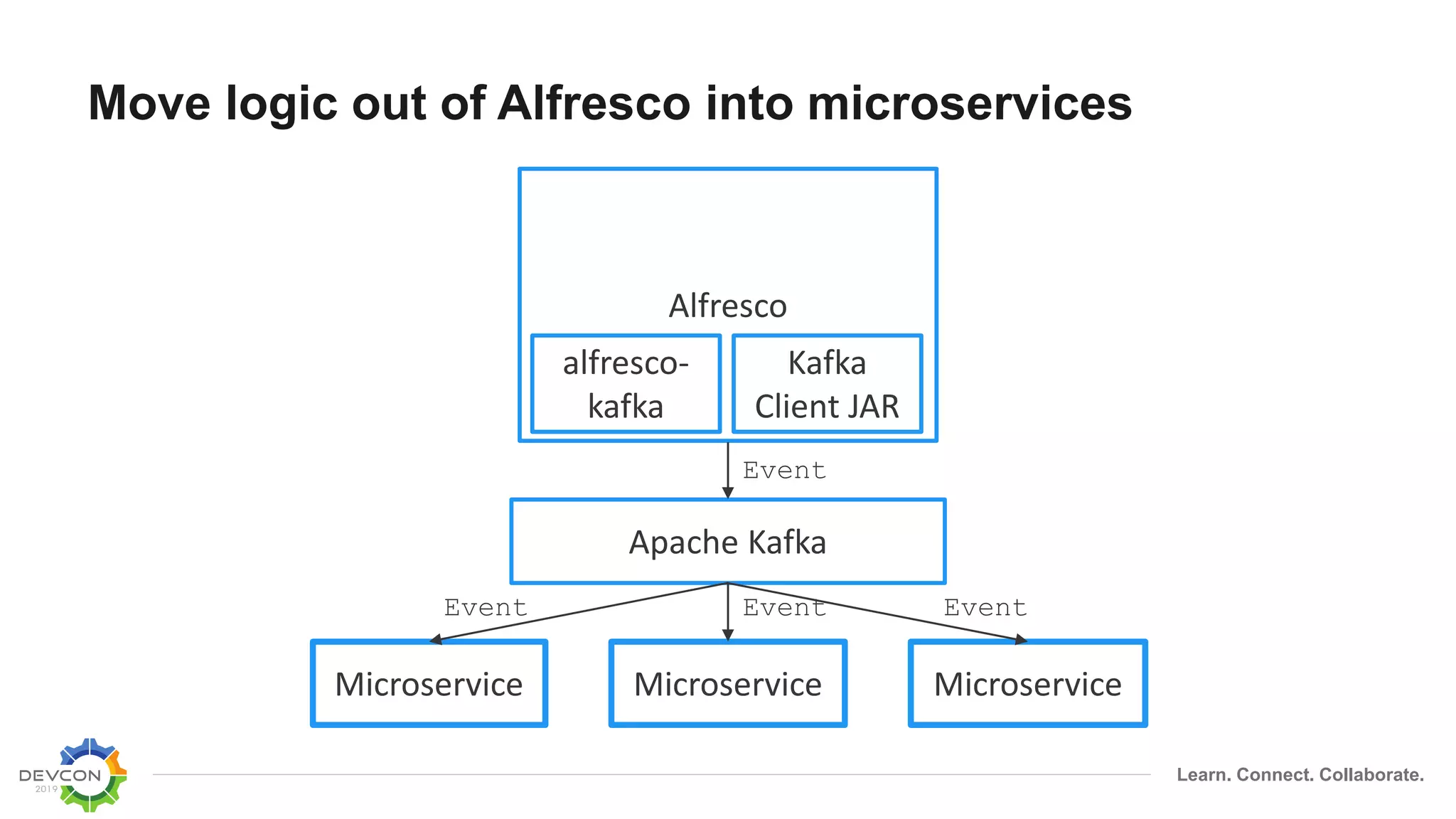
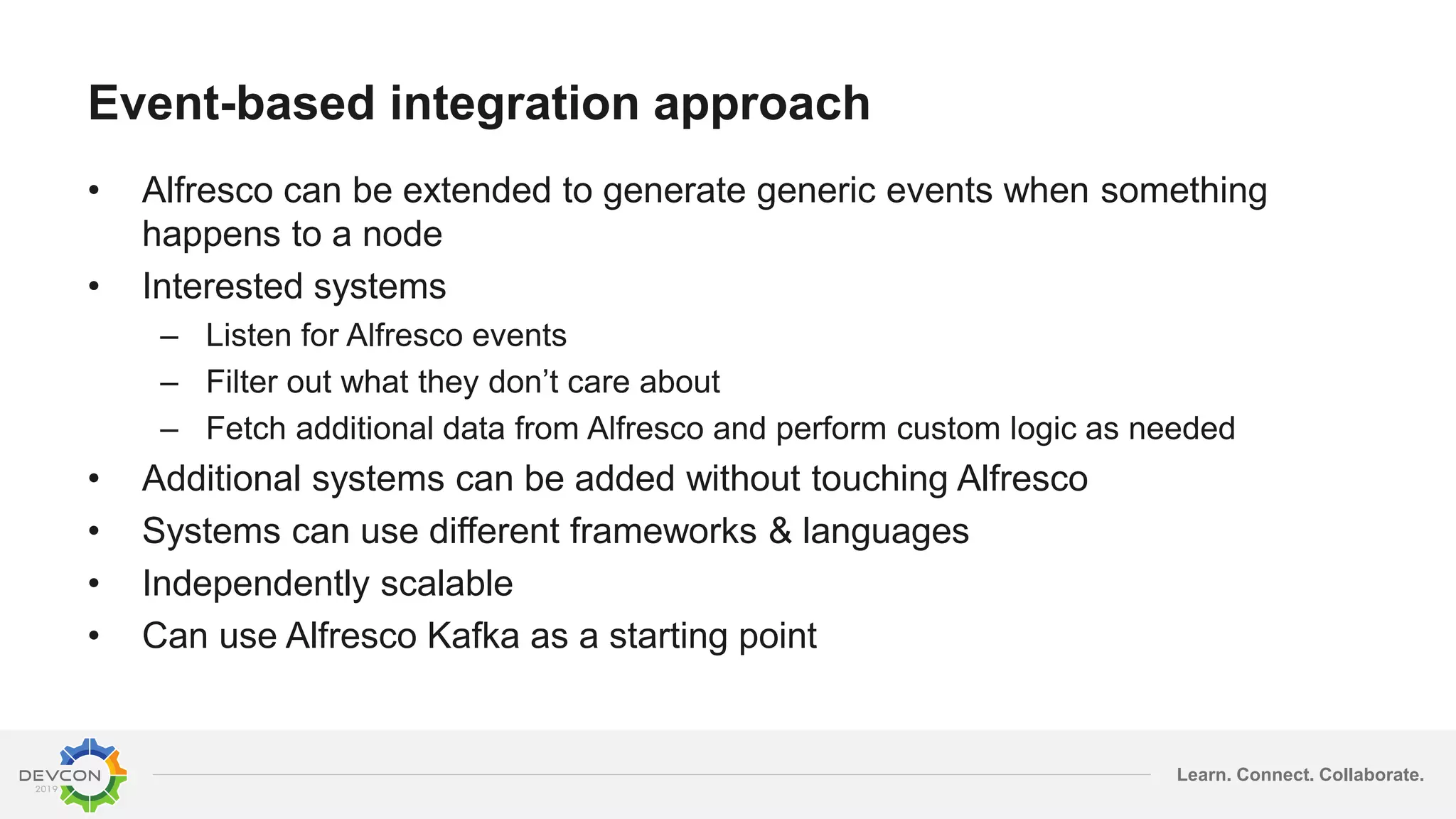
Event-based integration approach
• Alfresco can be extended to generate generic events when something
happens to a node
• Interested systems
– Listen for Alfresco events
– Filter out what they don’t care about
– Fetch additional data from Alfresco and perform custom logic as needed
• Additional systems can be added without touching Alfresco
• Systems can use different frameworks & languages
• Independently scalable
• Can use Alfresco Kafka as a starting point
Learn. Connect. Collaborate.
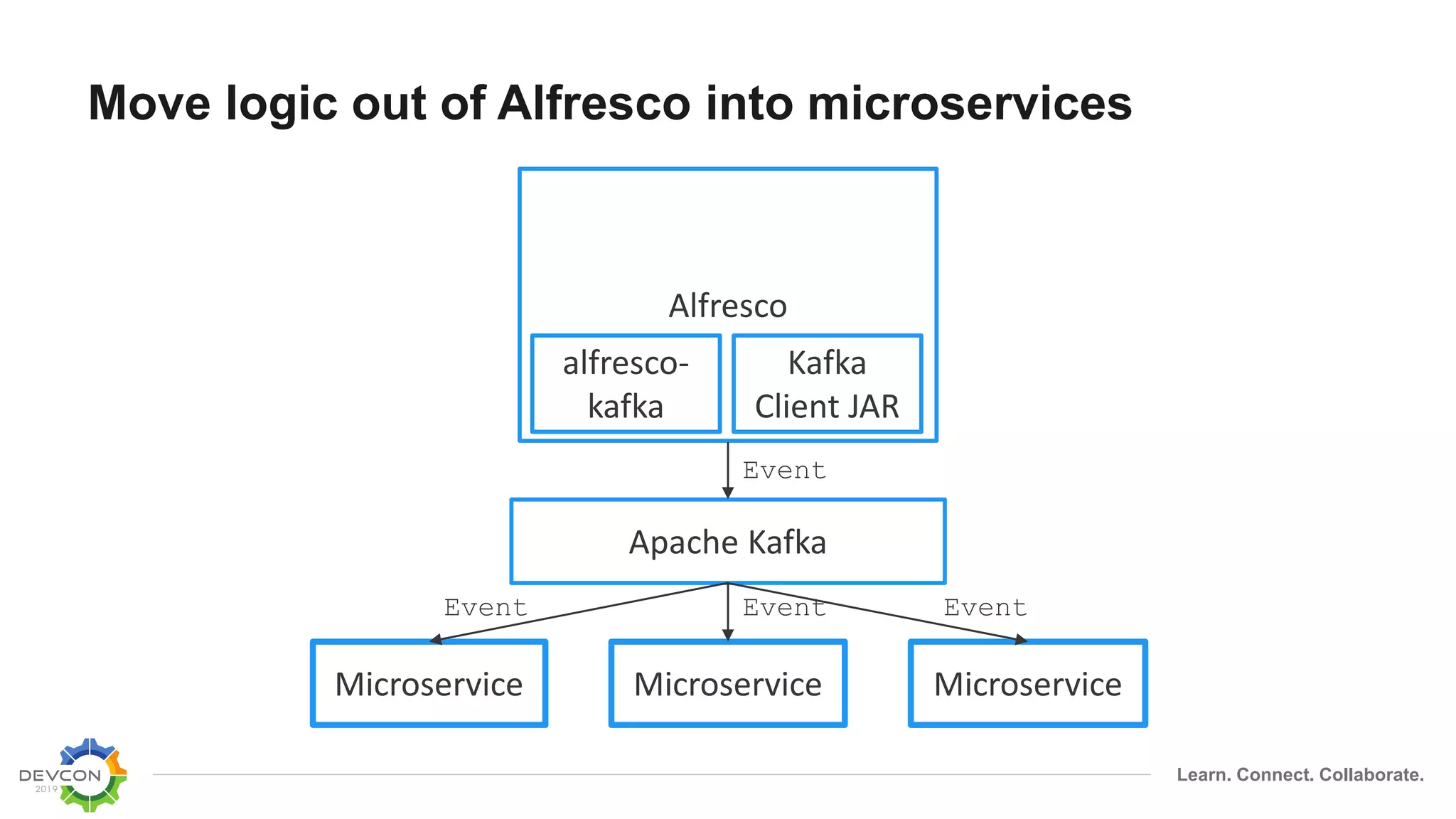
Apache Kafka
Alfresco
Microservice
Event
Event
Microservice
Event
Microservice
Event
Move logic out of Alfresco into microservices
alfresco-
kafka
Kafka
Client JAR
Learn. Connect. Collaborate.
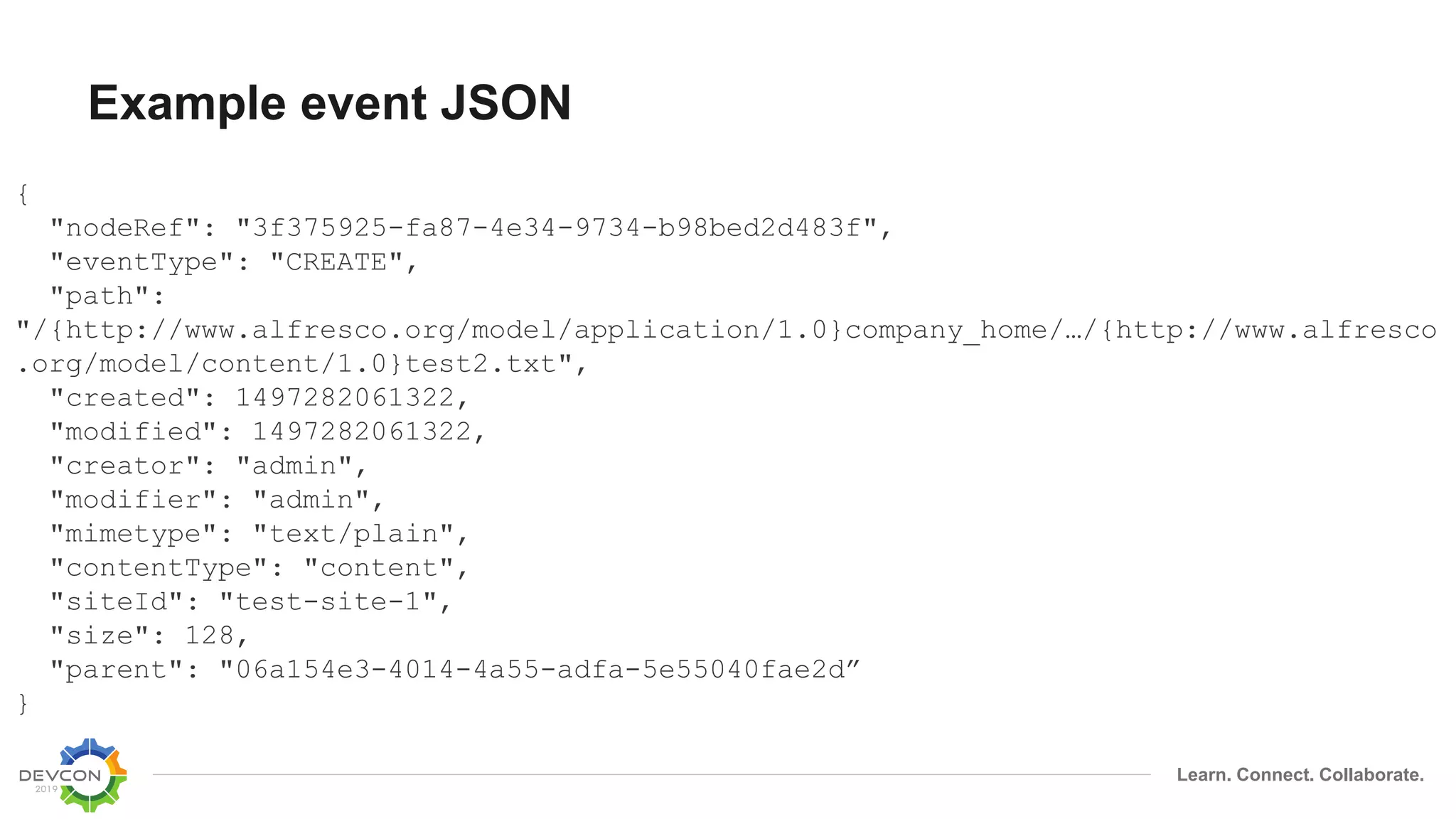
Example event JSON
{
"nodeRef": "3f375925-fa87-4e34-9734-b98bed2d483f",
"eventType": "CREATE",
"path":
"/{http://www.alfresco.org/model/application/1.0}company_home/…/{http://www.alfresco
.org/model/content/1.0}test2.txt",
"created": 1497282061322,
"modified": 1497282061322,
"creator": "admin",
"modifier": "admin",
"mimetype": "text/plain",
"contentType": "content",
"siteId": "test-site-1",
"size": 128,
"parent": "06a154e3-4014-4a55-adfa-5e55040fae2d”
}
Simple Example
Learn. Connect. Collaborate.
Alfresco Kafka Listener Example
• Alfresco Kafka
– https://github.com/jpotts/alfresco-kafka
• Alfresco Kafka Listener Example
– https://github.com/jpotts/alfresco-kafka-listener-example
• Demo: https://youtu.be/K40M2gJA7vM
Learn. Connect. Collaborate.
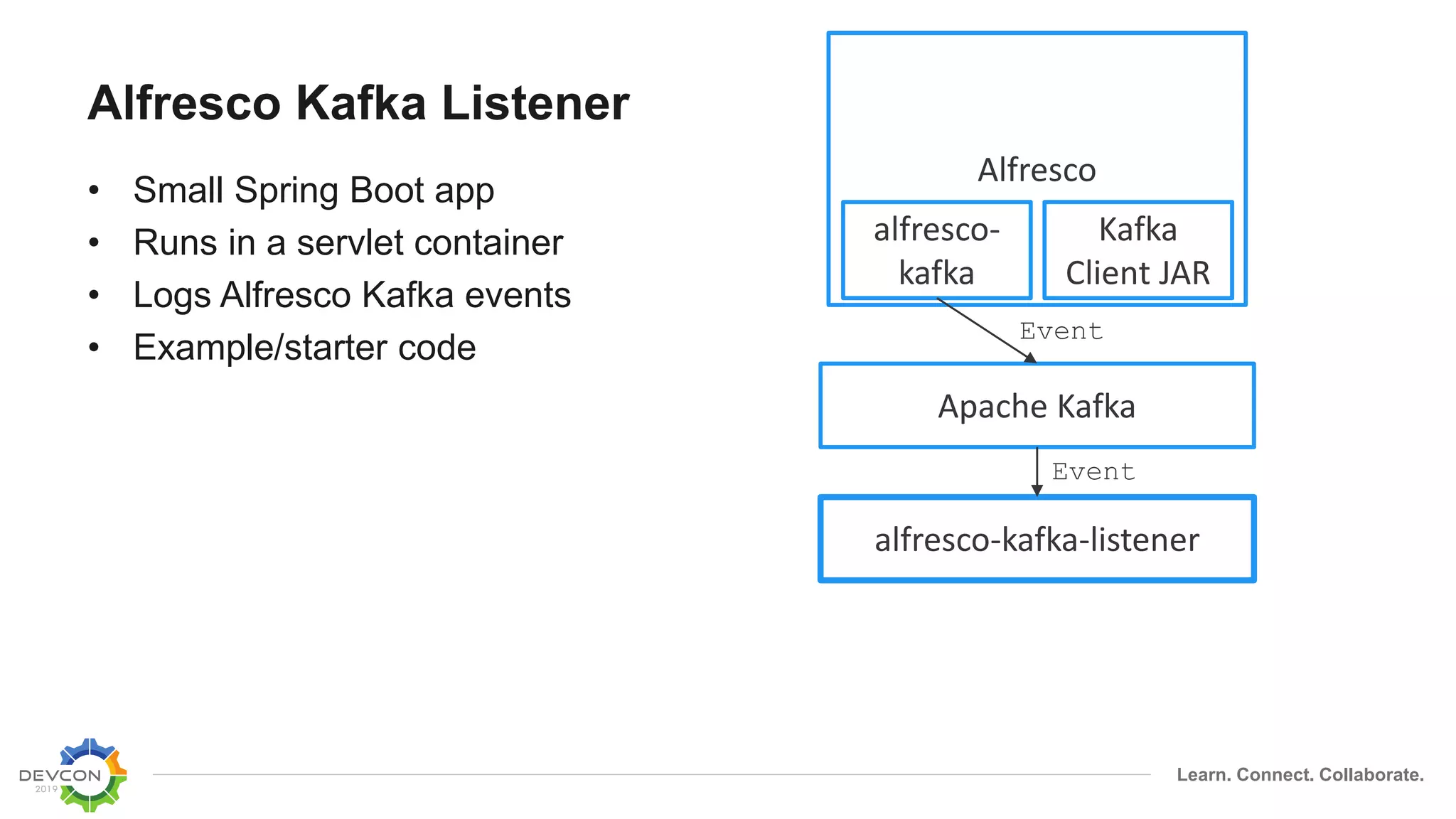
Alfresco Kafka Listener
• Small Spring Boot app
• Runs in a servlet container
• Logs Alfresco Kafka events
• Example/starter code
Apache Kafka
Alfresco
alfresco-kafka-listener
alfresco-
kafka
Kafka
Client JAR
Event
Event
Demo: Alfresco Kafka Listener
Learn. Connect. Collaborate.
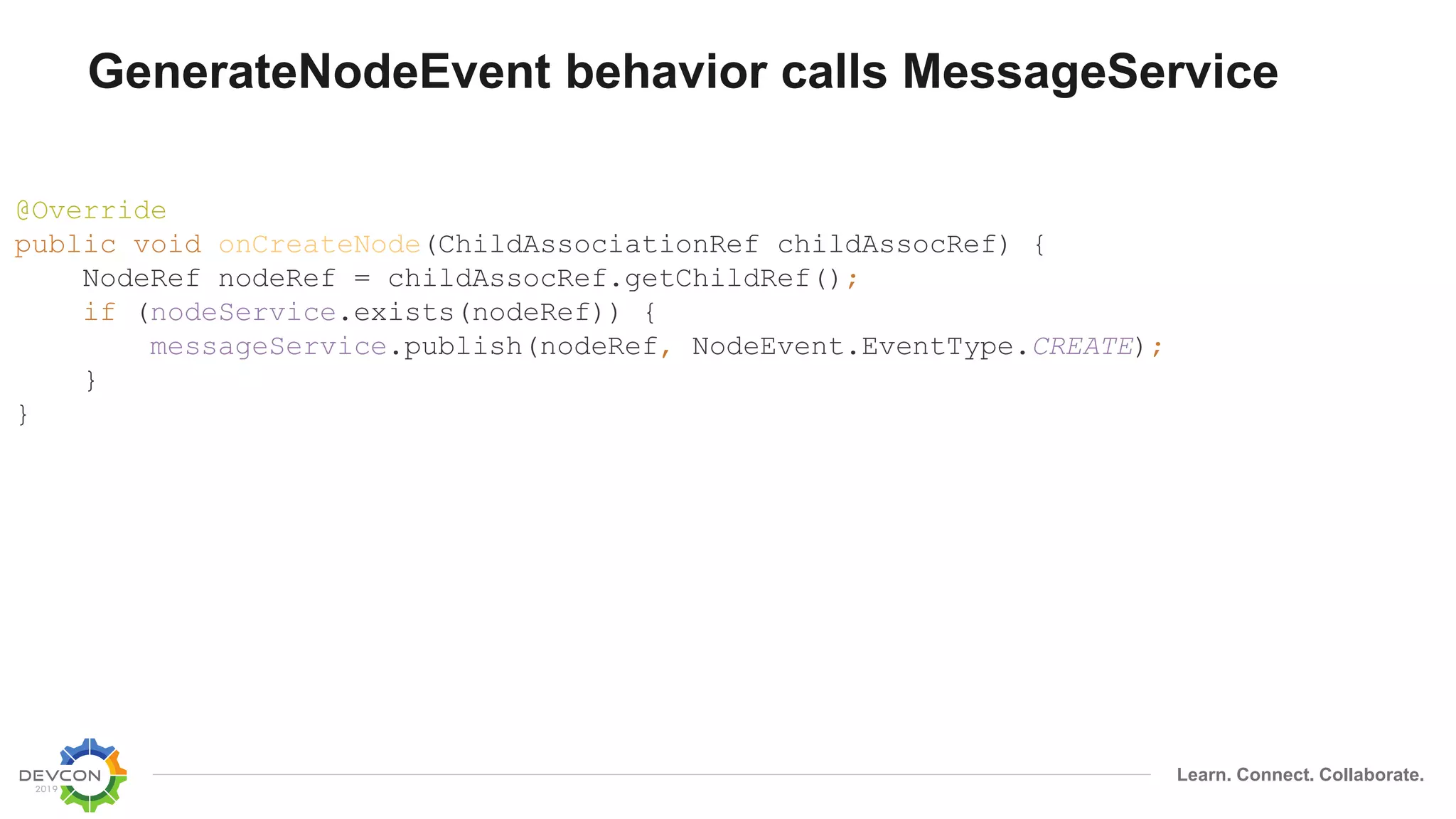
GenerateNodeEvent behavior calls MessageService
@Override
public void onCreateNode(ChildAssociationRef childAssocRef) {
NodeRef nodeRef = childAssocRef.getChildRef();
if (nodeService.exists(nodeRef)) {
messageService.publish(nodeRef, NodeEvent.EventType.CREATE);
}
}
Learn. Connect. Collaborate.
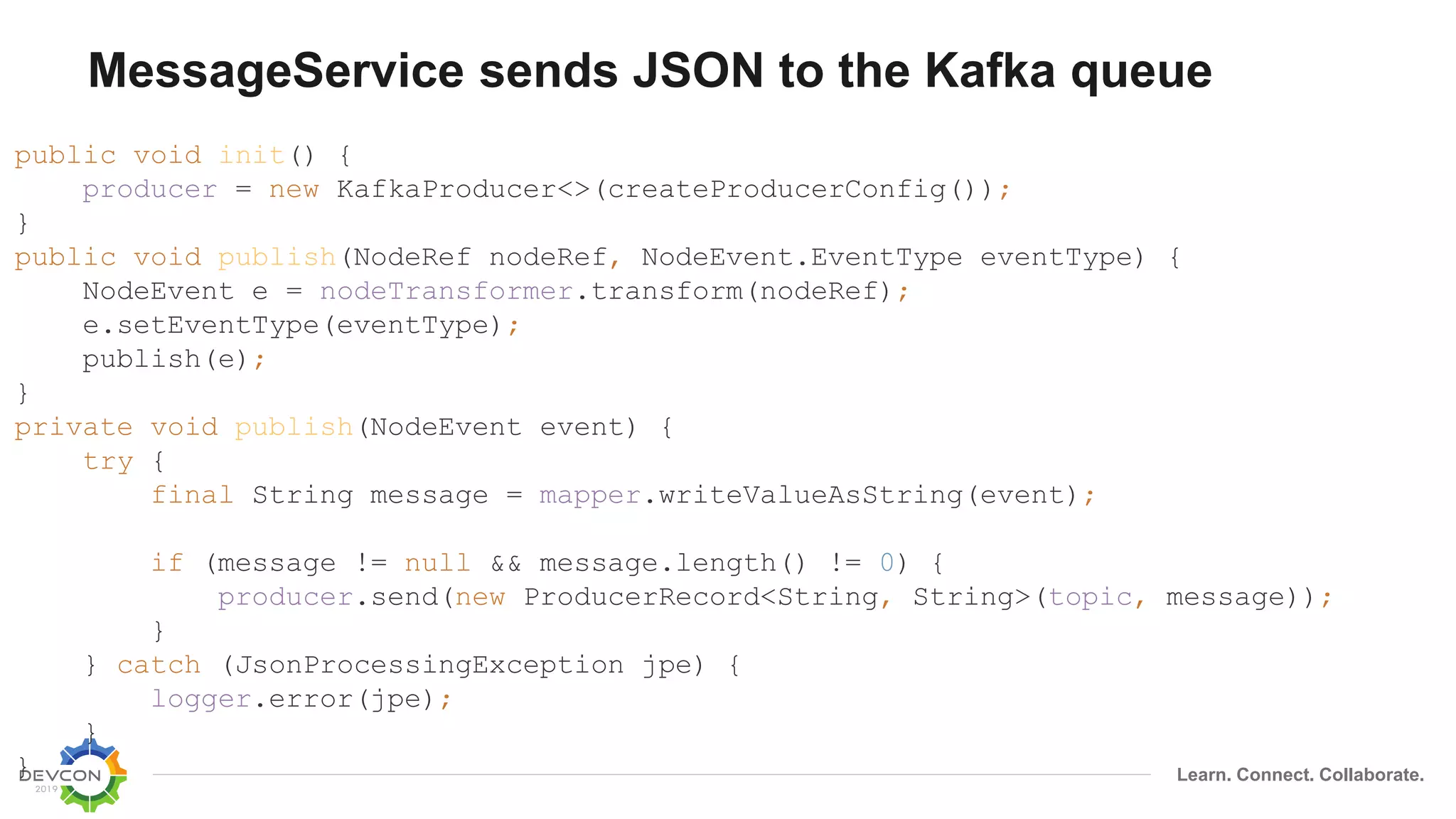
MessageService sends JSON to the Kafka queue
public void init() {
producer = new KafkaProducer<>(createProducerConfig());
}
public void publish(NodeRef nodeRef, NodeEvent.EventType eventType) {
NodeEvent e = nodeTransformer.transform(nodeRef);
e.setEventType(eventType);
publish(e);
}
private void publish(NodeEvent event) {
try {
final String message = mapper.writeValueAsString(event);
if (message != null && message.length() != 0) {
producer.send(new ProducerRecord<String, String>(topic, message));
}
} catch (JsonProcessingException jpe) {
logger.error(jpe);
}
}
Learn. Connect. Collaborate.
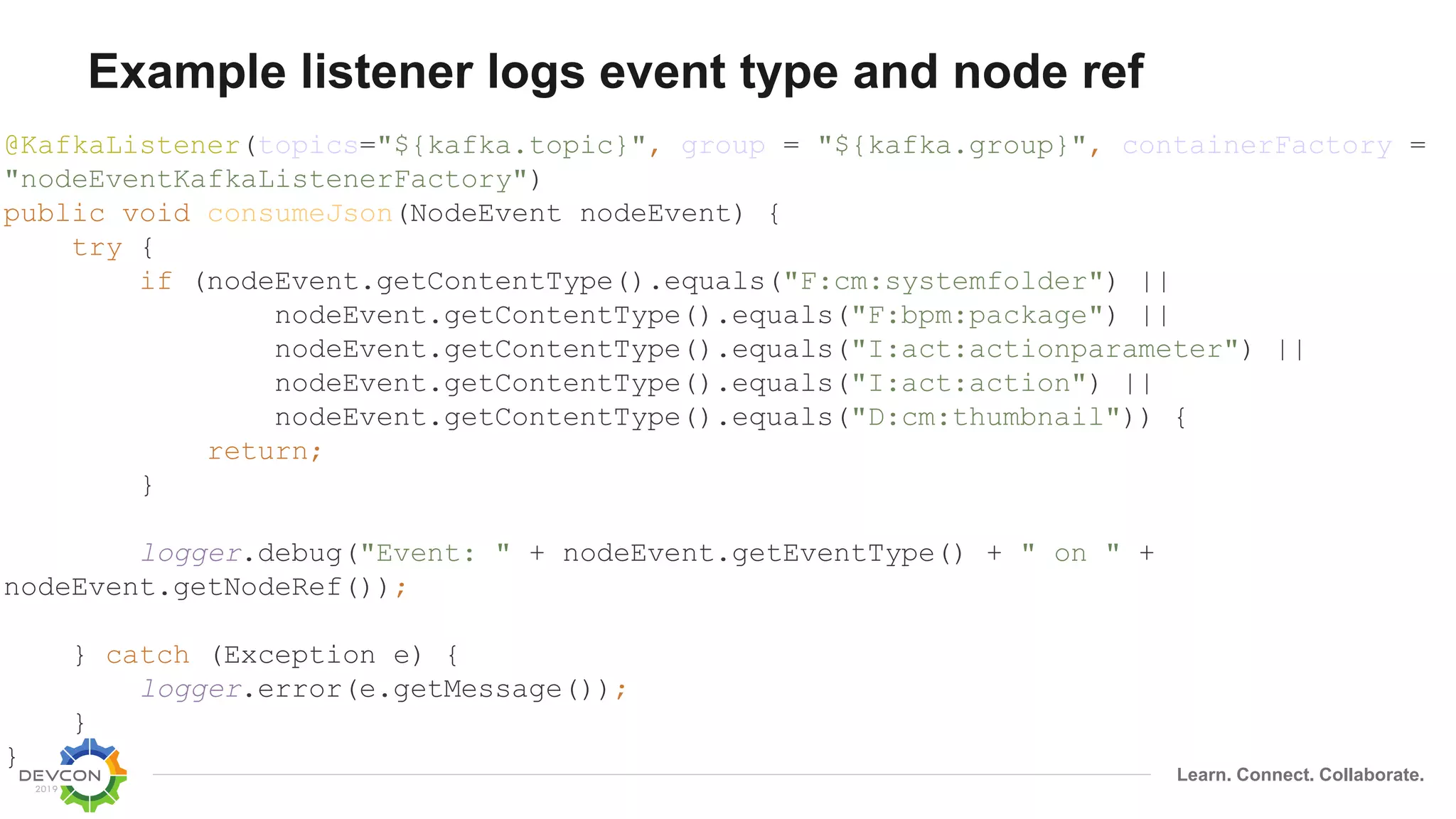
Example listener logs event type and node ref
@KafkaListener(topics="${kafka.topic}", group = "${kafka.group}", containerFactory =
"nodeEventKafkaListenerFactory")
public void consumeJson(NodeEvent nodeEvent) {
try {
if (nodeEvent.getContentType().equals("F:cm:systemfolder") ||
nodeEvent.getContentType().equals("F:bpm:package") ||
nodeEvent.getContentType().equals("I:act:actionparameter") ||
nodeEvent.getContentType().equals("I:act:action") ||
nodeEvent.getContentType().equals("D:cm:thumbnail")) {
return;
}
logger.debug("Event: " + nodeEvent.getEventType() + " on " +
nodeEvent.getNodeRef());
} catch (Exception e) {
logger.error(e.getMessage());
}
}
Real World Example: Reporting
Learn. Connect. Collaborate.
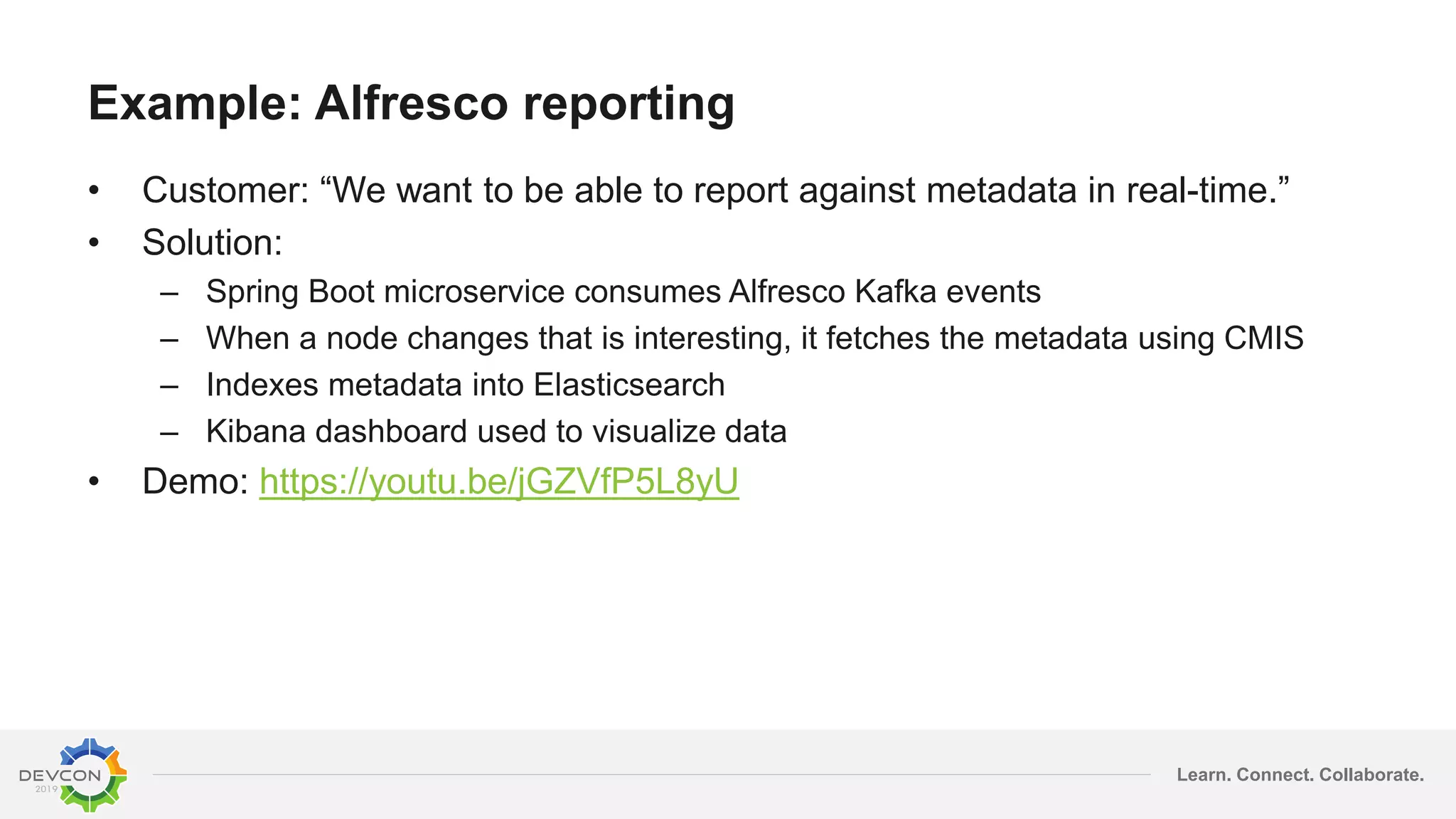
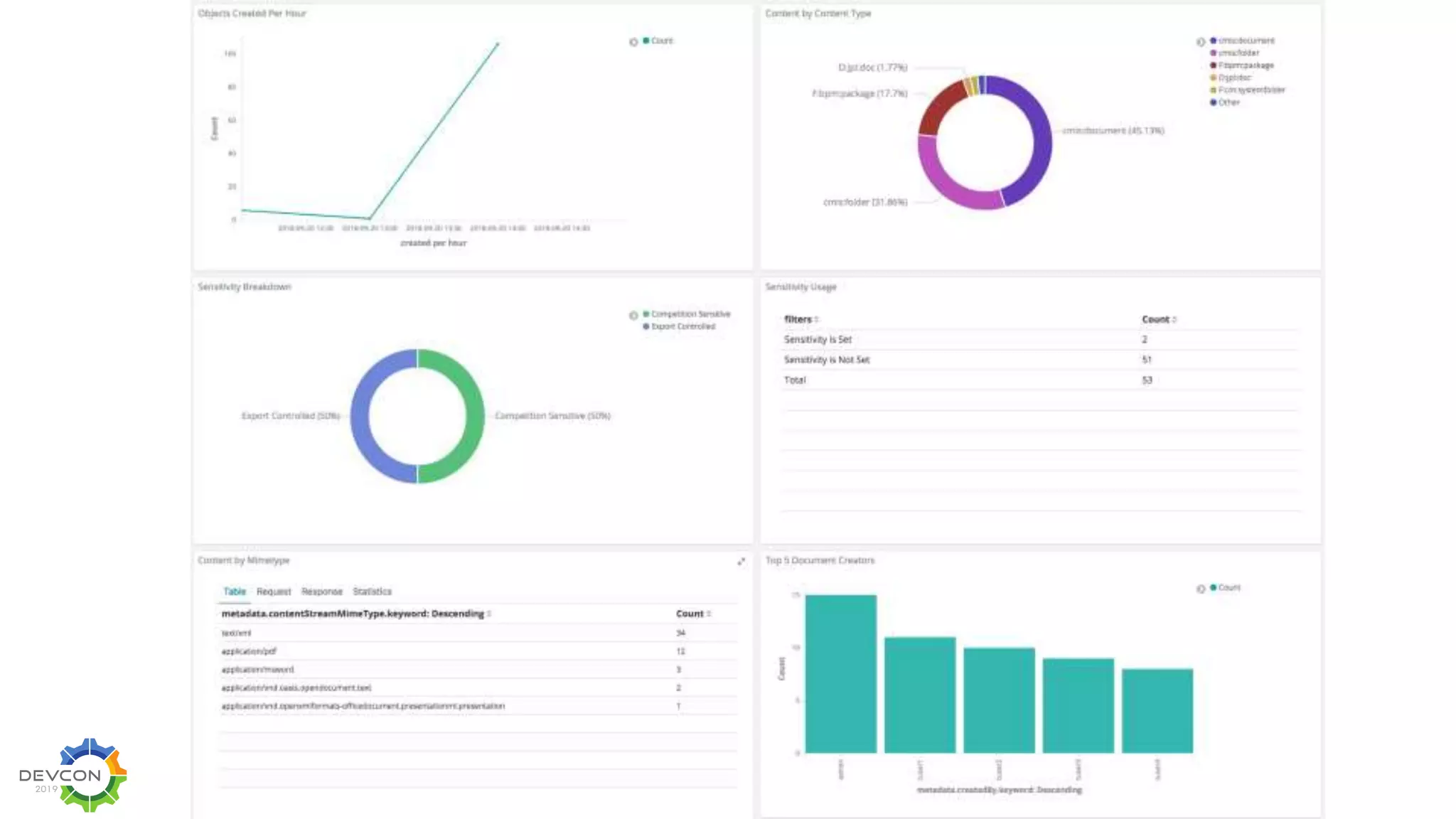
Example: Alfresco reporting
• Customer: “We want to be able to report against metadata in real-time.”
• Solution:
– Spring Boot microservice consumes Alfresco Kafka events
– When a node changes that is interesting, it fetches the metadata using CMIS
– Indexes metadata into Elasticsearch
– Kibana dashboard used to visualize data
• Demo: https://youtu.be/jGZVfP5L8yU
Learn. Connect. Collaborate.
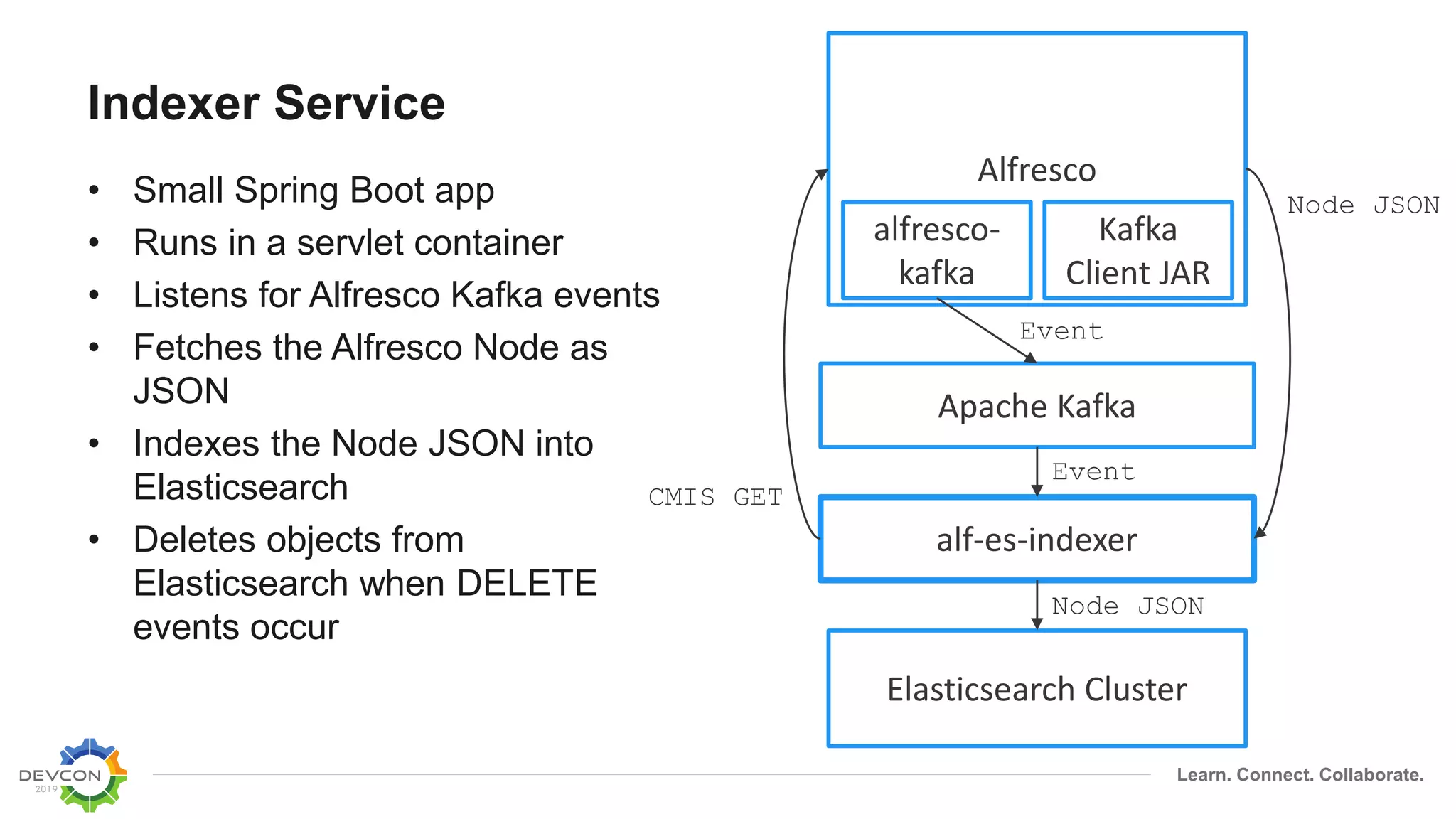
Indexer Service
• Small Spring Boot app
• Runs in a servlet container
• Listens for Alfresco Kafka events
• Fetches the Alfresco Node as
JSON
• Indexes the Node JSON into
Elasticsearch
• Deletes objects from
Elasticsearch when DELETE
events occur
Apache Kafka
Alfresco
Elasticsearch Cluster
alf-es-indexer
alfresco-
kafka
Kafka
Client JAR
Event
Event
CMIS GET
Node JSON
Node JSON
Demo: alf-es-indexer
Learn. Connect. Collaborate.
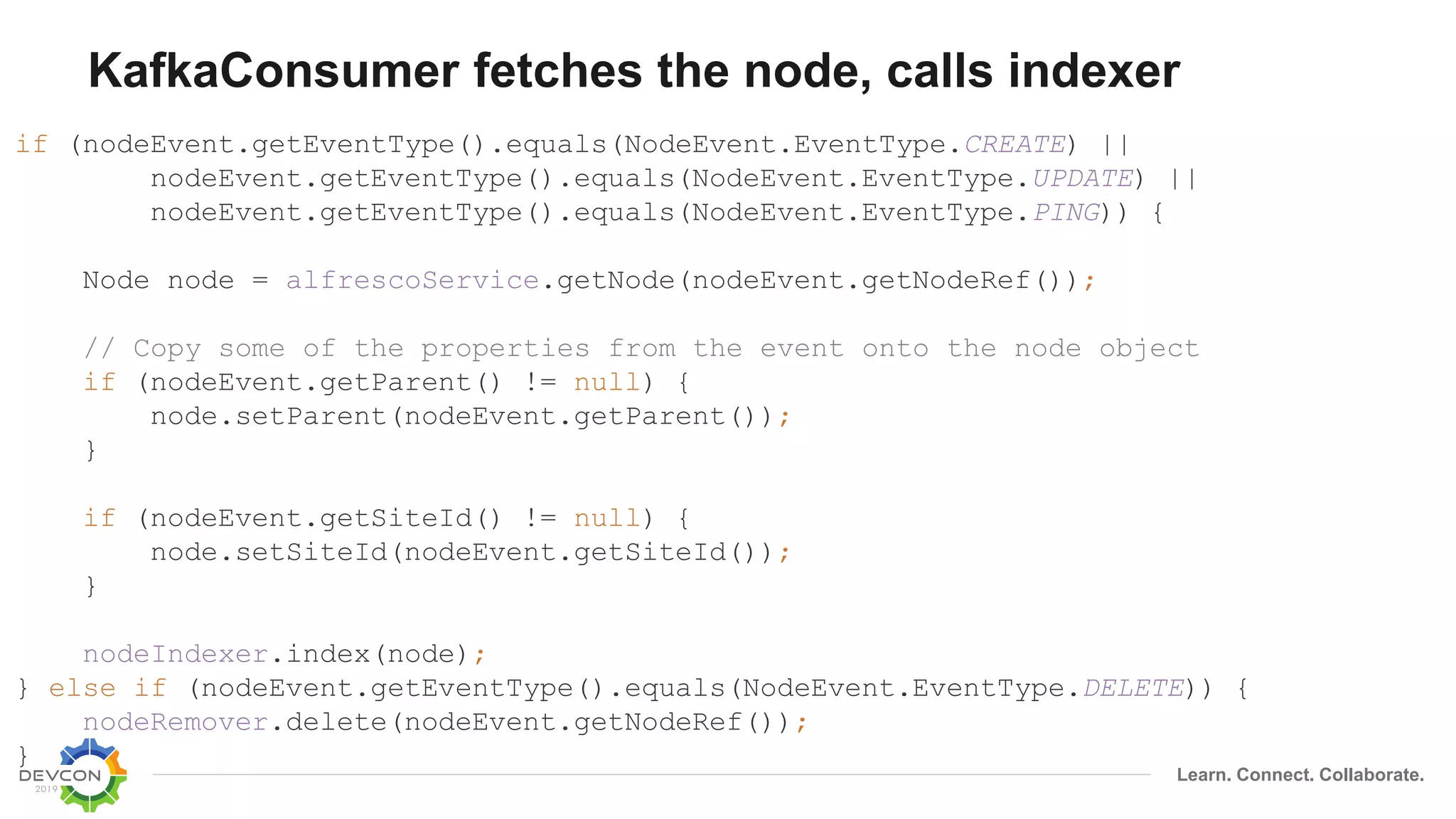
KafkaConsumer fetches the node, calls indexer
if (nodeEvent.getEventType().equals(NodeEvent.EventType.CREATE) ||
nodeEvent.getEventType().equals(NodeEvent.EventType.UPDATE) ||
nodeEvent.getEventType().equals(NodeEvent.EventType.PING)) {
Node node = alfrescoService.getNode(nodeEvent.getNodeRef());
// Copy some of the properties from the event onto the node object
if (nodeEvent.getParent() != null) {
node.setParent(nodeEvent.getParent());
}
if (nodeEvent.getSiteId() != null) {
node.setSiteId(nodeEvent.getSiteId());
}
nodeIndexer.index(node);
} else if (nodeEvent.getEventType().equals(NodeEvent.EventType.DELETE)) {
nodeRemover.delete(nodeEvent.getNodeRef());
}
Learn. Connect. Collaborate.
Real World Example: Metadata
Enrichment with NLP
Learn. Connect. Collaborate.
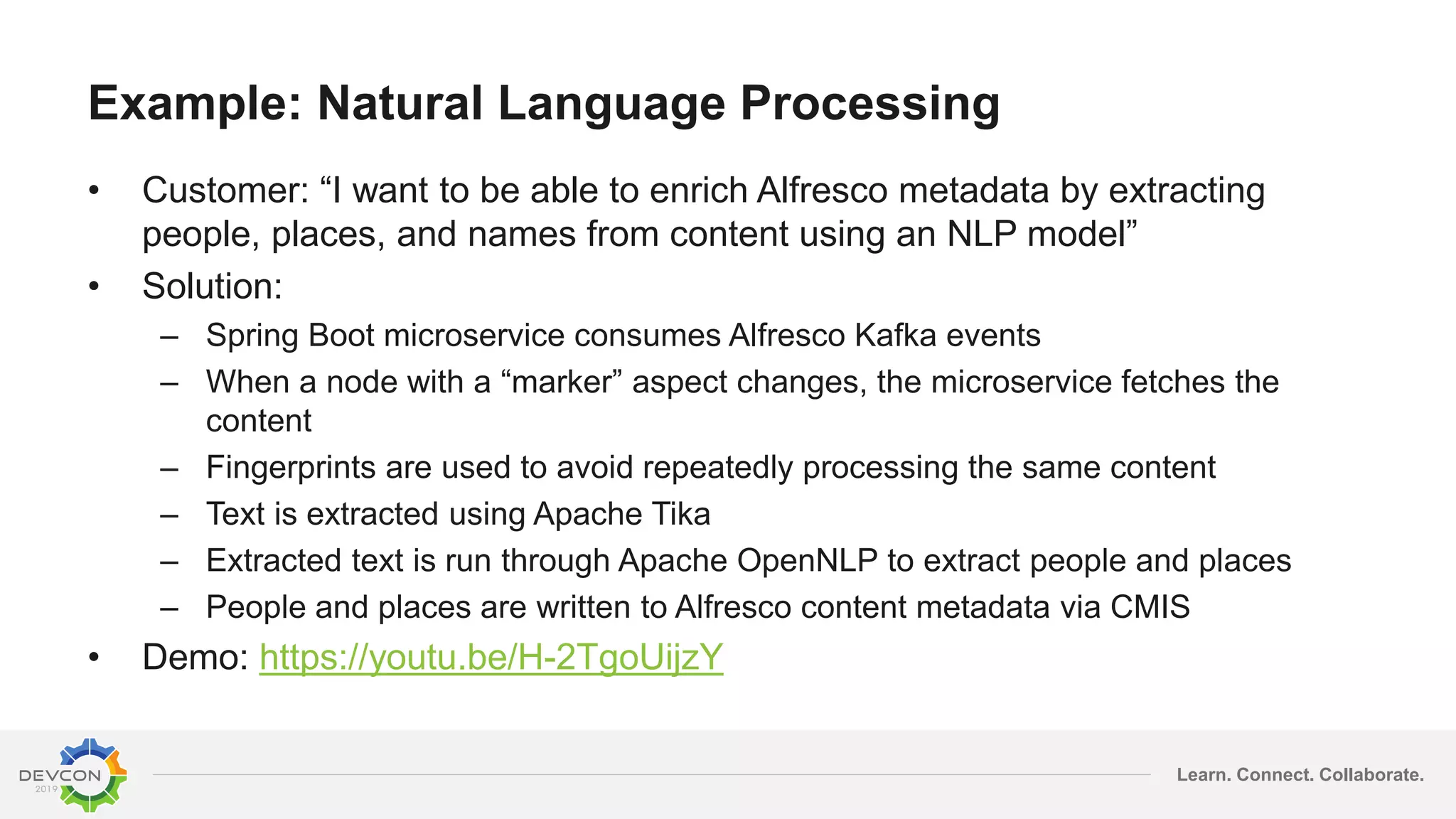
Example: Natural Language Processing
• Customer: “I want to be able to enrich Alfresco metadata by extracting
people, places, and names from content using an NLP model”
• Solution:
– Spring Boot microservice consumes Alfresco Kafka events
– When a node with a “marker” aspect changes, the microservice fetches the
content
– Fingerprints are used to avoid repeatedly processing the same content
– Text is extracted using Apache Tika
– Extracted text is run through Apache OpenNLP to extract people and places
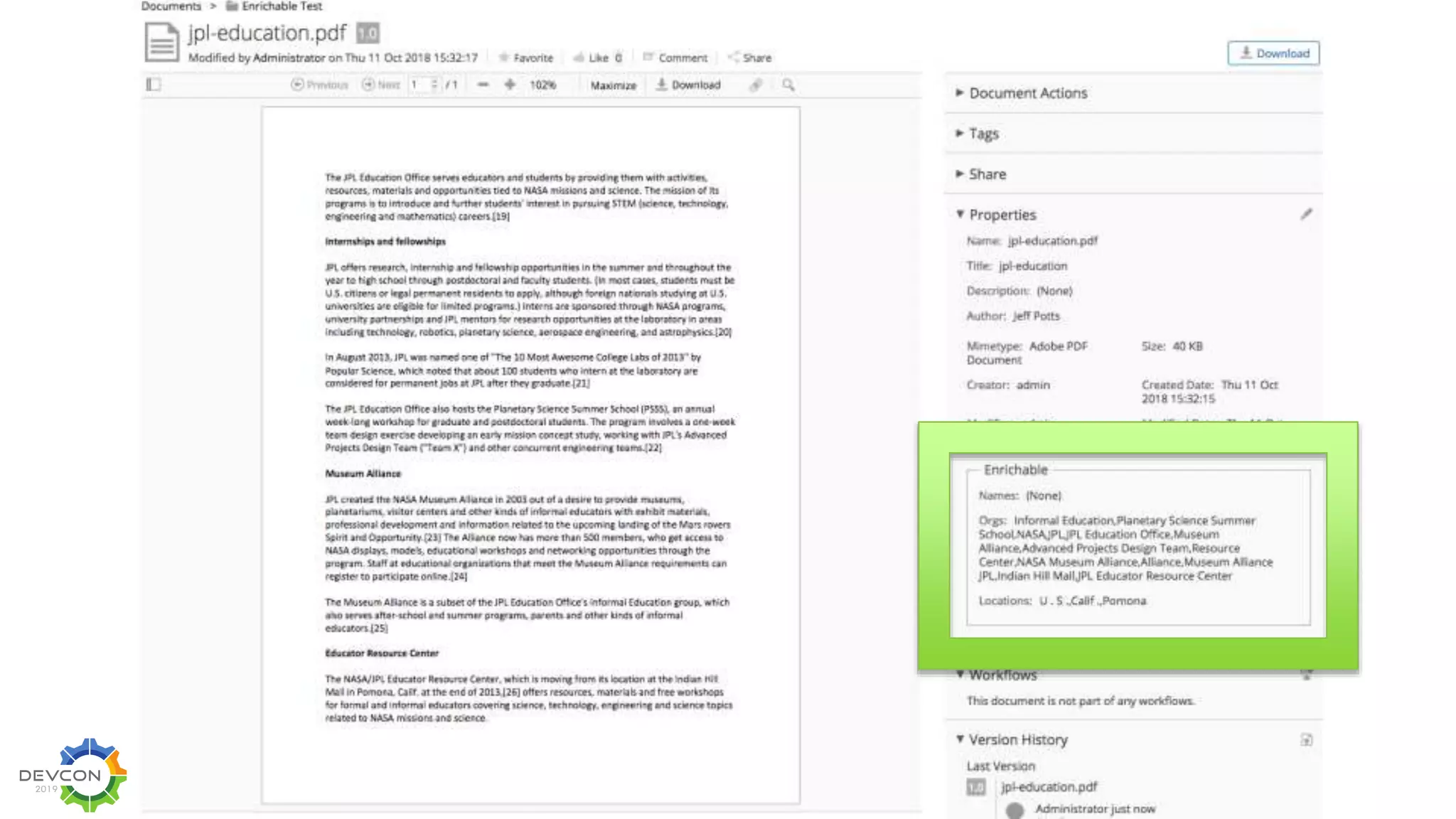
– People and places are written to Alfresco content metadata via CMIS
• Demo: https://youtu.be/H-2TgoUijzY
Learn. Connect. Collaborate.
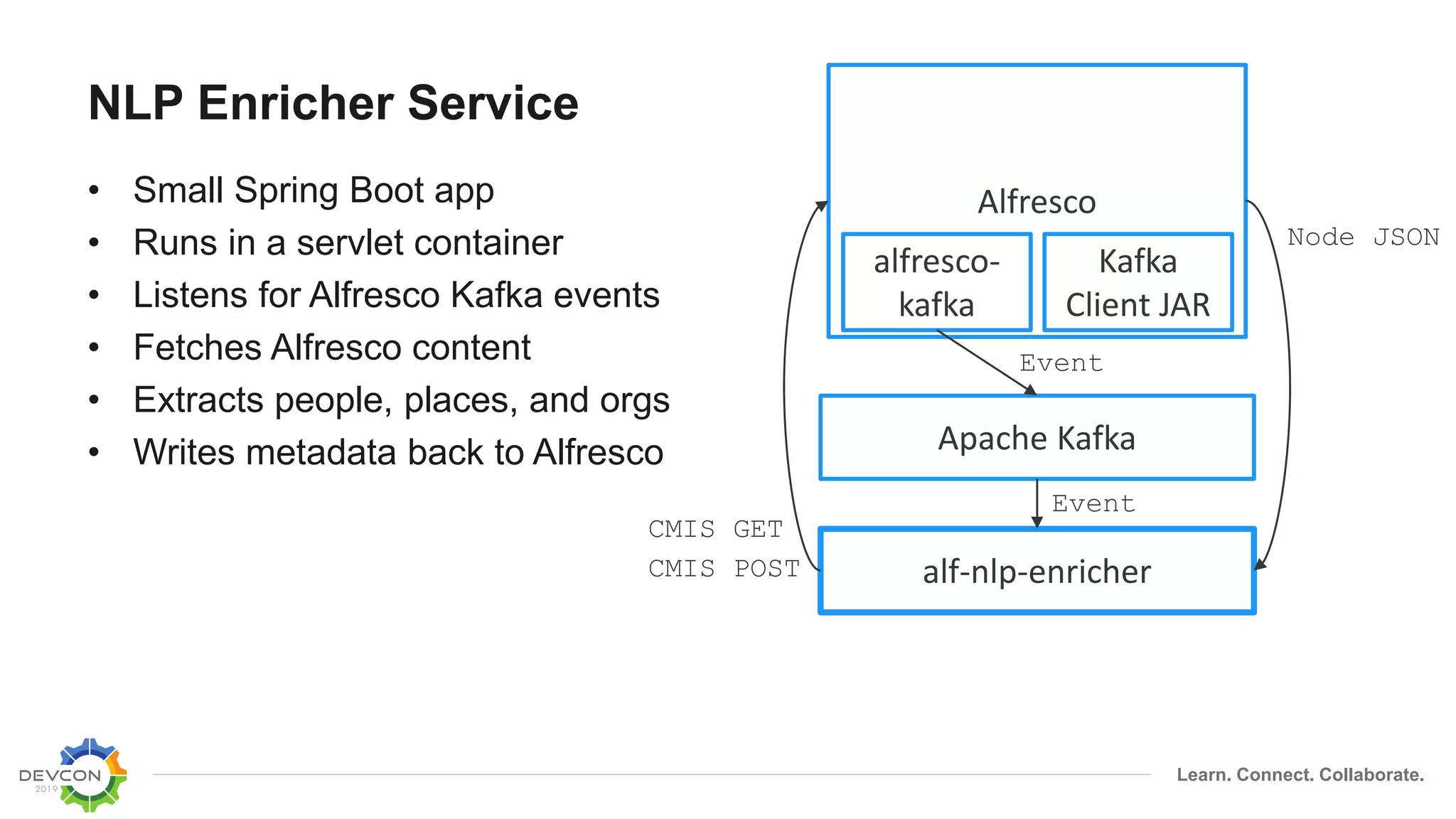
NLP Enricher Service
• Small Spring Boot app
• Runs in a servlet container
• Listens for Alfresco Kafka events
• Fetches Alfresco content
• Extracts people, places, and orgs
• Writes metadata back to Alfresco Apache Kafka
Alfresco
alf-nlp-enricher
alfresco-
kafka
Kafka
Client JAR
Event
Event
CMIS GET
Node JSON
CMIS POST
Demo: alf-nlp-enricher
Learn. Connect. Collaborate.
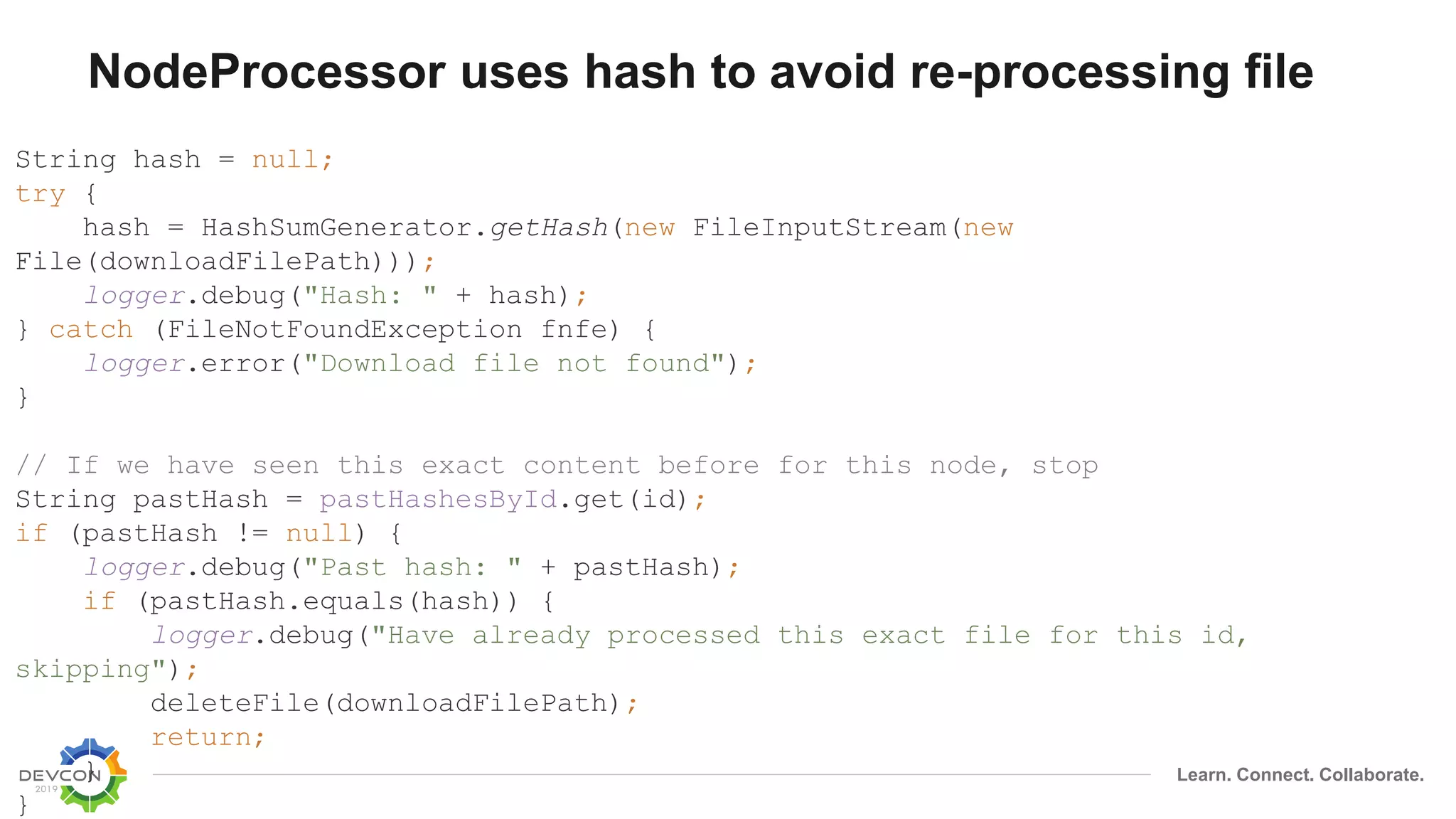
NodeProcessor uses hash to avoid re-processing file
String hash = null;
try {
hash = HashSumGenerator.getHash(new FileInputStream(new
File(downloadFilePath)));
logger.debug("Hash: " + hash);
} catch (FileNotFoundException fnfe) {
logger.error("Download file not found");
}
// If we have seen this exact content before for this node, stop
String pastHash = pastHashesById.get(id);
if (pastHash != null) {
logger.debug("Past hash: " + pastHash);
if (pastHash.equals(hash)) {
logger.debug("Have already processed this exact file for this id,
skipping");
deleteFile(downloadFilePath);
return;
}
}
Learn. Connect. Collaborate.
Detect sentences, call OpenNLP, update metadata
String sentences[] = sentenceDetector.detect(text);
for (String sentence : sentences) {
locations = addToSet(locationExtractor.extract(sentence), locations);
orgs = addToSet(orgExtractor.extract(sentence), orgs);
names = addToSet(nameExtractor.extract(sentence), names);
}
HashMap<String, Serializable> properties = new HashMap<>();
properties.put(PROP_LOCATIONS, toArrayList(locations));
properties.put(PROP_ORGS, toArrayList(orgs));
properties.put(PROP_NAMES, toArrayList(names));
try {
alfrescoService.updateNode(id, properties);
} catch (AlfrescoServiceException ase) {
logger.error(ase.getMessage());
}
Learn. Connect. Collaborate.
Considerations
Learn. Connect. Collaborate.
Apache Kafka
Alfresco
Microservice
Event
Event
Microservice
Event
Microservice
Event
Move logic out of Alfresco into microservices
alfresco-
kafka
Kafka
Client JAR
Learn. Connect. Collaborate.
Other potential uses
• Full-text search indexing into standalone search engine
• Synchronizing content with other servers
• Improved HTML transformations
• Notification/subscription service
• Chat integration
Learn. Connect. Collaborate.
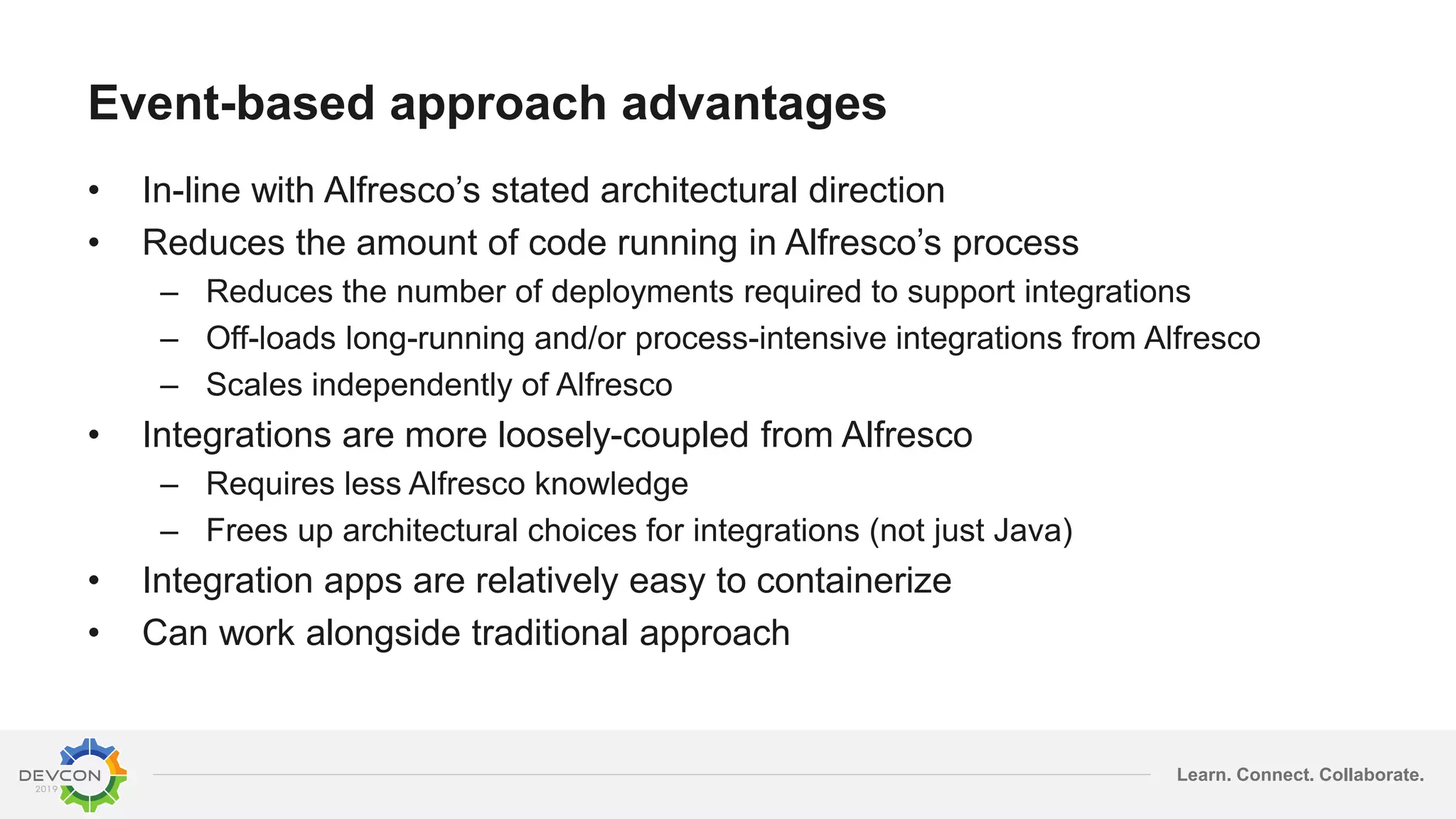
Event-based approach disadvantages
• More code/complexity than traditional approach
• User feedback/notification is not straightforward
• Potentially increases the number of “containers” in the IT shop
Learn. Connect. Collaborate.
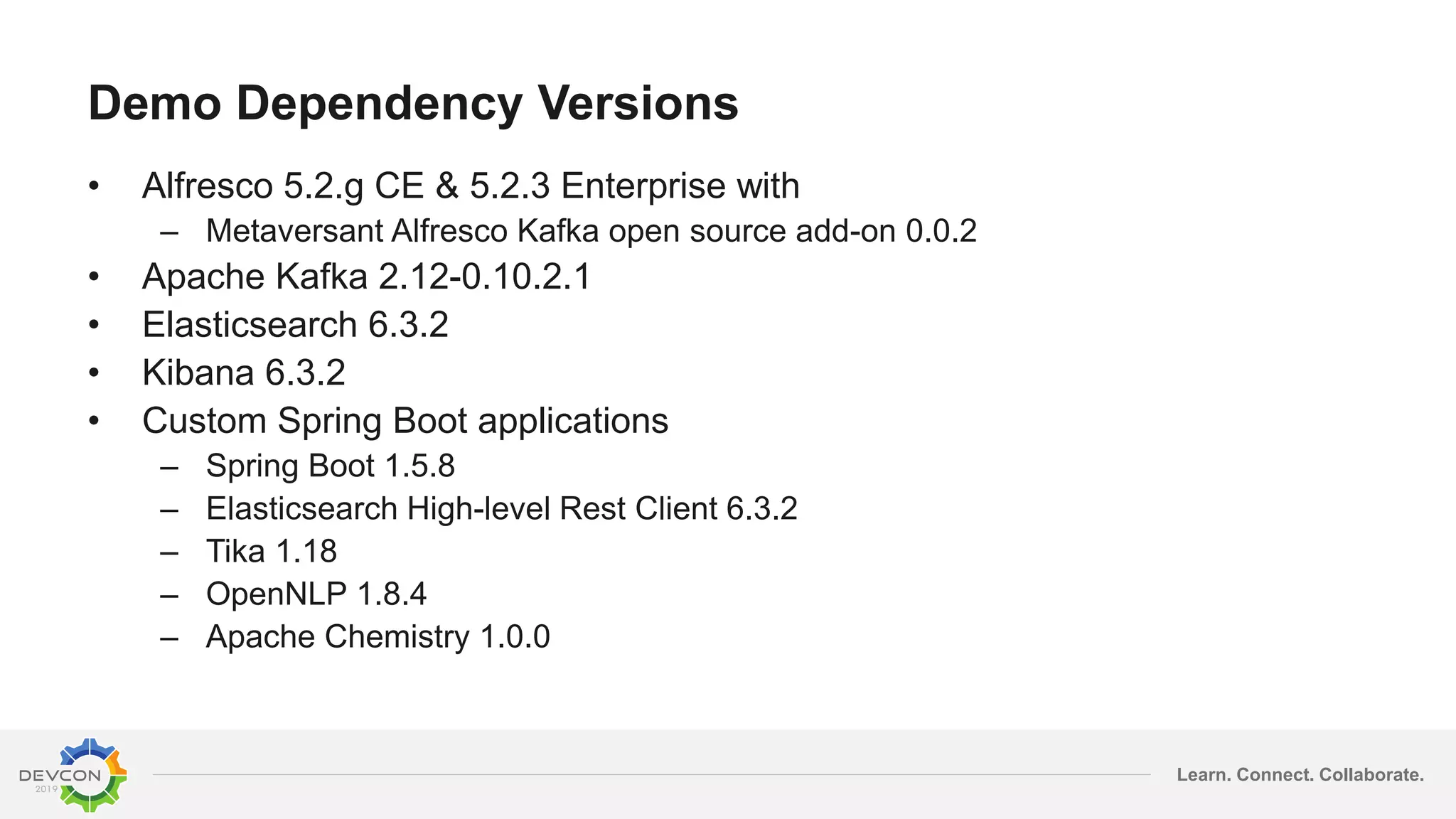
Event-based approach advantages
• In-line with Alfresco’s stated architectural direction
• Reduces the amount of code running in Alfresco’s process
– Reduces the number of deployments required to support integrations
– Off-loads long-running and/or process-intensive integrations from Alfresco
– Scales independently of Alfresco
• Integrations are more loosely-coupled from Alfresco
– Requires less Alfresco knowledge
– Frees up architectural choices for integrations (not just Java)
• Integration apps are relatively easy to containerize
• Can work alongside traditional approach
Learn. Connect. Collaborate.
Demo Dependency Versions
• Alfresco 5.2.g CE & 5.2.3 Enterprise with
– Metaversant Alfresco Kafka open source add-on 0.0.2
• Apache Kafka 2.12-0.10.2.1
• Elasticsearch 6.3.2
• Kibana 6.3.2
• Custom Spring Boot applications
– Spring Boot 1.5.8
– Elasticsearch High-level Rest Client 6.3.2
– Tika 1.18
– OpenNLP 1.8.4
– Apache Chemistry 1.0.0
Learn. Connect. Collaborate.
Links
• Apache Kafka: http://kafka.apache.org/
• Apache OpenNLP: http://opennlp.apache.org/
• Apache Tika: https://tika.apache.org/
• Elasticsearch: https://www.elastic.co/products/elasticsearch
• Kibana: https://www.elastic.co/products/kibana
• Spring Boot: https://spring.io/projects/spring-boot
Learn. Connect. Collaborate.
See Also
• Apache ManifoldCF
– http://manifoldcf.apache.org/
– Crawler that indexes from repositories like Alfresco into Solr & Elasticsearch
• Apache Stanbol
– http://stanbol.apache.org/
– Semantic engine that can do metadata enhancement and other things
• Apache Camel
– http://camel.apache.org/
– Enterprise integration platform
Learn. Connect. Collaborate.
• Consulting firm focused on solving business problems with open source
Content Management, Workflow, & Search technology
• Founded in 2010
• Clients all over the world in a variety of industries, including:
– Airlines & Aerospace
– Manufacturing
– Construction
– Financial Services
– Higher Education
– Life Sciences
– Professional Services
https://www.metaversant.com
Moving from Actions &
Behaviors to Microservices
Jeff Potts, Metaversant
@jeffpotts01

Moving From Actions & Behaviors to Microservices

  • 1.
    Moving from Actions& Behaviors to Microservices Jeff Potts, Metaversant @jeffpotts01
  • 2.
    How do wemake it easier to integrate Alfresco with other systems?
  • 3.
    Learn. Connect. Collaborate. “Wewant to be able to report against metadata in real-time.” “When this custom property changes we need to notify this other system.” “We want to improve how Alfresco transforms Word documents into HTML.” “When content changes we want to run it through an NLP model.” “Our company has an enterprise search solution that needs to index Alfresco content.” “We want to replicate content between multiple Alfresco servers.” Recurring customer requirements
  • 4.
    Learn. Connect. Collaborate. Traditionalapproaches run in-process • Custom Alfresco Actions – Java, deployed to Alfresco WAR – Triggered by rule on a folder, a UI action, or by a schedule • Custom Alfresco Behaviors – Java, deployed to Alfresco WAR – Bound to a policy on a class of nodes (e.g., specific type or aspect) • Custom Web Scripts – Java or JavaScript, deployed to Alfresco WAR – Triggered by a REST call • All of these run in Alfresco’s process
  • 5.
    Learn. Connect. Collaborate. Tradeoffsof the traditional approach • Advantages – Full access to the Alfresco API – Runs as the authenticated user or as the system user – Code is managed with the content model and other customizations • Disadvantages – Performance risk – Requires server restart to deploy – Requires an Alfresco developer familiar with Alfresco API • Java & JavaScript are the only practical language options – Long-running tasks may block user interface – Scales as Alfresco scales
  • 6.
  • 7.
    Learn. Connect. Collaborate. Event-basedintegration approach • Alfresco can be extended to generate generic events when something happens to a node • Interested systems – Listen for Alfresco events – Filter out what they don’t care about – Fetch additional data from Alfresco and perform custom logic as needed • Additional systems can be added without touching Alfresco • Systems can use different frameworks & languages • Independently scalable • Can use Alfresco Kafka as a starting point
  • 8.
    Learn. Connect. Collaborate. ApacheKafka Alfresco Microservice Event Event Microservice Event Microservice Event Move logic out of Alfresco into microservices alfresco- kafka Kafka Client JAR
  • 9.
    Learn. Connect. Collaborate. Exampleevent JSON { "nodeRef": "3f375925-fa87-4e34-9734-b98bed2d483f", "eventType": "CREATE", "path": "/{http://www.alfresco.org/model/application/1.0}company_home/…/{http://www.alfresco .org/model/content/1.0}test2.txt", "created": 1497282061322, "modified": 1497282061322, "creator": "admin", "modifier": "admin", "mimetype": "text/plain", "contentType": "content", "siteId": "test-site-1", "size": 128, "parent": "06a154e3-4014-4a55-adfa-5e55040fae2d” }
  • 10.
  • 11.
    Learn. Connect. Collaborate. AlfrescoKafka Listener Example • Alfresco Kafka – https://github.com/jpotts/alfresco-kafka • Alfresco Kafka Listener Example – https://github.com/jpotts/alfresco-kafka-listener-example • Demo: https://youtu.be/K40M2gJA7vM
  • 12.
    Learn. Connect. Collaborate. AlfrescoKafka Listener • Small Spring Boot app • Runs in a servlet container • Logs Alfresco Kafka events • Example/starter code Apache Kafka Alfresco alfresco-kafka-listener alfresco- kafka Kafka Client JAR Event Event
  • 13.
  • 14.
    Learn. Connect. Collaborate. GenerateNodeEventbehavior calls MessageService @Override public void onCreateNode(ChildAssociationRef childAssocRef) { NodeRef nodeRef = childAssocRef.getChildRef(); if (nodeService.exists(nodeRef)) { messageService.publish(nodeRef, NodeEvent.EventType.CREATE); } }
  • 15.
    Learn. Connect. Collaborate. MessageServicesends JSON to the Kafka queue public void init() { producer = new KafkaProducer<>(createProducerConfig()); } public void publish(NodeRef nodeRef, NodeEvent.EventType eventType) { NodeEvent e = nodeTransformer.transform(nodeRef); e.setEventType(eventType); publish(e); } private void publish(NodeEvent event) { try { final String message = mapper.writeValueAsString(event); if (message != null && message.length() != 0) { producer.send(new ProducerRecord<String, String>(topic, message)); } } catch (JsonProcessingException jpe) { logger.error(jpe); } }
  • 16.
    Learn. Connect. Collaborate. Examplelistener logs event type and node ref @KafkaListener(topics="${kafka.topic}", group = "${kafka.group}", containerFactory = "nodeEventKafkaListenerFactory") public void consumeJson(NodeEvent nodeEvent) { try { if (nodeEvent.getContentType().equals("F:cm:systemfolder") || nodeEvent.getContentType().equals("F:bpm:package") || nodeEvent.getContentType().equals("I:act:actionparameter") || nodeEvent.getContentType().equals("I:act:action") || nodeEvent.getContentType().equals("D:cm:thumbnail")) { return; } logger.debug("Event: " + nodeEvent.getEventType() + " on " + nodeEvent.getNodeRef()); } catch (Exception e) { logger.error(e.getMessage()); } }
  • 17.
  • 18.
    Learn. Connect. Collaborate. Example:Alfresco reporting • Customer: “We want to be able to report against metadata in real-time.” • Solution: – Spring Boot microservice consumes Alfresco Kafka events – When a node changes that is interesting, it fetches the metadata using CMIS – Indexes metadata into Elasticsearch – Kibana dashboard used to visualize data • Demo: https://youtu.be/jGZVfP5L8yU
  • 19.
    Learn. Connect. Collaborate. IndexerService • Small Spring Boot app • Runs in a servlet container • Listens for Alfresco Kafka events • Fetches the Alfresco Node as JSON • Indexes the Node JSON into Elasticsearch • Deletes objects from Elasticsearch when DELETE events occur Apache Kafka Alfresco Elasticsearch Cluster alf-es-indexer alfresco- kafka Kafka Client JAR Event Event CMIS GET Node JSON Node JSON
  • 20.
  • 21.
    Learn. Connect. Collaborate. KafkaConsumerfetches the node, calls indexer if (nodeEvent.getEventType().equals(NodeEvent.EventType.CREATE) || nodeEvent.getEventType().equals(NodeEvent.EventType.UPDATE) || nodeEvent.getEventType().equals(NodeEvent.EventType.PING)) { Node node = alfrescoService.getNode(nodeEvent.getNodeRef()); // Copy some of the properties from the event onto the node object if (nodeEvent.getParent() != null) { node.setParent(nodeEvent.getParent()); } if (nodeEvent.getSiteId() != null) { node.setSiteId(nodeEvent.getSiteId()); } nodeIndexer.index(node); } else if (nodeEvent.getEventType().equals(NodeEvent.EventType.DELETE)) { nodeRemover.delete(nodeEvent.getNodeRef()); }
  • 22.
  • 23.
    Real World Example:Metadata Enrichment with NLP
  • 24.
    Learn. Connect. Collaborate. Example:Natural Language Processing • Customer: “I want to be able to enrich Alfresco metadata by extracting people, places, and names from content using an NLP model” • Solution: – Spring Boot microservice consumes Alfresco Kafka events – When a node with a “marker” aspect changes, the microservice fetches the content – Fingerprints are used to avoid repeatedly processing the same content – Text is extracted using Apache Tika – Extracted text is run through Apache OpenNLP to extract people and places – People and places are written to Alfresco content metadata via CMIS • Demo: https://youtu.be/H-2TgoUijzY
  • 25.
    Learn. Connect. Collaborate. NLPEnricher Service • Small Spring Boot app • Runs in a servlet container • Listens for Alfresco Kafka events • Fetches Alfresco content • Extracts people, places, and orgs • Writes metadata back to Alfresco Apache Kafka Alfresco alf-nlp-enricher alfresco- kafka Kafka Client JAR Event Event CMIS GET Node JSON CMIS POST
  • 26.
  • 27.
    Learn. Connect. Collaborate. NodeProcessoruses hash to avoid re-processing file String hash = null; try { hash = HashSumGenerator.getHash(new FileInputStream(new File(downloadFilePath))); logger.debug("Hash: " + hash); } catch (FileNotFoundException fnfe) { logger.error("Download file not found"); } // If we have seen this exact content before for this node, stop String pastHash = pastHashesById.get(id); if (pastHash != null) { logger.debug("Past hash: " + pastHash); if (pastHash.equals(hash)) { logger.debug("Have already processed this exact file for this id, skipping"); deleteFile(downloadFilePath); return; } }
  • 28.
    Learn. Connect. Collaborate. Detectsentences, call OpenNLP, update metadata String sentences[] = sentenceDetector.detect(text); for (String sentence : sentences) { locations = addToSet(locationExtractor.extract(sentence), locations); orgs = addToSet(orgExtractor.extract(sentence), orgs); names = addToSet(nameExtractor.extract(sentence), names); } HashMap<String, Serializable> properties = new HashMap<>(); properties.put(PROP_LOCATIONS, toArrayList(locations)); properties.put(PROP_ORGS, toArrayList(orgs)); properties.put(PROP_NAMES, toArrayList(names)); try { alfrescoService.updateNode(id, properties); } catch (AlfrescoServiceException ase) { logger.error(ase.getMessage()); }
  • 29.
  • 30.
  • 31.
    Learn. Connect. Collaborate. ApacheKafka Alfresco Microservice Event Event Microservice Event Microservice Event Move logic out of Alfresco into microservices alfresco- kafka Kafka Client JAR
  • 32.
    Learn. Connect. Collaborate. Otherpotential uses • Full-text search indexing into standalone search engine • Synchronizing content with other servers • Improved HTML transformations • Notification/subscription service • Chat integration
  • 33.
    Learn. Connect. Collaborate. Event-basedapproach disadvantages • More code/complexity than traditional approach • User feedback/notification is not straightforward • Potentially increases the number of “containers” in the IT shop
  • 34.
    Learn. Connect. Collaborate. Event-basedapproach advantages • In-line with Alfresco’s stated architectural direction • Reduces the amount of code running in Alfresco’s process – Reduces the number of deployments required to support integrations – Off-loads long-running and/or process-intensive integrations from Alfresco – Scales independently of Alfresco • Integrations are more loosely-coupled from Alfresco – Requires less Alfresco knowledge – Frees up architectural choices for integrations (not just Java) • Integration apps are relatively easy to containerize • Can work alongside traditional approach
  • 35.
    Learn. Connect. Collaborate. DemoDependency Versions • Alfresco 5.2.g CE & 5.2.3 Enterprise with – Metaversant Alfresco Kafka open source add-on 0.0.2 • Apache Kafka 2.12-0.10.2.1 • Elasticsearch 6.3.2 • Kibana 6.3.2 • Custom Spring Boot applications – Spring Boot 1.5.8 – Elasticsearch High-level Rest Client 6.3.2 – Tika 1.18 – OpenNLP 1.8.4 – Apache Chemistry 1.0.0
  • 36.
    Learn. Connect. Collaborate. Links •Apache Kafka: http://kafka.apache.org/ • Apache OpenNLP: http://opennlp.apache.org/ • Apache Tika: https://tika.apache.org/ • Elasticsearch: https://www.elastic.co/products/elasticsearch • Kibana: https://www.elastic.co/products/kibana • Spring Boot: https://spring.io/projects/spring-boot
  • 37.
    Learn. Connect. Collaborate. SeeAlso • Apache ManifoldCF – http://manifoldcf.apache.org/ – Crawler that indexes from repositories like Alfresco into Solr & Elasticsearch • Apache Stanbol – http://stanbol.apache.org/ – Semantic engine that can do metadata enhancement and other things • Apache Camel – http://camel.apache.org/ – Enterprise integration platform
  • 38.
    Learn. Connect. Collaborate. •Consulting firm focused on solving business problems with open source Content Management, Workflow, & Search technology • Founded in 2010 • Clients all over the world in a variety of industries, including: – Airlines & Aerospace – Manufacturing – Construction – Financial Services – Higher Education – Life Sciences – Professional Services https://www.metaversant.com
  • 39.
    Moving from Actions& Behaviors to Microservices Jeff Potts, Metaversant @jeffpotts01

Editor's Notes

  • #3 …without writing one-off integrations that must be deployed to the Alfresco server …without adding unnecessary performance burden on Alfresco …without requiring other teams to learn Alfresco internals
  • #4 Triggers can be action-driven or change-driven or both. These requirements often met with actions and behaviors.
  • #10 Event is kept minimal to avoid disclosing sensitive information and to keep the solution as generic as possible.
  • #19 Alfresco Insight Engine is an interesting alternative, but it requires the latest Alfresco version.
  • #28 For a production implementation, the past hashes should probably be persisted somewhere instead of being kept in memory