Canada’s Anti-Spam
Legislation
What Every Business Needs to Know
By John Lepore, WSI - Ottawa
What is it?
©2014 WSI. All rights reserved.
An Act to promote the efficiency and
adaptability of the Canadian economy by
regulating certain activities that discourage
reliance on electronic means of carrying out
commercial activities, and to amend the
Canadian Radio-television and
Telecommunications Commission Act, the
Competition Act, the Personal Information
Protection and Electronic Documents Act and
the Telecommunications Act
No…Really...What is it?
A law to protect Canadians against
unwanted SPAM
©2014 WSI. All rights reserved.
When?
July 1st, 2014
©2014 WSI. All rights reserved.
Who Needs to Know?
Anyone who makes use of commercial
electronic messages, is involved with the
alteration of transmission data, or produces
or installs computer programs needs to be
aware of this law.
©2014 WSI. All rights reserved.
A commercial electronic message is
any electronic message that
encourages participation in a
commercial activity, regardless of
whether there is an expectation of
profit.
Bill C-28 Penalties
The maximum penalty for a violation is
$1,000,000 in the case of an individual, and
$10,000,000 in the case of any other person.*
©2014 WSI. All rights reserved.
In the case of a contravention of
section 6 [unsolicited CEM], $200 for
each contravention of that
provision, not exceeding $1,000,000
for each day on which a
contravention occurred*
*Refer to the act for clarification and details
What is SPAM?
• Sending of unsolicited commercial electronic
messages
• Unauthorized alteration of transmission data
• Installation of computer programs without
consent
• False and misleading electronic
representations online (including websites)
• Unauthorized collection of electronic
addresses
• Collection of personal information by
accessing a computer system in
contravention of an Act of Parliament.
©2014 WSI. All rights reserved.
All inclusive!!!
• These violations
include, but are not
limited to:
• Spam
• Malware
• Spyware
• address harvesting, and
false and misleading
representations…
• Involving the use of
any means of:
• Telecommunications
• Short Message Services
(SMS)
• social networking,
websites
• URL's and other locators
• Applications
• Blogs
• Voice over Internet
Protocol (VoIP), and
• any other current and
future internet and
wireless telecom threats
prohibited by
Canada's anti-
spam legislation.
©2014 WSI. All rights reserved.
Enforcement Bodies
• Canadian Radio-television and
Telecommunications Commission (CRTC)
• Competition Bureau
• Office of the Privacy Commissioner of
Canada
• Private Right of Action (July 1st 2017)
©2014 WSI. All rights reserved.
Best Practice
©2014 WSI. All rights reserved.
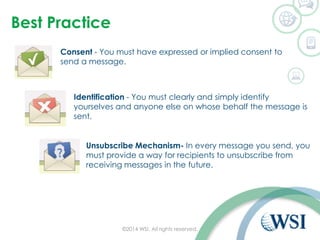
Consent - You must have expressed or implied consent to
send a message.
Identification - You must clearly and simply identify
yourselves and anyone else on whose behalf the message is
sent.
Unsubscribe Mechanism- In every message you send, you
must provide a way for recipients to unsubscribe from
receiving messages in the future.
Questions?
©2014 WSI. All rights reserved.
More details can be found at:
http://fightspam.gc.ca/

Canada's anti spam legislation

  • 1.
    Canada’s Anti-Spam Legislation What EveryBusiness Needs to Know By John Lepore, WSI - Ottawa
  • 2.
    What is it? ©2014WSI. All rights reserved. An Act to promote the efficiency and adaptability of the Canadian economy by regulating certain activities that discourage reliance on electronic means of carrying out commercial activities, and to amend the Canadian Radio-television and Telecommunications Commission Act, the Competition Act, the Personal Information Protection and Electronic Documents Act and the Telecommunications Act
  • 3.
    No…Really...What is it? Alaw to protect Canadians against unwanted SPAM ©2014 WSI. All rights reserved.
  • 4.
    When? July 1st, 2014 ©2014WSI. All rights reserved.
  • 5.
    Who Needs toKnow? Anyone who makes use of commercial electronic messages, is involved with the alteration of transmission data, or produces or installs computer programs needs to be aware of this law. ©2014 WSI. All rights reserved. A commercial electronic message is any electronic message that encourages participation in a commercial activity, regardless of whether there is an expectation of profit.
  • 6.
    Bill C-28 Penalties Themaximum penalty for a violation is $1,000,000 in the case of an individual, and $10,000,000 in the case of any other person.* ©2014 WSI. All rights reserved. In the case of a contravention of section 6 [unsolicited CEM], $200 for each contravention of that provision, not exceeding $1,000,000 for each day on which a contravention occurred* *Refer to the act for clarification and details
  • 7.
    What is SPAM? •Sending of unsolicited commercial electronic messages • Unauthorized alteration of transmission data • Installation of computer programs without consent • False and misleading electronic representations online (including websites) • Unauthorized collection of electronic addresses • Collection of personal information by accessing a computer system in contravention of an Act of Parliament. ©2014 WSI. All rights reserved.
  • 8.
    All inclusive!!! • Theseviolations include, but are not limited to: • Spam • Malware • Spyware • address harvesting, and false and misleading representations… • Involving the use of any means of: • Telecommunications • Short Message Services (SMS) • social networking, websites • URL's and other locators • Applications • Blogs • Voice over Internet Protocol (VoIP), and • any other current and future internet and wireless telecom threats prohibited by Canada's anti- spam legislation. ©2014 WSI. All rights reserved.
  • 9.
    Enforcement Bodies • CanadianRadio-television and Telecommunications Commission (CRTC) • Competition Bureau • Office of the Privacy Commissioner of Canada • Private Right of Action (July 1st 2017) ©2014 WSI. All rights reserved.
  • 10.
    Best Practice ©2014 WSI.All rights reserved. Consent - You must have expressed or implied consent to send a message. Identification - You must clearly and simply identify yourselves and anyone else on whose behalf the message is sent. Unsubscribe Mechanism- In every message you send, you must provide a way for recipients to unsubscribe from receiving messages in the future.
  • 11.
    Questions? ©2014 WSI. Allrights reserved. More details can be found at: http://fightspam.gc.ca/