The Beauty of Paganism An Introduction to Basic Beliefs and Practices
What Exactly Is Paganism Anyway? Paganism is a religion based upon pre-Christian beliefs, but continues to evolve. It is a blanket term which covers several nature-based religions such as Wicca, Asatru and Druidry. Many choose to integrate cultural and ethnic belief systems, such as Native American faiths. Some Pagans do not chose a specific path, simply identifying as Pagan.
What Do Pagans Get Out of It? Paganism is a beautiful path through which you can better yourself and the lives of those around you. It is extremely personal and takes a lot of dedication in order to fully grasp the benefits of a truly pagan lifestyle. Paganism effects every aspect of the practitioner’s life and should not be taken lightly.
God and Goddess Almost every branch of Paganism believes in a God and a Goddess.  God is the masculine aspect of the unifying spirit, and the Goddess is the feminine aspect.  God and Goddess are further broken up into three sub categories.
Deities Defined God Son – creativity, high energy, self-sacrifice Father – rule maker, judge, provider, hunter Sage – wisdom, leader, tenacity, eloquence Goddess Maiden – innocence, warrior, beauty Mother – fertility, empathy, love, nurturing Crone – gatekeeper, transition, compassion, death, rebirth
Deities Defined So you’re probably wondering…where are Zeus and Hera and all of those gods I learned about in school?  The God can be further divided into aspects of personality, or individual gods. Zeus would be an example of a Father god.  Hera would be an example of a Mother goddess.
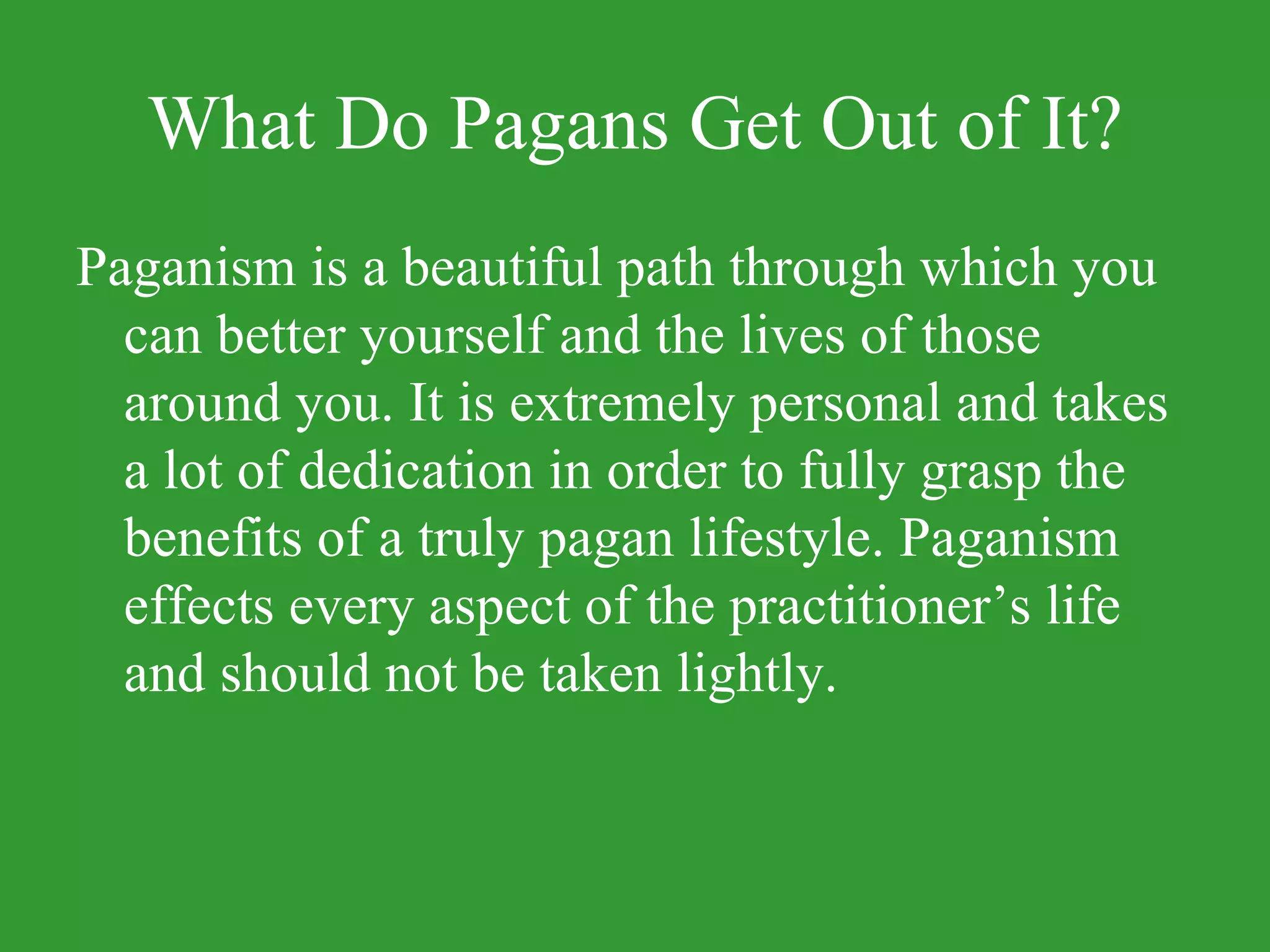
Pentacle Also commonly referred to as the pentagram Five pointed star within a circle used to represent the five elements Earth Air Fire  Water Spirit
Code of Morality Many faiths, Pagan and non-Pagan alike, have codes of morality. An example is the Wiccan Rede.  It says “An it harm none, do what ye will.”  This includes harm to self, others, and allowing others to harm them.  Harm can be direct and intentional, or it could be subtle and unintentional.  So a Wiccan thinks things through carefully before doing anything, and makes sure it’s in everyone’s best interest, as far as they can tell!
Magick Essential to Paganism is the belief in magick.  Some view magick as a formalized prayer  Magick can be used to worship a deity, alter situations in reality and a plethora of other things Magick can be done by one’s self or in a group Magick cannot be used to interfere with someone’s free will.  For example, you could do magick to bring love to you, but you can’t do magick to make a specific person fall in love with you.
What About All That “New Age” Stuff? Ancient Pagans believed strongly in many of practices which are now considered “New Age.” As part of religious practice, many Pagans include these elements. Examples of these “New Age” elements are meditation, reincarnation, divination, and karma.
Meditation Meditation allows us to explore various realities otherwise unavailable to us.  Through meditation, one can learn to find: Inner peace A feeling of connection to self, others, and your environment
Reincarnation In order to learn all the lessons one can learn while on this world, the soul must be incarnated many times  After all the lessons are learned, the soul will then reach heaven/enlightenment/nirvana/etc Lessons of a past life can be remembered in this life through a type of meditation known as past life regression If one fails to learn his/her lesson in this life, one must repeat that life until he/she can attain wisdom
Divination Commonly known methods of divination are tarot cards, palm reading, and crystal ball gazing.  Less commonly known are: Scrying, or looking into a pool of water Runes, an ancient alphabet, in which each symbol has a special meaning. Oracle cards, which are similar to tarot cards but usually picture Gods or mythological events
Karma Most Pagans believe that every action, no matter how minute, has importance.  The concept of Karma has several different names. If something “evil” is done, it will come back on you.  If something “good” is done, it will also come back on you. Some sects believe the energy comes back in multipliers, such as the three or ten. Karma effects your next life if you cannot overcome your Karmic debt
Question and Answer Period

The Beauty of Paganism

  • 1.
    The Beauty ofPaganism An Introduction to Basic Beliefs and Practices
  • 2.
    What Exactly IsPaganism Anyway? Paganism is a religion based upon pre-Christian beliefs, but continues to evolve. It is a blanket term which covers several nature-based religions such as Wicca, Asatru and Druidry. Many choose to integrate cultural and ethnic belief systems, such as Native American faiths. Some Pagans do not chose a specific path, simply identifying as Pagan.
  • 3.
    What Do PagansGet Out of It? Paganism is a beautiful path through which you can better yourself and the lives of those around you. It is extremely personal and takes a lot of dedication in order to fully grasp the benefits of a truly pagan lifestyle. Paganism effects every aspect of the practitioner’s life and should not be taken lightly.
  • 4.
    God and GoddessAlmost every branch of Paganism believes in a God and a Goddess. God is the masculine aspect of the unifying spirit, and the Goddess is the feminine aspect. God and Goddess are further broken up into three sub categories.
  • 5.
    Deities Defined GodSon – creativity, high energy, self-sacrifice Father – rule maker, judge, provider, hunter Sage – wisdom, leader, tenacity, eloquence Goddess Maiden – innocence, warrior, beauty Mother – fertility, empathy, love, nurturing Crone – gatekeeper, transition, compassion, death, rebirth
  • 6.
    Deities Defined Soyou’re probably wondering…where are Zeus and Hera and all of those gods I learned about in school? The God can be further divided into aspects of personality, or individual gods. Zeus would be an example of a Father god. Hera would be an example of a Mother goddess.
  • 7.
    Pentacle Also commonlyreferred to as the pentagram Five pointed star within a circle used to represent the five elements Earth Air Fire Water Spirit
  • 8.
    Code of MoralityMany faiths, Pagan and non-Pagan alike, have codes of morality. An example is the Wiccan Rede. It says “An it harm none, do what ye will.” This includes harm to self, others, and allowing others to harm them. Harm can be direct and intentional, or it could be subtle and unintentional. So a Wiccan thinks things through carefully before doing anything, and makes sure it’s in everyone’s best interest, as far as they can tell!
  • 9.
    Magick Essential toPaganism is the belief in magick. Some view magick as a formalized prayer Magick can be used to worship a deity, alter situations in reality and a plethora of other things Magick can be done by one’s self or in a group Magick cannot be used to interfere with someone’s free will. For example, you could do magick to bring love to you, but you can’t do magick to make a specific person fall in love with you.
  • 10.
    What About AllThat “New Age” Stuff? Ancient Pagans believed strongly in many of practices which are now considered “New Age.” As part of religious practice, many Pagans include these elements. Examples of these “New Age” elements are meditation, reincarnation, divination, and karma.
  • 11.
    Meditation Meditation allowsus to explore various realities otherwise unavailable to us. Through meditation, one can learn to find: Inner peace A feeling of connection to self, others, and your environment
  • 12.
    Reincarnation In orderto learn all the lessons one can learn while on this world, the soul must be incarnated many times After all the lessons are learned, the soul will then reach heaven/enlightenment/nirvana/etc Lessons of a past life can be remembered in this life through a type of meditation known as past life regression If one fails to learn his/her lesson in this life, one must repeat that life until he/she can attain wisdom
  • 13.
    Divination Commonly knownmethods of divination are tarot cards, palm reading, and crystal ball gazing. Less commonly known are: Scrying, or looking into a pool of water Runes, an ancient alphabet, in which each symbol has a special meaning. Oracle cards, which are similar to tarot cards but usually picture Gods or mythological events
  • 14.
    Karma Most Pagansbelieve that every action, no matter how minute, has importance. The concept of Karma has several different names. If something “evil” is done, it will come back on you. If something “good” is done, it will also come back on you. Some sects believe the energy comes back in multipliers, such as the three or ten. Karma effects your next life if you cannot overcome your Karmic debt
  • 15.