Notes
The idea of imprisonment as an appropriate response to crime has only been widespread for about 200 years.  Money payments, corporal punishment, and slave labor had been in common use prior to that time.  The US introduced the first  penitentiary  systems, with mottos like “labor, silence, penitence.”
In 1870, the prison reform movement began, and a number of  reformatories  were opened.  These sought to reform prisoners, reward good behavior, and teach them a trade.  This movement started falling out of favor by 1910.
Prisons are now usually called  correctional facilities .  An idea that grew out of the reformatory movement and became popular in the 1960s was treatment in the community, which mainly took two forms:  parole  and  probation .
There are three reasons for the growth of treatment in the community:  1) cost is far less than imprisonment  2) nation’s growing prison population threatened to overwhelm the system  3) labor unions opposed prison labor, which undercut their wages.  Its function of reintegrating people into communities has been hampered due to underfunding.
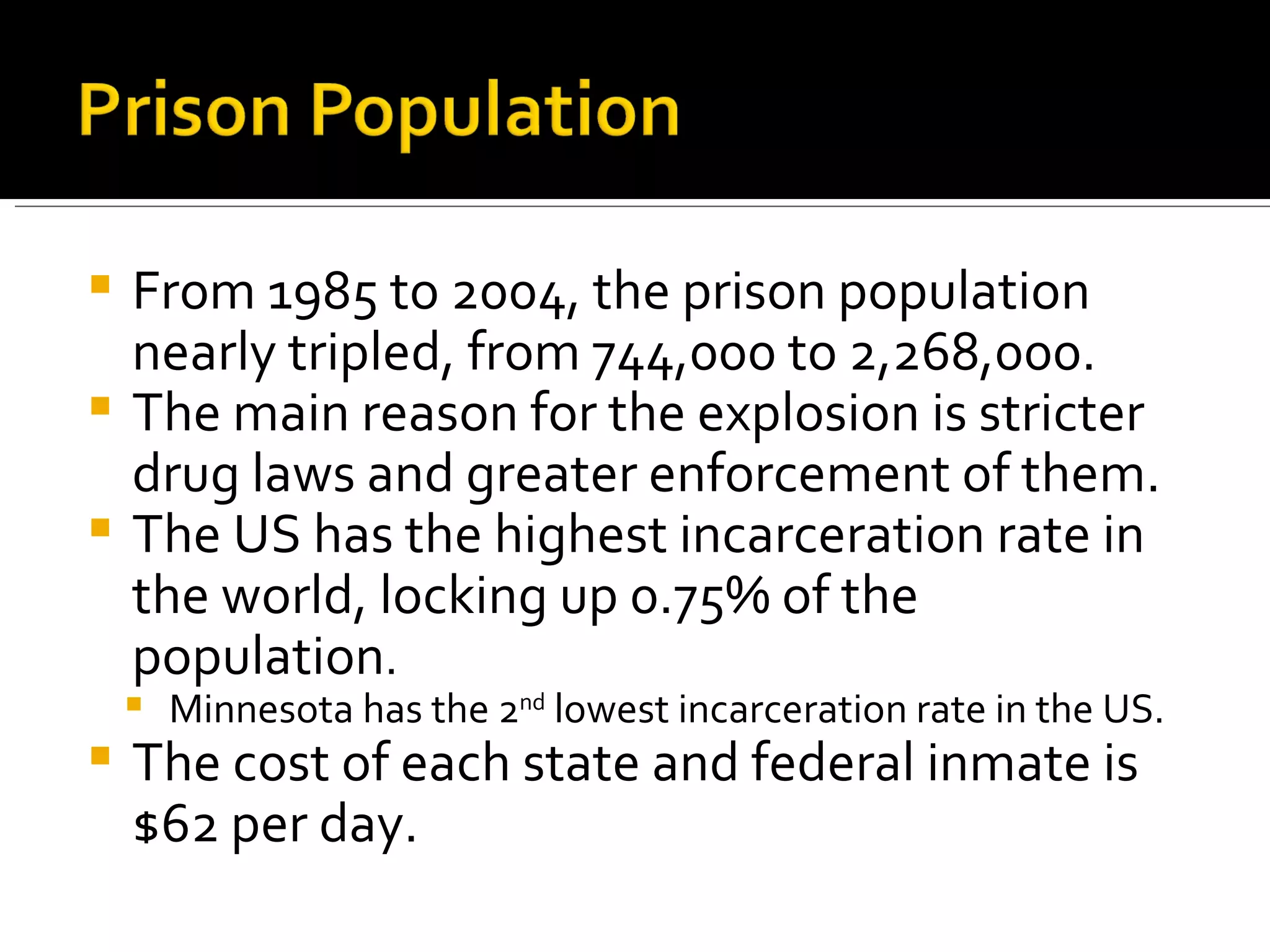
From 1985 to 2004, the prison population nearly tripled, from 744,000 to 2,268,000.  The main reason for the explosion is stricter drug laws and greater enforcement of them. The US has the highest incarceration rate in the world, locking up 0.75% of the population . Minnesota has the 2 nd  lowest incarceration rate in the US. The cost of each state and federal inmate is $62 per day.
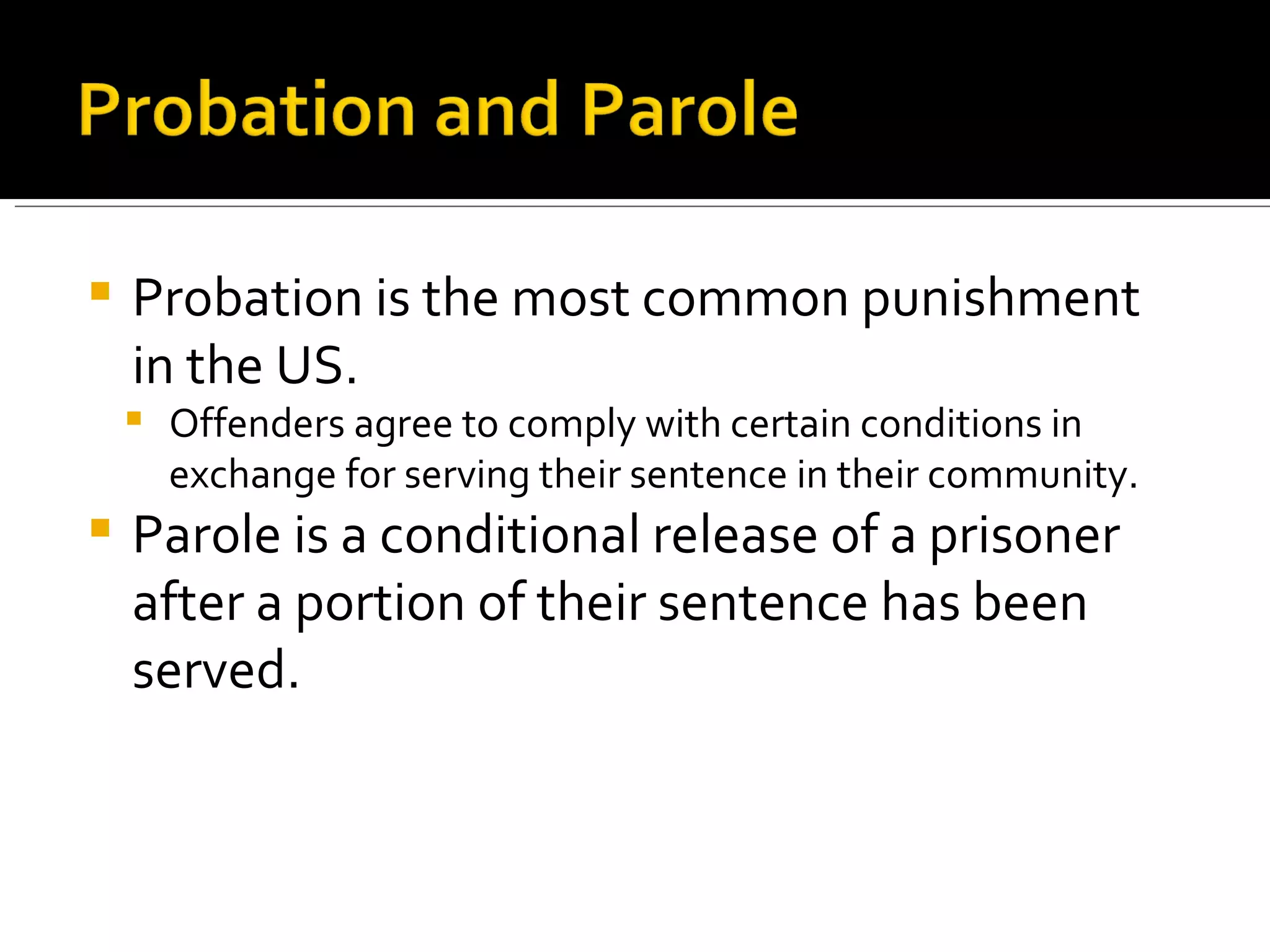
Probation is the most common punishment in the US. Offenders agree to comply with certain conditions in exchange for serving their sentence in their community. Parole is a conditional release of a prisoner after a portion of their sentence has been served.

Corrections notes

  • 1.
  • 2.
    The idea ofimprisonment as an appropriate response to crime has only been widespread for about 200 years. Money payments, corporal punishment, and slave labor had been in common use prior to that time. The US introduced the first penitentiary systems, with mottos like “labor, silence, penitence.”
  • 3.
    In 1870, theprison reform movement began, and a number of reformatories were opened. These sought to reform prisoners, reward good behavior, and teach them a trade. This movement started falling out of favor by 1910.
  • 4.
    Prisons are nowusually called correctional facilities . An idea that grew out of the reformatory movement and became popular in the 1960s was treatment in the community, which mainly took two forms: parole and probation .
  • 5.
    There are threereasons for the growth of treatment in the community: 1) cost is far less than imprisonment 2) nation’s growing prison population threatened to overwhelm the system 3) labor unions opposed prison labor, which undercut their wages. Its function of reintegrating people into communities has been hampered due to underfunding.
  • 6.
    From 1985 to2004, the prison population nearly tripled, from 744,000 to 2,268,000. The main reason for the explosion is stricter drug laws and greater enforcement of them. The US has the highest incarceration rate in the world, locking up 0.75% of the population . Minnesota has the 2 nd lowest incarceration rate in the US. The cost of each state and federal inmate is $62 per day.
  • 7.
    Probation is themost common punishment in the US. Offenders agree to comply with certain conditions in exchange for serving their sentence in their community. Parole is a conditional release of a prisoner after a portion of their sentence has been served.