International Research Journal of Engineering and Technology (IRJET) e-ISSN: 2395-0056
Volume: 09 Issue: 06 | June 2022 www.irjet.net p-ISSN: 2395-0072
© 2022, IRJET | Impact Factor value: 7.529 | ISO 9001:2008 Certified Journal | Page 2301
Fertilizer Dispenser
Dr. Sudhir Kadam1, Bhawarth Gupta2, Deenanath Yadav3, Gaurav Pal4
11st Author, Department of E&TC Engineering, Bharati Vidyapeeth (Deemed to be University), College of
Engineering, Pune, India
2,3,4 Electronics and Telecommunication, Bharati Vidyapeeth (Deemed University) College of Engineering,Pune,
India
--------------------------------------------------------------------------***-----------------------------------------------------------------------
Abstract— We live in a technologically advanced
society where digitalisation and technology pervade
every aspect of our lives. The importance of technology
in agriculture is becoming increasingly apparent with
each passing day. Every day, the agriculture industry in
India loses ground, affecting the ecosystem's output
capability. There is a growing need to address this and
return it to higher growth. To improve the farmer's
agricultural productivity and profitability through better
management, which is relevant to both small and large
farms. The goal of this paper is to automate fertiliser
control and water flow monitoring.
Keywords: ESP32,Relay,Automation system, Fertilizer.
I. INTRODUCTION
Agriculture is one of the few industries where
technology has not been widely adopted; one of the
reasons for this is the precarious state of most farmers in
India and other developing countries. Due to two key
problems, overpopulation and urbanisation, the scarcity
of agricultural products is increasing day by day.
Overpopulation will raise total demand for agricultural
products, while urbanisation has resulted in the
conversion of many agricultural lands into Non-
Agricultural fields (NA) for infrastructure construction
near metropolitan centres. Basically, the agricultural
land is shrinking every day, and as a result, the amount
of farming is shrinking as well, potentially resulting in a
drop in agricultural production. To beat this scenario,
the only way is to increase agricultural output by
intelligently employing resources. Precision agriculture
was born out of the need to reduce waste of readily
available resources. The conventional irrigation
procedure includes a time-based fertiliser dispensing
system, in which farmers fertilise the crop after a certain
period of time has passed (typically some days).
However, the problem with this strategy is that
sometimes the crop does not require fertiliser so early,
resulting in excessive fertiliser consumption, and other
crops do require fertiliser a little earlier. So, to address
this issue, this research proposes an autonomous system
that can tell us exactly how much fertiliser is used in the
cropping of the soil. This aids in the prevention of over-
irrigation, which can result in diseases inside the crop in
addition to water waste. The second benefit is that it
reduces the amount of fertiliser used. Excess fertiliser
use can lead to heavy metal accumulation,
eutrophication, and phosphate and nitrate accumulation.
Excess phosphorus in water could pose a hazard to its
quality.
II. LITERATURE SURVEY
 The study [1] outlines the technological
constraints and issues that must be addressed
during the deployment of an IoT-based low-
scale pilot project in the agriculture area. This
study lays forth a conceptual framework for all
stages of agricultural product development,
including food production, processing,
distribution, and retail.
 In [2,] P. A. Bhosale and V. V. Dixit present an
indigenous low-cost time-dependent
microcontroller-based irrigation scheduler that
includes a variety of sensors for measuring
moisture, temperature, and wind. Using these
parameters, this approach generates
appropriate actuators (relay, solenoid valves,
motor). Through the GSM module, the captured
data is sent to the user in the form of an SMS and
stored on a memory card.
 Advances in greenhouse automation and
controlled environment agriculture: A transition
to plant factories and urban agriculture[3]
explains how a variety of environmental factors
interact to allow plants to thrive optimally in
various settings.
 The proposed system in paper [4] is an
investigation of the application of system on
chip (SoC) in WSN for greenhouse parameter
management and monitoring. The author also
addresses the progress of wireless networks
and, as a result, the development of
conventional sensor nodes, which comprise an
I/O interface, memory, processor, transceiver,
and battery, as well as sensors.
International Research Journal of Engineering and Technology (IRJET) e-ISSN: 2395-0056
Volume: 09 Issue: 06 | June 2022 www.irjet.net p-ISSN: 2395-0072
© 2022, IRJET | Impact Factor value: 7.529 | ISO 9001:2008 Certified Journal | Page 2302
III. REQUIREMENTS
Electronic components
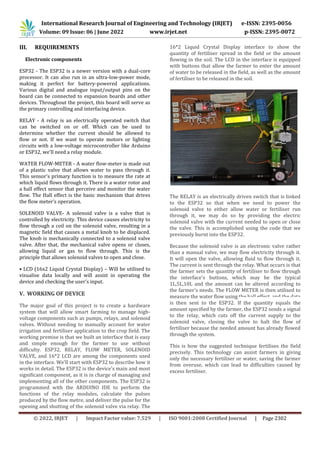
ESP32 - The ESP32 is a newer version with a dual-core
processor. It can also run in an ultra-low-power mode,
making it perfect for battery-powered applications.
Various digital and analogue input/output pins on the
board can be connected to expansion boards and other
devices. Throughout the project, this board will serve as
the primary controlling and interfacing device.
RELAY - A relay is an electrically operated switch that
can be switched on or off. Which can be used to
determine whether the current should be allowed to
flow or not. If we want to operate motors or lighting
circuits with a low-voltage microcontroller like Arduino
or ESP32, we'll need a relay module.
WATER FLOW-METER - A water flow-meter is made out
of a plastic valve that allows water to pass through it.
This sensor's primary function is to measure the rate at
which liquid flows through it. There is a water rotor and
a hall effect sensor that perceive and monitor the water
flow. The Hall effect is the basic mechanism that drives
the flow meter's operation.
SOLENOID VALVE- A solenoid valve is a valve that is
controlled by electricity. This device causes electricity to
flow through a coil on the solenoid valve, resulting in a
magnetic field that causes a metal knob to be displaced.
The knob is mechanically connected to a solenoid valve
valve. After that, the mechanical valve opens or closes,
allowing liquid or gas to flow through. This is the
principle that allows solenoid valves to open and close.
• LCD (16x2 Liquid Crystal Display) – Will be utilised to
visualise data locally and will assist in operating the
device and checking the user's input.
V. WORKING OF DEVICE
The major goal of this project is to create a hardware
system that will allow smart farming to manage high-
voltage components such as pumps, relays, and solenoid
valves. Without needing to manually account for water
irrigation and fertiliser application to the crop field. The
working premise is that we built an interface that is easy
and simple enough for the farmer to use without
difficulty. ESP32, RELAY, FLOW METER, SOLENOID
VALVE, and 16*2 LCD are among the components used
in the interface. We'll start with ESP32 to describe how it
works in detail. The ESP32 is the device's main and most
significant component, as it is in charge of managing and
implementing all of the other components. The ESP32 is
programmed with the ARDUINO IDE to perform the
functions of the relay modules, calculate the pulses
produced by the flow metre, and deliver the pulse for the
opening and shutting of the solenoid valve via relay. The
16*2 Liquid Crystal Display interface to show the
quantity of fertiliser spread in the field or the amount
flowing in the soil. The LCD in the interface is equipped
with buttons that allow the farmer to enter the amount
of water to be released in the field, as well as the amount
of fertiliser to be released in the soil.
The RELAY is an electrically driven switch that is linked
to the ESP32 so that when we need to power the
solenoid valve to either allow water or fertiliser run
through it, we may do so by providing the electric
solenoid valve with the current needed to open or close
the valve. This is accomplished using the code that we
previously burnt into the ESP32.
Because the solenoid valve is an electronic valve rather
than a manual valve, we may flow electricity through it.
It will open the valve, allowing fluid to flow through it.
The current is sent through the relay. What occurs is that
the farmer sets the quantity of fertiliser to flow through
the interface's buttons, which may be the typical
1L,5L,10L and the amount can be altered according to
the farmer's needs. The FLOW METER is then utilised to
measure the water flow using the hall effect, and the data
is then sent to the ESP32. If the quantity equals the
amount specified by the farmer, the ESP32 sends a signal
to the relay, which cuts off the current supply to the
solenoid valve, closing the valve to halt the flow of
fertiliser because the needed amount has already flowed
through the system.
This is how the suggested technique fertilises the field
precisely. This technology can assist farmers in giving
only the necessary fertiliser or water, saving the farmer
from overuse, which can lead to difficulties caused by
excess fertiliser.
International Research Journal of Engineering and Technology (IRJET) e-ISSN: 2395-0056
Volume: 09 Issue: 06 | June 2022 www.irjet.net p-ISSN: 2395-0072
© 2022, IRJET | Impact Factor value: 7.529 | ISO 9001:2008 Certified Journal | Page 2303
VI.CONCLUSION
 As a result, the suggested system enables the
automation of the process of administering
fertiliser in the field without the need for human
interaction. The suggested system is a beginning
point in the large area of combining agricultural
approaches and technology to build improved
ways that will assist farmers in raising crop
yield and utilising resources to the greatest
extent feasible.
 With a fast rising population, demand can only
be fulfilled if we make it feasible for not just
large farmers, but also small farmers, to have
access to improved agricultural practises that
employ technology profitably.
 • The demand for additional crops has pushed
us to look for strategies to boost agricultural
yield because farming land is limited and cannot
be expanded due to the expanding human
population.
 As a result, the suggested method was created
with the intention of offering some answer to
the problem that farmers have while delivering
fertiliser to crops, allowing them to focus on
other things that would aid in raising
production.
VII. FUTURE SCOPE
 Agriculture has played an important part in
India's economic progress since then and will
continue to do so in the future. Farmers
encounter significant obstacles throughout the
agricultural process. The study attempts to fix
the issue through automation, which can
manage agricultural labour instead of spending
most of one's time on crop upkeep and
production, giving farmers more time for their
personal lives and thereby raising the society's
overall socioeconomic standard.
 The suggested system has the capability of
automating the whole process of watering as
well as fertiliser chaneling at a precise time
without the need for human interaction. As one
of the conceivable outcomes of the employment
of technology in farming, the suggested system
has enormous and multifarious possibilities.
• The applications are limitless since it is up
to us to use our imagination and thoughts in
this specific area. It is our obligation as
humans to develop ways and technologies
that will benefit and aid in the optimization
of the use of resources available to satisfy
the demands of the human race for food
production.
• The applications are limitless since it is up
to us to use our imagination and thoughts in
this specific area. It is our obligation as
humans to develop ways and technologies
that will benefit and aid in the optimization
of the use of resources available to satisfy
the demands of the human race for food
production.
VIII.REFERENCES
 [1] C. Brewster, I. Roussaki, N. Kalatzis, K.
Doolin, K. Ellis, “IoT in Agriculture: Designing a
Europe-Wide Large scale Pilot”, IEEE
Communications Magazine September 2017
 [2] P. A. Bhosale, V. V. Dixit, “Water Saving-
Irrigation Automatic Agricultural Controller.” in
International Journal of Scientific and
Technology Research (ISSN 2277-8616),
Volume 1, Issue 11, December 2012.
 [3] Advances in greenhouse automation and
controlled environment agriculture: A transition
to plant factories and urban agriculture
Redmond Ramin Shamshiri1* , Fatemeh
Kalantari2 , K. C. Ting3 , Kelly R. Thorp4 ,
International Research Journal of Engineering and Technology (IRJET) e-ISSN: 2395-0056
Volume: 09 Issue: 06 | June 2022 www.irjet.net p-ISSN: 2395-0072
© 2022, IRJET | Impact Factor value: 7.529 | ISO 9001:2008 Certified Journal | Page 2304
Ibrahim A. Hameed5 , Cornelia Weltzien6 , Desa
Ahmad1 , Zahra Mojgan Shad7 .
 [4] D. Chaudhary, S. Nayse, L. Waghmare,
“Application of Wireless Sensor Networks for
Greenhouse parameter control in precision
agriculture”, International Journal of Wireless &
Mobile Networks Feb 2011.
 [5]Mr.Sudhir Kadam, Dr. M. S. Chavan “Design of
Digital Filter by particle swarm optimization
algorithm” International Journal of Engineering
Science Invention (IJESI), ISSN (Online): 2319 –
6734, ISSN (Print): 2319 – 6726, www.ijesi.org
||Volume 8 Issue 01 Series. III || Jan 2019 || PP
04-09.
 [6]Mr.Sudhir Kadam, Dr. M. S. Chavan “Design of
Digital Filter by Differential Evolution”
International Journal of Recent Technology and
Engineering (IJRTE), ISSN: 2277-3878, Volume-
8 Issue-2, July 2019.

Fertilizer Dispenser

  • 1.
    International Research Journalof Engineering and Technology (IRJET) e-ISSN: 2395-0056 Volume: 09 Issue: 06 | June 2022 www.irjet.net p-ISSN: 2395-0072 © 2022, IRJET | Impact Factor value: 7.529 | ISO 9001:2008 Certified Journal | Page 2301 Fertilizer Dispenser Dr. Sudhir Kadam1, Bhawarth Gupta2, Deenanath Yadav3, Gaurav Pal4 11st Author, Department of E&TC Engineering, Bharati Vidyapeeth (Deemed to be University), College of Engineering, Pune, India 2,3,4 Electronics and Telecommunication, Bharati Vidyapeeth (Deemed University) College of Engineering,Pune, India --------------------------------------------------------------------------***----------------------------------------------------------------------- Abstract— We live in a technologically advanced society where digitalisation and technology pervade every aspect of our lives. The importance of technology in agriculture is becoming increasingly apparent with each passing day. Every day, the agriculture industry in India loses ground, affecting the ecosystem's output capability. There is a growing need to address this and return it to higher growth. To improve the farmer's agricultural productivity and profitability through better management, which is relevant to both small and large farms. The goal of this paper is to automate fertiliser control and water flow monitoring. Keywords: ESP32,Relay,Automation system, Fertilizer. I. INTRODUCTION Agriculture is one of the few industries where technology has not been widely adopted; one of the reasons for this is the precarious state of most farmers in India and other developing countries. Due to two key problems, overpopulation and urbanisation, the scarcity of agricultural products is increasing day by day. Overpopulation will raise total demand for agricultural products, while urbanisation has resulted in the conversion of many agricultural lands into Non- Agricultural fields (NA) for infrastructure construction near metropolitan centres. Basically, the agricultural land is shrinking every day, and as a result, the amount of farming is shrinking as well, potentially resulting in a drop in agricultural production. To beat this scenario, the only way is to increase agricultural output by intelligently employing resources. Precision agriculture was born out of the need to reduce waste of readily available resources. The conventional irrigation procedure includes a time-based fertiliser dispensing system, in which farmers fertilise the crop after a certain period of time has passed (typically some days). However, the problem with this strategy is that sometimes the crop does not require fertiliser so early, resulting in excessive fertiliser consumption, and other crops do require fertiliser a little earlier. So, to address this issue, this research proposes an autonomous system that can tell us exactly how much fertiliser is used in the cropping of the soil. This aids in the prevention of over- irrigation, which can result in diseases inside the crop in addition to water waste. The second benefit is that it reduces the amount of fertiliser used. Excess fertiliser use can lead to heavy metal accumulation, eutrophication, and phosphate and nitrate accumulation. Excess phosphorus in water could pose a hazard to its quality. II. LITERATURE SURVEY  The study [1] outlines the technological constraints and issues that must be addressed during the deployment of an IoT-based low- scale pilot project in the agriculture area. This study lays forth a conceptual framework for all stages of agricultural product development, including food production, processing, distribution, and retail.  In [2,] P. A. Bhosale and V. V. Dixit present an indigenous low-cost time-dependent microcontroller-based irrigation scheduler that includes a variety of sensors for measuring moisture, temperature, and wind. Using these parameters, this approach generates appropriate actuators (relay, solenoid valves, motor). Through the GSM module, the captured data is sent to the user in the form of an SMS and stored on a memory card.  Advances in greenhouse automation and controlled environment agriculture: A transition to plant factories and urban agriculture[3] explains how a variety of environmental factors interact to allow plants to thrive optimally in various settings.  The proposed system in paper [4] is an investigation of the application of system on chip (SoC) in WSN for greenhouse parameter management and monitoring. The author also addresses the progress of wireless networks and, as a result, the development of conventional sensor nodes, which comprise an I/O interface, memory, processor, transceiver, and battery, as well as sensors.
  • 2.
    International Research Journalof Engineering and Technology (IRJET) e-ISSN: 2395-0056 Volume: 09 Issue: 06 | June 2022 www.irjet.net p-ISSN: 2395-0072 © 2022, IRJET | Impact Factor value: 7.529 | ISO 9001:2008 Certified Journal | Page 2302 III. REQUIREMENTS Electronic components ESP32 - The ESP32 is a newer version with a dual-core processor. It can also run in an ultra-low-power mode, making it perfect for battery-powered applications. Various digital and analogue input/output pins on the board can be connected to expansion boards and other devices. Throughout the project, this board will serve as the primary controlling and interfacing device. RELAY - A relay is an electrically operated switch that can be switched on or off. Which can be used to determine whether the current should be allowed to flow or not. If we want to operate motors or lighting circuits with a low-voltage microcontroller like Arduino or ESP32, we'll need a relay module. WATER FLOW-METER - A water flow-meter is made out of a plastic valve that allows water to pass through it. This sensor's primary function is to measure the rate at which liquid flows through it. There is a water rotor and a hall effect sensor that perceive and monitor the water flow. The Hall effect is the basic mechanism that drives the flow meter's operation. SOLENOID VALVE- A solenoid valve is a valve that is controlled by electricity. This device causes electricity to flow through a coil on the solenoid valve, resulting in a magnetic field that causes a metal knob to be displaced. The knob is mechanically connected to a solenoid valve valve. After that, the mechanical valve opens or closes, allowing liquid or gas to flow through. This is the principle that allows solenoid valves to open and close. • LCD (16x2 Liquid Crystal Display) – Will be utilised to visualise data locally and will assist in operating the device and checking the user's input. V. WORKING OF DEVICE The major goal of this project is to create a hardware system that will allow smart farming to manage high- voltage components such as pumps, relays, and solenoid valves. Without needing to manually account for water irrigation and fertiliser application to the crop field. The working premise is that we built an interface that is easy and simple enough for the farmer to use without difficulty. ESP32, RELAY, FLOW METER, SOLENOID VALVE, and 16*2 LCD are among the components used in the interface. We'll start with ESP32 to describe how it works in detail. The ESP32 is the device's main and most significant component, as it is in charge of managing and implementing all of the other components. The ESP32 is programmed with the ARDUINO IDE to perform the functions of the relay modules, calculate the pulses produced by the flow metre, and deliver the pulse for the opening and shutting of the solenoid valve via relay. The 16*2 Liquid Crystal Display interface to show the quantity of fertiliser spread in the field or the amount flowing in the soil. The LCD in the interface is equipped with buttons that allow the farmer to enter the amount of water to be released in the field, as well as the amount of fertiliser to be released in the soil. The RELAY is an electrically driven switch that is linked to the ESP32 so that when we need to power the solenoid valve to either allow water or fertiliser run through it, we may do so by providing the electric solenoid valve with the current needed to open or close the valve. This is accomplished using the code that we previously burnt into the ESP32. Because the solenoid valve is an electronic valve rather than a manual valve, we may flow electricity through it. It will open the valve, allowing fluid to flow through it. The current is sent through the relay. What occurs is that the farmer sets the quantity of fertiliser to flow through the interface's buttons, which may be the typical 1L,5L,10L and the amount can be altered according to the farmer's needs. The FLOW METER is then utilised to measure the water flow using the hall effect, and the data is then sent to the ESP32. If the quantity equals the amount specified by the farmer, the ESP32 sends a signal to the relay, which cuts off the current supply to the solenoid valve, closing the valve to halt the flow of fertiliser because the needed amount has already flowed through the system. This is how the suggested technique fertilises the field precisely. This technology can assist farmers in giving only the necessary fertiliser or water, saving the farmer from overuse, which can lead to difficulties caused by excess fertiliser.
  • 3.
    International Research Journalof Engineering and Technology (IRJET) e-ISSN: 2395-0056 Volume: 09 Issue: 06 | June 2022 www.irjet.net p-ISSN: 2395-0072 © 2022, IRJET | Impact Factor value: 7.529 | ISO 9001:2008 Certified Journal | Page 2303 VI.CONCLUSION  As a result, the suggested system enables the automation of the process of administering fertiliser in the field without the need for human interaction. The suggested system is a beginning point in the large area of combining agricultural approaches and technology to build improved ways that will assist farmers in raising crop yield and utilising resources to the greatest extent feasible.  With a fast rising population, demand can only be fulfilled if we make it feasible for not just large farmers, but also small farmers, to have access to improved agricultural practises that employ technology profitably.  • The demand for additional crops has pushed us to look for strategies to boost agricultural yield because farming land is limited and cannot be expanded due to the expanding human population.  As a result, the suggested method was created with the intention of offering some answer to the problem that farmers have while delivering fertiliser to crops, allowing them to focus on other things that would aid in raising production. VII. FUTURE SCOPE  Agriculture has played an important part in India's economic progress since then and will continue to do so in the future. Farmers encounter significant obstacles throughout the agricultural process. The study attempts to fix the issue through automation, which can manage agricultural labour instead of spending most of one's time on crop upkeep and production, giving farmers more time for their personal lives and thereby raising the society's overall socioeconomic standard.  The suggested system has the capability of automating the whole process of watering as well as fertiliser chaneling at a precise time without the need for human interaction. As one of the conceivable outcomes of the employment of technology in farming, the suggested system has enormous and multifarious possibilities. • The applications are limitless since it is up to us to use our imagination and thoughts in this specific area. It is our obligation as humans to develop ways and technologies that will benefit and aid in the optimization of the use of resources available to satisfy the demands of the human race for food production. • The applications are limitless since it is up to us to use our imagination and thoughts in this specific area. It is our obligation as humans to develop ways and technologies that will benefit and aid in the optimization of the use of resources available to satisfy the demands of the human race for food production. VIII.REFERENCES  [1] C. Brewster, I. Roussaki, N. Kalatzis, K. Doolin, K. Ellis, “IoT in Agriculture: Designing a Europe-Wide Large scale Pilot”, IEEE Communications Magazine September 2017  [2] P. A. Bhosale, V. V. Dixit, “Water Saving- Irrigation Automatic Agricultural Controller.” in International Journal of Scientific and Technology Research (ISSN 2277-8616), Volume 1, Issue 11, December 2012.  [3] Advances in greenhouse automation and controlled environment agriculture: A transition to plant factories and urban agriculture Redmond Ramin Shamshiri1* , Fatemeh Kalantari2 , K. C. Ting3 , Kelly R. Thorp4 ,
  • 4.
    International Research Journalof Engineering and Technology (IRJET) e-ISSN: 2395-0056 Volume: 09 Issue: 06 | June 2022 www.irjet.net p-ISSN: 2395-0072 © 2022, IRJET | Impact Factor value: 7.529 | ISO 9001:2008 Certified Journal | Page 2304 Ibrahim A. Hameed5 , Cornelia Weltzien6 , Desa Ahmad1 , Zahra Mojgan Shad7 .  [4] D. Chaudhary, S. Nayse, L. Waghmare, “Application of Wireless Sensor Networks for Greenhouse parameter control in precision agriculture”, International Journal of Wireless & Mobile Networks Feb 2011.  [5]Mr.Sudhir Kadam, Dr. M. S. Chavan “Design of Digital Filter by particle swarm optimization algorithm” International Journal of Engineering Science Invention (IJESI), ISSN (Online): 2319 – 6734, ISSN (Print): 2319 – 6726, www.ijesi.org ||Volume 8 Issue 01 Series. III || Jan 2019 || PP 04-09.  [6]Mr.Sudhir Kadam, Dr. M. S. Chavan “Design of Digital Filter by Differential Evolution” International Journal of Recent Technology and Engineering (IJRTE), ISSN: 2277-3878, Volume- 8 Issue-2, July 2019.