International Research Journal of Engineering and Technology (IRJET) e-ISSN: 2395-0056
Volume: 09 Issue: 05 | May 2022 www.irjet.net p-ISSN: 2395-0072
© 2022, IRJET | Impact Factor value: 7.529 | ISO 9001:2008 Certified Journal | Page 2311
Electricity Generation Tiles Using Piezoelectric Sensor
1Silvester Souza, 2Soha Nadgouda, 3Sammed Kallannavar, 4 Saihil Nandre,5 Dr. Ashok M
Hulagabali, 6 Dr. Rajendra M Galagali
1,2,3,4 Student, Department of Mechanical Engineering, S.G. Balekundri Institute of Technology, Belagavi,
Karnataka, India
5 Associate Professor and Project Guide, Department of Mechanical Engineering S.G. Balekundri Institute of
Technology, Belagavi, Karnataka, India,
6 Professor & Head, Department of Mechanical Engineering S.G. Balekundri Institute of Technology, Belagavi,
Karnataka, India
---------------------------------------------------------------------***---------------------------------------------------------------------
Key Words: Electrical Power Generation, Piezoelectric
Sensor, Energy Harvesting Technique, Environment
Friendly.
1. INTRODUCTION
Energy demand in all countries is
constantly increasing, and the production and import of
electricity cannot meet consumption and export. We
always go with wind energy or solar energy or tidal energy
or other sources of energy the power production is still
not sufficient. .So to cope with this situation we need to
generate electricity by any ways necessary.
When people walk, they lose energy to the surface they
are walking on, due to the transfer of weight on to the
surface. The idea of this model is to capture this energy
and convert it into a usable form. The energy generated
during walking is concentrated on piezoelectric sensor,
which converts this energy into electrical energy. This
energy is stored and used in the battery.
The aim is to generate energy from foot step. This system
provides a platform where footsteps can be placed.
Whenever people walk or stand on the top plate it dips
down slightly and their weight is converted to electrical
power.
If we install such system in some of the busiest centers of
our cities from train stations to airport, from offices,
2. SYSTEM CONFIGURATIOIN
 COMPONENTS
1 Diodes
1) Piezoelectric sensor tile
Piezoelectric materials are the central part of the
piezoelectric sensor. These materials can produce
electricity when mechanical stress is applied. The word
piezoelectric means electricity generated by pressure. A
device that makes use of piezoelectric effect is called a
piezoelectric sensor. The piezo electric tile is a tile of
dimension 30cm x 30cm. The number of piezoelectric
sensors are installed on this tile are Eight. The sensors are
connected in a series-parallel combination. Electricity is
generated when the tile is subjected to compressive or
tensile stress, developing a voltage gradient and a next
current flow.
4) RFID module
5) Rectifier
6) Arduino
7) Resistors
8) Capacitors
2) Voltage regulator
3) Piezoelectric Sensor Tile
Abstract - The consumption of electrical power is
increasing rapidly at a very fast rate. We are in a situation
where electricity production is not able to cover up the
electricity consumption. This paper proposes a method to
generate electricity by harvesting human power. Human
power is defined as, use of human work for energy
generation which can be used to power electronic device. In
countries like India, which have a large pedestrian
population human power like walking, running and
jumping can be used as a power source . This paper
presents a method for energy harvesting, from human
motion with the use of piezo electric sensor and also exhibits
the use of stored energy that is to charge mobile phone
using RFID. The force exerted from walking, is converted
into voltage by piezo electric sensor. This voltage built up
can be used to power a storage battery. The more people
walk through these tiles, the more energy is stored
in batteries and can be used to power lights, train stations,
gyms and other public places. This is
an environmentally friendly approach to energy productio
n. The documentation provides simplified concepts and
design details of the model.
International Research Journal of Engineering and Technology (IRJET) e-ISSN: 2395-0056
Volume: 09 Issue: 05 | May 2022 www.irjet.net p-ISSN: 2395-0072
© 2022, IRJET | Impact Factor value: 7.529 | ISO 9001:2008 Certified Journal | Page 2312
Figure 1: Piezoelectric sensor tile
2) Voltage Regulator
Voltage Regulator (LM 7805), employs internal current,
restricting thermal close down and secure running area
protection, making it essentially indestructible. It
can provide output currents up to 1A.It has fixed output
voltage of 5, 6, 8, 9, 10, 12, 15, 16, 18, 24 V.
Therefore, it is useful in a variety of applications. Despite
the fact that designed ordinarily as fixed voltage regulator,
the device can also be used with external components to
reap voltage and current.
Figure 2: Voltage Regulator
3) Diode
A diode is two-terminal electronic issue which conducts
electricity, primarily only in single direction. A diode has
high resistance on one end and occasional resistance on
the opposite end.
Figure 3: Diode
The arrowhead is the anode terminal which represents the
path of the current flow. Another end terminal is cathode.

 Light Emitting Diode (LED)
“A light-emitting diode (LED) is a semiconductor light
source. When a light-emitting diode is forward based,
electrons are able to recombine with holes, within the
device, releasing energy in the shape of
photons”. Colors are available based on wavelength range,
voltage drop, and material. Red, green,
yellow and blue LEDs are very common.[5]
Figure 4: Light Emitting Diode (LED)
1N4007 Diode
It is a rectifier diode. It is specifically designed for circuits
that need to convert alternating current to direct
current how the diode is made by two dissimilar P and N
semiconductors type, a junction is formed between the
diodes. The identification number for this particular diode
is 4007. It can pass current of up to 1A. The PIV rating is
1000 V.
Figure 5: 1N4007 Diode
4) RFID Module
Radio Frequency identification, or RFID, is an
identification and logging technology. RFID system uses
tiny chips, called as "tags", to transmit piece of information
to an RFID reader. The tag contains a Transponder
with digital memory chip with unique electronics code.
RFID is a technology that communicates over radio waves
to exchange signals with electronic
tags and readers attached to objects for identification
International Research Journal of Engineering and Technology (IRJET) e-ISSN: 2395-0056
Volume: 09 Issue: 05 | May 2022 www.irjet.net p-ISSN: 2395-0072
© 2022, IRJET | Impact Factor value: 7.529 | ISO 9001:2008 Certified Journal | Page 2313
and tracking purposes. We are using RFID for the
authentication of the user and not compromising the
accuracy and functioning of the system.
.
Figure 6: RFID Module
3. BLOCK DIAGRAM
Figure 7: BLOCK DIAGRAM
4. WORKING
The piezoelectric tile in which piezoelectric sensors are
installed. It displaces slightly every time a person walks
over the platform,. It is designed in such a way that it dips
down slightly when the weight is applied and returns back
to its original state when the weight is removed. This
platform channels the pressure developed by the human
activity, like walking, running on it. The output given by
the piezoelectric material is not steady. The charge
developed by this sensor is always AC. A bridge circuit is
used to convert this unsteady voltage to linear voltage. It is
done to stabilize the charge and to convert AC into DC.
Rechargeable batteries are used to store the output DC
voltage. The battery can be utilized to charge mobile using
RFID access.
Figure 8: Working of Piezoelectric tile
The LCD display is calculated using an ATMEGA 328P
microcontroller. When the system is turned on, a welcome
message is displayed, which is read by the ADC on the
microcontroller. Both the microcontroller and LCD are
powered by 5V. user is required to register in the system.
Once all the users are registered the system asks to swipe
the card and connect the charger. Default charging time is
set which can be later modified. The card can be recharged
by using recharge button present in the system.
5. ANALYSIS DONE ON PIEZOELECTRIC TILE
The ability of the piezoelectric tiles to generate voltage
was tested by having people weighing between 35 and 70
kg walk on them. Piezoelectric floors are best suited for
areas with high floating populations. Pressure-assisted
power generation technology using piezoelectric tiles is a
new development. Companies in this sector are still
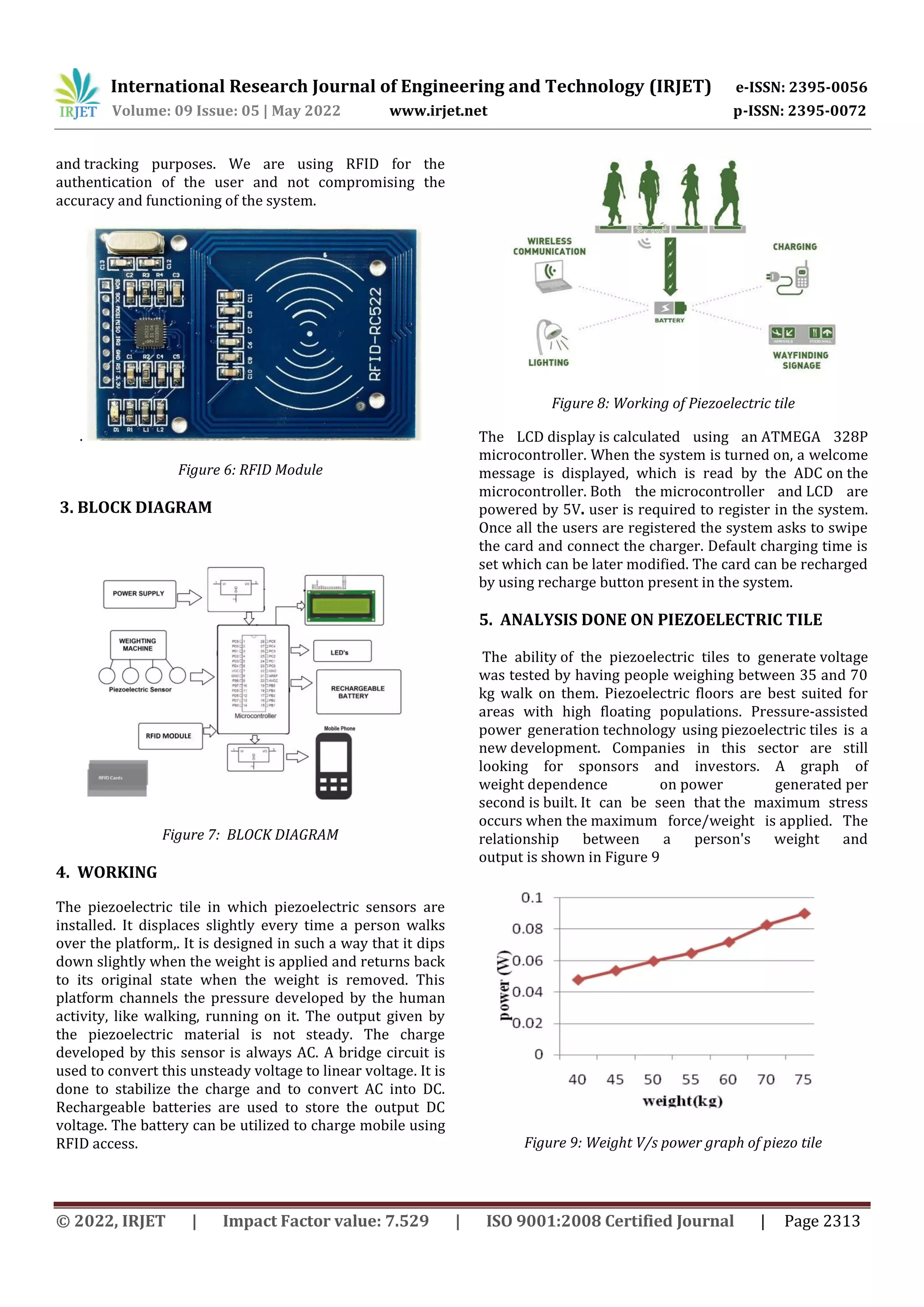
looking for sponsors and investors. A graph of
weight dependence on power generated per
second is built. It can be seen that the maximum stress
occurs when the maximum force/weight is applied. The
relationship between a person's weight and
output is shown in Figure 9
Figure 9: Weight V/s power graph of piezo tile
International Research Journal of Engineering and Technology (IRJET) e-ISSN: 2395-0056
Volume: 09 Issue: 05 | May 2022 www.irjet.net p-ISSN: 2395-0072
© 2022, IRJET | Impact Factor value: 7.529 | ISO 9001:2008 Certified Journal | Page 2314
6. ADVANTAGES
1) Encourages use of environment friendly energy.
2) Easy to install simple installation
3) Easy to handle.
7. CONCLUSION
We have developed a system that can generate energy
from stairs, and the energy generated can be used for
basic applications such as charging mobile devices.
Comparing the different types of piezoelectric materials,
PZT has been shown to outperform them. We also
compared the different types and found that the series-
parallel coupled connection is more suitable. As a result of
studying the weight applied to the piezoelectric tile and
the corresponding generated voltage, it can be seen that
there is a linear relationship. It can be
used for street lights without using long power lines. It can
also be used as a charging port and can provide lighting for
buildings overlooking the sidewalk.
ACKNOWLEDGEMENT
We are highly thankful to Dr. B .R. Patagundi, Principal,
SGBIT, Belagavi for providing the opportunity for building
and demonstration of the project.
We would like to express deep sense of thanks and
gratitude to Dr. Rajendra M Galagali, HOD, Department
of Mechanical Engineering, SGBIT, Belagavi for
providing necessary technical suggestion during project.
We are grateful to Dr. Ashok M Hulagabali, Associate
Professor and Project guide, SGBIT, Belagavi for his
continuous valuable guidance and support.
We are thankful to Prof.Vishwanath Kadakbhavi,
Assistant Professor, SGBIT, Belagavi for encouraging us
in conduction and generous support during the conduction
of the project
Finally, we are thankful to the staff of Department of
Mechanical Engineering, SGBIT, Belagavi for their
support.
REFERENCES
[1] Roundy, S., P.K. Wright and J. Rabaey, A study of low-
level vibration as a power source for wireless sensor
nodes.
[2] Vibration Based Energy Harvesting Using
Piezoelectric Material, M.N.Fakhzan, Asan G.A. Muthalif,
Department of Mechatronics Engineering, International
Islamic University Malaysia, IIUM,Kuala Lumpur, Malaysia.
[3] G. K. Ottoman”Adaptive piezoelectric energy
harvesting circuit for wireless remote power supply”
[4] P.D. Mitcheson, E.M Yeatman, G.K. Rao, A.S Holmes and
T.C. Green "Human and machine motion for wireless
electronic devices"
[5] Marshiana. D, Elizabeth Sherine. M, Sunitha. N, ,
“Footstep Power production using Piezoelectric Sensors”
[6] Henry A. Sodano, Daniel J. Inman, Gyuhae Park.
“Estimation of Electric Charge Output for Piezoelectric
Energy Harvesting”
[7] Energy generation in public buildings using
piezoelectric flooring tiles; A case study of a metro station
Rania Rushdy Moussa, Madonna Makram Solban
Architectural department, The British University in Egypt
(BUE), El- Sherouk City, Egypt.
[8] Lukai Guo, Qing Lu “ Potentials of piezoelectric and
thermoelectric technologies for harvesting energy from
pavements “
[9] T. G. Engel, C. Keawboonchuay, and W. C. Nunnally,
“Energy conversion and high-power pulse production
using miniature piezoelectric compressors”.
[10] M. Ferrari V. Ferrari, D. Marioli and A. Taroni
"Modeling, fabrication and performance measurements of
a piezo electric energy convertor for power harvesting in
autonomous micro system"
[11] C. Keawboonchua “Factors Affecting Maximum Power
Generation in Piezoelectric Pulse Generator “
[12] Mervyn Fernandes, “Implementation of Piezoelectric
Sensors for Generation of Power”,

Electricity Generation Tiles Using Piezoelectric Sensor

  • 1.
    International Research Journalof Engineering and Technology (IRJET) e-ISSN: 2395-0056 Volume: 09 Issue: 05 | May 2022 www.irjet.net p-ISSN: 2395-0072 © 2022, IRJET | Impact Factor value: 7.529 | ISO 9001:2008 Certified Journal | Page 2311 Electricity Generation Tiles Using Piezoelectric Sensor 1Silvester Souza, 2Soha Nadgouda, 3Sammed Kallannavar, 4 Saihil Nandre,5 Dr. Ashok M Hulagabali, 6 Dr. Rajendra M Galagali 1,2,3,4 Student, Department of Mechanical Engineering, S.G. Balekundri Institute of Technology, Belagavi, Karnataka, India 5 Associate Professor and Project Guide, Department of Mechanical Engineering S.G. Balekundri Institute of Technology, Belagavi, Karnataka, India, 6 Professor & Head, Department of Mechanical Engineering S.G. Balekundri Institute of Technology, Belagavi, Karnataka, India ---------------------------------------------------------------------***--------------------------------------------------------------------- Key Words: Electrical Power Generation, Piezoelectric Sensor, Energy Harvesting Technique, Environment Friendly. 1. INTRODUCTION Energy demand in all countries is constantly increasing, and the production and import of electricity cannot meet consumption and export. We always go with wind energy or solar energy or tidal energy or other sources of energy the power production is still not sufficient. .So to cope with this situation we need to generate electricity by any ways necessary. When people walk, they lose energy to the surface they are walking on, due to the transfer of weight on to the surface. The idea of this model is to capture this energy and convert it into a usable form. The energy generated during walking is concentrated on piezoelectric sensor, which converts this energy into electrical energy. This energy is stored and used in the battery. The aim is to generate energy from foot step. This system provides a platform where footsteps can be placed. Whenever people walk or stand on the top plate it dips down slightly and their weight is converted to electrical power. If we install such system in some of the busiest centers of our cities from train stations to airport, from offices, 2. SYSTEM CONFIGURATIOIN  COMPONENTS 1 Diodes 1) Piezoelectric sensor tile Piezoelectric materials are the central part of the piezoelectric sensor. These materials can produce electricity when mechanical stress is applied. The word piezoelectric means electricity generated by pressure. A device that makes use of piezoelectric effect is called a piezoelectric sensor. The piezo electric tile is a tile of dimension 30cm x 30cm. The number of piezoelectric sensors are installed on this tile are Eight. The sensors are connected in a series-parallel combination. Electricity is generated when the tile is subjected to compressive or tensile stress, developing a voltage gradient and a next current flow. 4) RFID module 5) Rectifier 6) Arduino 7) Resistors 8) Capacitors 2) Voltage regulator 3) Piezoelectric Sensor Tile Abstract - The consumption of electrical power is increasing rapidly at a very fast rate. We are in a situation where electricity production is not able to cover up the electricity consumption. This paper proposes a method to generate electricity by harvesting human power. Human power is defined as, use of human work for energy generation which can be used to power electronic device. In countries like India, which have a large pedestrian population human power like walking, running and jumping can be used as a power source . This paper presents a method for energy harvesting, from human motion with the use of piezo electric sensor and also exhibits the use of stored energy that is to charge mobile phone using RFID. The force exerted from walking, is converted into voltage by piezo electric sensor. This voltage built up can be used to power a storage battery. The more people walk through these tiles, the more energy is stored in batteries and can be used to power lights, train stations, gyms and other public places. This is an environmentally friendly approach to energy productio n. The documentation provides simplified concepts and design details of the model.
  • 2.
    International Research Journalof Engineering and Technology (IRJET) e-ISSN: 2395-0056 Volume: 09 Issue: 05 | May 2022 www.irjet.net p-ISSN: 2395-0072 © 2022, IRJET | Impact Factor value: 7.529 | ISO 9001:2008 Certified Journal | Page 2312 Figure 1: Piezoelectric sensor tile 2) Voltage Regulator Voltage Regulator (LM 7805), employs internal current, restricting thermal close down and secure running area protection, making it essentially indestructible. It can provide output currents up to 1A.It has fixed output voltage of 5, 6, 8, 9, 10, 12, 15, 16, 18, 24 V. Therefore, it is useful in a variety of applications. Despite the fact that designed ordinarily as fixed voltage regulator, the device can also be used with external components to reap voltage and current. Figure 2: Voltage Regulator 3) Diode A diode is two-terminal electronic issue which conducts electricity, primarily only in single direction. A diode has high resistance on one end and occasional resistance on the opposite end. Figure 3: Diode The arrowhead is the anode terminal which represents the path of the current flow. Another end terminal is cathode.   Light Emitting Diode (LED) “A light-emitting diode (LED) is a semiconductor light source. When a light-emitting diode is forward based, electrons are able to recombine with holes, within the device, releasing energy in the shape of photons”. Colors are available based on wavelength range, voltage drop, and material. Red, green, yellow and blue LEDs are very common.[5] Figure 4: Light Emitting Diode (LED) 1N4007 Diode It is a rectifier diode. It is specifically designed for circuits that need to convert alternating current to direct current how the diode is made by two dissimilar P and N semiconductors type, a junction is formed between the diodes. The identification number for this particular diode is 4007. It can pass current of up to 1A. The PIV rating is 1000 V. Figure 5: 1N4007 Diode 4) RFID Module Radio Frequency identification, or RFID, is an identification and logging technology. RFID system uses tiny chips, called as "tags", to transmit piece of information to an RFID reader. The tag contains a Transponder with digital memory chip with unique electronics code. RFID is a technology that communicates over radio waves to exchange signals with electronic tags and readers attached to objects for identification
  • 3.
    International Research Journalof Engineering and Technology (IRJET) e-ISSN: 2395-0056 Volume: 09 Issue: 05 | May 2022 www.irjet.net p-ISSN: 2395-0072 © 2022, IRJET | Impact Factor value: 7.529 | ISO 9001:2008 Certified Journal | Page 2313 and tracking purposes. We are using RFID for the authentication of the user and not compromising the accuracy and functioning of the system. . Figure 6: RFID Module 3. BLOCK DIAGRAM Figure 7: BLOCK DIAGRAM 4. WORKING The piezoelectric tile in which piezoelectric sensors are installed. It displaces slightly every time a person walks over the platform,. It is designed in such a way that it dips down slightly when the weight is applied and returns back to its original state when the weight is removed. This platform channels the pressure developed by the human activity, like walking, running on it. The output given by the piezoelectric material is not steady. The charge developed by this sensor is always AC. A bridge circuit is used to convert this unsteady voltage to linear voltage. It is done to stabilize the charge and to convert AC into DC. Rechargeable batteries are used to store the output DC voltage. The battery can be utilized to charge mobile using RFID access. Figure 8: Working of Piezoelectric tile The LCD display is calculated using an ATMEGA 328P microcontroller. When the system is turned on, a welcome message is displayed, which is read by the ADC on the microcontroller. Both the microcontroller and LCD are powered by 5V. user is required to register in the system. Once all the users are registered the system asks to swipe the card and connect the charger. Default charging time is set which can be later modified. The card can be recharged by using recharge button present in the system. 5. ANALYSIS DONE ON PIEZOELECTRIC TILE The ability of the piezoelectric tiles to generate voltage was tested by having people weighing between 35 and 70 kg walk on them. Piezoelectric floors are best suited for areas with high floating populations. Pressure-assisted power generation technology using piezoelectric tiles is a new development. Companies in this sector are still looking for sponsors and investors. A graph of weight dependence on power generated per second is built. It can be seen that the maximum stress occurs when the maximum force/weight is applied. The relationship between a person's weight and output is shown in Figure 9 Figure 9: Weight V/s power graph of piezo tile
  • 4.
    International Research Journalof Engineering and Technology (IRJET) e-ISSN: 2395-0056 Volume: 09 Issue: 05 | May 2022 www.irjet.net p-ISSN: 2395-0072 © 2022, IRJET | Impact Factor value: 7.529 | ISO 9001:2008 Certified Journal | Page 2314 6. ADVANTAGES 1) Encourages use of environment friendly energy. 2) Easy to install simple installation 3) Easy to handle. 7. CONCLUSION We have developed a system that can generate energy from stairs, and the energy generated can be used for basic applications such as charging mobile devices. Comparing the different types of piezoelectric materials, PZT has been shown to outperform them. We also compared the different types and found that the series- parallel coupled connection is more suitable. As a result of studying the weight applied to the piezoelectric tile and the corresponding generated voltage, it can be seen that there is a linear relationship. It can be used for street lights without using long power lines. It can also be used as a charging port and can provide lighting for buildings overlooking the sidewalk. ACKNOWLEDGEMENT We are highly thankful to Dr. B .R. Patagundi, Principal, SGBIT, Belagavi for providing the opportunity for building and demonstration of the project. We would like to express deep sense of thanks and gratitude to Dr. Rajendra M Galagali, HOD, Department of Mechanical Engineering, SGBIT, Belagavi for providing necessary technical suggestion during project. We are grateful to Dr. Ashok M Hulagabali, Associate Professor and Project guide, SGBIT, Belagavi for his continuous valuable guidance and support. We are thankful to Prof.Vishwanath Kadakbhavi, Assistant Professor, SGBIT, Belagavi for encouraging us in conduction and generous support during the conduction of the project Finally, we are thankful to the staff of Department of Mechanical Engineering, SGBIT, Belagavi for their support. REFERENCES [1] Roundy, S., P.K. Wright and J. Rabaey, A study of low- level vibration as a power source for wireless sensor nodes. [2] Vibration Based Energy Harvesting Using Piezoelectric Material, M.N.Fakhzan, Asan G.A. Muthalif, Department of Mechatronics Engineering, International Islamic University Malaysia, IIUM,Kuala Lumpur, Malaysia. [3] G. K. Ottoman”Adaptive piezoelectric energy harvesting circuit for wireless remote power supply” [4] P.D. Mitcheson, E.M Yeatman, G.K. Rao, A.S Holmes and T.C. Green "Human and machine motion for wireless electronic devices" [5] Marshiana. D, Elizabeth Sherine. M, Sunitha. N, , “Footstep Power production using Piezoelectric Sensors” [6] Henry A. Sodano, Daniel J. Inman, Gyuhae Park. “Estimation of Electric Charge Output for Piezoelectric Energy Harvesting” [7] Energy generation in public buildings using piezoelectric flooring tiles; A case study of a metro station Rania Rushdy Moussa, Madonna Makram Solban Architectural department, The British University in Egypt (BUE), El- Sherouk City, Egypt. [8] Lukai Guo, Qing Lu “ Potentials of piezoelectric and thermoelectric technologies for harvesting energy from pavements “ [9] T. G. Engel, C. Keawboonchuay, and W. C. Nunnally, “Energy conversion and high-power pulse production using miniature piezoelectric compressors”. [10] M. Ferrari V. Ferrari, D. Marioli and A. Taroni "Modeling, fabrication and performance measurements of a piezo electric energy convertor for power harvesting in autonomous micro system" [11] C. Keawboonchua “Factors Affecting Maximum Power Generation in Piezoelectric Pulse Generator “ [12] Mervyn Fernandes, “Implementation of Piezoelectric Sensors for Generation of Power”,