Steps for
Effective
Patient and
Staff Contact
Tracing to
Defend Against
COVID-19
Spread Josh Ferguson, APRN, ACNP, ANP-BC, VP of Clinical Outcomes Improvement
John Hansmann, MSIE, LFHIMSS, DSHS, Professional Services, VP
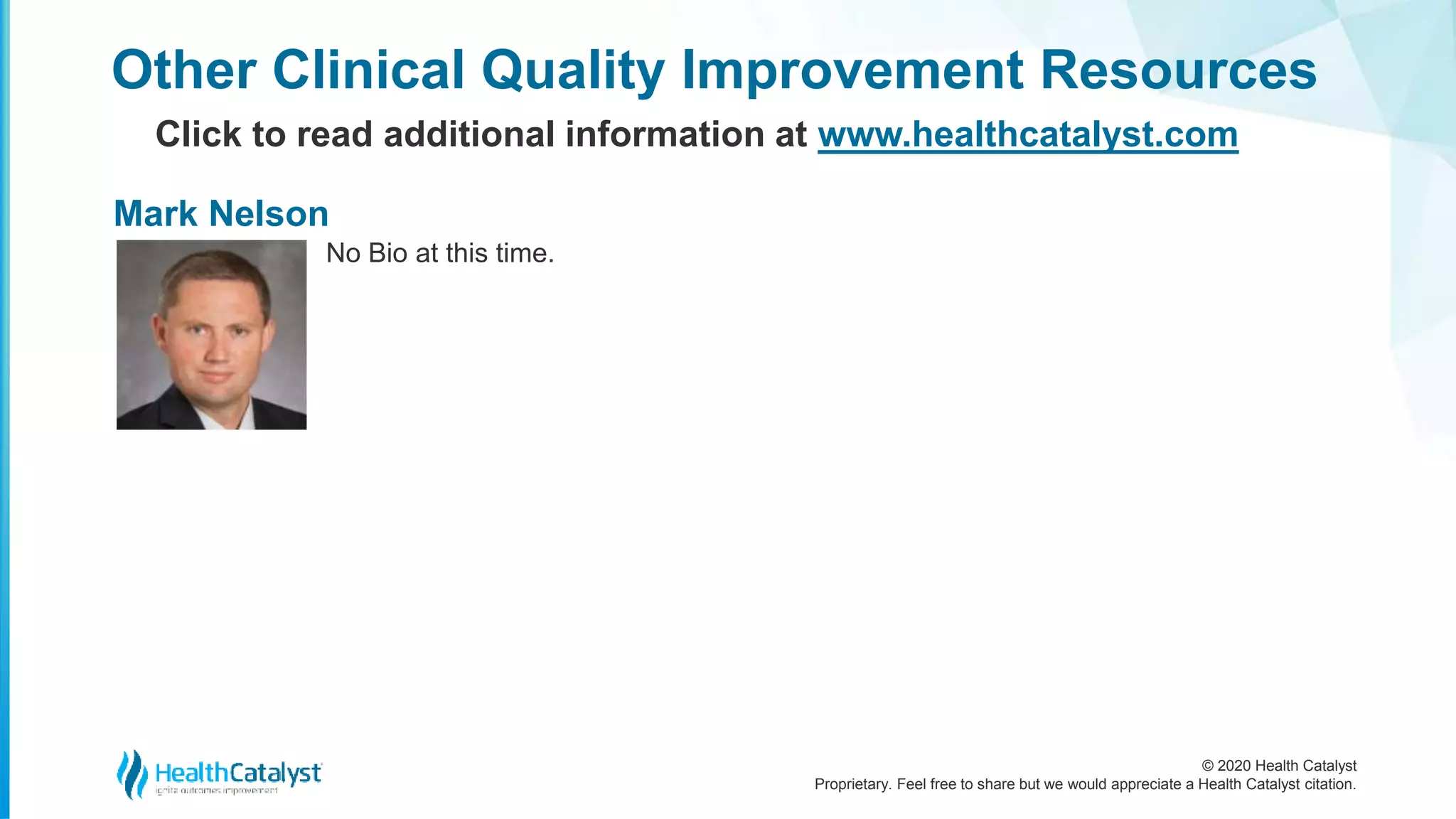
Mark Nelson, VP, Business Development
Monica Horvath, Strategic Consultant, Health Intelligence & Product Adoption
© 2020 Health Catalyst
Proprietary. Feel free to share but we would appreciate a Health Catalyst citation.
Preventing COVID-19 Transmission
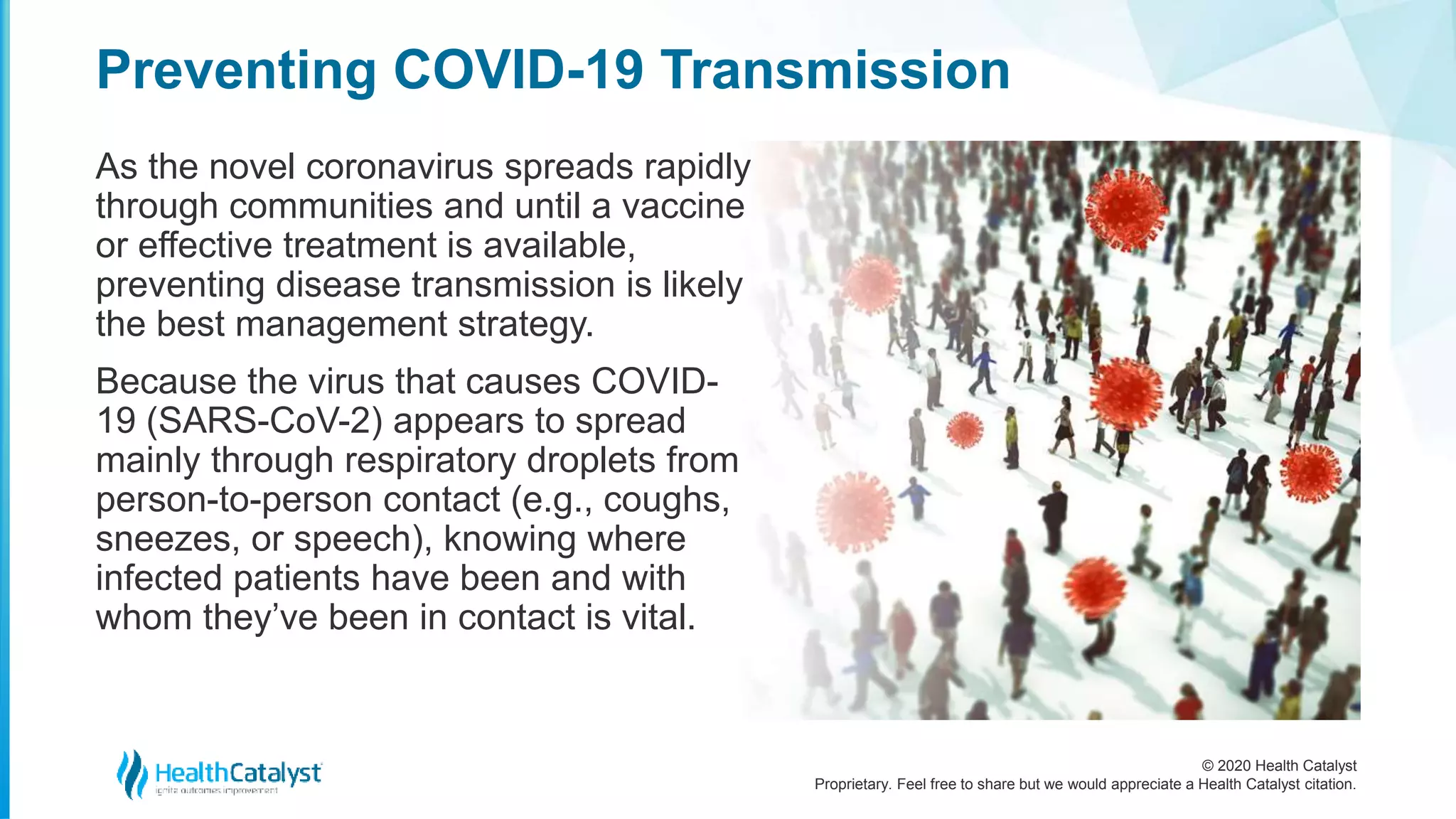
As the novel coronavirus spreads rapidly
through communities and until a vaccine
or effective treatment is available,
preventing disease transmission is likely
the best management strategy.
Because the virus that causes COVID-
19 (SARS-CoV-2) appears to spread
mainly through respiratory droplets from
person-to-person contact (e.g., coughs,
sneezes, or speech), knowing where
infected patients have been and with
whom they’ve been in contact is vital.
© 2020 Health Catalyst
Proprietary. Feel free to share but we would appreciate a Health Catalyst citation.
Preventing COVID-19 Transmission
Contact tracing follows COVID-19-
confirmed patients through the health
system, informing surveillance teams
where patients have been in the
facility and with which staff members
they’ve interacted.
These vital insights support
transmission management by
informing testing, quarantine efforts,
and decontamination activities.
© 2020 Health Catalyst
Proprietary. Feel free to share but we would appreciate a Health Catalyst citation.
Preventing COVID-19 Transmission
Before COVID-19, many health systems
did not prioritize the active monitoring of
the in-house spread of infectious disease.
While paper-based, manual tracing
processes have been the norm, they
generate only a limited picture of the
natural patient flow patterns across
hospital departments and fail to drive
preventive workflow modifications.
Now with COVID-19 making the need
for better patient tracing urgent,
organizations must adopt capable
patient-and-staff-tracing processes.
© 2020 Health Catalyst
Proprietary. Feel free to share but we would appreciate a Health Catalyst citation.
Patient and Staff Contact Tracing: Part of an
Active Infection Surveillance Strategy
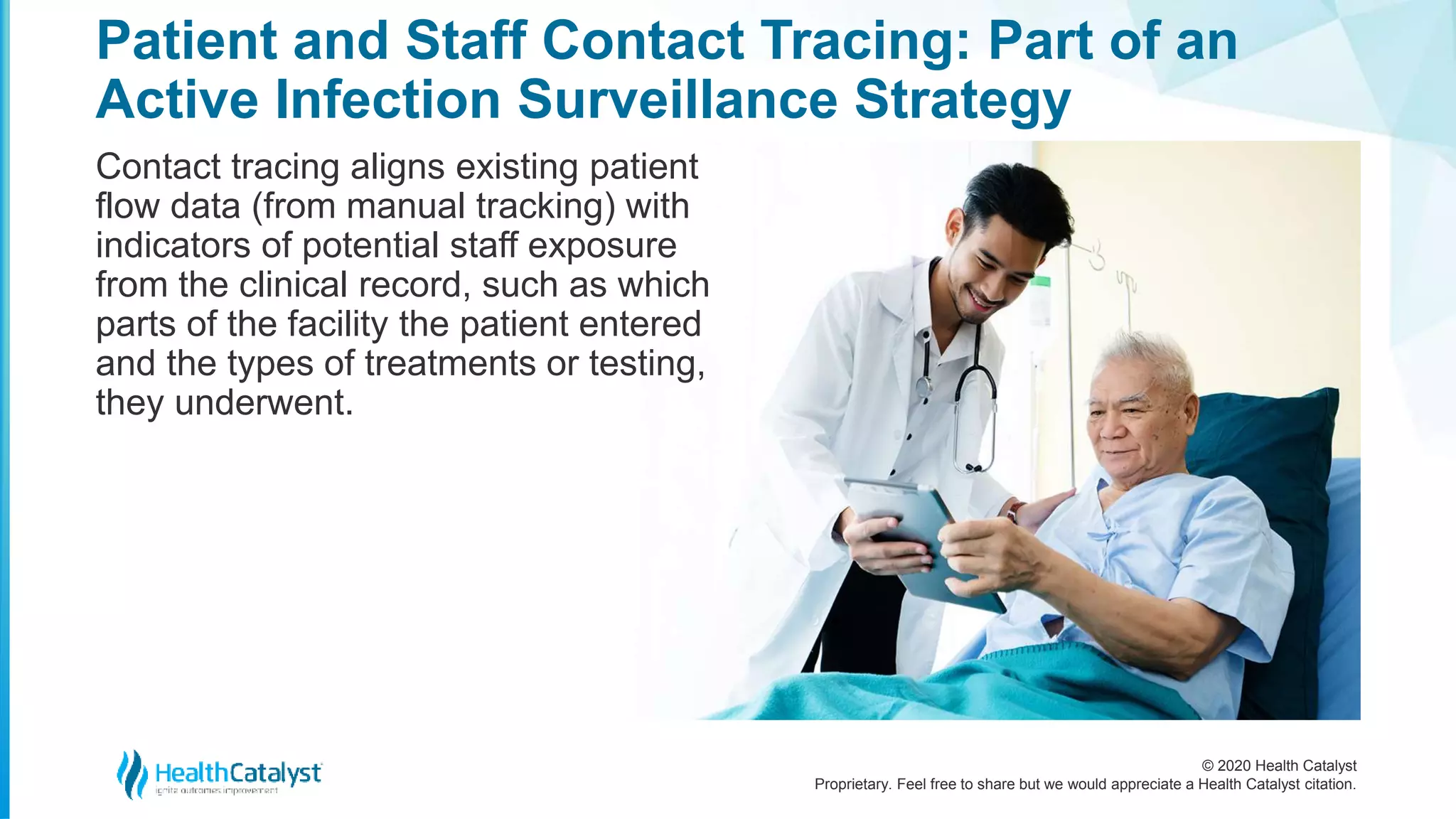
Contact tracing aligns existing patient
flow data (from manual tracking) with
indicators of potential staff exposure
from the clinical record, such as which
parts of the facility the patient entered
and the types of treatments or testing,
they underwent.
© 2020 Health Catalyst
Proprietary. Feel free to share but we would appreciate a Health Catalyst citation.
Patient and Staff Contact Tracing: Part of an
Active Infection Surveillance Strategy
Contact tracing aligns existing patient flow
data (from manual tracking) with indicators
of potential staff exposure from the clinical
record, such as which parts of the facility
the patient entered and the types of
treatments or testing, they underwent.
© 2020 Health Catalyst
Proprietary. Feel free to share but we would appreciate a Health Catalyst citation.
Patient and Staff Contact Tracing: Part of an
Active Infection Surveillance Strategy
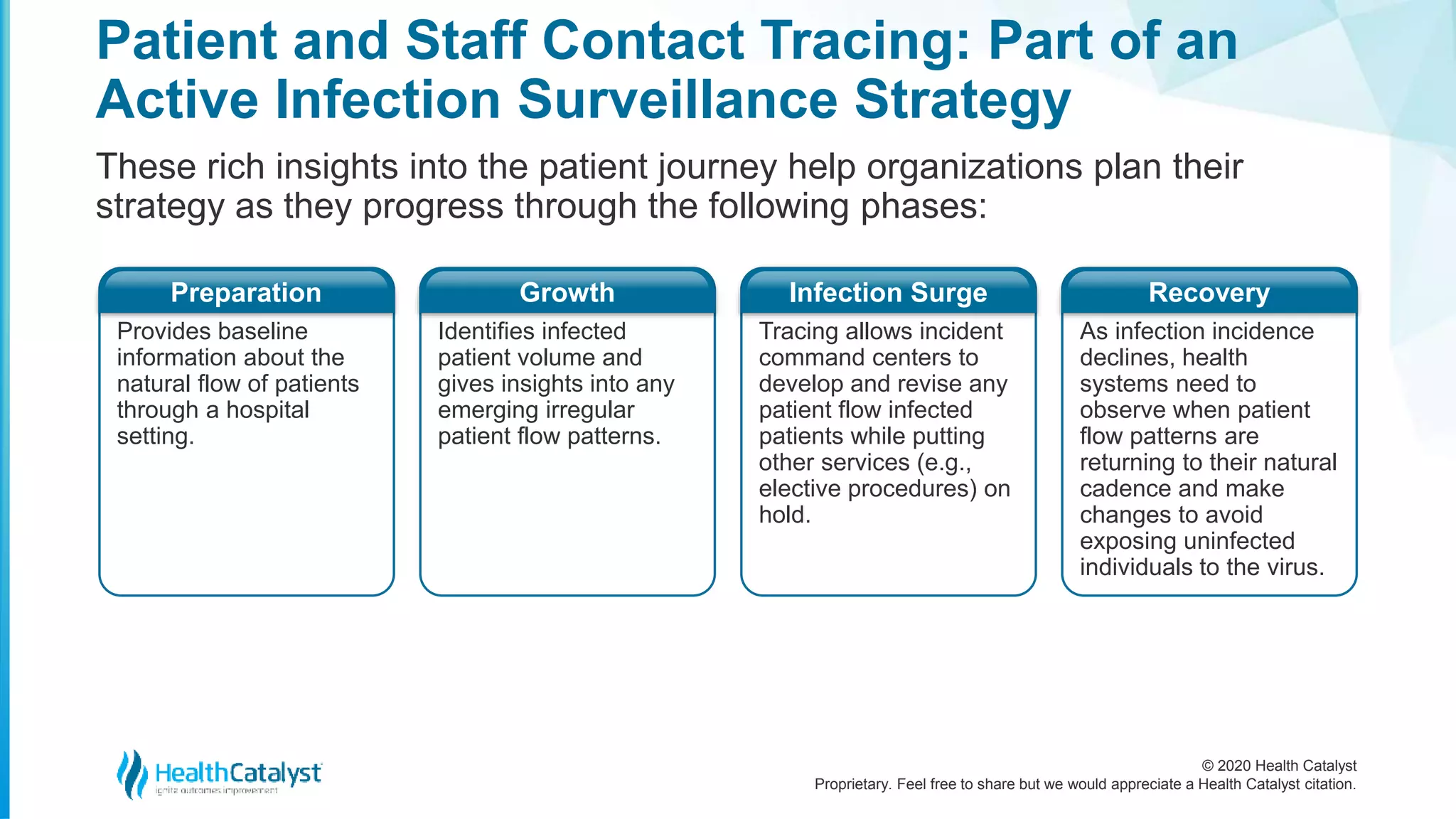
These rich insights into the patient journey help organizations plan their
strategy as they progress through the following phases:
Provides baseline
information about the
natural flow of patients
through a hospital
setting.
Preparation
Identifies infected
patient volume and
gives insights into any
emerging irregular
patient flow patterns.
Growth
Tracing allows incident
command centers to
develop and revise any
patient flow infected
patients while putting
other services (e.g.,
elective procedures) on
hold.
Infection Surge
As infection incidence
declines, health
systems need to
observe when patient
flow patterns are
returning to their natural
cadence and make
changes to avoid
exposing uninfected
individuals to the virus.
Recovery
© 2020 Health Catalyst
Proprietary. Feel free to share but we would appreciate a Health Catalyst citation.
Patient and Staff Contact Tracing: Part of an
Active Infection Surveillance Strategy
To fulfill the above critical COVID-19
contact tracing roles, Health Catalyst
created the Patient and Staff Tracker early
in the course of the 2020 pandemic.
The tracker provides analytic insights
surrounding patient movement and
interactions between staff and patients with
either a confirmed or suspected infection.
These data can then encourage informed,
data-driven, and timely action.
© 2020 Health Catalyst
Proprietary. Feel free to share but we would appreciate a Health Catalyst citation.
From Identification to Action
The first step of contact tracing is to identify
the initial population of infected individuals.
Health Catalyst leverages cohort discovery
tools, such as its Population Builder™, to
allow searches for patients according to
customizable criteria.
© 2020 Health Catalyst
Proprietary. Feel free to share but we would appreciate a Health Catalyst citation.
From Identification to Action
Users can identify an initial population,
typically from diagnostic testing or
diagnosis codes, then enrich the results
with additional data, including the following:
Admit-discharge-transfer
data that describes the
movement of patients
through the hospital,
ideally at the bed level.
Data from electronic
documentation that
uniquely identifies staff
and their interactions with
patients (e.g., activity-type
interactions with patients,
orders, notes, etc.).
© 2020 Health Catalyst
Proprietary. Feel free to share but we would appreciate a Health Catalyst citation.
From Identification to Action
Once patient tracing insights are
available, dashboards provide
visualizations to inform infection
prevention teams, incident command
leadership, infectious disease experts,
hospital unit leaders, employee health,
and risk management departments.
COVID-19 response teams can then
leverage tracing data to drive
actionable insights.
© 2020 Health Catalyst
Proprietary. Feel free to share but we would appreciate a Health Catalyst citation.
From Identification to Action
The following questions can inform these insights:
• Are unnecessary departmental transfers minimalized to
reduce exposure risk to other patients and staff?
• Are there unrealized ancillary staff (e.g., environmental,
dietary, or transport services) interacting with infected
patients?
• Have additional patients been exposed through sharing
a room or other location with an infected individual?
• Are staff adhering to infection mitigation and
containment practices?
© 2020 Health Catalyst
Proprietary. Feel free to share but we would appreciate a Health Catalyst citation.
Tracing Data Supports Multiple Processes
How organizations fold contact tracing into
their exposure investigation efforts depends
on the unique needs of the specific hospital
and the community it supports.
Some sites may choose to integrate
exposure monitoring into outpatient case
management workflows for uniquely at-risk
individuals.
If detailed transfer data from outside
facilities are available, including it in the
contact tracing data strategy might lessen
both exposure risk and unnecessary testing.
© 2020 Health Catalyst
Proprietary. Feel free to share but we would appreciate a Health Catalyst citation.
Tracing Data Supports Multiple Processes
Additionally, contact tracing can help
employee health departments at health
systems understand whether infected staff
members were possibly exposed at work,
as their treatment may become a workers’
compensation claim.
And risk management teams may want to
conduct risk assessment activities on
potentially exposed patients and staff and
collect more in-depth data regarding
personal protective equipment usage or
perceived exposure length of time.
© 2020 Health Catalyst
Proprietary. Feel free to share but we would appreciate a Health Catalyst citation.
A Must-Have Short- and Long-Term Capability
As the long-term impact of many of the
COVID-19 treatment protocols remains
unknown, aspects of the patient
experience captured within contact tracing
can support ongoing preparation.
By revealing the most common pathways
through hospital departments for different
care episodes, contact tracing feeds
forecasting methods, allowing
organizations to scale their disaster
planning approaches by outbreak severity.
© 2020 Health Catalyst
Proprietary. Feel free to share but we would appreciate a Health Catalyst citation.
A Must-Have Short- and Long-Term Capability
Tracing insights might also inspire
workflow efficiencies to limit future
exposure risk, and aspects of the
contact tracing data, such as how
long an infected patient spends in a
department, may have meaningful
relationships to lifelong outcomes.
© 2020 Health Catalyst
Proprietary. Feel free to share but we would appreciate a Health Catalyst citation.
A Must-Have Short- and Long-Term Capability
COVID-19 is not likely the last
infectious disease crisis the U.S.
health system faces, and there’s no
known end to the current pandemic.
Some models suggest the need for
rolling lockdown periods while the
outbreak fluctuates seasonally.
For organizations committed to
continuous improvement, historical
contact data will be invaluable to
future disaster planning efforts.
© 2020 Health Catalyst
Proprietary. Feel free to share but we would appreciate a Health Catalyst citation.
The Bigger Picture of Emergency Management Planning
While patient-staff contact tracing is a focus
for the current COVID-19 pandemic, health
systems can use many of the same
strategies to prepare for future outbreaks
with the potential for similar capacity strains.
Organizations must strengthen their data-
driven emergency planning and monitoring
capability to react in an appropriate, efficient,
and timely manner.
© 2020 Health Catalyst
Proprietary. Feel free to share but we would appreciate a Health Catalyst citation.
The Bigger Picture of Emergency Management Planning
For many organizations, COVID-19 has
highlighted gaps in their patient flow
data strategy.
Looking towards contact tracing using
existing data sources is a meaningful
first step in growing an active infection
surveillance strategy.
© 2020 Health Catalyst
Proprietary. Feel free to share but we would appreciate a Health Catalyst citation.
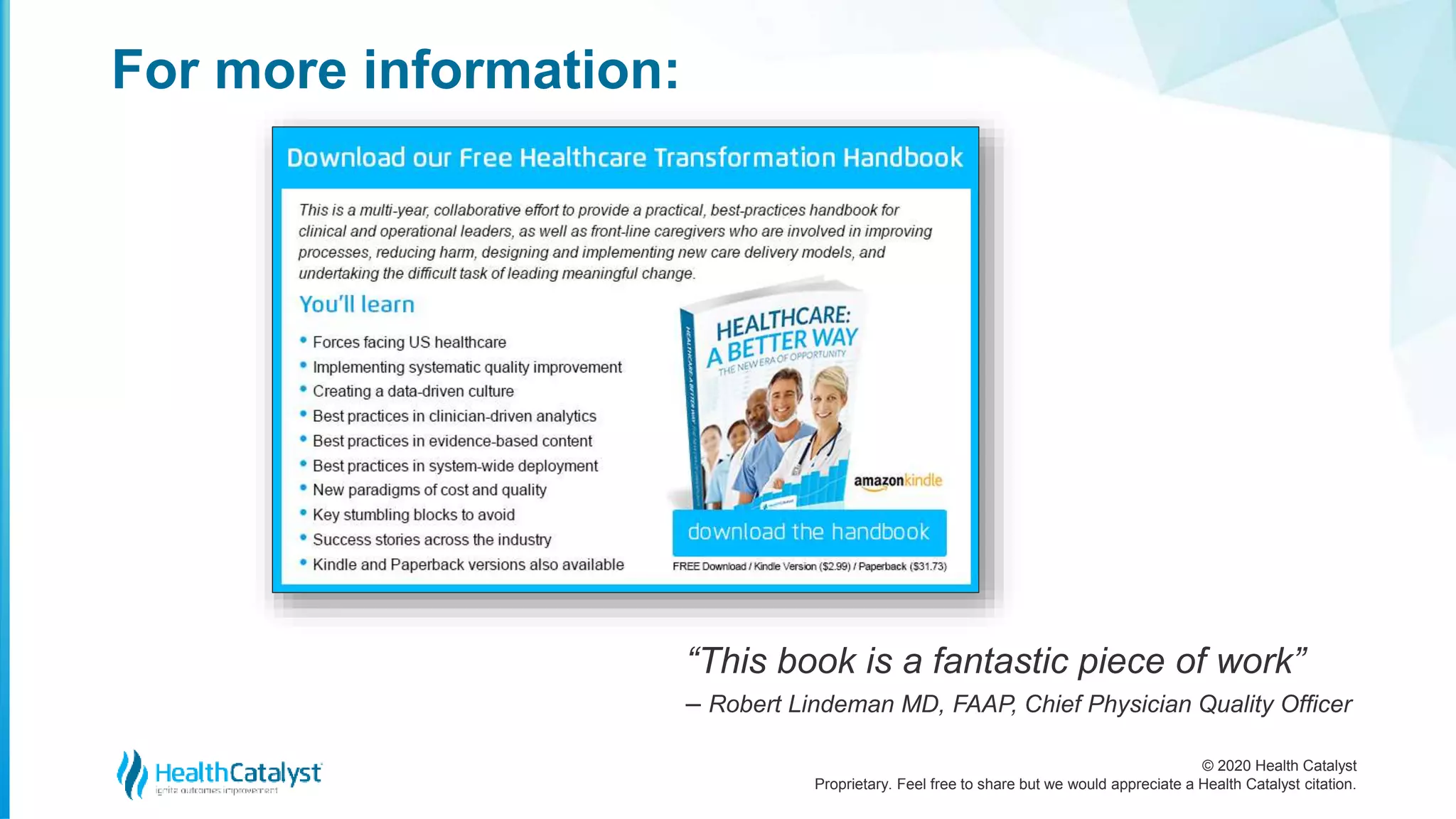
For more information:
“This book is a fantastic piece of work”
– Robert Lindeman MD, FAAP, Chief Physician Quality Officer
© 2020 Health Catalyst
Proprietary. Feel free to share but we would appreciate a Health Catalyst citation.
More about this topic
Link to original article for a more in-depth discussion.
Steps for Effective Patient and Staff Contact Tracing to Defend Against COVID-19 Spread
Using Improvement Science in Healthcare to Create True Change
Heather Schoonover, MN, ARNP-CNS, PHCNS-BC, FCNS, VP
Healthcare Data Literacy: A Must-Have for Becoming a Data-Driven Organization
Anna Kleckner, PhD, MPH, Business Consultant
Three Must-Haves for a Successful Healthcare Data Strategy
David Grauer, MBA, MHSA, SVP, Professional Services
Five Practical Steps Towards Healthcare Data Governance
Stephen Hess
Four Steps to Effective Opportunity Analysis
Health Catalyst Editors
© 2020 Health Catalyst
Proprietary. Feel free to share but we would appreciate a Health Catalyst citation.
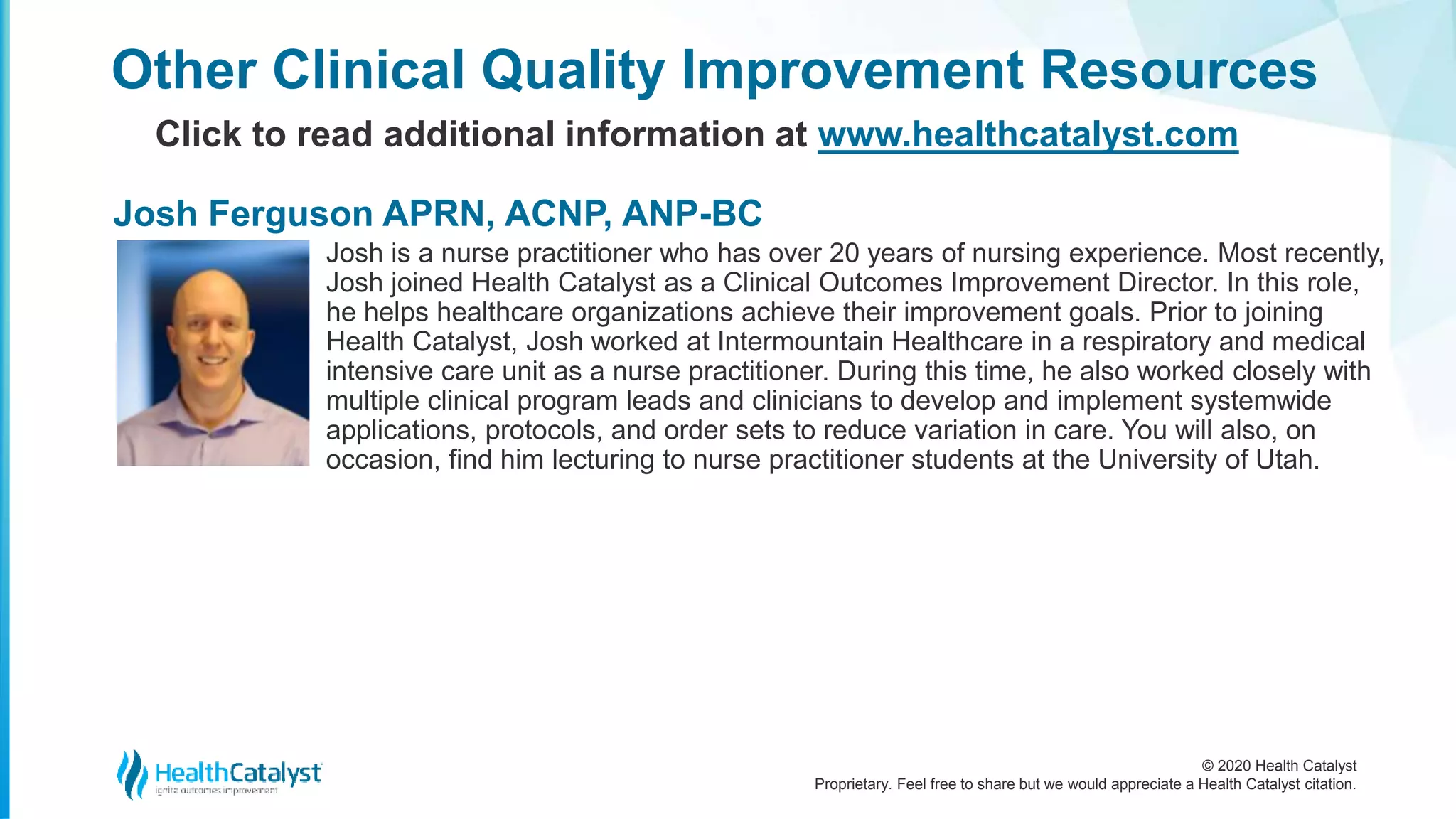
Josh is a nurse practitioner who has over 20 years of nursing experience. Most recently,
Josh joined Health Catalyst as a Clinical Outcomes Improvement Director. In this role,
he helps healthcare organizations achieve their improvement goals. Prior to joining
Health Catalyst, Josh worked at Intermountain Healthcare in a respiratory and medical
intensive care unit as a nurse practitioner. During this time, he also worked closely with
multiple clinical program leads and clinicians to develop and implement systemwide
applications, protocols, and order sets to reduce variation in care. You will also, on
occasion, find him lecturing to nurse practitioner students at the University of Utah.
Other Clinical Quality Improvement Resources
Click to read additional information at www.healthcatalyst.com
Josh Ferguson APRN, ACNP, ANP-BC
© 2020 Health Catalyst
Proprietary. Feel free to share but we would appreciate a Health Catalyst citation.
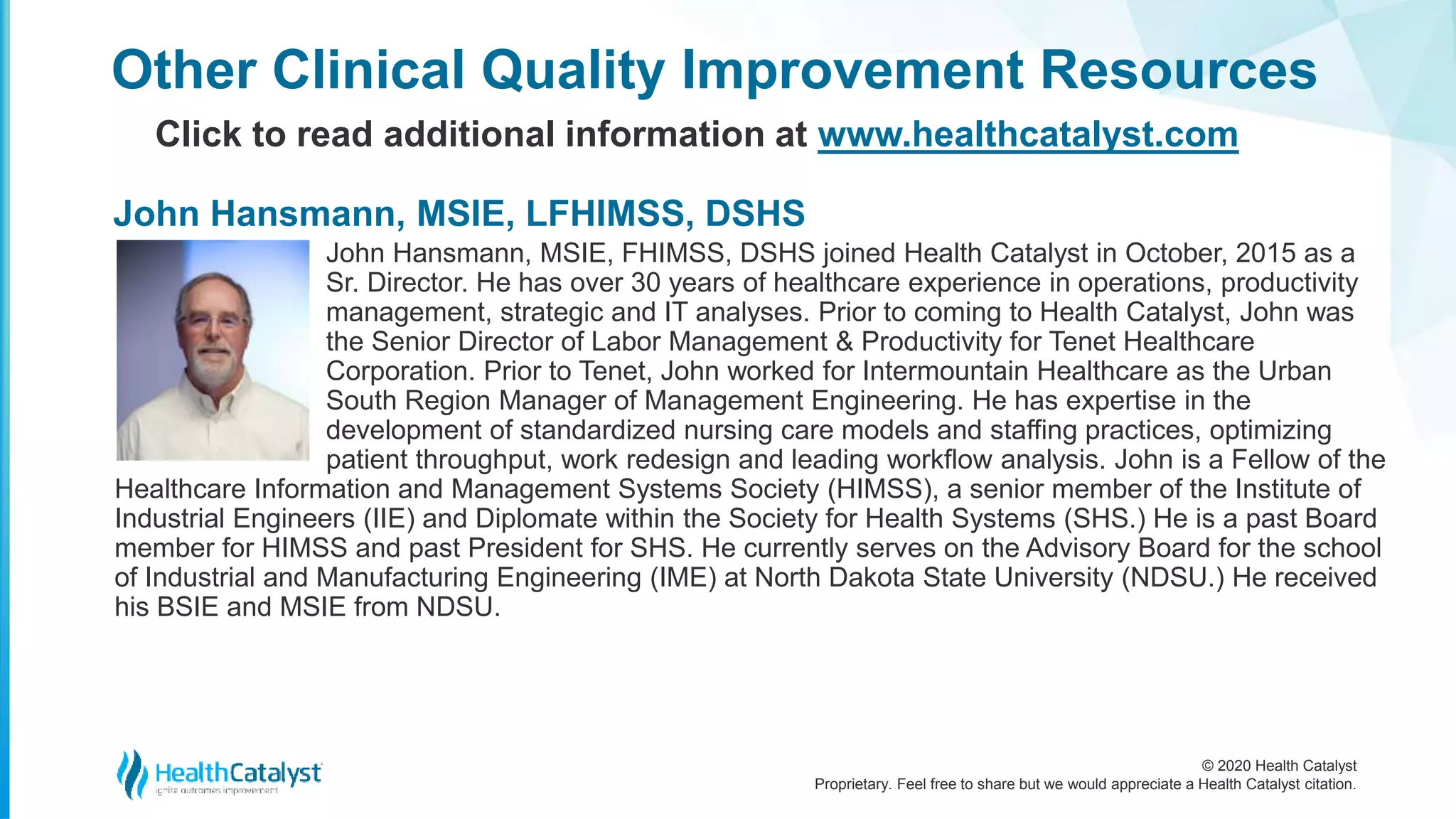
John Hansmann, MSIE, FHIMSS, DSHS joined Health Catalyst in October, 2015 as a
Sr. Director. He has over 30 years of healthcare experience in operations, productivity
management, strategic and IT analyses. Prior to coming to Health Catalyst, John was
the Senior Director of Labor Management & Productivity for Tenet Healthcare
Corporation. Prior to Tenet, John worked for Intermountain Healthcare as the Urban
South Region Manager of Management Engineering. He has expertise in the
development of standardized nursing care models and staffing practices, optimizing
patient throughput, work redesign and leading workflow analysis. John is a Fellow of the
Healthcare Information and Management Systems Society (HIMSS), a senior member of the Institute of
Industrial Engineers (IIE) and Diplomate within the Society for Health Systems (SHS.) He is a past Board
member for HIMSS and past President for SHS. He currently serves on the Advisory Board for the school
of Industrial and Manufacturing Engineering (IME) at North Dakota State University (NDSU.) He received
his BSIE and MSIE from NDSU.
Other Clinical Quality Improvement Resources
Click to read additional information at www.healthcatalyst.com
John Hansmann, MSIE, LFHIMSS, DSHS
© 2020 Health Catalyst
Proprietary. Feel free to share but we would appreciate a Health Catalyst citation.
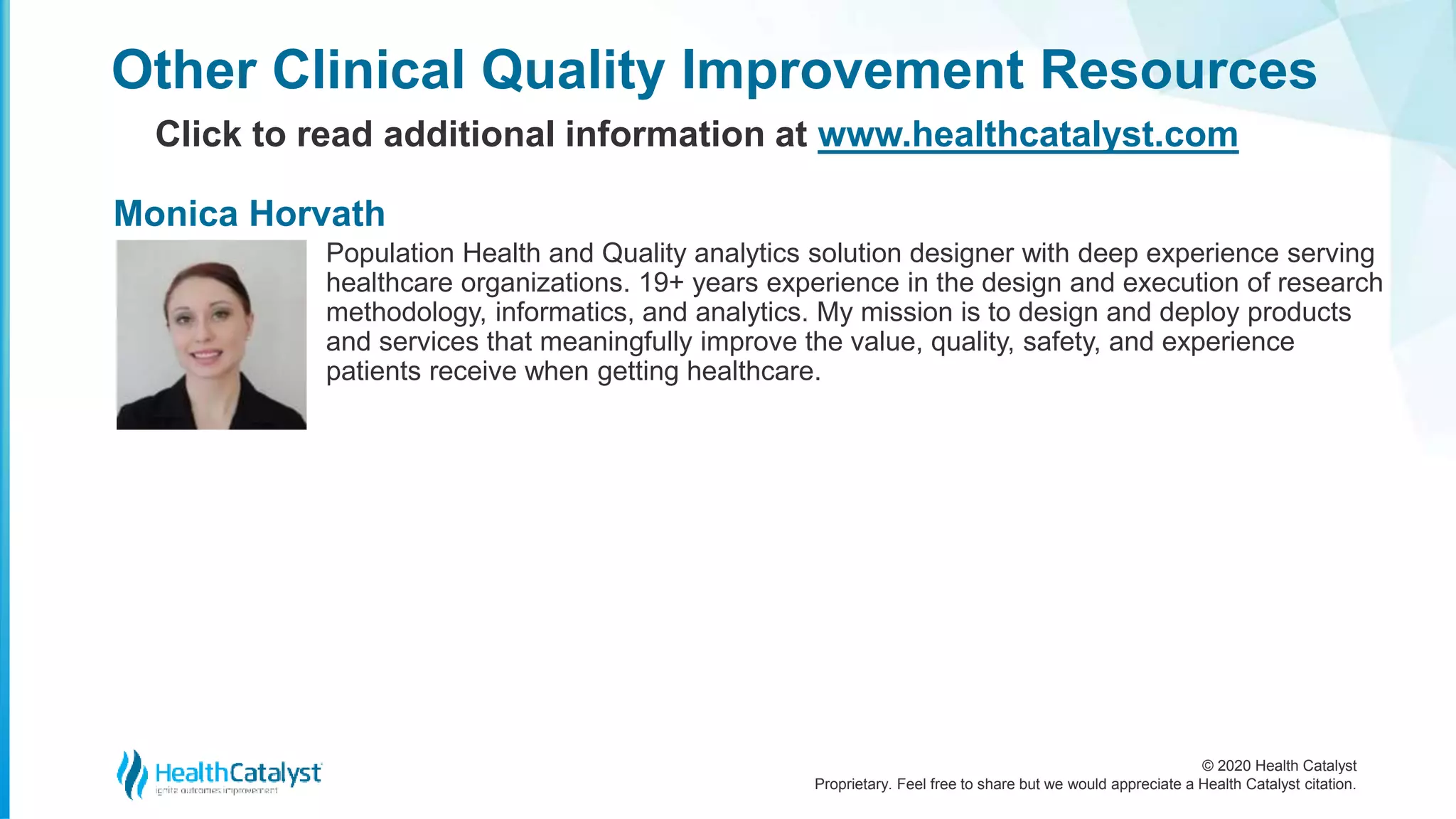
Population Health and Quality analytics solution designer with deep experience serving
healthcare organizations. 19+ years experience in the design and execution of research
methodology, informatics, and analytics. My mission is to design and deploy products
and services that meaningfully improve the value, quality, safety, and experience
patients receive when getting healthcare.
Other Clinical Quality Improvement Resources
Click to read additional information at www.healthcatalyst.com
Monica Horvath
© 2020 Health Catalyst
Proprietary. Feel free to share but we would appreciate a Health Catalyst citation.
No Bio at this time.
Other Clinical Quality Improvement Resources
Click to read additional information at www.healthcatalyst.com
Mark Nelson
© 2020 Health Catalyst
Proprietary. Feel free to share but we would appreciate a Health Catalyst citation.
Other Clinical Quality Improvement Resources
Click to read additional information at www.healthcatalyst.com
Health Catalyst is a mission-driven data warehousing, analytics and outcomes-improvement
company that helps healthcare organizations of all sizes improve clinical, financial, and operational
outcomes needed to improve population health and accountable care. Our proven enterprise data
warehouse (EDW) and analytics platform helps improve quality, add efficiency and lower costs in
support of more than 65 million patients for organizations ranging from the largest US health system
to forward-thinking physician practices.
Health Catalyst was recently named as the leader in the enterprise healthcare BI market in
improvement by KLAS, and has received numerous best-place-to work awards including Modern
Healthcare in 2013, 2014, and 2015, as well as other recognitions such as “Best Place to work for
Millenials, and a “Best Perks for Women.”

Steps for Effective Patient and Staff Contact Tracing to Defend Against COVID-19 Spread

  • 1.
    Steps for Effective Patient and StaffContact Tracing to Defend Against COVID-19 Spread Josh Ferguson, APRN, ACNP, ANP-BC, VP of Clinical Outcomes Improvement John Hansmann, MSIE, LFHIMSS, DSHS, Professional Services, VP Mark Nelson, VP, Business Development Monica Horvath, Strategic Consultant, Health Intelligence & Product Adoption
  • 2.
    © 2020 HealthCatalyst Proprietary. Feel free to share but we would appreciate a Health Catalyst citation. Preventing COVID-19 Transmission As the novel coronavirus spreads rapidly through communities and until a vaccine or effective treatment is available, preventing disease transmission is likely the best management strategy. Because the virus that causes COVID- 19 (SARS-CoV-2) appears to spread mainly through respiratory droplets from person-to-person contact (e.g., coughs, sneezes, or speech), knowing where infected patients have been and with whom they’ve been in contact is vital.
  • 3.
    © 2020 HealthCatalyst Proprietary. Feel free to share but we would appreciate a Health Catalyst citation. Preventing COVID-19 Transmission Contact tracing follows COVID-19- confirmed patients through the health system, informing surveillance teams where patients have been in the facility and with which staff members they’ve interacted. These vital insights support transmission management by informing testing, quarantine efforts, and decontamination activities.
  • 4.
    © 2020 HealthCatalyst Proprietary. Feel free to share but we would appreciate a Health Catalyst citation. Preventing COVID-19 Transmission Before COVID-19, many health systems did not prioritize the active monitoring of the in-house spread of infectious disease. While paper-based, manual tracing processes have been the norm, they generate only a limited picture of the natural patient flow patterns across hospital departments and fail to drive preventive workflow modifications. Now with COVID-19 making the need for better patient tracing urgent, organizations must adopt capable patient-and-staff-tracing processes.
  • 5.
    © 2020 HealthCatalyst Proprietary. Feel free to share but we would appreciate a Health Catalyst citation. Patient and Staff Contact Tracing: Part of an Active Infection Surveillance Strategy Contact tracing aligns existing patient flow data (from manual tracking) with indicators of potential staff exposure from the clinical record, such as which parts of the facility the patient entered and the types of treatments or testing, they underwent.
  • 6.
    © 2020 HealthCatalyst Proprietary. Feel free to share but we would appreciate a Health Catalyst citation. Patient and Staff Contact Tracing: Part of an Active Infection Surveillance Strategy Contact tracing aligns existing patient flow data (from manual tracking) with indicators of potential staff exposure from the clinical record, such as which parts of the facility the patient entered and the types of treatments or testing, they underwent.
  • 7.
    © 2020 HealthCatalyst Proprietary. Feel free to share but we would appreciate a Health Catalyst citation. Patient and Staff Contact Tracing: Part of an Active Infection Surveillance Strategy These rich insights into the patient journey help organizations plan their strategy as they progress through the following phases: Provides baseline information about the natural flow of patients through a hospital setting. Preparation Identifies infected patient volume and gives insights into any emerging irregular patient flow patterns. Growth Tracing allows incident command centers to develop and revise any patient flow infected patients while putting other services (e.g., elective procedures) on hold. Infection Surge As infection incidence declines, health systems need to observe when patient flow patterns are returning to their natural cadence and make changes to avoid exposing uninfected individuals to the virus. Recovery
  • 8.
    © 2020 HealthCatalyst Proprietary. Feel free to share but we would appreciate a Health Catalyst citation. Patient and Staff Contact Tracing: Part of an Active Infection Surveillance Strategy To fulfill the above critical COVID-19 contact tracing roles, Health Catalyst created the Patient and Staff Tracker early in the course of the 2020 pandemic. The tracker provides analytic insights surrounding patient movement and interactions between staff and patients with either a confirmed or suspected infection. These data can then encourage informed, data-driven, and timely action.
  • 9.
    © 2020 HealthCatalyst Proprietary. Feel free to share but we would appreciate a Health Catalyst citation. From Identification to Action The first step of contact tracing is to identify the initial population of infected individuals. Health Catalyst leverages cohort discovery tools, such as its Population Builder™, to allow searches for patients according to customizable criteria.
  • 10.
    © 2020 HealthCatalyst Proprietary. Feel free to share but we would appreciate a Health Catalyst citation. From Identification to Action Users can identify an initial population, typically from diagnostic testing or diagnosis codes, then enrich the results with additional data, including the following: Admit-discharge-transfer data that describes the movement of patients through the hospital, ideally at the bed level. Data from electronic documentation that uniquely identifies staff and their interactions with patients (e.g., activity-type interactions with patients, orders, notes, etc.).
  • 11.
    © 2020 HealthCatalyst Proprietary. Feel free to share but we would appreciate a Health Catalyst citation. From Identification to Action Once patient tracing insights are available, dashboards provide visualizations to inform infection prevention teams, incident command leadership, infectious disease experts, hospital unit leaders, employee health, and risk management departments. COVID-19 response teams can then leverage tracing data to drive actionable insights.
  • 12.
    © 2020 HealthCatalyst Proprietary. Feel free to share but we would appreciate a Health Catalyst citation. From Identification to Action The following questions can inform these insights: • Are unnecessary departmental transfers minimalized to reduce exposure risk to other patients and staff? • Are there unrealized ancillary staff (e.g., environmental, dietary, or transport services) interacting with infected patients? • Have additional patients been exposed through sharing a room or other location with an infected individual? • Are staff adhering to infection mitigation and containment practices?
  • 13.
    © 2020 HealthCatalyst Proprietary. Feel free to share but we would appreciate a Health Catalyst citation. Tracing Data Supports Multiple Processes How organizations fold contact tracing into their exposure investigation efforts depends on the unique needs of the specific hospital and the community it supports. Some sites may choose to integrate exposure monitoring into outpatient case management workflows for uniquely at-risk individuals. If detailed transfer data from outside facilities are available, including it in the contact tracing data strategy might lessen both exposure risk and unnecessary testing.
  • 14.
    © 2020 HealthCatalyst Proprietary. Feel free to share but we would appreciate a Health Catalyst citation. Tracing Data Supports Multiple Processes Additionally, contact tracing can help employee health departments at health systems understand whether infected staff members were possibly exposed at work, as their treatment may become a workers’ compensation claim. And risk management teams may want to conduct risk assessment activities on potentially exposed patients and staff and collect more in-depth data regarding personal protective equipment usage or perceived exposure length of time.
  • 15.
    © 2020 HealthCatalyst Proprietary. Feel free to share but we would appreciate a Health Catalyst citation. A Must-Have Short- and Long-Term Capability As the long-term impact of many of the COVID-19 treatment protocols remains unknown, aspects of the patient experience captured within contact tracing can support ongoing preparation. By revealing the most common pathways through hospital departments for different care episodes, contact tracing feeds forecasting methods, allowing organizations to scale their disaster planning approaches by outbreak severity.
  • 16.
    © 2020 HealthCatalyst Proprietary. Feel free to share but we would appreciate a Health Catalyst citation. A Must-Have Short- and Long-Term Capability Tracing insights might also inspire workflow efficiencies to limit future exposure risk, and aspects of the contact tracing data, such as how long an infected patient spends in a department, may have meaningful relationships to lifelong outcomes.
  • 17.
    © 2020 HealthCatalyst Proprietary. Feel free to share but we would appreciate a Health Catalyst citation. A Must-Have Short- and Long-Term Capability COVID-19 is not likely the last infectious disease crisis the U.S. health system faces, and there’s no known end to the current pandemic. Some models suggest the need for rolling lockdown periods while the outbreak fluctuates seasonally. For organizations committed to continuous improvement, historical contact data will be invaluable to future disaster planning efforts.
  • 18.
    © 2020 HealthCatalyst Proprietary. Feel free to share but we would appreciate a Health Catalyst citation. The Bigger Picture of Emergency Management Planning While patient-staff contact tracing is a focus for the current COVID-19 pandemic, health systems can use many of the same strategies to prepare for future outbreaks with the potential for similar capacity strains. Organizations must strengthen their data- driven emergency planning and monitoring capability to react in an appropriate, efficient, and timely manner.
  • 19.
    © 2020 HealthCatalyst Proprietary. Feel free to share but we would appreciate a Health Catalyst citation. The Bigger Picture of Emergency Management Planning For many organizations, COVID-19 has highlighted gaps in their patient flow data strategy. Looking towards contact tracing using existing data sources is a meaningful first step in growing an active infection surveillance strategy.
  • 20.
    © 2020 HealthCatalyst Proprietary. Feel free to share but we would appreciate a Health Catalyst citation. For more information: “This book is a fantastic piece of work” – Robert Lindeman MD, FAAP, Chief Physician Quality Officer
  • 21.
    © 2020 HealthCatalyst Proprietary. Feel free to share but we would appreciate a Health Catalyst citation. More about this topic Link to original article for a more in-depth discussion. Steps for Effective Patient and Staff Contact Tracing to Defend Against COVID-19 Spread Using Improvement Science in Healthcare to Create True Change Heather Schoonover, MN, ARNP-CNS, PHCNS-BC, FCNS, VP Healthcare Data Literacy: A Must-Have for Becoming a Data-Driven Organization Anna Kleckner, PhD, MPH, Business Consultant Three Must-Haves for a Successful Healthcare Data Strategy David Grauer, MBA, MHSA, SVP, Professional Services Five Practical Steps Towards Healthcare Data Governance Stephen Hess Four Steps to Effective Opportunity Analysis Health Catalyst Editors
  • 22.
    © 2020 HealthCatalyst Proprietary. Feel free to share but we would appreciate a Health Catalyst citation. Josh is a nurse practitioner who has over 20 years of nursing experience. Most recently, Josh joined Health Catalyst as a Clinical Outcomes Improvement Director. In this role, he helps healthcare organizations achieve their improvement goals. Prior to joining Health Catalyst, Josh worked at Intermountain Healthcare in a respiratory and medical intensive care unit as a nurse practitioner. During this time, he also worked closely with multiple clinical program leads and clinicians to develop and implement systemwide applications, protocols, and order sets to reduce variation in care. You will also, on occasion, find him lecturing to nurse practitioner students at the University of Utah. Other Clinical Quality Improvement Resources Click to read additional information at www.healthcatalyst.com Josh Ferguson APRN, ACNP, ANP-BC
  • 23.
    © 2020 HealthCatalyst Proprietary. Feel free to share but we would appreciate a Health Catalyst citation. John Hansmann, MSIE, FHIMSS, DSHS joined Health Catalyst in October, 2015 as a Sr. Director. He has over 30 years of healthcare experience in operations, productivity management, strategic and IT analyses. Prior to coming to Health Catalyst, John was the Senior Director of Labor Management & Productivity for Tenet Healthcare Corporation. Prior to Tenet, John worked for Intermountain Healthcare as the Urban South Region Manager of Management Engineering. He has expertise in the development of standardized nursing care models and staffing practices, optimizing patient throughput, work redesign and leading workflow analysis. John is a Fellow of the Healthcare Information and Management Systems Society (HIMSS), a senior member of the Institute of Industrial Engineers (IIE) and Diplomate within the Society for Health Systems (SHS.) He is a past Board member for HIMSS and past President for SHS. He currently serves on the Advisory Board for the school of Industrial and Manufacturing Engineering (IME) at North Dakota State University (NDSU.) He received his BSIE and MSIE from NDSU. Other Clinical Quality Improvement Resources Click to read additional information at www.healthcatalyst.com John Hansmann, MSIE, LFHIMSS, DSHS
  • 24.
    © 2020 HealthCatalyst Proprietary. Feel free to share but we would appreciate a Health Catalyst citation. Population Health and Quality analytics solution designer with deep experience serving healthcare organizations. 19+ years experience in the design and execution of research methodology, informatics, and analytics. My mission is to design and deploy products and services that meaningfully improve the value, quality, safety, and experience patients receive when getting healthcare. Other Clinical Quality Improvement Resources Click to read additional information at www.healthcatalyst.com Monica Horvath
  • 25.
    © 2020 HealthCatalyst Proprietary. Feel free to share but we would appreciate a Health Catalyst citation. No Bio at this time. Other Clinical Quality Improvement Resources Click to read additional information at www.healthcatalyst.com Mark Nelson
  • 26.
    © 2020 HealthCatalyst Proprietary. Feel free to share but we would appreciate a Health Catalyst citation. Other Clinical Quality Improvement Resources Click to read additional information at www.healthcatalyst.com Health Catalyst is a mission-driven data warehousing, analytics and outcomes-improvement company that helps healthcare organizations of all sizes improve clinical, financial, and operational outcomes needed to improve population health and accountable care. Our proven enterprise data warehouse (EDW) and analytics platform helps improve quality, add efficiency and lower costs in support of more than 65 million patients for organizations ranging from the largest US health system to forward-thinking physician practices. Health Catalyst was recently named as the leader in the enterprise healthcare BI market in improvement by KLAS, and has received numerous best-place-to work awards including Modern Healthcare in 2013, 2014, and 2015, as well as other recognitions such as “Best Place to work for Millenials, and a “Best Perks for Women.”