Indian
Mathematicians

Math Project for 2013-2014
Introduction
There is no doubt that the world today is
indebted to the contributions made by Indian
mathematicians. Some of the most
important contributions made by Indian
mathematicians were the introduction of
decimal system as well as the invention of
zero. Here are some the famous Indian
mathematicians, along with their
contributions.
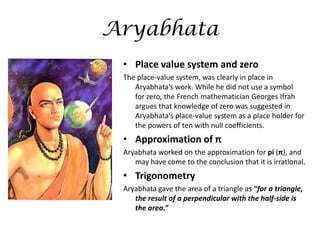
Aryabhata
• Place value system and zero
The place-value system, was clearly in place in
Aryabhata’s work. While he did not use a symbol
for zero, the French mathematician Georges Ifrah
argues that knowledge of zero was suggested in
Aryabhata's place-value system as a place holder for
the powers of ten with null coefficients.

• Approximation of π
Aryabhata worked on the approximation for pi (π), and
may have come to the conclusion that it is irrational.

• Trigonometry
Aryabhata gave the area of a triangle as "for a triangle,
the result of a perpendicular with the half-side is
the area.”
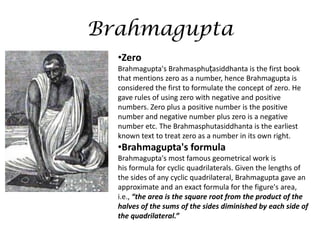
Brahmagupta
•Zero
Brahmagupta's Brahmasphuṭasiddhanta is the first book
that mentions zero as a number, hence Brahmagupta is
considered the first to formulate the concept of zero. He
gave rules of using zero with negative and positive
numbers. Zero plus a positive number is the positive
number and negative number plus zero is a negative
number etc. The Brahmasphutasiddhanta is the earliest
known text to treat zero as a number in its own right.

•Brahmagupta's formula
Brahmagupta's most famous geometrical work is
his formula for cyclic quadrilaterals. Given the lengths of
the sides of any cyclic quadrilateral, Brahmagupta gave an
approximate and an exact formula for the figure's area,
i.e., “the area is the square root from the product of the
halves of the sums of the sides diminished by each side of
the quadrilateral.”
Srinivasa Ramanujan
In mathematics, there is a distinction between having
an insight and having a proof. Ramanujan's talent
suggested a plethora of formulae that could then be
investigated in depth later. It is said that Ramanujan's
discoveries are unusually rich and that there is often
more to them than initially meets the eye. As a byproduct, new directions of research were opened up.
Examples of the most interesting of these formulae
include the intriguing infinite series for π, one of
which is given below
P.C. Mahalanobis
•Mahalanobis Distance
P.C. Mahalnobis asked Nelson Annandale the questions on
what factors influence the formation of European and
Indian marriages. He wanted to examine if the Indian side
came from any specific castes. He used the data collected
by Annandale and the caste specific measurements made
by Herbert Risley to come up with the conclusion that the
sample represented a mix of Europeans mainly with
people from Bengal and Punjab but not with those from
the Northwest Frontier Provinces or from Chhota Nagpur.
He also concluded that the intermixture more frequently
involved the higher castes than the lower ones. This
analysis was described by his first scientific paper in
1922. During the course of these studies he found a way
of comparing and grouping populations using a
multivariate distance measure. This measure, denoted
"D2" and now named Mahalanobis distance, is
independent of measurement scale.
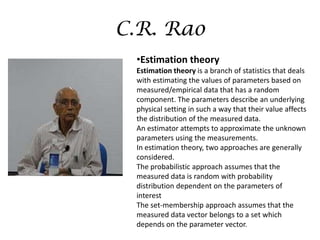
C.R. Rao
•Estimation theory
Estimation theory is a branch of statistics that deals
with estimating the values of parameters based on
measured/empirical data that has a random
component. The parameters describe an underlying
physical setting in such a way that their value affects
the distribution of the measured data.
An estimator attempts to approximate the unknown
parameters using the measurements.
In estimation theory, two approaches are generally
considered.
The probabilistic approach assumes that the
measured data is random with probability
distribution dependent on the parameters of
interest
The set-membership approach assumes that the
measured data vector belongs to a set which
depends on the parameter vector.
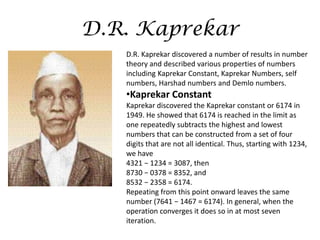
D.R. Kaprekar
D.R. Kaprekar discovered a number of results in number
theory and described various properties of numbers
including Kaprekar Constant, Kaprekar Numbers, self
numbers, Harshad numbers and Demlo numbers.

•Kaprekar Constant
Kaprekar discovered the Kaprekar constant or 6174 in
1949. He showed that 6174 is reached in the limit as
one repeatedly subtracts the highest and lowest
numbers that can be constructed from a set of four
digits that are not all identical. Thus, starting with 1234,
we have
4321 − 1234 = 3087, then
8730 − 0378 = 8352, and
8532 − 2358 = 6174.
Repeating from this point onward leaves the same
number (7641 − 1467 = 6174). In general, when the
operation converges it does so in at most seven
iteration.
Harish Chandra
He was influenced by the mathematicians Hermann
Weyl and Claude Chevalley. From 1950 to 1963 he was
at the Columbia University and worked on
representations of semisimple Lie groups. During this
period he established as his special area the study of
the discrete series representations of semisimple Lie
groups, which are analogues of the Peter–Weyl
theory in the non-compact case.

•Discrete Series Representation
In mathematics, a discrete series representation an
irreducible unitary representation of a locally
compact topological group G that is a
subrepresentation of the left regular representation of
G on L²(G). In the Plancherel measure, such
representations have positive measure. The name
comes from the fact that they are exactly the
representations that occur discretely in the
decomposition of the regular representation.
Satyendra Nath Bose
•Bose-Einstein Statistics/Condensate
Bose showed that the contemporary theory was
inadequate, because it predicted results not in
accordance with experimental results. In the process of
describing this discrepancy, Bose for the first time took
the position that the Maxwell–Boltzmann
distribution would not be true for microscopic particles,
where fluctuations due to Heisenberg's uncertainty
principle will be significant. Thus he stressed the
probability of finding particles in the phase space, each
state having volume h3, and discarding the distinct
position and momentum of the particles. Bose's
interpretation is now called Bose–Einstein statistics.
Einstein adopted the idea and extended it to atoms. This
led to the prediction of the existence of phenomena
which became known as Bose–Einstein condensate, a
dense collection of bosons, which was demonstrated to
exist by experiment in 1995.
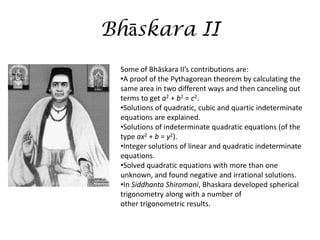
Bhāskara II
Some of Bhāskara II’s contributions are:
•A proof of the Pythagorean theorem by calculating the
same area in two different ways and then canceling out
terms to get a2 + b2 = c2.
•Solutions of quadratic, cubic and quartic indeterminate
equations are explained.
•Solutions of indeterminate quadratic equations (of the
type ax2 + b = y2).
•Integer solutions of linear and quadratic indeterminate
equations.
•Solved quadratic equations with more than one
unknown, and found negative and irrational solutions.
•In Siddhanta Shiromani, Bhaskara developed spherical
trigonometry along with a number of
other trigonometric results.
Narendra Karmarkar
•Karmarkar's algorithm
Karmarkar's algorithm solves linear programming problems
in polynomial time. These problems are represented by "n"
variables and "m" constraints. The previous method of
solving these problems consisted of problem representation
by an "x" sided solid with "y" vertices, where the solution
was approached by traversing from vertex to vertex.
Karmarkar's novel method approaches the solution by
cutting through the above solid in its traversal.
Consequently, complex optimization problems are solved
much faster using the Karmarkar algorithm.
His algorithm thus enables faster business and policy
decisions. Karmarkar's algorithm has stimulated the
development of several other interior point methods, some
of which are used in current codes for solving linear
programs.
Done by:
Jerome George, IX-C
DPS, Riyadh

Indian Mathematicians

  • 1.
  • 2.
    Introduction There is nodoubt that the world today is indebted to the contributions made by Indian mathematicians. Some of the most important contributions made by Indian mathematicians were the introduction of decimal system as well as the invention of zero. Here are some the famous Indian mathematicians, along with their contributions.
  • 3.
    Aryabhata • Place valuesystem and zero The place-value system, was clearly in place in Aryabhata’s work. While he did not use a symbol for zero, the French mathematician Georges Ifrah argues that knowledge of zero was suggested in Aryabhata's place-value system as a place holder for the powers of ten with null coefficients. • Approximation of π Aryabhata worked on the approximation for pi (π), and may have come to the conclusion that it is irrational. • Trigonometry Aryabhata gave the area of a triangle as "for a triangle, the result of a perpendicular with the half-side is the area.”
  • 4.
    Brahmagupta •Zero Brahmagupta's Brahmasphuṭasiddhanta isthe first book that mentions zero as a number, hence Brahmagupta is considered the first to formulate the concept of zero. He gave rules of using zero with negative and positive numbers. Zero plus a positive number is the positive number and negative number plus zero is a negative number etc. The Brahmasphutasiddhanta is the earliest known text to treat zero as a number in its own right. •Brahmagupta's formula Brahmagupta's most famous geometrical work is his formula for cyclic quadrilaterals. Given the lengths of the sides of any cyclic quadrilateral, Brahmagupta gave an approximate and an exact formula for the figure's area, i.e., “the area is the square root from the product of the halves of the sums of the sides diminished by each side of the quadrilateral.”
  • 5.
    Srinivasa Ramanujan In mathematics,there is a distinction between having an insight and having a proof. Ramanujan's talent suggested a plethora of formulae that could then be investigated in depth later. It is said that Ramanujan's discoveries are unusually rich and that there is often more to them than initially meets the eye. As a byproduct, new directions of research were opened up. Examples of the most interesting of these formulae include the intriguing infinite series for π, one of which is given below
  • 6.
    P.C. Mahalanobis •Mahalanobis Distance P.C.Mahalnobis asked Nelson Annandale the questions on what factors influence the formation of European and Indian marriages. He wanted to examine if the Indian side came from any specific castes. He used the data collected by Annandale and the caste specific measurements made by Herbert Risley to come up with the conclusion that the sample represented a mix of Europeans mainly with people from Bengal and Punjab but not with those from the Northwest Frontier Provinces or from Chhota Nagpur. He also concluded that the intermixture more frequently involved the higher castes than the lower ones. This analysis was described by his first scientific paper in 1922. During the course of these studies he found a way of comparing and grouping populations using a multivariate distance measure. This measure, denoted "D2" and now named Mahalanobis distance, is independent of measurement scale.
  • 7.
    C.R. Rao •Estimation theory Estimationtheory is a branch of statistics that deals with estimating the values of parameters based on measured/empirical data that has a random component. The parameters describe an underlying physical setting in such a way that their value affects the distribution of the measured data. An estimator attempts to approximate the unknown parameters using the measurements. In estimation theory, two approaches are generally considered. The probabilistic approach assumes that the measured data is random with probability distribution dependent on the parameters of interest The set-membership approach assumes that the measured data vector belongs to a set which depends on the parameter vector.
  • 8.
    D.R. Kaprekar D.R. Kaprekardiscovered a number of results in number theory and described various properties of numbers including Kaprekar Constant, Kaprekar Numbers, self numbers, Harshad numbers and Demlo numbers. •Kaprekar Constant Kaprekar discovered the Kaprekar constant or 6174 in 1949. He showed that 6174 is reached in the limit as one repeatedly subtracts the highest and lowest numbers that can be constructed from a set of four digits that are not all identical. Thus, starting with 1234, we have 4321 − 1234 = 3087, then 8730 − 0378 = 8352, and 8532 − 2358 = 6174. Repeating from this point onward leaves the same number (7641 − 1467 = 6174). In general, when the operation converges it does so in at most seven iteration.
  • 9.
    Harish Chandra He wasinfluenced by the mathematicians Hermann Weyl and Claude Chevalley. From 1950 to 1963 he was at the Columbia University and worked on representations of semisimple Lie groups. During this period he established as his special area the study of the discrete series representations of semisimple Lie groups, which are analogues of the Peter–Weyl theory in the non-compact case. •Discrete Series Representation In mathematics, a discrete series representation an irreducible unitary representation of a locally compact topological group G that is a subrepresentation of the left regular representation of G on L²(G). In the Plancherel measure, such representations have positive measure. The name comes from the fact that they are exactly the representations that occur discretely in the decomposition of the regular representation.
  • 10.
    Satyendra Nath Bose •Bose-EinsteinStatistics/Condensate Bose showed that the contemporary theory was inadequate, because it predicted results not in accordance with experimental results. In the process of describing this discrepancy, Bose for the first time took the position that the Maxwell–Boltzmann distribution would not be true for microscopic particles, where fluctuations due to Heisenberg's uncertainty principle will be significant. Thus he stressed the probability of finding particles in the phase space, each state having volume h3, and discarding the distinct position and momentum of the particles. Bose's interpretation is now called Bose–Einstein statistics. Einstein adopted the idea and extended it to atoms. This led to the prediction of the existence of phenomena which became known as Bose–Einstein condensate, a dense collection of bosons, which was demonstrated to exist by experiment in 1995.
  • 11.
    Bhāskara II Some ofBhāskara II’s contributions are: •A proof of the Pythagorean theorem by calculating the same area in two different ways and then canceling out terms to get a2 + b2 = c2. •Solutions of quadratic, cubic and quartic indeterminate equations are explained. •Solutions of indeterminate quadratic equations (of the type ax2 + b = y2). •Integer solutions of linear and quadratic indeterminate equations. •Solved quadratic equations with more than one unknown, and found negative and irrational solutions. •In Siddhanta Shiromani, Bhaskara developed spherical trigonometry along with a number of other trigonometric results.
  • 12.
    Narendra Karmarkar •Karmarkar's algorithm Karmarkar'salgorithm solves linear programming problems in polynomial time. These problems are represented by "n" variables and "m" constraints. The previous method of solving these problems consisted of problem representation by an "x" sided solid with "y" vertices, where the solution was approached by traversing from vertex to vertex. Karmarkar's novel method approaches the solution by cutting through the above solid in its traversal. Consequently, complex optimization problems are solved much faster using the Karmarkar algorithm. His algorithm thus enables faster business and policy decisions. Karmarkar's algorithm has stimulated the development of several other interior point methods, some of which are used in current codes for solving linear programs.
  • 13.
    Done by: Jerome George,IX-C DPS, Riyadh